
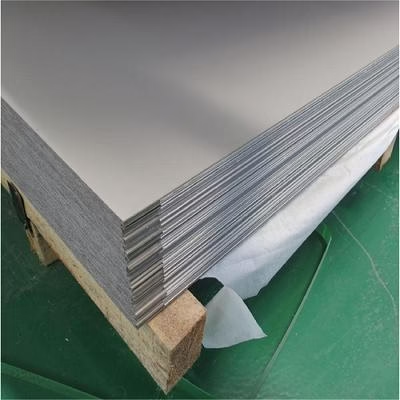
Nickel Alloy Plate (Inconel / Hastelloy / Monel / Incoloy)
Nickel Alloy Plate in Inconel 625/718/600/690, Hastelloy C276/C22/B2/B3/X, Monel 400/K500, Incoloy 825/800H, Nickel 200/201. Thickness 1.5–100mm, width up to 2,500mm. Solution annealed, ASTM B443/B575/B127/B409/B424/B162, ASME SB-series. Ultrasonic testing available. Mill test certificate EN 10204 3.1/3.2 provided.
| Material | Nickel-Chromium-Molybdenum / Nickel-Copper / Nickel-Iron-Chromium Superalloy Plate and Sheet |
|---|---|
| Grade / Standard | Inconel 625 / 718 / 600 / 601 / 690 / Hastelloy C276 / C22 / B2 / B3 / X / Monel 400 / K500 / Incoloy 825 / 800H / 800HT / Nickel 200 / 201 |
| Thickness | 1.5mm – 100mm (Standard hot-rolled / cold-rolled plate) / up to 200mm special by hot pressing |
| Width | Up to 2,500mm (alloy and thickness dependent) |
| Length | Up to 6,000mm / Cut-to-size, water-jet cutting, plasma cutting available |
| MOQ | 1 Piece (Custom Plate) / 100 kg (Standard Sheet) |
| Delivery Time | 25-50 Days (Custom Production) / 20-35 Days (Stock) |
| Loading Port | Tianjin / Shanghai / Qingdao |
Overview of Nickel Alloy Plate
Nickel Alloy Plate refers to flat-rolled plate, sheet, and strip products manufactured from the nickel-based superalloy family — including Inconel (nickel-chromium-molybdenum), Hastelloy (nickel-molybdenum-chromium), Monel (nickel-copper), Incoloy (nickel-iron-chromium), and pure nickel grades — engineered to deliver the extraordinary combination of corrosion resistance in the most aggressive chemical and marine environments, mechanical strength retention at elevated service temperatures up to 1,100°C, toughness and fatigue resistance under cyclic loading, and dimensional stability that defines nickel alloy performance in applications where all grades of stainless steel, duplex stainless steel, and conventional alloy steels fail prematurely. Nickel alloy plate is the construction material of last resort and first choice simultaneously — last resort because its cost (typically 10–60 times the price of carbon steel plate) demands that all less expensive alternatives have been evaluated; first choice because in the specific environments for which each nickel alloy is engineered, it provides performance that no other commercially available plate material can replicate at any price.
Nickel alloy plate is standardised under a comprehensive framework of ASTM, ASME, AMS, and EN standards covering each alloy family: ASTM B443 / ASME SB-443 for Inconel 625 (UNS N06625) plate, sheet and strip; ASTM B670 for Inconel 718 (UNS N07718); ASTM B168 / ASME SB-168 for Inconel 600 (UNS N06600) and 601 (UNS N06601); ASTM B575 / ASME SB-575 for Hastelloy C276 (UNS N10276) and C22 (UNS N06022); ASTM B333 / ASME SB-333 for Hastelloy B2 (UNS N10665) and B3 (UNS N10675); ASTM B127 / ASME SB-127 for Monel 400 (UNS N04400); ASTM B409 / ASME SB-409 for Incoloy 800H (UNS N08810) and 800HT (UNS N08811); ASTM B424 / ASME SB-424 for Incoloy 825 (UNS N08825); ASTM B162 / ASME SB-162 for Nickel 200 (UNS N02200) and Nickel 201 (UNS N02201); and EN 10095 for heat-resistant nickel alloys covering the European W.Nr. (Werkstoffnummer) designation equivalents. Each standard specifies chemical composition limits, minimum mechanical properties, heat treatment condition, dimensional tolerances, surface finish, and inspection requirements appropriate to the alloy and product form.
Key Features and Manufacturing Process
Nickel alloy plate is produced through a sophisticated multi-stage manufacturing process beginning with primary melting in a vacuum induction furnace (VIM) to achieve precise alloy chemistry under controlled atmosphere that prevents oxidation and volatile element loss — particularly important for chromium-containing alloys where surface oxidation during open-air melting would reduce chromium availability and for alloys with reactive elements such as titanium and niobium used as strengthening additions in Inconel 625 and 718. The VIM-produced ingot or electrode is subsequently remelted by vacuum arc remelting (VAR) for premium aerospace grades (Inconel 718, Waspaloy) or electroslag remelting (ESR) for corrosion-resistant grades (Inconel 625, Hastelloy C276, Incoloy 825) to achieve the internal cleanliness, macrostructure uniformity, and freedom from segregation required for pressure vessel-grade ultrasonic testing qualification and premium machined component service.
The refined ingot is hot-rolled at alloy-specific temperatures — Inconel 625 at 980–1,230°C, Hastelloy C276 at 1,065–1,175°C, Monel 400 at 870–1,175°C, Incoloy 825 at 1,100–1,175°C, Nickel 200 at 650–1,260°C — on reversing hot mills in a rolling programme designed to achieve required plate thickness with adequate total rolling reduction (typically 4:1 minimum for plates above 25mm) to ensure complete breakdown of the ingot cast structure, uniform carbide distribution, and isotropic mechanical properties in the longitudinal and transverse plate directions. Following hot rolling, the plate undergoes solution annealing — heating to the alloy-specific solution temperature (Inconel 625: 1,093–1,204°C; Hastelloy C276: 1,121–1,177°C; Monel 400: 871°C minimum) to dissolve precipitated secondary phases and carbides into solid solution, followed by rapid quenching — and acid descaling (pickling in HF/HNO3 mixture for nickel alloys) to remove the tenacious high-temperature oxide scale before surface inspection, dimensional verification, and non-destructive testing. Plate thickness ranges from 1.5mm to 100mm in standard production, with thicker plates up to 200mm available by hot pressing or stepped hot rolling from larger ingots for special pressure vessel and heat exchanger tube sheet applications. Each plate undergoes mandatory chemical composition analysis by ICP spectrometry, tensile and hardness testing at plate quarter-thickness in both longitudinal and transverse directions, ultrasonic testing per ASTM A435 / A578 for pressure vessel applications, surface inspection, and dimensional measurement including thickness at multiple grid positions, width, length, flatness (maximum deviation from flat surface per EN 10029 or ASTM A480), and squareness.
Main Applications of Nickel Alloy Plate
Nickel alloy plate is the foundational material for pressure vessel and reactor vessel fabrication in the most corrosive chemical processing environments where every grade of stainless steel is inadequate. Hastelloy C276 plate vessels handle the most aggressive process streams in the global chemical industry including strong hydrochloric acid (HCl) at all concentrations and temperatures to boiling, wet chlorine gas and sodium hypochlorite bleach in chlor-alkali production, concentrated sulfuric acid (H2SO4) up to 70% in fertiliser and explosives manufacturing, mixed oxidising-reducing acid environments in pharmaceutical synthesis, chlorinated organic solvent production environments, and flue gas desulfurisation (FGD) absorber vessels where the combined presence of sulfuric acid, hydrochloric acid, and chlorides at elevated temperature creates the most demanding corrosion challenge in the electric power generation industry. Inconel 625 plate provides the broadest application range across corrosive environments — serving as the primary plate material for offshore oil and gas chemical injection package vessels, seawater handling equipment, marine riser and umbilical termination structures, chemical process vessels requiring combined corrosion resistance and mechanical strength, and aerospace exhaust duct fabrication.
The pharmaceutical and biotechnology industry employs Hastelloy C276 and Inconel 625 plate for sterile reactor vessel shells, vessel heads, agitator housing plates, crystalliser vessels, spray dryer cone sections, and process fluid contact surfaces in API (active pharmaceutical ingredient) manufacturing, vaccine production, and biotechnology fermentation systems — applications where regulatory compliance with FDA 21 CFR and EU GMP requires absolute elimination of metallic contamination sources. Nuclear power generation uses Inconel 690 and 600 plate for steam generator shell and tube sheet components, reactor vessel internal baffles, and primary circuit equipment fabrication in pressurised water reactor (PWR) and boiling water reactor (BWR) nuclear power plants, where the combination of specific nickel alloy chemistry controlling cobalt content (to minimise neutron activation products) and guaranteed corrosion resistance to high-temperature pressurised water eliminates the primary corrosion mechanisms that degrade carbon and low-alloy steel in nuclear primary circuit service. High-temperature furnace and heat treatment equipment manufacture uses Incoloy 800H and 801 plate for radiant tube walls, furnace retort shells, and muffle furnace components at service temperatures of 850–1,100°C in carburising, nitriding, and normalising atmospheres. Other major applications include marine vessel chemical tanker cargo tank internal cladding, desalination plant pressure vessel shells and heads, oil and gas refinery acid alkylation unit vessels, chlor-alkali electrolyser cell end plates, heat exchanger tube sheets in thick plate (25–100mm), pollution control scrubber vessel fabrication, military and defence equipment applications, and the full range of industrial equipment in extreme corrosion and temperature environments.
Why Choose Us for Nickel Alloy Plate
Shandong Tanglu Metal Material Co., Ltd. supplies premium Nickel Alloy Plate sourced from internationally recognised alloy producers including Baosteel Special Steel (China), Western Superconducting Technologies (China), and with access to plates from Special Metals Corporation (USA, original Inconel producer), Haynes International (USA, Hastelloy producer), and VDM Metals (Germany), providing both internationally branded original-mill plates for the most demanding specifications and cost-competitive equivalent-grade plates for standard industrial applications. Every nickel alloy plate shipment is accompanied by original mill test certificates in EN 10204 3.1 format covering full quantitative ICP chemical composition analysis of all major alloying elements and controlled impurities against applicable standard limits, mechanical property test results in both longitudinal and transverse directions (tensile strength, 0.2% proof stress, elongation at break) at plate quarter-thickness sampling position, hardness verification at multiple plate positions, ultrasonic testing results per ASTM A578 Level B or better for pressure vessel and tube sheet applications, surface quality inspection, dimensional measurement data (thickness at minimum 5-position grid, width, length, flatness in mm/m, squareness), and complete heat and plate number traceability enabling full metallurgical batch identification throughout fabrication and construction.
We offer a comprehensive nickel alloy plate specification range: Inconel 625 (ASTM B443 / ASME SB-443), Inconel 718 (ASTM B670 / AMS 5596), Inconel 600 (ASTM B168 / ASME SB-168), Inconel 601 (ASTM B168 variant), Inconel 690 (ASTM B168 / ASME SB-168), Hastelloy C276 (ASTM B575 / ASME SB-575), Hastelloy C22 (ASTM B575), Hastelloy B2 / B3 (ASTM B333 / ASME SB-333), Hastelloy X (AMS 5536 / ASTM B435), Monel 400 (ASTM B127 / ASME SB-127), Monel K500 (ASTM B865), Incoloy 825 (ASTM B424 / ASME SB-424), Incoloy 800H / 800HT (ASTM B409 / ASME SB-409), Nickel 200 / 201 (ASTM B162 / ASME SB-162), in thicknesses from 1.5mm to 100mm, widths up to 2,500mm, and lengths up to 6,000mm. Cut-to-size, water-jet cutting, plasma cutting, and drilling services available. Explosion-bonded nickel alloy clad plate over carbon steel or stainless steel backing available for Inconel 625, Hastelloy C276, and Monel 400 cladding combinations. With established monthly supply capacity of 150 tons of premium nickel and specialty alloy products and export relationships with pressure vessel fabricators, chemical plant constructors, offshore equipment producers, pharmaceutical equipment manufacturers, nuclear power contractors, and defence equipment manufacturers across more than 40 countries, we support packages from single-plate prototype orders to full vessel plate packages for major industrial projects. Each shipment includes original mill test certificate per EN 10204 3.1, with EN 10204 3.2, ultrasonic testing report, PMI (XRF) verification report, and third-party inspection by SGS, Bureau Veritas, ABS, DNV GL, or Lloyd’s Register available for ASME Code, NORSOK, and nuclear applications.
📐 Dimension & Size Table
| Alloy Grade | UNS Number | ASTM / ASME Standard | W.Nr. (DIN) | Thickness Range (mm) | Width (mm) | Primary Service Environment |
|---|---|---|---|---|---|---|
| Inconel 625 | N06625 | B443 / SB-443 | 2.4856 / 1.5–100 / Up to 2,500 / Marine, chemical, offshore, aerospace exhaust | |||
| Inconel 718 | N07718 | B670 / AMS 5596 | 2.4668 / 1.5–80 / Up to 2,000 / Aerospace gas turbine, downhole oil & gas tools | |||
| Inconel 600 | N06600 | B168 / SB-168 | 2.4816 / 1.5–50 / Up to 2,000 / Furnace liners, nuclear, heat treatment fixtures | |||
| Inconel 601 | N06601 | B168 variant | 2.4851 / 1.5–50 / Up to 1,500 / High-temp oxidation resistance above 1,050°C | |||
| Inconel 690 | N06690 | B168 / SB-168 | 2.4642 / 1.5–50 / Up to 1,500 / Nuclear PWR steam generators, AGR reactors | |||
| Hastelloy C276 | N10276 | B575 / SB-575 | 2.4819 / 1.5–100 / Up to 2,500 / HCl, H2SO4, chlorinated chemicals, FGD systems | |||
| Hastelloy C22 | N06022 | B575 / SB-575 | 2.4602 / 1.5–80 / Up to 2,000 / Oxidising chloride, pharmaceutical, mixed acid | |||
| Hastelloy B2 | N10665 | B333 / SB-333 | 2.4617 / 1.5–50 / Up to 1,500 / Pure HCl acid, hydrochloric acid plants | |||
| Hastelloy B3 | N10675 | B333 variant | 2.4600 / 1.5–50 / Up to 1,500 / Improved B2 — HCl with oxidising contamination | |||
| Hastelloy X | N06002 | B435 / AMS 5536 | 2.4665 / 1.5–50 / Up to 1,500 / Gas turbine combustors, aerospace nacelles | |||
| Monel 400 | N04400 | B127 / SB-127 | 2.4360 / 1.5–80 / Up to 2,000 / Seawater, HF acid, marine equipment | |||
| Monel K500 | N05500 | B865 | 2.4375 / 1.5–50 / Up to 1,500 / High-strength marine, downhole production | |||
| Incoloy 825 | N08825 | B424 / SB-424 | 2.4858 / 1.5–80 / Up to 2,000 / H2SO4, H3PO4, oil & gas sour service | |||
| Incoloy 800H | N08810 | B409 / SB-409 | 1.4876 / 1.5–80 / Up to 2,000 / Petrochemical furnace, reformers, carburising | |||
| Incoloy 800HT | N08811 | B409 / SB-409 | 1.4876 / 1.5–80 / Up to 2,000 / Highest temp creep resistance of 800 series | |||
| Nickel 200 | N02200 | B162 / SB-162 | 2.4066 / 1.5–50 / Up to 2,000 / Caustic soda (NaOH), food processing, electronics | |||
| Nickel 201 | N02201 | B162 / SB-162 | 2.4068 / 1.5–50 / Up to 2,000 / Low-C Ni — caustic above 300°C, fluorine service |
* Custom sizes available upon request. Tolerances per relevant international standards.
🔬 Chemical Composition
| Element | Min | Max | Display Value | Note |
|---|---|---|---|---|
| Ni (Inconel 625) | 58.0 | - | ≥58.0 (balance) | Per ASTM B443 — nickel base providing corrosion resistance, high-temp strength, and non-magnetic properties |
| Cr (Inconel 625) | 20.0 | 23.0 | 20.0–23.0 | Oxidation and corrosion resistance in oxidising environments |
| Mo (Inconel 625) | 8.0 | 10.0 | 8.0–10.0 | Pitting and crevice corrosion resistance; solid solution strengthening |
| Nb+Ta (Inconel 625) | 3.15 | 4.15 | 3.15–4.15 | Solid solution strengthening; suppresses sensitisation in as-welded condition (Grade 1 solution annealed) |
| Fe (Inconel 625) | - | 5.0 | ≤5.0 | Maximum allowable — excess Fe reduces corrosion resistance in aggressive environments |
| Ni (Hastelloy C276) | Bal. | - | Balance (~57%) | Per ASTM B575 — highest-performance corrosion-resistant commercial alloy |
| Mo (Hastelloy C276) | 15.0 | 17.0 | 15.0–17.0 | Highest Mo of any commercial alloy — critical for reducing acid resistance (HCl, H2SO4) |
| Cr (Hastelloy C276) | 14.5 | 16.5 | 14.5–16.5 | Oxidising environment resistance; combined Mo+Cr provides broadest chemical resistance |
| W (Hastelloy C276) | 3.0 | 4.5 | 3.0–4.5 | Enhances localised corrosion resistance in mixed oxidising-reducing chloride environments |
| Ni (Monel 400) | 63.0 | - | ≥63.0 | Per ASTM B127 — Ni-Cu binary alloy base for seawater and HF acid service |
| Cu (Monel 400) | 28.0 | 34.0 | 28.0–34.0 | Copper for seawater corrosion resistance and hydrofluoric acid resistance |
| Ni (Incoloy 825) | 38.0 | 46.0 | 38.0–46.0 | Per ASTM B424 — Ni-Fe-Cr base; intermediate Ni content between stainless steel and Inconel |
| Cr (Incoloy 825) | 19.5 | 23.5 | 19.5–23.5 | Chromium for oxidising acid resistance |
| Mo (Incoloy 825) | 2.5 | 3.5 | 2.5–3.5 | Molybdenum for pitting resistance and H2SO4 / H3PO4 resistance |
| Ni (Nickel 200) | 99.0 | - | ≥99.0 | Per ASTM B162 — commercially pure nickel; maximum corrosion resistance in caustic and fluorine |
| C (Nickel 201) | - | 0.02 | ≤0.02 | Low-carbon Nickel 201 — prevents graphite precipitation in grain boundaries above 300°C in caustic |
* Chemical composition may vary by heat, thickness and specification. Please refer to the actual mill test certificate.
⚙️ Mechanical Properties
| Property | Value | Unit | Test Condition |
|---|---|---|---|
| Tensile Strength — Inconel 625 (SA, Grade 1, t≤50mm) | ≥827 | MPa (120 ksi) | Solution Annealed per ASTM B443 Grade 1 (corrosion service) |
| Yield Strength — Inconel 625 (SA, Grade 1) | ≥414 | MPa (60 ksi) | 0.2% proof stress, Solution Annealed |
| Elongation — Inconel 625 (SA) | ≥30 | % | Excellent ductility enabling severe forming of vessel heads and complex shapes |
| Tensile Strength — Inconel 625 (SA, Grade 2, t≤50mm) | ≥758 | MPa (110 ksi) | Higher annealing temperature — improved corrosion resistance, lower strength |
| Tensile Strength — Inconel 718 (STA) | ≥1,241 | MPa (180 ksi) | Solution Treated + Double Aged per AMS 5596 / ASTM B670 |
| Yield Strength — Inconel 718 (STA) | ≥1,034 | MPa (150 ksi) | Highest strength nickel alloy plate for aerospace applications |
| Tensile Strength — Hastelloy C276 (SA) | ≥690 | MPa (100 ksi) | Solution Annealed per ASTM B575 |
| Yield Strength — Hastelloy C276 (SA) | ≥283 | MPa (41 ksi) | 0.2% proof stress — outstanding elongation (≥40%) enables complex vessel forming |
| Elongation — Hastelloy C276 (SA) | ≥40 | % | Highest elongation of nickel alloy plate family — superior formability for vessel heads |
| Tensile Strength — Hastelloy B2 (SA) | ≥760 | MPa (110 ksi) | Solution Annealed per ASTM B333 — HCl acid service grade |
| Tensile Strength — Monel 400 (Annealed) | ≥480 | MPa (70 ksi) | Annealed per ASTM B127 — seawater and HF acid service |
| Elongation — Monel 400 (Annealed) | ≥35 | % | Good formability for vessel fabrication and deep-drawn components |
| Tensile Strength — Incoloy 825 (SA) | ≥586 | MPa (85 ksi) | Solution Annealed per ASTM B424 — H2SO4 and H3PO4 service |
| Tensile Strength — Incoloy 800H (SA) | ≥448 | MPa (65 ksi) | Solution Annealed per ASTM B409 — high-temperature creep service |
| Tensile Strength — Nickel 200 (Annealed) | ≥380 | MPa (55 ksi) | Annealed per ASTM B162 — commercially pure nickel for caustic service |
| Density — Inconel 625 | 8.44 | g/cm³ | Reference for plate weight calculation — approximately 9× more expensive than carbon steel per kg |
| Max Service Temperature — Inconel 625 (oxidising) | ≤980 | °C | Continuous service in oxidising atmosphere — exceeds all stainless steel grades |
* Values shown are minimum requirements unless otherwise stated.
📦 Commercial Information
| Packaging | Premium seaworthy export packing for high-value nickel alloy plate. Individual plate pieces wrapped on all six faces with multiple protective layers specifically designed for nickel alloy surface protection: primary wrapping with VCI (Volatile Corrosion Inhibitor) anti-rust paper applied directly to all plate surfaces — nickel alloys, while corrosion-resistant in service, can develop surface staining and tarnish from atmospheric moisture, chloride contamination, and contact with ferrous packaging materials during ocean transit that damages the bright pickled or polished surface finish and may require re-pickling before fabrication. Particular attention to prevention of iron contamination on Hastelloy and pure nickel plate surfaces — embedded iron causes pitting in service by galvanic corrosion. Secondary wrapping with 200-micron heavy-duty polyethylene moisture-barrier film. For No. 2B and polished surface plates, additional 3mm PE foam sheet between VCI paper and plate surface prevents mechanical marking from vibration. For electropolished (EP) pharmaceutical-grade plates, individual bubble-wrap inner layer and PE foam outer wrapping with edge protectors on all four plate edges prevents any contact damage to the mirror-polished surface finish that would require re-electropolishing. Plate edges protected with HDPE plastic angle protectors on all four sides. Multiple plates stacked on ISPM-15 heat-treated timber pallets with non-metallic plastic spacer blocks between plate layers — absolutely no bare metal-to-metal contact between stacked plates. Complete pallet secured with PE-coated steel strapping through pallet base. Each plate individually identified with permanent stainless steel wire-attached metal tag showing: plate number, heat number, alloy grade (Inconel 625, Hastelloy C276, Monel 400, etc.), UNS number, applicable ASTM/ASME standard, thickness × width × length in mm, plate weight in kg net, delivery condition (SA/STA/HRAP/BA), surface finish designation (No.1/2B/BA/Polished/EP), and customer purchase order reference. Large heavy plates (thickness ≥25mm, weight ≥500 kg per plate) enclosed in purpose-built wooden crates with internal steel angle reinforcement at corners, foam cushioning at plate edges, waterproof marine-grade plywood sheathing, and rated lifting attachment points. Desiccant sachets (silica gel minimum 300g per pallet) inside PE film wrap for high-humidity destination markets. Complete material documentation package in waterproof document pouch on each pallet: original mill test certificate, UT report (if applicable), PMI (XRF) report, third-party inspection certificate, packing list, Certificate of Origin, and SDS. |
|---|---|
| Payment Terms | T/T (Telegraphic Transfer),L/C (Letter of Credit),D/P (Documents against Payment),Western Union,PayPal |
| Price Term | FOB,CFR,CIF,EXW |
| Supply Capacity | 150 Tons/Month (Premium Nickel Alloy Plate) |
| Loading Port | Tianjin / Shanghai / Qingdao |
Why Choose Our Nickel Alloy Plate (Inconel / Hastelloy / Monel / Incoloy)?
Pressure Vessel & Nuclear Grade Certification
Nickel alloy plate supplied with EN 10204 3.1/3.2 mill test certificate covering full ICP chemical composition against ASTM/ASME limits, mechanical properties (tensile, yield, elongation) in longitudinal and transverse directions at plate quarter-thickness, ultrasonic testing per ASTM A578 Level B/C for tube sheets and pressure vessels, PMI (XRF) verification, and complete heat and plate traceability. ASME SB-series Code compliance, NORSOK MDS, and nuclear NQA-1 documentation available.
Complete Nickel Alloy Grade & Thickness Range
Inconel 625/718/600/601/690, Hastelloy C276/C22/B2/B3/X, Monel 400/K500, Incoloy 825/800H/800HT, Nickel 200/201. Thickness 1.5mm thin sheet through 100mm heavy plate (up to 200mm special). Width up to 2,500mm. Cut-to-size, water-jet, and plasma cutting available. Explosion-bonded clad plate available for Inconel 625 and C276 over carbon steel backing.
Extreme Corrosion & Temperature Performance
Hastelloy C276 resists boiling HCl at all concentrations (no other commercial alloy survives). Inconel 625 PREN >50 — outperforms super duplex stainless in seawater pitting. Incoloy 800H maintains structural integrity at 870°C in carburising atmospheres where stainless steels fail by sigma phase embrittlement. Nickel 200 survives concentrated NaOH at 350°C where all stainless steels corrode catastrophically.
Multi-Code & Multi-Industry Compliance
ASME BPVC Section II SB-series (pressure vessels, nuclear), AMS specifications (aerospace), NORSOK MDS M-630/M-650/M-710 (offshore oil & gas, NACE MR0175/ISO 15156 sour service), API 6A/17D (oil & gas equipment), EN 10095 (heat-resistant nickel alloys), ISO 13485 (medical device), PED 2014/68/EU. ABS, DNV, LR, BV, NK, RINA, TUV, SGS third-party inspection available.
Stock Plates & Project Supply Packages
Inconel 625, Hastelloy C276, Monel 400, and Incoloy 825 in standard thicknesses from stock: 20–35 days. Cut-to-size from stock: add 5–10 working days. Custom heat and thickness: 35–60 days. Full vessel plate packages including all plate items, nozzle blanks, and tube sheet blanks coordinated supply available for major chemical plant and offshore project contracts.
🏭 Applications of Nickel Alloy Plate (Inconel / Hastelloy / Monel / Incoloy)
Nickel alloy plate is the indispensable construction material for the most technically demanding pressure-containing, high-temperature, and corrosion-resistant equipment applications across the global chemical processing, offshore oil and gas, aerospace, pharmaceutical, nuclear power, and defence industries — applications where the combination of extreme chemical corrosivity, elevated operating temperature, high pressure, and safety criticality creates service conditions that no other commercially available plate material can satisfy. Hastelloy C276 plate vessel fabrication for the chemical processing industry represents the primary application by tonnage, with C276 plate vessels serving as the primary construction material for hydrochloric acid production unit absorption towers, hydrogen chloride (HCl) synthesis furnace containment, methylene chloride (DCM) and chloroform (trichloromethane) production reactor vessels, vinyl chloride monomer (VCM) production equipment, chlorinated solvent distillation column shells, mixed mineral acid processing equipment in pharmaceuticals and explosives manufacturing, phosphoric acid concentration evaporator vessel shells, wet process phosphoric acid production equipment, sulfuric acid alkylation unit reactor vessels in petroleum refining, and flue gas desulfurisation (FGD) absorber vessels in coal-fired power stations where the combined presence of dilute sulfuric acid, hydrochloric acid, fluoride, and particulates from flue gas scrubbing at temperatures of 50–70°C creates the most aggressive corrosion environment encountered in environmental compliance equipment. Hastelloy C22 plate provides enhanced performance versus C276 in strongly oxidising chloride environments including wet chlorine gas processing, concentrated nitric acid plus chloride mixed environments, and pharmaceutical manufacturing operations using mixed acid sanitising reagents, where the higher chromium and lower molybdenum balance of C22 provides better resistance to highly oxidising conditions while maintaining C276-equivalent performance in most reducing acid environments. Hastelloy B2 and B3 plate vessels serve the unique application of pure hydrochloric acid — the one environment where Hastelloy C276, Inconel 625, and all chromium-containing alloys are inferior, because the oxidising potential of dissolved chromium oxide in reducing HCl accelerates corrosion. B2 and B3 with minimal chromium content (≤1.0% Cr) provide the best available commercial alloy corrosion resistance in hot concentrated HCl for HCl synthesis, HCl absorption, and hydrochloric acid storage and distribution systems in chlorine chemistry installations. Inconel 625 plate serves a remarkably broad application range spanning three distinct industry sectors: offshore oil and gas topside and subsea equipment including chemical injection package vessels, seawater handling vessel shells, subsea wellhead component fabrication plates, flexible riser armour wire production from plate, and piping manifold plate blanks where NACE MR0175 / ISO 15156 compliance and seawater corrosion resistance are simultaneously required; aerospace and defence structural applications including aircraft engine exhaust duct panels, afterburner liner segments and combustion chamber components produced from Inconel 625 sheet by rolling and welding, helicopter dynamic component fabrication, and aerospace fastener blanks from plate; and marine and naval applications including nuclear submarine hull penetration flanges, naval vessel seawater system component plates, and special military vessel structural components requiring the combination of non-magnetic properties, seawater corrosion immunity, and adequate structural strength. Incoloy 825 plate serves as the more economical alternative to Inconel 625 for sulfuric acid and phosphoric acid service applications — the combination of 38–46% nickel (intermediate between stainless steel and Inconel), 19.5–23.5% chromium, 2.5–3.5% molybdenum, copper addition, and titanium stabilisation provides excellent resistance to sulfuric acid at concentrations commonly encountered in fertiliser production (H2SO4 5–50%), phosphoric acid processing (H3PO4 up to 85%), organic acid production (acetic acid, formic acid, lactic acid), and oil and gas sour service environments per NACE MR0175 — at material cost 25–40% lower than Inconel 625, making Incoloy 825 the standard specification for H2SO4 and H3PO4 plant vessels and heat exchangers, oil and gas production separator vessels and scrubbers, and sour gas field gathering system vessel shells. Incoloy 800H and 800HT plate serves the high-temperature chemical and petrochemical industry for applications where sustained mechanical strength above 600°C combined with resistance to carburisation and oxidation is required — ethylene cracking furnace radiant coil support structures, steam methane reformer furnace vestibule panels and catalyst tube support grids, primary reformer furnace shell panels, and secondary reformer exit vessel components in ammonia and methanol production plants where service temperatures of 850–1,000°C in carburising, steam-reforming, and oxidising atmospheres require the sustained creep strength and carburisation resistance of the nickel-iron-chromium alloy family. Nickel 200 and Nickel 201 plate serves the specific application niche of caustic soda (sodium hydroxide, NaOH) at high concentrations and temperatures — Nickel 200 for service up to 300°C in all concentrations of NaOH from dilute to molten (315°C), and low-carbon Nickel 201 specifically for service above 300°C in concentrated and molten caustic to prevent the graphite embrittlement (carbon precipitation at grain boundaries during high-temperature caustic exposure) that limits Nickel 200 service above 300°C. Nickel 200 and 201 plate vessels are standard in chlor-alkali plant evaporator vessels concentrating NaOH from diaphragm cell 12% to commercial 50% and 73% concentrations, caustic soda storage and distribution equipment, soap and detergent production caustic handling vessels, textile industry mercerising equipment, food industry caustic cleaning systems, and electronics industry potassium hydroxide (KOH) etching equipment where the combination of pure nickel's exceptional resistance to all caustic alkali concentrations and temperatures and its FDA compliance for food contact materials makes it the standard and only practical construction material.
📋 Quality & Certification
Our Certifications
- ✅ ISO 9001:2015
- ✅ CE Marking
- ✅ ABS
- ✅ DNV GL
- ✅ Lloyd's Register (LR)
- ✅ Bureau Veritas (BV)
- ✅ SGS Certified
- ✅ NK
- ✅ RINA
Mill Certificate Type
- 📋 EN 10204 3.1
- 📋 EN 10204 3.2
- 📋 Original Mill Certificate
- 📋 Third Party Inspection Available
- 📋 Certificate of Origin
❓ Frequently Asked Questions
What is the difference between nickel alloy plate and stainless steel plate, and when is nickel alloy necessary?
Nickel alloy plate and stainless steel plate are both corrosion-resistant alloy flat products, but they differ fundamentally in nickel content, alloy system, corrosion resistance mechanisms, temperature capability, and cost — differences that determine when the substantially higher cost of nickel alloy is justified by performance requirements that stainless steel cannot meet. Stainless steel plate (304L, 316L, 321, 2205 duplex, 2507 super duplex) relies on a chromium-iron alloy system where 10–28% chromium forms a passive chromium oxide surface film providing corrosion protection in oxidising and neutral environments. The best austenitic stainless steel (904L) and super duplex stainless (2507 with PREN ~43) provide resistance to seawater and mildly aggressive chemicals at moderate temperatures. Nickel alloy plate (Inconel, Hastelloy, Monel, Incoloy) uses a nickel-based alloy system where nickel (38–99%) provides the corrosion-resistant matrix, with alloying additions of chromium (for oxidising resistance), molybdenum (for reducing acid resistance), copper (for seawater and HF acid resistance), and tungsten (for localised corrosion resistance) each contributing to specific service environment capability. Specific situations requiring nickel alloy plate: (1) Hydrochloric acid service at moderate to high concentrations — HCl above 1% at any temperature corrodes 316L rapidly; Hastelloy C276 and B2/B3 provide acceptable corrosion rates in HCl at all concentrations to boiling. (2) Mixed oxidising-reducing chloride environments — where both high chromium (for oxidising resistance) and high molybdenum (for reducing resistance) are required simultaneously, the Hastelloy C276 and C22 composition balances both requirements; no stainless steel grade provides this combination. (3) High-temperature oxidising service above 870°C — austenitic stainless steels suffer sigma phase embrittlement, accelerated oxidation scaling, and carburisation above 870°C; Inconel 601, 600, and Incoloy 800H maintain integrity to 1,100°C. (4) Concentrated caustic soda above 150°C — high-concentration NaOH causes stress corrosion cracking of austenitic stainless steels at concentrations above 30% and temperatures above 100°C; Nickel 200/201 is the standard material for hot concentrated caustic service. (5) Seawater at elevated temperature or turbulent conditions — 316L stainless steel suffers crevice corrosion and pitting in warm seawater above 25°C; super duplex 2507 provides resistance to approximately 40°C; Inconel 625 and cupronickel provide excellent seawater resistance at all temperatures including hot seawater above 60°C. The cost premium of nickel alloy (10–60× carbon steel versus 3–8× for stainless steel) is justified only when genuine service environment requirements exceed stainless steel capability — always conduct a thorough material selection evaluation with corrosion engineering expertise before specifying nickel alloy plate.
What are the differences between Inconel 625 Grade 1 and Grade 2, and which should be specified for pressure vessel service?
Inconel 625 (UNS N06625) plate is available in two grades under ASTM B443, designated Grade 1 and Grade 2, differentiated by annealing temperature, resulting microstructure, and the relative balance of corrosion resistance versus creep strength: Grade 1 (Annealed at 927–1,038°C, lower temperature solution anneal): This lower annealing temperature produces a finer grain size (ASTM grain size number ~5–8) with more complete niobium and molybdenum in solid solution, providing maximum tensile strength (≥827 MPa / 120 ksi), higher room-temperature yield strength (≥414 MPa / 60 ksi), and — critically — maintains niobium and molybdenum in solid solution rather than allowing precipitation of secondary Ni₃(Nb,Mo) phases that can reduce room-temperature corrosion resistance. Grade 1 is specified for corrosion service applications including chemical process vessels, offshore platform components, seawater equipment, and marine applications where maximum room-temperature corrosion resistance and mechanical strength are required. Grade 1 designation in the ASTM B443 system is 'annealed' at the lower temperature range. Grade 2 (Annealed at 1,093–1,204°C, higher temperature solution anneal): This higher annealing temperature dissolves gamma prime (γ') and delta (δ) precipitate phases more completely, producing a coarser grain structure (ASTM grain size ~3–5) with improved high-temperature creep and stress rupture properties at temperatures above approximately 600°C, enabling reliable long-term structural performance in elevated temperature service. The minimum tensile strength requirement for Grade 2 is slightly lower (≥758 MPa / 110 ksi versus ≥827 MPa for Grade 1) reflecting the coarser grain structure trade-off against improved high-temperature performance. Grade 2 is specified for high-temperature pressure vessel service, aerospace gas turbine component fabrication, and applications where creep performance at service temperatures above 600°C is the primary design criterion. For most chemical processing pressure vessel applications operating below 600°C, Grade 1 is the correct specification providing maximum corrosion resistance and room-temperature strength. For ASME Code pressure vessels, the applicable design allowable stress (Table 1B, Section II Part D of ASME BPVC) varies between Grade 1 and Grade 2 at different temperatures — consult the appropriate ASME table for the vessel design temperature to confirm which grade provides the required design allowable for the specific application.
When should Hastelloy C276 be used versus Hastelloy C22 for chemical process vessels?
Hastelloy C276 (UNS N10276) and Hastelloy C22 (UNS N06022) are both nickel-molybdenum-chromium alloys from Haynes International providing exceptional corrosion resistance in aggressive chemical environments, but their different alloy compositions make each superior in distinct service environment sub-categories — understanding this distinction prevents over-specifying the more expensive C22 where C276 is adequate, and prevents using C276 where C22 would provide superior service life. Hastelloy C276 (Mo 15–17%, Cr 14.5–16.5%, W 3–4.5%) was developed specifically for the most corrosive reducing acid environments. Its very high molybdenum content (15–17% Mo — the highest of any commercial alloy) provides exceptional resistance to reducing acids including: hydrochloric acid (HCl) at all concentrations and temperatures including boiling (the defining capability of C276); sulfuric acid (H2SO4) up to 70% concentration; acetic acid and formic acid at elevated temperatures; reducing conditions in mixed acid environments; and chlorinated organic solvent environments in pharmaceutical and specialty chemical production. C276 is the first-choice specification for any vessel or component handling HCl, mixed reducing acids, or chlorinated organics. Hastelloy C22 (Mo 12.5–14.5%, Cr 20–22.5%, W 2.5–3.5%) was developed as an improved alloy for environments containing both oxidising and reducing conditions simultaneously — a common situation in industrial chemical processes where feedstock variability or process upsets cause alternating oxidising and reducing conditions. C22's higher chromium content (20–22.5% versus C276's 14.5–16.5%) provides significantly better resistance to highly oxidising environments including: concentrated nitric acid (HNO3) and nitric/hydrochloric acid (aqua regia) mixtures; wet chlorine gas in chlor-alkali plants; ferric chloride (FeCl3) and cupric chloride solutions used as etchants in printed circuit board production; chromic acid solutions; oxidising hypochlorite bleach solutions in high concentrations; and process streams contaminated with oxidising impurities that would cause C276 to corrode at accelerated rates. C22 provides similar or slightly lower performance versus C276 in pure reducing acid environments (pure HCl, H2SO4) but superior performance in strongly oxidising or mixed conditions. Selection guidance: Specify C276 for well-characterised reducing acid environments (HCl, reducing H2SO4 below 70%), chlorinated organic solvents, and reducing mixed chemical environments. Specify C22 for strongly oxidising environments, mixed oxidising-reducing variable environments where process chemistry varies, applications requiring maximum assurance against localised corrosion (C22 has slightly higher PREN than C276), and pharmaceutical manufacturing where the clean process chemistry frequently requires alternating acid and alkaline cleaning cycles creating mixed oxidation potential conditions. C22 typically commands a 10–20% price premium over C276 — this premium is justified only when the specific service environment genuinely benefits from C22's higher chromium content.
What is Incoloy 825 and when is it a more economical alternative to Inconel 625?
Incoloy 825 (UNS N08825, EN W.Nr. 2.4858 / NiCr21Mo, ASTM B424) is a nickel-iron-chromium alloy with molybdenum, copper, and titanium additions that occupies an important cost-performance position between super austenitic stainless steels (904L, 6Mo grades) and the more expensive Inconel 625 in the nickel alloy hierarchy. Its nominal composition — approximately 42% nickel, 22% chromium, 3% molybdenum, 2.2% copper, and 0.9% titanium (remainder iron) — combines the nickel content sufficient to provide immunity to stress corrosion cracking in chloride environments (unlike austenitic stainless steels which are susceptible above ~60 ppm chloride at service temperature), reasonable pitting resistance in moderate chloride service (PREN approximately 33–35, similar to standard duplex stainless), excellent resistance to sulfuric acid over a wide concentration range (0–50% H2SO4 at temperatures to 80°C), phosphoric acid resistance superior to stainless steels for wet-process H3PO4 production, and corrosion resistance to organic acids (acetic acid, formic acid, oxalic acid) in chemical and pharmaceutical applications — all at a material cost approximately 25–40% lower than Inconel 625 plate of equivalent thickness. The economical justification for Incoloy 825 versus Inconel 625 is strongest in: Sulfuric and phosphoric acid chemical plant construction — H2SO4 fertiliser (single and double superphosphate), H3PO4 from wet process phosphate rock digestion, and phosphate fertiliser production plants routinely use Incoloy 825 for vessels, heat exchangers, and piping components handling dilute-to-moderate acid concentrations where the 3% Mo content of 825 provides adequate pitting resistance and the 22% Cr provides oxidising acid resistance that Inconel 625 also provides but at higher cost without additional corrosion benefit in these specific environments. Oil and gas sour service applications — NACE MR0175 / ISO 15156 qualification for sour (H2S-containing) oil and gas service: Incoloy 825 is listed in ISO 15156 Part 3 Table A.3 for use in sour service at H2S partial pressures up to 0.1 MPa (with specific hardness and heat treatment requirements), covering the majority of produced gas and oil well completion and wellhead applications — at substantially lower material cost than Inconel 625 for non-critical sour service vessel shells and fittings. Moderate marine and seawater service — Incoloy 825 provides adequate seawater corrosion resistance for moderately aggressive marine conditions including seawater at ambient temperatures in heat exchanger tube sheets and condenser vessel shells where the full PREN >50 of Inconel 625 is not required. Critical limitation of Incoloy 825 versus Inconel 625: Incoloy 825 is NOT suitable for hydrochloric acid service at any significant concentration — the 22% Cr content undergoes rapid corrosion in reducing HCl environments where both Inconel 625 and Hastelloy C276 are fully resistant. For any HCl-containing service, Inconel 625 or Hastelloy C276/B2 must be specified.
What ultrasonic testing requirements apply to nickel alloy plate for heat exchanger tube sheets?
Nickel alloy plate used for heat exchanger tube sheet fabrication requires the most stringent ultrasonic testing (UT) of any nickel alloy plate application because internal laminations, inclusions, or voids in the thick plate (25–100mm) must be detected before the tube sheet is machined with hundreds to thousands of tube holes — discovering a subsurface defect after drilling represents an irreplaceable loss of expensive nickel alloy material and extended fabrication schedule. The UT requirements for nickel alloy tube sheet plate depend on the heat exchanger design code and purchase specification. ASTM A578 (Straight-Beam Ultrasonic Examination of Rolled Steel Plates for Special Applications) is the most commonly invoked standard for pressure vessel and heat exchanger nickel alloy plate UT — the word 'steel' in the title notwithstanding, the straight-beam pulse-echo methodology of A578 is equally applicable to nickel alloys and is routinely applied to Inconel, Hastelloy, Monel, and Incoloy plate by purchaser specification. ASTM B548 (Ultrasonic Inspection of Aluminum-Alloy Plate for Pressure Vessels) provides alternative methodology for non-ferrous plate UT applicable to nickel alloys. The key A578 acceptance levels for tube sheet plate are: Level B (standard commercial pressure vessel quality) — 50mm × 50mm scanning grid, rejection of any indication exceeding 50% of back-wall echo amplitude, plus rejection of any continuous indication of length exceeding the plate thickness. Level A (most stringent) — 25mm × 25mm scanning grid with same amplitude criteria — specified for critical tube sheets where maximum confidence in through-thickness soundness is required to ensure all drilled tube holes remain defect-free. Additional UT requirements sometimes specified for nickel alloy tube sheets in critical service: 100% volumetric coverage scanning grid with permanent electronic or paper chart record of the full plate scan; scanning in two perpendicular directions to detect planar defects at any orientation; phased array ultrasonic testing (PAUT) providing electronic beam steering with digital C-scan imaging of entire plate volume and permanent digital data record for project quality records; angle beam UT specifically targeting laminar-type discontinuities parallel to plate surface; and automated UT scanning by mechanised scanner to eliminate operator variability and provide complete plate coverage traceability. For ASME Code pressure vessels including heat exchangers, ASME Section VIII Div. 2 Part 6 and Appendix 9 provide applicable NDE requirements that may mandate specific UT procedures beyond A578 minimum requirements for plate over 50mm thickness in Class 1 or Class 2 pressure parts. Nickel alloy UT calibration requires calibration blocks of the same alloy and thickness as the plate being examined — the acoustic velocity and attenuation characteristics of nickel alloys differ from carbon steel, making carbon steel calibration blocks inappropriate for nickel alloy UT. Always confirm with the UT service provider that they have the correct alloy calibration block for the specific nickel alloy being tested.
Get a Quote for
Nickel Alloy Plate (Inconel / Hastelloy / Monel / Incoloy)
Submit your requirements and receive a competitive price quote within 24 hours.
- ✓ Fast response within 24 hours
- ✓ Competitive factory-direct pricing
- ✓ Free technical consultation
- ✓ Mill test certificate provided
- ✓ Flexible payment terms available
⏱ Response within 24 hours
Send Your Inquiry
All fields marked with * are required