
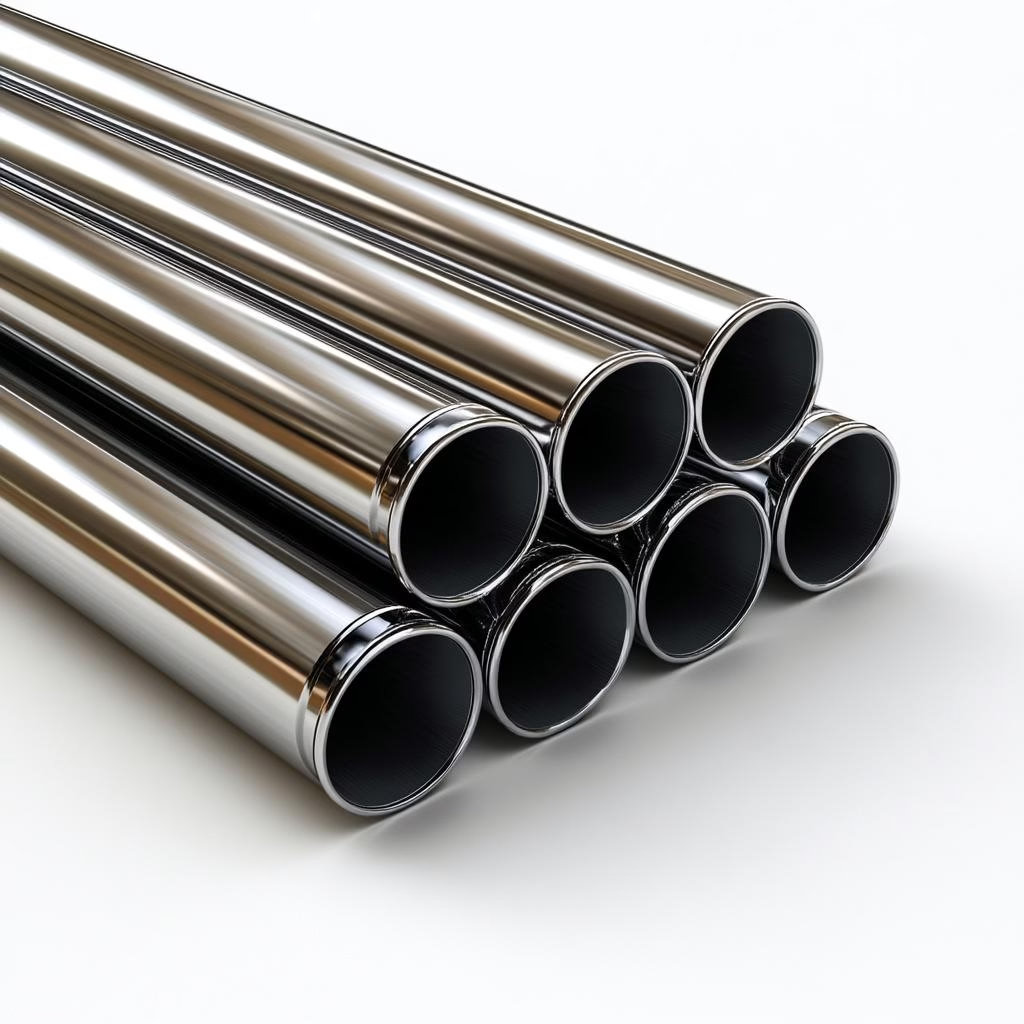
Titanium Pipe (Grade 2 / Grade 5 / Grade 7 / Grade 9 / Grade 12)
Titanium Pipe and Tube in Grade 1, Grade 2 (CP), Grade 5 (Ti-6Al-4V), Grade 7 (Ti-0.15Pd), Grade 9 (Ti-3Al-2.5V), Grade 12 (Ti-Mo-Ni). Seamless (ASTM B861) and welded (ASTM B862) pipe; heat exchanger tube (ASTM B338). OD 3–610mm, wall 0.3–25mm, length 6m. ASME SB-337/SB-338 pressure vessel code. Mill test certificate with hydrostatic test provided.
| Material | Commercially Pure Titanium / Alpha-Beta Titanium Alloy Seamless and Welded Pipe and Tube |
|---|---|
| Grade / Standard | Grade 1 (R50250) / Grade 2 (R50400) / Grade 4 (R50700) / Grade 5 Ti-6Al-4V (R56400) / Grade 7 Ti-0.15Pd (R52400) / Grade 9 Ti-3Al-2.5V (R56320) / Grade 12 Ti-Mo-Ni (R53400) |
| Length | 6m standard / Custom cut-to-length / Coiled (Grade 9 hydraulic tubing) / Random mill length |
| MOQ | 10 kg (Precision Tubing) / 100 kg (Standard Heat Exchanger Tube) / 500 kg (Process Pipe) |
| Delivery Time | 20-45 Days (Standard Grades) / 30-60 Days (Custom / Special Grade) |
| Loading Port | Tianjin / Shanghai / Qingdao |
Overview of Titanium Pipe
Titanium Pipe encompasses seamless and welded tubular products manufactured from commercially pure titanium and titanium alloys, engineered to deliver the extraordinary corrosion resistance, lightweight structural performance, and biocompatibility of titanium in piping, heat exchanger, and pressure containment applications where the complete spectrum of aggressive chemical, marine, thermal, and biological service conditions simultaneously exceed the capability of stainless steel, duplex stainless steel, and even many nickel alloys. Titanium pipe serves two distinct functional roles in industrial and engineering applications: as process piping conveying corrosive fluids including seawater, chlorinated chemicals, nitric acid, hydrogen peroxide, and pharmaceutical process streams; and as heat exchanger tubing providing thermal energy transfer across tube walls while resisting the corrosive attack of both tube-side and shell-side process fluids — a dual service demand uniquely met by titanium’s combination of thermal conductivity (16–21 W/m·K), near-zero corrosion rate in most aqueous environments, and thin-wall pressure containment capability.
Titanium pipe and tube is standardised under ASTM B337 (seamless and welded titanium and titanium alloy pipe), ASTM B338 (seamless and welded titanium and titanium alloy tubes for condensers and heat exchangers), ASTM B861 (titanium and titanium alloy seamless pipe), ASTM B862 (titanium and titanium alloy welded pipe), ASME SB-337 / SB-338 / SB-861 / SB-862 (ASME pressure vessel equivalents), AMS 4942 / 4944 (Ti-3Al-2.5V seamless hydraulic tubing for aerospace), EN ISO 9727-1 (round titanium and titanium alloy tubes for general applications), JIS H4631 (titanium and titanium alloy tubes), and GB/T 3624 (seamless titanium and titanium alloy tubes) / GB/T 3625 (titanium and titanium alloy tubes for heat exchangers). Principal grades span the complete titanium alloy family: Grade 1 (UNS R50250) for maximum formability in thin-wall condenser tubes, Grade 2 (UNS R50400, the dominant CP titanium pipe grade) for standard chemical, marine, and desalination service, Grade 7 (Ti-0.15Pd, UNS R52400) for enhanced crevice corrosion resistance in reducing acid environments, Grade 9 (Ti-3Al-2.5V, UNS R56320) for aerospace hydraulic tubing combining higher strength with cold-workability, Grade 12 (Ti-0.3Mo-0.8Ni, UNS R53400) for elevated temperature marine and chemical service, and Grade 5 (Ti-6Al-4V, UNS R56400) for high-pressure aerospace hydraulic lines and structural tubing requiring maximum strength.
Key Features and Manufacturing Process
Titanium pipe and tube is produced by two principal manufacturing routes — seamless and welded — each with distinct dimensional capabilities, pressure ratings, and applications, reflecting the unique metallurgical processing challenges of titanium’s high reactivity at elevated temperatures. Seamless titanium pipe is produced by rotary piercing of titanium billet at carefully controlled temperatures (Grade 2 at 800–950°C, Ti-6Al-4V at 870–980°C below beta transus), followed by tube rolling or extrusion to intermediate dimensions, then cold drawing through tungsten carbide dies in multiple passes to the final specified outside diameter and wall thickness with intermediate vacuum annealing between cold-drawing passes in vacuum or inert gas atmosphere furnaces to restore ductility without surface oxidation. The final vacuum anneal develops the uniform equiaxed grain structure required for optimal corrosion resistance and mechanical properties across the tube wall. Seamless titanium tube provides the highest pressure rating, complete absence of a longitudinal weld zone, and best dimensional concentricity — critical for thin-wall condenser tubing where weld zone strength reduction would be unacceptable.
Welded titanium pipe is produced by cold-roll forming titanium strip (slit from annealed coil) into a circular tube form and continuously welding the longitudinal seam using autogenous (filler-free) gas tungsten arc welding (GTAW) in an inert argon-purged weld chamber — the inert atmosphere purging of both the weld torch area and the tube interior bore is mandatory because titanium oxidises to a blue, gold, or white oxide scale in air above 400°C, and any oxidation of the weld metal indicates atmospheric contamination that embrittles the weld zone and reduces corrosion resistance. Premium welded tube undergoes reduction by cold drawing or cold pilgering after welding to achieve full-wall work hardening, weld seam flaw closure, and improved dimensional accuracy, followed by vacuum annealing to restore full ductility — this ‘welded and drawn’ (W&D) or ‘welded and cold-pilgered’ (W&CP) tube provides mechanical properties approaching seamless tube at lower manufacturing cost for medium-pressure applications. Welded titanium pipe is the economically preferred choice for heat exchanger condenser tubing (ASTM B338) in diameters 12.7–50.8mm where the thin wall (0.5–2.0mm) and high volume production requirements favour the continuous welded tube manufacturing approach. Each titanium pipe lot undergoes mandatory chemical composition verification, mechanical property testing (tensile, yield, elongation), hydrostatic pressure testing per ASTM B337/B338 at specified test pressure, non-destructive examination by eddy current testing (ECT) for surface and near-surface defects or ultrasonic testing (UT) for wall thickness verification, dimensional inspection of OD, wall thickness, straightness, ovality, and end squareness, and surface quality inspection for contamination, oxidation, and mechanical damage.
Main Applications of Titanium Pipe
Condenser and heat exchanger tubing represents the single largest application for titanium pipe, with Grade 1 and Grade 2 seamless and welded tubes in standard sizes of 15.88mm (5/8 inch), 19.05mm (¾ inch), and 25.4mm (1 inch) OD with wall thicknesses of 0.5–2.0mm used in steam surface condensers at power stations, water-cooled industrial process condensers, seawater-cooled compressor aftercoolers and intercoolers, desalination plant multi-effect evaporator heat exchanger tubes, HVAC free cooling heat exchangers for data centres and commercial buildings, pharmaceutical process heat exchangers, and marine vessel heat exchangers where the seawater-side corrosion resistance, biofouling resistance, and thin-wall pressure containment capability of titanium tubes provide 30–50 year service life without maintenance compared to the 5–15 year service life of admiralty brass or aluminium brass condenser tubes in the same seawater service. Grade 7 (Ti-0.15Pd) tubes are specified for condensers and heat exchangers where reducing acid contamination (hydrochloric acid, sulfuric acid, or organic acid impurities) in the cooling water creates crevice corrosion risk at tube-to-tubesheet joints that standard Grade 2 cannot survive reliably.
Process piping systems for corrosive chemical service use Grade 2 and Grade 7 titanium pipe in the chlor-alkali industry (chlorine gas piping, sodium hypochlorite distribution piping, hydrogen collection piping), the pharmaceutical industry (process fluid transfer piping in API synthesis, CIP cleaning loop piping requiring absolute absence of metallic contamination), the semiconductor industry (ultrapure chemical distribution piping for HF, HNO3, and H2O2 etch chemicals in wafer fabrication facilities), the pulp and paper industry (chlorine dioxide bleaching liquor piping), the food and beverage industry (fruit juice concentration and sterilisation piping requiring non-contaminating surfaces), and desalination plant brine piping where titanium’s immunity to the warm concentrated seawater brine stream ensures maintenance-free operation throughout plant design life. Marine and offshore applications include seawater piping systems on naval vessels where the non-magnetic properties of titanium are critical for degaussed warships, fire suppression system piping on naval vessels requiring seawater corrosion immunity without cathodic protection systems, and offshore platform seawater injection system piping where large-diameter Grade 2 titanium pipe (100–500mm NPS) eliminates the biocide injection and pigging operations required for carbon steel seawater injection pipe maintenance. Aerospace hydraulic tubing from Grade 9 (Ti-3Al-2.5V) per AMS 4942/4944 is the standard material for aircraft hydraulic system tubes (2,000–5,000 psi operating pressure) in commercial and military aircraft, where titanium’s 50% weight saving versus stainless steel hydraulic tube at equivalent pressure rating contributes to overall aircraft weight reduction.
Why Choose Us for Titanium Pipe
Shandong Tanglu Metal Material Co., Ltd. supplies premium Titanium Pipe sourced from leading Chinese titanium tube producers including Baoji Titanium Industry, Western Superconducting Technologies, and Baoji Titanium Alloy Tube Factory — all operating dedicated titanium tube production lines with vacuum annealing furnaces, argon-purged GTAW welding stations, cold drawing and pilgering equipment, eddy current and ultrasonic non-destructive testing systems, and chemical composition verification by optical emission spectrometry, certified to ISO 9001, ASTM B337 / B338 / B861 / B862, ASME SB-337 / SB-338, AMS 4942 / 4944, and GB/T 3624 / 3625 product standard requirements. Every titanium pipe lot is accompanied by original mill test certificates covering full chemical composition analysis of all required elements including interstitial elements (O, N, C, H) for Grade 2 and alloying elements (Al, V, Fe, O) for Grade 5 and Grade 9, mechanical property test results (tensile strength, yield strength, elongation), hydrostatic test pressure applied and pass confirmation, NDE method and acceptance criteria, dimensional inspection data (OD, wall thickness at multiple positions, straightness, ovality), and complete heat and tube number traceability.
We offer a comprehensive titanium pipe specification range: Grade 1 (ASTM B338 heat exchanger tubing, thin wall seamless and welded), Grade 2 (ASTM B337 / B338 / B861 / B862 standard process pipe and heat exchanger tubing), Grade 4 (ASTM B338, higher strength CP), Grade 5 Ti-6Al-4V (ASTM B337 / B861 high-pressure structural pipe), Grade 7 Ti-0.15Pd (ASTM B337 / B338 crevice-resistant process pipe and heat exchanger tubing), Grade 9 Ti-3Al-2.5V (AMS 4942 aerospace hydraulic tubing, ASTM B338), Grade 12 Ti-0.3Mo-0.8Ni (ASTM B337 / B338 elevated temperature service), and Grade 23 Ti-6Al-4V ELI (medical device tubing applications). Pipe sizes from 3mm OD (precision miniature tubing) to 610mm OD (large process piping), wall thickness 0.3mm to 25mm, standard lengths 6m with custom cut-to-length. Both seamless (per ASTM B861) and welded (per ASTM B862) pipe available; seamless and welded-drawn heat exchanger tube per ASTM B338. With established monthly supply capacity and export relationships with power plant condenser contractors, desalination project EPC contractors, chemical plant builders, offshore platform fabricators, aerospace system integrators, and pharmaceutical equipment manufacturers across more than 40 countries, we support both small-quantity prototype and sample orders and large project titanium tube supply contracts for major industrial installations. Each shipment includes original mill test certificate per EN 10204 3.1, with EN 10204 3.2, hydrostatic test certificate, eddy current / ultrasonic NDE report, and third-party inspection by SGS, Bureau Veritas, ABS, DNV GL, or Lloyd’s Register available for ASME Code, NORSOK, and defence applications.
📐 Dimension & Size Table
| Grade | Application | OD Range (mm) | Wall Thickness (mm) | Standard | Manufacturing Route |
|---|---|---|---|---|---|
| Grade 1 (CP Ti) | Condenser tube (max formability) | 6.35–25.4 | 0.30–1.65 / ASTM B338 / Seamless or Welded-Drawn | ||
| Grade 2 (CP Ti) | Heat exchanger tube — seawater, chemical | 6.35–50.8 | 0.40–2.77 / ASTM B338 / Seamless or Welded-Drawn | ||
| Grade 2 (CP Ti) | Process pipe — chemical, marine, pharma | 12.7–610 | 1.0–25.0 / ASTM B337/B861/B862 / Seamless or Welded | ||
| Grade 4 (CP Ti) | Higher-strength condenser tube | 6.35–50.8 | 0.40–2.77 / ASTM B338 / Seamless or Welded-Drawn | ||
| Grade 5 (Ti-6Al-4V) | High-pressure structural pipe | 12.7–273 | 1.5–20.0 / ASTM B337/B861 / Seamless | ||
| Grade 7 (Ti-0.15Pd) | Crevice-resistant process pipe and HX tube | 6.35–610 | 0.40–25.0 / ASTM B337/B338/B861/B862 / Seamless or Welded | ||
| Grade 9 (Ti-3Al-2.5V) | Aerospace hydraulic tubing | 3.0–50.8 | 0.30–3.0 / AMS 4942/4944 / Seamless | ||
| Grade 9 (Ti-3Al-2.5V) | Bicycle frame / sports tubing | 19–76 | 0.80–3.0 / ASTM B338 / Seamless | ||
| Grade 12 (Ti-Mo-Ni) | Elevated temperature marine/chemical | 12.7–219 | 1.0–10.0 / ASTM B337/B338 / Seamless or Welded | ||
| Grade 23 (Ti-6Al-4V ELI) | Medical device structural tubing | 3.0–50.8 | 0.30–5.0 / ASTM F1108 / Seamless |
* Custom sizes available upon request. Tolerances per relevant international standards.
🔬 Chemical Composition
| Element | Min | Max | Display Value | Note |
|---|---|---|---|---|
| Ti (Grade 2) | Bal. | - | Balance (≥99%) | Per ASTM B337/B338 — commercially pure titanium; all balance is titanium |
| O (Grade 2) | - | 0.25 | ≤0.25 | Primary strength-controlling interstitial; Grade 1: ≤0.18%; Grade 4: ≤0.40% |
| Fe (Grade 2) | - | 0.30 | ≤0.30 | Iron residual — controlled for crevice corrosion resistance at grain boundaries |
| N (Grade 2) | - | 0.03 | ≤0.03 | Nitrogen interstitial — solid solution strengthener; tightly controlled for toughness |
| C (Grade 2) | - | 0.08 | ≤0.08 | Carbon — forms TiC if excessive; controlled for microstructure uniformity |
| H (Grade 2) | - | 0.015 | ≤0.015 | Hydrogen — strictly limited to prevent delayed hydride cracking in high-stress applications |
| Pd (Grade 7) | 0.12 | 0.25 | 0.12–0.25 | Palladium — cathodic depolariser preventing crevice corrosion in reducing acid service |
| Al (Grade 5 / Ti-6Al-4V) | 5.50 | 6.75 | 5.50–6.75 | Per ASTM B337 / AMS 4942 — alpha-stabiliser providing high-temperature strength |
| V (Grade 5 / Ti-6Al-4V) | 3.50 | 4.50 | 3.50–4.50 | Beta-stabiliser enabling controlled beta phase retention for strengthening |
| Al (Grade 9 / Ti-3Al-2.5V) | 2.50 | 3.50 | 2.50–3.50 | Per AMS 4942 / ASTM B338 — lower Al than Grade 5, maintains cold-workability for tubing |
| V (Grade 9 / Ti-3Al-2.5V) | 2.00 | 3.00 | 2.00–3.00 | Lower V than Grade 5 — enables cold drawing to final aerospace hydraulic tube dimensions |
| Mo (Grade 12) | 0.20 | 0.40 | 0.20–0.40 | Molybdenum — improves elevated temperature corrosion resistance and crevice resistance |
| Ni (Grade 12) | 0.60 | 0.90 | 0.60–0.90 | Nickel — reduces crevice corrosion susceptibility at elevated temperatures |
* Chemical composition may vary by heat, thickness and specification. Please refer to the actual mill test certificate.
⚙️ Mechanical Properties
| Property | Value | Unit | Test Condition |
|---|---|---|---|
| Tensile Strength — Grade 1 (Annealed) | ≥240 | MPa (35 ksi) | Per ASTM B337/B338 — minimum for CP Grade 1 annealed; maximum ductility for condenser tube forming |
| Tensile Strength — Grade 2 (Annealed) | ≥345 | MPa (50 ksi) | Per ASTM B337/B338 — standard CP titanium process pipe and heat exchanger tube |
| Yield Strength — Grade 2 (Annealed) | ≥275 | MPa (40 ksi) | 0.2% proof stress, annealed condition |
| Elongation — Grade 2 (Annealed) | ≥20 | % | Adequate ductility for tube expansion in heat exchanger tube sheets |
| Tensile Strength — Grade 4 (Annealed) | ≥550 | MPa (80 ksi) | Per ASTM B338 — highest-strength CP titanium; for high-pressure condenser service |
| Tensile Strength — Grade 5 Ti-6Al-4V (Annealed) | ≥895 | MPa (130 ksi) | Per ASTM B337/B861 — high-pressure structural titanium pipe |
| Yield Strength — Grade 5 Ti-6Al-4V (Annealed) | ≥828 | MPa (120 ksi) | Enables thin-wall high-pressure pipe design for weight-critical applications |
| Tensile Strength — Grade 7 Ti-0.15Pd (Annealed) | ≥345 | MPa (50 ksi) | Per ASTM B337/B338 — same mechanical properties as Grade 2, enhanced crevice resistance |
| Tensile Strength — Grade 9 Ti-3Al-2.5V (Annealed) | ≥620 | MPa (90 ksi) | Per AMS 4942 / ASTM B338 — intermediate strength between Grade 2 and Grade 5 |
| Tensile Strength — Grade 9 (Cold Worked + Stress Relieved) | ≥690 | MPa (100 ksi) | Per AMS 4944 — standard aerospace hydraulic tubing condition |
| Yield Strength — Grade 9 CW+SR | ≥483 | MPa (70 ksi) | Per AMS 4944 — 2,000–5,000 psi aerospace hydraulic system pressure rating |
| Tensile Strength — Grade 12 (Annealed) | ≥483 | MPa (70 ksi) | Per ASTM B337/B338 — elevated temperature marine and chemical service |
| Hydrostatic Test Pressure — Grade 2 Pipe (ASTM B337) | Per calculated formula | - | Test pressure = 2S×t/D where S=138 MPa (Grade 2), t=wall thickness, D=OD; minimum 170 MPa test |
| Density — All Titanium Grades | 4.43–4.51 | g/cm³ | ~56% of steel density — critical weight advantage for aerospace and marine piping systems |
* Values shown are minimum requirements unless otherwise stated.
📦 Commercial Information
| Packaging | Premium seaworthy export packing for titanium pipe and tube with strict contamination prevention protocols — titanium surfaces must be completely protected from iron contamination (embedded iron causes pitting corrosion in service) and from moisture ingress into tube bores during transit. Heat exchanger tubes (small OD, thin wall) bundled in hexagonal close-packed arrangements using non-ferrous strapping (polypropylene or aluminium wire) — never carbon steel strapping — with plastic end caps pressed into both tube ends to seal the bore against moisture, insects, and contamination during transit. Complete bundle wrapped with VCI (Volatile Corrosion Inhibitor) polyethylene film to prevent surface tarnishing and mild atmospheric oxidation during ocean transit. For bright annealed or electropolished pharmaceutical-grade tubing, individual tube-to-tube protective sleeves (plastic tube or foam sleeve) prevent contact scratch damage between adjacent tubes before bundle wrapping. Large-diameter process pipe (OD above 100mm) bundled with timber dunnage supports at minimum 3 support points per 6m length, non-ferrous strapping, plastic end caps on all pipe ends, and complete PE film overwrap. Pipe ends protected against mechanical damage by plastic bevel-face protectors (for bevelled weld-prep ends) or plastic flat-face protectors (for plain-end pipe). Each tube or pipe piece tagged with stainless steel wire-attached metal identification tag showing: titanium grade (Grade 2, Grade 7, Grade 9, etc.), UNS number, applicable standard (ASTM B337, B338, B861, B862, AMS 4942), manufacturing route (seamless / welded / welded-drawn), OD × wall thickness × length in mm, tube weight in kg, heat number, lot number, delivery condition (annealed / CW+SR), and hydrostatic test pressure applied. For aerospace Grade 9 (AMS 4942/4944) hydraulic tubing, each tube additionally marked with unique serial number traceable to AMS 4942 compliance test records. Bundle shipping pallet uses ISPM-15 heat-treated timber. Complete documentation package (mill test certificate, hydrostatic test certificate, eddy current NDE report, dimensional inspection report, Certificate of Origin) in waterproof document pouch attached to each pallet. Desiccant sachets inside PE film wrap for tropical and high-humidity destinations. Container loading: 20FT FCL typically 8–12 tons of titanium pipe (titanium density approximately 4.5 g/cm³ versus 7.85 g/cm³ steel — larger volumetric fill per container for equivalent weight compared to steel pipe). |
|---|---|
| Payment Terms | T/T (Telegraphic Transfer),L/C (Letter of Credit),D/P (Documents against Payment),Western Union,PayPal |
| Price Term | FOB,CFR,CIF,EXW |
| Supply Capacity | 100 Tons/Month (Titanium Pipe and Tube) |
| Loading Port | Tianjin / Shanghai / Qingdao |
Why Choose Our Titanium Pipe (Grade 2 / Grade 5 / Grade 7 / Grade 9 / Grade 12)?
ASTM B337/B338/B861/B862 & ASME SB Code Certified
Titanium pipe supplied with EN 10204 3.1/3.2 mill test certificate covering full chemical composition (all elements including interstitials O, N, C, H), mechanical properties (tensile, yield, elongation), hydrostatic test certificate showing applied test pressure and pass result, eddy current or ultrasonic NDE report per ASTM A450/A213 methodology, dimensional inspection data, and complete heat and tube number traceability per ASTM B337/B338/B861/B862 and ASME SB-series.
Comprehensive Grade, Size & Form Range
Grade 1 through Grade 23 — CP titanium (Gr.1/2/4), Ti-0.15Pd (Gr.7), Ti-3Al-2.5V (Gr.9), Ti-Mo-Ni (Gr.12), Ti-6Al-4V (Gr.5), Ti-6Al-4V ELI (Gr.23). OD 3mm to 610mm. Wall 0.3mm to 25mm. Heat exchanger tube (ASTM B338), process pipe (ASTM B337/B861/B862), aerospace hydraulic tubing (AMS 4942/4944). Seamless and welded available.
Near-Zero Corrosion in Seawater & Aggressive Chemicals
Grade 2 titanium pipe: corrosion rate <0.025 mm/year in seawater at all temperatures including hot seawater above 100°C in desalination service; resistant to wet chlorine, sodium hypochlorite at all concentrations, nitric acid, hydrogen peroxide, and oxidising chemicals where stainless steel fails. Grade 7 additionally resists crevice corrosion in reducing acid environments. 30–50 year service life in condenser and seawater piping versus 5–15 years for copper alloy or stainless steel alternatives.
Multi-Code Compliance for Pressure Equipment
ASME BPVC Section II SB-337/SB-338/SB-861/SB-862 for pressure vessels and heat exchangers; AMS 4942/4944 for aerospace hydraulic tubing; ASTM F136 / ISO 5832-3 for medical device tubing; NORSOK MDS M-630 for offshore titanium piping (seawater injection); PED 2014/68/EU for European pressure equipment. ABS, DNV, LR, BV, NK, RINA, TUV classification society approval available.
Stock Heat Exchanger Tube & Custom Process Pipe
Grade 2 condenser tube (ASTM B338) in standard sizes (OD 15.88mm/19.05mm/25.4mm, wall 0.5–1.65mm) from stock: 20–30 days. Custom process pipe diameters and wall schedules: 35–55 days. Grade 9 aerospace hydraulic tubing (AMS 4942): 40–60 days. Non-ferrous packaging protocols and iron contamination prevention maintained throughout production and shipping.
🏭 Applications of Titanium Pipe (Grade 2 / Grade 5 / Grade 7 / Grade 9 / Grade 12)
Titanium pipe and tube serves as the essential corrosion-resistant fluid containment and heat transfer material across the widest range of aggressive chemical, marine, thermal, and biological service environments of any tubular metallic product — applications where the combination of near-zero corrosion rate, biofouling resistance, lightweight structure, and pressure containment capability simultaneously required by the service conditions create material selection requirements that no other commercially available pipe and tube material satisfies. Steam surface condenser and industrial heat exchanger tubing represents the largest single application for titanium tube by tonnage and unit count, with coastal and offshore power generation plants worldwide installing Grade 1 and Grade 2 titanium condenser tubes in seawater-cooled steam condensers for gas turbine combined cycle plants, nuclear power station turbine condensers, and oil and gas offshore platform utility condensers — the titanium tubes providing 30–50 year corrosion-free service life in direct seawater cooling duty compared to the 5–15 year service life of the admiralty brass, aluminium brass, or 90/10 cupronickel tubes previously installed in the same condensers. The biofouling resistance of titanium — marine organisms do not readily attach to titanium tube surfaces because titanium releases no biocidal metal ions unlike copper alloys — eliminates the biocide dosing costs and periodic mechanical cleaning maintenance required for copper alloy condenser tube systems, providing additional lifecycle cost advantages that complement titanium's extended service life in seawater condenser service. Desalination plant multi-effect evaporator (MEE) and multi-stage flash (MSF) heat exchanger tubes in Grade 1 and Grade 2 titanium operate in the hot concentrated brine streams at temperatures of 60–120°C and chloride concentrations of 50,000–70,000 ppm that cause rapid pitting corrosion in stainless steel and require expensive corrosion inhibitor additions for duplex stainless — titanium provides maintenance-free service in these conditions across the 20–25 year design life of modern large-scale desalination facilities. Seawater reverse osmosis (SWRO) desalination plants use Grade 2 titanium high-pressure pump casings, impeller housings, and pressure exchanger components machined from pipe and tube blanks for the high-pressure seawater feed pumps (55–80 bar operating pressure) that drive seawater through the RO membranes. Chlor-alkali plant piping systems employ Grade 2 titanium pipe throughout the chlorine gas and sodium hypochlorite product distribution systems — wet chlorine gas at the anode outlet of membrane electrolysis cells is one of the most corrosive environments in the entire chemical industry, corroding virtually all metals and polymers, but titanium's TiO2 passive film remains stable in wet chlorine at temperatures to 130°C, making it the only metallic material suitable for chlorine gas piping in modern membrane chlor-alkali plants. Large-diameter Grade 2 titanium pipe (DN150–DN500, wall schedule 5S or 10S) is installed for the chlorine gas main collection header, the hydrogen gas collection piping, and the sodium hypochlorite product distribution piping throughout modern chlor-alkali facilities, with welded titanium pipe joints providing the leak-free, maintenance-free service that carbon steel, nickel alloy, and polymer-lined piping systems cannot deliver in this environment. Pharmaceutical and biotechnology process piping from Grade 2 titanium (and electropolished Grade 2 for product contact surfaces) serves active pharmaceutical ingredient (API) synthesis plants, vaccine manufacturing fermentation bioreactor systems, chemical synthesis units handling acidic and oxidising process streams, and solvent recovery units where the combination of absolute corrosion resistance to the process chemistry, zero metallic contamination of the pharmaceutical product, and compliance with FDA 21 CFR Part 211 current Good Manufacturing Practice (cGMP) requirements for equipment material safety makes titanium the preferred metallic piping material for the most critical pharmaceutical process fluid systems. Marine naval vessel seawater piping in Grade 2 titanium (and Grade 7 for submarine applications where crevice corrosion resistance under sustained static seawater exposure is critical) is installed on naval warships for seawater supply, fire suppression, and cooling systems, exploiting titanium's non-magnetic properties — an essential requirement for ships in degaussed condition minimising magnetic signature for mine countermeasure and submarine warfare applications — combined with seawater corrosion immunity that eliminates the cathodic protection, coating maintenance, and impressed current CP systems required for steel seawater piping on naval vessels. Aerospace hydraulic tubing from Grade 9 Ti-3Al-2.5V per AMS 4942 (cold-worked annealed) and AMS 4944 (cold-worked stress-relieved) is installed throughout commercial and military aircraft hydraulic systems — primary flight control hydraulic lines, secondary flight control hydraulic circuits, landing gear extension and retraction hydraulic supply lines, thrust reverser hydraulic actuation lines, braking system hydraulic supply, and nose wheel steering hydraulic lines — where the combination of high specific strength (Rm/ρ ~155–165 kN·m/kg for Grade 9 CW+SR condition), compatibility with phosphate ester hydraulic fluid (Skydrol), resistance to moisture-induced corrosion in aircraft fuel tank adjacent routing, and 50% weight saving versus AISI 304L stainless steel hydraulic tube at equivalent 3,000–5,000 psi pressure rating contributes to the overall aircraft structural weight reduction targets of modern commercial and military aircraft programmes. Nuclear power plant service water systems — the seawater, river water, or lake water cooling circuits providing ultimate heat sink for reactor safety systems in boiling water reactors (BWR) and pressurised water reactors (PWR) — use Grade 2 titanium pipe for biofouling-resistant, corrosion-immune service water supply and return piping in coastal and inland nuclear power stations where the service water must remain flowing throughout all reactor operating and emergency conditions for the 40–60 year plant design life without corrosion-related failures that could compromise safety system availability.
📋 Quality & Certification
Our Certifications
- ✅ ISO 9001:2015
- ✅ CE Marking
- ✅ ABS
- ✅ DNV GL
- ✅ Lloyd's Register (LR)
- ✅ Bureau Veritas (BV)
- ✅ SGS Certified
- ✅ NK
- ✅ RINA
Mill Certificate Type
- 📋 EN 10204 3.1
- 📋 EN 10204 3.2
- 📋 Original Mill Certificate
- 📋 Third Party Inspection Available
- 📋 Certificate of Origin
❓ Frequently Asked Questions
What is the difference between ASTM B337, B338, B861, and B862 for titanium pipe and tube?
These four ASTM standards cover titanium tubular products for different applications with distinct dimensional, manufacturing, and inspection requirements. ASTM B337 (Titanium and Titanium Alloy Seamless and Welded Pipe) covers pipe intended for general industrial piping applications including chemical, marine, power generation, and process plant service. B337 pipe follows standard pipe dimensions (NPS designation system with nominal bore and schedule wall thickness per ASME B36.19M for metric sizes), available in both seamless and welded manufacture, grades 1 through 38. The standard specifies hydrostatic testing of every length at a test pressure calculated from the specified minimum yield strength, mandatory dimensional inspection, and either hydrostatic or non-destructive examination (eddy current) of the weld seam for welded pipe. ASTM B861 (Titanium and Titanium Alloy Seamless Pipe) covers seamless pipe only, with the same dimensional system as B337 but applicable specifically to the seamless manufacturing route — B861 replaces the seamless pipe provisions formerly combined with B337. ASTM B862 (Titanium and Titanium Alloy Welded Pipe) similarly covers welded pipe only, specifically the electric fusion welded or GTAW autogenous welded manufacturing route — B862 covers welded titanium pipe from large-diameter applications not efficiently produced by seamless methods. ASTM B338 (Seamless and Welded Titanium and Titanium Alloy Tubes for Condensers and Heat Exchangers) covers tube intended for installation in heat exchanger and condenser applications where the tube must be expanded into and sometimes welded to a tube sheet. B338 tube uses the OD × wall thickness dimensional system (rather than the nominal bore schedule system of B337/B861/B862) in the typical condenser tube range of 12.7–50.8mm OD with thin walls of 0.5–2.77mm, providing the thin-wall, high surface-area tubular geometry optimal for heat transfer. B338 requires eddy current or ultrasonic examination of the full length of every tube for internal and surface defects — mandatory because a single defective tube in a heat exchanger bundle cannot be individually replaced without complete tube bundle removal. The critical practical distinction: use B337/B861/B862 for titanium process piping systems; use B338 for heat exchanger tube bundles, condenser tube bundles, and other shell-and-tube heat exchanger applications.
What is the difference between seamless and welded titanium pipe, and when should each be specified?
Seamless and welded titanium pipe differ in manufacturing method, dimensional capability, mechanical property uniformity, weld zone characteristics, pressure rating philosophy, and cost — with each manufacturing route suited to different application requirements. Seamless titanium pipe is produced by hot piercing and rolling of solid titanium billet into a hollow tube without any longitudinal weld seam, followed by cold drawing and annealing to achieve final dimensions and properties. The defining advantage of seamless pipe is the absence of a longitudinal weld zone — the entire circumference of the pipe cross-section has uniform metallurgical structure and mechanical properties, with no potential weld defects, heat-affected zone microstructural changes, or residual welding stresses that must be managed in pressure system design. This makes seamless pipe the preferred specification for: high-pressure applications (above approximately 1,000 psi / 70 bar service pressure) where the weld zone margin is important; cyclic pressure and thermal fatigue applications where weld zone stress concentrations could initiate fatigue cracking; corrosive high-temperature service where weld zone sensitisation would accelerate local corrosion; critical aerospace structural tubing (AMS 4942 Grade 9 hydraulic tubing); and small-diameter precision tubing below approximately 25mm OD where seamless production is the only practical manufacturing route. Welded titanium pipe is produced by roll-forming titanium strip into a cylinder and joining the longitudinal seam by autogenous GTAW welding in argon atmosphere. Welded pipe offers: lower production cost versus seamless for medium and large diameters (above approximately 50mm OD) and thin wall thicknesses where seamless production is expensive or unavailable; better dimensional accuracy (OD and wall thickness tolerance) for the welded-and-drawn (W&D) production route; and availability in very large diameters (up to 610mm OD) where seamless titanium pipe is impractical due to ingot and equipment size limitations. The weld seam in premium welded titanium pipe (full penetration autogenous GTAW with argon backing gas purge) provides mechanical properties in the weld zone (ultimate tensile strength, yield, elongation) meeting or very closely approaching the parent material specification values — the titanium weld seam does not require filler metal and the weld chemistry is identical to the base material. Welded titanium pipe is the dominant commercial form for: heat exchanger condenser tubing (ASTM B338) in the 12.7–50.8mm OD range where high-volume welded-drawn production provides the closest possible dimensional tolerances for tube-to-tubesheet expansion; large-diameter process piping (DN100–DN600) for seawater and chemical service where the cost of seamless pipe in this size range is prohibitive; and medium-pressure piping systems (below approximately 700 psi / 50 bar) where the ASME B31.3 chemical plant piping code applies and welded pipe with the standard weld joint efficiency factor of 0.85 (or 1.0 for 100% radiography examined welds) provides adequate pressure rating.
How is titanium condenser tube expanded into tube sheets and what wall thickness is required?
Titanium heat exchanger condenser tube installation in tube sheets requires specific mechanical expansion techniques adapted to titanium's unique work-hardening characteristics and the necessity of achieving leak-free, pull-out-resistant joints without exceeding titanium's ductility limits. The tube-to-tubesheet expansion process for titanium tubes follows the same mechanical rolling or hydraulic expansion methodology used for brass and stainless steel condenser tubes, with specific parameter adjustments required for titanium's higher yield strength (Grade 2: 275 MPa yield versus ~170 MPa for 90/10 cupronickel) and higher work-hardening rate. Mechanical roller expansion uses a mandrel-driven multi-roll expander that radially expands the titanium tube against the tube sheet bore, creating a mechanical interference fit joint — the tube OD is increased by 1.5–2.5% beyond the tube sheet bore diameter to generate sufficient contact pressure for leak-free sealing and adequate tube pull-out resistance. For thin-wall titanium condenser tube (wall 0.5–0.89mm, typical for high thermal performance condensers), the permitted tube thinning during expansion (typically expressed as percentage of wall thickness reduction) must be carefully controlled to prevent over-expansion that reduces wall thickness below the minimum required for tube integrity, or under-expansion that provides insufficient joint seal integrity — titanium tube expansion practice typically uses 5–10% wall reduction as the target, compared to 3–7% for brass and 8–12% for stainless steel, reflecting titanium's higher yield strength requiring more expansion force but its faster work-hardening rate limiting maximum permissible expansion. Hydraulic expansion (also called hydroswage or Swagelok-type expansion) uses an elastomeric plug inflated with pressurised hydraulic fluid to expand the tube uniformly around its full circumference without the localised roll contact marks that can cause crevice corrosion initiation sites in corrosive tube sheet environments — hydraulic expansion is preferred for Grade 7 (Ti-0.15Pd) and pharmaceutical-grade titanium tube installations where crevice corrosion resistance and cleanliness are priorities. Tube wall thickness selection for ASTM B338 titanium condenser tubes follows TEMA (Tubular Exchanger Manufacturers Association) standards, with 0.5mm (0.020 inch) wall being the minimum practical for Grade 2 tube in clean seawater service, 0.7mm (0.028 inch) as the standard conservative selection for most power station condenser service, and 0.9mm (0.035 inch) for higher-velocity or slightly more aggressive seawater conditions — the thin titanium walls, even at 0.5mm, provide adequate corrosion allowance because titanium's corrosion rate in seawater is effectively zero (less than 0.002 mm/year measured corrosion rate in clean seawater), so no corrosion allowance addition to the structural wall thickness is required unlike steel tube sizing calculations. Tube sheet bore diameter and tube-to-tubesheet clearance for titanium tubes per TEMA standards: standard groove (two grooves per tube sheet bore are standard for expanded tube joints) with 0.4mm (1/64 inch) diametral clearance for Grade 2 tube; the grooves lock the expanded tube against longitudinal pull-out forces from thermal expansion differential and hydraulic pressure end thrust in the condenser.
What is Grade 9 Ti-3Al-2.5V titanium tubing and why is it used for aerospace hydraulic systems?
Grade 9 titanium (Ti-3Al-2.5V, UNS R56320, ASTM Grade 9) is an alpha-beta titanium alloy containing 3% aluminium and 2.5% vanadium — a composition specifically engineered to balance three competing requirements for aerospace hydraulic tubing: sufficient strength to contain hydraulic system operating pressures of 3,000–5,000 psi (207–345 bar); adequate cold-workability to enable cold-drawing to final tube dimensions in the small OD range (3–19mm) required for aircraft hydraulic lines; and minimum weight for equivalent pressure containment versus the stainless steel tubing it replaces. The Ti-3Al-2.5V alloy composition was specifically chosen over the stronger but less cold-workable Ti-6Al-4V (Grade 5) for hydraulic tubing because the lower aluminium (3% vs 6%) and lower vanadium (2.5% vs 4%) content maintains sufficient beta phase stability and ductility at room temperature to enable cold drawing of thin-wall small-diameter tube to the tight dimensional tolerances (OD ±0.05mm, wall ±0.05mm) required by aerospace hydraulic line specifications — Ti-6Al-4V cannot be cold-drawn to small OD thin-wall dimensions without multiple intermediate anneals, making tube production impractical for high-volume aerospace hydraulic system production. Grade 9 per AMS 4942 (annealed condition) achieves minimum tensile strength 620 MPa (90 ksi) and yield strength 483 MPa (70 ksi) — approximately 30% higher than Grade 2 CP titanium, enabling thinner tube walls for equivalent pressure rating. Per AMS 4944 (cold-worked and stress-relieved condition, the standard for aircraft hydraulic tubing), Grade 9 achieves 690 MPa tensile and 483 MPa (minimum) yield — providing the required burst pressure safety factor of 4:1 above working pressure in the typical 3mm–12mm OD hydraulic tube sizes used in aircraft hydraulic circuits. The weight saving of Grade 9 titanium hydraulic tubing versus the 304L stainless steel tube it replaces is approximately 43% (titanium density 4.51 g/cm³ versus stainless 7.95 g/cm³) at equivalent hydraulic pressure rating — for a wide-body commercial aircraft with 2,000–3,000 metres of hydraulic tubing throughout its hydraulic system, this represents 50–100 kg of structural weight saving per aircraft, which over a 30-year commercial life at current fuel economics represents millions of dollars of fuel saving per aircraft. Grade 9 titanium is fully compatible with phosphate ester hydraulic fluid (Skydrol LD-4 and equivalent), the aviation-standard hydraulic fluid required by aircraft certification for fire resistance — unlike aluminium alloy hydraulic tubing which reacts with phosphate ester in the presence of moisture, titanium hydraulic tubing is inert to all approved aviation hydraulic fluids at all operating temperatures. Grade 9 is supplied per AMS 4944 with mandatory eddy current inspection of the full tube length (100% ET to ASTM E309 methodology detecting surface and near-surface defects ≥0.076mm depth in 3–6mm OD tubes), hydraulic pressure testing to minimum 110 MPa (16,000 psi) for 3,000 psi rated tubing, dimensional inspection of OD and wall at minimum 15 positions per tube, and grain flow macroexamination to verify tube forming quality.
What precautions are required when welding titanium pipe in the field, and what shielding gas is needed?
Field welding of titanium pipe is significantly more demanding than welding stainless steel or carbon steel due to titanium's extreme reactivity with oxygen, nitrogen, and hydrogen at welding temperatures — contamination of the weld metal or heat-affected zone by atmospheric gases produces brittle oxide, nitride, and hydride phases that dramatically reduce the toughness and corrosion resistance of the welded joint, potentially causing immediate weld cracking or in-service failure. The critical welding requirement is complete exclusion of all atmospheric gases from the weld metal, heat-affected zone, and the cooling titanium surface throughout the entire welding cycle and cooling period. Shielding gas requirements: high-purity argon (99.999% minimum purity, dew point ≤−60°C) is the standard shielding gas for all titanium welding; helium or argon-helium mixtures are used for higher heat input when penetration requirements demand it; nitrogen, CO2, and mixed gas blends used for steel and stainless welding are absolutely prohibited for titanium. Three shielding zones must be established simultaneously: (1) Primary arc shielding — the GTAW torch cup delivers argon gas directly around the tungsten electrode and weld puddle from the front; (2) Trailing gas shield — a separate trailing shield (often called a 'shoe' or 'sled') supplies additional argon coverage over the completed weld and HAZ as the torch advances, protecting the hot titanium surface as it cools below 400°C — the colour of the titanium weld surface is the indicator of atmospheric contamination: bright silver (acceptable, no contamination), light gold (borderline acceptable in non-critical areas — minor surface oxidation), purple or blue (reject — significant oxidation, loss of corrosion resistance), grey-white (reject — severe oxidation, embrittlement), white chalky (catastrophic contamination — weld must be completely removed). (3) Purge gas — the interior bore of the pipe must be continuously purged with argon throughout the welding operation to prevent oxidation of the pipe bore weld root pass, which is exposed to atmospheric air if not purged. The bore purge requirement distinguishes titanium pipe welding from stainless steel pipe welding — stainless steel pipe is purged to prevent carbide precipitation (sensitisation) at the weld root, but titanium pipe purging prevents catastrophic oxidation embrittlement that would occur without purge. Practical purge requirements: argon purge flow rate minimum 10–20 SLPM introduced at one end of the pipe section, with monitoring of the exit end purge gas quality using an oxygen analyser (oxygen level must be below 50 ppm, ideally below 20 ppm, before welding commences and maintained throughout); use dedicated titanium pipe purge plugs or inflatable pipe dams at both ends of the weld section to contain the purge gas; allow minimum 5 pipe volume changes of purge gas before welding. For orbital (automatic) GTAW welding of titanium hydraulic and process tubing in controlled environments (fabrication shops), dedicated titanium welding glove boxes or local inert atmosphere enclosures eliminate the atmospheric contamination risk entirely and are the preferred approach for high-quality titanium pipe spool fabrication. Filler metal for titanium GTAW should match parent material composition — ERTi-2 for Grade 2 parent pipe, ERTi-9 for Grade 9 parent pipe — and must be stored in sealed dry containers to prevent hydrogen pick-up from atmospheric moisture. Weld joint design should specify 100% penetration butt joints; fillet welds on titanium should be avoided as they create crevice geometries vulnerable to the crevice corrosion mechanism in titanium in reducing acid environments.
Get a Quote for
Titanium Pipe (Grade 2 / Grade 5 / Grade 7 / Grade 9 / Grade 12)
Submit your requirements and receive a competitive price quote within 24 hours.
- ✓ Fast response within 24 hours
- ✓ Competitive factory-direct pricing
- ✓ Free technical consultation
- ✓ Mill test certificate provided
- ✓ Flexible payment terms available
⏱ Response within 24 hours
Send Your Inquiry
All fields marked with * are required