
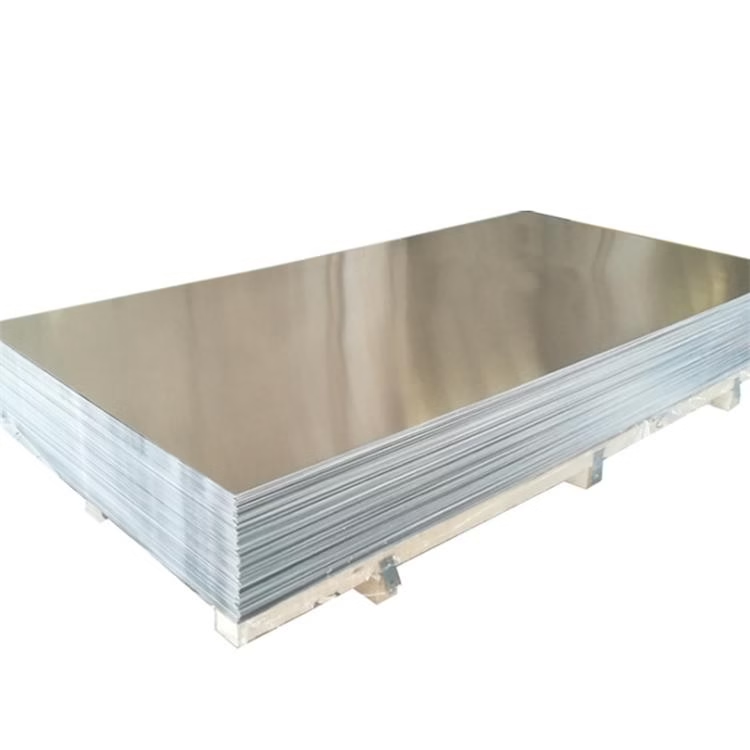
Alloy Plate (Inconel / Hastelloy / Monel / Titanium)
Alloy Plate in Inconel 625/718, Hastelloy C276/C22, Monel 400/K500, Incoloy 825, Titanium Grade 2/5 for pressure vessels, heat exchanger tube sheets, reactor fabrication, aerospace structure, and corrosion-resistant equipment. Thickness 1.5–100mm, width up to 2,500mm. ASTM B443/B575/B127/B265 certified. Ultrasonic testing available. Mill test certificate provided.
| Material | Nickel-based Superalloy / Titanium Alloy Hot-Rolled / Cold-Rolled Plate and Sheet |
|---|---|
| Grade / Standard | Inconel 625 / 718 / 600 / 601 / Hastelloy C276 / C22 / B2 / X / Monel 400 / K500 / Incoloy 825 / 800H / Titanium Grade 1 / 2 / 4 / 5 (Ti-6Al-4V) / Grade 7 / Grade 12 |
| Thickness | 1.5mm – 100mm (Standard) / up to 200mm by hot pressing or forging for special applications |
| Width | Up to 2,500mm (Standard mill width, alloy dependent) |
| Length | Up to 6,000mm / Cut-to-size service available |
| Delivery Condition | as_rolled |
| Surface Treatment | coated |
| MOQ | 1 Piece (Custom Plate) / 100 kg (Standard Sheet) |
| Delivery Time | 25-50 Days (Custom Production) / 20-35 Days (Stock) |
| Loading Port | Tianjin / Shanghai / Qingdao |
Overview of Alloy Plate (Inconel / Hastelloy / Monel / Titanium)
Alloy Plate refers to flat-rolled or hot-pressed thick flat product manufactured from nickel-based superalloys, titanium alloys, cobalt-based alloys, and other high-performance specialty metals, supplied as individual cut plates or sheets in thicknesses from 1.5mm to 100mm and widths up to 2,500mm — the primary raw material for pressure vessel fabrication, reactor vessel construction, heat exchanger tube sheet drilling, flange and fitting machining, structural equipment components, and cladding applications in the most demanding industrial service environments. Unlike alloy coil which is optimised for continuous thin-gauge forming operations, and alloy bar which serves machined component production, alloy plate provides the large flat cross-sectional area, substantial thickness range, and individual piece flexibility required for pressure-containing equipment, structural fabrication, and machined flat components that are the backbone of chemical plant, offshore platform, pharmaceutical, and nuclear infrastructure.
Alloy plate is standardised under ASTM B443 (Inconel 625 plate, sheet and strip), ASTM B575 (Hastelloy C276 / C22 plate, sheet and strip), ASTM B127 (Monel 400 plate, sheet and strip), ASTM B162 (Nickel 200/201 plate), ASTM B409 (Incoloy 800/800H plate), ASTM B424 (Incoloy 825 plate), ASTM B265 (Titanium plate, sheet and strip), EN 10095 (heat-resistant nickel alloys), and ASME SB-series pressure vessel equivalents for each material — with chemical composition, mechanical property, dimensional tolerance, and surface finish requirements precisely specified for each alloy and thickness range. Principal grades include Inconel 625 (UNS N06625) for the broadest combination of corrosion resistance and strength suitable for chemical, marine, offshore, and aerospace plate applications; Hastelloy C276 (UNS N10276) for extreme chemical corrosion resistance in chlorinated, acidic, and mixed oxidising-reducing environments; Monel 400 (UNS N04400) for seawater and hydrofluoric acid service; Incoloy 825 (UNS N08825) for sulfuric and phosphoric acid chemical plant; and Titanium Grade 2 (UNS R50400) and Grade 5 Ti-6Al-4V (UNS R56400) for lightweight corrosion-resistant structural and aerospace plate applications where the density advantage of titanium (4.4–4.5 g/cm³ versus 8.4–8.9 g/cm³ for nickel alloys) is a critical design parameter.
Key Features and Manufacturing Process
Alloy plate is manufactured through specialised primary melting and hot-rolling or hot-pressing processes specifically adapted to the unique metallurgical characteristics of each alloy family and the thickness requirements of pressure vessel and structural applications. Production begins with vacuum induction melting (VIM) of the alloy ingot to precisely controlled chemistry under vacuum atmosphere, followed by vacuum arc remelting (VAR) for aerospace-grade titanium plate (AMS 4928 Ti-6Al-4V) or electroslag remelting (ESR) for premium nickel alloy plate grades requiring maximum cleanliness and microstructure uniformity for ultrasonic testing qualification. The refined ingot or slab is hot-rolled at alloy-specific temperatures — Inconel 625 at 980–1,230°C, Hastelloy C276 at 1,065–1,175°C, Monel 400 at 870–1,175°C, Titanium Grade 2 at 760–900°C, Titanium Grade 5 below beta transus at 870–980°C — through a rolling programme designed to achieve the required plate thickness with uniform through-thickness mechanical properties, minimum decarburisation and grain boundary oxidation, and controlled rolling reduction (typically 3:1 to 6:1 total reduction ratio from ingot to plate) for adequate grain refinement and mechanical property isotropy in the finished plate.
Alloy plate is supplied in thicknesses from 1.5mm to 100mm (and beyond for special applications up to 200mm by hot pressing or heavy forging), widths up to 2,500mm for standard mill width, and lengths up to 6,000mm or cut-to-length from mill plate. Standard delivery conditions include solution annealed (the dominant condition for Inconel 625, Hastelloy C276, Monel 400, and Titanium Grade 2 plate, providing maximum corrosion resistance, ductility for cold forming, and stress-free condition for pressure vessel fabrication per ASME codes), and solution annealed and aged (for Inconel 718 and Monel K500 plate achieving precipitation-hardened maximum strength). Surface finish options range from hot-rolled annealed pickled (No. 1 — standard industrial surface for most pressure vessel and structural applications), cold-rolled annealed pickled (No. 2B — smoother surface for pharmaceutical and food-grade equipment), and mechanically polished (Ra ≤0.8μm or Ra ≤0.4μm for sterile pharmaceutical and medical applications). Each alloy plate undergoes mandatory chemical composition analysis by ICP spectroscopy, full mechanical property testing including tensile strength, yield strength, elongation, and hardness at plate quarter-thickness position, ultrasonic testing per ASTM A435 / A578 for internal soundness (mandatory for pressure vessel and heat exchanger tube sheet applications), surface quality inspection for laps, seams, and pits, and dimensional inspection of thickness, width, length, flatness, and squareness per applicable standard. For ASME Boiler and Pressure Vessel Code applications, additional third-party inspection, Manufacturer’s Data Report (MDR), and NDE documentation are provided.
Main Applications of Alloy Plate
Alloy plate is the fundamental construction material for pressure vessels, reactors, columns, and heat exchangers in the chemical processing, pharmaceutical, oil and gas, and nuclear industries. Pressure vessel and reactor vessel fabrication is the largest application, with Hastelloy C276, Inconel 625, and Incoloy 825 plate used for vessels handling corrosive process streams including chlorinated chemicals, mineral acids, mixed acid environments, and high-temperature aggressive media in fertiliser plants, pharmaceutical manufacturing, fine chemical production, pesticide synthesis, and petroleum refining where the vessel must resist corrosive process fluids on the inner surface while the outer carbon steel shell provides structural strength — requiring alloy plate either as solid alloy construction or as explosion-bonded clad plate over carbon steel. Heat exchanger tube sheets are a critical application for thick alloy plate (25–100mm), where Titanium Grade 2, Inconel 625, Hastelloy C276, and Monel 400 tube sheets are drilled with hundreds to thousands of holes for tube attachment in shell-and-tube heat exchangers, condensers, and coolers — the tube sheet must resist the shell-side and tube-side fluids simultaneously, resist crevice corrosion at tube-to-tubesheet joints, and maintain dimensional stability under thermal cycling.
Offshore oil and gas platform and subsea equipment manufacture employs Inconel 625 and Duplex/Super Duplex plate for topside equipment, process piping flanges, manifold bodies, subsea wellhead components, and umbilical termination heads where NORSOK and API standards mandate specific corrosion-resistant alloys for sour service per NACE MR0175. Aerospace structural plate applications include Titanium Grade 5 (Ti-6Al-4V) per AMS 4928 for aircraft bulkhead machining, wing fitting blanks, engine mount structure, and military aircraft structural components where the combination of high strength (UTS ≥895 MPa) and low density (4.43 g/cm³) provides specific strength exceeding high-strength steels and aluminium alloys. The pharmaceutical and food processing industry uses Hastelloy C276, Inconel 625, and Titanium Grade 2 plate for agitator vessel heads and shells, dryer cone sections, sterile reactor components, and process fluid contact surfaces where absolute corrosion resistance to aggressive cleaning agents (CIP solutions containing caustic, acids, and hypochlorite) and absence of metallic contamination of pharmaceutical products are regulatory requirements. Nuclear power applications include Inconel 690 and 600 plate for steam generator components, reactor vessel cladding, and primary circuit equipment. Other significant applications include marine vessel hull inserts and sea chest components from Titanium and Monel, chemical tanker tank lining from Hastelloy and Incoloy, desalination plant pressure vessel shells from Titanium Grade 2 and duplex stainless, heat treatment furnace components from Inconel 601 and 602CA, pulp and paper bleaching equipment from Hastelloy C276 and Titanium, and the complete range of custom machined flat components for valves, pumps, flanges, and specialised equipment in extreme service environments.
Why Choose Us for Alloy Plate
Shandong Tanglu Metal Material Co., Ltd. supplies premium Alloy Plate sourced from leading international and Chinese specialty alloy producers including Baosteel Special Steel, Western Superconducting Technologies (Titanium), and established nickel alloy plate mills with dedicated alloy hot-rolling and heat treatment facilities certified to ISO 9001, AS9100 (aerospace titanium plate), NORSOK MDS M-630/M-650 (oil and gas materials), ASME QSC (Authorized Inspection Programme), and PED (Pressure Equipment Directive) requirements. Every alloy plate shipment is accompanied by original mill test certificates in EN 10204 3.1 format covering full ICP chemical composition analysis of all principal and trace elements against applicable standard limits, mechanical property test results (tensile strength, yield strength, elongation — both longitudinal and transverse directions at plate quarter-thickness), hardness verification, ultrasonic testing results per ASTM A435 / A578 or ASTM B548 quality class, surface quality inspection, dimensional measurement data (thickness at multiple positions, width, length, flatness, squareness), and complete heat and plate number traceability.
We offer a comprehensive alloy plate specification range covering Inconel 625 (ASTM B443 / ASME SB-443), Inconel 718 (ASTM B670 / AMS 5596), Inconel 600 (ASTM B168 / ASME SB-168), Hastelloy C276 (ASTM B575 / ASME SB-575), Hastelloy C22 (ASTM B575 variant), Monel 400 (ASTM B127 / ASME SB-127), Incoloy 825 (ASTM B424 / ASME SB-424), Incoloy 800H (ASTM B409 / ASME SB-409), Titanium Grade 1 / 2 / 4 / 5 / 7 / 12 (ASTM B265 / ASME SB-265 / AMS 4928 for Ti-6Al-4V), in thicknesses from 1.5mm to 100mm, widths up to 2,500mm, and lengths up to 6,000mm with cut-to-size service. Explosion-bonded clad plate (alloy cladding on carbon steel, stainless steel, or low-alloy steel backing) available for Inconel 625, Hastelloy C276, Monel 400, and Titanium Grade 2 clad combinations. With established monthly supply capacity of 150 tons of premium alloy products and export relationships with pressure vessel fabricators, heat exchanger manufacturers, chemical plant constructors, offshore equipment producers, aerospace machining centres, and pharmaceutical equipment manufacturers across more than 40 countries, we support packages from single-plate prototype orders to large-project plate supply contracts. Each shipment includes original mill test certificate per EN 10204 3.1, with EN 10204 3.2, ultrasonic testing report, PMI (XRF) verification report, and third-party inspection by SGS, Bureau Veritas, ABS, DNV GL, or Lloyd’s Register available for ASME Code, NORSOK, and AS9100 aerospace applications.
📐 Dimension & Size Table
| Alloy Grade | Standard | Thickness Range (mm) | Width Range (mm) | Standard Condition | Primary Application |
|---|---|---|---|---|---|
| Inconel 625 | ASTM B443 / ASME SB-443 | 1.5–100 | Up to 2,500 / SA / Chemical, marine, offshore, aerospace | ||
| Inconel 718 | ASTM B670 / AMS 5596 | 1.5–80 | Up to 2,000 / SA or STA / Aerospace machined components, oil & gas | ||
| Inconel 600 | ASTM B168 / ASME SB-168 | 1.5–50 | Up to 2,000 / SA / Furnace liners, nuclear, heat treatment | ||
| Inconel 601 | ASTM B168 variant | 1.5–50 | Up to 1,500 / SA / High-temperature oxidation above 1000°C | ||
| Inconel 690 | ASTM B168 / ASME SB-168 | 1.5–50 | Up to 1,500 / SA / Nuclear steam generator, AGR reactors | ||
| Hastelloy C276 | ASTM B575 / ASME SB-575 | 1.5–100 | Up to 2,500 / SA / Chemical reactors, scrubbers, pharmaceutical | ||
| Hastelloy C22 | ASTM B575 variant | 1.5–80 | Up to 2,000 / SA / Oxidizing chloride environments, FGD systems | ||
| Hastelloy B2 | ASTM B333 / ASME SB-333 | 1.5–50 | Up to 1,500 / SA / HCl acid vessels, hydrochloric acid plants | ||
| Hastelloy X | AMS 5536 / ASTM B435 | 1.5–50 | Up to 1,500 / SA / Gas turbine combustors, aerospace nacelles | ||
| Monel 400 | ASTM B127 / ASME SB-127 | 1.5–80 | Up to 2,000 / Annealed / Seawater, HF acid vessels, marine | ||
| Monel K500 | ASTM B865 / QQ-N-286 | 1.5–50 | Up to 1,500 / STA / High-strength marine, downhole components | ||
| Incoloy 825 | ASTM B424 / ASME SB-424 | 1.5–80 | Up to 2,000 / SA / H2SO4, H3PO4 plants, oil & gas | ||
| Incoloy 800H / 800HT | ASTM B409 / ASME SB-409 | 1.5–80 | Up to 2,000 / SA / Petrochemical furnace, reformer tubes | ||
| Titanium Grade 1 | ASTM B265 / ASME SB-265 | 1.0–50 | Up to 2,000 / Annealed / Max formability, chemical equipment | ||
| Titanium Grade 2 | ASTM B265 / ASME SB-265 | 1.0–80 | Up to 2,500 / Annealed / Heat exchanger tube sheets, marine, chemical | ||
| Titanium Grade 4 | ASTM B265 | 1.5–50 | Up to 1,500 / Annealed / Higher strength CP Ti applications | ||
| Titanium Grade 5 (Ti-6Al-4V) | ASTM B265 / AMS 4928 | 1.5–100 | Up to 2,000 / Annealed or STA / Aerospace structure, medical, marine | ||
| Titanium Grade 7 (Ti-0.2Pd) | ASTM B265 | 1.5–50 | Up to 1,500 / Annealed / Reducing acid environments, crevice corrosion | ||
| Titanium Grade 12 (Ti-Mo-Ni) | ASTM B265 | 1.5–50 | Up to 1,500 / Annealed / Elevated temp marine and chemical service |
* Custom sizes available upon request. Tolerances per relevant international standards.
🔬 Chemical Composition
| Element | Min | Max | Display Value | Note |
|---|---|---|---|---|
| Ni (Inconel 625) | 58.0 | - | ≥58.0 (balance) | Per ASTM B443 — nickel base for corrosion resistance and high-temp strength |
| Cr (Inconel 625) | 20.0 | 23.0 | 20.0–23.0 | Oxidation resistance and chromium carbide precipitation resistance |
| Mo (Inconel 625) | 8.0 | 10.0 | 8.0–10.0 | Pitting and crevice corrosion resistance in chloride environments |
| Nb+Ta (Inconel 625) | 3.15 | 4.15 | 3.15–4.15 | Solid solution strengthening; stabilises against sensitisation in welded condition |
| Fe (Inconel 625) | - | 5.0 | ≤5.0 | Maximum allowable — excess Fe reduces corrosion resistance |
| Ni (Hastelloy C276) | Bal. | - | Balance (~57%) | Per ASTM B575 — nickel matrix for extreme chemical resistance |
| Cr (Hastelloy C276) | 14.5 | 16.5 | 14.5–16.5 | Oxidising environment corrosion resistance |
| Mo (Hastelloy C276) | 15.0 | 17.0 | 15.0–17.0 | Highest Mo of commercial alloys — critical for reducing acid resistance |
| W (Hastelloy C276) | 3.0 | 4.5 | 3.0–4.5 | Further enhances localised corrosion resistance in oxidising chloride |
| Ni (Monel 400) | 63.0 | - | ≥63.0 | Per ASTM B127 — Ni-Cu alloy base |
| Cu (Monel 400) | 28.0 | 34.0 | 28.0–34.0 | Seawater, HF acid, and reducing environment corrosion resistance |
| Fe (Monel 400) | - | 2.5 | ≤2.5 | Strictly controlled residual |
| Ti (Titanium Grade 2) | Bal. | - | Balance (≥99%) | Per ASTM B265 — commercially pure titanium; best corrosion resistance of Ti grades |
| Al (Titanium Grade 5) | 5.5 | 6.75 | 5.5–6.75 | Alpha phase stabiliser for high strength in Ti-6Al-4V |
| V (Titanium Grade 5) | 3.5 | 4.5 | 3.5–4.5 | Beta phase stabiliser enabling heat treatment to high strength levels |
| O (Titanium Grade 5) | - | 0.20 | ≤0.20 | Interstitial element — strictly controlled for ductility and fracture toughness |
* Chemical composition may vary by heat, thickness and specification. Please refer to the actual mill test certificate.
⚙️ Mechanical Properties
| Property | Value | Unit | Test Condition |
|---|---|---|---|
| Tensile Strength — Inconel 625 (SA, t≤50mm) | ≥827 | MPa (120 ksi) | Solution Annealed per ASTM B443 |
| Yield Strength — Inconel 625 (SA) | ≥414 | MPa (60 ksi) | 0.2% proof stress, Solution Annealed |
| Elongation — Inconel 625 (SA) | ≥30 | % | Gauge length 4D, longitudinal direction |
| Tensile Strength — Inconel 718 (STA) | ≥1,241 | MPa (180 ksi) | Solution Treated + Double Aged per AMS 5596 / ASTM B670 |
| Yield Strength — Inconel 718 (STA) | ≥1,034 | MPa (150 ksi) | 0.2% proof stress, fully age hardened |
| Elongation — Inconel 718 (STA) | ≥12 | % | Reduced from SA condition due to age hardening |
| Tensile Strength — Hastelloy C276 (SA) | ≥690 | MPa (100 ksi) | Solution Annealed per ASTM B575 |
| Yield Strength — Hastelloy C276 (SA) | ≥283 | MPa (41 ksi) | 0.2% proof stress — excellent ductility for vessel forming |
| Elongation — Hastelloy C276 (SA) | ≥40 | % | Outstanding formability for vessel head pressing |
| Tensile Strength — Monel 400 (Annealed) | ≥480 | MPa (70 ksi) | Annealed per ASTM B127 |
| Yield Strength — Monel 400 (Annealed) | ≥170 | MPa (25 ksi) | 0.2% proof stress — very high ductility annealed |
| Elongation — Monel 400 (Annealed) | ≥35 | % | Excellent for deep drawing and forming operations |
| Tensile Strength — Titanium Grade 2 (Annealed) | ≥345 | MPa (50 ksi) | Annealed per ASTM B265 — corrosion-resistant CP titanium |
| Yield Strength — Titanium Grade 2 (Annealed) | ≥275 | MPa (40 ksi) | 0.2% proof stress |
| Tensile Strength — Titanium Grade 5 (Annealed) | ≥895 | MPa (130 ksi) | Annealed per ASTM B265 / AMS 4928 |
| Yield Strength — Titanium Grade 5 (Annealed) | ≥828 | MPa (120 ksi) | 0.2% proof stress — specific strength exceeds high-strength steel |
| Density — Inconel 625 / Hastelloy C276 | 8.44 / 8.89 | g/cm³ | Reference for plate weight calculation |
| Density — Titanium Grade 2 / Grade 5 | 4.51 / 4.43 | g/cm³ | ~56% lighter than nickel alloys — critical advantage in aerospace and weight-sensitive applications |
* Values shown are minimum requirements unless otherwise stated.
📦 Commercial Information
| Packaging | Premium seaworthy export packing for high-value alloy plate. Individual plate pieces wrapped on all six faces with multiple protective layers: primary wrapping with VCI (Volatile Corrosion Inhibitor) anti-rust paper applied directly to alloy plate surface to prevent atmospheric oxidation, chloride contamination, and galvanic corrosion from contact with ferrous packaging materials — particularly critical for titanium plate which must be kept free from iron contamination that can cause pitting in service. Secondary wrapping with heavy-duty 200-micron polyethylene film providing moisture barrier and mechanical abrasion protection. For No. 2B and polished surface plates, additional bubble-wrap layer or PE foam sheet between VCI paper and plate surface prevents mechanical surface marking from vibration during ocean transit. Plate edges protected with L-shaped cardboard or plastic edge protectors on all four plate edges to prevent corner and edge deformation damage from handling. Multiple plates stacked on timber export pallets (ISPM-15 heat-treated timber) with non-metallic plastic or timber dunnage separators between plate layers (never bare metal-to-metal stacking that would cause surface marking) — maximum stack height limited to maintain stability during container transit. Full stack secured with PE-coated steel strapping or polypropylene strapping through pallet holes to prevent movement in container. Each plate individually tagged with permanent metal identification label or heat-shrink label showing: plate number, heat number, alloy grade (Inconel 625, Hastelloy C276, etc.), UNS number, applicable ASTM / ASME standard, thickness × width × length (mm), plate weight (kg), delivery condition (SA / STA / HRAP), surface finish, and customer purchase order reference. Desiccant sachets (silica gel minimum 150g per pallet) placed inside PE film outer wrapping layer for high-humidity destinations. Large heavy alloy plates (thickness ≥25mm, weight ≥500 kg per plate) packed in purpose-built wooden crates (ISPM-15 certified timber) with internal steel angle iron reinforcement at all four base corners, foam cushioning at plate edges, and waterproof marine-grade plywood sheathing. Crate exterior stencilled with gross weight, dimensions, handling instructions (FRAGILE SURFACE, ALLOY PLATE, THIS SIDE UP), crane attachment points, and shipping marks. Complete material documentation package (original mill test certificate, UT report, PMI report, third-party inspection certificate, packing list, Certificate of Origin) provided in waterproof document pouch sealed to exterior of crate or pallet for customs clearance and receiving inspection. |
|---|---|
| Payment Terms | T/T (Telegraphic Transfer),L/C (Letter of Credit),D/P (Documents against Payment),Western Union,PayPal |
| Price Term | FOB,CFR,CIF,EXW |
| Supply Capacity | 150 Tons/Month (Premium Alloy Plate) |
| Loading Port | Tianjin / Shanghai / Qingdao |
Why Choose Our Alloy Plate (Inconel / Hastelloy / Monel / Titanium)?
Pressure Vessel & Aerospace Grade Certified
Alloy plate supplied with EN 10204 3.1/3.2 mill test certificate covering full ICP chemical analysis, mechanical properties (tensile, yield, elongation — longitudinal and transverse), ultrasonic testing per ASTM A435/A578 for pressure vessel tube sheets, PMI (XRF) verification, and complete heat and plate number traceability. ASME SB-series compliance, AS9100 aerospace, and NORSOK MDS documentation available.
Comprehensive Grade & Thickness Range
Full alloy plate range: Inconel 625/718/600/601/690, Hastelloy C276/C22/B2/X, Monel 400/K500, Incoloy 825/800H, Titanium Grade 1/2/4/5/7/12. Thickness 1.5–100mm standard, up to 200mm special. Width up to 2,500mm. Length up to 6,000mm. Cut-to-size, water-jet cutting, and drilling service available.
Superior Performance Beyond Stainless Steel
Inconel 625: PREN >50, serviceable in boiling seawater without pitting; Hastelloy C276: resists boiling HCl at all concentrations and 70% H2SO4; Titanium Grade 2: near-zero corrosion in wet chlorine and bleach; Ti-6Al-4V: highest specific strength (strength/weight) of any standard plate material. Temperature capability from cryogenic (−253°C for titanium) to 1,200°C (Inconel 625 short-term oxidation).
Multi-Code Compliance Available
ASME Boiler and Pressure Vessel Code (SB-443/SB-575/SB-127/SB-265), AMS 4928 aerospace Ti-6Al-4V, NORSOK MDS M-630/M-650/M-710 (oil & gas), API 6A/17D (oil & gas equipment), EN 10095 (heat-resistant alloys), ISO 13485 (medical device), PED 2014/68/EU (pressure equipment). ABS, DNV, LR, BV, NK, RINA, TUV, SGS third-party inspection available.
Stock Plates & Cut-to-Size Service
Common grades (Inconel 625, Hastelloy C276, Ti Grade 2, Ti Grade 5) in standard thicknesses from stock: 20–35 days dispatch. Cut-to-size from stock plate: 5–10 working days additional. Custom heat and gauge production: 35–55 days. Water-jet and plasma cutting, drilling, and basic machining services available. 20FT FCL typically 10–15 tons of alloy plate.
🏭 Applications of Alloy Plate (Inconel / Hastelloy / Monel / Titanium)
Alloy plate serves as the fundamental construction material for the most demanding pressure-containing, structural, and corrosion-resistant equipment applications across the chemical processing, offshore oil and gas, aerospace, pharmaceutical, nuclear, and marine industries — applications where the superior performance of nickel superalloys and titanium alloys in extreme chemical, thermal, and mechanical environments justifies their substantial cost premium over stainless steel construction. Pressure vessel and reactor vessel fabrication is the single largest alloy plate application, with Hastelloy C276, Inconel 625, and Incoloy 825 plate fabricated into vessels for corrosive chemical process streams including hydrochloric acid production and handling equipment, sulfuric acid alkylation unit vessels in petroleum refining, chlorinated organic chemical reactors in pharmaceutical and agrochemical plants, phosphoric acid and fertiliser production vessels, mixed acid pickling baths for steel treatment, waste acid recovery unit vessels, and pollution control equipment including flue gas desulfurisation (FGD) absorber vessels where the combination of sulfuric acid, hydrochloric acid, chlorides, and high temperature exceeds the capability of all grades of stainless steel and duplex stainless. Heat exchanger tube sheet fabrication is the second-largest thick alloy plate application, with Titanium Grade 2, Inconel 625, Hastelloy C276, and Monel 400 tube sheets in thicknesses of 25–100mm drilled with hundreds to thousands of precisely located holes for tube attachment in shell-and-tube heat exchangers for power plant condensers (seawater-cooled — Ti Grade 2), refinery overhead condensers (corrosive condensate service — Hastelloy C276), petrochemical plant heat exchangers (hydrogen sulfide and amine service — Inconel 825), desalination plant multi-stage flash evaporators (seawater service — Ti Grade 2), and pharmaceutical process heat exchangers (corrosive cleaning chemical service — Hastelloy C276 or Ti Grade 2). Vessel heads and column sections for distillation and absorption towers in chemical plants use Hastelloy C276 and Incoloy 825 plate pressed into hemispherical, ellipsoidal, and torispherical head forms for columns in chlorinated chemical production, sulfuric acid concentration units, hydrochloric acid gas absorption columns, and phosphoric acid evaporator systems. Offshore oil and gas platform and subsea equipment fabrication employs Inconel 625 and 22% Chromium duplex stainless plate for topside equipment including process separator vessel shells, piping manifold plate flanges and weld neck blanks, subsea wellhead component machining blanks, HIPPS (High Integrity Pressure Protection System) valve body plates, and umbilical termination head forgings where NORSOK and DNV standards mandate specific corrosion-resistant alloys for sour service (H2S containing) per NACE MR0175 / ISO 15156. Aerospace structural applications consume Titanium Grade 5 (Ti-6Al-4V) plate per AMS 4928 for aircraft bulkhead machining, including pressure bulkhead and frame components for wide-body commercial aircraft, wing root fitting blanks, engine mount and nacelle structural brackets, military fighter aircraft structural members, helicopter rotor head components, and spacecraft structural elements where the combination of tensile strength ≥895 MPa, excellent fatigue strength, and density of only 4.43 g/cm³ provides specific strength exceeding both high-strength aluminium alloys (7075-T6) and medium-strength steels while delivering the corrosion resistance to eliminate protective coating requirements in many applications. The pharmaceutical and food processing industry uses Hastelloy C276, Inconel 625, and Titanium Grade 2 plate for agitated reaction vessel shells and heads in pharmaceutical API synthesis, sterile pharmaceutical product vessels, crystalliser vessel shells, centrifuge bowl components, spray dryer cone sections, and fluid bed dryer chamber components — all requiring the combination of absolute resistance to aggressive CIP (Clean-in-Place) sanitising solutions (sodium hydroxide, nitric acid, citric acid, and sodium hypochlorite at elevated temperature), zero metallic contamination of pharmaceutical product, and compliance with FDA 21 CFR and EU GMP regulatory requirements for pharmaceutical manufacturing equipment. Nuclear power generation employs Inconel 690 plate for steam generator secondary side shell plate and tube sheet in pressurised water reactors (PWR), Inconel 600 for reactor vessel internal component fabrication, and titanium alloy for condenser tube sheets in water-cooled nuclear power plant secondary circuits. Marine vessel construction includes Titanium Grade 2 pressure vessel plate for submarine pressure hull fittings and sea chest components, Monel 400 plate for seawater piping flange blanks and valve body plate, and Inconel 625 plate for ship propulsion shaft stern tube components where seawater corrosion and stray current electrolytic corrosion are combined service challenges. Desalination plant construction uses Titanium Grade 2 plate extensively for multi-stage flash (MSF) and reverse osmosis (RO) pressure vessel shells, vessel heads, and tube sheets where near-zero corrosion rate in hot seawater (up to 120°C in MSF flash chambers) combined with the relative ease of welding and forming titanium plate compared to nickel alloys makes it the material of choice for large-scale desalination infrastructure. Pulp and paper industry bleaching equipment including chlorine dioxide bleaching tower shells, chlorine gas and hypochlorite mixing vessel components, and oxygen delignification pressure vessel heads use Titanium Grade 2 and Hastelloy C276 plate for the aggressive oxidising chloride environments of modern elemental chlorine-free (ECF) and total chlorine-free (TCF) bleaching systems.
📋 Quality & Certification
Our Certifications
- ✅ ISO 9001:2015
- ✅ CE Marking
- ✅ ABS
- ✅ DNV GL
- ✅ Lloyd's Register (LR)
- ✅ Bureau Veritas (BV)
- ✅ SGS Certified
- ✅ NK
- ✅ RINA
Mill Certificate Type
- 📋 EN 10204 3.1
- 📋 EN 10204 3.2
- 📋 Original Mill Certificate
- 📋 Third Party Inspection Available
- 📋 Certificate of Origin
❓ Frequently Asked Questions
What is alloy plate and which grades are available for pressure vessel applications?
Alloy plate for pressure vessel applications refers to flat-rolled plate of nickel-based superalloys, titanium alloys, and other high-performance specialty metals that meet the material requirements of ASME Boiler and Pressure Vessel Code Section II (Materials), specifically the SB-series specifications that are the ASME-adopted equivalents of ASTM B-series alloy standards. The most important grades for pressure vessel service are: Inconel 625 (ASME SB-443 / ASTM B443, UNS N06625) — the most widely used nickel alloy for general corrosive service pressure vessels, offering excellent resistance to seawater, chlorides, oxidising acids, and a wide range of chemical media up to 980°C. Minimum tensile strength 827 MPa (120 ksi) in solution annealed condition. Hastelloy C276 (ASME SB-575 / ASTM B575, UNS N10276) — the most corrosion-resistant commercial alloy available, specified for the most aggressive chemical environments including strong hydrochloric acid, mixed acids, chlorinated organics, and mixed oxidising-reducing conditions. Minimum tensile 690 MPa (100 ksi) in solution annealed condition. Incoloy 825 (ASME SB-424 / ASTM B424, UNS N08825) — nickel-iron-chromium alloy with molybdenum and copper additions providing excellent resistance to sulfuric acid, phosphoric acid, and seawater at lower cost than Inconel 625 — widely used in oil and gas, chemical fertiliser, and sour gas production equipment. Monel 400 (ASME SB-127 / ASTM B127, UNS N04400) — nickel-copper alloy mandatory for hydrofluoric acid service where all other alloys are attacked; also excellent in seawater. Titanium Grade 2 (ASME SB-265 / ASTM B265, UNS R50400) — commercially pure titanium with maximum corrosion resistance in oxidising acids, chloride solutions, and seawater; widely used for heat exchanger tube sheets and desalination vessel construction. For ASME Code vessel fabrication, material must also meet the applicable ASME Section IX welding qualification requirements, and the vessel manufacturer must be certified per ASME Section VIII pressure vessel code with National Board registration.
What is the difference between alloy plate and explosion-bonded clad plate?
Alloy plate (solid alloy) and explosion-bonded clad plate (alloy cladding on carbon steel backing) are two fundamentally different approaches to providing corrosion-resistant construction for vessels, columns, and pressure equipment, with distinct cost profiles, fabrication characteristics, and application suitability. Solid alloy plate uses the premium alloy as the entire plate cross-section — for example, a 50mm thick Hastelloy C276 vessel shell is entirely C276 throughout its thickness, providing full corrosion resistance on both surfaces and in the through-thickness direction (including welds). Solid alloy construction is used when: the vessel will contain corrosive fluid on both surfaces (inside and outside), mechanical strength requirements are modest and the alloy's own yield strength is sufficient without backing steel, the vessel operates at extreme temperatures where the alloy's thermal properties are required throughout, extremely high corrosion resistance margins are necessary (e.g., nuclear or pharmaceutical applications where any contamination is unacceptable), or vessel size is small enough that the material cost premium is acceptable relative to total project cost. Explosion-bonded clad plate (also called explosion welded, explosion cladding, or EXW cladding) bonds a thin alloy cladding layer (typically 2–10mm thick) metallurgically to a thicker carbon steel or low-alloy steel backing plate (typically 10–100mm thick) using the energy of controlled explosive detonation to generate extreme pressure at the interface and create a solid-state weld bond. Clad plate is used when: corrosion protection is only required on one surface (the inner process-contacting surface) while the outer surface is in non-corrosive atmospheric or water service, where the structural load-bearing function is provided by the carbon steel backing while the alloy cladding provides only corrosion protection, reducing alloy consumption by 60–80% compared to solid alloy plate of equivalent total thickness, significantly reducing material cost while maintaining corrosion performance. For a 50mm total thickness vessel shell with 6mm C276 cladding on 44mm carbon steel backing, the C276 content is only 12% of total weight versus 100% for solid alloy — at current alloy prices, this typically reduces material cost by 50–70% for large vessels. Limitations of clad plate: inspection of cladding integrity (ultrasonic shear wave testing per ASTM A264) must verify bond quality; post-fabrication heat treatment risks disbonding if clad and backing have very different thermal expansion; weld joint design must restore corrosion protection at all joints using alloy overlay welding or alloy backing strips; and inspection of cladding thickness uniformity throughout vessel fabrication requires dedicated procedures.
What ultrasonic testing is required for alloy plate used in heat exchanger tube sheets?
Heat exchanger tube sheets are one of the most demanding alloy plate applications for ultrasonic testing (UT) because any internal laminations, inclusions, or voids in the thick plate must be detected before tube sheet drilling — a defect discovered after drilling hundreds of holes in an expensive alloy tube sheet represents a catastrophic and irreplaceable material loss. The ultrasonic testing requirements for alloy plate tube sheets depend on the heat exchanger design code and purchaser specification. ASTM A435 (Straight-Beam Ultrasonic Examination of Steel Plates) is the most commonly referenced standard for pressure vessel and heat exchanger alloy plate UT, providing requirements for straight-beam (compressional wave) pulse-echo examination using 2.25 MHz or 5 MHz search units scanning on a grid pattern of 50mm × 50mm maximum spacing across the entire plate surface. ASTM A578 (Straight-Beam Ultrasonic Examination of Rolled Steel Plates for Special Applications) provides more stringent requirements with Level A (25mm grid), Level B (50mm grid), and Level C acceptance criteria for progressively more demanding applications. ASTM B548 (Ultrasonic Inspection of Aluminum-Alloy Plate for Pressure Vessels) provides equivalent methodology adapted for non-ferrous alloy plate applicable to titanium and nickel alloy plate UT when specified. Rejection criteria under ASTM A578 Level A (most stringent, typically specified for tube sheets): any single indication exceeding 50% of back wall echo amplitude; any continuous indication having a length exceeding the plate thickness; cluster indications (multiple indications within a defined area exceeding density limits). Additional UT requirements sometimes specified for critical tube sheets: full volumetric coverage scanning on 25mm × 25mm grid; 100% coverage confirmation with calibration block verification every 4 hours; scanning in two perpendicular directions to detect planar defects in any orientation; angle beam UT for detection of laminar-type discontinuities oriented parallel to the plate surface; phased array ultrasonic testing (PAUT) providing electronic beam steering for complete volumetric examination with digital imaging and permanent record of entire plate volume. For ASME Boiler and Pressure Vessel Code tube sheets, ASME Section VIII Div. 1 Appendix 22 or Div. 2 Part 7 may invoke UT requirements with specific acceptance standards that must be verified against the applicable tube sheet design. When ordering alloy plate for tube sheet service, always specify the applicable UT standard, acceptance level, grid spacing, search unit frequency, and required documentation (UT report with scan records, calibration certificates, and operator qualification records per ASNT SNT-TC-1A Level II certification).
How does Titanium Grade 2 plate compare to super duplex stainless steel for heat exchanger tube sheets?
Titanium Grade 2 (UNS R50400) and super duplex stainless steel (UNS S32750, 2507 grade) are both widely specified for seawater and corrosive fluid heat exchanger tube sheets, with distinct advantages and limitations that determine the optimal selection for each specific application. Corrosion resistance: Titanium Grade 2 provides near-zero corrosion rate in seawater at all temperatures (including hot seawater above 80°C, superheated steam, wet chlorine gas, chlorine dioxide, and oxidising acids) with essentially no susceptibility to pitting, crevice corrosion, or stress corrosion cracking in chloride environments — making it the superior choice for the most aggressive seawater and oxidising chloride environments. Super duplex 2507 provides excellent seawater corrosion resistance (PREN ~43, critical pitting temperature >50°C in seawater per ASTM G48 Method E) but can suffer crevice corrosion at tube-to-tubesheet crevices in hot stagnant seawater above 40°C, and is susceptible to stress corrosion cracking in concentrated chloride at elevated temperature (above 60°C under stress). Mechanical strength: Super duplex 2507 tube sheets have significantly higher tensile strength (Rm ≥795 MPa, Rp0.2 ≥550 MPa) and hardness than Ti Grade 2 (Rm ≥345 MPa, Rp0.2 ≥275 MPa) — this higher strength enables thinner tube sheet design for the same pressure rating, potentially offsetting super duplex's higher material density (7.8 g/cm³ versus Ti's 4.5 g/cm³) in terms of finished tube sheet weight. Material cost: Titanium Grade 2 plate is typically 15–30% more expensive than super duplex 2507 plate by weight, but the lower density of titanium means the finished tube sheet volume is the same despite lower weight — the cost comparison per tube sheet must be made by finished piece weight rather than per kilogram raw material. Fabrication: Titanium tube sheets require dedicated (non-contaminating) equipment and strict iron contamination prevention protocols during machining and drilling — any iron contamination embedded in the titanium surface causes galvanic pitting in seawater service. Super duplex can be machined and drilled on standard carbon steel equipment. Tube-to-tubesheet joining: Titanium tubes to titanium tube sheets can be welded by GTAW with pure titanium filler wire in inert atmosphere purging, providing full-penetration welds with complete elimination of crevice. Super duplex tubes to super duplex tube sheets are similarly weldable. Recommended selection: Ti Grade 2 for tube sheets in seawater coolers handling hot seawater above 40°C, power plant condensers, desalination evaporators, and services involving wet chlorine or bleach; super duplex 2507 for seawater services at moderate temperatures (ambient to 40°C) and petrochemical/offshore applications where high mechanical strength and better machinability justify the slightly reduced corrosion safety margin.
What surface finish options are available for alloy plate and which is required for pharmaceutical applications?
Alloy plate surface finish selection balances corrosion resistance, formability, cleanliness requirements, and cost according to the specific application. Available surface finishes for alloy plate follow standard designations: No. 1 (Hot Rolled, Annealed, Descaled / Pickled) — the standard as-produced condition for hot-rolled alloy plate, providing a dull grey, oxide-free surface after acid pickling of the hot-roll scale. Suitable for structural fabrication, vessel construction where surfaces will be welded, further machined, or coated, and applications where surface appearance is not a design criterion. This is the lowest-cost surface finish and is adequate for most industrial pressure vessel and heat exchanger applications. No. 2D (Cold Rolled, Annealed, Pickled) — produced by cold rolling to final thickness for thinner gauges (typically below 6mm), followed by annealing and acid pickling, giving a matte, non-reflective surface with uniform appearance. Improved dimensional accuracy and surface uniformity compared to No. 1. Suitable for most process equipment, moderate corrosion environments, and fabrication applications not requiring visual appeal. No. 2B (Cold Rolled, Annealed, Pickled, Skin-Passed) — the most widely specified standard finish for alloy plate and sheet in process equipment, produced by applying a light final skin-pass rolling after annealing and pickling that smooths the surface and provides a semi-reflective, uniform appearance. The skin-pass also improves flatness and tightens thickness tolerance. Better corrosion resistance than 2D (smoother surface reduces crevice and deposit corrosion sites). Specified for pharmaceutical, food processing, and general industrial alloy plate where a clean, smooth surface is required. Polished finishes — mechanical polishing to specific Ra surface roughness values using progressively finer abrasive media: Ra ≤1.6μm (P180 grit — standard 'engineering polish'), Ra ≤0.8μm (P240 grit — 'fine polish'), Ra ≤0.4μm (P400 grit — 'very fine polish'), Ra ≤0.2μm (P800 grit or belted), and Ra ≤0.1μm (P1200 / buffed — 'electropolish quality'). For pharmaceutical applications specifically, the FDA (Food and Drug Administration) and EU GMP (Good Manufacturing Practice) guidelines for pharmaceutical manufacturing equipment specify: product-contact surfaces Ra ≤0.8μm (32 μin) minimum for general pharmaceutical equipment, Ra ≤0.4μm (16 μin) for parenteral (injectable drug) product contact surfaces, and Ra ≤0.2μm (8 μin) for high-purity bioprocessing and vaccine manufacturing equipment surfaces. Electropolishing (EP) — electrochemical dissolution of the metal surface in a controlled acid electrolyte (typically phosphoric acid / sulfuric acid mixture at 50–90°C) — is the highest-quality surface treatment for pharmaceutical alloy plate, producing Ra ≤0.2μm surface roughness, preferential removal of surface inclusions and chromium-depleted areas (improving effective chromium content of the surface layer), and an enhanced passive oxide film that provides better corrosion resistance and easier cleaning validation than mechanically polished surfaces. Electropolished Hastelloy C276, Inconel 625, and Titanium Grade 2 surfaces are standard in biotechnology and pharmaceutical injectable manufacturing vessel construction, with cleaning validation data (TOC, conductivity, microbial counts) referenced to the electropolished surface condition.
Get a Quote for
Alloy Plate (Inconel / Hastelloy / Monel / Titanium)
Submit your requirements and receive a competitive price quote within 24 hours.
- ✓ Fast response within 24 hours
- ✓ Competitive factory-direct pricing
- ✓ Free technical consultation
- ✓ Mill test certificate provided
- ✓ Flexible payment terms available
⏱ Response within 24 hours
Send Your Inquiry
All fields marked with * are required