
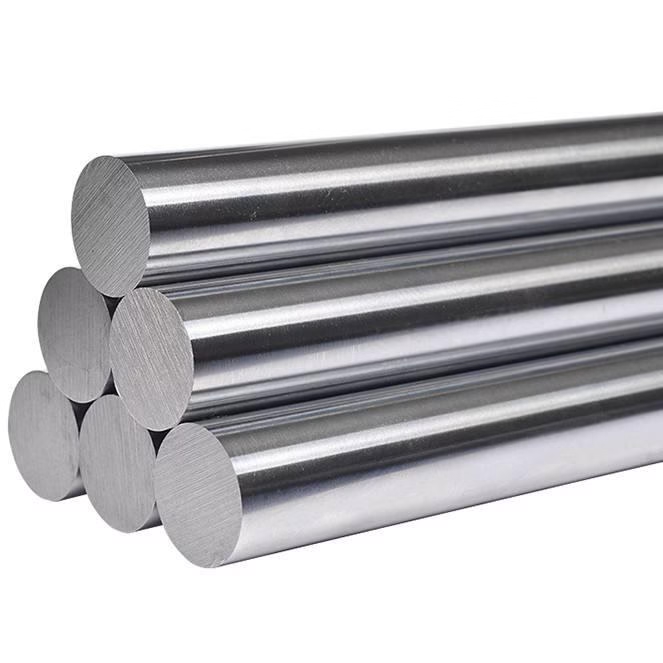
Alloy Bar (Inconel / Hastelloy / Monel / Titanium)
Alloy bar offering Inconel 625/718, Hastelloy C276, Monel 400/K500, Titanium Grade 2/5 for extreme service environments. Diameter 6-500mm, custom forging up to 1000mm. Solution annealed, aged, or cold drawn conditions. Premium quality for aerospace, oil & gas, chemical, marine, and medical applications.
| Material | Nickel-based Superalloy / Cobalt-based Alloy / Titanium Alloy |
|---|---|
| Grade / Standard | Inconel 625 / 718 / 600 / Hastelloy C276 / C22 / Monel 400 / K500 / Titanium Gr2 / Gr5 |
| Diameter | 6mm - 500mm (Standard) / Custom forged up to 1000mm / Large blocks up to 30 tons |
| Length | 3m / 6m (or cut to length per customer requirement) |
| Delivery Condition | hot_rolled / cold_rolled / quenched_tempered |
| Surface Treatment | coated |
| MOQ | 1 Piece (Custom Diameter) / 100 kg (Standard Bar) |
| Delivery Time | 30-60 Days (Custom Forging) / 20-30 Days (Stock) |
| Loading Port | Tianjin / Shanghai / Qingdao |
Overview of Alloy Bar (Inconel / Hastelloy / Monel / Titanium)
Alloy bar refers to a category of high-performance metal bars made from nickel-based superalloys, cobalt-based alloys, titanium alloys, and other specialty metals designed for extreme service environments where stainless steel and conventional alloys fail. These specialized alloy bars combine exceptional corrosion resistance, high-temperature strength, fatigue resistance, and reliable performance in conditions including high temperature (up to 1200°C), high pressure (up to 20,000 psi), aggressive chemical attack (chlorides, sulfides, acids), oxidizing and reducing atmospheres, and cryogenic temperatures (down to -253°C). Specified under ASTM B637 / B408 / B164 / B348 / EN / DIN / ASME standards, alloy bars have become indispensable materials for aerospace, oil and gas, chemical processing, marine, nuclear power, and pharmaceutical industries worldwide.
The most widely used alloy bar grades include Inconel 625 (UNS N06625) for chemical processing and marine applications combining superior pitting and crevice corrosion resistance with excellent fatigue strength, Inconel 718 (UNS N07718) for aerospace gas turbine components offering exceptional strength up to 700°C through age hardening, Hastelloy C276 (UNS N10276) for the most aggressive corrosive environments including hydrochloric acid and sulfuric acid service, Monel 400 (UNS N04400) for seawater and hydrofluoric acid applications, Monel K500 (UNS N05500) age-hardened version of Monel 400 with double the strength, and Titanium Grade 2 / Grade 5 (UNS R50400 / R56400) for aerospace, marine, medical implants, and chemical processing requiring lightweight high-strength corrosion-resistant materials. Each alloy family has specific service temperature ranges, corrosion resistance characteristics, and mechanical properties that determine optimal application selection. Tanglu Group supplies all major alloy bar grades from leading international and Chinese alloy mills with full material certification and traceability for critical industrial applications.
Key Features and Manufacturing Process
Alloy bars are manufactured through specialized melting and processing routes to achieve the precise chemical composition and microstructure required for high-performance applications. The melting processes include vacuum induction melting (VIM) for initial alloy formation under controlled atmosphere to prevent contamination, vacuum arc remelting (VAR) for premium grades requiring exceptional cleanliness and microstructure uniformity (mandatory for aerospace gas turbine components), and electroslag remelting (ESR) for further refinement and inclusion control. After melting, ingots are forged or hot rolled at carefully controlled temperatures specific to each alloy family (e.g., Inconel 625 forging at 980-1230°C, Titanium Gr5 forging at 870-980°C below beta transus) to develop optimal grain structure for required mechanical properties.
The alloy bar is supplied in diameter range from 6mm to 500mm in round bar form, with standard lengths of 3 meters and 6 meters, and custom cut-to-length service available. Standard delivery conditions include solution annealed (the standard condition for Inconel 625, Hastelloy C276, Monel 400, and Titanium Gr2 providing optimal corrosion resistance and ductility), solution annealed and aged (for precipitation-hardening alloys like Inconel 718 and Monel K500 achieving maximum strength), hot rolled (as-supplied condition for further processing), and cold drawn (for tighter dimensional tolerance and improved surface finish in smaller diameters). Surface conditions include peeled and turned (standard for premium applications providing defect-free bright surface), centerless ground (precision tolerance for direct machining), polished (for medical implants and visual applications), and mill finish (for parts requiring further machining). Each alloy bar undergoes mandatory chemical composition analysis verified by inductively coupled plasma (ICP) spectroscopy, mechanical property testing including tensile, yield, elongation, and hardness verification at multiple cross-section locations, ultrasonic testing per ASTM A388 for internal soundness (mandatory for aerospace and pressure vessel applications), microstructure inspection ensuring proper grain size and phase distribution, dimensional inspection per ASTM B637 / B408 / B164 / B348 latest revision, and full metallurgical traceability documentation.
Main Applications of Alloy Bar
Alloy bars are critical materials for the aerospace and gas turbine industry where Inconel 718 is used for jet engine compressor and turbine disks, blade attachments, casings, and structural components requiring high strength up to 700°C with excellent fatigue resistance. Inconel 625 serves aerospace exhaust components, afterburner liners, thrust reverser actuators, and helicopter dynamic components requiring oxidation resistance up to 980°C. Titanium Grade 5 (Ti-6Al-4V) is the dominant material for aerospace structural components including aircraft frames, landing gear components, engine mounts, fasteners, and military aircraft applications where strength-to-weight ratio is critical.
The oil and gas industry employs alloy bars for downhole tools and drilling equipment in sour service environments containing H2S and CO2, including drill collars, MWD/LWD tool housings, packers, valve trim, wellhead Christmas tree components, and BOP (blowout preventer) parts where Inconel 625, Inconel 718, Monel K500, and Hastelloy C276 provide corrosion resistance and mechanical reliability. Subsea oilfield equipment relies on these alloys for connectors, manifolds, and control system components operating in deep-water sour environments. The chemical processing industry uses alloy bars for reactor internals, mixer shafts, pump shafts, valve stems, and instrumentation components in plants producing chlorinated organics, pharmaceuticals, fertilizers, fine chemicals, and other corrosive products. Hastelloy C276 is the workhorse for chlorine-bearing chemicals, sulfuric acid, hydrochloric acid, and oxidizing environments, while Inconel 625 handles seawater corrosion and marine biofouling resistance. Other major applications include marine engineering (Monel 400 for seawater piping, propeller shafts, ferrules, and fasteners; Titanium Grade 2 for desalination plant components and seawater heat exchangers), nuclear power generation (Inconel 600/690 for steam generator tubing and reactor internals, Titanium for condenser tubing), pharmaceutical and biotechnology (Hastelloy C276 for sterile reactors, Titanium Gr2 for medical equipment), medical implants (Titanium Grade 5 for dental implants, joint replacements, bone screws, and surgical instruments), heat treatment fixtures (Inconel 600 for furnace fixtures and radiant tubes), and a comprehensive range of high-value applications requiring materials beyond the capability of stainless steel.
Why Choose Us for Alloy Bar
Shandong Tanglu Metal Material Co., Ltd. supplies premium alloy bars sourced from leading international alloy mills including Special Metals (Inconel/Monel grades), Haynes International (Hastelloy grades), TIMET (Titanium grades), and major Chinese specialty alloy mills with proven export experience and certified production facilities meeting ISO 9001, AS9100 (aerospace quality management), NORSOK MDS (oil and gas materials), API 6A and 17D (oil and gas equipment), ASME, and PED requirements. Every alloy bar undergoes mandatory chemical composition analysis verified by inductively coupled plasma (ICP) spectroscopy, mechanical property testing including tensile, yield, elongation, hardness, and impact verification at multiple cross-section locations, ultrasonic testing per ASTM A388 quality classes 1-4 for internal soundness, microstructure inspection per ASTM E112 for grain size and ASTM E45 for inclusion content, dimensional inspection per ASTM B637 / B408 / B164 / B348 latest revision, full PMI (Positive Material Identification) verification using portable XRF spectrometers, and complete metallurgical traceability from heat to finished bar.
We offer comprehensive alloy bar range including all major Inconel grades (600, 601, 625, 690, 718, 725, X-750), Hastelloy grades (C276, C22, B2, B3, X), Monel 400 and K500, Titanium Grade 1, 2, 5, 7, 9, 12, plus specialized grades like Incoloy 800/825/825 and 17-4 PH stainless steel. Available diameters from 6mm small precision bars to 500mm large diameter bars for major equipment components, with custom forging service for diameters up to 1000mm and large blocks up to 30 tons. With monthly supply capacity of 150 tons of premium alloy bars and established export relationships with aerospace contractors, oil and gas equipment manufacturers, chemical plant builders, marine engineering companies, and medical device manufacturers in over 30 countries, we support both small prototype orders and large series production. Each shipment includes original mill test certificate (MTC) conforming to EN 10204 3.1 standard, with EN 10204 3.2 plus enhanced documentation including PMI verification reports, ultrasonic testing reports, microstructure photographs, and third-party inspection (SGS, BV, ABS, DNV, LR, TUV) available for critical aerospace, oil and gas, and nuclear applications requiring full traceability and compliance certification.
📐 Dimension & Size Table
| Alloy Grade | Diameter Range (mm) | Standard Condition | Typical Application |
|---|---|---|---|
| Inconel 625 | 6-500mm | Solution Annealed | Chemical, marine, aerospace exhaust |
| Inconel 718 | 10-500mm | Solution Annealed + Aged | Aerospace gas turbine, downhole tools |
| Inconel 600 | 10-300mm | Solution Annealed | Heat treatment fixtures, nuclear |
| Inconel 690 | 10-300mm | Solution Annealed | Steam generator tubing, nuclear |
| Inconel X-750 | 10-200mm | Solution Annealed + Aged | Springs, gas turbine bolting |
| Hastelloy C276 | 6-300mm | Solution Annealed | Chlorinated chemicals, scrubbers |
| Hastelloy C22 | 10-300mm | Solution Annealed | Oxidizing chloride environments |
| Hastelloy B2 | 10-200mm | Solution Annealed | Hydrochloric acid service |
| Hastelloy X | 10-200mm | Solution Annealed | Gas turbine combustors |
| Monel 400 | 6-300mm | Annealed / Cold Drawn | Seawater, hydrofluoric acid |
| Monel K500 | 10-300mm | Solution Annealed + Aged | Marine pump shafts, downhole tools |
| Incoloy 800H | 10-300mm | Solution Annealed | Heat exchanger, petrochemical |
| Incoloy 825 | 10-300mm | Solution Annealed | Sulfuric acid, phosphoric acid |
| Titanium Grade 1 | 6-300mm | Annealed | Chemical equipment, cathodic protection |
| Titanium Grade 2 | 6-500mm | Annealed | Chemical, marine, desalination |
| Titanium Grade 5 (Ti-6Al-4V) | 6-500mm | Annealed / STA | Aerospace, medical implants, marine |
| Titanium Grade 7 | 10-200mm | Annealed | Reducing acids, chemical process |
| Titanium Grade 9 (Ti-3Al-2.5V) | 10-200mm | Annealed / Cold Worked | Aerospace tubing, sports equipment |
| Titanium Grade 12 | 10-200mm | Annealed | Chemical, marine moderate corrosion |
| 17-4 PH Stainless | 10-300mm | Solution Annealed + Aged | Aerospace, oil and gas valves |
* Custom sizes available upon request. Tolerances per relevant international standards.
🔬 Chemical Composition
| Element | Min | Max | Display Value | Note |
|---|---|---|---|---|
| Ni (Inconel 625) | 58.0 | - | ≥58.0 | Per ASTM B637 (typical 60-63%) |
| Cr (Inconel 625) | 20.0 | 23.0 | 20.0-23.0 | Corrosion resistance element |
| Mo (Inconel 625) | 8.0 | 10.0 | 8.0-10.0 | Pitting resistance enhancer |
| Nb+Ta (Inconel 625) | 3.15 | 4.15 | 3.15-4.15 | Solid solution strengthening |
| Fe (Inconel 625) | - | 5.0 | ≤5.0 | Maximum allowable |
| Ni (Hastelloy C276) | Bal. | - | Balance (~57%) | Per ASTM B574 |
| Cr (Hastelloy C276) | 14.5 | 16.5 | 14.5-16.5 | |
| Mo (Hastelloy C276) | 15.0 | 17.0 | 15.0-17.0 | Maximum corrosion resistance |
| W (Hastelloy C276) | 3.0 | 4.5 | 3.0-4.5 | Localized corrosion resistance |
| Ni (Monel 400) | 63.0 | - | ≥63.0 | Per ASTM B164 |
| Cu (Monel 400) | 28.0 | 34.0 | 28.0-34.0 | Seawater corrosion resistance |
| Ti (Titanium Gr5) | Bal. | - | Balance (~90%) | Per ASTM B348 (Ti-6Al-4V) |
| Al (Titanium Gr5) | 5.5 | 6.75 | 5.5-6.75 | Alpha stabilizer, strength |
| V (Titanium Gr5) | 3.5 | 4.5 | 3.5-4.5 | Beta stabilizer, strength |
| O (Titanium Gr5) | - | 0.20 | ≤0.20 | Strict control for ductility |
* Chemical composition may vary by heat, thickness and specification. Please refer to the actual mill test certificate.
⚙️ Mechanical Properties
| Property | Value | Unit | Test Condition |
|---|---|---|---|
| Tensile Strength (Inconel 625, SA) | ≥827 | MPa (120 ksi) | Solution Annealed per ASTM B637 |
| Yield Strength (Inconel 625, SA) | ≥414 | MPa (60 ksi) | 0.2% proof stress, Solution Annealed |
| Elongation (Inconel 625) | ≥30 | % | Gauge length 4D |
| Tensile Strength (Inconel 718, STA) | ≥1241 | MPa (180 ksi) | Solution Treated + Aged per AMS 5663 |
| Yield Strength (Inconel 718, STA) | ≥1034 | MPa (150 ksi) | 0.2% proof, age hardened |
| Tensile Strength (Hastelloy C276) | ≥690 | MPa (100 ksi) | Solution Annealed per ASTM B574 |
| Yield Strength (Hastelloy C276) | ≥283 | MPa (41 ksi) | 0.2% proof stress |
| Tensile Strength (Monel 400) | ≥480 | MPa (70 ksi) | Annealed per ASTM B164 |
| Tensile Strength (Monel K500, STA) | ≥965 | MPa (140 ksi) | Solution Treated + Aged |
| Tensile Strength (Titanium Gr5, Ann) | ≥895 | MPa (130 ksi) | Annealed per ASTM B348 |
| Yield Strength (Titanium Gr5) | ≥828 | MPa (120 ksi) | 0.2% proof stress |
| Tensile Strength (Titanium Gr2) | ≥345 | MPa (50 ksi) | Annealed, commercially pure |
| Hardness (Solution Annealed) | Various | HRB / HRC | Inconel 625: HRB 95-100, Hastelloy C276: HRB 95-100 |
| Density (Inconel 625) | 8.44 | g/cm³ | Reference value |
| Density (Titanium Gr5) | 4.43 | g/cm³ | Lightweight advantage vs steel |
* Values shown are minimum requirements unless otherwise stated.
📦 Commercial Information
| Packaging | Premium export packing for high-value alloy bars. Round bars individually wrapped with PE film and anti-rust paper to prevent surface damage and corrosion during international transit. Bars bundled with non-marking plastic strapping (avoiding steel strapping that could mark soft alloy surfaces), typical bundle weight 200-1000 kg depending on alloy and diameter. Each bar tagged with permanent metal identification including heat number, alloy grade (Inconel 625, Hastelloy C276, Monel 400, etc.), UNS number, diameter, length, and customer purchase order reference. Premium packaging in custom wooden crates with internal steel framework, foam cushioning, and waterproof barrier provided for aerospace, medical, and ESR-grade premium materials. Vacuum-sealed packaging available for surface-sensitive titanium grades and polished bars. Anti-static packaging available for medical implant grade titanium. All packaging meets export regulations including ISPM-15 wood treatment requirements and includes complete material certification documentation in waterproof envelopes attached to each shipment. |
|---|---|
| Payment Terms | T/T (Telegraphic Transfer),L/C (Letter of Credit),D/P (Documents against Payment),Western Union,PayPal |
| Price Term | FOB,CFR,CIF,EXW |
| Supply Capacity | 150 Tons/Month (Premium Alloy Bars) |
| Loading Port | Tianjin / Shanghai / Qingdao |
Why Choose Our Alloy Bar (Inconel / Hastelloy / Monel / Titanium)?
Aerospace & Premium Quality Certified
Alloy bars supplied with original mill test certificate EN 10204 3.1/3.2 plus enhanced documentation including PMI (Positive Material Identification) verification by portable XRF spectrometer, ICP chemical analysis, ultrasonic testing per ASTM A388, microstructure inspection per ASTM E112/E45, and complete metallurgical traceability meeting AS9100 aerospace and NORSOK MDS oil & gas requirements.
Comprehensive Alloy Range
Complete range of premium alloy bars: Inconel (600/601/625/690/718/725/X-750), Hastelloy (C276/C22/B2/B3/X), Monel (400/K500), Titanium (Grade 1/2/5/7/9/12), Incoloy (800H/825), and 17-4 PH stainless steel. Diameters from 6mm precision bars to 500mm large bars, with custom forgings up to 1000mm and 30 tons.
Extreme Service Environment Solutions
Premium alloys designed for environments beyond stainless steel capability: high temperature up to 1200°C (Inconel/Hastelloy), aggressive chemical attack including chlorides and acids (Hastelloy C276), seawater corrosion (Monel 400, Titanium Gr2), aerospace gas turbine service (Inconel 718), medical implant biocompatibility (Titanium Gr5), and cryogenic temperatures down to -253°C.
Multi-Industry Compliance
Compliant with AS9100 (aerospace quality), NORSOK MDS M-630/650/710 (oil & gas materials), API 6A and 17D (oil & gas equipment), ASME (pressure vessel and nuclear), ASTM B637/B348/B574/B164/B408/B446 (alloy bar standards), ISO 13485 (medical device quality), plus ABS, DNV, LR, BV, SGS, NK, RINA marine and certification body approvals.
Reliable Premium Alloy Supply
Standard alloy bars delivery 20-30 days from stock. Custom forging production cycle 30-60 days depending on alloy, size, and complexity. Established export logistics with experience shipping high-value alloys via expedited air freight or 20FT/40FT FCL with proper handling protocols, anti-rust protection, and complete documentation packages for customs clearance.
🏭 Applications of Alloy Bar (Inconel / Hastelloy / Monel / Titanium)
Alloy bars are critical materials for the aerospace and gas turbine industry where Inconel 718 is used for jet engine compressor and turbine disks, blade attachment dovetails, casings, structural components, and rocket engine components requiring exceptional strength up to 700°C with excellent fatigue resistance and creep performance. Inconel 625 serves aerospace exhaust components, afterburner liners, thrust reverser actuators, helicopter dynamic components, and rocket engine combustion chambers requiring oxidation resistance up to 980°C. Titanium Grade 5 (Ti-6Al-4V) is the dominant material for aerospace structural components including aircraft wing structures, fuselage frames, landing gear components, engine pylons, fasteners, and military aircraft applications where strength-to-weight ratio is critical for fuel efficiency and payload capacity. The oil and gas industry employs alloy bars for downhole tools and drilling equipment in sour service environments containing H2S and CO2, including drill collars, stabilizers, MWD/LWD tool housings, packers, valve trim and seats, wellhead Christmas tree components, blowout preventer parts, and subsea connectors and manifolds where Inconel 625, Inconel 718, Monel K500, Hastelloy C276, and 17-4 PH stainless steel provide the necessary corrosion resistance and mechanical reliability for safe operation in deep-water and sour environments per NACE MR0175 / ISO 15156 requirements. The chemical processing industry uses alloy bars for reactor internals, agitator and mixer shafts, pump shafts, valve stems and trim, instrumentation components, and heat exchanger tube sheets in plants producing chlorinated organics, pharmaceuticals, fertilizers, fine chemicals, herbicides, pesticides, and other corrosive products. Hastelloy C276 is the workhorse for chlorine-bearing chemicals, sulfuric acid, hydrochloric acid, and oxidizing environments, while Inconel 625 handles seawater corrosion and marine biofouling resistance, and Hastelloy B2 specializes in pure hydrochloric acid service. Marine engineering applications include Monel 400 for seawater piping systems, propeller shafts, tail shafts, ferrules, and fasteners; Titanium Grade 2 for desalination plant components, seawater heat exchangers, condenser tubing, and offshore platform piping systems requiring extreme corrosion resistance with weight savings. The nuclear power generation industry uses Inconel 600/690 for steam generator tubing and reactor internals, Inconel X-750 for reactor springs and bolts, Titanium for condenser tubing in water-cooled plants, and Hastelloy for nuclear fuel processing equipment. Pharmaceutical and biotechnology industries employ Hastelloy C276 for sterile reactors handling aggressive process chemicals, Titanium Gr2 for medical equipment, and 316L/904L stainless for general clean room applications. Medical implant applications include Titanium Grade 5 (Ti-6Al-4V) for dental implants, hip and knee joint replacements, bone screws and plates, and surgical instruments where biocompatibility, MRI compatibility, and corrosion resistance are essential. Other major applications include heat treatment furnace fixtures and radiant tubes (Inconel 600), industrial gas turbine blades and vanes (Inconel 738/792), automotive turbocharger components (Inconel 713), military armor applications (Titanium), sporting goods (Titanium golf clubs and bicycle frames), high-performance racing engine components, marine fasteners and underwater equipment, recovery boiler tubing in pulp and paper industry, fertilizer plant equipment, and a comprehensive range of high-value applications requiring materials beyond the capability of stainless steel and conventional alloys.
📋 Quality & Certification
Our Certifications
- ✅ ISO 9001:2015
- ✅ CE Marking
- ✅ ABS
- ✅ DNV GL
- ✅ Lloyd's Register (LR)
- ✅ Bureau Veritas (BV)
- ✅ SGS Certified
- ✅ NK
- ✅ RINA
Mill Certificate Type
- 📋 EN 10204 3.1
- 📋 EN 10204 3.2
- 📋 Original Mill Certificate
- 📋 Third Party Inspection Available
- 📋 Certificate of Origin
❓ Frequently Asked Questions
What are alloy bars and how are they different from stainless steel bars?
Alloy bars (also called specialty alloys, super alloys, or exotic alloys) are high-performance metal bars made from nickel-based superalloys (Inconel, Monel, Incoloy), cobalt-based alloys (Hastelloy, Stellite), titanium alloys, and other specialty metals designed for extreme service environments where conventional stainless steels fail. Key differences from stainless steel: 1) Higher corrosion resistance - Hastelloy C276 resists chlorinated chemicals, sulfuric acid, and hydrochloric acid where 316L stainless rapidly corrodes; 2) Higher temperature capability - Inconel 625 retains strength up to 980°C while 316L is limited to ~870°C; 3) Higher strength - Inconel 718 achieves 1241 MPa tensile strength after age hardening vs ~580 MPa for 316L; 4) Specialized applications - Titanium Grade 5 provides aerospace strength-to-weight ratio impossible with stainless steel, Monel 400 handles hydrofluoric acid where stainless fails completely, and pure titanium provides medical biocompatibility. The trade-offs are significantly higher cost (10-50× more expensive than stainless steel), longer lead times, more specialized fabrication requirements, and limited supplier availability. Alloy bars are selected only when stainless steel cannot meet specific service requirements - aerospace, oil & gas sour service, aggressive chemicals, marine, nuclear, and medical applications.
What is the difference between Inconel 625 and Inconel 718?
Inconel 625 and Inconel 718 are both nickel-based superalloys but are designed for different applications with distinct properties. Inconel 625 (UNS N06625) is a solid-solution strengthened alloy containing 58-63% Ni, 20-23% Cr, 8-10% Mo, and 3.15-4.15% Nb+Ta, providing exceptional corrosion resistance in seawater, chemical processing, and marine environments. It maintains useful strength up to 980°C and is the preferred choice for aerospace exhaust systems, chemical processing equipment, marine applications, and downhole oil and gas tools. Inconel 625 is supplied in solution annealed condition with tensile strength ~827 MPa and excellent ductility (elongation ~30%). Inconel 718 (UNS N07718) is a precipitation-hardening (age-hardenable) alloy containing 50-55% Ni, 17-21% Cr, 17-21% Fe, 4.75-5.5% Nb+Ta, and 2.8-3.3% Mo, designed primarily for aerospace gas turbine applications requiring maximum strength up to 700°C. After solution treatment + age hardening (STA), Inconel 718 achieves tensile strength ~1241 MPa (50% stronger than 625) with excellent fatigue and creep resistance. Inconel 718 is the most widely used superalloy in jet engines for compressor disks, turbine disks, blade attachments, and structural components. Selection criteria: choose 625 for chemical/marine corrosion resistance and high-temperature oxidation up to 980°C; choose 718 for maximum strength applications up to 700°C, especially aerospace gas turbines, downhole oil and gas tools, and high-stress structural components.
What is the difference between Hastelloy C276 and Inconel 625 for chemical processing?
Hastelloy C276 and Inconel 625 are both excellent corrosion-resistant alloys but have distinct strengths in different chemical environments. Hastelloy C276 (UNS N10276) contains ~57% Ni, 14.5-16.5% Cr, 15-17% Mo, and 3-4.5% W, providing the highest corrosion resistance available from any commercial alloy in oxidizing-reducing chloride environments, hydrochloric acid (HCl) at all concentrations and temperatures up to boiling point, sulfuric acid (H2SO4) up to 70% concentration, and chlorinated organic chemicals. C276 also resists pitting, crevice corrosion, and stress corrosion cracking even in severely contaminated environments. The high molybdenum (15-17%) content is the key to its superior performance in reducing acid environments. Inconel 625 (UNS N06625) contains 60-63% Ni, 20-23% Cr, and 8-10% Mo, providing excellent general corrosion resistance with particular strength in seawater (better than C276 in most marine applications due to higher Cr), neutral and alkaline chloride environments, and oxidizing chemicals. 625 is also superior for high-temperature service up to 980°C while C276 is limited to ~675°C. Selection guidelines: Use Hastelloy C276 for the most aggressive reducing acids (HCl, H2SO4 below 70%), chlorinated solvents, mixed oxidizing-reducing chloride environments, and pulp and paper bleaching equipment. Use Inconel 625 for seawater and marine applications, oxidizing environments, high-temperature service, and applications requiring higher strength than C276 (625 is ~30% stronger). When in doubt, C276 is generally the safer choice for chemical processing applications, while 625 wins for marine and high-temperature applications.
What is the difference between Titanium Grade 2 and Grade 5 (Ti-6Al-4V)?
Titanium Grade 2 and Grade 5 are the two most widely used titanium grades but serve very different applications due to dramatically different mechanical properties. Titanium Grade 2 (UNS R50400, also called CP Grade 2 or 'Commercially Pure Grade 2') is essentially pure titanium (>99% Ti) with controlled oxygen and iron levels, providing excellent corrosion resistance in chloride environments, seawater, oxidizing acids (nitric acid), neutral chemicals, and biological systems, with moderate strength (tensile ~345 MPa, yield ~275 MPa) and excellent ductility (elongation ~20%) and formability. Grade 2 is the workhorse of the titanium chemical processing industry, used for heat exchangers, condensers, reaction vessels, piping systems, desalination plants, pulp and paper bleaching equipment, and chlor-alkali production where corrosion resistance is critical and high strength is not required. Titanium Grade 5 (UNS R56400, also called Ti-6Al-4V or '6/4 Titanium') is an alpha-beta titanium alloy containing 5.5-6.75% aluminum and 3.5-4.5% vanadium, providing dramatically higher strength (tensile ~895 MPa, yield ~828 MPa - 2.5× stronger than Grade 2) at slightly reduced ductility (elongation ~10%) and density essentially identical to Grade 2 (4.43 g/cm³). Grade 5 is the dominant titanium alloy for aerospace structural applications (aircraft frames, landing gear, engine components, fasteners), medical implants (hip and knee replacements, dental implants, bone screws and plates), high-performance marine applications (military submarine components, offshore platforms), automotive racing components (connecting rods, valves, exhaust systems), sporting goods (golf clubs, bicycle frames), and chemical equipment requiring both corrosion resistance and high strength. Selection criteria: Use Grade 2 when corrosion resistance is the primary requirement and moderate strength is sufficient (chemical equipment, desalination, marine piping). Use Grade 5 when high strength-to-weight ratio is critical (aerospace, medical implants, high-performance applications). Note that Grade 5 is significantly more expensive than Grade 2 and more difficult to machine due to its higher strength and work hardening tendency.
What documentation and certifications are available for alloy bars used in critical applications?
Alloy bars for critical applications require comprehensive documentation packages depending on industry and project requirements. Standard documentation included with all alloy bar shipments: Original Mill Test Certificate (MTC) per EN 10204 3.1 including chemical composition (verified by ICP spectroscopy), mechanical properties (tensile, yield, elongation, hardness), heat treatment condition, dimensional inspection, and heat number traceability; Certificate of Origin for customs clearance; Material Safety Data Sheet (MSDS) where applicable. Enhanced documentation for critical applications: EN 10204 3.2 mill certificate with witness inspection by independent inspection authority (SGS, BV, ABS, DNV, LR, TUV); PMI (Positive Material Identification) verification report using portable XRF spectrometer to confirm grade matches certificate; Ultrasonic testing reports per ASTM A388 with quality classes 1-4 indicating internal soundness; Microstructure photographs per ASTM E112 (grain size) and ASTM E45 (inclusion content); Hardness mapping showing uniformity across cross-section; Hydrostatic test reports for pressure containment applications. Industry-specific certifications: AS9100 documentation for aerospace applications including detailed traceability, special process approvals, and First Article Inspection Reports; NORSOK MDS (Material Data Sheet) M-630/650/710 documentation for North Sea oil and gas applications with sour service compliance per NACE MR0175 / ISO 15156; API 6A documentation for oil and gas wellhead and Christmas tree equipment with PSL (Product Specification Level) 1-4 traceability; ASME Code stamping and QSC documentation for nuclear and pressure vessel applications; FDA and ISO 13485 documentation for medical implant grade titanium with biocompatibility test reports per ISO 10993. Custom documentation including Material Verification Reports (MVR), Inspection and Test Plans (ITP), and complete project documentation packages available upon request. All documentation provided in waterproof envelopes attached to shipments and electronic copies emailed for project records. Tanglu Group maintains extensive documentation database and can reproduce historical certificates for warranty and traceability purposes throughout product lifecycle.
Get a Quote for
Alloy Bar (Inconel / Hastelloy / Monel / Titanium)
Submit your requirements and receive a competitive price quote within 24 hours.
- ✓ Fast response within 24 hours
- ✓ Competitive factory-direct pricing
- ✓ Free technical consultation
- ✓ Mill test certificate provided
- ✓ Flexible payment terms available
⏱ Response within 24 hours
Send Your Inquiry
All fields marked with * are required