
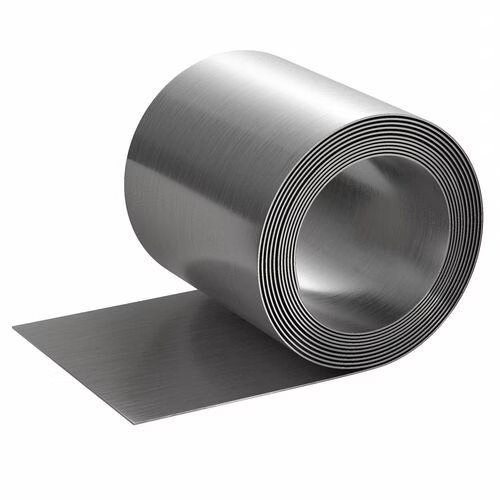
Alloy Coil (Inconel / Hastelloy / Monel / Titanium)
Alloy Coil in Inconel 625/718, Hastelloy C276, Monel 400/K500, Titanium Grade 2/5 for precision stamping, heat exchanger pressing, tube welding, and formed component production in extreme environments. Thickness 0.05–6.0mm, width 10–1,500mm. Solution annealed, cold-rolled, bright annealed. ASTM B443/B575/B127/B265 certified. Mill test certificate provided.
| Material | Nickel-based Superalloy / Titanium Alloy Cold-Rolled / Hot-Rolled Strip Coil |
|---|---|
| Grade / Standard | Inconel 625 / 718 / 600 / Hastelloy C276 / C22 / Monel 400 / K500 / Incoloy 825 / Titanium Grade 1 / 2 / 5 (Ti-6Al-4V) / Grade 7 / Grade 12 |
| Thickness | 0.05mm – 6.0mm (Cold Rolled) / up to 10mm (Hot Rolled Strip) |
| Width | 10mm – 1,500mm (Slit to order, tolerance ±0.1mm) |
| MOQ | 50 kg (Thin Precision Foil) / 500 kg (Standard Gauge Coil) |
| Delivery Time | 25-45 Days (Custom Production) / 20-30 Days (Stock) |
| Loading Port | Tianjin / Shanghai / Qingdao |
Overview of Alloy Coil (Inconel / Hastelloy / Monel / Titanium)
Alloy Coil refers to nickel-based superalloys, titanium alloys, cobalt-based alloys, and other high-performance specialty metals supplied in coiled strip or sheet form — thin flat product wound into a coil for continuous processing, precision forming, stamping, and fabrication operations where the exceptional corrosion resistance, high-temperature strength, and specialised properties of these premium alloys are required in thin gauge format. Alloy coil encompasses hot-rolled and cold-rolled strip in thicknesses from 0.05mm (ultra-thin precision foil) to 6.0mm (heavy gauge strip), widths from 10mm to 1,500mm, and coil weights from 50 kg to 5,000 kg depending on alloy density, gauge, and width — providing the continuous feed material essential for progressive die stamping of precision components, roll forming of profiles, tube welding mills, heat exchanger fin production, and flexible strip applications in aerospace, chemical processing, marine, medical, and nuclear industries.
Alloy coil is standardised under ASTM B168 (Inconel 600/625 sheet, strip and plate), ASTM B443 (Inconel 625 plate, sheet and strip), ASTM B575 (Hastelloy C276 plate, sheet and strip), ASTM B127 (Monel 400 plate, sheet and strip), ASTM B265 (Titanium strip, sheet and plate), EN 10095 (heat-resistant steels and nickel alloys), and ASME equivalents SB-443, SB-575, SB-127, SB-265 for pressure vessel and nuclear applications. The principal grades mirror the round bar family — Inconel 625 (UNS N06625) for chemical and marine strip applications, Inconel 718 (UNS N07718) for aerospace stamped components requiring age-hardening strength, Hastelloy C276 (UNS N10276) for the most aggressive chemical environments, Monel 400 (UNS N04400) for seawater and hydrofluoric acid service, and Titanium Grade 2 / Grade 5 (UNS R50400 / R56400) for lightweight corrosion-resistant and aerospace structural strip applications — all providing performance in extreme environments far beyond the capability of stainless steel strip at equivalent gauge.
Key Features and Manufacturing Process
Alloy coil is produced through specialised melting and rolling processes specifically adapted to the unique metallurgical characteristics of each alloy family. The production sequence begins with vacuum induction melting (VIM) of the alloy to precisely controlled chemistry under vacuum or inert atmosphere, followed by vacuum arc remelting (VAR) or electroslag remelting (ESR) for premium grades requiring the highest cleanliness and microstructure uniformity demanded by aerospace and nuclear applications. The refined ingot is then hot-rolled at alloy-specific temperatures — Inconel 625 at 980–1,230°C, Hastelloy C276 at 1,065–1,175°C, Monel 400 at 870–1,175°C, and Titanium Grade 5 below the beta transus at 870–980°C — to produce hot-rolled coil of intermediate thickness, followed by annealing, descaling (by pickling in hydrofluoric acid / nitric acid mixtures for nickel alloys, or mixed acid for titanium), and cold rolling in multiple passes to achieve final gauge with the tight thickness tolerance (±0.01–0.05mm depending on gauge) and excellent surface finish required for precision alloy strip applications.
Alloy coil is supplied in thicknesses from 0.05mm to 6.0mm, widths from 10mm to 1,500mm (limited by rolling mill width capacity for each alloy), in standard coil weights of 50–5,000 kg, with slit coil service available in custom widths to ±0.1mm tolerance. Standard delivery conditions include solution annealed (the dominant condition for Inconel 625, Hastelloy C276, and Monel 400 strip providing maximum corrosion resistance and ductility for forming), cold rolled hardened (work-hardened by cold rolling for spring-temper strip applications), solution annealed and skin-passed (light final rolling pass for improved flatness and surface finish), and full-hard cold-rolled (maximum hardness from cold work for wear applications). Surface finish options include No. 1 (hot-rolled, annealed, pickled — standard industrial finish), No. 2B (cold-rolled, annealed, pickled, skin-passed — standard finish for most applications), No. 2D (cold-rolled, annealed, pickled — matte finish with good formability), bright annealed (BA — cold-rolled then annealed in hydrogen atmosphere for highly reflective surface), and polished (mechanical polishing to Ra ≤0.4μm or mirror finish for medical and decorative applications). Each alloy coil undergoes mandatory chemical composition analysis by ICP spectroscopy, mechanical property testing including tensile strength, yield strength, elongation, and hardness verification, surface quality inspection for pits, laps, and seams, dimensional inspection of thickness, width, and flatness, and full heat and coil number traceability documentation.
Main Applications of Alloy Coil
Alloy coil is the primary raw material for stamped and formed precision components in aerospace, chemical, marine, and medical industries. Aerospace applications include the progressive die stamping of jet engine combustion liner segments, turbine exhaust duct segments, and afterburner flame holder brackets from Inconel 625 strip; stamped and formed aerospace fuel system fitting blanks and brackets from Inconel 718 strip subsequently age-hardened; titanium structural brackets, clips, and shim stock from Ti-6Al-4V strip for airframe weight reduction; and honeycomb core material from thin Inconel or titanium foil for sandwich panel structures used in aerospace nacelles and thrust reversers.
Heat exchanger and process equipment manufacture consumes large quantities of alloy coil for plate heat exchanger (PHE) pressing from Inconel 625, Hastelloy C276, and Titanium Grade 2 strip — the characteristic corrugated plate geometry of gasketed and brazed plate heat exchangers is formed by hydraulic pressing from thin alloy strip (0.4–1.0mm) in production press lines. Titanium Grade 2 is the dominant heat exchanger plate material for seawater and chemical service. Hastelloy C276 plate exchanger packs handle chlorinated chemical and pharmaceutical process streams. Welded tube production uses alloy strip as the skelp feedstock for roll-forming and seam-welding thin-wall alloy tubing from Inconel 625, Inconel 600, Monel 400, and Titanium Grade 2 strip on tube mills producing finned heat exchanger tubing, instrumentation tubing, and small-bore process tubing. Medical device manufacturing employs Ti-6Al-4V strip for stamped surgical implant components including bone staples, clip appliers, and orthopaedic device components, as well as Nitinol (nickel-titanium shape memory alloy) strip for cardiovascular stent blanks and orthodontic wire. Chemical processing equipment production uses Hastelloy C276, Inconel 625, and Monel 400 coil for fabrication of bellows, expansion joints, flexible hose, diaphragms for chemical pumps and valves, rupture disc blanks, and vessel cladding liners where thin-gauge alloy strip provides corrosion protection at lower material cost than solid alloy fabrication. Marine and offshore applications include Monel 400 coil for marine hardware stampings and fastener blanks, Titanium Grade 2 coil for desalination plant and offshore platform component production, and Inconel 625 coil for subsea flexible pipe armour and bend restrictor fabrication. Other significant applications include EMC shielding and spring contacts in electronic equipment from Inconel alloy strip, nuclear fuel element spacer grid production from Zircaloy and Inconel strip, pharmaceutical and food processing equipment lining from Hastelloy and titanium foil, and the complete range of precision fabricated components in critical service environments where alloy coil enables economical mass production of complex thin-wall alloy parts through stamping, roll forming, and automated welding.
Why Choose Us for Alloy Coil
Shandong Tanglu Metal Material Co., Ltd. supplies premium Alloy Coil sourced from leading international and Chinese specialty alloy strip producers including Baosteel Special Steel, Western Superconducting Technologies (Titanium), and established nickel alloy cold rolling mills with dedicated alloy processing lines, all operating production facilities certified to ISO 9001, AS9100 (aerospace quality), ASTM B443 / B575 / B127 / B265, and ASME SB-series pressure vessel equivalents. Every alloy coil shipment is accompanied by original mill test certificates in EN 10204 3.1 format covering full ICP chemical composition analysis of all principal and trace elements, mechanical property test results (tensile strength, yield strength, elongation per applicable gauge direction), hardness verification, surface quality inspection results, thickness and width dimensional measurements at multiple coil positions, and complete heat and coil number traceability enabling full batch identification throughout forming and fabrication operations.
We offer a comprehensive alloy coil specification range covering Inconel 625 (ASTM B443), Inconel 718 (AMS 5596), Hastelloy C276 (ASTM B575), Monel 400 (ASTM B127), Monel K500, Incoloy 825, Titanium Grade 1, 2, 4, 5 (Ti-6Al-4V), 7, and 12 (ASTM B265), in thicknesses from 0.05mm to 6.0mm and widths from 10mm to 1,500mm in solution annealed, cold-rolled hardened, and bright annealed surface conditions. Custom slit coil widths to ±0.1mm tolerance, custom surface finishes including mechanical and electrolytic polishing, and custom coil dimensions (ID, OD, coil weight) to match customer processing equipment available. With established monthly supply capacity of 150 tons of premium alloy products and export relationships with heat exchanger manufacturers, aerospace component stampers, chemical equipment fabricators, medical device producers, and marine equipment makers across more than 40 countries, we support packages from small precision strip samples to large production coil supply programmes. Each shipment includes original mill test certificate per EN 10204 3.1, with EN 10204 3.2, PMI (Positive Material Identification) XRF verification reports, and third-party inspection by SGS, Bureau Veritas, ABS, DNV, or Lloyd’s Register available for aerospace, nuclear, and critical chemical processing coil applications.
📐 Dimension & Size Table
| Alloy Grade | Standard | Thickness Range (mm) | Width Range (mm) | Standard Condition | Typical Application |
|---|---|---|---|---|---|
| Inconel 625 | ASTM B443 / ASME SB-443 | 0.10–6.0 | 10–1,500 / SA / Chemical, marine, aerospace strip | ||
| Inconel 718 | AMS 5596 / ASTM B670 | 0.10–6.0 | 10–1,200 / SA or STA / Aerospace stamped components | ||
| Inconel 600 | ASTM B168 / ASME SB-168 | 0.10–6.0 | 10–1,500 / SA / Furnace components, nuclear | ||
| Inconel 601 | ASTM B168 variant | 0.10–5.0 | 10–1,200 / SA / High-temperature oxidation resistance | ||
| Hastelloy C276 | ASTM B575 / ASME SB-575 | 0.10–6.0 | 10–1,500 / SA / Aggressive chemical, pharmaceutical | ||
| Hastelloy C22 | ASTM B575 variant | 0.10–5.0 | 10–1,200 / SA / Oxidizing chloride environments | ||
| Hastelloy B2 | ASTM B333 | 0.10–5.0 | 10–1,000 / SA / Hydrochloric acid service | ||
| Hastelloy X | AMS 5536 | 0.10–5.0 | 10–1,200 / SA / Gas turbine combustor liners | ||
| Monel 400 | ASTM B127 / ASME SB-127 | 0.10–6.0 | 10–1,500 / Annealed / Seawater, HF acid components | ||
| Monel K500 | ASTM B865 strip | 0.10–4.0 | 10–1,000 / SA / Age-hardened marine strip springs | ||
| Incoloy 800H / 800HT | ASTM B409 / ASME SB-409 | 0.10–6.0 | 10–1,500 / SA / Petrochemical furnace liners | ||
| Incoloy 825 | ASTM B424 / ASME SB-424 | 0.10–6.0 | 10–1,500 / SA / Sulfuric/phosphoric acid | ||
| Titanium Grade 1 | ASTM B265 / ASME SB-265 | 0.10–6.0 | 10–1,500 / Annealed / Highest ductility chemical strip | ||
| Titanium Grade 2 | ASTM B265 / ASME SB-265 | 0.05–6.0 | 10–1,500 / Annealed / Heat exchanger plates, marine | ||
| Titanium Grade 4 | ASTM B265 | 0.10–5.0 | 10–1,200 / Annealed / Higher strength CP titanium | ||
| Titanium Grade 5 (Ti-6Al-4V) | ASTM B265 / AMS 4911 | 0.10–6.0 | 10–1,200 / Annealed or STA / Aerospace structural strip | ||
| Titanium Grade 7 (Ti-0.2Pd) | ASTM B265 | 0.10–4.0 | 10–1,000 / Annealed / Reducing acid resistance | ||
| Titanium Grade 12 (Ti-Mo-Ni) | ASTM B265 | 0.10–4.0 | 10–1,000 / Annealed / Elevated temperature marine |
* Custom sizes available upon request. Tolerances per relevant international standards.
🔬 Chemical Composition
| Element | Min | Max | Display Value | Note |
|---|---|---|---|---|
| Ni (Inconel 625) | 58.0 | - | ≥58.0 (bal.) | Per ASTM B443; provides corrosion resistance and high-temperature strength |
| Cr (Inconel 625) | 20.0 | 23.0 | 20.0–23.0 | Oxidation and corrosion resistance |
| Mo (Inconel 625) | 8.0 | 10.0 | 8.0–10.0 | Pitting and crevice corrosion resistance |
| Nb+Ta (Inconel 625) | 3.15 | 4.15 | 3.15–4.15 | Solid solution strengthening, stabilises against sensitisation |
| Fe (Inconel 625) | - | 5.0 | ≤5.0 | Maximum allowable residual |
| Ni (Hastelloy C276) | Bal. | - | Balance (~57%) | Per ASTM B575 — nickel matrix for corrosion resistance |
| Cr (Hastelloy C276) | 14.5 | 16.5 | 14.5–16.5 | Oxidising environment resistance |
| Mo (Hastelloy C276) | 15.0 | 17.0 | 15.0–17.0 | Highest Mo of standard alloys — superior reducing acid resistance |
| W (Hastelloy C276) | 3.0 | 4.5 | 3.0–4.5 | Enhances localised corrosion resistance |
| Ni (Monel 400) | 63.0 | - | ≥63.0 | Per ASTM B127 — Ni-Cu alloy for seawater and HF acid |
| Cu (Monel 400) | 28.0 | 34.0 | 28.0–34.0 | Seawater and reducing acid corrosion resistance |
| Ti (Titanium Grade 2) | Bal. | - | Balance (≥99%) | Per ASTM B265 — commercially pure Ti, maximum corrosion resistance |
| O (Titanium Grade 2) | - | 0.25 | ≤0.25 | Interstitial element controlling strength and ductility |
| Al (Titanium Grade 5) | 5.5 | 6.75 | 5.5–6.75 | Alpha stabiliser providing strength |
| V (Titanium Grade 5) | 3.5 | 4.5 | 3.5–4.5 | Beta stabiliser — enables heat treatment to high strength |
* Chemical composition may vary by heat, thickness and specification. Please refer to the actual mill test certificate.
⚙️ Mechanical Properties
| Property | Value | Unit | Test Condition |
|---|---|---|---|
| Tensile Strength — Inconel 625 (SA, t≤6mm) | ≥827 | MPa (120 ksi) | Solution Annealed per ASTM B443 |
| Yield Strength — Inconel 625 (SA) | ≥414 | MPa (60 ksi) | 0.2% proof stress, Solution Annealed |
| Elongation — Inconel 625 (SA) | ≥30 | % | Gauge length 50mm longitudinal |
| Tensile Strength — Inconel 718 (STA) | ≥1,241 | MPa (180 ksi) | Solution Treated + Aged per AMS 5596 / ASTM B670 |
| Yield Strength — Inconel 718 (STA) | ≥1,034 | MPa (150 ksi) | 0.2% proof stress, age hardened |
| Tensile Strength — Hastelloy C276 (SA) | ≥690 | MPa (100 ksi) | Solution Annealed per ASTM B575 |
| Yield Strength — Hastelloy C276 (SA) | ≥283 | MPa (41 ksi) | 0.2% proof stress, Solution Annealed |
| Elongation — Hastelloy C276 (SA) | ≥40 | % | Excellent formability for pressing and stamping |
| Tensile Strength — Monel 400 (Annealed) | ≥480 | MPa (70 ksi) | Annealed per ASTM B127 |
| Elongation — Monel 400 (Annealed) | ≥35 | % | Good formability for deep drawing |
| Tensile Strength — Titanium Grade 2 (Annealed) | ≥345 | MPa (50 ksi) | Annealed per ASTM B265 |
| Yield Strength — Titanium Grade 2 (Annealed) | ≥275 | MPa (40 ksi) | 0.2% proof stress — excellent formability |
| Elongation — Titanium Grade 2 (Annealed) | ≥20 | % | Suitable for heat exchanger plate pressing |
| Tensile Strength — Titanium Grade 5 (Ti-6Al-4V, Annealed) | ≥895 | MPa (130 ksi) | Annealed per ASTM B265 / AMS 4911 |
| Yield Strength — Titanium Grade 5 (Annealed) | ≥828 | MPa (120 ksi) | 0.2% proof stress |
| Density — Inconel 625 / C276 | 8.44 / 8.89 | g/cm³ | Reference for coil weight calculation |
| Density — Titanium Grade 2 / Grade 5 | 4.51 / 4.43 | g/cm³ | ~56% lighter than nickel alloys — weight advantage |
* Values shown are minimum requirements unless otherwise stated.
📦 Commercial Information
| Packaging | Premium seaworthy export packing for high-value alloy coil. Each coil individually wrapped with multiple protective layers: first layer VCI (Volatile Corrosion Inhibitor) anti-rust paper applied directly to alloy coil surface to prevent oxidation and inter-leaf corrosion of the bright alloy surface — critical for nickel alloys and titanium which can develop surface staining from atmospheric moisture and chloride contamination during ocean transit. Second layer heavy-duty polyethylene stretch film providing moisture barrier and mechanical protection against abrasion from coil-to-coil contact. Coil inner bore protected with plastic or cardboard core tube preventing ID collapse during stacking and handling. Coil outer diameter protected with 3mm PE foam or cardboard sheet wrap preventing surface marking from handling equipment. For bright annealed (BA) and polished surface alloy coil, additional interleaving with non-woven protective tissue between inner coil wraps during rewinding prevents coil-to-coil surface contact marks on reflective surfaces. Each coil labelled with individual identification tag (inside wrapping and external strap tag) showing: coil number, heat number, alloy grade (Inconel 625, Hastelloy C276, Monel 400, Ti Gr2, Ti Gr5 etc.), UNS number, ASTM standard designation (B443, B575, B127, B265), thickness (mm), width (mm), coil weight (kg net and gross), delivery condition (SA / STA / 2B / BA), surface finish designation, and customer purchase order reference. Multiple coils palletised on timber export pallets (ISPM-15 heat-treated timber) with steel or PE banding through pallet-to-coil — maximum 2–3 coil layers high depending on coil weight. Desiccant sachets (silica gel) placed inside PE film wrap for high-humidity destinations (Southeast Asia, tropical regions, Middle East). For aerospace and nuclear applications, coils additionally packed in heat-sealed polyethylene bags with inert nitrogen gas purge to eliminate residual oxygen before sealing. Custom wooden crates with internal foam padding available for single large-diameter coils of premium alloy grades (Inconel 718, Titanium Grade 5 AMS 4911) requiring maximum surface protection. Complete material documentation package (mill test certificate, PMI report, third-party inspection certificate, packing list, Certificate of Origin) provided in waterproof document envelope secured to each pallet. |
|---|---|
| Payment Terms | T/T (Telegraphic Transfer),L/C (Letter of Credit),D/P (Documents against Payment),Western Union,PayPal |
| Price Term | FOB,CFR,CIF,EXW |
| Supply Capacity | 150 Tons/Month (Premium Alloy Coil) |
| Loading Port | Tianjin / Shanghai / Qingdao |
Why Choose Our Alloy Coil (Inconel / Hastelloy / Monel / Titanium)?
Aerospace & Critical Industry Certified
Alloy coil supplied with original mill test certificate EN 10204 3.1/3.2 covering full ICP chemical composition of all principal and trace elements, mechanical properties (tensile, yield, elongation — both longitudinal and transverse directions), thickness uniformity across coil width and length, surface quality inspection, PMI (XRF) verification, and complete heat and coil number traceability per ASTM B443/B575/B127/B265, AMS 5596, and ASME SB-series requirements.
Comprehensive Grade & Gauge Range
Full alloy coil range: Inconel 625/718/600, Hastelloy C276/C22/B2/X, Monel 400/K500, Incoloy 800H/825, Titanium Grade 1/2/4/5/7/12. Thickness 0.05mm ultra-thin foil to 6.0mm heavy gauge. Width 10mm to 1,500mm, precision slit to ±0.1mm. All standard surface finishes: No.1, 2B, 2D, Bright Annealed, Polished.
Superior Performance in Extreme Environments
Inconel 625 coil: pitting resistance equivalent number (PREN) >50, far exceeding super duplex stainless (PREN ~40); Hastelloy C276: resists boiling HCl at all concentrations where all stainless steels fail; Titanium Grade 2: near-zero corrosion rate in seawater and bleach solutions; Titanium Grade 5: highest specific strength (strength/density) of structural metals for aerospace stamped components.
Multi-Industry Standard Compliance
Compliant with ASTM B443/B575/B127/B265 (material standards), AMS 4911/5596 (aerospace), ASME SB-443/SB-575/SB-127/SB-265 (pressure vessel / nuclear), EN 10095 (heat-resistant alloys), ISO 13485 (medical device), API (oil and gas equipment). ABS, DNV, LR, BV, NK, RINA, TUV, SGS third-party inspection available.
Precision Slit & Custom Coil Dimensions
Standard alloy coil grades in standard gauges and widths from stock: 20–30 days dispatch. Custom slit widths from stock master coil: 10–15 working days. Special alloys, gauges, and surface conditions: 30–50 days production. Custom coil ID/OD and weight specifications to match customer processing equipment. Container loading 10–15 tons per 20FT FCL for dense alloy coils.
🏭 Applications of Alloy Coil (Inconel / Hastelloy / Monel / Titanium)
Alloy coil serves as the primary thin-gauge raw material enabling mass production of precision-formed alloy components across the most technically demanding industries worldwide, where the coiled continuous strip format provides economical feedstock for automated forming, stamping, and welding operations producing components impossible or impractical to manufacture from bar or plate at competitive cost. Aerospace and gas turbine manufacturing consumes significant quantities of Inconel 625 and Inconel 718 coil for progressive die stamping of combustion liner segments, turbine exhaust duct sections, afterburner flame holder and mixer components, exhaust nozzle actuator brackets, and aircraft engine cowling attachment clips — all applications requiring the stamped thin-wall geometry achievable from strip combined with the elevated-temperature oxidation resistance (Inconel 625 to 980°C) or age-hardening high strength (Inconel 718 to 700°C) of the nickel superalloy. Titanium Grade 5 (Ti-6Al-4V) strip per AMS 4911 is stamped and formed into aircraft structural brackets, shims, access panel clips, airframe attachment brackets, and honeycomb sandwich panel face sheets for aerospace nacelles, thrust reversers, and fairings where the exceptional strength-to-weight ratio of Ti-6Al-4V (specific strength exceeding all structural steels and aluminium alloys) enables structural weight reduction contributing directly to aircraft fuel efficiency and payload capacity. Hastelloy X coil is formed into gas turbine combustion liner panels where the alloy must withstand direct flame impingement at 870–1,175°C combined with the cyclic thermal stress of repeated start-stop operation. Heat exchanger and process equipment manufacture represents the largest tonnage application for alloy coil, with Titanium Grade 2 strip per ASTM B265 being the dominant material for gasketed plate heat exchanger (PHE) pressing — the highly corrugated heat transfer plate geometry characteristic of Alfa Laval, APV, Tranter, and GEA plate exchangers is formed by hydraulic pressing from 0.4–0.8mm Ti Grade 2 strip on dedicated plate pressing lines producing thousands of heat exchanger plates per day for seawater-cooled condensers, HVAC free cooling heat exchangers, marine heat recovery systems, desalination plant heat exchangers, pharmaceutical process heat exchangers, and chemical industry corrosive fluid heat exchangers where titanium's near-zero corrosion rate in chloride service provides 20–40 year service life unattainable with stainless steel. Hastelloy C276 and Inconel 625 strip are pressed into plate heat exchanger packs for pharmaceutical, chemical, and petrochemical applications handling halogenated organics, strong mineral acids, and mixed oxidising-reducing chemical streams that attack both standard and super-austenitic stainless steels. Alloy tube mill production uses Inconel 625, Inconel 600, Monel 400, and Titanium Grade 2 strip as skelp feedstock on dedicated tube welding mills that continuously form the strip into circular cross-section and TIG-weld the seam to produce small-bore alloy tubing for heat exchanger tubing, instrumentation tubing, hydraulic and pneumatic control tubing, subsea umbilical tubing, and offshore chemical injection tubing — all applications requiring the combination of corrosion resistance and formability that alloy strip enables at lower cost than seamless alloy tube. Medical device manufacturing uses Ti-6Al-4V strip per AMS 4911 and ISO 5832-3 for stamped surgical instrument components, orthopaedic staples, bone clip implants, cranial plate blanks, and trial implant components where biocompatibility, MRI compatibility, mechanical strength, and corrosion resistance in physiological saline are all simultaneously required. Chemical processing equipment manufacture consumes Hastelloy C276, Inconel 625, and Monel 400 coil for fabrication of metallic bellows (formed from thin strip by hydraulic die pressing of individual convolutions then welded together for flexible expansion joints), diaphragms for chemical pumps and pressure transmitters, rupture disc blanks, flexible metal hose inner core strip, and vessel cladding explosion-bonded or roll-bonded to carbon steel base material for reactor and vessel corrosion protection. Marine and offshore oil and gas applications include Monel 400 coil for marine hardware stampings (seawater valve components, ship propeller hardware, pump impeller blanks, and marine fastener blanks), Titanium Grade 2 coil for offshore platform desalination equipment, seawater injection system components, and riser clamp manufacturing, and Inconel 625 coil for subsea flexible pipe pressure armour wires and stiffener elements where the combination of seawater corrosion resistance, fatigue performance, and hydrogen embrittlement resistance of the alloy is essential for 20+ year subsea service life. Nuclear power generation uses Inconel 600 and 690 coil for steam generator tube sheet boring blanks, fuel element spacer grid stamping (Inconel or Zircaloy strip), and reactor vessel internal component fabrication where strict chemical composition limits, low cobalt content (to minimise neutron activation), and guaranteed ultrasonic cleanliness are mandatory quality requirements. Pharmaceutical and food processing industries use Hastelloy C276 and Titanium Grade 2 coil for sterile reactor vessel cladding liner sheets, heat exchanger plates in CIP (clean-in-place) sanitising systems, pharmaceutical dryer component fabrication, and food contact surface applications requiring the combination of corrosion resistance to aggressive cleaning agents and absence of product contamination metals. Electronic and electrical applications include Inconel and Hastelloy spring alloy coil for EMC shielding finger stock contact strips, high-temperature connector contact components in downhole oil and gas electronics, and precision spring elements in sensors and actuators operating in corrosive or elevated-temperature environments beyond stainless steel capability.
📋 Quality & Certification
Our Certifications
- ✅ ISO 9001:2015
- ✅ CE Marking
- ✅ ABS
- ✅ DNV GL
- ✅ Lloyd's Register (LR)
- ✅ Bureau Veritas (BV)
- ✅ SGS Certified
- ✅ NK
- ✅ RINA
Mill Certificate Type
- 📋 EN 10204 3.1
- 📋 EN 10204 3.2
- 📋 Original Mill Certificate
- 📋 Third Party Inspection Available
- 📋 Certificate of Origin
❓ Frequently Asked Questions
What is alloy coil and how does it differ from alloy bar and alloy plate?
Alloy coil, alloy bar, and alloy plate are three distinct product forms of high-performance specialty metals serving different manufacturing processes and applications, differentiated by geometry, dimension range, delivery form, and downstream processing method. Alloy coil is a thin flat product (thickness 0.05–6.0mm, width 10–1,500mm) wound into a coil for continuous automated processing — it is the primary feedstock for progressive die stamping, plate heat exchanger pressing, tube mill welding, and roll forming operations where the continuous coil form enables high-volume automated production of thin-wall alloy components. The coil form is essential when production rates of hundreds to thousands of components per hour are required from thin-gauge alloy material — a plate heat exchanger manufacturer pressing 10,000 Ti Grade 2 plates per day could not economically handle individual cut sheets and must use coil-fed presses. Alloy plate is a flat product of similar thickness range (typically 1.5–100mm) but supplied in individual cut sheets or sawn plates rather than coiled form, used for vessel and reactor fabrication, structural machined components, heat exchanger tube sheets, and flanges where individual piece handling and larger dimensions are more practical than coil feeding. Alloy bar is a round, square, or rectangular solid cross-section product (diameter or side 6–500mm) used for machining, turning, milling, and drilling of precision components including valve bodies, pump shafts, flanges, connectors, and structural fittings where the solid cross-section provides the material volume for machining to complex geometries. The selection between coil, plate, and bar is driven by the component geometry and manufacturing process: thin-wall formed/stamped components → coil; flat fabricated structures and tube sheets → plate; solid machined components → bar. All three product forms can be available in the same alloy grade (Inconel 625, Hastelloy C276, Titanium Grade 2, etc.) with the same chemical composition, but with manufacturing processes and quality control parameters specific to each product form.
Which alloy coil grade is best for heat exchanger plate applications?
Heat exchanger plate (PHE plate) material selection depends primarily on the process fluid corrosivity, operating temperature, pressure rating, and budget. Titanium Grade 2 (ASTM B265) is by far the most widely used alloy coil for gasketed plate heat exchanger pressing, accounting for over 70% of all non-stainless alloy PHE plate production globally. Its advantages include: near-zero corrosion rate in seawater and chloride solutions at all temperatures (no pitting or crevice corrosion in seawater even above 100°C), excellent resistance to oxidising acids including nitric acid, chlorine compounds, and bleach solutions, good resistance to most organic chemicals and alkaline solutions, low density (4.51 g/cm³ — only 57% of stainless steel density) enabling lightweight heat exchanger designs, good formability enabling the deep corrugation of PHE plates in 0.4–0.8mm gauge, and competitive cost compared to nickel alloys making it the economical standard for seawater and general chemical service. Ti Grade 2 is specified for seawater coolers in marine, HVAC, desalination, and power generation applications; pharmaceutical CIP heat exchangers; brewery and food processing coolers; general chemical heat exchangers for chlorinated service. Hastelloy C276 (ASTM B575) is specified for the most aggressive chemical PHE applications including strong hydrochloric acid, mixed acids, chlorinated organic chemicals, and pharmaceutical solvent systems where even titanium may corrode or be attacked by specific reducing chemicals. C276 PHE plates are standard in pharmaceutical API (active pharmaceutical ingredient) production, chlor-alkali plant heat recovery, and aggressive chemical plant applications — at approximately 3–5× the material cost of Ti Grade 2. Inconel 625 (ASTM B443) is selected for high-temperature chemical service and seawater applications requiring combined corrosion resistance and mechanical strength at 200–400°C — typically for compressor inter/aftercoolers and high-pressure applications where titanium's lower strength is limiting. Monel 400 (ASTM B127) is used for hydrofluoric acid (HF) service heat exchangers where it is the only economic alloy with adequate HF acid resistance. For budget-sensitive applications where corrosion requirements are moderate, super-austenitic stainless steels (904L, 254SMO) and duplex stainless steels should be considered before specifying expensive alloy coil.
What surface finish standards apply to alloy coil and which should I specify?
Alloy coil surface finish is specified per ASTM A480 (for general reference), with specific alloy standards (B443, B575, B127, B265) providing applicable finish designations. The principal surface finishes available for alloy coil are: No. 1 (Hot Rolled, Annealed, Descaled / Pickled) — the standard as-produced finish for hot-rolled alloy coil with a dull grey, slightly rough surface showing the pickling texture after acid descaling of mill scale. Suitable for further processing including cold rolling, press forming where surface appearance is not critical, and fabrication where the surface will be subsequently welded, ground, or coated. No. 2D (Cold Rolled, Annealed, Pickled) — cold-rolled to smooth flat surface, annealed to restore ductility, then pickled to bright matte finish. Provides good formability and acceptable corrosion resistance for most industrial applications. Standard for Hastelloy C276 and Inconel 625 coil for chemical equipment fabrication. No. 2B (Cold Rolled, Annealed, Pickled, Skin-Passed) — same as 2D plus a final light skin-pass rolling that improves surface smoothness and flatness without significantly increasing hardness. Provides a semi-reflective surface with better corrosion resistance than 2D (smoother surface retains less contamination). Standard for most stainless steel coil applications and widely used for alloy coil in pharmaceutical and general industrial applications. Bright Annealed (BA) — cold-rolled to final thickness then annealed in a hydrogen or vacuum atmosphere furnace (no subsequent pickling), producing a highly reflective mirror-like surface. Provides the best corrosion resistance of standard finishes (no pickling-induced surface roughening or contamination) and is mandatory for applications where visual appearance and maximum corrosion resistance are both required — medical device components, pharmaceutical equipment, food processing, and decorative architectural alloy applications. Polished — mechanical polishing after annealing using progressively finer abrasive grit to achieve specific Ra surface roughness: Ra ≤1.6μm (P180 grit, standard industrial polish), Ra ≤0.8μm (P240 grit, smooth), Ra ≤0.4μm (P400 grit, fine), Ra ≤0.1μm (P1200 grit / buffed, mirror). Required for medical implant-grade titanium components and pharmaceutical direct product contact surfaces. For most industrial alloy coil applications, No. 2B is the standard specification providing the optimal balance of formability, corrosion resistance, and cost. Specify BA for pharmaceutical, medical, and food contact applications. Specify polished for implant-grade and high-appearance applications.
What coil dimensions should I specify when ordering alloy coil for press forming?
Specifying correct coil dimensions for press forming operations ensures compatibility with your coil unwinding system, press feed equipment, and die design. The key parameters to specify are: Thickness — specify to ±0.01–0.05mm tolerance depending on forming tightness requirements; tighter tolerance costs more but ensures consistent part thickness and forming loads. For PHE plate pressing, typical specification is ±0.02mm on 0.6mm nominal. Width — specify to ±0.1mm for standard slit coil; ±0.05mm for precision slit. Width must match your die width plus any material bridge and carrier strip allowance in progressive die design. Coil Inner Diameter (ID) — must fit over your coil reel / decoiler mandrel spindle. Standard IDs are 508mm (20 inch, North American standard), 610mm (24 inch), and 300/400/500mm (metric standard). Always confirm mandrel diameter compatibility before ordering. Coil Outer Diameter (OD) — governed by your decoiler capacity and the clearance envelope in your press room. Maximum OD is typically 1,000–1,500mm for most industrial decoilers. Coil Weight — must be within the rated capacity of your coil reel. Standard alloy coil weights are 100–2,000 kg; larger coils are available for wide strip but require higher-rated handling equipment. Note that nickel alloys (Inconel, Hastelloy, Monel) have density of 8.2–9.0 g/cm³ — approximately twice titanium (4.4–4.5 g/cm³) and 12% higher than steel — so alloy coils are significantly heavier per unit volume than equivalent stainless steel coils; this must be factored into coil reel capacity calculations. Edge Condition — mill edge (as-rolled), trimmed edge (edge trimmed to remove edge cracks and ensure straight sides), or deburred slit edge (burr removed from slit edge). Trimmed or deburred edges are mandatory for thin alloy strip to prevent edge cracking during press forming, which initiates at slit edge microdefects in thin high-strength alloy strip. Surface Protection — specify 'paper interleaved' (protective paper interlayer wound between strip layers during rewinding) for bright annealed and polished alloy coil surfaces to prevent inter-coil contact marks during transit and storage.
What documentation and certifications are required for alloy coil in aerospace and nuclear applications?
Alloy coil documentation requirements for aerospace and nuclear applications are significantly more comprehensive than for standard industrial applications, reflecting the safety-critical nature of the end-use components and the strict traceability requirements of aerospace and nuclear regulatory frameworks. For aerospace applications per AS9100 / AMS specifications: AMS material specification compliance (e.g., AMS 4911 for Ti-6Al-4V strip, AMS 5596 for Inconel 718 strip) with all test results reported on the certificate against AMS minimum requirements; First Article Inspection Report (FAIR) per AS9102 for initial material qualification including dimensional, chemical, and mechanical testing beyond standard mill certificate scope; Certified Material Test Report (CMTR) per AS9100 showing complete traceability from raw material heat through all processing operations to the finished coil; Special process approvals including approved heat treatment records with furnace calibration certificates (AMS 2750 pyrometry), approved pickling process records with acid bath composition and temperature logs, and approved inspection records with calibration traceability of all measurement equipment used; Positive Material Identification (PMI) report by portable XRF or OES spectrometer on finished coil confirming grade matches certificate — mandatory for AS9100 aerospace material receiving inspection; Non-conformance records for any material disposition other than 'use as is' with engineering disposition authority sign-off. For nuclear applications per ASME NQA-1 / 10 CFR 50 Appendix B: ASME Section III N-certificate or supplier qualification per ASME NCA-3800 for nuclear components; Material Test Reports (MTR) per ASME Section II chemistry and mechanical property tables with certified individual heat results; Nuclear-specific supplementary requirements including low cobalt content certification (Co typically ≤0.05% for austenitic alloys to minimise neutron activation), intergranular corrosion test results per ASTM A262 Practice E (for sensitisation resistance verification), and charpy impact test results at design temperature; Complete chain of custody documentation from steel mill through processing mill to final product; Third-party witness inspection by NRC-approved inspection organisations (ABS, Bureau Veritas, Lloyds, TUV Rheinland) with inspector signature on each test certificate. Both aerospace and nuclear applications require all documentation to be maintained in permanent records with retrieval capability for 20–40 years per respective regulatory requirements.
Get a Quote for
Alloy Coil (Inconel / Hastelloy / Monel / Titanium)
Submit your requirements and receive a competitive price quote within 24 hours.
- ✓ Fast response within 24 hours
- ✓ Competitive factory-direct pricing
- ✓ Free technical consultation
- ✓ Mill test certificate provided
- ✓ Flexible payment terms available
⏱ Response within 24 hours
Send Your Inquiry
All fields marked with * are required