
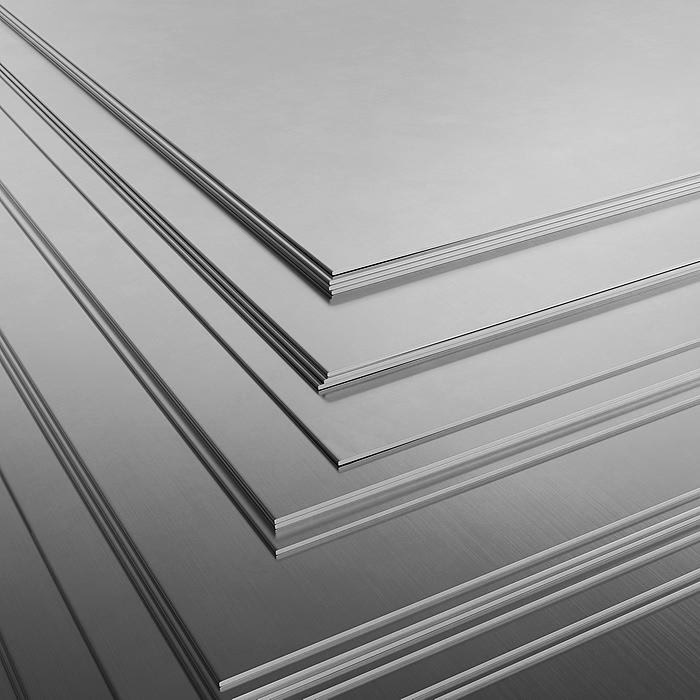
Titanium Plate (Grade 1 / Grade 2 / Grade 5 / Grade 7 / Grade 12)
Titanium Plate in Grade 1, Grade 2 (CP), Grade 4, Grade 5 Ti-6Al-4V (AMS 4911), Grade 7 (Ti-0.15Pd), Grade 9, Grade 12, Grade 23 ELI. Thickness 0.5–100mm, width up to 3,000mm. ASTM B265, ASME SB-265, AMS 4911. Pickled, polished, electropolished surface. Ultrasonic testing available. Mill test certificate EN 10204 3.1/3.2 provided.
| Material | Commercially Pure Titanium / Alpha-Beta Titanium Alloy Plate, Sheet and Strip |
|---|---|
| Grade / Standard | Grade 1 (R50250) / Grade 2 (R50400) / Grade 4 (R50700) / Grade 5 Ti-6Al-4V (R56400) / Grade 7 Ti-0.15Pd (R52400) / Grade 9 Ti-3Al-2.5V (R56320) / Grade 12 Ti-Mo-Ni (R53400) / Grade 23 Ti-6Al-4V ELI (R56401) |
| Thickness | 0.5mm – 100mm (Standard rolled plate) / up to 150mm by hot pressing for special applications |
| Width | Up to 3,000mm (Grade 2 standard; Grade 5 up to 2,000mm — alloy and thickness dependent) |
| Length | Up to 6,000mm / Cut-to-size by waterjet, plasma cutting, or shear available |
| MOQ | 1 Piece (Custom Plate) / 50 kg (Standard Sheet) |
| Delivery Time | 20-45 Days (Standard Grades) / 35-60 Days (Special Grade / Thick Plate) |
| Loading Port | Tianjin / Shanghai / Qingdao |
Overview of Titanium Plate
Titanium Plate is a flat-rolled product manufactured from commercially pure titanium or titanium alloys, supplied as individual cut plates or sheets in thicknesses from 0.5mm (thin sheet) to 100mm (heavy structural plate), providing the exceptional corrosion resistance, lightweight structural performance, biocompatibility, and non-magnetic properties of titanium in flat panel, vessel, heat exchanger tube sheet, aerospace structural, and marine engineering applications. Titanium plate occupies a uniquely advantageous position in the materials hierarchy for aggressive service environments — it provides the seawater corrosion immunity of cupronickel and the chemical corrosion resistance approaching Hastelloy C276 in oxidising environments at approximately 56% of their density, enabling structural and pressure containment designs at substantially lower total installed weight than any other corrosion-resistant metallic plate material. In the chemical processing, offshore, desalination, power generation, and aerospace industries, titanium plate is increasingly specified not merely as a premium alternative to stainless steel and nickel alloys, but as the technically correct and economically optimal material choice when total lifecycle cost — including installation weight savings, reduced corrosion maintenance, and extended equipment service life — is evaluated against the higher initial material purchase price.
Titanium plate is standardised under ASTM B265 (titanium and titanium alloy strip, sheet and plate), ASME SB-265 (ASME Boiler and Pressure Vessel Code equivalent of ASTM B265 for pressure vessel applications), AMS 4911 (Ti-6Al-4V sheet, strip and plate for aerospace structural applications), AMS 4902 (commercially pure titanium Grade 2 sheet, strip and plate), EN ISO 9727-2 (titanium and titanium alloy flat products for general applications), JIS H4600 (titanium and titanium alloy sheets, plates and strips), and GB/T 3621 (titanium and titanium alloy sheets and plates). The principal grades available as plate product span the complete titanium alloy family: Grade 1 (UNS R50250, softest CP titanium, maximum formability), Grade 2 (UNS R50400, the dominant CP titanium plate grade for chemical, marine, and general industrial applications), Grade 4 (UNS R50700, highest strength commercially pure titanium), Grade 5 Ti-6Al-4V (UNS R56400, the dominant aerospace structural plate grade per AMS 4911), Grade 7 Ti-0.15Pd (UNS R52400, enhanced crevice corrosion resistance for reducing acid environments), Grade 9 Ti-3Al-2.5V (UNS R56320, intermediate strength), Grade 12 Ti-0.3Mo-0.8Ni (UNS R53400, elevated temperature marine and chemical service), and Grade 23 Ti-6Al-4V ELI (UNS R56401, ASTM F136, for medical device plate applications).
Key Features and Manufacturing Process
Titanium plate is produced through a carefully controlled primary melting and hot-rolling sequence that addresses the unique metallurgical challenges of titanium — its high reactivity with oxygen, nitrogen, and hydrogen at elevated temperatures; the need to control rolling temperature relative to the beta transus to achieve the required microstructure; and the requirement for complete prevention of iron contamination throughout all processing steps. Production begins with vacuum arc remelting (VAR) of titanium ingot — single VAR for commercial corrosion-service grade plate, double VAR for premium aerospace structural plate per AMS 4911. The refined ingot is converted by press forging to produce a flat slab with homogeneous grain structure before hot rolling. Hot rolling of titanium slab to plate thickness is performed at carefully controlled temperatures — Grade 2 CP titanium at 760–950°C, Grade 5 Ti-6Al-4V at 870–980°C (below the beta transus of approximately 995°C for alpha-beta rolling developing the optimal equiaxed alpha-beta microstructure for fatigue resistance and toughness) — on dedicated titanium hot rolling mills with equipment contamination prevention protocols ensuring no iron transfer from mill rolls or handling equipment to titanium surfaces. Following hot rolling, the plate undergoes annealing at alloy-specific temperatures in vacuum or controlled-atmosphere furnaces to recrystallise the deformed microstructure and relieve rolling stresses, followed by descaling by grit blasting and acid pickling in hydrofluoric acid / nitric acid (HF/HNO3) mixtures to remove the tenacious blue-grey titanium oxide scale formed during hot rolling.
Final surface finishing involves straightening on roller levellers to achieve flatness specification, edge trimming by plasma or waterjet cutting to achieve specified width with clean defect-free plate edges, and surface inspection under raking light to identify and evaluate any surface defects including laps, seams, tool marks, and contamination spots. Thick titanium plate (above 25mm) undergoes mandatory ultrasonic testing per ASTM A578 or ASTM B265 Supplementary Requirement S1 for internal soundness verification before shipment for pressure vessel and aerospace applications. Chemical composition is verified by inductively coupled plasma (ICP) spectrometry or optical emission spectrometry (OES) on each heat, with particular attention to interstitial elements — oxygen (O), nitrogen (N), carbon (C), and hydrogen (H) — that critically affect titanium mechanical properties and are not visible by surface inspection. Mechanical property testing (tensile strength, 0.2% proof stress, elongation in both longitudinal and transverse directions) and hardness verification at plate quarter-thickness complete the mandatory testing programme for each plate heat.
Main Applications of Titanium Plate
Chemical processing pressure vessel and reactor vessel fabrication represents the primary application for titanium plate, with Grade 2 and Grade 7 titanium plate used for vessel shells, heads, and nozzle neck flanges in chlor-alkali production equipment (chlorine gas handling vessels, sodium hypochlorite concentration vessels, hydrogen collection systems), pharmaceutical synthesis reactor vessels handling oxidising acid and halogenated solvent process streams, wet process phosphoric acid (WPA) production equipment where H3PO4 combined with HF and H2SO4 creates a uniquely aggressive chemical environment, chlorinated organic chemical production reactor vessels, and environmental control equipment including wet scrubbers, oxidation reactors, and effluent treatment vessels where titanium’s immunity to the corrosive chemical media enables maintenance-free equipment service life of 20–40 years versus the 5–10 year replacement cycle of even the best stainless steel alternatives.
Heat exchanger tube sheet fabrication in thick titanium plate (25–100mm) is a major application for Grade 2 and Grade 12 titanium, with titanium tube sheets drilled with thousands of precisely located holes for tube bundle installation in shell-and-tube heat exchangers in coastal and offshore power plant condensers, desalination plant multi-stage flash evaporators, HVAC seawater free-cooling heat exchangers, and industrial process heat exchangers in chemical plants handling corrosive fluid on both shell-side and tube-side. Aerospace structural applications use Grade 5 Ti-6Al-4V plate per AMS 4911 for aircraft bulkhead machining blanks, wing fitting plate blanks, engine mount structural plate, military aircraft structural panel blanks, and helicopter structural component blanks where the combination of tensile strength ≥895 MPa, fatigue resistance, and density of 4.43 g/cm³ (56% of steel) provides specific strength exceeding all other standard structural plate materials. Marine and offshore applications include naval vessel structural hull plate inserts, sea chest gratings, offshore platform seawater system manifold flange plates, and subsea equipment structural plate in Grade 2 titanium. Medical device applications for Grade 23 Ti-6Al-4V ELI plate include custom orthopaedic implant machining blanks, maxillofacial reconstruction plate blanks, and medical device structural components requiring biocompatibility and MRI compatibility. Desalination plant applications use large quantities of Grade 2 titanium plate for pressure vessel shells, tube sheet panels, and structural panels throughout multi-stage flash (MSF), multi-effect distillation (MED), and reverse osmosis (RO) desalination plant construction in the Arabian Gulf, North Africa, and Asia-Pacific coastal regions.
Why Choose Us for Titanium Plate
Shandong Tanglu Metal Material Co., Ltd. supplies premium Titanium Plate sourced from leading Chinese titanium plate producers including Baoji Titanium Industry Group — China’s largest and most technically advanced titanium plate rolling mill with hot rolling mill capability up to 3,000mm wide and 100mm thick titanium plate — Western Superconducting Technologies, and Baosteel Special Steel, all operating dedicated titanium processing lines with vacuum annealing furnaces, dedicated titanium acid pickling systems, ultrasonic testing equipment, and optical emission spectrometry chemical analysis laboratories certified to ISO 9001, AS9100 (aerospace quality for AMS 4911 Ti-6Al-4V plate), ASTM B265 / ASME SB-265, AMS 4911, and GB/T 3621 product standard requirements. Every titanium plate is accompanied by original mill test certificates covering full quantitative ICP / OES chemical composition analysis of all elements including interstitials (O, N, C, H for Grade 2; Al, V, Fe, O for Grade 5), tensile and yield strength in both longitudinal and transverse directions, elongation, hardness, flatness measurement, and complete VAR melt heat traceability.
We offer a comprehensive titanium plate specification range: Grade 1 (ASTM B265, UNS R50250), Grade 2 (ASTM B265 / ASME SB-265, the dominant corrosion-service plate grade), Grade 4 (ASTM B265), Grade 5 Ti-6Al-4V (ASTM B265 / AMS 4911, aerospace structural plate), Grade 7 Ti-0.15Pd (ASTM B265, crevice-resistant chemical service plate), Grade 9 Ti-3Al-2.5V (ASTM B265), Grade 12 Ti-0.3Mo-0.8Ni (ASTM B265, elevated temperature marine plate), and Grade 23 Ti-6Al-4V ELI (ASTM F136 / ASTM B265, medical device plate). Thicknesses from 0.5mm thin sheet to 100mm heavy structural plate, widths up to 3,000mm, lengths up to 6,000mm with cut-to-size service by waterjet or plasma cutting, and available surface finishes including pickled matte (standard), mechanically polished (Ra ≤1.6μm, Ra ≤0.8μm for pharmaceutical applications), and electropolished (Ra ≤0.4μm for biotech and injectable drug contact surfaces). Explosion-bonded titanium clad plate (Grade 2 titanium cladding on carbon steel, stainless steel, or low-alloy steel pressure vessel backing plate) available as a cost-effective alternative to solid titanium plate for pressure vessel fabrication. With established monthly supply capacity of 100 tons of titanium plate and export relationships with chemical plant EPC contractors, heat exchanger manufacturers, aerospace component machining centres, naval shipyards, desalination plant builders, and medical device manufacturers across more than 40 countries, we support packages from single-plate prototype orders to large vessel plate supply contracts. Each shipment includes original mill test certificate per EN 10204 3.1, with EN 10204 3.2, ultrasonic testing report for thick plate, and third-party inspection by SGS, Bureau Veritas, ABS, DNV GL, or Lloyd’s Register available for ASME Code, NORSOK, and aerospace applications.
📐 Dimension & Size Table
| Grade | UNS Number | ASTM Standard | Composition | Thickness Range (mm) | Width (mm) | Primary Service Application |
|---|---|---|---|---|---|---|
| Grade 1 (CP Ti) | R50250 | ASTM B265 | Pure Ti, O ≤0.18% / 0.5–50 / Up to 2,000 / Maximum formability, deep drawn chemical equipment | |||
| Grade 2 (CP Ti) | R50400 | ASTM B265 / ASME SB-265 | Pure Ti, O ≤0.25% / 0.5–100 / Up to 3,000 / Chemical, marine, desalination, heat exchanger tube sheets | |||
| Grade 4 (CP Ti) | R50700 | ASTM B265 | Pure Ti, O ≤0.40% / 0.5–50 / Up to 2,000 / Highest-strength CP Ti — surgical implant plate blanks | |||
| Grade 5 (Ti-6Al-4V) | R56400 | ASTM B265 / AMS 4911 | Ti-6Al-4V / 0.5–100 / Up to 2,000 / Aerospace structural, military, marine high-strength | |||
| Grade 5 ELI | R56401 | ASTM B265 / ASTM F136 | Ti-6Al-4V, O ≤0.13% / 0.5–50 / Up to 1,500 / Medical device plate, orthopaedic implant blanks | |||
| Grade 7 (Ti-0.15Pd) | R52400 | ASTM B265 / ASME SB-265 | Ti-0.15Pd / 0.5–80 / Up to 2,500 / Reducing acid vessels, crevice-resistant chemical service | |||
| Grade 9 (Ti-3Al-2.5V) | R56320 | ASTM B265 | Ti-3Al-2.5V / 0.5–50 / Up to 1,500 / Intermediate strength, bicycle frame, sports structure | |||
| Grade 11 (Ti-0.15Pd) | R52250 | ASTM B265 | Ti-0.15Pd (low O) / 0.5–30 / Up to 1,500 / Highest formability Pd-alloyed sheet, complex formed parts | |||
| Grade 12 (Ti-Mo-Ni) | R53400 | ASTM B265 / ASME SB-265 | Ti-0.3Mo-0.8Ni / 0.5–50 / Up to 2,000 / Elevated temperature marine, hot brine service | |||
| Grade 23 Ti-6Al-4V ELI | R56401 | ASTM F136 / ASTM B265 | Ti-6Al-4V, O ≤0.13%, Fe ≤0.25% / 0.5–50 / Up to 1,500 / Surgical implant plate, medical device components | |||
| Grade 29 (Ti-6Al-4V-0.1Ru) | R56404 | ASTM B265 | Ti-6Al-4V-0.1Ru / 0.5–50 / Up to 1,500 / Chemical service with enhanced crevice corrosion resistance |
* Custom sizes available upon request. Tolerances per relevant international standards.
🔬 Chemical Composition
| Element | Min | Max | Display Value | Note |
|---|---|---|---|---|
| Ti (Grade 2 CP) | Bal. | - | Balance (≥99%) | Per ASTM B265 — commercially pure titanium; all balance is titanium; no intentional alloying additions |
| O (Grade 2) | - | 0.25 | ≤0.25 | Primary strength-controlling interstitial; Grade 1: ≤0.18% (softer); Grade 4: ≤0.40% (stronger) |
| Fe (Grade 2) | - | 0.30 | ≤0.30 | Iron residual — must be minimised to prevent pitting corrosion at TiO₂ / Ti-Fe second phase boundaries in aggressive service |
| N (Grade 2) | - | 0.03 | ≤0.03 | Nitrogen interstitial — solid solution strengthener; controlled for ductility and toughness |
| C (Grade 2) | - | 0.08 | ≤0.08 | Carbon — forms TiC at grain boundaries if excessive, reducing formability and toughness |
| H (Grade 2) | - | 0.015 | ≤0.015 | Hydrogen — strictly limited to prevent delayed hydride cracking; monitored in plate from hydrogen pick-up in pickling |
| Ti (Grade 5 Ti-6Al-4V) | Bal. | - | Balance (~90%) | Per ASTM B265 / AMS 4911 — alpha-beta titanium alloy base |
| Al (Grade 5) | 5.50 | 6.75 | 5.50–6.75 | Alpha-phase stabiliser — primary strengthening addition providing high strength at elevated temperature |
| V (Grade 5) | 3.50 | 4.50 | 3.50–4.50 | Beta-phase stabiliser enabling STA age-hardening treatment for maximum structural strength |
| O (Grade 5) | - | 0.20 | ≤0.20 | Standard Grade 5: ≤0.20%; Grade 23 ELI: ≤0.13% for superior fracture toughness in medical implant applications |
| Fe (Grade 5) | - | 0.30 | ≤0.30 | Grade 5 standard: ≤0.30%; Grade 23 ELI: ≤0.25% for improved toughness |
| Pd (Grade 7) | 0.12 | 0.25 | 0.12–0.25 | Palladium — cathodic depolarisation mechanism prevents crevice corrosion in reducing acid environments that attack Grade 2 |
* Chemical composition may vary by heat, thickness and specification. Please refer to the actual mill test certificate.
⚙️ Mechanical Properties
| Property | Value | Unit | Test Condition |
|---|---|---|---|
| Tensile Strength — Grade 1 (Annealed) | ≥240 | MPa (35 ksi) | Per ASTM B265 — softest CP titanium, maximum formability for deep drawn components |
| Elongation — Grade 1 (Annealed) | ≥24 | % | Highest elongation of titanium grades — enables deep drawing of complex vessel heads |
| Tensile Strength — Grade 2 (Annealed) | ≥345 | MPa (50 ksi) | Per ASTM B265 / ASME SB-265 — standard CP titanium, dominant corrosion-service plate |
| Yield Strength — Grade 2 (Annealed) | ≥275 | MPa (40 ksi) | 0.2% proof stress — enables ASME vessel design with appropriate wall thickness |
| Elongation — Grade 2 (Annealed) | ≥20 | % | Good formability for press-formed vessel heads, tube sheet flanging, and plate welding |
| Tensile Strength — Grade 4 (Annealed) | ≥550 | MPa (80 ksi) | Per ASTM B265 — highest strength CP titanium plate |
| Tensile Strength — Grade 5 Ti-6Al-4V (Annealed / MA) | ≥895 | MPa (130 ksi) | Per ASTM B265 / AMS 4911 — standard aerospace structural plate condition |
| Yield Strength — Grade 5 Ti-6Al-4V (Annealed) | ≥828 | MPa (120 ksi) | Specific strength (Rm/ρ) ≈249 kN·m/kg — exceeds all other standard structural plate materials |
| Elongation — Grade 5 (Annealed) | ≥10 | % | Reduced vs CP grades; adequate for structural applications with welded joints |
| Tensile Strength — Grade 5 Ti-6Al-4V (STA) | ≥1,103 | MPa (160 ksi) | Per AMS 4911 STA condition — maximum strength for critical aerospace structural plate components |
| Yield Strength — Grade 5 (STA) | ≥1,000 | MPa (145 ksi) | Highest strength standard titanium plate available; for weight-critical structural applications |
| Tensile Strength — Grade 7 Ti-0.15Pd (Annealed) | ≥345 | MPa (50 ksi) | Per ASTM B265 — identical mechanical properties to Grade 2, enhanced crevice corrosion resistance only |
| Tensile Strength — Grade 12 Ti-Mo-Ni (Annealed) | ≥483 | MPa (70 ksi) | Per ASTM B265 — higher strength than Grade 2; for elevated temperature marine service |
| Density — Grade 2 / Grade 5 | 4.51 / 4.43 | g/cm³ | ~56% of steel (7.85), ~52% of nickel alloys (8.4–8.9) — critical weight advantage for structural design |
| Max Service Temperature — Grade 2 (aqueous corrosion) | ≤315 | °C | Above 315°C sustained, Grade 2 loses passive film stability in some environments; Grade 12 extends to ~370°C |
* Values shown are minimum requirements unless otherwise stated.
📦 Commercial Information
| Packaging | Premium seaworthy export packing for titanium plate with strict iron contamination prevention as the primary packaging protocol requirement — embedded iron on titanium plate surfaces causes localised galvanic pitting corrosion in seawater and chemical service environments, and any iron contamination of aerospace-grade Ti-6Al-4V plate surfaces can compromise the fatigue performance of machined components. All handling equipment, strapping, packaging components, and dunnage in contact with titanium plate surfaces must be non-ferrous or coated to prevent iron transfer. Individual titanium plate pieces wrapped on all faces with VCI (Volatile Corrosion Inhibitor) polyethylene film applied directly to the pickled plate surface, preventing atmospheric oxidation (surface tarnishing) and chloride contamination during ocean transit — titanium does not rust like steel but can develop cosmetic surface staining from atmospheric moisture and chloride exposure that may require re-pickling before fabrication. For mechanically polished or electropolished plate (pharmaceutical and medical applications), additional 3mm PE foam inner layer prevents scratch damage. Plate edges protected with HDPE plastic edge angle protectors on all four plate edges. Non-ferrous strapping (polypropylene banding or stainless steel strapping) used for all plate bundles — carbon steel strapping is absolutely prohibited for titanium plate. Plates stacked on ISPM-15 timber pallets with non-ferrous spacer blocks (aluminium or plastic) between plate layers — no bare metal-to-metal plate stacking. Each plate individually tagged with stainless steel wire-attached metal identification showing: titanium grade, UNS number, applicable ASTM/ASME/AMS standard, thickness × width × length in mm, plate weight in kg, heat number, VAR melt count, delivery condition (MA/RXA/STA/annealed), surface finish, and customer purchase order reference. Large plates (thickness ≥25mm, weight ≥300 kg) packed in engineered wooden crates with internal aluminium angle supports, foam cushioning, and waterproof plywood sheathing. Desiccant sachets inside PE film. For AMS 4911 aerospace titanium plate, each plate additionally carries a unique plate number with complete chain-of-custody documentation from VAR ingot to finished plate required by AS9100 aerospace quality system traceability requirements. Complete documentation package (mill test certificate, UT report where applicable, AMS/ASTM compliance statement, Certificate of Origin) in waterproof document pouch. |
|---|---|
| Payment Terms | T/T (Telegraphic Transfer),L/C (Letter of Credit),D/P (Documents against Payment),Western Union,PayPal |
| Price Term | FOB,CFR,CIF,EXW |
| Supply Capacity | 100 Tons/Month (Titanium Plate and Sheet) |
| Loading Port | Tianjin / Shanghai / Qingdao |
Why Choose Our Titanium Plate (Grade 1 / Grade 2 / Grade 5 / Grade 7 / Grade 12)?
ASTM B265 / AMS 4911 / ASME SB-265 Certified
Titanium plate supplied with EN 10204 3.1/3.2 mill test certificate covering full ICP/OES chemical composition including interstitials (O, N, C, H), mechanical properties (tensile, yield, elongation) in longitudinal and transverse directions, hardness, ultrasonic testing per ASTM A578 for thick plate, and complete VAR melt heat traceability. AMS 4911 aerospace, ASTM F136 medical, ASME SB-265 pressure vessel, and NORSOK MDS compliance documentation available.
Complete Grade & Thickness Range
Grade 1 through Grade 23 covering CP titanium (Gr.1/2/4), Ti-0.15Pd (Gr.7/11), Ti-3Al-2.5V (Gr.9), Ti-Mo-Ni (Gr.12), Ti-6Al-4V (Gr.5/AMS 4911), Ti-6Al-4V ELI (Gr.23/ASTM F136). Thickness 0.5mm thin sheet to 100mm heavy plate. Width up to 3,000mm for Grade 2. Cut-to-size, waterjet, and plasma cutting available. Explosion-bonded titanium clad plate available.
Near-Zero Corrosion Rate Across Widest Chemical Range
Grade 2 titanium plate: <0.025 mm/year in seawater, wet chlorine, NaOCl, HNO3, H2O2, and most oxidising media — near-zero corrosion that eliminates corrosion allowance from vessel wall thickness calculation. Grade 7 (Ti-0.15Pd) extends immunity to reducing acid crevice environments. Density 4.51 g/cm³ — 56% of steel, enabling 44% weight saving versus equivalent steel plate construction at same pressure rating.
Multi-Industry Code Compliance
ASME BPVC Section II ASME SB-265 (pressure vessels, heat exchangers), AMS 4911 (aerospace Ti-6Al-4V), ASTM F136 / ISO 5832-3 (medical device), NORSOK MDS M-630 (offshore titanium piping systems), API 6A (oil & gas wellhead), PED 2014/68/EU (European pressure equipment). ABS, DNV, LR, BV classification society approval available for marine structural titanium plate.
Stock Plate & Custom Cut-to-Size Service
Grade 2 CP titanium in standard thicknesses (2–25mm) from stock: 20–35 days. Grade 5 AMS 4911 in 5–50mm from stock: 25–40 days. Thick plate (50–100mm) and special grades: 40–60 days. Waterjet cut-to-size from stock plate: add 5–10 working days. Non-ferrous packaging and contamination prevention protocols throughout production and shipping.
🏭 Applications of Titanium Plate (Grade 1 / Grade 2 / Grade 5 / Grade 7 / Grade 12)
Titanium plate serves as the primary flat-product construction material for the most technically demanding corrosion-resistant, lightweight structural, and biomedical applications across the global chemical processing, offshore oil and gas, power generation, aerospace, defence, pharmaceutical, medical device, and marine industries — applications where titanium's unique combination of near-zero aqueous corrosion rate, lowest density of any structurally useful metal for this corrosion performance level, and biological inertness creates unmatched material selection value that justifies its substantial premium over stainless steel and nickel alloy plate alternatives. Chemical processing vessel and reactor fabrication in Grade 2 titanium plate is the dominant application by plate tonnage — pressure vessel shells, heads, nozzle necks, and manway flanges fabricated from Grade 2 titanium plate for chlor-alkali plant equipment (chlorine gas collection and distribution vessels, NaOH concentration evaporator vessel shells, HCl gas absorption tower shells, electrolyser cell end plates), pharmaceutical synthesis reactor vessels handling oxidising chlorinated and acid process streams requiring absolute absence of metallic contamination of the pharmaceutical active ingredient, wet process phosphoric acid (WPA) evaporator and flash cooler vessel fabrication for fertiliser production plants where the combined H3PO4/H2SO4/HF process chemistry corrodes all grades of stainless steel and most nickel alloys at acceptable corrosion rates while Grade 2 titanium provides corrosion rates below 0.05 mm/year enabling 25+ year service life, chlorinated organic chemical production (methylene chloride, chloroform, vinyl chloride monomer) process vessel shells where the oxidising character of the chlorinated process atmosphere creates conditions optimal for titanium passive film stability, and environmental control scrubber vessel fabrication in Grade 2 titanium for flue gas desulfurisation (FGD), industrial waste gas treatment, and semiconductor manufacturing exhaust scrubbing systems handling wet HCl, HF, and other corrosive gas streams. Heat exchanger tube sheet fabrication from thick Grade 2 titanium plate (25–100mm) represents the second-largest titanium plate application — the titanium tube sheet provides the structural anchor for the heat exchanger tube bundle while simultaneously providing corrosion resistance to both the shell-side and tube-side process fluids across the tube sheet face area, a dual service demand uniquely satisfied by titanium's universal corrosion resistance in most aqueous environments. Power plant seawater condenser tube sheets in Grade 2 titanium (100mm thick, 3,000mm diameter for large utility condensers) anchor thousands of titanium condenser tubes (ASTM B338) providing 40–50 year service life in direct once-through seawater cooling duty without replacement — the tube sheet bore diameter tolerances and tube-to-tubesheet expansion procedures follow TEMA standards adapted for titanium's higher yield strength and lower modulus of elasticity versus steel or copper alloy tube sheets. Aerospace structural applications for Grade 5 Ti-6Al-4V plate per AMS 4911 — aircraft primary structural bulkheads (pressure bulkhead separating pressurised cabin from non-pressurised fuselage section, frame bulkheads carrying fuselage load distribution), wing structural panels (lower surface tension panel for aircraft generating lift, upper surface compression panel under positive g manoeuvring), nacelle fire zone structural panels (requiring titanium's fire resistance in bypass air high-temperature service), engine mount structural backing plates, and military aircraft structural panels where signature reduction requirements limit steel use — all machined from AMS 4911-certified Grade 5 plate with full traceability documentation required by AS9100 aerospace quality management. Desalination plant construction in Grade 2 titanium plate represents perhaps the largest single-site quantity demand for titanium plate globally — a large multi-stage flash (MSF) desalination plant producing 300,000 m³/day of fresh water requires titanium tube sheets, heat transfer plate bundles, and structural panels throughout the brine heater and flash stage heat exchanger trains operating in hot concentrated seawater brine (temperature 60–120°C, chloride concentration 50,000–70,000 ppm) that causes rapid corrosion of duplex stainless steel and requires expensive corrosion inhibitor treatment for carbon steel — Grade 2 titanium provides maintenance-free service in these conditions across the 20–25 year design life of modern large-scale desalination facilities, making the higher initial titanium material cost recover through elimination of annual maintenance, tube replacement, and plant downtime costs over the facility lifetime. Marine and naval vessel structural applications include Grade 2 titanium plate for naval surface combatant sea chest grating panels (the intake structure for seawater drawn into the ship's cooling, firefighting, and ballast water systems — titanium provides immunity to the biofouling attachment and galvanic corrosion that limits steel service life in seawater immersion), Grade 2 titanium for submarine pressure hull penetration flange plates and sea chest structural plates where the combination of non-magnetic properties and seawater corrosion immunity are simultaneously required, Grade 5 Ti-6Al-4V for high-strength naval vessel structural fittings where weight savings contribute to reserve buoyancy and payload capacity, and Grade 2 titanium for offshore platform seawater system structural flange plates. Medical device manufacturing from Grade 23 Ti-6Al-4V ELI (ASTM F136) and Grade 4 CP titanium plate includes maxillofacial reconstruction plate blanks (the titanium mesh and solid plates used to reconstruct skull and facial bone defects following trauma or cancer surgery, laser-cut and formed from thin Grade 23 ELI plate to custom patient anatomy), custom orthopaedic implant machining blanks for patient-specific hip, knee, and shoulder implant components, intervertebral fusion cage plate blanks, and titanium medical packaging for implant sterilisation pouches where the non-reactive, autoclave-compatible properties of titanium plate provide definitive protection during steam sterilisation at 134°C.
📋 Quality & Certification
Our Certifications
- ✅ ISO 9001:2015
- ✅ CE Marking
- ✅ ABS
- ✅ DNV GL
- ✅ Lloyd's Register (LR)
- ✅ Bureau Veritas (BV)
- ✅ SGS Certified
Mill Certificate Type
- 📋 EN 10204 3.1
- 📋 EN 10204 3.2
- 📋 Original Mill Certificate
- 📋 Third Party Inspection Available
- 📋 Certificate of Origin
❓ Frequently Asked Questions
What is the difference between titanium plate Grade 1, Grade 2, Grade 4, and how do I select the right CP titanium grade?
Commercially pure (CP) titanium plate grades 1, 2, and 4 are all essentially unalloyed titanium — the only significant composition difference is the oxygen content limit, which is the primary interstitial element controlling strength and ductility in CP titanium. Higher oxygen content increases yield strength and tensile strength but simultaneously reduces elongation (ductility) and fracture toughness. Grade 1 (UNS R50250, O ≤0.18%): The softest and most ductile CP titanium, with minimum tensile strength of only 240 MPa (35 ksi) and minimum elongation of 24%. The very low oxygen limit produces maximum formability — Grade 1 is selected for applications requiring the most severe forming operations including deep drawing of complex vessel head geometries, hydroforming into tubular shapes, and spinning into conical or ellipsoidal forms where the material must flow extensively without cracking. Grade 1 is also specified where maximum toughness and fatigue resistance in thin-section plate is critical. The penalty for Grade 1's superior formability is its lower strength — pressure vessels designed to minimum Grade 1 mechanical properties require thicker walls than Grade 2 for the same pressure rating, partially offsetting the weight advantage of titanium. Grade 2 (UNS R50400, O ≤0.25%): The dominant commercial CP titanium plate grade, providing the optimal balance between formability (elongation ≥20%) and strength (tensile ≥345 MPa, yield ≥275 MPa) for the broadest range of industrial plate applications. Grade 2 is the standard specification for chemical plant vessels, heat exchanger tube sheets, seawater piping flanges, desalination equipment, and marine structural components where moderate cold forming is required during fabrication and the higher strength versus Grade 1 enables reduced wall thickness for equivalent pressure rating. ASME SB-265 Grade 2 is the standard design basis for ASME Code titanium pressure vessels. Grade 4 (UNS R50700, O ≤0.40%): The highest-strength CP titanium, with minimum tensile strength of 550 MPa (80 ksi) — 60% stronger than Grade 2 — but significantly reduced elongation (≥15%), making it less suitable for complex forming operations. Grade 4 is selected where the maximum CP titanium strength is needed without resorting to Ti-6Al-4V alloy — applications include dental implant component blanks (where Grade 4 CP titanium is the standard for endosseous dental implant fixtures requiring high thread engagement strength), bone screw blanks where CP titanium is preferred over Ti-6Al-4V for improved biocompatibility and MRI compatibility in sensitive locations, and pressure-containing components designed to maximum CP titanium allowable stress. Selection principle: maximum formability → Grade 1; broadest general industrial applications → Grade 2; maximum CP titanium strength → Grade 4.
When should Grade 7 (Ti-0.15Pd) titanium plate be specified instead of Grade 2 for chemical process vessels?
Grade 7 titanium (Ti-0.15Pd, UNS R52400, ASTM B265) provides identical tensile strength, yield strength, and elongation to Grade 2 (the compositions are the same base CP titanium with only 0.12–0.25% palladium added), but adds specific resistance to crevice corrosion in reducing acid environments — the one service limitation of standard Grade 2 that Grade 7 was specifically developed to address. Understanding the mechanism: Grade 2 CP titanium relies on a stable TiO₂ passive film for its corrosion resistance. In most environments (seawater, oxidising acids, neutral chlorides, alkaline solutions), this passive film is self-maintaining and self-healing. However, in tight crevice geometries (under gaskets, at flange faces, beneath bolt heads, at tube-to-tubesheet joints), the chemistry within the crevice can become depleted in oxidising species (dissolved oxygen, ferric ions) that maintain the passive film. In reducing acid environments (hydrochloric acid, sulfuric acid, formic acid, reducing process streams), the local chemistry within the crevice becomes sufficiently reducing to break down the TiO₂ passive film and initiate active corrosion — crevice corrosion that can perforate thin titanium plate or flange gasket seating areas within months of service. The 0.12–0.25% palladium addition in Grade 7 prevents this crevice corrosion through an electrochemical noble metal coupling mechanism: the palladium-enriched micro-zones on the titanium surface act as cathodic sites that provide a small anodic protection current maintaining the titanium passive film within the crevice even under reducing acid conditions. When to specify Grade 7 instead of Grade 2: (1) Any vessel or piping component in reducing acid service — hydrochloric acid (all concentrations), dilute sulfuric acid (below 30%), reducing sulfuric acid contaminated with HCl, formic acid, and other reducing organic acids. (2) Heat exchanger tube-to-tubesheet joints in service where the tube-side or shell-side fluid is mildly reducing — the crevice at the tube-to-tubesheet expanded joint is particularly vulnerable to crevice corrosion if Grade 2 is specified in reducing acid heat exchanger service. (3) Flanged pipe joints in reducing acid chemical piping systems — the flange gasket seating creates crevice geometry where reducing acid trapped beneath the gasket can attack Grade 2. (4) Any application where inspection for and repair of crevice corrosion damage would be difficult or expensive once the vessel is commissioned. When Grade 2 is adequate (Grade 7 not necessary and economically unjustifiable): seawater service at any temperature; oxidising acid service (HNO3, H2O2, wet chlorine); neutral and alkaline service; applications without significant crevice geometry. Grade 7 costs approximately 15–25% more than Grade 2 due to the palladium addition (palladium is a platinum group metal with volatile pricing); specify Grade 7 only when the reducing acid crevice corrosion mechanism is genuinely present in the specific service environment.
What are the AMS 4911 requirements for Ti-6Al-4V aerospace structural plate and why are they more stringent than ASTM B265?
AMS 4911 (SAE Aerospace Material Specification 4911, revision current) is the primary specification for Ti-6Al-4V sheet, strip, and plate for aerospace structural applications, providing significantly more stringent requirements than the general commercial ASTM B265 specification in three key areas that determine the fatigue life and fracture toughness of aerospace structural components machined from the plate. Chemical composition: AMS 4911 specifies the same nominal Al 5.50–6.75% and V 3.50–4.50% ranges as ASTM B265 for Grade 5, but additionally restricts the sum of all other elements (other than titanium) to ≤0.40% total — preventing accumulation of multiple residual elements at their individual maximum limits that would degrade fatigue performance. Interstitial limits are comparable between the two standards (O ≤0.20% for AMS 4911 standard grade) but AMS 4911 requires hydrogen testing (H ≤0.0150% maximum) documented on the mill certificate, which ASTM B265 Grade 5 does not mandate. Mechanical properties and testing: AMS 4911 requires mechanical property testing (tensile strength ≥896 MPa / ≥130 ksi, yield ≥827 MPa / ≥120 ksi, elongation ≥10%) in both the longitudinal and transverse directions for plate above a specified thickness — ASTM B265 requires tensile testing in one direction only (longitudinal) for most plate sizes. This bidirectional testing requirement confirms that the rolling process has produced sufficiently isotropic properties for structural design validity in any loading direction. Additionally, AMS 4911 specifies minimum elongation of 10% in the short transverse direction (through-thickness) for plate above 19mm thickness, addressing the risk of delamination failure in thick plate under through-thickness loading at machined features. Microstructure and homogeneity: AMS 4911 requires primary alpha content assessment and grain size verification to confirm the plate has been processed to the correct alpha-beta microstructure with the equiaxed primary alpha morphology providing the optimal fatigue resistance combination. Macrograph examination of each plate confirms freedom from seams, laps, and stringers visible at macrostructure scale. The more stringent AMS 4911 requirements reflect the consequence-of-failure severity for aerospace structural components — a fatigue crack in an aircraft bulkhead or wing fitting could cause catastrophic structural failure with loss of aircraft and crew, justifying the higher testing cost and tighter acceptance criteria of AMS 4911 versus the general industrial ASTM B265 specification appropriate for chemical plant and marine structural applications where the failure consequences, while serious, are less immediate than in-flight structural failure.
How is explosion-bonded titanium clad plate used as a cost-effective alternative to solid titanium plate?
Explosion-bonded (or explosion-welded, EXW) titanium clad plate is a composite flat product bonding a thin corrosion-resistant titanium cladding layer (typically 1.5–6mm Grade 2 or Grade 7 titanium) to a thicker carbon steel, low-alloy steel, or stainless steel backing plate (typically 10–100mm thickness), creating a product that provides the corrosion protection of solid titanium plate for the vessel inner surface at approximately 30–50% of the material cost of equivalent solid titanium plate construction. The explosion bonding process uses controlled detonation of explosive sheets to accelerate the titanium cladding plate at high velocity toward the backing steel plate, creating a transient high-pressure wave at the metal-to-metal interface that exceeds the yield strength of both metals and creates an atomic-level metallurgical bond without fusion — the interface shows a characteristic wavy geometry in cross-section where the two metals have interdiffused at the wave crests under the extreme pressure (gigapascal range) of the detonation wave. The bond quality is verified by ultrasonic testing (shear wave method per ASTM A264 or ASTM A578) to confirm complete bonding coverage — unbonded zones appear as flat bright reflectors in UT examination and are rejectable per applicable standard criteria. Applications where titanium clad plate provides optimal value versus solid titanium plate: large-diameter pressure vessels (diameter ≥2,000mm, wall thickness ≥25mm) where the total titanium mass of solid construction is extremely large and the structural load is carried primarily by the backing steel — clad plate provides the same internal corrosion protection at 10–20% of the titanium material cost of solid wall construction; heat exchanger tube sheet construction (tube sheet diameters 800–3,000mm, thickness 50–100mm) where the drilling cost of a very thick solid titanium tube sheet is prohibitive and Grade 2 titanium clad (5–6mm) on low-alloy steel provides equivalent tube-to-tubesheet expansion and roll performance to solid titanium at substantially lower material cost; column and tower construction for chlor-alkali and chemical plant where the Grade 2 titanium lining protects the carbon steel structural shell from corrosion by providing a continuous metal barrier rather than relying on a painted or rubber-lined coating system that can fail at welds, nozzle attachments, and inspection access openings. Design and fabrication considerations for titanium clad plate vessels: the cladding layer participates in pressure containment design only at a reduced credit (typically ASME Section IX prescribes the clad plate design with backing plate carrying the full pressure load); all field weld joints require restoration of the titanium cladding over the weld joint area using titanium weld overlay (alloy 625 or titanium ERTi-2 filler) or titanium backing strips at each butt weld; nozzle connections require titanium-lined nozzle necks and titanium-faced flanges to maintain the continuous corrosion barrier at all vessel penetrations.
What special precautions are required when welding titanium plate in vessel fabrication?
Welding titanium plate for pressure vessel fabrication requires comprehensive atmospheric contamination prevention protocols that are far more demanding than those applied to stainless steel or nickel alloy vessel welding, because titanium reacts catastrophically with oxygen, nitrogen, and hydrogen in the weld pool and heat-affected zone at temperatures above approximately 400°C — contamination that produces brittle titanium oxides, nitrides, and hydrides significantly reducing toughness, corrosion resistance, and weld integrity. The colour of the completed weld bead surface is the primary visual quality indicator: bright silver indicates no contamination (acceptable); light straw-gold indicates minor surface oxidation that is borderline acceptable for non-critical welds; purple-blue indicates significant oxidation that is unacceptable for pressure vessel service (reduced toughness); grey to white chalky indicates severe embrittlement (immediate rejection and weld removal required). Complete shielding gas requirements: High-purity argon (99.999% minimum, dew point ≤−60°C) is mandatory for all titanium welding — nitrogen, CO2, and mixed gases used for steel welding are absolutely prohibited. Three shielding zones must be simultaneously maintained: (1) Primary GTAW torch cup argon shield covering the weld pool and immediate surrounding area; (2) Trailing shield — a custom fabricated argon-purge trailing shoe covering the completed weld and HAZ as the torch advances, maintaining argon coverage until the titanium surface cools below 400°C (typically 100–200mm trailing shoe length, minimum 20 SLPM argon flow); (3) Back purge — continuous argon purging of the vessel interior (or pipe bore in pipe welding) throughout welding and cooling to protect the weld root from atmospheric oxidation. Argon purge must be established before welding begins (minimum 5 complete vessel volume changes) and oxygen content of exit purge gas monitored with an oxygen analyser — welding must not commence until oxygen level is below 50 ppm at the exit, ideally below 20 ppm. Joint preparation: All titanium plate edges to be welded must be machined (not plasma or flame cut) to remove contaminated cut edge material, thoroughly degreased with acetone or clean alcohol (titanium retains no oxide layer that requires grinding — no angle grinding with abrasive discs), and white-glove handled to prevent skin oils and iron particulate from contaminating weld preparation. Titanium shears, saws, and machine tools used for joint preparation must be dedicated to titanium processing only — use of tools previously used on steel will transfer iron contamination that will cause weld porosity and potential corrosion at the embedded iron sites. Filler wire: ERTi-2 for Grade 2 parent plate, ERTi-7 for Grade 7, ERTi-9 for Grade 9, stored in sealed containers protected from moisture and handled with clean gloves. For ASME Code pressure vessel titanium welding, Welding Procedure Specifications (WPS) and Procedure Qualification Records (PQR) must be developed per ASME Section IX with specific titanium welding requirements addressing shielding gas, purge gas verification, and weld colour acceptance criteria documented in the WPS.
Get a Quote for
Titanium Plate (Grade 1 / Grade 2 / Grade 5 / Grade 7 / Grade 12)
Submit your requirements and receive a competitive price quote within 24 hours.
- ✓ Fast response within 24 hours
- ✓ Competitive factory-direct pricing
- ✓ Free technical consultation
- ✓ Mill test certificate provided
- ✓ Flexible payment terms available
⏱ Response within 24 hours
Send Your Inquiry
All fields marked with * are required