
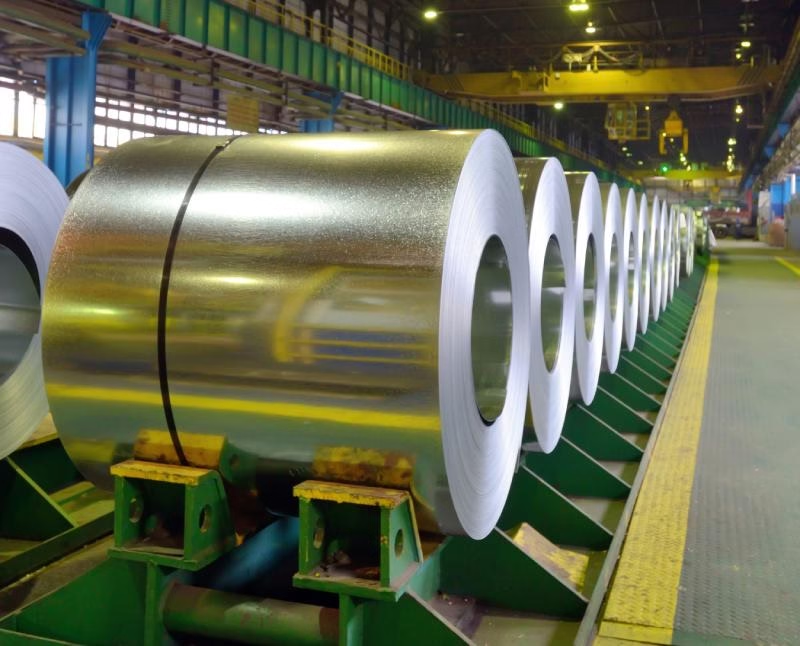
Press Hardening Steel (PHS / 22MnB5 / Usibor)
Press Hardening Steel (PHS / 22MnB5 / Usibor 1500 equivalent) is hot stamping boron steel achieving 1,500–2,000 MPa tensile strength after die quenching for A-pillar, B-pillar, door ring, and anti-intrusion automotive structural components. AlSi-coated (60/60 g/m²). Thickness 0.7–3.0mm. VDA 239-100 / SAE J2340 / GB/T 32979 certified. IATF 16949. Blank and coil supply. PPAP support.
| Material | Boron-Alloyed Hot Stamping Press Hardening Steel (PHS) — AlSi-Coated Cold-Rolled Coil and Blank |
|---|---|
| Grade / Standard | PHS1500 (22MnB5 / Usibor 1500 / B1500HS) / PHS2000 (37MnB4 / Usibor 2000 / B2000HS) / Tailor-Rolled Blank (TRB) |
| Thickness | 0.7mm – 3.0mm (Standard PHS coil and blank range for automotive) |
| Width | 600mm – 1,850mm (Coil width) / Custom blank dimensions per drawing |
| MOQ | 5 Tons (Sample / Development Blanks) / 20 Tons (Standard Production Coil / Blank Order) |
| Delivery Time | 25-45 Days (Standard PHS1500 AlSi Coil) / 30-55 Days (PHS2000 / TRB / Custom Blanks) |
| Loading Port | Tianjin / Shanghai / Qingdao |
Overview of Press Hardening Steel (PHS)
Press Hardening Steel (PHS), also widely designated as hot stamping steel, die quenching steel, or boron steel, is a specialist ultra-high-strength automotive sheet steel engineered to be formed into complex three-dimensional structural component geometries and simultaneously hardened to 1,500–2,000 MPa tensile strength in a single integrated hot stamping operation — a process that overcomes the fundamental formability limitation of ultra-high-strength steel by performing the forming operation while the material is in the soft, ductile austenitic condition (above 750°C) and then immediately quenching the formed part in water-cooled dies to achieve the fully martensitic microstructure providing the final component’s structural performance. This process innovation — press hardening, or hot stamping — enables automotive engineers to produce safety-critical structural components with the geometrical complexity achievable in conventional cold stamping of mild steel, combined with the tensile strength of 1,500–2,000 MPa achievable only in fully martensitic steel, without the springback, fracture, and formability limitations that prevent cold forming of equivalent-strength martensitic sheet steel. The combination of complex formable geometry and maximum structural strength in a single hot stamping operation makes PHS the dominant material for the most safety-critical automotive body-in-white components — door ring structures, A-pillars, B-pillars, floor tunnels, longitudinal anti-intrusion structures, and roof rails — where the simultaneous requirements of crash energy absorption, minimal intrusion into the passenger compartment, geometrical packaging within the vehicle design envelope, and weight reduction for fuel economy and electric vehicle range cannot be satisfied by any cold-formable steel or aluminium alloy at comparable total component cost.
Press Hardening Steel is standardised primarily under the proprietary designations of its developers — ArcelorMittal’s Usibor 1500 and Usibor 2000 (the original and most widely used PHS grades), Thyssen Krupp’s MBW 1500 and MBW 2000, Nippon Steel’s NSHA1500 and NSHA2000, Baosteel’s B1500HS and B2000HS — and under broader standard specifications including EN 10083-3 (27MnCrB5, 34MnB5 as alloy bar equivalents), SAE J2340 PHS1500 and PHS2000, VDA 239-100 (CR/HD designations for hot stamped PHS grades), and GB/T 32979 (Chinese national standard for press hardening steels). The baseline chemistry for the dominant PHS grade is 22MnB5 — designating approximately 0.22% carbon, manganese strengthening, and 0.001–0.005% boron (B) addition that is the metallurgically critical element enabling the complete martensitic transformation achievable at the relatively moderate die quenching rates (30–50°C/s) achievable in large industrial water-cooled hot stamping dies, through boron’s unique effect of dramatically increasing austenite hardenability by segregating to austenite grain boundaries and blocking the nucleation of ferrite and pearlite transformation. Higher-strength PHS2000 grades use modified chemistry (37MnB4, 34MnB5, or proprietary compositions with C 0.30–0.40%, Si 0.20–0.40%) that increases martensite hardness and tensile strength to 1,800–2,000+ MPa after die quenching while maintaining the hardenability for complete martensitic transformation in complex three-dimensional die shapes.
Key Features and Manufacturing Process
Press Hardening Steel production encompasses two distinct manufacturing steps — the steel mill production of the as-delivered coil or blank, and the hot stamping operation at the automotive parts manufacturer — that together determine the final component’s mechanical properties and surface condition. The steel mill production step for PHS involves: vacuum degassing steelmaking to achieve the precise carbon (0.20–0.25% for PHS1500 based on 22MnB5), manganese (1.1–1.4%), chromium (0.15–0.25%), titanium (0.020–0.050%), and boron (0.0015–0.0050% — the critical hardenability element) composition; hot rolling and cold rolling of the substrate to the specified gauge (typically 0.7–3.0mm for automotive applications); and application of the aluminium-silicon (AlSi) metallic coating by hot-dip coating — the standard surface treatment for PHS, protecting the steel surface from oxidation and decarburisation during the furnace heating step of the hot stamping process and providing cathodic corrosion protection in the finished vehicle. The AlSi coating (with composition approximately Al 85–90%, Si 8–10%, Fe balance) transforms during the furnace heating step from a soft metallic coating into a hard, fully bonded Fe-Al intermetallic compound layer that provides the oxide-free, decarburisation-free substrate surface essential for the complete martensitic transformation and predictable mechanical properties required in hot stamped structural components. Without the AlSi coating protection, the bare steel surface would rapidly oxidise and decarburise in the hot stamping furnace at 900–950°C, producing a scaled, decarburised surface layer that reduces fatigue resistance, impairs spot weld quality, and requires scale removal by shot blasting before painting — all commercially unacceptable for high-volume automotive production.
The hot stamping manufacturing operation at the automotive component supplier involves: loading pre-cut blanks (or coil-fed blanks in fully automated lines) into a roller hearth or walking beam furnace maintained at 900–950°C; soaking the blanks at temperature for typically 4–7 minutes per millimetre of blank thickness to achieve complete and homogeneous austenitisation and AlSi coating transformation; transferring the hot blank within a strictly controlled maximum transfer time (typically ≤5–10 seconds) to the water-cooled forming die; closing the die and simultaneously forming the blank into the component geometry and quenching from 750–900°C at the die surface at cooling rates of 27–50°C/s (above the critical cooling rate for full martensite transformation in 22MnB5 of approximately 25–30°C/s); holding the formed part in the closed die under pressure for 5–20 seconds to ensure complete quenching to below the martensite finish temperature; and ejecting the fully hardened hot stamped part with final microstructure of essentially 100% martensite and tensile strength of 1,500 MPa (PHS1500) or 2,000 MPa (PHS2000). The component is then trimmed to final geometry by laser cutting (the preferred trimming method for fully hardened PHS parts, as mechanical blanking and piercing of 1,500–2,000 MPa material requires extremely high cutting forces and rapid tool wear), shot blasted to remove any surface oxides, and prepared for resistance spot welding assembly into the vehicle BIW.
Main Applications of Press Hardening Steel (PHS)
A-pillar and A-pillar reinforcement systems represent one of the most critical PHS applications in modern vehicle architecture — the A-pillar connecting the windshield frame to the front door hinge face provides the primary structural resistance to frontal offset crash intrusion into the passenger compartment, and must simultaneously be narrow enough to minimise driver forward sight-line obstruction for safety (mandated by ECE-R21 and FMVSS 201 occupant protection standards), strong enough to resist the intrusion forces of a 40% frontal offset impact at 64 km/h (Euro NCAP, IIHS small overlap test) without penetrating into the occupant space, and light enough to contribute to overall vehicle weight reduction targets. PHS1500 hot stamped components enable A-pillar cross-sections of 45–60mm maximum width (versus 70–90mm required in DP780 steel constructions of equivalent intrusion resistance) while providing the structural resistance that achieves Euro NCAP 5-star and IIHS Good ratings across the complete crash test programme.
B-pillar assemblies using PHS1500 as the primary reinforcement material represent perhaps the largest single tonnage application for press hardening steel in passenger vehicles — the hot stamped B-pillar inner reinforcement (or increasingly the complete hot stamped ‘door ring’ that integrates the A-pillar, B-pillar, door sill, and roof rail into a single press-hardened stamping in advanced vehicle architectures) provides the structural backbone of the passenger safety cage. Hot stamped B-pillars enable the characteristic design strategy of soft zone / hard zone tailored properties — where the lower portion of the B-pillar (in the crumple zone) is controlled to achieve lower strength (600–800 MPa) by tailored heating (leaving this zone below full austenitisation temperature) or tailored quenching (slower cooling rate in the lower B-pillar area), while the upper B-pillar critical intrusion resistance zone is fully hardened to 1,500 MPa — a ‘gradient hardness’ or ‘tailored property’ hot stamping concept that improves energy absorption below the belt line while maximising intrusion resistance above it. Longitudinal anti-intrusion structures for frontal and side crash energy management — including front longitudinal rails (the primary frontal crash energy absorbing members), rocker panel reinforcements, and floor tunnel reinforcements — use PHS1500 to provide maximum intrusion resistance at minimum weight for compliance with NCAP and IIHS small overlap crash tests where the vehicle must demonstrate adequate structural resistance to prevent steering column intrusion into the occupant space. Roof structures and roof crush resistance components from PHS1500 include header reinforcements (front and rear), roof bow reinforcements spanning the vehicle width, and roof rail inner reinforcements — all contributing to the vehicle’s resistance to roof crush forces in rollover accidents (FMVSS 220 requiring resistance to 1.5× vehicle weight at maximum 127mm deformation). Electric vehicle battery structural protection from PHS represents a growing and technically demanding application — hot stamped PHS1500 floor cross members provide the maximum intrusion resistance against bottom-strike battery damage from road debris, and PHS door ring structures provide the side impact intrusion resistance protecting the floor-mounted battery pack in the event of a lateral vehicle collision.
Why Choose Us for Press Hardening Steel (PHS)
Shandong Tanglu Metal Material Co., Ltd. supplies premium Press Hardening Steel (PHS) sourced from China’s most technically advanced automotive steel producers including Baoshan Iron & Steel (Baosteel) — producing B1500HS (22MnB5 equivalent) and B2000HS (high-carbon PHS2000 equivalent) with AlSi coating on dedicated hot-dip AlSi coating lines with precise coating weight and coating composition control — and HBIS Group, all with IATF 16949 certification and proven approval status with global automotive OEMs. Every PHS coil and blank is accompanied by original mill test certificates covering steel chemistry (C, Mn, Cr, Ti, B, and all other elements), AlSi coating weight (g/m²) per side, pre-painted coil condition mechanical properties (yield and tensile of the as-delivered soft condition), and targeted post-hardening mechanical properties (tensile ≥1,500 MPa for PHS1500, ≥2,000 MPa for PHS2000) validated by coupon test hardening cycles.
We offer a comprehensive PHS specification range covering 22MnB5 (PHS1500 — Usibor 1500 equivalent), 37MnB4 / modified chemistry (PHS1700/PHS2000 — Usibor 2000 equivalent), and tailor-rolled blank (TRB) capability for thickness-variable PHS blanks in the as-delivered soft AlSi-coated condition. Standard AlSi coating weight 60/60 g/m² and 100/100 g/m² per side. Thicknesses 0.7mm to 3.0mm, widths 600mm to 1,850mm, in standard coil or precision-cut blank form (laser-cut or die-cut blanks to customer drawing dimensions with ±0.3mm positional tolerance). PPAP documentation, hot stamping process window data (furnace temperature, soak time, transfer time, die quenching rate requirements), resistance spot welding parameter recommendations for PHS assemblies, and laser trimming parameter data provided. With established monthly supply capacity and export relationships with automotive hot stamping press operators, automotive Tier 1 structural component suppliers, and OEM purchasing organisations across more than 30 countries, we support packages from prototype blank development orders to high-volume production programme blank and coil supply contracts. Each shipment includes original mill test certificate per EN 10204 3.1, VDA 239-100 or OEM-specific material certificate, AlSi coating quality certification, and third-party inspection by SGS, Bureau Veritas, or TUV available for automotive OEM qualification requirements.
📐 Dimension & Size Table
| Grade | Chemistry Base | Tensile (As-Delivered Soft) | Tensile (After Hot Stamping) | Yield After HS (MPa) | Elongation After HS (%) | Key Application |
|---|---|---|---|---|---|---|
| PHS1500 / BR1500HS / 22MnB5 | C~0.22%, Mn~1.2%, B~0.003% | ~400–600 MPa | 1,500–1,700 / ≥1,000 / 5–8 / A-pillar, B-pillar, door ring, roof, floor tunnel | |||
| PHS1800 / Modified 22MnB5 | C~0.27%, Mn~1.2%, B~0.003% | ~450–650 MPa | 1,700–2,000 / ≥1,200 / 4–7 / Premium B-pillar, anti-intrusion sill, EV battery floor | |||
| PHS2000 / BR2000HS / 37MnB4 | C~0.35%, Mn~1.2%, B~0.004% | ~500–700 MPa | 1,900–2,200 / ≥1,400 / 4–6 / Ultra-lightweight safety cage, A-pillar, advanced B-pillar | |||
| PHS1500 TRB (Tailor-Rolled Blank) | 22MnB5 base | ~400–600 MPa (varies with thickness) | 1,500 (thick zones) / ≥1,000 / 5–8 / Variable-thickness B-pillar, floor tunnel (graduated strength) | |||
| PHS1500 TWB (Tailor-Welded Blank) | 22MnB5 + CR/DP base | Varies by zone | 1,500 (PHS zone) / ≥1,000 / 5–8 / Door ring with integrated PHS hard zone and soft flanges | |||
| PHS1000 (Partial Hardening) | 22MnB5 (partial austenitisation) | ~400–600 MPa | 800–1,200 / 600–900 / 8–15 / Crumple zones requiring energy absorption with partial hardness |
* Custom sizes available upon request. Tolerances per relevant international standards.
🔬 Chemical Composition
| Element | Min | Max | Display Value | Note |
|---|---|---|---|---|
| C | 0.20 | 0.25 | 0.20–0.25 | 22MnB5 per EN 10083-3 / per automotive PHS1500 specifications — C controls martensite hardness; PHS2000 grades: C 0.30–0.40% |
| Si | 0.15 | 0.35 | 0.15–0.35 | Solid solution strengthening and oxidation resistance; controlled low to prevent coating adhesion issues in AlSi coating process |
| Mn | 1.10 | 1.40 | 1.10–1.40 | Hardenability element — stabilises austenite during transfer from furnace to die, suppresses ferrite nucleation during die quenching |
| P | - | 0.025 | ≤0.025 | Strictly controlled — P segregates to prior austenite grain boundaries during austenitisation, severely embrittling hot stamped martensite and reducing fatigue performance |
| S | - | 0.010 | ≤0.010 | Very low S — MnS inclusions reduce toughness of hot stamped martensite; critical for minimum elongation after hot stamping (A80 ≥5%) |
| Cr | 0.15 | 0.25 | 0.15–0.25 | Hardenability addition — Cr suppresses bainite, ensuring complete martensite even in thicker blank zones with lower local quench rate in the die |
| Ti | 0.020 | 0.050 | 0.020–0.050 | Critical dual function: (1) forms TiN at high temperature controlling prior austenite grain size during furnace heating; (2) combines with N as TiN protecting boron from consuming N at grain boundaries |
| B | 0.0015 | 0.0050 | 0.0015–0.0050 | THE critical hardenability element in PHS — boron segregates to austenite grain boundaries, dramatically suppressing ferrite nucleation and enabling complete martensite at die-achievable quench rates of 27–50°C/s |
| Al | 0.020 | 0.060 | 0.020–0.060 | Deoxidiser; Al combines with N as AlN providing secondary protection for B where Ti is insufficient; Al-killed steel essential for consistent hardenability |
| N | - | 0.005 | ≤0.005 | Strictly controlled — free N at austenite grain boundaries competes with B for boundary segregation, reducing B's hardenability effectiveness; TiN and AlN precipitation must consume all free N |
| AlSi Coating (per side) | 50 | 150 | 50–150 g/m² | Al-Si metallic coating (Al~88%, Si~10%) — transforms to Fe-Al intermetallic during furnace heating, protecting against oxidation and decarburisation during 900–950°C furnace soak |
* Chemical composition may vary by heat, thickness and specification. Please refer to the actual mill test certificate.
⚙️ Mechanical Properties
| Property | Value | Unit | Test Condition |
|---|---|---|---|
| Tensile Strength — PHS1500 22MnB5 (As-Delivered Soft, AlSi-Coated) | 400–700 | MPa | As-delivered condition before hot stamping — soft and formable for blanking operations; actual value depends on prior cold work and temper |
| Yield Strength — PHS1500 (As-Delivered Soft) | 280–500 | MPa | Soft as-delivered condition; low yield enables blanking without excessive blanking force on press lines |
| Elongation — PHS1500 (As-Delivered Soft) | ≥14 | % | A80 in as-delivered soft condition — adequate for blanking, laser cutting, and handling without cracking |
| Tensile Strength — PHS1500 (After Hot Stamping, 22MnB5) | 1,500–1,700 | MPa | After austenitisation 900–950°C + die quench at ≥27°C/s — fully martensitic microstructure |
| Yield Strength Rp0.2 — PHS1500 (After Hot Stamping) | ≥1,000 | MPa | 0.2% proof stress of hot stamped part — high yield ratio 0.67–0.73 in martensitic condition |
| Total Elongation A80 — PHS1500 (After Hot Stamping) | 5–8 | % | Typical range after standard die quenching cycle — higher than cold MS steel due to fine prior austenite grain |
| Hardness — PHS1500 (After Hot Stamping) | 450–520 | HV10 | Uniform through-thickness — confirms complete martensitic transformation; lower hardness = incomplete quench, reduced strength |
| Tensile Strength — PHS2000 37MnB4 (After Hot Stamping) | 1,900–2,200 | MPa | After austenitisation + die quench — requires higher C (0.35–0.40%) martensite for maximum hardness |
| Yield Strength — PHS2000 (After Hot Stamping) | ≥1,400 | MPa | Higher yield than PHS1500 due to higher C martensite hardness |
| Total Elongation A80 — PHS2000 (After Hot Stamping) | 4–6 | % | Slightly reduced versus PHS1500 due to higher C martensite brittleness |
| Critical Cooling Rate for Full Martensite (22MnB5) | ≥27 | °C/s | Minimum die surface cooling rate required to achieve >95% martensite and ≥1,500 MPa tensile in all blank zones |
| Minimum Die Temperature for Ejection | ≤200 | °C | Part must be cooled below 200°C before die opening to complete martensite transformation (Ms ≈ 400°C, Mf ≈ 200°C for 22MnB5) |
| AlSi Coating Weight (Standard Grade, per side) | 60–100 | g/m² | AS60 to AS100 coating designation — provides 15+ years corrosion protection as Fe-Al intermetallic after hot stamping |
| Furnace Austenitisation Temperature (22MnB5) | 900–950 | °C | Optimal range: complete austenitisation + AlSi coating transformation, without excessive prior austenite grain growth |
* Values shown are minimum requirements unless otherwise stated.
📦 Commercial Information
| Packaging | Specialist seaworthy export packing for Press Hardening Steel coils and precision-cut blanks. PHS coil packaging follows standard automotive coil protocols with specific additions for the AlSi-coated surface — the grey, slightly rough AlSi coating surface is more scratch-resistant than bare cold-rolled steel but requires protection from contact contamination (iron particles, abrasives, moisture) that could impair AlSi coating performance in the hot stamping furnace. Each coil wrapped with moisture-barrier VCI polyethylene film applied to coil OD surface, with coil bore and OD face protected by heavy-duty cardboard or foam board protectors. Non-marking plastic-coated steel strapping (minimum 4 wraps) — no bare metal strapping that could scratch or embed in the AlSi coating. Heavy-duty steel eye ID and OD rings prevent telescoping. For precision-cut PHS blanks (the more common supply form for direct hot stamping line feeding), blanks are stacked in precisely sized hardwood pallet stacks with interleaving paper (acid-free, silicon-free, chloride-free) between each blank to prevent inter-blank scratching of the AlSi surface — the AlSi coating is harder than mild steel but softer than typical abrasive particles and must be protected from grit and scale contamination that could impair coating performance during furnace heating. Blank stacks secured with through-stack steel strapping at minimum 4 positions, wooden side boards preventing stack toppling during transit, and complete PE film external wrap. Maximum stack height limited to 500mm or 2,000 kg per pallet depending on blank thickness, ensuring the bottom blanks are not distorted by stack weight. Each coil or blank identified with durable metal identification tag or label showing: PHS grade (PHS1500/22MnB5, PHS2000/37MnB4), AlSi coating weight designation (AS60, AS100), thickness (mm), width (mm) for coil / dimensions (mm × mm) for blanks, weight (kg net), heat number, coil/blank lot number, furnace window data summary (target austenitisation temperature, soak time per mm thickness, maximum transfer time), and customer PO and part number reference. Complete technical documentation package (mill test certificate per EN 10204 3.1, VDA 239-100 or OEM material certificate, AlSi coating quality certificate, hot stamping process window data sheet, RSW welding parameter recommendations, laser trimming parameter recommendations, post-hot-stamping mechanical properties validation data from coupon testing at certified independent laboratory) in waterproof document pouch attached to each shipment pallet. |
|---|---|
| Payment Terms | T/T (Telegraphic Transfer),L/C (Letter of Credit),D/P (Documents against Payment),Western Union,PayPal |
| Price Term | FOB,CFR,CIF,EXW |
| Supply Capacity | 3,000 Tons/Month (Press Hardening Steel PHS Coil and Blank) |
| Loading Port | Tianjin / Shanghai / Qingdao |
Why Choose Our Press Hardening Steel (PHS / 22MnB5 / Usibor)?
IATF 16949 Certified — AlSi-Coated PHS Quality Assured
PHS supplied from IATF 16949 certified production with EN 10204 3.1/3.2 mill test certificate covering 22MnB5/37MnB4 chemistry (all elements including B 0.0015–0.005% and Ti 0.020–0.050%), as-delivered soft mechanical properties, AlSi coating weight per side by gravimetric method, AlSi coating composition verification, post-hot-stamping mechanical properties validated by coupon test (tensile ≥1,500 MPa PHS1500, ≥2,000 MPa PHS2000), and complete heat traceability. PPAP documentation and OEM-specific Material Certificates provided.
Coil, Precision Blank, TRB, and TWB Supply
PHS1500 (22MnB5) and PHS2000 (37MnB4/modified) in standard AlSi-coated coil (0.7–3.0mm × 600–1,850mm), precision laser-cut or die-cut blanks to customer drawing (±0.3mm tolerance), tailor-rolled blanks (TRB — variable thickness in a single coil for graduated strength hot stampings), and tailor-welded blanks (TWB — laser-welded PHS + mild steel or PHS + DP combinations). Coating weight AS60, AS100, AS150 per side available.
1,500–2,000 MPa After Hot Stamping — Complex Geometry
PHS uniquely enables forming of complex 3D automotive structural components at 1,500–2,000 MPa final strength — 100–350% stronger than DP780, yet formable in the soft austenitic state at 900°C before die quenching. This process overcomes the fundamental formability vs. strength trade-off of cold steel forming: complex A-pillar and door ring geometries achievable at full 1,500 MPa strength, reducing gauge by 30–50% versus DP780 equivalents.
Hot Stamping Process Window Technical Support
Complete hot stamping process engineering data provided: furnace temperature and soak time specification per thickness, maximum blank transfer time, minimum die quenching rate requirement (≥27°C/s for 22MnB5), die temperature monitoring requirements, RSW welding schedule for PHS assemblies, laser trimming parameters, and post-stamping mechanical property validation protocol. Forming simulation material cards (hot forming constitutive model parameters) for AUTOFORM HF, PAM-STAMP, and LS-DYNA hot forming simulation.
Coil and Blank Supply to Hot Stamping Lines
PHS1500 standard coil and pre-cut blanks from stock: 20–35 days. PHS2000 and TRB/TWB configurations: 35–55 days. Precision blank dimensional accuracy ±0.3mm enabling direct loading into hot stamping line blank magazines without additional blanking operations at customer. Container loading 15–20 tons per 20FT FCL for coil; 10–15 tons for stacked blank pallet shipments (lower density due to interleaving paper and pallet structure).
🏭 Applications of Press Hardening Steel (PHS / 22MnB5 / Usibor)
Press Hardening Steel serves as the enabling material for the most safety-critical, geometrically complex, and weight-optimised structural components in modern automotive body-in-white construction — components where the simultaneous requirements of crash structural performance, passenger compartment protection, geometrical packaging within the vehicle design envelope, and contribution to overall vehicle weight reduction create a material selection demand that no cold-formed steel, aluminium, or composite material can address at comparable total manufactured part cost across the vehicle production volumes (typically 50,000–500,000 vehicles per year) required for commercial viability. A-pillar and A-pillar reinforcement systems using PHS1500 are the defining application for press hardening steel in automotive safety design — the A-pillar must simultaneously be narrow enough to preserve the driver's forward field of vision for active safety (the A-pillar blind spot is a significant contributor to pedestrian and cyclist collisions at urban intersections, creating regulatory pressure in Euro NCAP and IIHS safety ratings for minimum A-pillar width), strong enough to resist the intrusion loads of 25% small overlap frontal impacts at 64 km/h that the IIHS small overlap test has identified as a frequent real-world accident scenario generating cabin intrusion fatalities, and light enough to meet vehicle weight reduction targets for EU CO2 emission regulations and electric vehicle range requirements. PHS1500 hot stamped A-pillar reinforcements achieve these competing requirements by providing 1,500 MPa structural resistance in a component cross-section of 40–55mm maximum width — compared to the 70–90mm A-pillar cross-section required in DP780 steel designs of equivalent structural strength — a packaging reduction that directly reduces the driver's A-pillar blind spot by 20–35% while simultaneously reducing A-pillar assembly mass by 25–40% versus equivalent DP780 construction. B-pillar assemblies incorporating PHS1500 hot stamped reinforcements represent the largest aggregate tonnage application for press hardening steel in passenger vehicle production — virtually every vehicle from economy class through premium achieving Euro NCAP 4-star or 5-star ratings incorporates either a hot stamped B-pillar inner reinforcement or a complete hot stamped door ring integrating the A-pillar lower, B-pillar, sill, and roof rail inner structure into a single press-hardened stamping. The hot stamped B-pillar's structural function is to resist lateral intrusion into the passenger cabin in side impact events (the IIHS MDB side impact test with a 1,500 kg moving deformable barrier at 50 km/h and the IIHS vehicle-to-vehicle side impact test are the primary global rating benchmarks) — the required structural performance demands a combination of high bending stiffness (governing intrusion depth at low deformation levels where the occupant thorax is at risk) and high fracture resistance (preventing catastrophic B-pillar collapse at high intrusion levels that would remove all upper body protection). The tailored property hot stamped B-pillar — with the upper zone hardened to 1,500 MPa for maximum intrusion resistance and the lower zone left at 600–800 MPa through partial or slower quenching for controlled energy absorption — is the most technically sophisticated PHS component design in production, enabling the B-pillar to simultaneously absorb crash energy (in the lower zone contributing to overall vehicle crash pulse management for IIHS side impact occupant response) and resist intrusion (in the upper zone protecting the driver's shoulder and head). Door ring hot stampings — single-piece press-hardened stampings integrating the A-pillar lower section, the complete B-pillar, the door sill inner section, and optionally the roof rail inner section into a single closed structural ring surrounding the door aperture — represent the most advanced architectural application of PHS technology, producing a continuous, joint-free structural ring with no assembly spot weld joints within the safety cage perimeter, eliminating the traditional assembly process risk of inadequate spot welding at critical joints between separately fabricated A-pillar, B-pillar, and sill reinforcement stampings. Door ring technology requires very large hot stamping presses (typically 1,500–3,000 tons press force) with very large water-cooled forming dies (typically 2,500–4,000mm × 1,500–2,500mm die plan area) and multiple individually controlled cooling circuit zones to achieve the required uniform quenching rate throughout the very large die contact area. Longitudinal anti-intrusion structures including front crash rail reinforcements (where PHS1500 inserts in the front rail assembly provide the maximum resistance to column intrusion in IIHS small overlap and moderate overlap frontal tests by resisting lateral push-over of the front rail that would allow the overlapping barrier to intrude directly into the footwell area), rocker panel inner reinforcements (where PHS1500 provides maximum sill bending stiffness against the lateral intrusion force of MDB side impact tests that pushes the sill inward toward the floor-mounted battery pack in EVs), and floor tunnel reinforcements (where PHS1500 provides maximum resistance to sill intrusion crossing the floor into the passenger footwell). Electric vehicle battery pack structural protection from road debris bottom strike represents the fastest-growing PHS application in the automotive industry — PHS1500 and PHS2000 hot stamped floor cross members beneath the floor-mounted battery pack provide the structural intrusion resistance to protect the battery cells from puncture by road debris impact (a safety scenario with severe fire risk consequences in lithium-ion battery packs), with hot stamping enabling the complex cross-section profiles that distribute the debris impact load and the high strength that resists deformation within the 10–15mm maximum intrusion allowance that prevents battery cell contact.
📋 Quality & Certification
Our Certifications
- ✅ ISO 9001:2015
- ✅ CE Marking
- ✅ DNV GL
- ✅ Lloyd's Register (LR)
- ✅ Bureau Veritas (BV)
- ✅ SGS Certified
Mill Certificate Type
- 📋 EN 10204 3.1
- 📋 EN 10204 3.2
- 📋 Original Mill Certificate
- 📋 Third Party Inspection Available
- 📋 Certificate of Origin
❓ Frequently Asked Questions
What is Press Hardening Steel (PHS) and how does the hot stamping process work?
Press Hardening Steel (PHS), also called hot stamping steel or die quenching steel, is a boron-alloyed steel (standardly 22MnB5 chemistry) that achieves ultra-high tensile strength of 1,500–2,000 MPa through a combined forming-and-hardening operation called hot stamping (press hardening), rather than by cold forming already-hardened steel. The hot stamping process works in the following sequence: Step 1 — Blank preparation: A flat blank is cut from AlSi-coated PHS coil (in the soft, cold-rolled condition with tensile strength ~400–600 MPa, fully formable). The AlSi coating protects against oxidation and decarburisation in the subsequent furnace heating step. Step 2 — Furnace heating: The blank is loaded into a roller-hearth furnace maintained at 900–950°C and soaked for 4–7 minutes per mm of blank thickness (typically 3–6 minutes total for 1.2–1.8mm PHS), achieving complete austenitisation of the steel and transformation of the AlSi metallic coating into a hard, bonded Fe-Al intermetallic compound. In the austenitic state at 900°C, 22MnB5 has tensile strength of only ~30–50 MPa — extremely soft and fully formable, comparable to soft aluminium. Step 3 — Transfer: The austenitised blank (glowing orange at 900°C) is rapidly transferred by robotic arm to the water-cooled forming die within a maximum transfer time of 5–10 seconds, ensuring the blank temperature does not fall below ~750°C (the minimum temperature for complete austenitisation throughout the blank thickness before die closure). Step 4 — Simultaneous forming and quenching: The water-cooled forming die closes, simultaneously pressing the hot blank into the complex three-dimensional component geometry (A-pillar, B-pillar, door ring) using conventional stamping press force while the water-cooled die surface quenches the formed part at cooling rates of 27–50°C/s — well above the critical cooling rate for 22MnB5 (approximately 25–30°C/s) that ensures complete transformation from austenite to martensite, producing the 1,500 MPa martensitic microstructure in the finished component. The part is held in the closed die for 5–20 seconds until cooled below the martensite finish temperature (~200°C), then ejected fully hardened. Step 5 — Laser trimming: The fully hardened PHS component (1,500 MPa) is trimmed to final geometry by high-power laser cutting, which cleanly cuts through the martensitic steel without the extreme mechanical cutting forces that would be required for mechanical punching of 1,500 MPa material, and without the edge damage and microcracking that mechanical shearing would create in the brittle martensitic edge zone.
Why is the AlSi coating essential for press hardening steel?
The aluminium-silicon (AlSi) metallic coating on press hardening steel (designated AS60, AS100, or AS150 per the approximate coating weight in g/m²) performs multiple critical functions that are collectively essential for commercially viable hot stamping production — making it the overwhelmingly dominant surface treatment for PHS worldwide, used on over 95% of all press-hardened automotive components. Protection against oxidation during furnace heating: When bare steel is heated to 900–950°C in a conventional roller-hearth furnace (the standard hot stamping furnace type), the steel surface rapidly forms a thick iron oxide (Fe3O4 and Fe2O3) scale layer within 3–5 minutes of furnace exposure. This scale layer: (1) physically prevents the die contact surface from achieving the required die-to-blank thermal contact for efficient quenching, reducing local cooling rates below the minimum required for complete martensite transformation and creating under-hardened zones with tensile strength below 1,500 MPa specification; (2) detaches from the component surface during die contact, depositing hard abrasive scale particles on the die face and water-cooling channels, causing die wear, die channel blockage, and production stoppages; (3) must be removed by shot blasting before painting, adding a secondary operation that damages the precision trimmed component geometry and creates dimensional variation unacceptable for automotive body assembly. The AlSi coating prevents all oxidation by forming a continuous, oxide-free Fe-Al intermetallic compound barrier during furnace heating. Protection against decarburisation: At 900°C furnace temperature, carbon diffuses from the steel surface into the furnace atmosphere (CO2, CO, H2O from combustion products), creating a surface decarburisation zone of 0.02–0.10mm depth in bare steel within the 5–7 minute furnace soak time. This decarburised surface zone has significantly lower martensite hardness than the subsurface (decarburised martensite hardness proportional to C content), reducing surface fatigue strength by 15–30% below the design requirement for cyclic-loaded structural components. The AlSi coating completely prevents decarburisation by blocking carbon diffusion from the steel surface. Cathodic corrosion protection in service: The Fe-Al intermetallic compound layer formed from the AlSi coating during hot stamping provides cathodic protection to the steel substrate at areas where the coating is damaged (scratches, cut edges, drilled holes) because aluminium is anodically active versus steel in the galvanic series, sacrificially oxidising to protect the steel from corrosion — a similar mechanism to zinc galvanic protection but operating through the Fe-Al intermetallic compound's aluminium-rich composition. Paint adhesion: The Fe-Al intermetallic surface provides excellent adhesion for the automotive electrocoating (e-coat) primer applied in the vehicle paint shop, enabling consistent paint film formation and long-term paint adhesion over the vehicle's design life.
What is the difference between PHS1500 (22MnB5) and PHS2000 (37MnB4 / Usibor 2000), and when should each be specified?
PHS1500 and PHS2000 are differentiated by carbon content, resulting martensite hardness and tensile strength after hot stamping, elongation, and application suitability — with each grade addressing a distinct position in the automotive structural performance-versus-weight optimisation design space. PHS1500 (22MnB5 chemistry, C 0.20–0.25%, EN designation per EN 10083-3 as 22MnB5): The dominant PHS grade representing approximately 95% of global press hardening steel production, providing tensile strength 1,500–1,700 MPa after hot stamping with elongation A80 of 5–8%. PHS1500 is the standard specification for: A-pillar and B-pillar reinforcements in all vehicle classes from economy through luxury; door ring structural stampings; longitudinal crash rail anti-intrusion sections; roof and header reinforcements; and EV battery floor cross-members. The 0.22% carbon content provides the martensite hardness for 1,500 MPa tensile strength while maintaining the minimum elongation (5–8%) required for crash energy absorption in bending (without catastrophic fracture of the structural member during crash deformation — a critical failure mode where the structural member breaks in two rather than folding progressively, providing no crash energy absorption after fracture). PHS2000 (modified chemistry, C 0.30–0.40%, designated 37MnB4 or proprietary compositions by different steel producers, commercial name Usibor 2000 by ArcelorMittal, MBW 2000 by ThyssenKrupp, B2000HS by Baosteel): Provides tensile strength 1,900–2,200 MPa after hot stamping with elongation A80 of 4–6%. PHS2000's 33% higher tensile strength versus PHS1500 enables a further 15–20% gauge reduction versus PHS1500 in strength-governed designs, or allows maintaining PHS1500 gauge while providing additional intrusion resistance safety margin. PHS2000 is specified for: the most critical anti-intrusion zones of A-pillar and B-pillar in premium and ultra-premium vehicles where absolute minimum intrusion depth is the overriding design requirement; high-performance EV battery protection structures where the combination of maximum intrusion resistance and minimum structural mass directly maximises battery capacity within the vehicle; future vehicle architectures targeting 30% body weight reduction requiring maximum lightweighting of each structural member; and components replacing what were previously thick-gauge multiple-reinforcement layer assemblies with a single-layer PHS2000 hot stamping. The primary limitation of PHS2000 versus PHS1500 is its slightly reduced elongation (4–6% versus 5–8% for PHS1500) which limits crash deformation capacity before fracture — component design for PHS2000 must ensure that the maximum deformation in the most severe design crash scenario does not locally exceed the fracture strain of the hot stamped component, requiring more careful crash simulation validation versus PHS1500 designs. Material cost of PHS2000 is approximately 20–35% higher than PHS1500 due to higher alloying cost (higher C, Mn, and potentially Cr/Mo) and more stringent process control requirements.
What is a tailor-rolled blank (TRB) in press hardening steel and what advantages does it provide?
A tailor-rolled blank (TRB) is a cold-rolled AlSi-coated PHS coil or blank produced with continuously varying thickness across the coil/blank width or length — achieved by dynamically adjusting the roll gap of the cold rolling mill during rolling to produce a strip with defined thick zones, thin zones, and continuous transition ramps between them in a single integrated piece of steel. For press hardening steel, TRB technology is the principal manufacturing method for producing 'gradient property' hot stamped structural components — components where the ideal structural performance requires different thicknesses (and corresponding different section properties) at different positions along the component length or across its width, to match the local structural requirement (maximum bending moment, shear force, crash energy absorption zone) with the optimal material volume at each position. The B-pillar is the prototypical TRB application: the upper B-pillar zone (from the belt line to the roof rail) must resist side impact door intrusion with maximum stiffness — requiring maximum thickness for maximum section modulus and bending resistance; the lower B-pillar zone (from the sill to the belt line) must absorb crash energy by progressive folding — optimally requiring less thickness (to reduce crush resistance and allow controlled folding in the energy absorption zone) while still providing adequate structural integrity; and the end attachment flanges at the sill connection and roof rail connection require specific thicknesses for spot weld joint strength. A TRB B-pillar blank has thickness varying from (for example) 1.8mm at the upper zone through a continuous ramp to 1.2mm at the lower zone through another ramp back to 1.5mm at the lower attachment flange — replacing the conventional approach of three separate stampings (upper reinforcement, lower reinforcement, attachment flange) spot welded together, which requires three separate dies, three separate hot stamping operations, and three spot welded joint areas within the B-pillar assembly. The TRB approach produces the entire variable-thickness B-pillar structure in a single hot stamping from a single blank — eliminating the assembly joints, reducing the part count from 3 to 1, reducing assembly labor and tooling investment, and improving the structural integrity by eliminating the lap-shear joint between upper and lower reinforcements (which is a preferential fracture location in B-pillar crash loading). Weight savings from TRB technology versus constant-thickness equivalent assemblies are typically 10–20% for the individual component, contributing directly to vehicle weight reduction targets. Manufacturing TRB PHS coil requires specialised cold rolling mill control systems that can dynamically change the roll gap during rolling with high dimensional accuracy (thickness tolerance ±0.05mm across the transition ramp) while maintaining consistent AlSi coating weight and mechanical properties throughout the variable-thickness coil. The blanks cut from TRB coil are loaded into the hot stamping furnace with orientation markers to ensure correct positioning relative to the die geometry, as the thick and thin zones must align precisely with the die areas designed for those thicknesses.
How is resistance spot welding (RSW) of hot stamped PHS components performed and what are the special requirements?
Resistance spot welding of hot stamped PHS1500 components (in the hardened 1,500 MPa martensitic condition) presents significant challenges compared to welding mild steel or conventional high-strength steel, because the high carbon content (0.22% for 22MnB5) and fully martensitic microstructure of the hot stamped parts create extremely hard, brittle weld nuggets and heat-affected zones (HAZ) at conventional mild steel welding parameters — making specially developed and validated PHS-specific RSW schedules essential for achieving the minimum joint strength requirements of automotive body assembly quality standards. The fundamental metallurgical challenges for PHS RSW are: (1) Weld nugget brittleness — the weld nugget in a spot welded PHS assembly solidifies and cools through the martensitic transformation range during the welding cycle, forming untempered martensite of hardness HV 550–650 (even harder than the surrounding hot stamped base metal HV 450–520) that is extremely brittle and prone to cold cracking if any diffusible hydrogen is present from moisture contamination of the AlSi-Fe intermetallic coating surface or electrode surface. (2) HAZ softening — immediately adjacent to the weld nugget, the heat input of welding reheats the hot stamped martensite to temperatures sufficient to temper the martensite (Ac1 ≈ 700°C defines the upper softening boundary), producing a locally softened HAZ ring of HV 280–380 that has yield strength 40–55% of the surrounding hot stamped base metal — creating a preferential fracture path in coach-peel and cross-tension weld testing. RSW parameter requirements for PHS components: (a) Multi-pulse current schedule — PHS RSW typically requires 2–3 current pulses with intermediate cooling periods (impulse welding schedule) rather than a single trapezoidal pulse used for mild steel. The multi-pulse approach allows partial tempering of the weld nugget HAZ during the intermediate cooling periods and reduces peak weld nugget temperature — reducing HAZ brittleness and hydrogen cold cracking risk. (b) Post-weld temper pulse — many PHS RSW schedules include a final low-current temper pulse applied 1–3 seconds after the main welding pulse sequence, at a current level below the expulsion threshold that heats the weld HAZ to 200–350°C for partial in-situ tempering — significantly improving cross-tension strength and reducing hydrogen-induced cold cracking susceptibility. (c) Minimum nugget diameter — PHS RSW specifications typically require larger minimum nugget diameters than mild steel (5.5√t to 6√t for PHS1500 versus 4√t for mild steel) to ensure that weld shear failure occurs through the nugget centre (plug fracture mode, full-strength joint) rather than through the softened HAZ ring (interfacial fracture mode, reduced-strength joint). (d) Electrode type — dome-radius CuCrZr electrodes of RWMA Class 2 material with 6–8mm tip diameter provide the required current density for PHS nugget formation while the dome geometry provides self-normalising contact angle correction as the electrode tip contacts the curved hot stamped component surface. (e) Electrode force — PHS requires higher electrode force than mild steel (typically 3.5–5.0 kN for 1.5mm PHS) to achieve adequate contact pressure against the harder base metal and prevent expulsion at the higher currents required for PHS nugget formation. (f) AlSi coating welding compatibility — the Fe-Al intermetallic compound surface of hot stamped AlSi-coated PHS has significantly different electrical resistivity than the zinc coating on galvanized steel, requiring specific current calibration. The Fe-Al coating has higher electrical resistance than Zn coating, generating more interface heating at lower current levels — PHS RSW currents must be calibrated specifically for the AlSi coated condition versus zinc coated PHS where this becomes available.
Get a Quote for
Press Hardening Steel (PHS / 22MnB5 / Usibor)
Submit your requirements and receive a competitive price quote within 24 hours.
- ✓ Fast response within 24 hours
- ✓ Competitive factory-direct pricing
- ✓ Free technical consultation
- ✓ Mill test certificate provided
- ✓ Flexible payment terms available
⏱ Response within 24 hours
Send Your Inquiry
All fields marked with * are required