
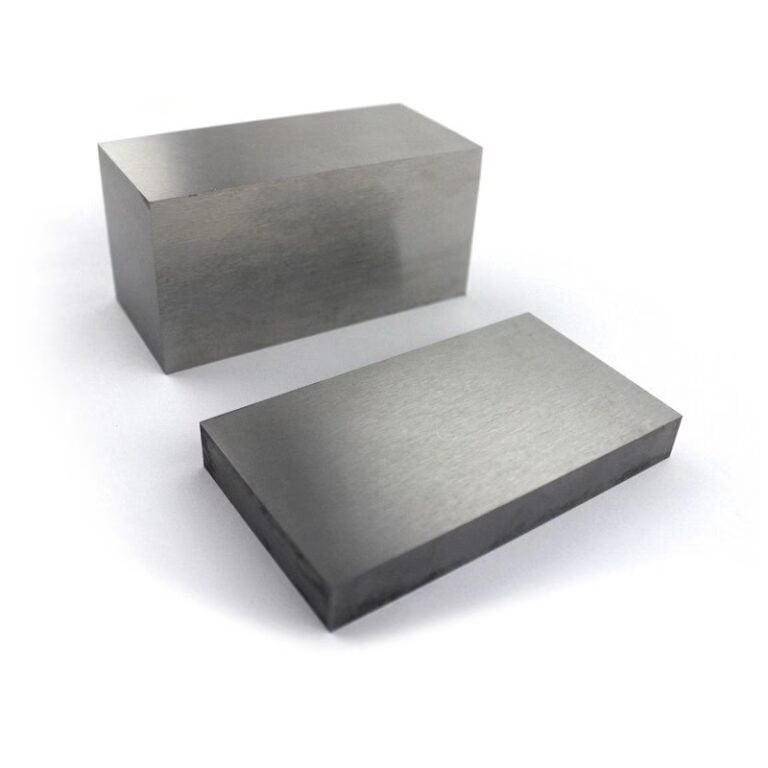
Mold Steel (P20 / 718 / NAK80 / H13 / S136)
Mold steel (P20 / 718 / NAK80 / S136 / H13) is specialty alloy steel for plastic injection moulds, die casting dies, and blow moulds. Pre-hardened HRC 28–40 supplied ready for CNC machining. Plate 10–400mm thick × up to 2000mm wide, round bar 20–600mm. ESR grade for mirror polish applications. Mill test certificate provided.
| Material | Pre-Hardened / Through-Hardening Alloy Mold Steel |
|---|---|
| Grade / Standard | AISI P20 / P20+Ni (718) / NAK80 / S136 (AISI 420 Modified) / H13 / DIN 2311 / 2312 / 2738 / 2344 |
| Diameter | Plate: 10–400mm thick × up to 2000mm wide / Round Bar: 20–600mm dia / Block: custom up to 50 tons |
| Length | Up to 6m (Round Bar) / Custom saw-cut lengths (Plate & Block per order) |
| Delivery Condition | as_rolled |
| Surface Treatment | coated |
| MOQ | 1 Piece (Custom Block) / 100 kg (Standard Plate & Bar) |
| Delivery Time | 15-35 Days (Stock Grades) / 30-50 Days (Custom Forging) |
| Loading Port | Tianjin / Shanghai / Qingdao |
Overview of Mold Steel
Mold steel is a broad category of specialty alloy steels engineered specifically for the fabrication of plastic injection moulds, blow moulds, compression moulds, rubber moulds, and die casting dies — the precision tooling that shapes the vast majority of polymer and light alloy components produced globally by the plastics processing, automotive, electronics, consumer goods, and medical device manufacturing industries. Unlike general structural steels or even standard tool steels, mold steels must simultaneously satisfy an unusually demanding combination of material properties: sufficient hardness for wear resistance against abrasive polymer fillers and glass fibres, excellent machinability in the annealed or pre-hardened condition to enable economical CNC machining and EDM (electrical discharge machining) of complex cavity geometries, high surface polishability to mirror finish (VDI 0, Ra ≤0.01μm) for optical and cosmetic part production, dimensional stability during heat treatment to maintain the tight tolerances established during cavity machining, adequate toughness to withstand injection pressure cycling without crack initiation, and in many applications corrosion resistance against moisture, acidic gases released by PVC and flame-retardant resins, and aggressive mould release agents.
Mold steels are standardised across national and proprietary designation systems — the most widely recognised international grades include AISI P20 (American standard, the global benchmark for pre-hardened general-purpose mould steel), AISI P20+Ni / 718 (nickel-modified P20 for enhanced toughness and polishability in large mould blocks), NAK80 (Japanese Daido Steel proprietary pre-hardened mould steel renowned for exceptional polishability and welding repair characteristics), S136 / AISI 420 modified (high-chromium stainless mould steel for corrosion-resistant applications), H13 (chromium hot work tool steel for die casting dies and high-temperature injection moulds), and 2344 / 2343 equivalents (European DIN designations for hot work mould applications). Pre-hardened mould steels — supplied at HRC 28–40 directly from the steel mill without requiring the mould maker to perform heat treatment — represent the dominant commercial form, as they eliminate the dimensional distortion risk of heat treating complex finished cavity blocks and simplify the mould making workflow from raw material to finished production tool.
Key Features and Manufacturing Process
Mold steels are produced through carefully controlled primary melting and secondary refining processes that achieve the inclusion cleanliness, chemical homogeneity, and microstructural uniformity essential for high-quality mould cavities. Standard quality mould steel is produced by electric arc furnace (EAF) melting, ladle refining with vacuum degassing (LF/VD), and ingot casting followed by heavy forging to refine the ingot structure and achieve the required cross-section — forging ratio typically 4:1 to 8:1 to ensure complete breakdown of the as-cast dendritic structure, uniform carbide distribution, and isotropic mechanical properties in all three principal directions. Premium quality mould steel undergoes ESR (Electroslag Remelting) as a secondary refining step, significantly reducing sulfur content (typically ≤0.003% vs ≤0.030% standard), eliminating macro-segregation, reducing non-metallic inclusion content to ASTM E45 rating A0–A1, and dramatically improving polishability — the latter being critical for mould grades such as NAK80 and S136 where mirror polish to VDI 0 is required for optical lens, automotive lighting, and cosmetic packaging applications.
Mold steels are supplied in multiple product forms tailored to mould making workflows. Pre-hardened plates are the dominant form for cavity blocks, core blocks, and insert materials, supplied in thicknesses from 10mm to 400mm, widths up to 2000mm, and custom lengths, at the specified hardness (typically HRC 28–34 for P20 grade, HRC 37–43 for NAK80 and 718H grades) ready for direct CNC machining without further heat treatment. Round bars in diameters from 20mm to 600mm serve as blanks for round inserts, cores, and cylindrical components. Flat bars and custom-forged blocks serve large injection mould frames, backing plates, and heavy automotive bumper and instrument panel mould applications. All mould steel production undergoes chemical composition analysis by optical emission spectrometry, hardness verification at multiple cross-section positions, ultrasonic testing per EN 10228-3 for internal defect detection, grain size assessment, and for premium ESR grades, inclusion rating per ASTM E45 with guaranteed polishability test results documenting surface finish achievable after standard polishing procedures.
Main Applications of Mold Steel
Plastic injection moulding tooling represents the dominant application for mould steel globally, with P20 and 718 grades used for medium to large injection moulds producing automotive interior trim components (dashboard panels, door trim inserts, centre consoles, pillar covers), automotive exterior parts (bumper fascias, grille assemblies, mirror housings), consumer electronics housings (laptop cases, tablet frames, smartphone covers, television bezels), home appliance components (washing machine panels, refrigerator drawers, air conditioning housings), packaging containers and closures, industrial equipment enclosures, and the full range of thermoplastic injection moulded parts produced in medium to high volumes where mould life of 500,000 to 1,000,000+ cycles is required. High-mirror-polish grades including NAK80 and S136 are specified for optical applications requiring surface finishes to VDI 0 — automotive clear lens headlight housings, tail light lenses, light guide plates for LCD displays, CD/DVD/Blu-ray disc moulds, optical lens blanks, transparent polycarbonate safety equipment, and premium cosmetic packaging for fragrance bottles and luxury goods containers.
Corrosion-resistant mould steel (S136, 1.2083, AISI 420) is the mandatory choice for processing corrosive resins including PVC (which releases hydrochloric acid during processing), fluoropolymers, flame-retardant ABS, halogen-containing engineering polymers, and hygroscopic resins in humid tropical manufacturing environments where standard mould steels would suffer rapid pitting corrosion in the mould cavity surface, causing surface defects in moulded parts and premature mould retirement. Die casting tooling for aluminium, zinc, and magnesium alloys is the primary hot work mould application, with H13 (SKD61, 4Cr5MoSiV1, 1.2344) serving as the standard material for die casting die cavities, cores, slides, and core pins at service temperatures of 150–300°C die face temperature. Other major applications include blow moulding tooling for bottles and containers (HDPE milk bottles, PET water bottles, automotive fuel tanks), thermoforming mould plates, rubber compression and transfer mould cavities, reaction injection moulding (RIM) tools for polyurethane structural parts, foam moulding tools, vacuum forming tools, rotational moulding tools, glass fibre reinforced composite lay-up and press moulds, SMC (sheet moulding compound) compression mould tools, powder injection moulding (PIM) tools for metal and ceramic powder processing, micro-injection moulding tools for miniaturised medical and electronic components, and multi-component injection moulding tools for over-moulded and two-shot parts in automotive and consumer goods applications.
Why Choose Us for Mold Steel
Shandong Tanglu Metal Material Co., Ltd. supplies premium mold steel sourced from major international and Chinese specialty steel producers including Buderus Edelstahl (Germany), Uddeholm (Sweden), Daido Steel (Japan), Finkl Steel (USA), and leading Chinese specialty steel mills, providing both internationally branded grades and cost-competitive Chinese equivalent grades to suit project budget and quality requirements. Every mold steel batch undergoes mandatory chemical composition analysis by optical emission spectrometry, hardness verification at multiple cross-section positions and depths per ASTM A370, ultrasonic testing per EN 10228-3 with quality class certification, grain size and carbide distribution microstructure inspection, and for premium ESR grades, inclusion rating per ASTM E45 and polishability qualification testing with documented surface finish results.
We offer a comprehensive mold steel range covering P20 / P20+S (free-machining), 718 / 718H / 718HH (nickel-modified P20 series), NAK80 / NAK55 (Japanese pre-hardened premium grades), S136 / S136H / 1.2083 (stainless mirror mold steel), H13 / SKD61 (hot work die casting grade), 2311 / 2312 / 2738 (European DIN equivalent grades), ASSAB grades (Viking, Stavax, Orvar, Corrax), and custom grade sourcing for proprietary branded steel specifications. Pre-hardened plates from 10mm to 400mm thickness with hardness certified at centre cross-section, ESR grade available for all major grades, and custom saw-cut, milled, or ground surface conditions. With established monthly supply capacity and export relationships with injection mould makers, die casting tooling companies, automotive mould manufacturers, blow mould producers, and mould base suppliers across more than 50 countries, we support packages from single prototype mould blocks to full series production mould steel programmes. Each shipment includes original mill test certificate per EN 10204 3.1, with EN 10204 3.2, ultrasonic testing reports, hardness survey data at multiple positions, and third-party inspection by SGS, Bureau Veritas, or TUV available for critical mould projects requiring enhanced quality documentation.
📐 Dimension & Size Table
| Grade | Application | Pre-Hardened Hardness (HRC) | After Full Heat Treatment (HRC) | Key Property |
|---|---|---|---|---|
| P20 / DIN 1.2311 | General plastic injection mould | 28–34 HRC (pre-hardened) | 50–54 HRC (optional full HT) | |
| P20+S (Free Cutting) | High-volume CNC machining | 28–34 HRC (pre-hardened) | 50–54 HRC (optional) | |
| 718 / DIN 1.2738 | Large mould, improved toughness | 28–34 HRC (pre-hardened) | 52–56 HRC (optional) | |
| 718H | Higher hardness large mould | 33–38 HRC (pre-hardened) | 54–58 HRC (optional) | |
| 718HH / 718S | Superior polishability large mould | 38–42 HRC (pre-hardened) | 54–58 HRC (optional) | |
| NAK80 | Mirror polish, weldable mould | 37–43 HRC (pre-hardened) | N/A (no further HT required) | |
| NAK55 | General pre-hardened, good polish | 40–45 HRC (pre-hardened) | N/A (no further HT required) | |
| S136 / DIN 1.2083 | Corrosive resin, mirror finish | Annealed ≤215 HBW | 48–52 HRC (after full HT) | |
| S136H (Pre-hardened) | Corrosion-resistant pre-hardened | 30–35 HRC (pre-hardened) | 48–52 HRC (optional) | |
| H13 / SKD61 / 1.2344 | Die casting, hot runner system | Annealed ≤229 HBW | 44–52 HRC (after HT) | |
| 2311 / 2312 (DIN) | European standard P20 equiv. | 28–34 HRC (pre-hardened) | 50–54 HRC (optional) | |
| 2344 / 2343 (DIN) | European hot work die casting | Annealed ≤229 HBW | 44–52 HRC (after HT) | |
| ASSAB Stavax ESR | Premium stainless mirror mould | Annealed ≤215 HBW | 50–54 HRC (after HT) |
* Custom sizes available upon request. Tolerances per relevant international standards.
🔬 Chemical Composition
| Element | Min | Max | Display Value | Note |
|---|---|---|---|---|
| C | 0.35 | 0.45 | 0.35–0.45 | P20 / 718 / 1.2738 — moderate C for pre-hardened condition balance of hardness and toughness |
| Si | 0.20 | 0.80 | 0.20–0.80 | Deoxidiser; NAK80 contains Al (0.05–0.10%) replacing Si for inclusion control |
| Mn | 1.30 | 1.60 | 1.30–1.60 | P20 / 718 hardenability element; through-hardening to large cross-sections |
| P | - | 0.030 | ≤0.030 | Strictly controlled for toughness in mould steel |
| S | - | 0.030 | ≤0.030 | P20+S free-machining grade: S 0.05–0.10% added for machinability |
| Cr | 1.80 | 2.10 | 1.80–2.10 | P20 / 718; S136 / 1.2083: Cr 12.00–14.00% for corrosion resistance and hardness |
| Mo | 0.30 | 0.55 | 0.30–0.55 | P20 / 718 hardenability and tempering resistance; H13: Mo 1.10–1.75% |
| Ni | 0.85 | 1.15 | 0.85–1.15 | 718 / 1.2738 only — Ni addition improves toughness and polishability vs standard P20 |
| V | - | 0.10 | ≤0.10 (residual) | H13 / SKD61: V 0.80–1.20% for hot hardness and grain refinement |
| Al | - | 0.10 | ≤0.10 | NAK80 proprietary grade: Al 0.05–0.10% for precipitation hardening and inclusion control |
| Cu | - | 1.00 | ≤1.00 | NAK80: Cu 0.80–1.20% for precipitation hardening response |
* Chemical composition may vary by heat, thickness and specification. Please refer to the actual mill test certificate.
⚙️ Mechanical Properties
| Property | Value | Unit | Test Condition |
|---|---|---|---|
| Hardness — P20 / 1.2311 (Pre-hardened) | 28–34 | HRC | Standard pre-hardened mould steel for general injection moulds; machinable with carbide tooling |
| Hardness — 718 / 1.2738 (Pre-hardened) | 28–34 | HRC | Large mould blocks with improved core toughness from Ni addition |
| Hardness — 718H (Pre-hardened) | 33–38 | HRC | Higher hardness pre-hardened for longer mould life in abrasive resin applications |
| Hardness — NAK80 (Pre-hardened) | 37–43 | HRC | Daido proprietary grade — exceptional mirror polishability and weld repair characteristics |
| Hardness — S136 / 1.2083 (After Q+T) | 48–52 | HRC | After full hardening at 1000–1050°C, temper at 200°C for mirror corrosion-resistant moulds |
| Hardness — S136H (Pre-hardened) | 30–35 | HRC | Pre-hardened stainless mould steel for corrosive resin without post-heat-treatment |
| Hardness — H13 / SKD61 (After Q+T) | 44–52 | HRC | After austenitizing 1020–1060°C, double temper at 550–620°C for die casting tooling |
| Tensile Strength — P20 (Pre-hardened) | 965–1,100 | MPa | Pre-hardened condition HRC 28–34 |
| Tensile Strength — 718 (Pre-hardened) | 965–1,100 | MPa | Pre-hardened condition HRC 28–34 |
| Impact Energy — P20 (Pre-hardened) | 40–60 | J | Charpy V-notch at room temperature, pre-hardened HRC 28–34 |
| Impact Energy — 718 / NAK80 (Pre-hardened) | 50–80 | J | Improved toughness from Ni / Cu / Al alloying vs standard P20 |
| Thermal Conductivity — P20 / 718 | 29–33 | W/m·K | At room temperature — governs mould cooling efficiency and cycle time |
| Density — P20 / 718 / NAK80 | 7.80 | g/cm³ | Reference value for mould weight calculation |
| Polishability — NAK80 / S136 ESR | VDI 0 (Ra ≤0.01μm) | Surface finish | Achievable mirror finish after standard polishing procedure — optical lens grade |
* Values shown are minimum requirements unless otherwise stated.
📦 Commercial Information
| Packaging | Standard seaworthy export packing for mould steel. Pre-hardened plates individually wrapped on all six faces with VCI (Volatile Corrosion Inhibitor) anti-rust paper to prevent oxidation of precision milled or ground surfaces during ocean transit, followed by polyethylene stretch film overwrap and edge protection with cardboard or foam corner guards. Plates stacked in bundles of 2–5 pieces with wooden dunnage separators (minimum 100mm thick) between layers to distribute load and prevent face-to-face contact damage; complete bundle secured with steel strapping (3–5 wraps) and positioned on timber export pallet. Round bars bundled with steel strapping (3–5 wraps), anti-rust oil applied to all bar surfaces, plastic end caps on both ends to protect bar bore and prevent moisture entry. Custom forged and saw-cut mould blocks (weight exceeding 1 ton per piece) packed individually in purpose-built wooden crates with internal steel angle iron corner protectors at all block edges, full VCI paper lining to all block faces, anti-rust oil on all machined surfaces, and external waterproof marine-grade plywood sheathing with moisture-absorbing desiccant sachets inside crate. Crate exterior stencilled with piece weight, gross weight, dimensions, handling instructions (DO NOT INVERT, FRAGILE SURFACE), and sling attachment points for safe crane lifting. For mirror-polished or precision ground surfaces, additional bubble wrap padding under VCI paper layer and foam edge protectors on all corners prevent surface damage from vibration during ocean freight. Each package tagged with grade designation, hardness value, heat number, dimensions (thickness × width × length in mm), weight (net and gross), delivery condition, and ESR designation where applicable. |
|---|---|
| Payment Terms | T/T (Telegraphic Transfer),L/C (Letter of Credit),D/P (Documents against Payment),Western Union,PayPal |
| Price Term | FOB,CFR,CIF,EXW |
| Supply Capacity | 500 Tons/Month (Premium Mold Steel) |
| Loading Port | Tianjin / Shanghai / Qingdao |
Why Choose Our Mold Steel (P20 / 718 / NAK80 / H13 / S136)?
Mill Certified Premium Mold Steel Quality
Mold steel supplied with original mill test certificate EN 10204 3.1/3.2 covering chemical composition by optical emission spectrometry, hardness verification at surface and multiple centre cross-section positions per ASTM A370, ultrasonic testing per EN 10228-3 quality class 3 or 4, inclusion rating per ASTM E45 for ESR grades, and complete metallurgical traceability from heat to finished product form.
Comprehensive Grade & Size Range
Full mold steel grade range from general P20 / 1.2311 through premium 718 / NAK80 / S136 / H13 in pre-hardened plate (10–400mm thick × up to 2000mm wide), round bar (20–600mm diameter), flat bar, and custom forged block (up to 50 tons). ESR premium grade available for mirror polish optical and cosmetic mould applications.
Pre-Hardened HRC 28–43 Ready for Machining
Pre-hardened mold steel supplied at certified hardness HRC 28–34 (P20 / 718) or HRC 37–43 (NAK80 / 718H) ready for direct CNC milling and EDM without further heat treatment — eliminating distortion risk, reducing mould making lead time, and enabling mould cavity machining with standard carbide tooling at lower cost than through-hardened tool steels.
Multi-Grade International Standard Coverage
AISI P20, P20+Ni (718), NAK80, NAK55, S136 / 1.2083 stainless, H13 / SKD61, DIN 1.2311 / 1.2312 / 1.2738 / 1.2344 / 1.2343, ASSAB equivalent grades, and Chinese GB 3Cr2Mo / 3Cr2MnNiMo / 4Cr13 equivalents available. Both international branded grades and cost-competitive equivalent grades supplied to suit project requirements.
Fast Dispatch from Mold Steel Stock
Common P20, 718, S136H, and H13 grades in standard thicknesses maintained in stock for 15–25 days dispatch. Custom saw-cut dimensions from stock plates within 5–10 working days. Custom forging production 30–50 days. Established export logistics handling mould steel blocks up to 50 tons per piece via flat-rack container or break-bulk vessel to mould makers worldwide.
🏭 Applications of Mold Steel (P20 / 718 / NAK80 / H13 / S136)
Mold steel serves as the fundamental structural and functional material for the complete spectrum of polymer and light alloy processing tooling, enabling the mass production of billions of precision plastic and die-cast metal components annually across virtually every manufacturing sector. Plastic injection moulding tooling is by far the dominant application, with P20 and 718 pre-hardened grades forming cavity blocks, core blocks, lifters, sliders, and insert components in medium to large injection moulds producing automotive interior trim systems including full dashboard assemblies, door trim panels, pillar covers, centre console boxes, glove box assemblies, and seat back panels for passenger vehicles; automotive exterior components including bumper fascias, grille assemblies, rocker panels, wheel arch liners, and mirror housings; consumer electronics housings for laptops, tablets, smartphones, wearable devices, gaming consoles, and personal care appliances; home appliance structural and cosmetic components for washing machines, refrigerators, dishwashers, air conditioners, and microwave ovens; industrial equipment enclosures, instrument panels, and structural covers for manufacturing and agricultural machinery; medical device housings and disposable component tools for syringes, blood glucose meters, inhalers, and diagnostic equipment; and the complete range of thermoplastic injection moulded industrial and consumer components manufactured in production volumes of 50,000 to 10,000,000+ pieces per year where mould life of 500,000 to 2,000,000 cycles is the economic basis of tooling investment. NAK80 and S136 ESR mirror-polish grades serve the optical and cosmetic premium segment including automotive clear lens headlight and tail light housings requiring VDI 0 mirror finish for optical clarity, light guide plate moulds for LCD and OLED display backlight systems, precision optical lens blanks for cameras, microscopes, and spectacles, CD / DVD / Blu-ray optical disc stamper moulds, premium cosmetic packaging moulds for fragrance bottle caps, lipstick cases, and luxury goods containers requiring flawless Class A surface finish, and transparent polycarbonate protective equipment including safety visors, goggles, and helmet visors. Corrosion-resistant S136 / 1.2083 stainless mould steel is mandatory for processing chemically aggressive resins including rigid PVC (which releases corrosive HCl gas at processing temperature of 180–200°C), flexible PVC for medical tubing and cable insulation, fluoropolymers (PTFE, PVDF, FEP) for chemical-resistant components, flame-retardant engineering polymers including brominated ABS, PC/ABS blends, and halogen-containing polyamides used in automotive and electronics applications, and hygroscopic resins processed in high-humidity tropical manufacturing environments where condensation on mould surfaces between cycles causes pitting corrosion on unprotected cavity steel. Hot work mould applications employing H13 and DIN 1.2344 include aluminium high-pressure die casting dies for automotive powertrain components, structural castings, and consumer electronics housings; zinc die casting dies for hardware, fasteners, decorative fittings, and automotive components; hot runner manifold blocks and nozzle bodies for injection mould hot runner systems operating at 200–350°C; blow moulding tooling for HDPE and PP bottles and containers; thermoforming moulds for packaging trays; and compression moulding tools for SMC and GMT glass-reinforced structural automotive components.
📋 Quality & Certification
Our Certifications
- ✅ ISO 9001:2015
- ✅ CE Marking
- ✅ ABS
- ✅ DNV GL
- ✅ Lloyd's Register (LR)
- ✅ Bureau Veritas (BV)
- ✅ SGS Certified
- ✅ RINA
Mill Certificate Type
- 📋 EN 10204 3.1
- 📋 EN 10204 3.2
- 📋 Original Mill Certificate
- 📋 Third Party Inspection Available
- 📋 Certificate of Origin
❓ Frequently Asked Questions
What is mold steel and how does it differ from standard tool steel and structural steel?
Mold steel is a specialised category of alloy steel engineered specifically for the fabrication of plastic injection moulds, die casting dies, blow moulds, and compression moulds — the precision tooling that produces polymer and light alloy components. Mold steel differs from standard structural steel (S355, Q345) in several fundamental ways: mold steel is produced to much tighter chemical composition tolerances with strict control of residual elements, undergoes secondary refining (LF/VD vacuum degassing, or ESR for premium grades) to achieve high inclusion cleanliness essential for polishability, and is supplied in pre-hardened condition (HRC 28–43) or with guaranteed through-hardening response — properties entirely absent from structural steel. Compared to general tool steels (H13, D2, O1), mold steels are specifically optimised for the unique combination of properties required by the mould making process: pre-hardened condition enabling direct CNC machining of complex cavity geometries without post-hardening distortion, superior polishability to achieve VDI 0 mirror finish for optical applications, weldability in pre-hardened condition for mould cavity repair without cracking, and adequate toughness under cyclic injection pressure loading (typically 50–200 MPa cavity pressure in injection moulding). The pre-hardened supply condition is the defining commercial characteristic of mold steels — it eliminates the heat treatment step from the mould making workflow, reduces distortion risk in finished cavities, and allows mould makers to begin cavity machining immediately upon material receipt without additional processing.
What is the difference between P20, 718, NAK80, and S136 mold steel grades?
These four grades represent distinct positions in the mold steel hierarchy, each optimised for different application requirements and performance levels. P20 (AISI P20, DIN 1.2311, GB 3Cr2Mo) is the baseline general-purpose pre-hardened mold steel with 0.35–0.45% C, 1.80–2.10% Cr, 0.30–0.55% Mo, supplied at HRC 28–34 for medium-sized injection moulds of standard engineering thermoplastics (PP, ABS, PA, POM) in production volumes of 200,000–500,000 cycles. P20 is the most economical and widely available mold steel and is the benchmark against which all other grades are compared. 718 (DIN 1.2738, also called P20+Ni) adds 0.85–1.15% nickel to the P20 composition, significantly improving toughness and core hardness uniformity in large cross-section mould blocks (thickness >400mm) where P20 core hardness falls below acceptable minimums — 718 is specified for large automotive bumper, instrument panel, and exterior trim moulds where block thicknesses exceed 400mm and uniform mechanical properties through the entire block cross-section are required. NAK80 (Daido Steel proprietary grade) is a precipitation-hardening pre-hardened mold steel containing copper (0.80–1.20%) and aluminium (0.05–0.10%) in addition to the chromium-molybdenum base, achieving HRC 37–43 pre-hardened condition with exceptional mirror polishability (VDI 0–1 achievable), excellent weld repair characteristics in pre-hardened condition without preheating, and superior resistance to surface etching during EDM — making it the preferred grade for high-appearance automotive headlight, tail light, and Class A interior trim moulds. S136 (ASSAB designation, equivalent DIN 1.2083, AISI 420 modified) is a high-chromium (12–14% Cr) stainless mold steel providing genuine corrosion resistance against PVC, fluoropolymer, and flame-retardant resin processing environments, supplied annealed for full hardening to HRC 48–52 or in pre-hardened S136H condition at HRC 30–35, with excellent mirror polishability for optical and cosmetic mould applications in corrosive environments.
What is the difference between standard quality and ESR grade mold steel, and when is ESR required?
ESR (Electroslag Remelting) is a secondary refining process that dramatically improves mold steel cleanliness, homogeneity, and polishability beyond what standard EAF + LF/VD production can achieve, and represents the quality standard for premium optical and cosmetic mould applications. Standard quality mold steel is produced by electric arc furnace melting, ladle refining with vacuum degassing, and ingot casting followed by forging — providing acceptable quality for general injection moulding of opaque engineering thermoplastics where VDI 12 or coarser surface finish is sufficient and tool life of 500,000 cycles is adequate. ESR grade mold steel subjects the standard ingot to secondary remelting through a controlled liquid slag bath, achieving: dramatically reduced sulfur content (typically ≤0.003% vs ≤0.030% standard), creating fewer and smaller sulfide inclusions that cause pitting and scratching during polishing; reduced non-metallic inclusion content rated A0 per ASTM E45, enabling polishing to VDI 0 (Ra ≤0.01μm) without inclusion-induced surface defects interrupting the mirror finish; more uniform carbide distribution eliminating carbide banding visible on polished surfaces; and improved ultrasonic testability achieving EN 10228-3 quality class 4, enabling full volumetric verification of large mould blocks. ESR grade is specified when: mirror polish to VDI 0–3 is required for optical or cosmetic applications; mould cavities will be used for transparent or translucent parts (clear PC, PMMA, PET) where any sub-surface imperfection reflects as a visual defect in the moulded part; photo-etching or texturing of mould cavities requires uniform steel microstructure for consistent texture depth and appearance; electrical discharge machining (EDM) of fine cavity detail requires homogeneous steel structure for uniform EDM performance and surface quality; or extended mould life exceeding 1,000,000 cycles is required for high-volume automotive production tools. ESR grade commands a 40–80% price premium over standard quality but is economically justified by the extended polishing life, reduced polishing labour cost, and elimination of costly tool rework from inclusion-induced polishing defects.
How do I select the correct mold steel grade for my injection mould application?
Mold steel grade selection involves evaluating five key parameters: resin type, mould size, required surface finish, production volume, and budget. Resin type is the first filter — if processing corrosive resins (PVC, fluoropolymers, flame-retardant ABS, halogen-containing compounds), S136 / 1.2083 stainless mold steel is mandatory regardless of other factors to prevent cavity pitting corrosion that ruins part surface quality. For abrasive resins with high glass fibre or mineral filler content (PA66+GF30%, PPS+GF40%, glass-filled PEEK), higher hardness grades (NAK80 HRC 37–43, or fully hardened S136 HRC 48–52) reduce cavity wear and extend mould life compared to softer P20 HRC 28–34. Mould size is the second critical factor — P20 can be through-hardened to HRC 28–34 in cross-sections up to approximately 400mm; for larger mould blocks (automotive bumper moulds, instrument panel moulds, large exterior trim moulds with cavity block thickness 400–800mm), 718 / 1.2738 with nickel addition is specified to ensure adequate core toughness and uniform hardness through the full block cross-section. Required surface finish drives the polishability requirement — standard engineering thermoplastic parts with VDI 12–18 texture can use P20 standard quality; glossy appearance parts (VDI 3–6) require 718 or NAK80 standard quality; mirror finish transparent or optical parts (VDI 0–1) require NAK80 ESR or S136 ESR grade. Production volume determines the minimum hardness and quality level — prototype and short-run moulds (< 50,000 cycles) may use lower-hardness P20 or even pre-hardened mild steel; medium production (50,000–500,000 cycles) suits standard P20 or 718; high production (500,000–2,000,000+ cycles) justifies NAK80, 718H, or S136 grades. Budget is the final constraint — P20 is most economical, 718 carries 15–25% premium, NAK80 25–50% premium, S136 50–80% premium, and ESR grades add 40–80% to standard grade pricing.
What product forms and sizes are available for mold steel, and can custom dimensions be supplied?
Mold steel is supplied in multiple product forms precisely matched to the mould making workflow. Pre-Hardened Plates are the dominant product form for cavity blocks and core blocks, available in standard thicknesses of 10, 15, 20, 25, 30, 40, 50, 60, 70, 80, 90, 100, 120, 150, 160, 180, 200, 250, 300, 350, and 400mm, widths from 400mm to 2000mm, and lengths from 400mm to 3000mm (standard mill lengths), certified to specified hardness at surface and verified at block centre. Custom saw-cut dimensions to within ±2mm tolerance are available from standard plate stock, with minimum 5–10 working days processing time for standard grades. Round Bars are produced in diameters from 20mm to 600mm in standard mill lengths up to 6 metres and custom cut lengths, in pre-hardened or annealed condition, for round inserts, core pins, cylindrical cavity components, and rotating cores in stack moulds. Flat Bars (rectangular bars) in thickness from 10mm to 250mm and width from 50mm to 1200mm serve as blanks for rectangular mould inserts, side actions, and cavity components where the flat bar cross-section closely matches the finished component geometry, minimising machining waste. Custom Forged Blocks are produced to customer-specified dimensions for very large single-piece mould cavity blocks (automotive bumper moulds, instrument panel moulds) that exceed standard plate dimensions, with forging dimensions up to 2500×1800×700mm and piece weights up to 50 tons. Custom forging with rough machined faces (5–10mm machining allowance per face), guaranteed through-hardness at centre cross-section, and full ultrasonic testing is available. Value-added services including CNC face milling to specified flatness (≤0.1mm over full face), precision surface grinding (Ra 0.8–1.6μm), mirror polishing, and EDM surface preparation are available for projects requiring minimal machining work by the mould maker. Custom marking including laser etching of grade, hardness, heat number, and customer part number on each piece is available for supply chain traceability in high-volume mould making operations.
Get a Quote for
Mold Steel (P20 / 718 / NAK80 / H13 / S136)
Submit your requirements and receive a competitive price quote within 24 hours.
- ✓ Fast response within 24 hours
- ✓ Competitive factory-direct pricing
- ✓ Free technical consultation
- ✓ Mill test certificate provided
- ✓ Flexible payment terms available
⏱ Response within 24 hours
Send Your Inquiry
All fields marked with * are required