
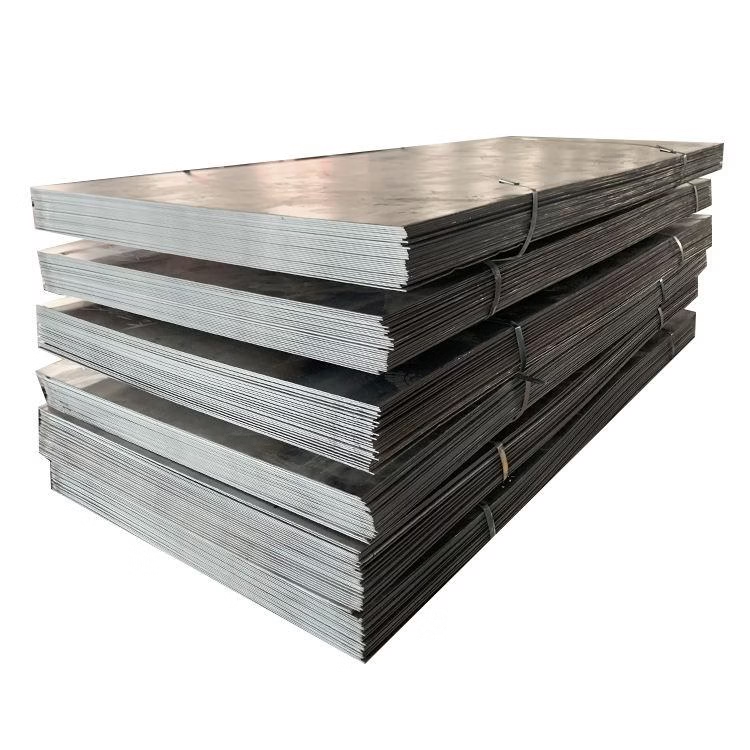
Grade E Shipbuilding Steel Plate
Grade E is a common-strength marine structural steel (235 MPa yield) certified for shipbuilding with guaranteed impact toughness at -40°C.
| Material | Common Strength Shipbuilding Steel (Extra Low Temp) |
|---|---|
| Grade / Standard | IACS Grade E / ASTM A131 |
| Thickness | 6mm - 150mm |
| Width | 1500mm - 4020mm |
| Length | 3000mm - 18000mm |
| Delivery Condition | hot_rolled / normalized / tmcp |
| Surface Treatment | shot_blasting / painting |
| MOQ | 1 Piece / 5 Tons |
| Delivery Time | 15-30 Days / In Stock |
| Loading Port | Tianjin / Shanghai / Qingdao |
Overview of Grade E Shipbuilding Steel Plate
Grade E shipbuilding steel is a high-integrity, common-strength structural steel plate certified by the IACS (International Association of Classification Societies). While it shares the same 235 MPa minimum yield strength as Grades A, B, and D, Grade E represents the pinnacle of low-temperature toughness for common-strength ship plates. The defining requirement for Grade E is mandatory impact toughness testing at -40°C, ensuring that the material retains its ductile properties and resists brittle fracture in extreme sub-zero maritime environments. This makes it an indispensable material for the most critical hull structures of vessels operating in arctic or sub-arctic shipping routes.
Shandong Tanglu Metal Material Co., Ltd. supplies premium Grade E plates certified by all major global classification societies, including ABS, LR, BV, DNV, and CCS. Our Grade E steel is strictly produced using advanced grain refinement practices and is typically delivered in a Normalized or Thermo-Mechanical Control Process (TMCP) condition to ensure a uniform, fine-grain microstructure. For B2B procurement in the energy and maritime sectors, our Grade E plates provide a reliable, high-safety solution for hull plating, main decks, and structural components requiring guaranteed performance in the world’s harshest maritime climates.
Key Features and Extreme Low-Temperature Advantages
The primary advantage of Grade E shipbuilding steel is its exceptional notch toughness at -40°C. According to IACS standards, Grade E plates must achieve significant energy absorption levels during Charpy V-notch testing at extra-low temperatures. This provides the highest safety margin in the common-strength series, making it suitable for safety-critical zones of the hull that may be exposed to high stress and extreme cold. The material’s chemistry is meticulously balanced with a low Carbon Equivalent (CEV), offering outstanding weldability. This allows for high-efficiency fabrication of thick hull sections while ensuring that welded joints remain as tough as the parent metal.
In terms of fabrication, Grade E steel demonstrates superior workability and reliability. It is ideal for precision CNC cutting, cold forming, and rolling, maintaining its specialized mechanical properties during shipyard construction. Every plate is delivered with original Mill Test Certificates (MTC) and can be ordered with Sa2.5 shot-blasting and high-performance shop-primer coating to prevent oxidation during storage and assembly. By choosing Tanglu’s Grade E steel, maritime project managers secure a globally certified material that guarantees the ultimate structural safety for vessels in extreme maritime service.
Main Applications of Grade E Steel Plate
Grade E shipbuilding steel is a foundational material for high-integrity maritime structures operating in extreme environments. It is primarily used for the construction of hulls, decks, and structural bulkheads for polar-class vessels, ice-strengthened merchant ships, and tankers operating in high-latitude regions. Its superior -40°C toughness makes it the standard choice for the most critical structural areas where standard grades might fail due to low-temperature embrittlement.
Beyond traditional hulls, Grade E is widely utilized in the offshore industry for structural components on drilling platforms, production modules, and offshore wind turbine foundations in arctic or sub-arctic locations. It is also an essential material for marine equipment that must withstand high impact loads and thermal stresses in extreme cold, such as deck machinery, ice-belts, and specialized subsea components. Due to its proven track record and specialized -40°C certification, Grade E remains the trusted global standard for high-safety, extra low-temperature marine structural engineering.
📐 Dimension & Size Table
| Thickness (mm) | Width (mm) | Length (mm) | Weight (kg/m²) |
|---|---|---|---|
| 10 | 2000 | 6000-12000 | 78.5 |
| 16 | 2500 | 6000-12000 | 125.6 |
| 20 | 2500 | 6000-12000 | 157.0 |
| 40 | 3000 | 6000-12000 | 314.0 |
| 60 | 2500 | 6000-12000 | 471.0 |
| 100 | 2000 | 6000 | 785.0 |
| 150 | 2000 | 4000 | 1177.5 |
* Custom sizes available upon request. Tolerances per relevant international standards.
🔬 Chemical Composition
| Element | Min | Max | Display Value | Note |
|---|---|---|---|---|
| C | - | 0.18 | ≤0.18 | Based on grade |
| Mn | 0.70 | - | ≥0.70 | Impact test requirement |
| Si | 0.10 | 0.35 | 0.10-0.35 | Fully killed |
| P | - | 0.030 | ≤0.030 | Low impurity |
| S | - | 0.030 | ≤0.030 | Low impurity |
| Al (Total) | 0.020 | - | ≥0.020 | Fine grain requirement |
* Chemical composition may vary by heat, thickness and specification. Please refer to the actual mill test certificate.
⚙️ Mechanical Properties
| Property | Value | Unit | Test Condition |
|---|---|---|---|
| Yield Strength | ≥235 | MPa | t ≤ 50mm |
| Tensile Strength | 400 - 520 | MPa | - |
| Elongation | ≥22 | % | High ductility |
| Impact Test | -40°C | KV2 / J | ≥27J (Longitudinal) |
* Values shown are minimum requirements unless otherwise stated.
📦 Commercial Information
| Packaging | Seaworthy export packaging, typically featuring Sa2.5 shot-blasting and red/grey shop primer for immediate shipyard assembly in arctic regions. |
|---|---|
| Payment Terms | T/T (Telegraphic Transfer),L/C (Letter of Credit),D/P (Documents against Payment),Western Union,PayPal |
| Price Term | FOB / CFR / CIF / EXW |
| Supply Capacity | 15,000 Tons/Month |
| Loading Port | Tianjin / Shanghai / Qingdao |
Why Choose Our Grade E Shipbuilding Steel Plate?
Extra Low Temp Safety (-40°C)
Guaranteed impact toughness at -40°C, providing the ultimate safety margin for hulls in arctic waters.
IACS Global Certification
Full certification from global societies (ABS, LR, BV, DNV, CCS) for worldwide marine compliance.
Common Strength Arctic Standard
The highest toughness grade in the 235 MPa yield series for critical maritime structural safety.
Optimized Weldability (Low CEV)
Specifically micro-alloyed to ensure high-quality welding and ease of fabrication in shipyard environments.
Shipyard-Ready Protection
Automated shot-blasting and high-performance primer coating services available to ensure immediate assembly.
Full Traceability MTC 3.1
Every shipment includes original Mill Test Certificates documenting chemical, mechanical, and -40°C impact compliance.
🏭 Applications of Grade E Shipbuilding Steel Plate
Grade E is the industry standard for extra-low temperature maritime safety, essential for arctic-rated hulls, decks, and offshore modules.
📋 Quality & Certification
Our Certifications
- ✅ ISO 9001:2015
- ✅ CE Marking
- ✅ ABS
- ✅ DNV GL
- ✅ Lloyd's Register (LR)
- ✅ Bureau Veritas (BV)
- ✅ SGS Certified
Mill Certificate Type
- 📋 EN 10204 3.1
- 📋 EN 10204 3.2
- 📋 Original Mill Certificate
- 📋 Third Party Inspection Available
- 📋 Certificate of Origin
❓ Frequently Asked Questions
What is the primary difference between Grade D and Grade E?
Grade D is impact tested at -20°C, while Grade E is tested at -40°C, offering a much higher safety margin for extreme cold climates.
Is Grade E steel used for icebreakers?
Yes, Grade E is a primary material for the hulls and internal structures of ice-strengthened vessels operating in arctic environments.
At what temperature is Grade E impact tested?
According to IACS and society rules, Grade E is tested for impact toughness at -40°C.
Which classification societies certify your Grade E steel?
We supply Grade E certified by all major IACS members, including ABS, LR, BV, DNV, CCS, NK, and KR.
What heat treatment is standard for Grade E?
Grade E is typically delivered in a Normalized (N) or Thermo-Mechanical Control Process (TMCP) condition to achieve its extra-low temperature toughness.
Get a Quote for
Grade E Shipbuilding Steel Plate
Submit your requirements and receive a competitive price quote within 24 hours.
- ✓ Fast response within 24 hours
- ✓ Competitive factory-direct pricing
- ✓ Free technical consultation
- ✓ Mill test certificate provided
- ✓ Flexible payment terms available
⏱ Response within 24 hours
Send Your Inquiry
All fields marked with * are required