Introduction
When sourcing carbon steel plates for construction, fabrication, or manufacturing projects, international buyers frequently encounter three names: ASTM A36, GB Q235B, and EN S235JR. These are the most widely produced and traded structural carbon steel grades globally, accounting for over 60% of worldwide carbon steel plate consumption. While they share many similarities and are often considered “equivalent” grades, important differences in chemical composition, mechanical properties, testing requirements, and pricing can significantly impact your project’s cost, compliance, and performance.
This comprehensive comparison guide will help you understand the key differences between these three grades and select the right material for your specific application.
What Are ASTM A36, Q235B, and S235JR?
ASTM A36 is the most widely specified carbon structural steel in the United States and North America, defined by ASTM International standard A36/A36M. It was first standardized in 1960 and has become the global benchmark for general-purpose structural steel applications. A36 is named after its minimum yield strength of 36,000 psi (approximately 250 MPa).
GB Q235B is the corresponding Chinese national standard grade defined under GB/T 700. The “Q” stands for “Qufu Diandian” (yield strength), “235” represents the minimum yield strength in MPa, and “B” indicates the impact toughness rating tested at +20°C. Q235B has been the workhorse of Chinese construction since the standard’s introduction and is the most commonly exported Chinese carbon steel grade.
EN S235JR is the European standard equivalent specified under EN 10025-2. The “S” indicates structural steel, “235” represents minimum yield strength in MPa, and “JR” indicates impact testing at room temperature with minimum 27J Charpy V-notch energy. S235JR is widely used throughout Europe and in projects following European building codes worldwide.
All three grades fall into the category of mild carbon structural steel with minimum yield strength of approximately 235-250 MPa, suitable for general structural fabrication, machinery construction, and welded structures requiring moderate strength and excellent weldability.
Chemical Composition Comparison
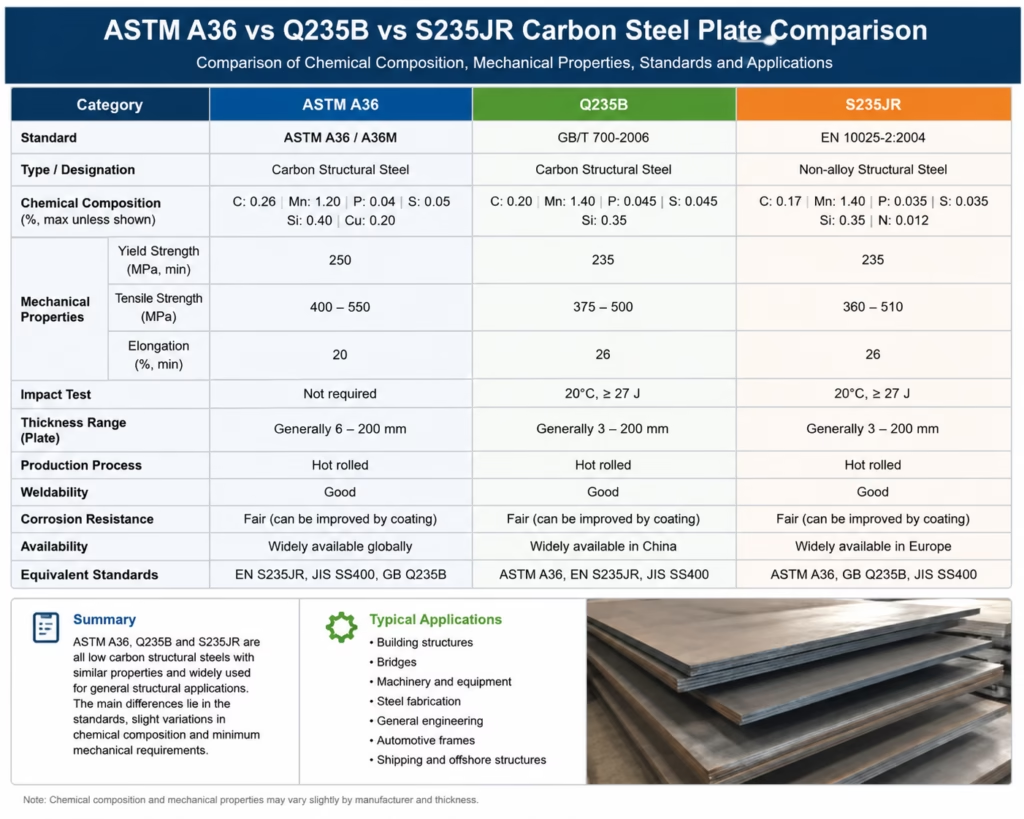
Understanding the chemical composition differences is critical because they directly affect weldability, mechanical properties, and corrosion behavior.
| Element | ASTM A36 | GB Q235B | EN S235JR |
|---|---|---|---|
| Carbon (C) | ≤0.26% | ≤0.20% | ≤0.17% |
| Manganese (Mn) | 0.80-1.20% | ≤1.40% | ≤1.40% |
| Phosphorus (P) | ≤0.040% | ≤0.045% | ≤0.040% |
| Sulfur (S) | ≤0.050% | ≤0.045% | ≤0.040% |
| Silicon (Si) | ≤0.40% | ≤0.35% | – |
| Copper (Cu) | ≥0.20% (when specified) | ≤0.30% | ≤0.55% |
Key observations:
- S235JR has the lowest carbon content (≤0.17%), providing the best weldability and most consistent properties for thick sections requiring extensive welding
- A36 allows the highest carbon content (≤0.26%), offering slightly higher strength potential but requiring more careful welding procedures for thicker sections
- Q235B sits in the middle with carbon ≤0.20%, balancing weldability and strength
- All three grades have similar phosphorus and sulfur limits, ensuring acceptable formability and impact resistance
For applications requiring extensive welding (especially in thick sections over 25mm), the lower carbon content of S235JR provides the best welding performance with minimal preheating requirements.
Mechanical Properties Comparison
The mechanical properties determine load-bearing capacity and structural performance.
| Property | ASTM A36 | GB Q235B | EN S235JR |
|---|---|---|---|
| Yield Strength (Min) | ≥250 MPa (36 ksi) | ≥235 MPa | ≥235 MPa |
| Tensile Strength | 400-550 MPa (58-80 ksi) | 375-500 MPa | 360-510 MPa |
| Elongation (Min) | ≥20% | ≥26% | ≥26% |
| Impact Energy | Not required | ≥27J at +20°C | ≥27J at +20°C |
| Bending Test | 180° (d=2t) | 180° (d=t) | 180° (d=t) |
Key observations:
- A36 has the highest minimum yield strength at 250 MPa vs 235 MPa for the other two
- Q235B and S235JR have higher minimum elongation at 26% vs A36’s 20%, indicating better ductility for forming applications
- A36 does not have mandatory impact testing requirements in its base specification, while Q235B and S235JR include Charpy V-notch impact testing at +20°C ensuring minimum 27J energy
- Tensile strength ranges are similar across all three grades
For projects in cold climates or applications requiring guaranteed impact toughness, S235JR or Q235B with their mandatory impact testing provide better assurance of cold-weather performance than A36 without specified impact requirements.
Quality Variants and Sub-Grades
Each grade has variants for different impact testing requirements and quality levels:
ASTM A36 variants:
- A36 (standard) – No impact testing required
- A36 with supplementary impact testing – Available upon request
GB Q235 variants:
- Q235A – No mandatory impact testing
- Q235B – Impact testing at +20°C, minimum 27J (most common export grade)
- Q235C – Impact testing at 0°C, minimum 27J
- Q235D – Impact testing at -20°C, minimum 27J (cold service)
EN S235 variants:
- S235JR – Impact testing at +20°C, minimum 27J (most common)
- S235J0 – Impact testing at 0°C, minimum 27J
- S235J2 – Impact testing at -20°C, minimum 27J (cold service)
- S235JRG2 – Older designation, similar to S235JR
For projects requiring service in cold climates (below -10°C ambient temperature), specify Q235C/D or S235J0/J2 grades with appropriate cold-temperature impact testing rather than the standard JR/B grades.
Application Comparison
While all three grades serve general structural purposes, regional preferences and code requirements often dictate selection:
ASTM A36 is preferred for:
- North American construction projects following AISC, ACI, or building codes
- Projects requiring AISC Steel Construction Manual compliance
- Bridge construction in the United States and Canada
- Industrial facilities in countries adopting American standards
- Mexico, Caribbean, and many Latin American markets following American standards
- Applications requiring W-shape (American Wide Flange) sections
GB Q235B is preferred for:
- Construction projects in China and countries adopting Chinese standards
- Belt and Road Initiative (BRI) infrastructure projects
- African and Southeast Asian projects with Chinese contractors
- Cost-sensitive applications where Chinese pricing is competitive
- Projects requiring large quantities with shorter lead times (China has the largest Q235B production capacity globally)
- General fabrication where cost is the primary driver
EN S235JR is preferred for:
- European Union construction projects (mandatory CE marking under EN 1090)
- Projects following Eurocodes (EN 1993 – Eurocode 3 for steel structures)
- Middle East and North African projects with European consultants
- Australian and South African projects (based on European standards)
- Applications requiring strict CE certification compliance
Welding Considerations
All three grades offer excellent weldability, but with subtle differences:
ASTM A36:
- Excellent weldability for sections up to 25mm without preheating
- Sections over 25mm may require preheating (especially with higher carbon content)
- Compatible with E60xx and E70xx series electrodes (SMAW), ER70S series (GMAW)
- Carbon equivalent (CE) typically 0.35-0.45 depending on chemistry
GB Q235B:
- Good weldability for sections up to 30mm without preheating
- Compatible with E50xx series electrodes (Chinese designation, equivalent to E70xx)
- Lower carbon content than A36 provides slightly easier welding
- Carbon equivalent typically 0.30-0.40
EN S235JR:
- Best weldability among the three grades due to lowest carbon content
- Sections up to 30mm typically require no preheating
- Compatible with all standard mild steel welding consumables
- Carbon equivalent typically 0.25-0.35
- Minimum requirements per EN ISO 5817 quality levels
For critical welded structures, S235JR offers the best welding performance, especially for thick sections or projects requiring multiple welding procedures.
Pricing Comparison
Pricing varies significantly based on origin, quantity, and market conditions, but general patterns can be identified:
Typical price hierarchy (FOB China port):
- GB Q235B: Most economical (baseline 100%)
- ASTM A36: 5-15% premium over Q235B
- EN S235JR: 8-20% premium over Q235B
Why pricing differs:
- Q235B benefits from massive Chinese production capacity (over 100 million tons annually) and lower production costs
- A36 produced in China requires testing to American standards (slightly higher QC costs)
- S235JR produced in China requires CE certification documentation and EN testing protocols (highest documentation costs)
- European-produced S235JR costs 30-50% more than Chinese-produced equivalent grade
Cost optimization tips:
- For projects accepting any of the three equivalent grades, specify “Q235B or equivalent” to maximize supplier flexibility and lower pricing
- Order Chinese-produced A36 or S235JR if your project requires those specifications but cost is critical
- Consider mill direct purchasing for orders over 100 tons to reduce middleman markups
- Verify mill test certificates carefully when purchasing Chinese-produced A36 or S235JR to ensure proper testing protocols were followed
Practical Selection Guide
Use this decision framework to select the right grade for your project:
Choose ASTM A36 when:
- Your project must comply with American building codes (AISC, IBC, ACI)
- You’re sourcing for the North American market
- Your design uses American sections (W-shape, S-shape, C-shape)
- Your engineering team is most familiar with imperial units and ASTM standards
- The project is in a country adopting American standards (Mexico, Caribbean, parts of Middle East)
Choose GB Q235B when:
- Cost is the primary decision factor
- Your project doesn’t require specific certification beyond mill test certificate
- You’re sourcing from China with shorter lead times
- The project is in China, Africa, or Southeast Asia
- You need large quantities (100+ tons) with reliable supply
- Your end-use specification accepts equivalent grades
Choose EN S235JR when:
- Your project must comply with European codes and CE marking requirements
- You’re supplying to EU markets (mandatory under EN 1090)
- Your engineering follows Eurocodes (EN 1993)
- Critical welded structures require best weldability
- The project is in Europe, Middle East with European consultants, or following European standards
Common Misconceptions
“They are 100% identical” – False. While the three grades have similar properties and are often used interchangeably, the specific chemical composition limits, mandatory testing requirements, and quality variants differ. Always verify the specific requirements of your project before substituting one grade for another.
“A36 is always the best because it’s American” – False. None of these grades is inherently “better” – they are designed for similar applications under different national standards. The right grade depends on your project’s code requirements, location, cost considerations, and specific performance needs.
“Chinese Q235B is lower quality” – False. Modern Q235B from major Chinese mills (Baosteel, HBIS, Shougang) meets or exceeds international quality standards and is widely used in major international infrastructure projects. The key is selecting reputable suppliers with proper mill test certificates and quality documentation.
“S235JR cannot be used in cold climates” – Partially true. The standard S235JR has impact testing at +20°C only, not suitable for service below -10°C ambient temperature. For cold climate applications, specify S235J0 (0°C testing) or S235J2 (-20°C testing) variants instead.
Frequently Asked Questions
Q: Can I substitute A36 with Q235B in my project?
A: In many cases yes, but always verify with your project engineer and ensure the substitution complies with applicable building codes. The grades have similar properties but specific applications may require code-compliant materials.
Q: Which grade is easiest to weld?
A: S235JR has the lowest carbon content and offers the best weldability, especially for thick sections. However, all three grades are considered easily weldable for general structural applications.
Q: Are these grades suitable for high-temperature service?
A: All three grades are intended for service at ambient temperatures. For elevated temperature service (above 250°C), specify boiler and pressure vessel grades like A516, P265GH, or Q345R instead.
Q: What about corrosion resistance?
A: All three grades have similar corrosion resistance (essentially none in atmospheric exposure). For corrosion-resistant applications, specify weathering steel grades (A588, S355J2WP) or apply protective coatings.
Q: How do I verify the grade I’m receiving matches what I ordered?
A: Always request and verify the original Mill Test Certificate (MTC) per EN 10204 3.1, which documents the chemical composition and mechanical properties of the actual steel batch. For critical applications, third-party inspection through SGS, BV, or similar agencies provides additional verification.
Conclusion
ASTM A36, GB Q235B, and EN S235JR are all excellent general-purpose carbon structural steel grades with similar properties and applications. The right choice depends primarily on:
- Project location and applicable building codes (American/Chinese/European)
- Cost considerations (Q235B typically most economical)
- Welding requirements (S235JR offers best weldability)
- Quality documentation needs (CE marking requires S235JR for EU markets)
- Lead time and supply considerations (Chinese mills offer largest production capacity)
For most international buyers, working with an experienced Chinese supplier capable of producing all three grades with proper certification provides maximum flexibility and competitive pricing while ensuring compliance with your project requirements.
At Shandong Tanglu Metal Material Co., Ltd., we supply ASTM A36, GB Q235B, and EN S235JR carbon steel plates from leading Chinese mills with full mill test certificates conforming to EN 10204 3.1 standard. Our experienced team can help you select the right grade for your specific application and provide competitive pricing with reliable delivery to over 50 countries worldwide.
Need expert guidance on carbon steel plate selection? Contact our team for personalized recommendations based on your project requirements. Get a competitive quote within 24 hours.