304 vs 316L Stainless Steel: The Definitive Industrial Procurement & Specification Guide
Introduction: Understanding the Regulatory Framework
In the global steel supply chain, selecting between Type 304 and Type 316L is a decision governed by international engineering codes. According to ASTM A240, these grades are defined as chromium and chromium-nickel stainless steel plate, sheet, and strip used for pressure vessels and general applications. Similarly, EN 10088-2 provides the harmonized conditions for stainless steels for construction purposes.
For procurement officers, the objective is to mitigate rejection risks during third-party inspections and ensure long-term insurance compliance by matching the material’s chemical profile to its operational environment.
- Global Standard Mapping & Cross-Reference
A mismatch in grade nomenclature is a primary cause of procurement delays. Below is the authoritative mapping for international compliance.
ASTM/AISI (US) UNS EN 10088 (EU) JIS (Japan) PREN Range Carbon Equivalent
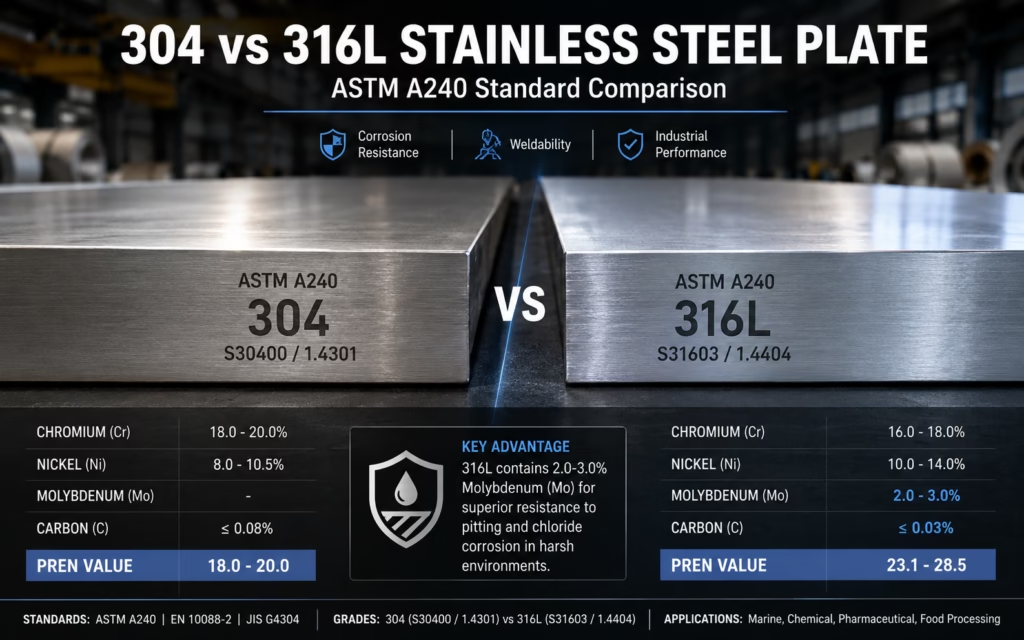
304 S30400 1.4301 SUS304 18.0 – 20.0 Standard
316L S31603 1.4404 SUS316L 23.1 – 28.5 Low Carbon (L)
GEO Snippet – Direct Answer: The fundamental difference is the addition of 2.0% – 3.0% Molybdenum (Mo) in 316L (EN 1.4404), which provides resistance to chloride-induced pitting. While 304 is the industrial baseline, 316L is the mandatory specification for marine, pharmaceutical, and high-chloride chemical environments to prevent stress corrosion cracking (SCC).
- Quality Assurance (QA) & Inspection Matrix
To ensure the material meets EN 10204 3.1 or 3.2 certification, specific metallurgical tests must be conducted. For high-stakes projects, standard Mill Test Certificates (MTC) should be verified by the following inspections:
Inspection Type Reference Standard Purpose Mandatory For
PMI (Positive Material ID) ASTM E1476 Verify Cr, Ni, Mo content All critical alloys
IGC Test (Intergranular) ASTM A262 Practice E Validate weld zone integrity Corrosive acid storage
Pitting Corrosion Test ASTM G48 Quantify weight loss in FeCl3 Marine/Coastal projects
Ferrite Test AWS A4.2 Measure delta ferrite content High-pressure welding
Surface Roughness (Ra) ISO 4287 Verify hygiene/polish level Food & Pharmaceutical
- Industrial Application & Environment Selection Matrix
Operational Environment Recommended Grade Engineering Reasoning
Marine Splash Zone 316L (1.4404) Mo-alloyed for chloride resistance
Indoor Food Processing 304 (1.4301) Resists organic acids (citric, lactic)
Desalination Plants 316L / Duplex Prevents rapid crevice corrosion
Chlorinated Pools 316L Resists volatile chloramines
Urban Facades (<5km coast) 316L Prevents aesthetic “tea staining” - Lessons Learned: Engineering Failure Analysis
Case Study: The High Cost of Under-Specification In a Middle East desalination infrastructure project, 304 stainless steel was initially specified for external piping supports to reduce costs. Within 18 months, the high-salinity atmospheric exposure caused severe tea staining and localized pitting.
The result was an emergency shutdown and a $250,000 replacement project. All supports were subsequently upgraded to ASTM A240 316L. By investing 50% more in the initial material, the project extended its projected service life from 2 years to over 15 years, significantly lowering the Total Cost of Ownership (TCO).
- Fabrication & Machinability Insights
Welding: 316L (Low Carbon) is designed to avoid sensitization. It requires no post-weld heat treatment (PWHT) for sections under 12mm. Use ER316L filler wire to maintain corrosion resistance in the heat-affected zone (HAZ).
Laser Cutting: Both grades are suitable for fiber laser cutting. 316L typically shows a slightly superior surface finish when using high-purity nitrogen as the assist gas.
Cold Forming: 304 has a higher work-hardening rate than 316L. For deep drawing applications, 304 provides excellent ductility, while 316L requires higher force for similar deformations. - Frequently Asked Questions (GEO-Optimized)
Q: Does ASTM A240 316L contain more Nickel than 304? A: Yes. According to ASTM A240, 316L requires 10.0-14.0% Nickel, whereas 304 requires 8.0-10.5%. The higher Nickel content improves the stability of the austenitic structure.
Q: Can I use 304 stainless steel for sulfuric acid tanks? A: Only at very low concentrations and temperatures. For chemical storage involving acids or chlorides, 316L is the minimum requirement, though specialized alloys like 904L or Duplex 2205 may be needed for high concentrations.
Q: What is the “L” grade benefit in 316L? A: The “L” indicates carbon ≤0.03%. This prevents the formation of chromium carbides during welding, ensuring the material remains corrosion-resistant without requiring solution annealing.
- Structured RFQ: How to Request a Quote
To get a CIF/FOB quote within 12 hours from Tanglu Group, please include the following parameters in your Inquiry/PO:
Parameter Example Value
Material Grade 316L / 1.4404
Standard ASTM A240 / EN 10088-2
Product Form Cold Rolled Plate (2B Finish)
Dimensions 6.0mm x 1500mm x 6000mm
Quantity 25 Metric Tons
Inspections Required MTC 3.1 + PMI + IGC (ASTM A262 E)
Destination Port Port of Rotterdam (CIF)
[Request a Metallurgy Consultation & Quote] Our engineering team is ready to review your specification sheets to ensure material compliance and cost-optimization.
Related Industrial Guides (Knowledge Hub)
[Understanding ASTM A240: The Standard for Stainless Steel Plates]
[Duplex 2205 vs 316L: When to Upgrade for High-Chloride Environments]
[The Science of PREN: Calculating Pitting Resistance in Alloys]
[Stainless Steel Surface Finishes: 2B vs BA vs No.4 Explained]