
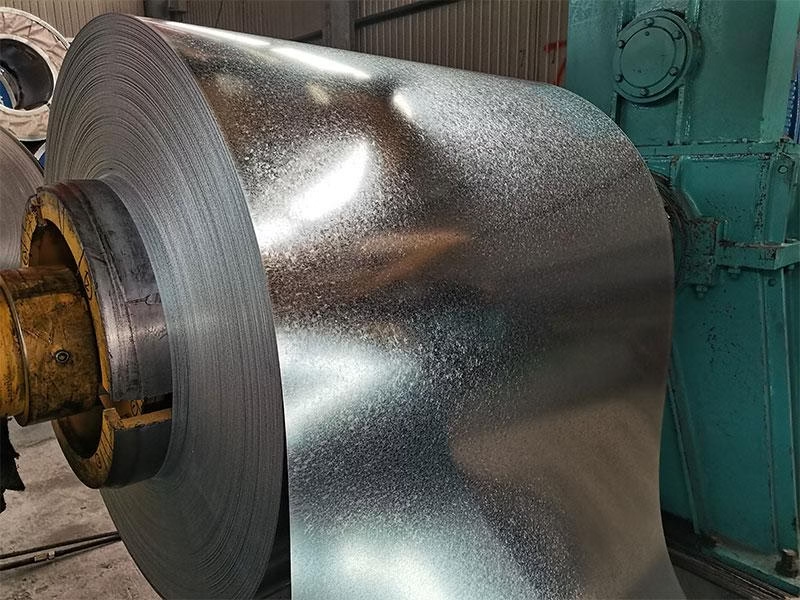
Bake Hardening Steel (BH210 / BH250 / BH300)
Bake Hardening Steel (BH210 / BH240 / BH260 / BH300) is cold-rolled ultra-low carbon steel for automotive outer body panels combining excellent formability during stamping with 30-50 MPa yield strength increase after paint baking. Thickness 0.4-2.5mm, width 600-1900mm. IATF 16949 certified.
| Material | Cold-Rolled Ultra-Low Carbon (ULC) Bake Hardening Steel |
|---|---|
| Grade / Standard | BH180 / BH210 / BH240 / BH260 / BH300 (per EN 10268) |
| Thickness | 0.4mm - 2.5mm |
| Width | 600mm - 1900mm |
| Inner Diameter (ID) | 508mm / 610mm |
| Coil Weight | 8-25 Tons (Standard 12-18 Tons) |
| Delivery Condition | cold_rolled / annealed |
| Surface Treatment | coated |
| MOQ | 5 Tons |
| Delivery Time | 30-45 Days (Custom) / 15-25 Days (Stock) |
| Loading Port | Tianjin / Shanghai / Qingdao |
Overview of Bake Hardening Steel (BH)
Bake Hardening Steel (BH) is a specialized category of cold-rolled high-strength low-alloy steel designed specifically for automotive outer body panel applications where excellent formability during stamping must be combined with high dent resistance after paint baking. Specified primarily under EN 10268 (European), JFS A2001 (Japan), VDA 239-100 (German automotive), and SAE J2340 (American automotive) standards, BH steel achieves a unique mechanical property enhancement through the strain aging mechanism where dissolved interstitial carbon and nitrogen atoms migrate to dislocations during paint baking heat treatment (typically 170°C for 20 minutes), producing a yield strength increase of 30-50 MPa above the as-formed condition. This ‘bake hardening effect’ provides automotive manufacturers with the optimal combination of stamping performance (using lower-strength material that forms easily into complex panel shapes) and final part dent resistance (achieving higher strength after the standard automotive paint baking cycle).
The most widely used BH steel grades worldwide include BH210 (yield strength 210 MPa minimum after baking, the entry-level BH grade for non-critical outer panels), BH240 (yield 240 MPa minimum, the most commonly specified BH grade for automotive door outer panels and hood outer panels), BH260 (yield 260 MPa minimum for performance vehicles requiring higher dent resistance), and BH300 (yield 300 MPa minimum, the highest standard BH grade for premium vehicle body panels). All BH grades are based on ultra-low carbon (ULC) steel chemistry with controlled carbon content (typically 0.0015-0.0050%), nitrogen content (0.001-0.004%), and microalloying additions (titanium and/or niobium for grain refinement). The bake hardening response (typically 30-50 MPa yield strength increase after 170°C/20min) requires precise control of solute carbon levels – too little carbon results in insufficient bake hardening, while too much carbon causes premature aging during storage that degrades stamping performance. Tanglu Group supplies all major BH steel grades from leading Chinese automotive steel mills with full material certification meeting global automotive OEM requirements including German Verband der Automobilindustrie (VDA), Japanese Jido shaha, and North American Big Three specifications.
Key Features and Manufacturing Process
Bake Hardening Steel is manufactured through a precisely controlled thermo-mechanical processing sequence that creates the unique microstructure responsible for the bake hardening effect. The manufacturing route begins with electric arc furnace or basic oxygen furnace steelmaking with vacuum degassing to achieve ultra-low carbon (≤0.005%) and nitrogen (≤0.004%) levels in the molten steel. Microalloying with titanium (0.005-0.040%) and/or niobium (0.005-0.030%) provides grain refinement and helps stabilize against premature aging. The slabs are continuously cast and hot rolled at controlled finish rolling temperatures, then cold rolled with reduction ratios of 70-80% to develop optimal cold-rolled microstructure. The critical heat treatment is continuous annealing at temperatures of 760-820°C with carefully controlled cooling rates to achieve the desired microstructure of equiaxed ferrite grains with controlled solute carbon content (typically 5-25 ppm) – this solute carbon provides the bake hardening response without causing premature aging during storage and transport.
The finished BH steel is supplied in cold-rolled coil form with thickness range from 0.4mm to 2.5mm and width from 600mm to 1900mm, with standard inner diameter 508mm or 610mm and coil weight 8-25 tons. The steel is delivered in skin pass rolled condition (typically 0.5-1.5% reduction) to control yield point elongation and produce smooth, defect-free surface suitable for automotive Class A surface applications. Surface treatments include pickled and oiled (P&O), electrolytic chromate passivation, and various organic coatings (anti-finger print, oxy-coat) for protection during automotive plant handling and storage. Each BH steel coil undergoes mandatory chemical composition analysis verified by spectroscopic methods, mechanical property testing including tensile, yield, elongation, n-value (work hardening exponent), r-value (plastic strain ratio for deep drawability), bake hardening response (BH2 = yield strength after 2% pre-strain + 170°C/20min bake), surface quality inspection per automotive industry standards, dimensional inspection, and aging stability testing to ensure properties remain stable during typical automotive plant storage periods (typically 6 months minimum). Tanglu Group supplies BH steel meeting all major automotive OEM specifications with full traceability and Production Part Approval Process (PPAP) documentation support.
Main Applications of Bake Hardening Steel
Bake Hardening Steel is the dominant material for automotive outer body panels across global automotive industry where combination of formability and post-baking dent resistance is critical. The primary application is automotive door outer panels for passenger cars, SUVs, light commercial vehicles, and pickup trucks, where BH240 and BH260 provide excellent deep drawability for forming complex door panel shapes with character lines and stylistic features, then achieve enhanced dent resistance after the standard 170°C paint baking cycle to resist parking lot dings and accidental impacts during normal vehicle service. Hood outer panels (also called bonnets) extensively use BH210 and BH240 for the large flat surfaces requiring resistance to hood-strike impacts and bird strike damage, with BH240 being the workhorse grade for mid-range and premium vehicles globally.
Other automotive outer panel applications include trunk lid (deck lid) outer panels using BH210/BH240 for resistance to luggage loading impacts, fender (mudguard) outer panels using BH240 for resistance to road debris and parking damage, roof outer panels using BH210 for the very large flat surfaces requiring stiffness and dent resistance, tailgate outer panels for SUVs and hatchbacks using BH240/BH260, side body outer panels (quarter panels) using BH240/BH260 for impact resistance in collision-prone areas, and outer panels for luxury vehicles using BH260/BH300 where superior dent resistance is critical for brand image. The premium automotive segment increasingly specifies BH300 grade for exterior body panels of luxury sedans, performance vehicles, and luxury SUVs from German automakers (BMW, Mercedes-Benz, Audi, Porsche), Japanese premium brands (Lexus, Infiniti, Acura), and electric vehicle manufacturers requiring weight-optimized panels with maximum dent resistance. Beyond automotive applications, BH steel is also used in commercial truck cab panels, agricultural equipment cabs, construction equipment cab panels, motorcycle fuel tanks and fairings, household appliance outer panels (refrigerator doors, washing machine cabinets) where similar formability and post-baking strength enhancement is desired, marine outboard motor cowlings, and a comprehensive range of consumer products requiring smooth deep-drawn outer surfaces with enhanced impact resistance after paint or coating baking processes.
Why Choose Us for Bake Hardening Steel
Shandong Tanglu Metal Material Co., Ltd. supplies premium Bake Hardening Steel sourced from major Chinese automotive steel mills including Baosteel (Baoshan Iron & Steel), HBIS (Hesteel Group), and Shougang with proven international export experience and certified production facilities meeting IATF 16949 (International Automotive Task Force) automotive quality management system, ISO 9001, ISO 14001, and PED requirements. Every BH steel coil undergoes mandatory chemical composition analysis verified by optical emission spectrometry and combustion analysis (for low carbon and nitrogen levels), mechanical property testing including tensile, yield, elongation, n-value, r-value, bake hardening response (BH2 testing per ISO 16630), surface quality inspection meeting automotive Class A surface requirements, dimensional inspection per EN 10131 / EN 10268 latest revision, aging stability testing at 50°C for 6 months simulating typical storage conditions, and full PPAP (Production Part Approval Process) documentation support for automotive supply chain integration.
We offer comprehensive BH steel range covering all major grades (BH180, BH210, BH240, BH260, BH300) plus specialized variants for specific automotive applications including BH steel with anti-finger print coating, oxy-coat surface protection, and zinc galvanized variants (ZE-BH and HG-BH). Available thickness from 0.4mm to 2.5mm, width from 600mm to 1900mm, in coil form (8-25 ton coil weight) or cut-to-length sheets per customer specification. With monthly supply capacity of 5,000 tons of automotive sheet steel and established relationships with global automotive Tier 1 suppliers, automotive stamping companies, and automotive OEM purchasing organizations in over 30 countries, we support both prototype development orders and high-volume production programs requiring just-in-time delivery to automotive assembly plants. Each shipment includes original mill test certificate (MTC) conforming to EN 10204 3.1 standard, with EN 10204 3.2 plus enhanced documentation including PPAP packages (Production Part Approval Process for automotive supply chain), Material Certificate per IATF 16949 requirements, traceability through Initial Sample Inspection Report (ISIR), and third-party inspection (SGS, BV, TUV) available for automotive OEM applications requiring full compliance verification per global automotive industry standards (VDA 6.3, ISO 16949 / IATF 16949).
📐 Dimension & Size Table
| Grade | Yield Strength (After Bake) | Tensile Strength | Typical Application |
|---|---|---|---|
| BH180 | ≥180 MPa | 300-380 MPa | Light outer panels, cost-sensitive applications |
| BH210 | ≥210 MPa | 320-400 MPa | Hood outer panels, trunk lid panels (entry-level) |
| BH240 | ≥240 MPa | 340-440 MPa | Door outer panels, fender panels (most common) |
| BH260 | ≥260 MPa | 360-460 MPa | Premium vehicle body panels, performance vehicles |
| BH300 | ≥300 MPa | 400-520 MPa | Luxury vehicle body panels, electric vehicles |
| ZE-BH (Electrogalvanized) | Per base grade + Zn coating | Same as base | Corrosion-resistant outer panels |
| HG-BH (Hot-Dip Galvanized) | Per base grade + Zn coating | Same as base | Long-term corrosion protection panels |
* Custom sizes available upon request. Tolerances per relevant international standards.
🔬 Chemical Composition
| Element | Min | Max | Display Value | Note |
|---|---|---|---|---|
| C | 0.0015 | 0.0050 | 0.0015-0.0050 | Ultra-low carbon (ULC) for formability |
| Si | - | 0.05 | ≤0.05 | Low silicon for surface quality |
| Mn | 0.10 | 0.40 | 0.10-0.40 | Solid solution strengthening |
| P | - | 0.020 | ≤0.020 | Strict control for formability |
| S | - | 0.020 | ≤0.020 | Impurity control |
| Al | 0.020 | 0.060 | 0.020-0.060 | Deoxidizer and grain refiner |
| Ti | 0.005 | 0.040 | 0.005-0.040 | Grain refinement, aging control |
| Nb | 0.005 | 0.030 | 0.005-0.030 | Optional, microalloying |
| N | 0.001 | 0.004 | 0.001-0.004 | Critical for bake hardening response |
| Cu | - | 0.10 | ≤0.10 | Residual element |
* Chemical composition may vary by heat, thickness and specification. Please refer to the actual mill test certificate.
⚙️ Mechanical Properties
| Property | Value | Unit | Test Condition |
|---|---|---|---|
| Yield Strength (BH240, As-Delivered) | 180-220 | MPa | Cold rolled, skin passed condition |
| Yield Strength (BH240, After 2% Strain + Bake) | ≥240 | MPa | After 2% pre-strain + 170°C/20min baking |
| Bake Hardening Response (BH2) | ≥30 (typical 35-50) | MPa | BH2 = yield strength increase after 170°C/20min bake |
| Tensile Strength (BH240) | 340-440 | MPa | Per EN 10268 specification |
| Total Elongation (A80, BH240) | ≥34 | % | Gauge length 80mm, transverse direction |
| n-value (Strain Hardening Exponent) | ≥0.18 | - | Critical for stretch forming performance |
| r-value (Plastic Strain Ratio) | ≥1.6 | - | Average r-value, deep drawability indicator |
| Yield Strength (BH210, After Bake) | ≥210 | MPa | BH210 grade specification |
| Yield Strength (BH260, After Bake) | ≥260 | MPa | BH260 grade specification |
| Yield Strength (BH300, After Bake) | ≥300 | MPa | BH300 premium grade specification |
| Aging Stability (Yield Strength Increase) | ≤30 | MPa | After 6 months at 50°C, simulating storage aging |
| Surface Roughness (Ra) | 0.6-1.6 | μm | Skin passed surface for automotive paint |
* Values shown are minimum requirements unless otherwise stated.
📦 Commercial Information
| Packaging | Premium automotive grade packing for BH steel coils. Each coil wrapped with VCI (volatile corrosion inhibitor) paper to prevent corrosion during long-distance ocean transit and automotive plant storage (typical 3-6 month shelf life requirement). Plastic-coated steel strapping (4-6 wraps per coil) avoiding any metal contact that could damage the smooth automotive surface finish. Steel eye protection rings on inner diameter and outer diameter to prevent telescoping during handling. Each coil tagged with permanent metal identification including heat number, BH grade designation (BH210/BH240/BH260/BH300), thickness, width, coil weight, surface treatment, customer purchase order, and automotive part number reference. Premium packaging includes top wooden cradles for stacked coils, side wooden separators between coils to prevent surface marking, and waterproof shrink wrapping for additional moisture protection. Custom packaging including individual coil wooden crates, metal identification plates, and barcode tracking labels available for automotive OEM direct-shipment requirements per IATF 16949 specifications. All packaging meets export regulations including ISPM-15 wood treatment and includes complete material certification documentation (MTC, PPAP, ISIR) in waterproof envelopes. |
|---|---|
| Payment Terms | T/T (Telegraphic Transfer),L/C (Letter of Credit),D/P (Documents against Payment),Western Union,PayPal |
| Price Term | FOB,CFR,CIF,EXW |
| Supply Capacity | 5,000 Tons/Month (Automotive BH Steel) |
| Loading Port | Tianjin / Shanghai / Qingdao |
Why Choose Our Bake Hardening Steel (BH210 / BH250 / BH300)?
IATF 16949 Automotive Certified
BH steel supplied from IATF 16949 (International Automotive Task Force) certified production facilities with full PPAP (Production Part Approval Process) documentation support, including original mill test certificate EN 10204 3.1/3.2, BH2 bake hardening response verification, n-value and r-value testing, surface quality inspection meeting automotive Class A surface requirements, and complete traceability for automotive supply chain integration.
Comprehensive BH Grade Range
Complete range of BH steel grades from BH180 (entry-level outer panels) to BH300 (premium luxury vehicle panels). Available in cold-rolled bare, anti-finger print coated, electrogalvanized (ZE-BH), and hot-dip galvanized (HG-BH) variants. Thickness 0.4-2.5mm and width 600-1900mm to match all automotive outer panel applications worldwide.
Optimal Forming + Dent Resistance
BH steel uniquely combines excellent stamping formability (yield strength 180-220 MPa as-delivered for easy forming, n-value ≥0.18 for stretch performance, r-value ≥1.6 for deep drawing) with 30-50 MPa yield strength enhancement after paint baking, providing automotive manufacturers with the optimal solution for outer body panels requiring both manufacturing efficiency and final part dent resistance.
Multi-Standard Automotive Compliance
BH steel meeting global automotive industry standards including EN 10268 (European), JFS A2001 (Japan), VDA 239-100 (German automotive), SAE J2340 (American automotive), GMW 3032 (General Motors), Ford WSS-M1A346-A (Ford), FCA MS-12.001 (Stellantis), and equivalent specifications for major Chinese automotive OEMs (SAIC, BYD, Geely).
Just-in-Time Automotive Supply
Standard BH steel coils delivery 15-25 days from stock for prototype development. Production volume orders 30-45 days with reliable scheduling support automotive plant just-in-time inventory management. Container loading optimized for 22-25 tons per 20FT FCL or 25 tons per 40FT FCL with proper coil bracing and VCI corrosion protection for international ocean transit to automotive assembly plants worldwide.
🏭 Applications of Bake Hardening Steel (BH210 / BH250 / BH300)
Bake Hardening Steel is the dominant material for automotive outer body panels across global automotive industry where the unique combination of formability and post-baking dent resistance is critical for manufacturing efficiency and final vehicle quality. The primary application is automotive door outer panels for passenger cars, SUVs, light commercial vehicles, and pickup trucks, where BH240 and BH260 grades provide excellent deep drawability for forming complex door panel shapes with character lines, embossed features, and stylistic details, then achieve enhanced dent resistance after the standard 170°C automotive paint baking cycle to resist parking lot impacts, hand-strikes, and accidental damage during normal vehicle service life. Hood outer panels (also called bonnets in European markets) extensively use BH210 and BH240 grades for the very large flat surfaces requiring resistance to hood-strike impacts during low-speed accidents, bird strike damage during driving, and hail damage during severe weather, with BH240 being the workhorse grade for mid-range and premium vehicles globally including European brands (Volkswagen, Renault, Peugeot), American brands (Ford, GM, Stellantis), Japanese brands (Toyota, Honda, Nissan, Mazda), and Chinese brands (SAIC, BYD, Geely, Great Wall). Other automotive outer panel applications include trunk lid (deck lid) outer panels using BH210/BH240 for resistance to luggage loading impacts and trunk closure stresses, fender (mudguard) outer panels using BH240 for resistance to road debris impacts and parking damage in collision-prone areas, roof outer panels using BH210 for the very large flat surfaces requiring stiffness against wind loads and dent resistance to hail damage and tree branch impacts, tailgate outer panels for SUVs and hatchback vehicles using BH240/BH260 for combined formability of complex shapes and high dent resistance for lift assist mechanisms, side body outer panels (quarter panels) using BH240/BH260 for impact resistance in collision-prone areas, and outer panels for luxury vehicles using BH260/BH300 grades where superior dent resistance is critical for brand image and customer satisfaction with body integrity over long ownership periods. The premium automotive segment increasingly specifies BH300 grade for exterior body panels of luxury sedans, performance sports cars, and luxury SUVs from German automakers (BMW 7-Series, Mercedes-Benz S-Class, Audi A8, Porsche Cayenne), Japanese premium brands (Lexus LS, Infiniti QX, Acura MDX), American luxury brands (Cadillac Escalade, Lincoln Navigator), and electric vehicle manufacturers (Tesla Model S/X, Lucid Air, Porsche Taycan) requiring weight-optimized panels with maximum dent resistance for premium customer expectations. Beyond traditional automotive applications, BH steel is increasingly used in commercial truck cab panels for medium-duty trucks (Ford F-Series, Ram 2500, Chevrolet Silverado HD), heavy-duty truck cabs (Volvo VNL, Peterbilt 579, Kenworth T680), agricultural equipment cabs (John Deere, Case IH, Massey Ferguson tractor cabs), construction equipment cab panels (Caterpillar, Komatsu, Hitachi excavator cabs), motorcycle fuel tanks and side fairings requiring smooth Class A surface and impact resistance, household appliance outer panels (refrigerator doors, washing machine cabinets, dishwasher panels, microwave oven exteriors) where similar formability and post-baking strength enhancement is desired through paint or color coating processes, marine outboard motor cowlings requiring smooth surface and impact resistance, recreational vehicle body panels (camper bodies, travel trailer panels), commercial truck box panels for delivery vehicles, and a comprehensive range of consumer products requiring smooth deep-drawn outer surfaces with enhanced impact resistance after paint or coating baking processes.
📋 Quality & Certification
Our Certifications
- ✅ ISO 9001:2015
- ✅ CE Marking
- ✅ ABS
- ✅ DNV GL
- ✅ Lloyd's Register (LR)
- ✅ Bureau Veritas (BV)
- ✅ SGS Certified
- ✅ NK
- ✅ RINA
Mill Certificate Type
- 📋 EN 10204 3.1
- 📋 EN 10204 3.2
- 📋 Original Mill Certificate
- 📋 Third Party Inspection Available
- 📋 Certificate of Origin
❓ Frequently Asked Questions
What is Bake Hardening (BH) Steel and how does it work?
Bake Hardening (BH) Steel is a specialized cold-rolled ultra-low carbon steel designed to take advantage of the strain aging mechanism for automotive outer body panel applications. The unique property is the 'bake hardening effect' - a yield strength increase of 30-50 MPa that occurs during the standard automotive paint baking cycle (typically 170°C for 20 minutes). The mechanism works as follows: 1) The steel is delivered with low yield strength (180-220 MPa) for excellent formability during stamping operations - allowing manufacturers to form complex door panel shapes, hood contours, and styling features with minimal force and reduced springback; 2) During stamping, the steel is plastically deformed (typically 2-5% strain), creating dislocations in the crystal structure; 3) During paint baking at 170°C, dissolved interstitial atoms (carbon and nitrogen) migrate to and pin these dislocations, creating Cottrell atmospheres that increase yield strength by 30-50 MPa; 4) The result is automotive panels with smooth Class A surface finish (from forming a low-strength material) and enhanced dent resistance (from the BH-strengthened final part). This unique combination cannot be achieved with conventional high-strength steels which would be too difficult to form into complex automotive shapes. BH steel grades are designated by the minimum yield strength after bake hardening, so BH240 means minimum yield 240 MPa after the standard bake cycle.
What is the difference between BH210, BH240, BH260, and BH300?
These BH steel grades are differentiated by minimum yield strength after the bake hardening process, with each grade serving different automotive applications based on dent resistance requirements and formability constraints. BH210 (minimum yield 210 MPa after bake) is the entry-level BH grade providing excellent formability for hood outer panels, trunk lid panels, and roof panels of economy and mid-range vehicles where moderate dent resistance is acceptable - the easiest BH grade to form into complex shapes. BH240 (minimum yield 240 MPa after bake) is the most commonly specified BH grade globally, used as the standard material for door outer panels, fender panels, and most automotive outer body panel applications where balanced formability and dent resistance are required - this is the 'workhorse' BH grade representing 60-70% of total BH steel production worldwide. BH260 (minimum yield 260 MPa after bake) provides enhanced dent resistance for premium vehicle outer panels including European mid-luxury vehicles (BMW 3/5-Series, Mercedes C/E-Class, Audi A4/A6) and Japanese premium brands (Lexus IS/ES, Acura TLX) - more difficult to form than BH240 due to higher initial strength but provides 8-10% better dent resistance. BH300 (minimum yield 300 MPa after bake) is the premium BH grade reserved for luxury vehicle outer panels (BMW 7-Series, Mercedes S-Class, Audi A8, Porsche, electric vehicles) where maximum dent resistance is critical for brand image and customer expectations - the most challenging to form due to highest initial strength but provides 20-25% better dent resistance than BH240. Selection criteria: Use BH210 for cost-sensitive applications where formability is critical; BH240 for mainstream automotive applications (most common choice); BH260 for premium vehicles requiring enhanced dent resistance; BH300 for luxury vehicles and high-end electric vehicles where maximum dent resistance justifies the higher material cost and forming difficulty.
What is the difference between BH steel and DP (Dual Phase) steel for automotive panels?
BH (Bake Hardening) steel and DP (Dual Phase) steel are both important high-strength automotive steels but serve different applications based on their distinct mechanical properties and intended use. BH Steel (e.g., BH240, BH300) is single-phase ferrite steel with controlled solute carbon content, providing yield strength 180-220 MPa as-delivered (for excellent formability) that increases to 240-300 MPa after paint baking through the strain aging mechanism. The unique advantage is the optimal combination of stamping formability and post-baking strength specifically for automotive outer body panels (door outer panels, hood, trunk lid, fenders) where deep drawing of complex shapes is required followed by dent resistance after paint baking. BH steel has total elongation 30-40% and excellent surface quality for automotive Class A surfaces. DP Steel (e.g., DP590, DP780, DP980, DP1180) has dual-phase microstructure consisting of soft ferrite matrix with hard martensite islands (typically 10-30% volume fraction), providing higher yield strength 350-700 MPa as-delivered without requiring bake hardening. DP steel does not exhibit significant bake hardening because the strength is achieved through the martensite phase rather than solute carbon strain aging. DP steel provides higher overall strength than BH steel but lower formability (elongation 15-25%) and is intended for automotive structural components where high strength is critical: B-pillars (passenger safety), side impact beams, bumper reinforcements, seat cross members, longitudinal rails, suspension components. Selection guidelines: Use BH steel for outer body panels (door, hood, trunk, fenders, roof) requiring excellent surface quality and balanced formability/dent resistance. Use DP steel for structural and safety components requiring high strength for crash protection. They are complementary materials, not substitutes - modern vehicles typically use BH steel for outer panels and DP steel for structural reinforcements, leveraging the strengths of each material category for optimal vehicle weight reduction and crash performance.
How long can BH steel be stored before its bake hardening properties degrade?
BH steel storage stability is a critical practical consideration for automotive supply chain management because the same strain aging mechanism that provides the desired bake hardening response can also cause undesirable aging during storage, gradually increasing yield strength before stamping and degrading formability. Modern BH steel grades from quality manufacturers (Baosteel, HBIS, Shougang, Tisco) are designed for stable storage at typical automotive plant conditions: Standard storage requirement is minimum 6 months at temperatures up to 30°C without significant property degradation - the yield strength increase during 6 months at 50°C accelerated aging test should not exceed 30 MPa (specified per JFS A2001 and EN 10268). For typical automotive plant storage in climate-controlled warehouses (15-25°C), BH steel typically retains required formability for 9-12 months with minimal aging effects. Critical storage management practices include: 1) First-In-First-Out (FIFO) inventory management ensuring oldest material is used first; 2) Climate-controlled storage in temperature range 10-25°C with humidity control to prevent surface corrosion; 3) Avoid prolonged storage above 35°C which accelerates aging significantly; 4) Use VCI (volatile corrosion inhibitor) packaging during transport and storage to prevent surface corrosion that can affect formability; 5) Track coil age from production date and prioritize older inventory for non-critical applications if storage exceeds 6 months. For just-in-time automotive plants, BH steel is typically delivered weekly with maximum 4-week inventory to avoid aging concerns. If BH steel exceeds recommended storage time, formability can be partially restored through stress relief annealing (250-300°C for 30 minutes) but this adds cost and is rarely practical. The newest generation of BH steels with optimized chemistry (controlled Ti and Nb microalloying) provide improved aging resistance allowing longer storage and more flexible supply chain management while still maintaining the desired bake hardening response during paint baking.
What documentation and quality requirements are needed for BH steel for automotive OEM applications?
BH steel for automotive OEM applications requires comprehensive documentation and quality control packages meeting global automotive industry standards. Essential documentation included with all BH steel shipments: 1) Original Mill Test Certificate (MTC) per EN 10204 3.1 including chemical composition, mechanical properties (yield, tensile, elongation, n-value, r-value), bake hardening response (BH2 testing per ISO 16630 = yield strength increase after 2% pre-strain + 170°C/20min bake), surface quality inspection results, dimensional inspection, and heat number traceability; 2) IATF 16949 Quality Management System certification of producing mill demonstrating automotive quality compliance; 3) Material Certificate per applicable customer specifications (e.g., GMW 3032 for General Motors, Ford WSS-M1A346-A for Ford, FCA MS-12.001 for Stellantis, VDA 239-100 for German VDA standards). Enhanced documentation required for automotive OEM Production Part Approval Process (PPAP): 1) Production Part Approval Process documentation Level 1-5 depending on customer requirements (typically Level 3 for new programs, Level 1 for established suppliers); 2) Initial Sample Inspection Report (ISIR) demonstrating material meets all specifications; 3) Material Certificate matching customer drawing requirements; 4) Chemical analysis results from accredited laboratory; 5) Mechanical property test reports for each shipment heat including BH2 verification; 6) Dimensional inspection reports per customer drawing tolerances; 7) Surface quality inspection reports including roughness measurements (Ra typically 0.6-1.6 μm for automotive Class A surface); 8) Aging stability test reports demonstrating storage performance; 9) Certificate of Origin and customs clearance documentation. Industry-specific requirements: 1) For German OEMs (VW, BMW, Mercedes, Audi): VDA 6.3 process audit compliance and VDA 239-100 specifications; 2) For Japanese OEMs (Toyota, Honda, Nissan): JFS A2001 specifications and JIS quality verification; 3) For American OEMs (Ford, GM, Stellantis): customer-specific specifications (Ford WSS, GMW, FCA MS) and AIAG (Automotive Industry Action Group) PPAP requirements; 4) For Chinese OEMs (SAIC, BYD, Geely): GB/T 20887 specifications and Chinese national standards. Tanglu Group provides complete documentation packages meeting all global automotive OEM requirements with experienced quality engineering support for PPAP submissions, technical reviews, and ongoing supply chain integration. All documentation provided in waterproof envelopes attached to shipments, electronic copies emailed for quality records, and historical documentation retained for traceability throughout vehicle production lifecycle and warranty period.
Get a Quote for
Bake Hardening Steel (BH210 / BH250 / BH300)
Submit your requirements and receive a competitive price quote within 24 hours.
- ✓ Fast response within 24 hours
- ✓ Competitive factory-direct pricing
- ✓ Free technical consultation
- ✓ Mill test certificate provided
- ✓ Flexible payment terms available
⏱ Response within 24 hours
Send Your Inquiry
All fields marked with * are required