
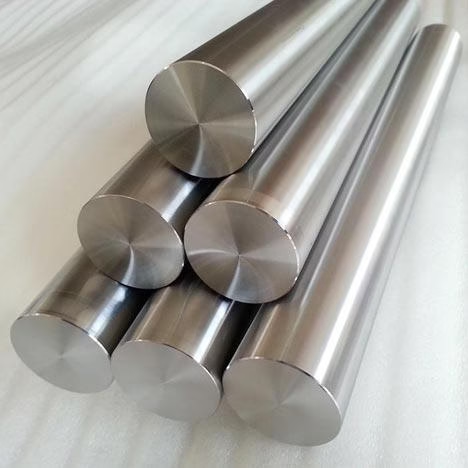
Titanium Bar (Grade 2 / Grade 5 Ti-6Al-4V / Grade 7 / Grade 9)
Titanium Bar in Grade 1, Grade 2 (CP), Grade 4, Grade 5 Ti-6Al-4V (AMS 4928 aerospace / ASTM F136 medical ELI), Grade 7 (Ti-0.15Pd), Grade 9 (Ti-3Al-2.5V), Grade 12, Grade 23 (Ti-6Al-4V ELI). Diameter 3–500mm. Round, hex, flat bar. Annealed or STA condition. ASTM B348, AMS 4928, ASTM F136. Double VAR melt. Mill test certificate provided.
| Material | Commercially Pure Titanium / Alpha-Beta Titanium Alloy Bar and Rod |
|---|---|
| Grade / Standard | Grade 1 (R50250) / Grade 2 (R50400) / Grade 4 (R50700) / Grade 5 Ti-6Al-4V (R56400) / Grade 7 Ti-0.15Pd (R52400) / Grade 9 Ti-3Al-2.5V (R56320) / Grade 12 (R53400) / Grade 23 Ti-6Al-4V ELI (R56401) |
| Diameter | Round Bar: 3mm – 500mm | Hexagonal Bar: 5mm – 100mm A/F | Flat Bar / Rectangle: 10×5mm to 300×100mm |
| Length | 1m / 3m standard lengths / Custom cut-to-length / Coiled rod for Grade 9 tubing applications |
| Delivery Condition | as_rolled |
| Surface Treatment | coated |
| MOQ | 1 Piece (Custom Size) / 10 kg (Standard Bar Stock) |
| Delivery Time | 20-45 Days (Custom / Special Grade) / 15-30 Days (Stock Grades) |
| Loading Port | Tianjin / Shanghai / Qingdao |
Overview of Titanium Bar
Titanium Bar is a round, hexagonal, or rectangular solid cross-section product manufactured from commercially pure titanium or titanium alloys, providing the unique combination of exceptional corrosion resistance across the broadest range of aqueous and chemical environments of any structural metal, the highest specific strength (strength-to-density ratio) of any commonly used engineering material when alloyed, and complete biocompatibility with human tissue — three properties that together make titanium the material of choice for aerospace structural components, medical implants, chemical processing equipment, marine hardware, and sports equipment where other metals would either fail by corrosion, require excessive weight, or be rejected by the body. With a density of only 4.43–4.51 g/cm³ — approximately 56% of steel (7.85 g/cm³) and 60% of nickel alloys (8.4 g/cm³) — titanium delivers structural performance per unit weight that exceeds high-strength aluminium alloys in specific strength when alloyed to Ti-6Al-4V (Grade 5) condition, making it the dominant structural material in military and civil aircraft construction where every kilogram of structural weight saved translates directly to fuel savings, payload increase, or range extension over the aircraft’s operational life.
Titanium bar is standardised under ASTM B348 (titanium and titanium alloy bar and billet), ASTM F136 (Ti-6Al-4V ELI bar for surgical implants), ASTM F1472 (Ti-6Al-4V bar for surgical implant applications), AMS 4928 (Ti-6Al-4V bar and billet for aerospace), AMS 4921 (Ti-3Al-2.5V bar), EN ISO 5832-2 / 5832-3 (titanium alloys for surgical implants), and JIS H4650 (titanium and titanium alloy bars and shapes), with GB/T 2965 as the Chinese equivalent. The principal grades span commercially pure (CP) titanium — Grade 1 (UNS R50250, lowest strength, maximum ductility and corrosion resistance), Grade 2 (UNS R50400, the dominant CP grade balancing strength and corrosion resistance), Grade 4 (UNS R50700, highest strength CP titanium) — and alloyed titanium — Grade 5 Ti-6Al-4V (UNS R56400, the most widely used titanium alloy, dominant aerospace structural grade), Grade 7 Ti-0.15Pd (UNS R52400, CP Grade 2 with palladium for enhanced crevice corrosion resistance in reducing acid environments), Grade 9 Ti-3Al-2.5V (UNS R56320, intermediate strength between Grade 2 and Grade 5, for aerospace tubing and bicycle frames), and Grade 23 Ti-6Al-4V ELI (UNS R56401, Extra Low Interstitial, for medical implants requiring maximum toughness).
Key Features and Manufacturing Process
Titanium bar is produced through a carefully controlled primary melting and deformation process specifically adapted to the reactivity and metallurgical characteristics of titanium alloys. The production sequence begins with primary melting by vacuum arc remelting (VAR) — the standard titanium melting process that melts a compacted electrode of titanium sponge, alloying additions, and recycled titanium under high vacuum in a water-cooled copper crucible, preventing oxygen, nitrogen, and hydrogen contamination that would degrade mechanical properties and toughness. Premium aerospace grades (Ti-6Al-4V per AMS 4928) undergo double or triple VAR to achieve the microstructural homogeneity and freedom from high-density inclusions required for flight-critical rotating components. Medical implant grades (Ti-6Al-4V ELI per ASTM F136) additionally specify reduced interstitial element limits (oxygen ≤0.13%, iron ≤0.25%) compared to standard Grade 5, providing improved fracture toughness and fatigue resistance critical for load-bearing orthopaedic implant applications.
Following VAR, the ingot is forged at carefully controlled temperatures relative to the beta transus temperature — the temperature above which the alloy exists entirely in the body-centred cubic beta phase — to develop the required microstructure. For Grade 5 Ti-6Al-4V, the beta transus is approximately 995°C, and forging is typically conducted below the beta transus (alpha-beta working at 870–980°C) to develop a fine equiaxed or bimodal alpha-beta microstructure providing optimal fatigue resistance, toughness, and ductility for structural applications. The forged billet is hot-rolled or warm-rolled to bar dimensions at appropriate temperatures with controlled rolling reduction and cooling rates to achieve the specification grain size. Final heat treatment — mill annealing (705–790°C / 1 hour / air cool) for maximum ductility, solution treatment and aging (STA: solution treat at 900–960°C + age at 480–595°C / 4 hours) for maximum strength — and surface finishing by centreless grinding, peeling, or polishing completes the production sequence. All titanium bar production requires mandatory contamination prevention — titanium is highly reactive with oxygen, nitrogen, and hydrogen at elevated temperatures, and with iron contamination at any temperature — making dedicated titanium-only processing equipment, rigorous material handling procedures, and contamination-free surface treatment using dedicated titanium acid pickling lines mandatory quality control requirements.
Main Applications of Titanium Bar
Aerospace structural applications represent the largest volume application for titanium bar, particularly Ti-6Al-4V (Grade 5) per AMS 4928 machined into airframe structural components including bulkhead sections and spars for wide-body commercial aircraft (Boeing 787 Dreamliner uses approximately 15% titanium by structural weight), fighter aircraft structural frames and longerons requiring maximum strength-to-weight ratio, landing gear main fittings and side strays machined from large-diameter bar and forging, engine mount structural brackets, nacelle structural components, wing root fittings and rib attachments, horizontal stabiliser fittings, vertical fin fittings, and the extensive range of structural fittings and brackets distributed throughout commercial and military aircraft structures. Engine components machined from titanium bar include compressor disc blanks and compressor blade attachments in early compressor stages (titanium’s upper temperature limit of approximately 315°C for sustained use prevents application in hotter compressor and turbine stages), fan blade roots and fan frame structural rings, and engine mount structural components.
Medical device and surgical implant manufacturing is the second major application sector, with Grade 5 Ti-6Al-4V ELI (ASTM F136) bar machined into orthopaedic implants including hip stem components, femoral head components, tibial tray base plates, knee femoral components, spine fusion cage components, pedicle screw blanks, bone screw and plate blanks, and external fixator bar components — all requiring the biocompatibility, osseointegration capability, and corrosion resistance in physiological saline that makes titanium the preferred metallic implant material for load-bearing skeletal reconstruction. Dental implants from Grade 4 CP titanium and Grade 5 Ti-6Al-4V bar are machined on precision CNC lathes into threaded implant fixtures for single-tooth and full-arch dental reconstruction systems. Chemical processing equipment applications use Grade 2 CP titanium bar machined into valve bodies, pump shafts, agitator shafts, fittings, and instrumentation components for chlorine chemistry, sodium hypochlorite, nitric acid, and seawater service. Marine and offshore applications include Grade 2 titanium bar for desalination plant components, seawater system fittings, offshore platform riser clamp components, and subsea equipment structural fasteners. Other applications include military armour applications, sports equipment (bicycle frames, golf club heads, tennis racket frames, swimming pool fittings), consumer products (watch cases and bracelets, eyeglass frames), and the growing additive manufacturing (3D printing) powder feedstock market where spherical titanium powder is atomised from bar.
Why Choose Us for Titanium Bar
Shandong Tanglu Metal Material Co., Ltd. supplies premium Titanium Bar sourced from leading Chinese titanium producers including Western Superconducting Technologies (Xi’an) — one of the world’s largest titanium alloy producers and a primary supplier to China’s commercial and military aerospace programmes — Baoji Titanium Industry, and AECC (Aero Engine Corporation of China) affiliated titanium material subsidiaries, all operating vacuum arc remelting and bar production facilities certified to ISO 9001, AS9100 (aerospace quality management for Ti-6Al-4V per AMS 4928), ISO 13485 (medical device quality for ASTM F136 / F1472), and ASTM B348 / AMS 4928 product standard requirements with DFARS (Defense Federal Acquisition Regulation Supplement) compliant titanium available for US defence procurement. Every titanium bar lot is accompanied by original mill test certificates covering full quantitative chemical composition analysis of all alloying elements (Al, V, Fe, O, C, N, H for Ti-6Al-4V) and interstitial element limits per applicable standard, mechanical property test results (tensile strength, 0.2% proof stress, elongation, reduction of area) at room temperature, hardness verification at multiple bar cross-section positions, macro-examination (sulphur print or acid etch) for ingot cleanliness and forging soundness confirmation, ultrasonic testing per AMS 2631 / ASTM B265 for premium aerospace grades, grain size assessment per ASTM E112, and complete double or triple VAR melt heat traceability from sponge charge to finished bar.
We offer a comprehensive titanium bar specification range: Grade 1 (UNS R50250, ASTM B348), Grade 2 (UNS R50400, ASTM B348 / ASME SB-348), Grade 4 (UNS R50700, ASTM B348), Grade 5 Ti-6Al-4V (UNS R56400, ASTM B348 / AMS 4928), Grade 5 ELI Ti-6Al-4V ELI (UNS R56401, ASTM F136 / AMS 4928 ELI, for medical implants), Grade 7 Ti-0.15Pd (UNS R52400, ASTM B348), Grade 9 Ti-3Al-2.5V (UNS R56320, AMS 4921), Grade 12 Ti-0.3Mo-0.8Ni (UNS R53400, ASTM B348), and Grade 23 Ti-6Al-4V ELI (UNS R56401, ASTM F136 for surgical implants). Diameters from 3mm (precision machining rod) to 500mm (large diameter billet for major structural forgings), in round bar, hexagonal bar, and rectangular bar sections, standard lengths 1m and 3m with cut-to-length service. Surface conditions include forged condition, turned and peeled (standard), centreless ground (precision h6/h7 tolerance), and polished (medical implant applications). With established monthly supply capacity and export relationships with aerospace Tier 1 and Tier 2 manufacturers, orthopaedic implant companies, chemical equipment fabricators, marine equipment producers, and precision machining companies across more than 40 countries, we support packages from small prototype implant machining orders to large aerospace structural bar supply contracts. Each shipment includes original mill test certificate per EN 10204 3.1, with EN 10204 3.2, AMS-specific certifications, ASTM F136 / ISO 5832-3 compliance documentation for medical grades, ultrasonic test reports, and third-party inspection by SGS, Bureau Veritas, TUV, or specialised aerospace and medical device inspection bodies available.
📐 Dimension & Size Table
| Grade | UNS Number | Standard | Composition | Diameter Range (mm) | Condition | Key Application |
|---|---|---|---|---|---|---|
| Grade 1 (CP Ti) | R50250 | ASTM B348 | Pure Ti, O ≤0.18% / Ø5–200 / Annealed / Maximum formability, chemical equipment, cathodes | |||
| Grade 2 (CP Ti) | R50400 | ASTM B348 / SB-348 | Pure Ti, O ≤0.25% / Ø3–500 / Annealed / Standard CP Ti — chemical, marine, desalination, implants | |||
| Grade 4 (CP Ti) | R50700 | ASTM B348 | Pure Ti, O ≤0.40% / Ø5–300 / Annealed / Highest-strength CP Ti — dental implants, medical | |||
| Grade 5 (Ti-6Al-4V) | R56400 | ASTM B348 / AMS 4928 | Ti-6Al-4V / Ø5–500 / MA or STA / Aerospace structure, general high-strength applications | |||
| Grade 5 ELI (Ti-6Al-4V) | R56401 | ASTM F1472 / AMS 4928 | Ti-6Al-4V, O ≤0.13% / Ø5–300 / MA / General surgical implant grade | |||
| Grade 7 (Ti-0.15Pd) | R52400 | ASTM B348 | Ti-0.15Pd / Ø10–200 / Annealed / Reducing acid crevice corrosion resistance | |||
| Grade 9 (Ti-3Al-2.5V) | R56320 | ASTM B338 / AMS 4921 | Ti-3Al-2.5V / Ø5–200 / Annealed-CW / Aerospace tubing, sports, bicycle frames | |||
| Grade 12 (Ti-Mo-Ni) | R53400 | ASTM B348 | Ti-0.3Mo-0.8Ni / Ø10–200 / Annealed / Elevated-temp marine and reducing acid service | |||
| Grade 23 (Ti-6Al-4V ELI) | R56401 | ASTM F136 / AMS 4928 ELI | Ti-6Al-4V, O ≤0.13%, Fe ≤0.25% / Ø5–300 / MA / Highest-quality surgical implants — hip, knee, spine | |||
| Grade 29 (Ti-6Al-4V-0.1Ru) | R56404 | ASTM B348 | Ti-6Al-4V-0.1Ru / Ø10–200 / MA / Chemical service with enhanced crevice resistance |
* Custom sizes available upon request. Tolerances per relevant international standards.
🔬 Chemical Composition
| Element | Min | Max | Display Value | Note |
|---|---|---|---|---|
| Ti (Titanium Grade 2) | Bal. | - | Balance (≥99%) | Per ASTM B348 — commercially pure titanium; balance is all titanium (no specified alloying additions) |
| O (Titanium Grade 2) | - | 0.25 | ≤0.25 | Interstitial oxygen — primary strength-control element in CP titanium; Grade 1: ≤0.18%; Grade 4: ≤0.40% |
| Fe (Titanium Grade 2) | - | 0.30 | ≤0.30 | Iron residual — must be controlled to prevent pitting corrosion at TiO2/Ti-Fe interphase boundaries in seawater |
| N (Titanium Grade 2) | - | 0.03 | ≤0.03 | Nitrogen interstitial — solid solution strengthener; strictly controlled for toughness |
| C (Titanium Grade 2) | - | 0.08 | ≤0.08 | Carbon interstitial — forms TiC at grain boundaries if excessive, reducing toughness |
| H (Titanium Grade 2) | - | 0.015 | ≤0.015 | Hydrogen — strictly limited; delayed hydride cracking risk in titanium above 0.015% H |
| Ti (Titanium Grade 5 / Ti-6Al-4V) | Bal. | - | Balance (~90%) | Per ASTM B348 / AMS 4928 — titanium base of the most important structural titanium alloy |
| Al (Titanium Grade 5) | 5.50 | 6.75 | 5.50–6.75 | Alpha-phase stabiliser — primary strengthening addition; maintains alpha phase at elevated temperature |
| V (Titanium Grade 5) | 3.50 | 4.50 | 3.50–4.50 | Beta-phase stabiliser — enables beta phase retention for age hardening response |
| O (Titanium Grade 5) | - | 0.20 | ≤0.20 | Interstitial oxygen — Grade 5 standard: ≤0.20%; Grade 23 ELI: ≤0.13% for superior toughness |
| Fe (Titanium Grade 5) | - | 0.30 | ≤0.30 | Grade 5 standard: ≤0.30%; Grade 23 ELI: ≤0.25% for improved fracture toughness |
| Pd (Titanium Grade 7) | 0.12 | 0.25 | 0.12–0.25 | Palladium — prevents crevice corrosion in reducing acid environments by cathodic protection mechanism |
* Chemical composition may vary by heat, thickness and specification. Please refer to the actual mill test certificate.
⚙️ Mechanical Properties
| Property | Value | Unit | Test Condition |
|---|---|---|---|
| Tensile Strength — Grade 1 CP Ti (Annealed) | ≥240 | MPa (35 ksi) | Per ASTM B348 — lowest strength, maximum ductility and formability |
| Elongation — Grade 1 CP Ti (Annealed) | ≥24 | % | Highest elongation of titanium grades — for complex forming and cold drawing |
| Tensile Strength — Grade 2 CP Ti (Annealed) | ≥345 | MPa (50 ksi) | Per ASTM B348 — standard corrosion-resistant CP titanium bar |
| Yield Strength — Grade 2 CP Ti (Annealed) | ≥275 | MPa (40 ksi) | 0.2% proof stress |
| Elongation — Grade 2 CP Ti (Annealed) | ≥20 | % | Good formability for chemical equipment and marine fittings machining |
| Tensile Strength — Grade 4 CP Ti (Annealed) | ≥550 | MPa (80 ksi) | Per ASTM B348 — highest strength CP titanium; for dental implants requiring high strength |
| Tensile Strength — Grade 5 Ti-6Al-4V (Mill Annealed) | ≥895 | MPa (130 ksi) | Per ASTM B348 / AMS 4928 — standard annealed aerospace structural grade |
| Yield Strength — Grade 5 Ti-6Al-4V (Mill Annealed) | ≥828 | MPa (120 ksi) | 0.2% proof stress — specific strength exceeds high-strength steel and aluminium alloys |
| Elongation — Grade 5 Ti-6Al-4V (Mill Annealed) | ≥10 | % | Adequate ductility for structural aerospace application; improved in ELI grade |
| Tensile Strength — Grade 5 Ti-6Al-4V (STA) | ≥1,103 | MPa (160 ksi) | Per AMS 4928 STA condition — maximum strength condition for critical structural components |
| Yield Strength — Grade 5 Ti-6Al-4V (STA) | ≥1,000 | MPa (145 ksi) | Solution treated and aged — highest strength titanium alloy bar available commercially |
| Tensile Strength — Grade 23 Ti-6Al-4V ELI (ASTM F136) | ≥860 | MPa (125 ksi) | Per ASTM F136 annealed — slightly lower than standard Grade 5 due to lower O interstitial content |
| Fracture Toughness — Grade 23 ELI vs Grade 5 | K1C improvement ~15–20% | - | ELI lower O and Fe content improves fracture toughness — critical for cyclically loaded implants |
| Density — All Titanium Grades | 4.43–4.51 | g/cm³ | Grade 5: 4.43; Grade 2 CP: 4.51 — approximately 56% of steel density (7.85 g/cm³) |
| Specific Strength — Grade 5 STA | ~248 | kN·m/kg | Specific tensile strength = Rm / density — exceeds all common structural metals including high-strength steel |
* Values shown are minimum requirements unless otherwise stated.
📦 Commercial Information
| Packaging | Premium seaworthy export packing for titanium bar with strict iron contamination prevention protocols — titanium surfaces must be kept completely free from iron contamination (from steel strapping, steel packaging components, or ferrous cutting tools) because embedded iron causes pitting corrosion by galvanic action in seawater service and potential biocompatibility issues in medical implant grades. Round bars and hex bars bundled using non-ferrous strapping (stainless steel strapping, polypropylene strapping, or aluminium wire) — never carbon steel banding — with wooden dunnage separators between bar layers preventing metal-to-metal contact and surface damage. Each bundle wrapped individually with VCI (Volatile Corrosion Inhibitor) polyethylene film to prevent atmospheric oxidation and surface staining during transit. For turned/peeled and centreless-ground surface titanium bar, additional bubble-wrap layer inside VCI film prevents surface scratch damage from vibration. For medical implant grade titanium bar (Grade 23 ASTM F136), individual bars wrapped in non-woven cleanroom-compatible polyethylene film, placed in sealed polyethylene bags with nitrogen purge and desiccant, then packed in cardboard inner carton inside plywood export crate — maintaining cleanliness standards compatible with medical device manufacturer incoming material requirements. Each bar or bundle tagged with permanent stainless steel wire-attached identification tag showing: titanium grade (Grade 2, Grade 5, Grade 23, etc.), UNS number (R50400, R56400, R56401), applicable standard (ASTM B348, AMS 4928, ASTM F136), melt condition (double VAR, triple VAR), diameter × length in mm, bar weight in kg, heat / ingot number, lot number, condition (MA / STA / annealed), and customer purchase order reference. Beryllium-free certificate and absence of restricted substances declaration available for medical device regulatory compliance (ISO 13485 / FDA 21 CFR Part 820). Aerospace titanium bar (AMS 4928) packed with complete chain-of-custody documentation from sponge origin through double/triple VAR melt to finished bar, required by AS9100 aerospace quality system and DFARS Buy American defence procurement requirements. Container loading: 20FT FCL typically 15–20 tons of titanium bar (titanium is significantly lighter than steel bar of equivalent dimensions). Air freight available for urgent aerospace and medical prototype orders. |
|---|---|
| Payment Terms | T/T (Telegraphic Transfer),L/C (Letter of Credit),D/P (Documents against Payment),Western Union,PayPal |
| Price Term | FOB,CFR,CIF,EXW |
| Supply Capacity | 100 Tons/Month (Titanium Bar and Billet) |
| Loading Port | Tianjin / Shanghai / Qingdao |
Why Choose Our Titanium Bar (Grade 2 / Grade 5 Ti-6Al-4V / Grade 7 / Grade 9)?
Aerospace & Medical Grade Certified
Titanium bar supplied with EN 10204 3.1/3.2 mill test certificate covering full quantitative chemical analysis of all alloying elements and interstitials (Al, V, Fe, O, N, C, H for Ti-6Al-4V), mechanical properties (Rm, Rp0.2, elongation, reduction of area), macro-examination for ingot soundness, ultrasonic testing per AMS 2631 for aerospace, and complete double/triple VAR melt heat traceability. AMS 4928 aerospace, ASTM F136 / ISO 5832-3 medical implant, ASTM B348 / ASME SB-348 pressure vessel certification available.
Complete Grade & Diameter Range
Grade 1 through Grade 23 covering CP titanium (Grades 1, 2, 4) and alloyed titanium (Grade 5 Ti-6Al-4V, Grade 5 ELI, Grade 7, Grade 9, Grade 12, Grade 23 ELI, Grade 29). Round bar Ø3–500mm, hexagonal bar 5–100mm A/F, flat bar custom sizes. Mill annealed, solution treated, and STA conditions. Double and triple VAR melt for aerospace and medical applications.
Highest Specific Strength of Any Structural Metal
Grade 5 Ti-6Al-4V in STA condition achieves tensile strength ≥1,103 MPa at density 4.43 g/cm³ — specific strength (Rm/ρ) of ~249 kN·m/kg exceeding both 7075-T6 aluminium alloy (~213 kN·m/kg) and 4340 steel STA (~160 kN·m/kg). Grade 2 CP titanium provides near-zero corrosion in seawater, wet chlorine, oxidising acids, and physiological saline — service environments where stainless steel, nickel alloys, and aluminium alloys all corrode.
Multi-Industry Standard Compliance
ASTM B348 / ASME SB-348 (pressure vessels), AMS 4928 (aerospace Ti-6Al-4V), ASTM F136 / F1472 / ISO 5832-3 / EN ISO 5832-3 (medical implants), DFARS-compliant aerospace titanium (US defence procurement), NORSOK MDS (offshore), API 6A/17D (oil & gas), ISO 13485 (medical device quality). AS9100 aerospace quality management system certification at producing mills.
Stock & Custom Production Available
Grade 2 CP and Grade 5 Ti-6Al-4V standard diameters (Ø10–150mm) in mill annealed condition from stock: 15–30 days. Custom diameters, Grade 23 ELI medical grade, and STA condition: 30–50 days. Precision centreless ground bar to h6 tolerance available. Non-ferrous packaging protocols prevent iron contamination critical for medical and corrosion-service titanium bar.
🏭 Applications of Titanium Bar (Grade 2 / Grade 5 Ti-6Al-4V / Grade 7 / Grade 9)
Titanium bar serves as the essential high-performance machining stock for the most demanding structural, corrosion-resistant, and biomedical components across global aerospace, medical device, chemical processing, marine, and defence industries, where titanium's unique combination of highest specific strength, exceptional corrosion resistance, and biological inertness cannot be replicated by any other engineering metal at acceptable weight or reliability. Aerospace structural component machining from Ti-6Al-4V (Grade 5) bar per AMS 4928 represents the largest and most technically sophisticated application — Boeing 787 Dreamliner's extensive titanium structure includes machined titanium bulkheads, floor beam fittings, seat track fittings, and hundreds of structural brackets throughout the fuselage and wing structures; Airbus A380 and A350 similarly employ titanium extensively in wing root fittings, landing gear bay structure, engine mount fittings, and horizontal stabiliser attachments machined from Ti-6Al-4V bar billets. Military aircraft represent the most titanium-intensive aircraft structures — F-22 Raptor contains approximately 36% titanium by structural weight in the airframe, machined from large-diameter Ti-6Al-4V bar into structural frames, longerons, bulkhead sections, and engine inlet duct structure where the combination of strength-to-weight ratio and low radar cross-section contribution makes titanium irreplaceable for stealth aircraft design requirements. Landing gear main fitting components machined from large-diameter Ti-6Al-4V bar (300–500mm diameter) represent some of the most structurally critical machined titanium components in commercial aviation, where the fitting must withstand hundreds of tons of landing impact load over 60,000+ flight cycles while minimising landing gear weight — a critical factor in wide-body aircraft payload capacity and fuel efficiency. Jet engine compressor components including fan blade root inserts, compressor blade lock plates, fan frame structural rings, and OGV (Outlet Guide Vane) attachment brackets machined from Ti-6Al-4V bar exploit the alloy's fatigue resistance and adequate strength at temperatures up to 315°C in early-stage cold section components where blade-out containment and bird strike resistance are structural requirements. Medical device and surgical implant manufacturing from Ti-6Al-4V ELI (Grade 23, ASTM F136) and CP titanium (Grade 4) bar represents the second major high-value application for titanium bar — the global orthopaedic implant industry machines orthopaedic hip stem components (Exeter, Zweymuller, and anatomic stem designs machined from Grade 5 ELI solid bar), femoral head components (28, 32, 36, 40mm diameter head blanks machined and polished from Grade 5 ELI bar), tibial base plate blanks (machined from Grade 23 ELI bar with precision porous surface preparation for bone ingrowth), total knee femoral components (complex three-dimensional geometry machined from Grade 5 ELI block or bar), spine interbody fusion cage components (PEEK-Ti hybrid or all-titanium ALIF, PLIF, TLIF cage bodies machined from Grade 23 ELI bar with surface texturing for osseointegration), pedicle screw blanks in Grade 5 ELI (machined by CNC automatic screw machines from bar and then thread-rolled), bone plate and cortical screw blanks, and external fixation system components including Ilizarov ring fixator connecting rods and tension wire fixation components. Dental implant production consumes significant quantities of Grade 4 CP titanium and Grade 5 Ti-6Al-4V bar machined on precision Swiss-type CNC lathes into endosseous dental implant fixtures (the threaded root form component surgically placed in the jawbone), abutments (the connecting piece between implant and crown), and healing caps, produced in batch quantities of thousands per day on multi-spindle CNC equipment from tight-tolerance centreless-ground titanium bar. Chemical processing equipment applications leverage Grade 2 CP titanium bar's near-zero corrosion rate in oxidising acid and chloride environments for agitator shaft and blade assemblies in pharmaceutical and chemical reactors handling nitric acid, sodium hypochlorite, and organic chloride solvents; pump shaft and impeller components for seawater, brine, and chemical pump assemblies in desalination plants and chemical facilities; valve body and stem components for chlorine and hypochlorite service; and instrumentation components including thermowell bodies and pressure transmitter flanges in aggressive chemical service environments. Marine and offshore applications include Grade 2 titanium bar machined into seawater piping flanges, riser clamp components, subsea fastener blanks, mooring system swivel components, and offshore platform structural connection hardware where the combination of absolute seawater corrosion immunity, non-magnetic properties (important for magnetic survey equipment), and low weight simplifies installation compared to heavier duplex stainless or copper alloy alternatives. Sports and consumer applications include Grade 5 Ti-6Al-4V bar machined into high-performance bicycle component blanks (stem, seatpost, brake lever bodies, hub axles), golf club head blanks (Ti-6Al-4V investment cast or forged from bar for high-performance driver faces), tennis racket frame tubes, and watch case and bracelet machining blanks where titanium's combination of light weight, skin-friendly non-allergenic surface, and premium perception justify its substantial price premium over aluminium and stainless steel in sports and consumer product applications.
📋 Quality & Certification
Our Certifications
- ✅ ISO 9001:2015
- ✅ CE Marking
- ✅ ABS
- ✅ DNV GL
- ✅ Lloyd's Register (LR)
- ✅ Bureau Veritas (BV)
- ✅ SGS Certified
Mill Certificate Type
- 📋 EN 10204 3.1
- 📋 EN 10204 3.2
- 📋 Original Mill Certificate
- 📋 Third Party Inspection Available
- 📋 Certificate of Origin
❓ Frequently Asked Questions
What is the difference between Titanium Grade 2 and Grade 5 (Ti-6Al-4V) bar, and how do I choose?
Titanium Grade 2 and Grade 5 are the two most important titanium bar grades, each representing a distinct approach to titanium's performance capability and serving fundamentally different application categories. Titanium Grade 2 (UNS R50400, commercially pure titanium CP-2) is unalloyed titanium — essentially pure titanium with oxygen (≤0.25%) as the primary strength-controlling interstitial element. Its properties in annealed condition are: tensile strength ≥345 MPa, yield strength ≥275 MPa, elongation ≥20%, density 4.51 g/cm³. Grade 2 is selected primarily for its exceptional corrosion resistance rather than mechanical performance — it provides near-zero corrosion rate in seawater (even hot seawater above 100°C), wet chlorine and sodium hypochlorite bleach at all concentrations, concentrated nitric acid, organic acids, hydrogen peroxide, and most oxidising chemical media. Grade 2 is the standard titanium for: chemical process equipment (agitator shafts, valve bodies, pump components); seawater desalination plant components; marine heat exchanger tube sheets; pharmaceutical and food processing equipment; cathodic protection anode structures; and applications where corrosion resistance is the primary requirement and high mechanical loads are not present. Titanium Grade 5 (UNS R56400, Ti-6Al-4V) is the most important titanium alloy, containing 6% aluminium and 4% vanadium as alloying additions. In annealed condition: tensile strength ≥895 MPa, yield strength ≥828 MPa — approximately 2.5× higher strength than Grade 2 at essentially the same density (4.43 g/cm³). In STA condition, Grade 5 achieves tensile strength ≥1,103 MPa. This combination of high strength and low density (specific strength ~249 kN·m/kg annealed, ~249 kN·m/kg STA) exceeds both high-strength aluminium alloys (7075-T6: ~213 kN·m/kg) and high-strength steels (4340 STA: ~160 kN·m/kg), making Grade 5 the preferred structural material where weight is critical. Grade 5 is selected for: aerospace structural components (bulkheads, fittings, landing gear, engine mounts); surgical implants (hip stems, knee components, spine cages, bone screws); high-performance sports equipment; military armour and hardware; and any application requiring maximum strength at minimum weight. The trade-off is that Grade 5 has reduced corrosion resistance compared to Grade 2 in some specific environments (particularly reducing acids like HCl where Grade 2 may perform better), higher cost, and requires more difficult machining. Selection rule: if corrosion resistance is the primary requirement → Grade 2; if high strength-to-weight ratio is required → Grade 5.
What is Ti-6Al-4V ELI (Grade 23) and why is it required for surgical implants instead of standard Grade 5?
Ti-6Al-4V ELI (Extra Low Interstitial, UNS R56401, ASTM Grade 23, specified per ASTM F136 and ISO 5832-3) is a refined version of standard Ti-6Al-4V (Grade 5) specifically developed for surgical implant applications requiring maximum fracture toughness, fatigue life, and biocompatibility compared to the standard aerospace grade. The 'Extra Low Interstitial' designation refers to reduced limits on the interstitial elements — oxygen (O) and iron (Fe) — that most significantly affect titanium alloy fracture toughness and fatigue crack propagation resistance. Specific composition differences between Grade 5 and Grade 23 ELI: Oxygen (O) — Grade 5 (ASTM B348): ≤0.20% maximum; Grade 23 ELI (ASTM F136): ≤0.13% maximum. Oxygen in titanium alloys is a potent solid solution strengthener but simultaneously reduces fracture toughness (K1c) by embrittling the alpha phase. Reducing O from 0.20% to 0.13% maximum improves fracture toughness (K1c) by approximately 15–20% and improves fatigue crack growth resistance. Iron (Fe) — Grade 5: ≤0.30% maximum; Grade 23 ELI: ≤0.25% maximum. Iron segregates preferentially into the beta phase and can cause local microstructural heterogeneity at high iron content, reducing fatigue performance in the near-threshold crack growth regime critical for implant cyclic loading. These differences in interstitial content translate to directly measurable improvements in the fracture mechanics properties most critical for implant performance: higher plain strain fracture toughness (K1c typically 75–95 MPa√m for ELI versus 55–75 MPa√m for standard Grade 5 in equiaxed microstructure), better fatigue crack propagation threshold (ΔKth ~4–6 MPa√m for ELI versus ~3–4 MPa√m for standard Grade 5), and improved elongation and reduction of area. These improvements are critical for load-bearing orthopaedic implants — particularly hip stems, tibial components, and spine implants — that experience 1–3 million load cycles annually throughout 15–20+ year service life in the human body, where fatigue crack initiation and propagation are the primary failure modes of metallic implants. The slightly lower minimum specified strength of Grade 23 ELI versus standard Grade 5 (tensile ≥860 MPa versus ≥895 MPa, yield ≥795 MPa versus ≥828 MPa) reflects the strength reduction from lower oxygen content, and implant designs are appropriately sized to achieve required structural performance at these lower guaranteed minimums. Standard Grade 5 (ASTM F1472) is acceptable for less critically loaded implant applications including dental implants, external fixators, and some instrumentation components where the fracture toughness premium of ELI is not required by design analysis.
What machining considerations apply to titanium bar and how does it differ from machining steel or aluminium?
Titanium bar machining presents specific challenges compared to steel and aluminium that must be understood and addressed for successful, economical production of titanium components. The primary machining challenges unique to titanium are: (1) Low thermal conductivity (16–22 W/m·K for Ti-6Al-4V versus 50 W/m·K for carbon steel and 177 W/m·K for aluminium) — heat generated at the cutting zone cannot dissipate rapidly through the workpiece as it does in steel and aluminium. Instead, 80–85% of cutting heat concentrates at the tool cutting edge and tool-chip interface, causing rapid tool wear by diffusion bonding of titanium to the tool material, adhesion wear, and chemical attack of the WC-Co cemented carbide binder by titanium at high interface temperatures. Consequence: titanium must be machined at lower cutting speeds than steel (typically 40–80 m/min for Ti-6Al-4V versus 200–400 m/min for carbon steel) and requires abundant flood cooling to remove heat from the cutting zone. (2) High reactivity — titanium reacts with oxygen, nitrogen, and hydrogen in the tool-chip interface at the elevated temperatures of machining, and has strong tendency to cold-weld to cutting tool materials through diffusion bonding. This makes titanium machining highly tool-wear-intensive: PVD-coated WC-Co carbide inserts with sharp cutting edges, positive rake angles, and abundant coolant are mandatory. TiAlN, AlTiN, and TiN coatings on carbide tools reduce diffusion bonding tendency versus uncoated carbide but do not eliminate it at elevated cutting temperatures. CBN (cubic boron nitride) tools, highly effective for hardened steel turning, are not recommended for titanium as they react chemically with titanium at machining temperatures. Diamond tools (PCD or CVD diamond) react with titanium through carbon dissolution and are also not suitable. (3) Work hardening — titanium work-hardens rapidly under the cutting tool, and the work-hardened surface layer from a previous cutting pass can be harder than the base material, increasing tool wear in subsequent passes. Use sharp tools and maintain adequate chip load to avoid rubbing. (4) Spring-back — titanium's high strength-to-elastic-modulus ratio (Young's modulus E = 114 GPa versus 200 GPa for steel) causes greater elastic spring-back after machining, affecting dimensional accuracy. Practical machining guidelines for titanium bar: Use sharp carbide inserts with positive cutting geometry (rake angle +5° to +15°); apply heavy, continuous flood coolant (minimum 40 bar pressure for Ti-6Al-4V) directed precisely at the cutting zone — never machine titanium dry or with interrupted coolant; cutting speed 40–80 m/min for Grade 5 MA, 30–60 m/min for Grade 5 STA; feed rate 0.10–0.25 mm/rev; maintain consistent chip load (avoid dwell and rubbing); use new sharp inserts — worn titanium machining inserts cause rapid workpiece surface damage; avoid iron contamination from cutting tools on medical-grade titanium bar.
What is the difference between Titanium Grade 7 (Ti-0.15Pd) and standard Grade 2 for chemical processing applications?
Titanium Grade 7 (UNS R52400, Ti-0.15Pd, ASTM B348 Grade 7) and Grade 2 (UNS R50400, CP titanium, ASTM B348 Grade 2) are both commercially pure titanium alloys with identical base chemical composition — the critical difference is the addition of 0.12–0.25% palladium (Pd) in Grade 7 that provides significantly enhanced resistance to crevice corrosion in reducing acid environments that would cause accelerated corrosion in standard Grade 2. Understanding the mechanism of palladium's beneficial effect: Standard Grade 2 titanium relies on a thin but stable TiO2 (titanium dioxide) passive film for its corrosion resistance — this passive film is self-healing when broken by mechanical damage and provides near-zero corrosion rates in oxidising and neutral environments (seawater, oxidising acids, neutral chlorides). However, in crevice geometries (under bolt heads, at flange gaskets, in tube-to-tubesheet joints) and in reducing acid environments, the local chemistry within the crevice becomes depleted in oxidising species (dissolved oxygen or Fe³⁺ ions) that are required to maintain and repair the passive TiO2 film. When the passive film breaks down in a crevice under reducing conditions, standard Grade 2 undergoes active corrosion in the reducing acid environment that exists within the crevice — a crevice corrosion problem distinct from but analogous to the crevice corrosion that affects stainless steels. The palladium addition in Grade 7 resolves this crevice corrosion susceptibility through an electrochemical mechanism: palladium (like other platinum group metals) has a high corrosion potential, and even at 0.15% addition, the Pd-enriched surface zones of Grade 7 provide a local cathodic surface that maintains the titanium passive film in reducing acid environments where Grade 2 would suffer crevice corrosion. This makes Grade 7 the preferred titanium grade for: tube-to-tubesheet joints in heat exchangers handling reducing acids (sulfuric acid, hydrochloric acid dilute, formic acid, acetic acid under reducing conditions); flanged connections and mechanical joints in reducing acid process piping systems; pump shaft and impeller components in reducing acid chemical pump service; and any titanium equipment application where crevice geometry combined with reducing acid chemistry would cause Grade 2 to fail. Grade 7 is typically priced 30–50% higher than Grade 2 due to the palladium addition cost. For applications in strictly oxidising environments (nitric acid, seawater, hypochlorite, hydrogen peroxide), Grade 2 provides fully adequate performance without requiring the Grade 7 palladium premium — Grade 7 is only justified where the reducing acid crevice corrosion mechanism is genuinely present in the specific service environment.
What double VAR and triple VAR melt requirements apply to aerospace titanium bar?
Vacuum Arc Remelting (VAR) melt count requirements for aerospace titanium bar reflect the progressive improvement in ingot cleanliness, microstructure homogeneity, and freedom from high-density inclusions (HDI) achieved by each additional remelting cycle, with different aerospace applications requiring different melt counts based on the fracture criticality of the component being manufactured. Single VAR titanium is rarely used in primary aerospace structural applications — it provides adequate chemistry but insufficient homogeneity and cleanliness for flight-critical components. The single-pass ingot typically shows centre segregation and dendritic microstructure that would require excessive forging reduction to eliminate before machining. Double VAR (2× VAR) is the minimum melt count requirement for most aerospace structural titanium applications including airframe structural components (brackets, fittings, secondary structure), non-rotating engine components, landing gear secondary structural components, and standard titanium hardware per AMS 4928. The second VAR remelting cycles significantly reduces macro-segregation (centre high-density or low-density zones) and microstructural heterogeneity from the first VAR ingot, and provides the ingot cleanliness level required for ASTM B265 or AMS standard ultrasonic testing qualification. Triple VAR (3× VAR) is the minimum melt count requirement for rotating engine components — compressor discs, fan discs, and any other rotating titanium structure where a material defect (HDI — high density inclusion such as Type II or Type III inclusions from tungsten electrode contamination, or titanium-nitride stabilised inclusions from sponge) could initiate a fatigue crack leading to uncontained disc burst with catastrophic consequences. The triple VAR requirement for rotating components is specified by all major turbine engine OEMs (GE Aviation, Pratt & Whitney, Rolls-Royce, Safran) as a mandatory procurement requirement for rotating grade titanium. High-Density Inclusion (HDI) concerns: the primary motivation for multiple VAR cycles in aerospace titanium is elimination of high-density inclusions — small defects of higher density than the surrounding titanium matrix that appear as bright spots in ultrasonic testing and as small hard particles in metallographic examination. These inclusions (Type I: oxygen-stabilised alpha particles; Type II: beta flecks; Type III: high-density alpha-stabilised inclusions from contaminated sponge) are the primary cause of titanium fatigue failures in rotating components, and their elimination requires the thorough mixing and dilution provided by multiple VAR cycles. The TITANIUM COMMITTEE of the Aerospace Industries Association (AIA) and the Rotating Component Working Group of major engine OEMs published the 'Titanium Rotating Components Review Team Report' following the 1989 United Airlines Flight 232 crash caused by a Type II titanium inclusion fatigue crack, establishing the triple VAR melt requirement for rotating components that remains the industry standard today. When ordering aerospace titanium bar, always specify the required melt count (double VAR or triple VAR) explicitly in the purchase order and verify it is documented on the mill test certificate with individual ingot/melt numbers for each VAR cycle, plus ultrasonic testing to AMS 2631 Class A or Class B as required by the component criticality classification.
Get a Quote for
Titanium Bar (Grade 2 / Grade 5 Ti-6Al-4V / Grade 7 / Grade 9)
Submit your requirements and receive a competitive price quote within 24 hours.
- ✓ Fast response within 24 hours
- ✓ Competitive factory-direct pricing
- ✓ Free technical consultation
- ✓ Mill test certificate provided
- ✓ Flexible payment terms available
⏱ Response within 24 hours
Send Your Inquiry
All fields marked with * are required