
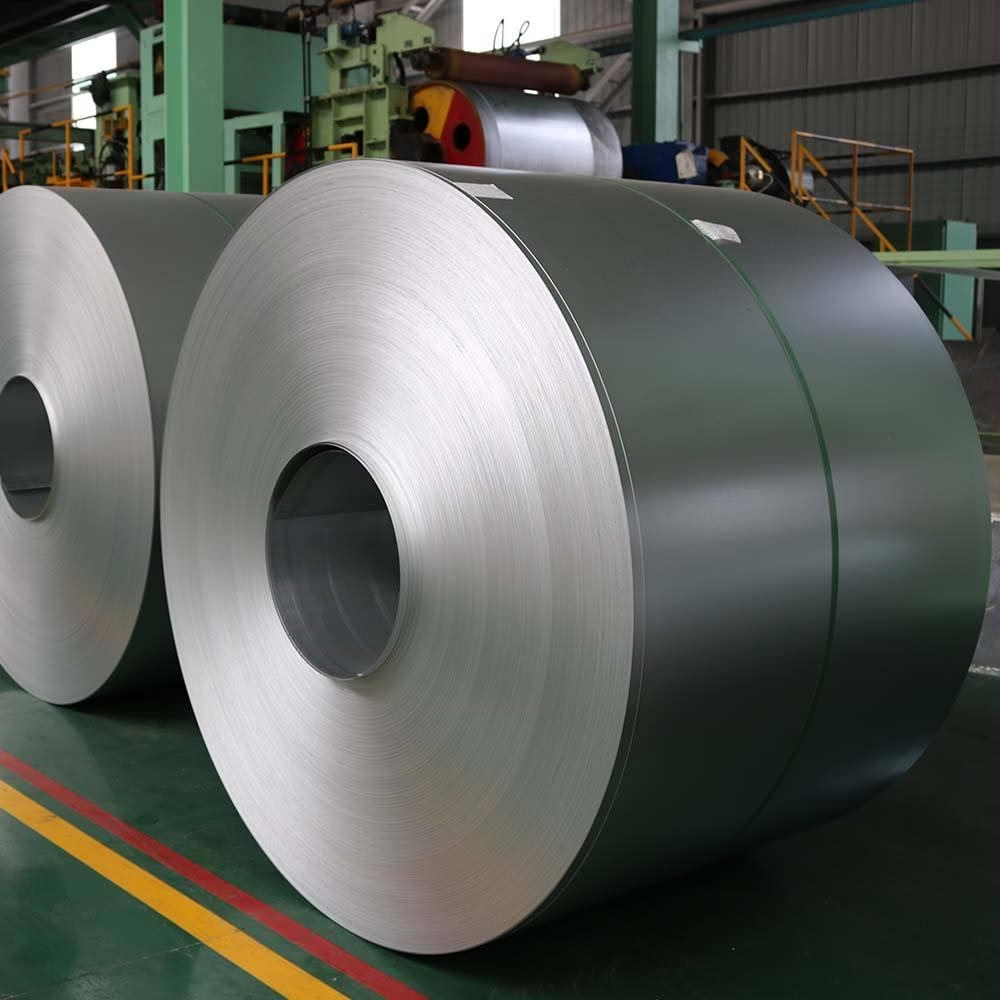
Tinplate Coil (ETP / MR / L / MC Grade)
Tinplate Coil (ETP) is cold-rolled low-carbon steel with electrolytic tin coating (1.0–8.4 g/m² per side) for food cans, beverage cans, crown caps, aerosol cans, and general metal packaging. Thickness 0.13–0.49mm, width 600–1,050mm, coil form. Tempers T1–DR10. MR / L / D grade steel. EN 10202, JIS G3303, ASTM A624, GB/T 2520. Mill test certificate with food contact compliance provided.
| Material | Cold-Rolled Carbon Steel with Electrolytic Tin Coating (Electrolytic Tinplate — ETP) |
|---|---|
| Grade / Standard | Steel Grade: MR / L / D / MC — Temper: T1 / T2 / T2.5 / T3 / T4 / T5 / DR8 / DR8.5 / DR9 / DR9.5 / DR10 — Tin Coating: 1.0/1.0 to 8.4/8.4 g/m² |
| Thickness | 0.13mm – 0.49mm (Standard electrolytic tinplate gauge range) |
| Width | 600mm – 1,050mm (Slit to custom widths to ±0.3mm tolerance) |
| Length | Coil form standard / Sheet (MRS Master Roll Sheet) available on request |
| MOQ | 5 Tons (Standard Coil) / 1 Ton (Sample / Trial Order) |
| Delivery Time | 20-40 Days (Standard) / 15-25 Days (Stock) |
| Loading Port | Tianjin / Shanghai / Qingdao |
Overview of Tinplate Coil
Tinplate Coil is cold-rolled low-carbon steel strip coated on both surfaces with a thin layer of pure tin by the electrolytic tinplating process, producing the world’s most widely used metal packaging material — a material that has protected food, beverages, oils, and chemical products in metal cans for over two centuries and continues to serve as the global packaging standard for shelf-stable food products by combining the structural strength and formability of steel with the corrosion resistance, food safety, solderability, and bright decorative appearance of tin. Electrolytic tinplate (ETP) is manufactured by continuously passing cold-rolled steel strip through an electrolytic tin plating bath where tin ions are deposited from a tin sulfate or methylsulfonic acid electrolyte onto the steel surface under precisely controlled current density, temperature, and plating speed conditions that determine coating weight uniformity, crystalline structure, and adhesion quality. The deposited tin coating is then subjected to reflow (melting and resolidifying the tin layer by induction or resistance heating above the tin melting point of 232°C) to produce the characteristic bright mirror-like finish of commercial tinplate through crystalline grain growth in the molten tin layer before solidification, followed by cathodic passivation treatment in sodium dichromate solution to form a thin chromium oxide / chromium metallic passivation layer over the tin that prevents tin oxidation (dulling) during storage and improves lacquer adhesion.
Tinplate coil is standardised under EN 10202 (cold-reduced electrolytic tinplate), JIS G3303 (tin mill products — electrolytic tinplate), ASTM A623 (tin mill products — general requirements), ASTM A624 (tin mill products — electrolytic tinplate), GB/T 2520 (cold-reduced electrolytic tinplate), and ASTM A625 (tin mill products — single-reduced black plate). The two principal tin coating weight designations in commercial tinplate are equal-coating (both sides the same coating weight, e.g., 2.8/2.8 g/m² — the most common commercial designation) and differential-coating (different coating weights on the two sides, e.g., 5.6/2.8 g/m² where the higher-coated side faces the food product interior and the lower-coated side faces the exterior where lacquer provides additional protection). Standard coating weight designations range from 1.0/1.0 g/m² (lightest coating, for minimal corrosion environments) through 2.8/2.8 g/m² (the most widely used standard coating for food cans) to 8.4/8.4 g/m² (heavy coating for long-life storage and corrosive product service). Steel substrate tempers range from T1 (softest, for deepest draw operations) through T5 (for can ends) and double-reduced DR8 through DR10 (for lightweight end stock).
Key Features and Manufacturing Process
Tinplate coil manufacturing begins with cold-rolled low-carbon steel substrate produced on the same cold rolling lines as tin-free steel, achieving the precise combination of low carbon content (≤0.13%), controlled manganese (≤0.60%), very low phosphorus (≤0.020%) and sulfur (≤0.020%), and aluminium-killed grain structure (Al 0.010–0.060%) required for the strain-age resistance, consistent mechanical properties, and surface quality demanded by high-speed can making operations. The cold-rolled steel substrate undergoes continuous strip annealing (for single-reduced substrate) or box annealing for certain temper grades, followed by temper rolling (skin passing at 1–2% reduction) to achieve the final mechanical properties, surface roughness, and flatness before entering the electrolytic tinplating process. The electrolytic tinplating line passes the steel strip at speeds of 200–600 metres per minute through a series of electrolytic plating cells containing an acidic tin electrolyte (tin sulfate or methylsulfonic acid system), where tin is deposited from solution onto both strip surfaces simultaneously under controlled current. The tin coating weight is determined by the plating current density and strip speed — higher current and lower speed deposit heavier tin coating. After plating, the tin-coated strip passes through induction reflow heating coils that rapidly melt the tin surface layer (above 232°C tin melting point) and then immediately resolidify it as the strip exits the reflow zone and cools, producing the bright reflective mirror surface characteristic of commercial tinplate through controlled tin crystal growth during the brief molten period. The reflowed strip immediately enters the passivation tank where cathodic treatment in sodium dichromate or Chrome-based solutions deposits a thin chromium compound passivation layer (5–15 mg/m² Cr) that prevents tin surface oxidation during storage and improves organic coating adhesion. Finally, a thin application of food-grade dioctyl sebacate (DOS) or acetyl tributyl citrate (ATBC) oil lubricant is applied at 1–3 mg/m² per side to reduce can-making tooling wear and improve strip handling.
Double-reduced (DR) tinplate is produced by cold rolling the annealed substrate a second time (without intervening anneal) at 20–40% additional reduction before tinplating, increasing yield strength significantly (DR8: ≥415 MPa, DR9: ≥440 MPa) and enabling production of lighter-gauge end stock with equivalent panel stiffness performance at reduced material consumption. The tinplate industry measures surface finish quality by tin coating weight (g/m²), roughness (Ra in μm), reflectivity (specular gloss), and passivation type (Type 300 chromate passivation — standard, Type 311 cathodic chromate, or Type D — alternative passivation systems).
Main Applications of Tinplate Coil
Food can body and end manufacturing is the dominant application for tinplate coil, consuming approximately 60–70% of global tinplate production in the form of three-piece food can bodies (vegetable cans, fish cans, tomato product cans, meat cans, pet food cans, baby food cans), two-piece drawn and redrawn (DRD) food cans (tuna fish, sardine, pet food, shallow pressed cans), and food can ends (both conventional non-easy-open ends and easy-open ring-pull ends — EOE) — all applications where the tin coating provides direct food-safe contact capability (approved under EU Regulation No. 10/2011 on plastic materials in contact with food and equivalent international food contact regulations for tin), corrosion protection in the presence of acidic food products and their brine, syrup, or oil packing media, and the bright metallic appearance suitable for printed decoration or unlacquered bright presentation. Beverage can manufacture uses tinplate for some beer, carbonated beverage, and energy drink can end stock (though aluminium alloy dominates beverage can bodies in North America and Europe, tinplate beverage can bodies remain competitive in Asia and developing markets for both cost and recycling logistics reasons), and tinplate two-piece DWI (drawn and wall-ironed) beverage cans for some beer and CSD applications in markets where steel can recycling infrastructure is established.
General line can manufacture from tinplate encompasses a very broad range of non-food product packaging applications including paint cans and pails (round and rectangular tinplate paint cans from 0.5L to 25L capacity), aerosol can bodies for personal care, household, and automotive aerosol products, lubricant and motor oil cans, decorative gift tins (biscuit tins, confectionery tins, tea tins, premium gift packaging), baby food packaging including pressed tinplate trays and lids, olive oil cans, peanut and nut tins, medical packaging (pill tins, supplement containers), tobacco packaging, and a comprehensive range of custom general line can applications. Crown cap closure manufacture is a major tinplate coil application in markets where glass bottle beer and carbonated beverages are the primary packaging format — the standard 26mm Pry-Off crown cap stamped from T4 or DR8 temper tinplate at 0.22–0.26mm thickness is the global standard bottle closure for premium beer, craft beer, sparkling water, and glass-packaged CSD products. Lithographic printing on tinplate sheet is the primary decorative surface treatment for food and gift can manufacturing, where UV or UV-LED curing offset litho printing in up to 6–8 colours plus varnish is applied to tinplate sheet or coil before can making, creating the high-resolution photographic-quality decoration characteristic of premium food, gift, and promotional metal packaging. Other applications include fishmeal can production in developing market coastal fishing industries, cooking oil tin production in Africa and South Asia, confectionery and chocolate tin packaging, aerosol valve cup manufacturing, and pharmaceutical tin packaging for healthcare and supplement products.
Why Choose Us for Tinplate Coil
Shandong Tanglu Metal Material Co., Ltd. supplies premium Tinplate Coil sourced from China’s leading integrated steel producers including Baoshan Iron & Steel (Baosteel) — operating one of the world’s most technically advanced electrolytic tinplating lines with superior tin coating uniformity, surface brightness, and passivation quality — Angang Steel, Shougang Jingtang, and Wuhan Iron & Steel (WISCO), all producing tinplate to EN 10202, JIS G3303, ASTM A624, and GB/T 2520 standards with ISO 9001, ISO 14001, and ISO 22000 (food safety management for food contact material production) certification. Every tinplate coil is accompanied by original mill test certificates covering cold-rolled substrate chemical composition (all elements including P, S, Al, N per packaging steel specifications), mechanical properties (yield strength, tensile strength, HR30T hardness per EN 10202), tin coating weight per side (by coulometric stripping per EN 10202, with both sides measured separately), passivation type and chromium deposit weight, surface roughness (Ra), oil coating weight, and complete coil heat and number traceability.
We offer a comprehensive tinplate specification range covering: Substrate tempers T1 through T5 (single-reduced) and DR8 through DR10 (double-reduced) per EN 10202 / JIS G3303; steel grades MR (most common — low residual element, suitable for all food applications including sulfurous products), L grade (lowest residual element content for the most sensitive food applications), D grade (higher strength for aerosol and crown applications), and MC grade (medium carbon, for specific mechanical property requirements); tin coating weights from 1.0/1.0 g/m² through 8.4/8.4 g/m² including standard 2.8/2.8, differential coating (5.6/2.8, 8.4/2.8) for food can interior/exterior applications; passivation Type 300 (standard), Type 311, and chromium-free passivation for specific customer requirements. Widths 600mm to 1,050mm slit to custom widths. Standard coil weights 3–10 tons with custom ID/OD specifications. With established monthly supply capacity of 5,000 tons of tinplate coil and export relationships with can manufacturers, packaging converters, crown cap producers, and general line can makers across more than 50 countries, we support both small sampling orders and large annual production coil supply contracts. Each shipment includes original mill test certificate per EN 10204 3.1, EU food contact material compliance declaration, and third-party inspection by SGS, Bureau Veritas, or Intertek available.
📐 Dimension & Size Table
| Temper | EN 10202 / JIS G3303 | HR30T Hardness Range | Typical Thickness (mm) | Tin Coating (g/m²) | Typical Application |
|---|---|---|---|---|---|
| T1 | EN T1 / JIS 1号 | 46–52 HR30T | 0.22–0.36 / 2.8/2.8–5.6/5.6 / Deepest draw — DRD 2-piece cans, complex formed components | ||
| T2 | EN T2 / JIS 2号 | 50–56 HR30T | 0.18–0.40 / 2.8/2.8 / Standard food can body — three-piece welded cans | ||
| T2.5 | EN T2.5 / JIS 2.5号 | 52–60 HR30T | 0.18–0.36 / 2.8/2.8 / Food can body and general can applications | ||
| T3 | EN T3 / JIS 3号 | 56–62 HR30T | 0.15–0.35 / 2.8/2.8–5.6/2.8 / Food can body, aerosol cans, general line | ||
| T4 | EN T4 / JIS 4号 | 61–73 HR30T | 0.14–0.32 / 2.8/2.8 / Crown caps, can ends, general line closures | ||
| T5 | EN T5 / JIS 5号 | 67–75 HR30T | 0.14–0.30 / 2.8/2.8 / Can ends, aerosol valve cups, stiff closures | ||
| DR8 | EN DR8 / JIS DR8 | 70–76 HR30T | 0.14–0.26 / 2.8/2.8 / Lightweight food can end stock | ||
| DR8.5 | EN DR8.5 | 72–80 HR30T | 0.14–0.22 / 2.8/2.8 / Thin end stock — steel weight reduction | ||
| DR9 | EN DR9 / JIS DR9 | 73–80 HR30T | 0.13–0.21 / 2.8/2.8 / Standard double-reduced end stock — most common DR grade | ||
| DR9.5 | EN DR9.5 | 76–84 HR30T | 0.13–0.19 / 2.8/2.8 / Ultra-thin lightweight end stock | ||
| DR10 | EN DR10 | 78–86 HR30T | 0.12–0.18 / 2.8/2.8 / Maximum hardness DR — thinnest end stock, maximum strength |
* Custom sizes available upon request. Tolerances per relevant international standards.
🔬 Chemical Composition
| Element | Min | Max | Display Value | Note |
|---|---|---|---|---|
| C | - | 0.13 | ≤0.13 | Low carbon steel substrate per EN 10202 / JIS G3303 — low C essential for can making formability and strain-age resistance |
| Mn | - | 0.60 | ≤0.60 | Manganese — strength contribution; controlled for formability balance |
| P | - | 0.020 | ≤0.020 | Strictly controlled — P promotes strain-age embrittlement degrading can making performance on high-speed lines |
| S | - | 0.020 | ≤0.020 | Strictly controlled — MnS inclusions reduce ductility; reacts with food to form FeS darkening in sulfurous food cans |
| Si | - | 0.020 | ≤0.020 | Very low Si — Si raises recrystallisation temperature, reduces formability of thin-gauge packaging steel |
| Al | 0.010 | 0.060 | 0.010–0.060 | Aluminium-killed grain structure — Al combines with N to form AlN preventing nitrogen-induced strain ageing embrittlement |
| N | - | 0.010 | ≤0.010 | Interstitial nitrogen — controlled; free N causes strain ageing and blue brittleness; must be combined as AlN |
| Cu | - | 0.10 | ≤0.10 | Residual element — Cu in MR grade limited; L grade has even lower Cu for most sensitive food applications |
| Sn (tin coating — per side) | 1.0 | 8.4 | 1.0–8.4 g/m² | Electrolytic tin coating weight per side — standard food can 2.8 g/m²; heavy coating 5.6–8.4 g/m² for corrosive/long-life applications |
| Cr (passivation) | 5 | 15 | 5–15 mg/m² | Cathodic passivation chromium deposit over tin — prevents tin oxidation, improves lacquer adhesion; Type 300 or Type 311 |
* Chemical composition may vary by heat, thickness and specification. Please refer to the actual mill test certificate.
⚙️ Mechanical Properties
| Property | Value | Unit | Test Condition |
|---|---|---|---|
| Yield Strength — T2 Substrate (Single Reduced) | 220–300 | MPa | Per EN 10202 T2 temper — standard can body grade, optimal forming balance |
| Tensile Strength — T2 Substrate | 310–410 | MPa | Per EN 10202 T2 temper |
| Elongation — T2 Substrate | ≥28 | % | Longitudinal direction, 80mm gauge length — excellent can body formability |
| Hardness — T2 (HR30T) | 50–56 | HR30T | Rockwell T scale — standard hardness specification for tinplate per EN 10202 / JIS G3303 |
| Hardness — T4 (HR30T) | 61–73 | HR30T | Per EN 10202 T4 — crown cap and can end stock hardness for panel stiffness |
| Yield Strength — T4 Substrate | 300–360 | MPa | Higher yield enabling thinner crown cap geometry |
| Yield Strength — DR9 Substrate (Double Reduced) | ≥440 | MPa | Per EN 10202 DR9 — high yield enabling lightweight thin end stock |
| Hardness — DR9 (HR30T) | 73–80 | HR30T | Maximum hardness range for double-reduced end stock |
| Tin Coating Weight — Equal Coating 2.8/2.8 | 2.8 ± 0.6 | g/m² per side | Per EN 10202 — dominant standard commercial tinplate coating weight for food can bodies and ends |
| Tin Coating Weight — Equal Coating 5.6/5.6 | 5.6 ± 0.8 | g/m² per side | Per EN 10202 — heavy coating for corrosive food products and long shelf-life storage requirements |
| Passivation Cr Deposit (Type 300) | 5–15 | mg/m² | Cathodic chromate passivation — standard Type 300; prevents tin oxidation, improves lacquer adhesion |
| DOS Lubricant Oil Weight | 1–3 | mg/m² per side | Dioctyl sebacate (DOS) application — food-grade lubricant reducing tooling wear in can making operations |
| Surface Roughness Ra | 0.3–0.8 | μm | Temper-roll imparted roughness — affects tin coating brightness, lacquer adhesion, and printing quality |
| Tin Coating Porosity (Alloy-Free Tin Fraction) | ≥70 | % of total Sn coating | Free metallic tin above FeSn₂ alloy layer — minimum % ensuring corrosion protection continuity |
* Values shown are minimum requirements unless otherwise stated.
📦 Commercial Information
| Packaging | Standard seaworthy export packing for tinplate coil with moisture protection as the primary packaging requirement — the tin-coated surface is susceptible to atmospheric oxidation (dulling), moisture-induced staining, and oil fingerprint contamination during transit that can affect subsequent lacquering, printing, and can making performance. Each tinplate coil individually wrapped with moisture-barrier polyethylene film (minimum 200 microns) applied directly to the coil surface and sealed at inner bore and outer OD face with PE tape, preventing moisture penetration through coil turns during extended ocean transit in potentially humid container environments. Outer wrap of heavy kraft paper or additional PE film provides mechanical abrasion protection during container loading and vessel transit. Coil inner bore protected with cardboard tube or steel core liner preventing ID deformation during handling. Coil OD face protected with corrugated cardboard face discs on both faces preventing edge damage from handling equipment contact. Multiple coils of identical specification (temper, thickness, tin coating, grade, width) stacked horizontally (eye-to-wall orientation — axis horizontal) on ISPM-15 heat-treated hardwood timber pallets with softwood timber support blocks between coil layers providing ventilation and preventing coil-to-coil contact damage; vertical steel strapping through pallet base prevents coil toppling. Standard pallet configuration: 2–4 coils per pallet depending on coil weight and height. Each coil identified with a coil label on outer PE wrap showing: coil number, temper (T2, T4, DR9, etc.), substrate grade (MR, L, D), thickness (mm), width (mm), tin coating designation (E2.8/E2.8, D5.6/2.8, etc. per EN 10202), passivation type (300/311), oil type (DOS/ATBC), coil weight (kg net), inner diameter (mm ID), outer diameter (mm OD), heat number, and customer purchase order reference. A duplicate identification tag on heat-resistant plastic card is also placed inside the inner bore for coil identification after outer label removal during processing. Desiccant sachets (silica gel minimum 300g per coil) placed inside the sealed PE film wrapping for high-humidity destination markets. Container loading: standard 20FT FCL typically 20–22 tons of tinplate coil; 40HQ for wider coils or mixed-gauge orders. Complete documentation (mill test certificate per EN 10202 / EN 10204 3.1, food contact compliance declaration per EU Regulation 10/2011, packing list, Certificate of Origin) provided in waterproof document pouch attached to outer packaging of each container shipment. |
|---|---|
| Payment Terms | T/T (Telegraphic Transfer),L/C (Letter of Credit),D/P (Documents against Payment),Western Union,PayPal |
| Price Term | FOB,CFR,CIF,EXW |
| Supply Capacity | 5,000 Tons/Month (Tinplate Coil ETP) |
| Loading Port | Tianjin / Shanghai / Qingdao |
Why Choose Our Tinplate Coil (ETP / MR / L / MC Grade)?
EN 10202 / JIS G3303 Certified Food-Safe Packaging Steel
Tinplate coil supplied with EN 10202 compliant mill test certificate covering substrate chemical composition (all elements including P, S, Al, N), mechanical properties (yield strength, tensile strength, HR30T hardness), tin coating weight per side by coulometric stripping, passivation type and Cr deposit, surface roughness, oil type and weight, and complete coil traceability. EU food contact compliance per Regulation (EU) No. 10/2011 and JIS G3303 compliance for Japanese market supplied with each shipment.
Complete Temper, Grade & Coating Weight Range
Full commercial tinplate range: SR tempers T1–T5 for can bodies and moderate draw; DR8–DR10 for lightweight end stock. Steel grades MR (all-purpose), L (low-residual premium), D (aerosol/crown). Tin coating 1.0/1.0 to 8.4/8.4 g/m² equal and differential coating. Width 600–1,050mm slit to custom specification. DOS or ATBC oiled. Passivation Type 300 / 311.
Bright Mirror Surface & Superior Food Compatibility
Reflowed tinplate achieves the characteristic bright mirror surface (specular gloss ≥600 GU) that provides food-safe direct contact capability (tin is approved for food contact globally — EU, FDA, JAS), corrosion protection through tin's galvanic sacrifice mechanism protecting steel substrate, excellent weldability for three-piece ERW can body seaming, and outstanding adhesion for epoxy, vinyl organosol, and PET film lacquer systems.
Multi-Standard Food Packaging Compliance
EN 10202 (European), JIS G3303 (Japanese), ASTM A624 (American), GB/T 2520 (Chinese). EU food contact material compliance per Regulation (EU) No. 10/2011. FDA 21 CFR compliance for US market. JAS (Japanese Agricultural Standard) food packaging compliance. ISO 22000 food safety management at producing mills. Available with Halal and Kosher food packaging compliance documentation.
Reliable Packaging Steel Supply Chain
Standard tinplate grades (T2, T4, DR9 in 2.8/2.8 MR) in standard widths from stock: 15–25 days dispatch. Custom widths and special coatings: 25–40 days production. Container loading 20–22 tons per 20FT FCL. Established export logistics to can manufacturers, packaging converters, crown cap producers, and general line can makers in Asia, Middle East, Africa, and Latin America.
🏭 Applications of Tinplate Coil (ETP / MR / L / MC Grade)
Tinplate coil serves as the foundational raw material for the global metal can packaging industry — a 400 billion unit per year market providing shelf-stable food preservation, beverage packaging, personal care product delivery, household chemical packaging, and decorative gift packaging that represents one of the oldest and most successful sustainable packaging systems in commercial history. Food can manufacturing consumes the largest proportion of global tinplate production, with three-piece food can body production from T2 and T3 temper tinplate at thicknesses of 0.18–0.28mm representing a technically sophisticated manufacturing process where tinplate coil is slit to can body blank width, the blanks are roll-formed into cylinders on high-speed can body makers (producing 400–1,000 can bodies per minute on modern equipment), the longitudinal seam is electric resistance welded (ERW side seam welding), and the can bodies are lacquered inside (epoxy or vinyl organosol applied by spray), decorated outside (offset lithographic printing in up to 8 colours plus varnish, applied to tinplate sheet before can making), flanged, beaded (for can strength), and double-seamed with pre-lacquered tinplate can ends — the completed food cans destined for filling with vegetables, fruit, fish, meat, tomato products, beans, soups, and pet food products that represent the core of global shelf-stable food supply chains. Easy-open end (EOE) production from DR9 and T4/T5 temper tinplate consumes significant quantities of tinplate coil in the manufacture of the ring-pull tab and score-line panel ends applied to food cans — the EOE is the most technically complex component in standard food can manufacture, combining the structural integrity to withstand retort sterilisation at 121°C for 60 minutes under 2–3 bar internal steam pressure, the fracture-controlled score line that enables clean panel separation by the ring-pull tab, and the tab rivet joint providing the mechanical connection between the tear tab and the panel — all formed from 0.18–0.21mm DR9 tinplate in a single-blow multi-station transfer press die at production rates of 300–600 ends per minute. Crown cap production from T4 and DR8 temper tinplate in 0.22–0.26mm thickness is one of the highest-volume stamped metal product applications globally — the standard 26mm Pry-Off crown cap (invented by William Painter in 1891 and still in widespread use unchanged in basic geometry) is produced by progressive or transfer press dies stamping from tinplate strip at rates of 1,500–3,000 crowns per minute, with the stamped shell then lined with a food-grade PVC plastisol or PECM (polyethylene copolymer) compound disk applied by rotary liner equipment and cured in an oven to form the hermetic bottle seal. Crown caps in tinplate provide corrosion resistance in contact with beer, sparkling water, and CSD products through the combination of tin coating (protecting the crown shell from corrosive beverage contact at the seal edge) and the plastic liner (providing the primary product contact barrier and seal), with the outside of the crown decorated by offset lithographic printing applied to tinplate sheet before stamping. Two-piece DRD (drawn and redrawn) food can production from T1 and T2 temper tinplate in thicknesses of 0.20–0.30mm produces shallow cylindrical cans for tuna fish, sardines, pet food, and corned beef products by progressive deep drawing and redrawing of a flat tinplate blank into a can body in a transfer press, requiring the maximum elongation and r-value (plastic strain ratio indicating deep drawability) performance available from T1 and T2 temper tinplate to complete the full drawing reduction without tearing. General line can production from T3 and T4 temper tinplate encompasses the broad range of non-food product metal packaging including paint cans and pails in 0.5L to 25L capacity (round and rectangular formats), aerosol can bodies for personal care (hairspray, deodorant, shaving gel), household (spray paint, insecticide, air freshener), and automotive (tyre inflator, brake cleaner) aerosol products, lubricant and motor oil cans, decorative gift tins for premium confectionery, biscuits, tea, and seasonal gift products, medical packaging tins for pharmaceutical tablets and supplements, baby food packaging components, and the complete spectrum of metal packaging for the global FMCG market. Beverage can manufacturing in tinplate — primarily two-piece DWI (drawn and wall-ironed) steel cans — remains commercially competitive with aluminium cans in Asian, African, and Latin American markets where established steel can recycling infrastructure, lower tin can manufacturing investment cost versus aluminium can lines, and the weight advantage of steel (enabling higher stacking height in distribution) support continued market positions for tinplate beer and CSD cans alongside the globally dominant aluminium beverage can market. Decorative gift tin manufacturing from printed tinplate sheet produces the premium collectible tin packaging for major confectionery brands (Cadbury, Ferrero Rocher, Haribo), premium biscuit brands (Walkers Shortbread, Thorntons), tea brands (Fortnum & Mason, Twinings), and seasonal Christmas and Valentine's Day gift collections where the decorative tinplate container is part of the premium brand proposition and serves as a collectible reusable container after the product is consumed.
📋 Quality & Certification
Our Certifications
- ✅ ISO 9001:2015
- ✅ CE Marking
- ✅ Bureau Veritas (BV)
- ✅ SGS Certified
Mill Certificate Type
- 📋 EN 10204 3.1
- 📋 EN 10204 3.2
- 📋 Third Party Inspection Available
- 📋 Certificate of Origin
❓ Frequently Asked Questions
What is electrolytic tinplate (ETP) and how is tin coating weight specified?
Electrolytic tinplate (ETP) is cold-rolled low-carbon steel strip coated on both surfaces with a thin layer of pure tin (Sn) deposited by the electrolytic plating process, producing the world's most widely used metal packaging material for food cans, beverage cans, crown caps, and general metal packaging. The term 'electrolytic' distinguishes modern tinplate from historical 'hot-dipped' tinplate where the steel was passed through a bath of molten tin — electrolytic plating provides precise coating weight control, uniform thin coatings achievable in the range 1–11 g/m², and high production speed that hot-dip tinning cannot match. Tin coating weight is specified in grams per square metre (g/m²) per side, expressed as a pair of values representing the coating on each surface. The two main coating weight systems are: EN 10202 / European designation: expressed as 'E' + coating weight in g/m², e.g., E2.8/E2.8 means 2.8 g/m² on each side (equal coating), or E5.6/E2.8 means 5.6 g/m² on the inside (food-contact side) and 2.8 g/m² on the outside (differential coating). ASTM / US designation: expressed as '#' + numeric code where each number represents 1.12 g/m² per lb/BB (pound per base box, the traditional US tinplate unit), e.g., #25/#25 = 2.8 g/m² per side. Standard commercial coating weights include: 1.0/1.0 g/m² — very light coating for dry product packaging or exterior-only use; 2.8/2.8 g/m² — the dominant global standard for food can bodies and ends providing adequate protection for most canned food products under 3–5 year shelf life; 5.6/5.6 g/m² — heavy coating for corrosive food products (high-acid fruit, sulfurous vegetables, fish in brine); 8.4/8.4 g/m² — maximum standard coating for the most corrosive applications and longest shelf life (10+ years military rations, long-term emergency food storage). Differential coating (5.6/2.8, 8.4/2.8) is commercially important — heavier coating on the can interior (food-contact side) provides enhanced corrosion protection from the product, while standard coating on the exterior reduces tin consumption and cost since the exterior is protected by the printed lacquer system.
What is the difference between MR grade, L grade, and D grade tinplate steel?
Tinplate steel grade designations (MR, L, D, MC in international standards; corresponding to grades in JIS G3303 and EN 10202) classify the steel substrate by its residual element content — primarily copper, nickel, chromium, and molybdenum — which affects the corrosion behaviour of the steel in the presence of food products and the solderability and weldability performance of the tinplate in can making operations. MR Grade (Most Restrictive, also called 'single reduced base' in some market designations): The most widely used commercial tinplate steel grade, with controlled residual element limits — copper ≤0.10%, nickel ≤0.06%, chromium ≤0.06%, molybdenum ≤0.01% per typical market specifications. MR grade steel is suitable for the full range of food packaging applications including sulfurous foods (fish, meat, pet food) where the steel substrate must not contribute sulfur-reactive elements that could form black FeS discoloration at pitting defects in the tin coating. MR grade tinplate is the standard specification for three-piece food can bodies, food can ends, DRD two-piece cans, and crown caps for the full range of food product applications. L Grade (Low residual): The most stringent residual element specification, with copper ≤0.05%, nickel ≤0.04%, chromium ≤0.04%, and other residuals at even lower limits than MR grade. L grade steel is specified for the most sensitive food applications including infant formula packaging, baby food, and premium canned foods where the absolute minimum level of metallic contamination potential is required and where the steel's corrosion behaviour must be most predictable and controlled over long shelf life. L grade commands approximately 5–8% price premium over MR grade. D Grade (Drawing quality for difficult can designs): Steel with controlled inclusion content and improved deep drawability characteristics for two-piece DRD can applications requiring the most severe forming deformation, aerosol can body production requiring deep draw and subsequent re-forming operations, and crown cap stock applications where high press speed stamping performance is critical. The D designation addresses the steel's formability and consistent mechanical properties for difficult stamping rather than residual element content like MR and L grades. MC Grade (Medium carbon): A less common grade specification for applications requiring specific mechanical property characteristics achievable by slightly higher carbon content than standard MR grade — used in some specialty aerosol and general line can specifications where higher hardness is required from SR tempers.
What lacquer systems are applied to tinplate for food can interior protection?
Tinplate food can interiors are coated with organic lacquer systems that provide the primary barrier between the steel/tin substrate and the packaged food product, preventing metallic contamination of the food, inhibiting corrosion reactions between the tin and food acids, controlling the dissolution rate of tin into the food product to within food safety limits, and in some applications providing the sealing function at the ERW seam area where the tin coating is disrupted by the welding process. The principal interior lacquer systems for tinplate food cans are: Epoxy-Phenolic Lacquers: The most widely used interior can lacquer globally, providing excellent adhesion to tinplate, outstanding resistance to the steam retort sterilisation process (121°C, 15–30 minutes at 2–3 bar), good chemical resistance to both acidic and neutral food products, and very low migration of lacquer components into the packaged food. Epoxy-phenolic is the standard interior coating for vegetable cans, meat cans, fish cans, pet food cans, soup cans, and all canned food products processed by retort sterilisation. Applied to tinplate coil or sheet by roll coater at typically 2–6 g/m² dry film weight, then oven-cured at 180–220°C. Vinyl Organosol Lacquers: A vinyl chloride / vinyl acetate copolymer dispersion providing excellent flexibility and extensibility for DRD drawn can applications, outstanding resistance to sulfur compounds (preventing tin sulfide blackening in fish, egg, and meat products), and very good retort resistance. Vinyl lacquers are the preferred choice for fish cans (sardines, tuna, salmon, mackerel), pet food cans, and other sulfurous product applications where standard epoxy-phenolic lacquers would develop black discoloration from sulfur reaction with the tin coating. PET Film Laminate: An alternative to liquid lacquer where a biaxially oriented polyethylene terephthalate (PET) film (12–25μm thickness) is heat-laminated directly to the tinplate surface before can making, providing a continuous pin-hole-free coverage impossible to achieve with liquid lacquer at practical application weights. PET laminated tinplate (FLTS — Film Laminated Tinplate) is used for high-production two-piece DRD fish and pet food cans where the continuous film eliminates the in-can corrosion failure mode of holidays (pinholes) in roll-coated liquid lacquer. Acrylic lacquers: Used as exterior can decoration base coats and some interior applications for specific product compatibility. Polyester lacquers: Used for some application areas requiring specific chemical resistance or food regulatory compliance characteristics. For ASME food safety and EU food contact material compliance, all lacquer systems used on food-contact tinplate must comply with EU Regulation (EU) No. 10/2011 on plastic materials in contact with food (for polymer-based coatings), EU Regulation (EU) No. 1935/2004 (Framework Regulation on food contact materials), and FDA 21 CFR regulations for the US market.
What is passivation of tinplate and what are the different passivation types?
Passivation of tinplate is a post-plating surface treatment that forms a thin protective layer over the bright reflowed tin surface to prevent tin oxidation (dulling/tarnishing) during storage and shipment before can making, and to improve the adhesion of lacquer and printing inks applied to the tinplate during can production. Without passivation, freshly reflowed tinplate surface would gradually develop a dull grey oxide film (stannic oxide, SnO₂) on storage — particularly in humid conditions — that would reduce the bright metallic appearance, impair lacquer adhesion, and reduce the solderability needed for some can seam applications. The standard commercial passivation systems are: Type 300 (Standard Cathodic Chromate Passivation): The dominant passivation system historically applied to almost all commercial tinplate worldwide. The reflowed tinplate strip passes through a dilute sodium dichromate (Na₂Cr₂O₇) electrolyte tank where cathodic current deposits a mixed layer of metallic chromium (Cr⁰) and chromium oxide / hydroxide on the tin surface, with total chromium deposit typically 5–15 mg/m². Type 300 passivation produces a thin, nearly invisible coating that provides excellent tin surface protection during storage, improves lacquer adhesion significantly versus unpassivated tin, and has excellent compatibility with all standard tinplate lacquer systems and printing ink formulations. Type 311 (Modified Cathodic Chromate Passivation): A variant of Type 300 with modified electrolyte chemistry or deposition conditions producing a slightly different passivation layer composition — used by some producers to achieve specific lacquer adhesion performance characteristics or compatibility with particular customer lacquer systems. Both Type 300 and Type 311 use hexavalent chromium (Cr⁶⁺) in the dichromate electrolyte, which creates a REACH regulation challenge — while the final passivation layer on tinplate contains primarily trivalent Cr⁰ and Cr³⁺, the process electrolyte itself contains hexavalent chromate. Alternative Passivation (Type D and Cr-Free): In response to REACH regulatory pressure on hexavalent chromium process chemicals, several tinplate producers have developed or are developing chrome-free passivation systems using alternative chemistry (organic passivation compounds, zirconium-based passivation, or other non-chromium technology) that achieve equivalent tin surface protection and lacquer adhesion without chromium compounds in the process electrolyte. These systems are increasingly specified by environmentally focused can makers and consumer brand owners with sustainability commitments, though they currently represent a small percentage of global tinplate production. Chemical Passivation (Type 300C — alternative designation): In some specifications, chemical passivation by immersion in dichromate solution without electrolytic current is an alternative to cathodic passivation, producing a thinner and less consistently uniform passivation layer than cathodic treatment. Oiling over passivation: Standard practice to apply food-grade lubricant oil (DOS — dioctyl sebacate, ATBC — acetyl tributyl citrate, or ATO — acetyl trioctyl citrate) at 1–3 mg/m² per side over the passivation layer to reduce friction and tooling wear during high-speed can making and to provide a thin barrier against further atmospheric contact with the passivated tin surface during storage and transit.
What is the difference between single-reduced and double-reduced tinplate and when is each used?
Single-reduced (SR) and double-reduced (DR) tinplate differ in the number of cold rolling stages applied to the steel substrate before tinplating, producing significantly different mechanical property levels that determine application suitability. Single-Reduced (SR) tinplate is produced by the conventional sequence: hot-rolled coil → pickle → cold roll to substrate thickness → anneal (continuous strip anneal or box anneal) → temper roll (skin pass 1–2%) → electrolytic tinplating. The anneal step recrystallises the cold-rolled microstructure into equiaxed grains providing balanced strength and ductility. SR tempers T1 through T5 range from yield strength ~220 MPa (T1, softest, for deepest draw) to ~360 MPa (T5, for ends requiring panel stiffness), with elongation from ≥28% (T1/T2 for can body forming) to ≥15% (T5). SR tinplate is the standard specification for: three-piece food can bodies (T2 and T3, requiring roll forming, ERW seam welding, flanging, beading, and double seaming operations); DRD two-piece drawn can bodies (T1 and T2, requiring severe drawing reduction to form the cup shape); aerosol can bodies (T3, requiring re-forming operations after initial drawing); and crown caps (T4, requiring the hardness to resist deformation from bottle internal pressure at the minimum thickness for crown geometry). Double-Reduced (DR) tinplate is produced by adding a second cold rolling stage without intermediate anneal after the base anneal: → base anneal → second cold roll at 20–40% reduction → temper roll → electrolytic tinplating. The second cold rolling pass work-hardens the steel substantially beyond the SR hardness range, increasing yield strength (DR8: ≥415 MPa, DR9: ≥440 MPa, DR10: ≥460 MPa) while reducing elongation to ≤8% — too low for most forming operations but adequate for the limited deformation of can end stamping. The higher yield strength of DR steel allows production of thinner end stock (0.13–0.21mm for DR9 versus 0.14–0.25mm for T4 SR) with equivalent panel resistance to buckling under internal can pressure — since the end panel stiffness depends on both yield strength and plate thickness (panel buckling strength approximately proportional to σ_y × t²), the higher yield strength of DR9 enables proportional thickness reduction while maintaining the same pressure resistance. This enables can end diameter, and particularly easy-open end (EOE) dimensions, to be produced from thinner and lighter gauge steel for the same pressure rating — reducing steel consumption per end and therefore per filled can. DR tinplate is the standard specification for: food can ends (both conventional non-easy-open ends and EOE ring-pull ends — DR9 at 0.18–0.21mm is the dominant end stock temper/gauge combination globally); beverage can ends for steel DWI cans (DR9 and DR10 for the thinnest possible end stock consistent with carbonation pressure panel buckling resistance); and crown caps (DR8 in some specifications as a higher-strength alternative to T4 SR for minimum gauge crowns).
Get a Quote for
Tinplate Coil (ETP / MR / L / MC Grade)
Submit your requirements and receive a competitive price quote within 24 hours.
- ✓ Fast response within 24 hours
- ✓ Competitive factory-direct pricing
- ✓ Free technical consultation
- ✓ Mill test certificate provided
- ✓ Flexible payment terms available
⏱ Response within 24 hours
Send Your Inquiry
All fields marked with * are required