
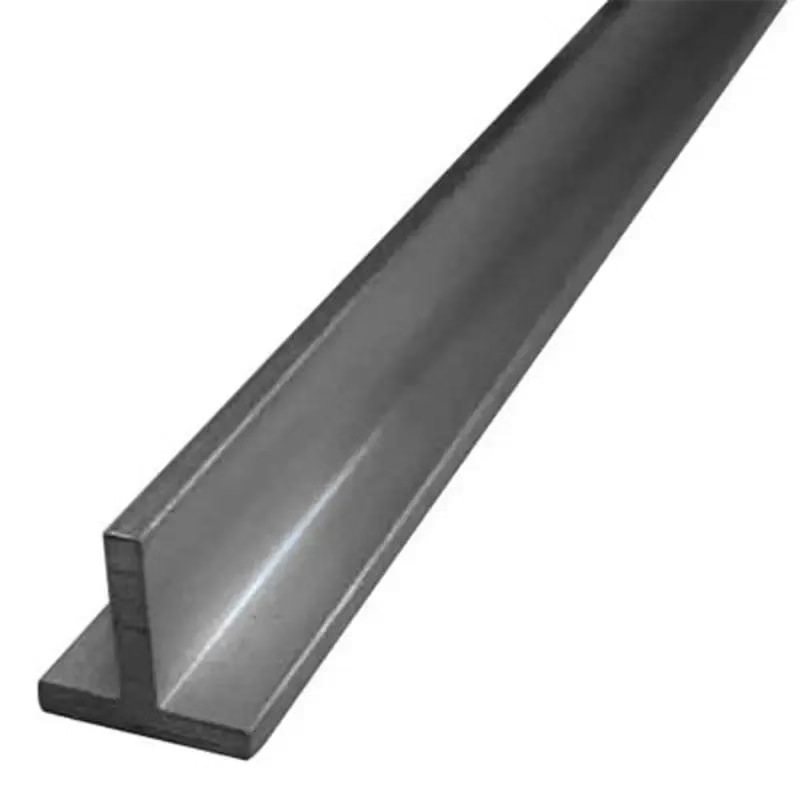
T-Bar Steel
T-Bar steel (structural T-section / tee bar) is hot-rolled steel section with T-shaped cross-section comprising flat flange and perpendicular stem. Equal-leg sizes 20×20mm to 200×200mm, lengths 6m/12m. Grades Q235B, Q345B, S355JR, A572 Gr50, SS400. Mill test certificate provided.
| Material | Carbon Structural Steel / Low Alloy High Strength Structural Steel |
|---|---|
| Grade / Standard | GB Q235B / Q345B / Q355B / EN S235JR / S355JR / S355J2 / ASTM A36 / A572 Grade 50 / JIS SS400 / SM490A |
| Section Size | Equal-leg: 20×20mm to 200×200mm | Unequal-leg: custom available |
| Flange Width | 20mm – 400mm |
| Web Height | 20mm – 400mm (stem height) |
| Web Thickness | 3mm – 25mm (stem and flange thickness) |
| Length | 6m / 12m (Custom cut-to-length available) |
| Delivery Condition | hot_rolled / normalized / as_rolled |
| Surface Treatment | shot_blasting / galvanized / coated |
| MOQ | 1 Ton |
| Delivery Time | 15-35 Days / In Stock |
| Loading Port | Tianjin / Shanghai / Qingdao |
Overview of T-Bar Steel
T-Bar steel, also referred to as structural T-section, T-beam, or tee bar, is a hot-rolled or welded structural steel section with a T-shaped cross-section comprising a flat horizontal flange and a perpendicular vertical stem (web) projecting from its centre. This simple yet highly versatile geometry provides efficient resistance to bending loads in one principal direction while offering a flat mounting face on the flange surface and a projecting stem suitable for welding connections, clip attachment, and load transfer in fabricated assemblies. T-bars are produced either by hot rolling as a dedicated T-section or by splitting standard wide-flange H-beams (W-sections or HEA/HEB beams) longitudinally along the web centreline using a circular saw or flame cutting process, producing two T-sections — commonly termed WT-sections (American practice) or split-tee sections — that inherit the superior material properties and dimensional accuracy of the parent rolled beam.
Hot-rolled T-bars are standardised under ASTM A6 (American WT series split from W-sections), JIS G3192 (Japanese T-bar series), EN 10055 (European equal-leg T-sections) and GB/T 706 (Chinese T-section standard), with section heights ranging from 20mm to 400mm and flange widths from 20mm to 400mm covering a comprehensive range of structural and fabrication applications. Steel grades encompass standard carbon structural grades Q235B / S235JR (yield 235 MPa), medium-strength low-alloy grades Q345B / Q355B / S355JR / A572 Grade 50 (yield 345–355 MPa), and higher-strength grades S420 / A572 Grade 60 / Q420B (yield 420 MPa) for demanding structural applications. T-bars serve critical functions across structural steel fabrication, machine building, shipbuilding, curtain wall systems, rail and transportation equipment, and architectural metalwork where the combination of a flat mounting face with a stiffening stem provides design solutions unavailable with other standard sections.
Key Features and Manufacturing Process
Hot-rolled T-bar steel is manufactured through continuous hot rolling at 1100–1250°C using dedicated T-section roll profiles on universal rolling mills, producing sections with well-defined flange-to-stem fillet radii, uniform thickness distribution, and consistent dimensional tolerances across the full production length. The rolling process refines the steel grain structure, providing superior toughness and ductility compared to flame-cut or plasma-cut T-sections produced from plate. Equal-leg T-bars (flange width equal to stem height) are the most commonly stocked standard form, while unequal T-bars with different flange widths and stem heights are available as special mill orders for specific structural requirements. WT-sections produced by splitting W-beams provide a much wider range of sizes and weights than dedicated rolled T-bars and are extensively used in truss chord and diagonal member applications in American structural practice.
T-bars are supplied in standard lengths of 6m and 12m, with custom cut-to-length service available, and standard equal-leg sections cover stem heights and flange widths from 20mm × 20mm (smallest bar stock sizes) up to 200mm × 200mm (large structural T-bars for heavy fabrication) in hot-rolled form, with welded T-sections available in custom dimensions for special applications. Common steel grades include GB Q235B / Q345B / Q355B, EN S235JR / S355JR / S355J2, ASTM A36 / A572 Grade 50, and JIS SS400 / SM490A. All T-bar production undergoes chemical composition analysis per applicable standard, mechanical property testing including yield strength, tensile strength, and elongation, dimensional inspection covering stem height, flange width, stem thickness, flange thickness, and straightness per EN 10055 / JIS G3192 / GB/T 706 tolerances, and surface quality inspection for harmful surface defects including seams, laps, and cracks.
Main Applications of T-Bar Steel
T-Bar steel is widely used in structural steel fabrication for truss and frame construction including roof truss chord members, lattice girder components, space frame node connectors, industrial shed portal frame bracing members, transmission tower leg and bracing elements, mast and pylon structural components, and crane runway beam stiffeners where the T-section geometry provides efficient load-carrying capacity combined with straightforward bolted or welded connection detailing to gusset plates and adjacent members.
The shipbuilding and marine industry is one of the largest consumers of T-bar steel, using it extensively for hull longitudinal and transverse framing stiffeners welded to shell plating and deck plating, bulkhead stiffeners, watertight division framing, hatch coaming stiffeners, deck beam stiffeners, engine room structural framing, accommodation block structural elements, offshore platform deck framing, jacket structure bracing stiffeners, and ship superstructure framing where the flat flange face provides excellent contact surface for continuous fillet welding to plating. The curtain wall and facade engineering sector uses T-bars as primary and secondary mullion and transom elements in glass curtain wall systems, structural glazing carriers, stone facade support brackets, and rainscreen cladding subframes where the T-section provides a stiff spine with a flat attachment face for cladding panel fixings. Other major applications include machine building and industrial equipment manufacturing for machine frame stiffeners, conveyor structure components, press frame elements, storage rack uprights and beams, mezzanine floor structure, overhead crane runway rail support beams, jig and fixture construction, lift guide rail support brackets, railway rolling stock underframe structural members, coach body structural framing, locomotive cab structural elements, agricultural machinery frame components, door and window frame reinforcement, architectural metalwork including decorative T-section features in building facades, and general steel fabrication and engineering workshops where T-bar serves as a versatile intermediate structural and stiffening section across a broad range of custom fabrication projects.
Why Choose Us for T-Bar Steel
Shandong Tanglu Metal Material Co., Ltd. supplies premium T-Bar steel sourced from reputable Chinese steel mills including Maanshan Steel, HBIS, and Laiwu Steel with established international export credentials and certified production facilities meeting ISO 9001, ISO 14001, and relevant product standard requirements including EN 10055, JIS G3192, and GB/T 706. Every T-bar shipment is accompanied by original mill test certificates covering chemical composition, mechanical property test results (yield strength, tensile strength, elongation), dimensional inspection data, and heat number traceability enabling complete batch identification throughout the supply chain.
We offer a comprehensive specification range covering equal-leg T-bars from 20×20mm to 200×200mm and unequal T-bar series in grades Q235B, Q345B, Q355B (GB/T 706), S235JR, S355JR, S355J2 (EN 10055), ASTM A36, A572 Grade 50, and JIS SS400, SM490A. Standard lengths 6m and 12m with custom cut-to-length service for fabrication projects. With an established monthly supply capacity and export relationships with structural steel fabricators, shipbuilders, curtain wall manufacturers, machinery manufacturers, and general engineering companies across more than 50 countries, we support both small fabrication material orders and large project supply packages. Each shipment includes an original mill test certificate (MTC) per EN 10204 3.1 standard, with EN 10204 3.2 and third-party inspection by SGS, Bureau Veritas, or equivalent available for critical structural and marine projects requiring enhanced quality documentation.
📐 Dimension & Size Table
| Section (T) | Height × Width (mm) | Stem Thickness (mm) | Flange Thickness (mm) | Weight (kg/m) |
|---|---|---|---|---|
| T 20×20 | 20 × 20 | 3.0 / 3.0 | 0.91 | |
| T 25×25 | 25 × 25 | 3.5 / 3.5 | 1.39 | |
| T 30×30 | 30 × 30 | 4.0 / 4.0 | 1.83 | |
| T 40×40 | 40 × 40 | 5.0 / 5.0 | 3.02 | |
| T 50×50 | 50 × 50 | 5.0 / 5.0 | 3.77 | |
| T 60×60 | 60 × 60 | 6.0 / 6.0 | 5.42 | |
| T 63×63 | 63 × 63 | 6.0 / 6.0 | 5.72 | |
| T 70×70 | 70 × 70 | 7.0 / 7.0 | 7.38 | |
| T 75×75 | 75 × 75 | 7.0 / 7.0 | 7.96 | |
| T 80×80 | 80 × 80 | 8.0 / 8.0 | 9.63 | |
| T 90×90 | 90 × 90 | 9.0 / 9.0 | 12.16 | |
| T 100×100 | 100 × 100 | 10.0 / 10.0 | 15.07 | |
| T 110×110 | 110 × 110 | 11.0 / 11.0 | 18.24 | |
| T 120×120 | 120 × 120 | 11.0 / 11.0 | 19.96 | |
| T 125×125 | 125 × 125 | 12.0 / 12.0 | 22.68 | |
| T 130×130 | 130 × 130 | 12.0 / 12.0 | 23.60 | |
| T 140×140 | 140 × 140 | 13.0 / 13.0 | 27.52 | |
| T 150×150 | 150 × 150 | 14.0 / 14.0 | 31.73 | |
| T 160×160 | 160 × 160 | 15.0 / 15.0 | 36.24 | |
| T 175×175 | 175 × 175 | 16.0 / 16.0 | 43.24 | |
| T 180×180 | 180 × 180 | 16.0 / 16.0 | 44.51 | |
| T 200×200 | 200 × 200 | 18.0 / 18.0 | 55.10 |
* Custom sizes available upon request. Tolerances per relevant international standards.
🔬 Chemical Composition
| Element | Min | Max | Display Value | Note |
|---|---|---|---|---|
| C | - | 0.22 | ≤0.22 | Q345B / S355JR per GB/T 1591 / EN 10025-2 |
| Si | - | 0.55 | ≤0.55 | |
| Mn | 1.00 | 1.60 | 1.00–1.60 | Strengthening element |
| P | - | 0.035 | ≤0.035 | |
| S | - | 0.035 | ≤0.035 | |
| V | - | 0.15 | ≤0.15 | Microalloying element |
| Nb | - | 0.05 | ≤0.05 | Microalloying element |
| Ti | - | 0.02 | ≤0.02 | Microalloying element |
| Cr | - | 0.30 | ≤0.30 | Residual element |
| Ni | - | 0.30 | ≤0.30 | Residual element |
| Cu | - | 0.30 | ≤0.30 | Residual element |
* Chemical composition may vary by heat, thickness and specification. Please refer to the actual mill test certificate.
⚙️ Mechanical Properties
| Property | Value | Unit | Test Condition |
|---|---|---|---|
| Yield Strength (Q235B / S235JR / A36 / SS400) | ≥235 | MPa | Per GB/T 700 / EN 10025-2 / ASTM A36 / JIS G3101, t≤16mm |
| Tensile Strength (Q235B / S235JR / A36 / SS400) | 370–500 | MPa | Per GB/T 700 / EN 10025-2 / ASTM A36 / JIS G3101 |
| Elongation (Q235B / S235JR / A36 / SS400) | ≥26 | % | Gauge length 200mm |
| Yield Strength (Q345B / Q355B / S355JR / A572 Gr50 / SM490A) | ≥345 / ≥355 | MPa | Per GB/T 1591 / EN 10025-2 / ASTM A572 / JIS G3106, t≤16mm |
| Tensile Strength (Q345B / Q355B / S355JR / A572 Gr50 / SM490A) | 470–630 | MPa | Per GB/T 1591 / EN 10025-2 / ASTM A572 / JIS G3106 |
| Elongation (Q345B / S355JR / A572 Gr50) | ≥21 | % | Gauge length 200mm |
| Yield Strength (Q420B / S420 / A572 Gr60) | ≥420 | MPa | High-strength grade, t≤16mm |
| Tensile Strength (Q420B / S420 / A572 Gr60) | 520–680 | MPa | Per GB/T 1591 / EN 10025-2 / ASTM A572 |
| Impact Energy (B / JR grade) | ≥27 | J | Charpy V-notch at +20°C |
| Impact Energy (J2 / J0 grade) | ≥27 | J | Charpy V-notch at −20°C / 0°C respectively |
* Values shown are minimum requirements unless otherwise stated.
📦 Commercial Information
| Packaging | Standard seaworthy export packing for T-bar steel sections. T-bars bundled in stacks with steel strapping (2–4 wraps per bundle depending on section size), typical bundle weight 1–5 tons. Each bundle clearly tagged with heat number, grade designation (Q345B, S355JR, A572 Gr50, SS400, etc.), section designation (T 100×100, T 150×150, etc.), length, and quantity. For small equal-leg T-bars (20×20 to 75×75mm), sections are nested in alternating orientations to maximise packing density and minimise bundle dimensions for container loading. For large T-bars (100×100mm and above), flat stacking with wooden dunnage separators between layers prevents flange deformation during transport. Anti-rust oil applied to all mill surface sections before bundling to prevent atmospheric corrosion during ocean transit and port storage. Custom packaging including individual section wrapping with VCI anti-corrosion paper, polyethylene stretch film, and moisture-barrier packaging available for orders destined for high-humidity tropical climates or requiring extended outdoor storage before fabrication use. |
|---|---|
| Payment Terms | T/T (Telegraphic Transfer),L/C (Letter of Credit),D/P (Documents against Payment),Western Union,PayPal |
| Price Term | FOB,CFR,CIF,EXW |
| Supply Capacity | 3,000 Tons/Month (T-Bar Steel Sections) |
| Loading Port | Tianjin / Shanghai / Qingdao |
Why Choose Our T-Bar Steel?
Mill Certified Structural Quality
T-Bar steel supplied with original mill test certificate EN 10204 3.1/3.2, covering full chemical composition, mechanical properties (yield strength, tensile strength, elongation, optional Charpy V-notch impact), dimensional inspection per EN 10055 / JIS G3192 / GB/T 706, and complete heat number traceability for full batch identification.
Comprehensive Size Range
Full equal-leg T-bar range from 20×20mm to 200×200mm covering light fabrication bar stock through heavy structural sections. Unequal-leg T-bar and custom welded T-section available on request. Standard lengths 6m and 12m with cut-to-length service for fabrication projects.
Versatile T-Section Geometry
The T-bar's flat flange face combined with a perpendicular stiffening stem provides a uniquely versatile structural geometry: flat mounting face for bolted connections and weld attachment to plates, stem acting as stiffener or load-transfer element, and efficient single-axis bending resistance — meeting structural and fabrication requirements unavailable with other standard sections.
Multiple Standards & Grades
Available in international structural grades GB Q235B / Q345B / Q355B, EN S235JR / S355JR / S355J2, ASTM A36 / A572 Grade 50 / Grade 60, and JIS SS400 / SM490A. Impact-tested J2 and J0 sub-grades available for cold-climate structural applications requiring verified toughness at −20°C and 0°C.
Stock Availability & Fast Delivery
Common equal-leg T-bar sizes in Q235B and Q345B maintained in stock for 15–20 days dispatch. Custom sizes and premium grades 25–35 days production cycle. Container loading 22–25 tons per 20FT FCL for sections up to 12m; LCL consolidation available for smaller orders of mixed T-bar sizes.
🏭 Applications of T-Bar Steel
T-Bar steel serves as a primary structural and fabrication section across multiple industries. In structural steel construction, T-bars function as truss chord and diagonal members in roof trusses, lattice girders, and space frame structures, as bracing members in industrial shed portal frames, as transmission tower leg and bracing sections, as mast and pylon structural elements, and as crane runway beam web stiffeners and connection brackets where the T-section geometry simplifies bolted and welded connection detailing to gusset plates, end plates, and adjacent structural members. The shipbuilding and offshore industry is one of the largest and most technically demanding consumers of T-bar sections, using hot-rolled T-bars extensively as longitudinal and transverse hull framing stiffeners continuously fillet-welded to shell plating, bottom plating, and deck plating to provide primary structural stiffness against hydrostatic pressure and wave-induced bending, as bulkhead stiffeners on watertight and structural transverse bulkheads, as hatch coaming stiffeners for cargo hold openings, as deck beam web stiffeners to prevent lateral torsional buckling, as engine room structural framing members, as accommodation block deck and bulkhead stiffeners, as offshore platform deck framing and jacket structure node stiffeners, and as ship superstructure structural framing throughout vessel construction. The curtain wall and architectural facade engineering sector uses T-bars as primary and secondary mullion elements in structural glazing systems, as transom sections in unitised and stick-built curtain wall frames, as stone facade support bracket spine elements, as rainscreen cladding subframe primary members, and as architectural decorative T-section features in exposed steel building facades. Machine building and industrial equipment manufacturing applications include machine frame longitudinal and cross stiffeners, conveyor structure support members, press and machine tool frame elements, storage rack structural uprights and load beams, mezzanine floor framing, overhead crane runway rail support brackets and stiffener plates, jig and fixture structural elements, and lift guide rail support brackets. Railway and transportation applications include rolling stock underframe structural cross-members, coach body longitudinal framing elements, locomotive cab structural members, and trailer and semi-trailer frame stiffener sections. Additional applications span agricultural and construction machinery frame stiffeners, door and window frame structural reinforcement, general engineering fabrication workshops for custom structural and stiffening applications, and architectural metalwork for decorative and functional T-section features in commercial and residential building interiors and exteriors.
📋 Quality & Certification
Our Certifications
- ✅ ISO 9001:2015
- ✅ CE Marking
- ✅ ABS
- ✅ DNV GL
- ✅ Lloyd's Register (LR)
- ✅ Bureau Veritas (BV)
- ✅ SGS Certified
- ✅ NK
- ✅ RINA
Mill Certificate Type
- 📋 EN 10204 3.1
- 📋 EN 10204 3.2
- 📋 Original Mill Certificate
- 📋 Third Party Inspection Available
- 📋 Certificate of Origin
❓ Frequently Asked Questions
What is T-bar steel and what are the main types available?
T-bar steel is a structural steel section with a T-shaped cross-section comprising a flat horizontal flange and a perpendicular vertical stem projecting from the flange centre. The two main production types are: (1) Hot-rolled T-bar — produced directly by hot rolling as a dedicated T-section on universal rolling mills, providing sections with integral flange-to-stem fillet radii and uniform material properties throughout. Standard hot-rolled equal-leg T-bars cover sizes from 20×20mm to 200×200mm per EN 10055, JIS G3192, and GB/T 706. (2) Split-T (WT section) — produced by longitudinally splitting standard wide-flange W-sections or HEA/HEB beams along the web centreline using circular saw or flame cutting, yielding two T-sections per parent beam. WT-sections (American designation) cover a much wider range of sizes and weights than dedicated rolled T-bars and are widely used in American structural practice for truss members, chord elements, and connection plates. Both types provide the same functional T-shaped geometry, but hot-rolled T-bars have smooth fillet radii at the flange-stem junction while split-T sections have a flat cut edge at the stem tip. Equal-leg T-bars (flange width equal to stem height) are the most commonly stocked standard form; unequal-leg T-bars with different flange width and stem height dimensions are available as custom mill orders or from specialised stock.
What is the difference between a T-bar, an angle bar, and a flat bar in structural applications?
T-bar, angle bar (L-section), and flat bar are the three most common simple structural bar sections, each with distinct geometric characteristics and structural advantages. A flat bar is a rectangular section with no projecting element — it provides uniform cross-section area but minimal bending stiffness (low second moment of area relative to its weight) and is primarily used for plate stiffening, connection elements, and bracket fabrication rather than as a primary structural beam. An angle bar (L-section) has two flat legs at 90 degrees, providing moderate bending stiffness about one axis and reasonable torsional stiffness, widely used for secondary framing, purlin and girt sections, shelf angles, curtain wall brackets, and light truss members. The T-bar combines a flat flange face (providing a wide flat mounting and connection surface similar to a flat bar) with a perpendicular stiffening stem (providing significantly higher bending stiffness and section modulus than a flat bar or angle of similar weight). For equal weight, a T-bar provides approximately 3–5 times greater bending stiffness than a flat bar of the same width, and greater one-axis bending resistance than an equal-leg angle. The T-bar's flat flange face makes it preferable to the angle where a continuous flat contact surface is required — for example, T-bar hull stiffeners welded to ship plating provide a wider flat fillet weld base than angle stiffeners of equivalent weight, improving weld access and fatigue performance at the stiffener-plating junction in marine structural applications.
Which steel grade should I choose for T-bar steel — Q235B, Q345B, or S355JR?
Grade selection for T-bar steel depends on the structural load requirements, design code, welding requirements, and project location. Q235B (yield ≥235 MPa, per GB/T 700) and its equivalents S235JR (EN 10025-2), ASTM A36 (yield ≥250 MPa), and JIS SS400 are suitable for light to medium structural applications including secondary framing, non-critical stiffeners, fabrication jigs and fixtures, agricultural machinery frames, and architectural metalwork where design stresses are low and structural weight is not a primary constraint. These grades offer excellent weldability (carbon equivalent typically 0.35–0.40) and are the most economical option for general fabrication. Q345B / Q355B (yield ≥345/355 MPa, per GB/T 1591) and equivalents S355JR / S355J2 (EN 10025-2), ASTM A572 Grade 50, and JIS SM490A are the standard grades for primary structural T-bar applications including roof truss members, ship hull stiffeners, crane runway stiffeners, offshore platform framing, and curtain wall primary mullions where higher yield strength reduces required section size and weight by approximately 30–35% versus Q235B, offsetting the material cost premium on weight-sensitive designs. For cold-climate applications where structures are exposed to temperatures below −10°C, S355J2 (impact tested at −20°C, ≥27J Charpy) or Q355B with supplementary −20°C impact testing should be specified instead of the standard JR / B sub-grade to ensure adequate toughness against brittle fracture. ASTM A572 Grade 50 is directly equivalent to S355JR/J2 in yield and tensile strength and is specified for T-bar in American-standard projects including offshore structures, industrial buildings, and structural fabrication under AISC specifications.
How is T-bar steel used as a stiffener in shipbuilding and what size should be selected?
T-bar steel is one of the most widely used stiffener sections in commercial shipbuilding and offshore structure fabrication. Hull stiffeners (also called longitudinals and frames) are T-bars fillet-welded with their flange flat against the shell, deck, or bulkhead plating, with the stem projecting inboard to provide bending resistance against hydrostatic pressure, cargo loads, and wave-induced hull girder bending. The T-bar stiffener resists lateral pressure as a beam spanning between primary frames (web frames or floors), with the plating acting compositely with the T-bar flange as an effective plate flange in the combined T-bar-plus-plating beam section. Classification society rules (Lloyd's Register, DNV GL, ABS, Bureau Veritas, NK) provide direct section modulus requirements for hull stiffeners based on: stiffener span (frame spacing), design lateral pressure (hydrostatic head plus dynamic loads), allowable bending stress (function of material yield strength), and effective plate breadth contribution. Typical T-bar stiffener sizes for commercial vessels: T 100×100 to T 150×150 (8–14mm thickness) for bulk carrier hold frames and tanker web stiffeners at normal frame spacing; T 120×120 to T 175×175 for deep web frames and large bulk carrier transverse frames; T 75×75 to T 100×100 for accommodation deck and superstructure framing; T 50×50 to T 75×75 for light bulkhead stiffeners and minor structural framing. Marine-grade steel (typically AH36 / DH36 / EH36 per classification society rules — equivalent to S355 with guaranteed impact toughness) is required for hull structural T-bar stiffeners on classification-certified vessels, with material certificates issued by the classification society surveyor.
Can T-bar steel be hot-dip galvanized, and what sizes are suitable for galvanizing?
Yes, T-bar steel can be hot-dip galvanized per ASTM A123 or ISO 1461 to provide long-term corrosion protection for outdoor structural applications. Hot-dip galvanizing is particularly suitable for T-bars used in outdoor curtain wall subframes, highway noise barrier support frames, transmission tower secondary members, outdoor conveyor structures, agricultural storage building frames, marina and waterfront structural components, and other exposed steel applications where paint maintenance is impractical or service life exceeding 25 years is required. Galvanizing process considerations for T-bar: (1) All T-bar sizes from 20×20mm through 200×200mm are physically suitable for batch hot-dip galvanizing — the T-section geometry allows good zinc drainage from the stem-flange junction during withdrawal from the zinc bath, preventing zinc drip accumulation that can cause dimensional problems on precision components. (2) Silicon and phosphorus content in the steel affects zinc coating thickness and appearance — silicon content between 0.04–0.14% (Sandelin range) can produce thicker, dull grey, and more brittle zinc coatings; steels outside this range (Si <0.04% or Si >0.20%) galvanize more predictably. For T-bars intended for galvanizing, specifying silicon content outside the Sandelin range (typically Si ≤0.03% or Si 0.15–0.25%) produces better coating quality. (3) Minimum zinc coating thickness per ASTM A123 for structural steel sections over 6mm thick is 85 μm (610 g/m²), providing approximately 30–40 years service life in moderate atmospheric environments. (4) T-bar sections should be pre-inspected for surface contamination, mill scale pockets, and weld slag before galvanizing, as these can cause bare spots (black spots) in the finished coating. Provide drain and vent holes at hollow fabricated assemblies incorporating T-bars to allow complete acid pickling and zinc penetration during processing.
Get a Quote for
T-Bar Steel
Submit your requirements and receive a competitive price quote within 24 hours.
- ✓ Fast response within 24 hours
- ✓ Competitive factory-direct pricing
- ✓ Free technical consultation
- ✓ Mill test certificate provided
- ✓ Flexible payment terms available
⏱ Response within 24 hours
Send Your Inquiry
All fields marked with * are required