
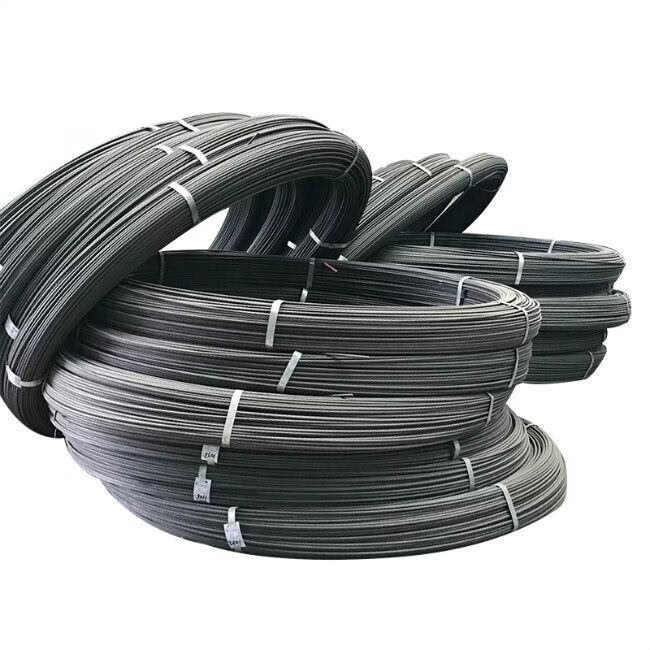
Spring Steel Wire (SWC / SWP / ASTM A227 / A228 / Oil Tempered Wire)
Spring Steel Wire is drawn and heat-treated carbon and alloy steel wire for helical compression springs, tension springs, torsion springs, and wire forms. Diameter 0.08–25mm. Hard-drawn (SWC / A227) and oil-tempered (SWP / SWOSC-V / A228 / A229) types. Tensile strength 1,000–2,600 MPa. Reel, coil, and traverse-wound supply. Mill test certificate provided.
| Material | Cold-Drawn / Oil-Tempered Carbon and Alloy Spring Steel Wire |
|---|---|
| Grade / Standard | JIS SWC / SWP / SWO / SWOSC-V / SWOCV-V / ASTM A227 / A228 / A229 / EN 10270-1 SH-DH / EN 10270-2 VT-DT / GB/T 4357 / 5218 |
| Diameter | 0.08mm – 25mm (Wire diameter) |
| Delivery Condition | as_rolled |
| Surface Treatment | coated |
| MOQ | 100 kg (Fine Wire) / 500 kg (Standard Spring Wire) |
| Delivery Time | 15-30 Days (Stock) / 25-45 Days (Custom Production) |
| Loading Port | Tianjin / Shanghai / Qingdao |
Overview of Spring Steel Wire
Spring Steel Wire is a drawn and heat-treated or cold-drawn carbon and alloy steel wire product engineered as the direct manufacturing material for helical compression springs, tension springs, torsion springs, wire forms, and related elastic components across the automotive, railway, industrial machinery, consumer goods, and precision engineering industries. The drawing process — progressive diameter reduction of hot-rolled wire rod through a series of tungsten carbide or diamond drawing dies — simultaneously refines the pearlitic microstructure of the starting rod, increases dislocation density through work hardening, reduces wire diameter to precise final tolerances, and improves surface finish quality, ultimately producing wire with tensile strength, surface quality, and dimensional accuracy far superior to the source rod. The subsequent heat treatment — either patenting (lead or salt bath austenite-to-pearlite transformation to restore ductility between drawing stages) or oil tempering (austenitise and oil quench of the drawn wire to produce a tempered martensitic structure for maximum spring performance) — determines the final mechanical property combination of the delivered spring wire and the processing route required by the spring coiling equipment.
Spring Steel Wire is classified into two principal categories by processing route and microstructure. Cold-drawn (hard-drawn) spring wire — designated SWC (Japanese JIS G3521), ASTM A227 Class I / II (American hard-drawn mechanical spring wire), and DIN EN 10270-1 SH / DH (European cold-drawn spring wire) — is produced by patenting the wire rod to restore fine pearlite structure, then cold drawing to final diameter, relying on work hardening from drawing to achieve tensile strength of 1,000–2,000 MPa depending on wire diameter. Hard-drawn wire is the most economical spring wire type, suitable for static or low-cycle spring applications where fatigue performance is not the primary design driver. Oil-tempered (oil-hardened and tempered) spring wire — designated SWP (Japanese JIS G3522 for piano wire), SWOSC-V, SWOCV-V (valve spring quality), ASTM A228 (music wire / piano wire), A229 (oil-tempered carbon spring wire), EN 10270-2 VT / DT (European oil-tempered spring wire), and DIN 17223-2 — is produced by drawing to near-final diameter, then continuously austenitising and oil-quenching the wire on a continuous heat treatment line (quench-and-temper line) to produce a uniform tempered martensitic microstructure, providing tensile strength of 1,400–2,600 MPa with a much tighter property distribution and superior fatigue performance compared to hard-drawn wire — making oil-tempered wire the mandatory specification for automotive suspension springs, valve springs, and high-cycle fatigue spring applications.
Key Features and Manufacturing Process
Spring Steel Wire manufacturing begins with hot-rolled wire rod of the specified spring steel chemistry (60Si2Mn, 65Mn, C82D, or alloy grades per application), which is acid-pickled to remove mill scale, coated with lime or phosphate as a drawing lubricant carrier, and drawn through a series of tungsten carbide dies in a multi-die drawing block or bull-block arrangement, reducing diameter in steps of 15–25% area reduction per pass. The total area reduction from rod to final wire diameter ranges from 80% to 99% depending on starting rod diameter and final wire size — a 12mm rod drawn to 3mm wire undergoes 93.75% area reduction through approximately 12–15 drawing passes with intermediate patenting anneals to restore ductility. The patenting step — austenitising the intermediate wire at 900–950°C and rapidly quenching into a lead bath or fluidised sand bed maintained at 480–540°C — causes transformation from austenite directly to fine pearlite at the eutectoid temperature, restoring the wire ductility consumed by cold drawing without the coarse spheroidised carbide structure produced by conventional furnace annealing that would reduce drawing efficiency in subsequent passes.
For oil-tempered spring wire, the drawn wire (typically drawn to within 10–20% area reduction of final diameter) passes through a continuous inline heat treatment furnace (austenitising at 900–980°C for carbon grades, 870–950°C for alloy grades), immediately followed by quenching in an oil bath at 40–80°C, then through a continuous tempering furnace at 350–500°C to achieve the specified tensile strength and hardness combination. The continuous process ensures uniform thermal history across the full wire length — a critical advantage over batch heat treatment for achieving the tight tensile strength tolerance (±60 MPa for premium valve spring wire per JIS G3561) required by automotive OEM spring specifications. Final drawing after tempering is sometimes applied (1–5% area reduction) to improve surface finish and dimensional tolerance of oil-tempered wire. Quality control in spring wire production encompasses: tensile strength testing per reel and per diameter lot; bend and wrap testing to verify ductility and freedom from seam-induced cracking; surface quality inspection by eddy current equipment (detecting surface defects ≥0.02mm depth for valve spring wire); torsion testing to verify torsional ductility; hydrogen embrittlement testing for electroplated wire; decarburisation depth measurement; and coil geometry (cast and helix) measurement to verify wire lay characteristics for spring coiling machine compatibility.
Main Applications of Spring Steel Wire
Spring Steel Wire is the direct raw material consumed by coil spring manufacturers producing helical compression springs, tension springs, and torsion springs across all industries. Automotive suspension coil spring production is the largest application by wire tonnage, consuming 11–16mm diameter oil-tempered 60Si2Mn or 55CrSi wire (tensile strength 1,700–2,000 MPa) for front strut springs, rear coil springs, and auxiliary springs in passenger cars, SUVs, and light commercial vehicles — each vehicle typically containing 4–8 coil springs requiring consistent performance over 150,000+ km service life and 10⁷ fatigue cycles. Automotive engine valve spring production is the highest-performance application, using 3–6mm diameter premium SWOSC-V or SWOCV-V oil-tempered Cr-Si or Cr-Si-V alloy wire (tensile strength 2,000–2,200 MPa) for intake and exhaust valve return springs operating at 6,000 rpm engine speed with 10⁸ cycle fatigue requirements under combined torsional and bending stress amplitudes exceeding 600 MPa.
Industrial compression spring production for die springs, hydraulic valve springs, pneumatic cylinder return springs, safety valve springs, pressure relief valve springs, and general machinery compression springs uses 2–25mm diameter oil-tempered or hard-drawn wire depending on fatigue life requirement and application. Railway vehicle suspension uses 25–45mm diameter wire or bar (at this diameter boundary, wire transitions to bar form) wound into primary and secondary suspension coil springs for passenger and freight rolling stock. Consumer mattress and furniture spring production is the largest application by spring quantity, consuming 1.6–5.0mm diameter hard-drawn SWC or ASTM A227 wire for Bonnell innerspring coils, pocketed coil springs, continuous LFK springs, and sinuous wire springs — applications where cost economy is the dominant selection criterion and fatigue life is measured in years of household use rather than millions of high-stress cycles. Garage door torsion spring production uses 4–10mm hard-drawn or oil-tempered wire in high-tensile classes. Screen door and storm door closure spring production, lawn and garden equipment springs, agricultural implement springs, trampolining spring assemblies, exercise equipment resistance springs, clock and timer mainsprings (from flat wire), and the complete range of consumer and light industrial mechanism springs complete the application spectrum of spring steel wire across global manufacturing.
Why Choose Us for Spring Steel Wire
Shandong Tanglu Metal Material Co., Ltd. supplies premium Spring Steel Wire sourced from leading Chinese spring wire producers including Jiangyin Xingcheng Special Steel Wire, Jiangyin Qinghe Jinzhu Stainless Steel, and established wire drawing mills operating dedicated spring wire production lines with inline continuous oil-tempering furnaces and eddy current surface inspection equipment, all certified to ISO 9001, IATF 16949 (for automotive supply wire), JIS G3521 / G3522, EN 10270-1 / 10270-2, and ASTM A227 / A228 / A229 product standard requirements. Every spring wire shipment is accompanied by original mill test certificates documenting tensile strength at multiple test points per reel (minimum one test per 5,000 kg lot for standard wire, one per reel for automotive valve spring wire), bend test or wrap test results, torsion test results, surface quality inspection by eddy current with guaranteed defect detection threshold, decarburisation depth, wire diameter tolerance verification, and complete reel and heat number traceability.
We offer a comprehensive spring wire range covering wire diameter from 0.08mm (ultra-fine precision spring wire) to 25mm (heavy industrial spring wire), in grades SWC / SWP hard-drawn carbon (JIS G3521), SWO oil-tempered carbon (JIS G3522), SWOC / SWOSC-V Cr-Si oil-tempered valve spring wire (JIS G3561), ASTM A227 Class I / II hard-drawn, A228 music wire, A229 oil-tempered, EN 10270-1 SH / DH, EN 10270-2 VT / DT, and GB/T 4357 / 5218 equivalent specifications. Supply forms include reels (standard 50–500 kg), coils (large diameter wire 2–25mm on straight or ring coils), and precision-wound traverse reels for CNC coiling machine feeding. With established monthly supply capacity and export relationships with automotive spring manufacturers, industrial spring producers, mattress spring manufacturers, and precision spring companies across more than 50 countries, we support both small sample orders and large series production annual supply contracts. Each shipment includes original mill test certificate per EN 10204 3.1, with EN 10204 3.2, eddy current inspection reports, and third-party inspection by SGS, Bureau Veritas, or TUV available for automotive OEM and critical industrial spring qualification requirements.
📐 Dimension & Size Table
| Wire Type / Grade | Standard | Diameter Range (mm) | Tensile Strength (MPa) | Typical Application |
|---|---|---|---|---|
| SWC (Hard-Drawn Carbon) | JIS G3521 | 0.30–10.0 | 1,000–1,900 / General springs, static load | |
| SWP (Piano / Music Wire) | JIS G3522 / ASTM A228 | 0.08–6.0 | 1,700–3,000 / Precision fine springs, instruments | |
| SWO (Oil-Tempered Carbon) | JIS G3522 / ASTM A229 | 0.50–25.0 | 1,200–2,000 / General coil springs, industrial | |
| SWOS (Oil-Tempered Si-Mn) | JIS G3560 | 0.50–20.0 | 1,300–2,000 / Suspension, heavy industrial springs | |
| SWOSC-V (Oil-Tempered Si-Cr) | JIS G3561 | 0.50–15.0 | 1,600–2,300 / Automotive valve and suspension springs | |
| SWOCV-V (Oil-Tempered Cr-V) | JIS G3561 | 0.50–12.0 | 1,600–2,200 / Premium valve springs, aerospace | |
| EN 10270-1 SH (Hard-Drawn) | EN 10270-1 | 0.10–17.0 | 1,000–1,900 / European market general springs | |
| EN 10270-1 DH (Hard-Drawn) | EN 10270-1 | 0.10–17.0 | 1,100–2,000 / Higher tensile hard-drawn springs | |
| EN 10270-2 VT (Oil-Tempered) | EN 10270-2 | 0.50–17.0 | 1,200–1,900 / European oil-tempered general springs | |
| EN 10270-2 VDSiCr (Oil-Temp Si-Cr) | EN 10270-2 | 0.50–12.0 | 1,700–2,300 / European valve spring wire | |
| ASTM A227 Class I (Hard-Drawn) | ASTM A227 | 0.50–12.7 | 1,000–1,700 / American general hard-drawn springs | |
| ASTM A227 Class II (Hard-Drawn) | ASTM A227 | 0.50–12.7 | 1,100–1,800 / Higher quality American hard-drawn | |
| ASTM A228 (Music Wire) | ASTM A228 | 0.10–6.35 | 1,700–3,000 / Highest quality American fine spring wire | |
| ASTM A229 Class I (Oil-Tempered) | ASTM A229 | 0.50–12.7 | 1,200–1,900 / American oil-tempered carbon spring wire |
* Custom sizes available upon request. Tolerances per relevant international standards.
🔬 Chemical Composition
| Element | Min | Max | Display Value | Note |
|---|---|---|---|---|
| C | 0.60 | 0.75 | 0.60–0.75 | SWC / SWO / A227 / A229 hard-drawn and oil-tempered carbon spring wire; SWP music wire: C 0.80–1.00%; SWOSC-V: C 0.51–0.59% |
| Si | 0.15 | 0.35 | 0.15–0.35 | SWC / SWO carbon grade; SWOS oil-tempered Si-Mn: Si 1.20–1.60%; SWOSC-V Si-Cr: Si 1.20–1.60% |
| Mn | 0.30 | 0.90 | 0.30–0.90 | Carbon spring wire grades; SWOS: Mn 0.60–0.90% for hardenability |
| P | - | 0.025 | ≤0.025 | Strictly controlled — P embrittles high-carbon spring wire, degrades fatigue life |
| S | - | 0.025 | ≤0.025 | Strictly controlled — MnS inclusions initiate fatigue cracks in spring wire |
| Cr | 0.50 | 0.80 | 0.50–0.80 | SWOSC-V Si-Cr grade / EN VDSiCr — Cr improves hardenability and hot relaxation resistance |
| V | 0.10 | 0.20 | 0.10–0.20 | SWOCV-V Cr-V grade only — V refines grain, improves fatigue and tempering resistance |
| Ni | - | 0.25 | ≤0.25 | Residual element — controlled low in spring wire |
| Cu | - | 0.20 | ≤0.20 | Residual element — controlled to prevent surface hot shortness during rod rolling |
| O (Oxygen) | - | 0.0020 | ≤20 ppm | Standard quality wire rod; SWOSC-V valve spring: ≤15 ppm from VD rod — oxide inclusions are primary fatigue initiators |
| H (Hydrogen) | - | 0.0003 | ≤3 ppm | VD rod requirement — prevents hydrogen-induced delayed cracking in high-strength wire |
* Chemical composition may vary by heat, thickness and specification. Please refer to the actual mill test certificate.
⚙️ Mechanical Properties
| Property | Value | Unit | Test Condition |
|---|---|---|---|
| Tensile Strength — SWC / A227 Class II (Ø2.0mm) | 1,620–1,860 | MPa | Hard-drawn carbon wire per JIS G3521 / ASTM A227 — tensile increases with diameter reduction |
| Tensile Strength — SWC / A227 Class II (Ø6.0mm) | 1,370–1,570 | MPa | Hard-drawn carbon wire — lower tensile for larger diameter as less total drawing reduction |
| Tensile Strength — SWP / A228 Music Wire (Ø1.0mm) | 2,210–2,600 | MPa | Piano / music wire — highest tensile of all spring wire types; fine wire achieves highest values |
| Tensile Strength — SWP / A228 Music Wire (Ø3.0mm) | 1,910–2,160 | MPa | Piano wire at medium diameter — still significantly higher than SWC at same diameter |
| Tensile Strength — SWO / A229 (Ø4.0mm, Oil-Tempered) | 1,470–1,720 | MPa | Oil-tempered carbon spring wire per JIS G3522 / ASTM A229 |
| Tensile Strength — SWOS Oil-Tempered Si-Mn (Ø8.0mm) | 1,520–1,720 | MPa | Si-Mn oil-tempered wire for automotive suspension springs |
| Tensile Strength — SWOSC-V Si-Cr Valve Spring (Ø4.0mm) | 1,910–2,110 | MPa | Oil-tempered Si-Cr premium valve spring wire per JIS G3561 |
| Tensile Strength — SWOSC-V Si-Cr Valve Spring (Ø8.0mm) | 1,720–1,960 | MPa | Premium Si-Cr wire for automotive suspension springs |
| Tensile Strength Tolerance (Oil-Tempered Wire) | ±60–100 | MPa | Per reel — tighter than hard-drawn wire; automotive valve spring wire: ±40 MPa per reel |
| Torsional Ductility — Number of Twists (SWO / SWC, Ø4mm) | ≥25 | turns | Per JIS G3522 / ASTM A229 — twists to fracture without cracking on smooth surface |
| Fatigue Limit — SWOSC-V (R = 0.1, shot peened) | 700–900 | MPa | Stress amplitude at 10⁷ cycles per SAE J1121 — automotive OEM suspension spring qualification |
| Elastic Limit Ratio (τ₀/τ_u) — Oil-Tempered Wire | 0.85–0.92 | - | Torsional elastic limit / torsional ultimate strength ratio in finished spring condition |
| Surface Decarburisation Depth — Premium Valve Spring Wire | ≤0.02 | mm (≤0.5% diameter) | Per JIS G3561 SWOSC-V — decarb must be ≤0.5% of wire diameter to prevent fatigue initiation |
| Relaxation Loss — SWOSC-V vs SWO at 120°C, 48h, 600 MPa | SWOSC-V: ≤3% vs SWO: ≤6% | - | Si-Cr wire provides 50% better relaxation resistance vs carbon wire at elevated temperature |
* Values shown are minimum requirements unless otherwise stated.
📦 Commercial Information
| Packaging | Standard seaworthy export packing for Spring Steel Wire. Fine and medium diameter wire (Ø0.08–6.0mm) supplied on plastic or steel flange spools (reels) in standard weights of 2 kg, 5 kg, 10 kg, 25 kg, 50 kg, 100 kg, 250 kg, and 500 kg per reel depending on wire diameter and customer winding equipment specifications. Reel flange diameter and traverse width matched to customer CNC spring coiling machine mandrel and pay-off reel specifications — always confirm reel dimensions before ordering. Individual reels wrapped with PE stretch film or kraft paper for surface protection, then packed in cardboard carton (small reels) or placed in plywood crate (large heavy reels above 100 kg). Large diameter spring wire (Ø6.0–25.0mm) supplied as ring coils (open coil form) or on steel tube cores in coil weights of 100–2,000 kg, wrapped with VCI anti-corrosion paper and PE stretch film to prevent oxidation of bright drawn wire surface. Each reel or coil tagged with individual identification showing: wire grade (SWC / SWO / SWOSC-V / A228 / EN VT / VDSiCr), wire diameter (mm), reel or coil weight (kg), tensile strength measured value at test point (MPa), heat number, coil number, lot number, and applicable standard. For automotive valve spring wire (SWOSC-V / SWOCV-V / EN VDSiCr), individual reel test certificates showing tensile at both wire ends (beginning and end of reel), eddy current surface inspection pass confirmation, decarburisation depth measurement, and diameter tolerance verification are provided with each reel for full traceability in automotive production. Desiccant sachets inside PE film wrapping prevent condensation corrosion during ocean transit to humid climates. Container loading: 20FT FCL typically 15–20 tons of spring wire reels; 40HQ for large reel or coil orders. Air freight available for urgent sample or prototype spring wire orders in small quantities (5–50 kg) using standard airline cardboard carton packaging with foam cushioning. |
|---|---|
| Payment Terms | T/T (Telegraphic Transfer),L/C (Letter of Credit),D/P (Documents against Payment),Western Union,PayPal |
| Price Term | FOB,CFR,CIF,EXW |
| Supply Capacity | 1,500 Tons/Month (Spring Steel Products) |
| Loading Port | Tianjin / Shanghai / Qingdao |
Why Choose Our Spring Steel Wire (SWC / SWP / ASTM A227 / A228 / Oil Tempered Wire)?
Mill Certified Spring Wire Quality
Spring steel wire supplied with original mill test certificate EN 10204 3.1/3.2 covering tensile strength at multiple test points per lot (end-to-end reel for valve spring wire), torsion test, bend/wrap test, diameter tolerance verification, decarburisation depth, eddy current surface inspection pass confirmation, and complete heat and reel number traceability per JIS G3521/G3561, EN 10270-1/2, ASTM A227/A228/A229.
Comprehensive Wire Type & Diameter Range
Wire diameter 0.08mm to 25mm across all standard spring wire types: hard-drawn SWC / A227 / EN SH/DH, oil-tempered SWO / A229 / EN VT/DT, music wire SWP / A228, and premium valve spring SWOSC-V / SWOCV-V / EN VDSiCr. Reel, ring coil, and traverse-wound precision reel supply forms for CNC coiling compatibility.
Tensile Strength 1,000–2,600 MPa by Grade & Diameter
Hard-drawn wire 1,000–1,900 MPa for economical static load springs; oil-tempered carbon 1,200–2,000 MPa for general industrial coil springs; premium SWOSC-V Si-Cr oil-tempered 1,600–2,300 MPa for automotive valve and suspension springs; music wire SWP 1,700–3,000 MPa for finest precision springs — complete tensile range for all spring design requirements.
Multi-Standard International Grade Coverage
JIS SWC / SWP / SWO / SWOS / SWOSC-V / SWOCV-V (Japanese G3521/G3522/G3560/G3561), EN 10270-1 SH/DH and EN 10270-2 VT/DT/VDSiCr (European), ASTM A227 / A228 / A229 (American), and GB/T 4357 / 5218 (Chinese). Individual reel test certificates for automotive OEM valve spring wire applications.
Stock Availability & Precision Reel Winding
Common SWC, SWO, and SWOSC-V grades in standard diameters (0.5–12mm) maintained in stock for 15–25 days dispatch. Custom reel dimensions, special diameter tolerances, and non-standard wire grades 25–45 days production. Precision traverse-wound reels for CNC spring coiling machine compatibility. Container loading 15–20 tons per 20FT FCL.
🏭 Applications of Spring Steel Wire (SWC / SWP / ASTM A227 / A228 / Oil Tempered Wire)
Spring Steel Wire serves as the fundamental production material for coil spring manufacturing across every industry segment, with the specific wire type, grade, and diameter selected to match the fatigue life requirement, operating environment, and economy of the finished spring application. Automotive suspension coil spring production consumes the largest tonnage of oil-tempered spring wire globally, with SWOS (Si-Mn) and SWOSC-V (Si-Cr) oil-tempered wire in 11–16mm diameter being cold-coiled on CNC coiling machines into MacPherson strut compression springs, rear coil-over shock absorber springs, front and rear auxiliary springs, and stabiliser bar end link springs for passenger cars, SUVs, crossovers, and light commercial vehicles — each automotive coil spring requiring verified fatigue performance of 10⁷ cycles at 700–900 MPa stress amplitude per SAE J1121 rotating bending fatigue test before OEM approval, with subsequent 100% magnetic particle inspection and dimensional verification of every coil spring before shipment to vehicle assembly lines. Engine valve spring production represents the highest technical challenge in spring wire application, with SWOSC-V (JIS G3561 Si-Cr oil-tempered) and SWOCV-V (Cr-V oil-tempered) wire in 3–6mm diameter meeting tensile strength of 2,000–2,200 MPa and guaranteed eddy current surface quality (no defects exceeding 0.02mm depth) for intake and exhaust valve return springs operating under combined torsional and bending stresses at frequencies of 50–100 Hz (3,000–6,000 rpm) through 10⁸ cycles between major engine service intervals — a fatigue performance requirement achievable only with premium VD-grade rod feedstock, precision drawing, continuous inline oil-tempering, and 100% eddy current surface inspection. Industrial compression spring production for pneumatic and hydraulic valve return springs, safety valve spring assemblies, die springs for metal stamping operations, railway vehicle draft gear springs, and general machinery compression springs uses 2–25mm SWO or SWOS oil-tempered wire in tensile strength classes appropriate to the specific spring load and fatigue requirement, with oil-tempered wire preferred over hard-drawn for all applications requiring more than 10,000 load cycles. Railway vehicle suspension spring production for primary suspension coil springs in passenger car bogies, freight wagon bogie springs, and locomotive truck springs uses 25–45mm wire or bar (at this diameter, commercial boundary between wire and bar is crossed) wound into heavy coil springs requiring exceptional toughness to withstand the shock loading from rail joints at operating speeds of 200–350 km/h for high-speed passenger trains. Consumer mattress spring production is the largest application by spring quantity, with hard-drawn SWC or ASTM A227 wire in 1.6–2.5mm diameter continuously fed through Bonnell spring coiling machines at production rates of 300–600 springs per minute, producing the innerspring assemblies for budget to mid-range mattresses; pocketed coil wire in 1.2–2.0mm diameter for individually wrapped pocket spring mattresses requiring quieter and more motion-isolated sleep performance; and LFK continuous coil wire for entry-level open coil innerspring systems. Garage door torsion spring production uses 4–9mm hard-drawn or oil-tempered wire tightly wound into high-tension torsion spring assemblies balanced against the garage door weight — one of the highest loaded consumer spring applications in terms of stress relative to spring size. Screen door closer tension springs, exercise equipment resistance spring elements, trampolining spring assemblies, fishing reel drag springs, camera shutter springs, mechanical timepiece mainspring wire (flat section spring wire), and the complete range of consumer product and light industrial mechanism springs manufactured from SWC, SWP, and SWO wire complete the application spectrum of spring steel wire across global manufacturing industries.
📋 Quality & Certification
Our Certifications
- ✅ ISO 9001:2015
- ✅ CE Marking
- ✅ ABS
- ✅ DNV GL
- ✅ Lloyd's Register (LR)
- ✅ Bureau Veritas (BV)
- ✅ SGS Certified
Mill Certificate Type
- 📋 EN 10204 3.1
- 📋 EN 10204 3.2
- 📋 Original Mill Certificate
- 📋 Third Party Inspection Available
- 📋 Certificate of Origin
❓ Frequently Asked Questions
What is spring steel wire and what are the main types available?
Spring steel wire is drawn and heat-treated carbon or alloy steel wire engineered as the direct raw material for manufacturing helical coil springs, tension springs, torsion springs, and wire form spring components. It is distinguished from ordinary steel wire by its precise tensile strength control, surface quality, and torsional ductility needed for consistent spring coiling and reliable fatigue performance in service. The main types available are defined by manufacturing process, carbon content, and alloying: Hard-Drawn Carbon Spring Wire (SWC per JIS G3521, ASTM A227 Class I/II, EN 10270-1 SH/DH) is produced by patenting (controlled pearlite transformation) and cold drawing to final diameter, with tensile strength achieved through work hardening. It is the most economical spring wire type, suitable for static or moderate fatigue duty applications including furniture springs, garage door springs, agricultural equipment springs, and general industrial compression springs. Oil-Tempered Carbon Spring Wire (SWO per JIS G3522, ASTM A229, EN 10270-2 VT/DT) is produced by drawing then austenitising and oil quenching in a continuous inline heat treatment furnace, producing a tempered martensitic microstructure with superior ductility, toughness, and fatigue performance compared to hard-drawn wire — specified for medium-duty industrial coil springs requiring reliable fatigue life. Music Wire / Piano Wire (SWP per JIS G3522, ASTM A228) is the highest quality carbon spring wire, produced from the highest-purity high-carbon rod with the most stringent surface and inclusion requirements, achieving the highest tensile strength of all spring wire types (up to 3,000 MPa at fine diameters) — used for precision instrument springs, clock springs, fine mechanical springs, and applications requiring maximum tensile strength in small wire diameters. Oil-Tempered Alloy Spring Wire (SWOSC-V Si-Cr, SWOCV-V Cr-V per JIS G3561, EN 10270-2 VDSiCr) represents the highest-performance category, adding silicon-chromium or chromium-vanadium alloying for superior hot hardness retention, relaxation resistance, and fatigue performance — mandatory for automotive engine valve springs and premium suspension springs.
What is the difference between hard-drawn (SWC) and oil-tempered (SWO / SWOSC-V) spring wire?
Hard-drawn and oil-tempered spring wires differ fundamentally in manufacturing process, microstructure, mechanical property consistency, and fatigue performance — differences that determine which type is appropriate for a given spring application. Hard-drawn spring wire (SWC, ASTM A227) is produced by patenting the intermediate wire to fine pearlite structure, then cold drawing to final diameter without subsequent heat treatment. The tensile strength of hard-drawn wire is achieved entirely by work hardening from drawing, and the microstructure remains drawn fine pearlite — a slightly fibrous, anisotropic structure with work-hardening stress locked into the wire. Key characteristics of hard-drawn wire: lower cost per kilogram, wider tensile strength tolerance (±100–150 MPa per production lot), lower ductility (lower twist number and bend test performance), less consistent torsional ductility, susceptibility to decarburisation-induced surface softness from drawing process heat generation, and lower fatigue life particularly in the high-stress, high-cycle range (above 10⁵ cycles at stress amplitude above 400 MPa). Hard-drawn wire is entirely adequate and the economical choice for: furniture and mattress springs (low cycle, low stress), garage door springs (low cycle, moderate stress), agricultural equipment springs, and general industrial compression springs with fatigue life requirements below 10⁵ cycles at low-to-medium stress amplitudes. Oil-tempered spring wire (SWO, SWOSC-V, ASTM A229) is produced by drawing to near-final diameter then passing through a continuous austenitise-quench-temper furnace line, producing uniform tempered martensite microstructure throughout the wire cross-section. The continuous tempering process achieves: tighter tensile strength tolerance (±60–100 MPa for SWO, ±40 MPa for valve spring SWOSC-V), superior torsional ductility with higher twist number and cleaner fracture mode, better relaxation resistance under sustained load at elevated temperature, and significantly improved high-cycle fatigue life (10⁶–10⁸ cycles at automotive suspension and valve spring stress levels). Oil-tempered wire is mandatory for automotive suspension coil springs (10⁷ cycle fatigue), engine valve springs (10⁸ cycle), railway vehicle suspension springs (10⁷+ cycle), and all springs where fatigue life and property consistency are primary design requirements. The price premium of oil-tempered wire over hard-drawn (typically 20–40%) is justified by the extended spring service life and reduced warranty claims in critical applications.
What is SWOSC-V and why is it specified for automotive valve springs?
SWOSC-V is a Japanese Industrial Standard (JIS G3561) designation for oil-tempered chromium-silicon alloy spring wire specifically engineered for automotive engine valve spring applications — the most technically demanding coil spring application in terms of fatigue life, operating temperature, and relaxation resistance requirements. The full designation breaks down as: SW = Spring Wire, O = Oil-Tempered, SC = Chromium-Silicon alloy, V = Valve spring quality. The chemical composition is characterised by silicon 1.20–1.60%, chromium 0.50–0.80%, carbon 0.51–0.59%, with the silicon-chromium alloying combination providing three critical performance advantages over standard carbon (SWO) and silicon-manganese (SWOS) spring wires for valve spring service. Superior hot relaxation resistance: valve springs in passenger car engines operate at 150–250°C due to proximity to combustion chambers and exhaust ports — at these temperatures, carbon spring wire undergoes progressive plastic deformation (relaxation / creep) under sustained compressive spring load, causing the installed spring force to decrease over engine life and eventually allowing valve float at high engine speeds. SWOSC-V silicon-chromium wire reduces relaxation loss at 150°C, 48 hours, 600 MPa stress to ≤3% versus ≤6% for standard SWO carbon wire, maintaining the designed valve spring force throughout the engine service interval. Superior high-cycle fatigue life: engine valve springs accumulate 10⁸ fatigue cycles between major engine service intervals at combined torsional and bending stress amplitudes exceeding 600 MPa at high engine speeds. The chromium addition improves tempering resistance of the martensitic matrix (carbide coarsening resistance) and the vanadium variant (SWOCV-V) further refines grain size through vanadium carbide precipitation, both mechanisms maintaining fatigue strength at the elevated operating temperatures not supportable by the carbon wire matrix. Premium cleanliness requirements: SWOSC-V specification requires vacuum degassed rod feedstock (oxygen ≤15 ppm), decarburisation depth ≤0.5% of wire diameter (versus ≤1.0% for SWO), and mandatory 100% eddy current surface inspection detecting defects ≥0.02mm — quality levels ensuring freedom from the surface and subsurface defects that would initiate fatigue cracking under the extreme stress cycles of valve spring service. The price of SWOSC-V wire is typically 40–80% higher than SWO carbon wire and 100–150% higher than SWC hard-drawn wire, entirely justified for valve spring applications where spring failure means catastrophic engine damage.
What reel specifications should I provide when ordering spring steel wire?
Specifying correct reel (spool) dimensions when ordering spring steel wire is essential for compatibility with your CNC spring coiling machine mandrel, wire pay-off system, and production efficiency. The key reel parameters to specify are: Wire Diameter — the most fundamental specification, determines all strength properties and reel weight capacity. Specify in mm to two decimal places (e.g. 4.00mm, 7.50mm) as wire diameter directly determines tensile strength class per standard. Reel Flange Diameter (OD) — the outer diameter of the spool flange, which must clear your pay-off reel guide roller system. Common standard flange diameters are 315mm, 400mm, 500mm, 630mm, and 800mm. Reel Bore Diameter (Hub ID) — the inner diameter of the spool hub that fits over your pay-off spindle or mandrel. Common standard IDs are 25mm, 32mm, 38mm (1.5 inch), 51mm (2 inch), 76mm (3 inch), and 100mm (4 inch). Confirm this matches your pay-off spindle diameter before ordering. Traverse Width (Winding Width) — the usable winding length between flanges, which determines reel wire capacity and must not exceed your CNC coiling machine traverse width. Common standard widths are 100mm, 160mm, 200mm, 250mm, and 315mm. Reel Weight (Net Wire Weight) — the wire weight per reel, governed by your coil handling system capacity and the production efficiency target (fewer reel changes = higher production rate). Standard weights are 25 kg, 50 kg, 100 kg, 200 kg, 300 kg, and 500 kg per reel depending on wire diameter. Winding Type — standard level-wound (traverse wound) for fine wire on CNC coiling machines ensures consistent unwinding tension; ring coil (open lay coil on cardboard core) for large diameter wire (above 8mm) fed from a rotating coil support. Wire End Position — specify whether the free wire end exits from the top (outside) or bottom (inside) of the reel to match your pay-off configuration. For automotive valve spring wire applications, additionally specify: individual reel test certificate requirement (tensile tested at both wire ends of each reel), eddy current surface inspection pass certificate, and lot identification marking on reel for production traceability to vehicle assembly records.
What is music wire (SWP / ASTM A228) and when should it be specified instead of standard spring wire?
Music wire (also called piano wire) is the highest quality and highest tensile strength carbon spring wire type, produced from specially selected high-carbon rod (0.80–1.00% C) of exceptional cleanliness and surface quality, drawn through the highest number of wire drawing passes with multiple intermediate patenting stages to achieve the finest possible drawn pearlite microstructure and the maximum work-hardening tensile strength achievable in carbon steel wire. The name derives from its original and still important application as piano string wire — an application demanding the combination of highest tensile strength (for high pitch and maximum musical energy storage), finest surface quality (for clean vibration without buzzing or rattling), and highest ductility (for tuning without string breakage). Specifications include JIS G3522 SWP (Japanese), ASTM A228 (American), and EN 10270-1 FDSiCr (though the European standard uses different terminology). Music wire achieves tensile strength of 1,700–3,000 MPa depending on wire diameter — at 0.5mm diameter, tensile strength can reach 2,800–3,000 MPa, far exceeding any other spring wire type. Music wire should be specified instead of standard SWC or SWO wire when: very fine wire diameters below 1.0mm are required for miniature precision springs (at these fine diameters, the extreme work hardening of music wire achieves tensile strength unavailable in oil-tempered types); maximum tensile strength in small diameter is the primary design criterion; the application requires the finest surface finish (music wire has the most stringent surface defect requirements of all spring wire types); precision instrument springs (pressure gauges, surgical instrument springs, dental handpiece springs, camera mechanism springs) demand the most consistent properties from end-to-end of each reel; spring design requires minimum wire diameter for a given load (maximum tensile strength enables smallest wire, smallest spring package). Music wire is not appropriate for: high-temperature applications (no alloy additions for tempering resistance, loses properties above 120°C); applications requiring welding (high carbon content makes joining difficult); springs with tight coil ratios requiring ductility; or applications where oil-tempered wire toughness is required to resist shock loading. Music wire carries a significant price premium over standard SWC and SWO wire (typically 50–100% higher) reflecting the stringent rod quality, additional drawing passes, and rigorous quality inspection required.
Get a Quote for
Spring Steel Wire (SWC / SWP / ASTM A227 / A228 / Oil Tempered Wire)
Submit your requirements and receive a competitive price quote within 24 hours.
- ✓ Fast response within 24 hours
- ✓ Competitive factory-direct pricing
- ✓ Free technical consultation
- ✓ Mill test certificate provided
- ✓ Flexible payment terms available
⏱ Response within 24 hours
Send Your Inquiry
All fields marked with * are required