
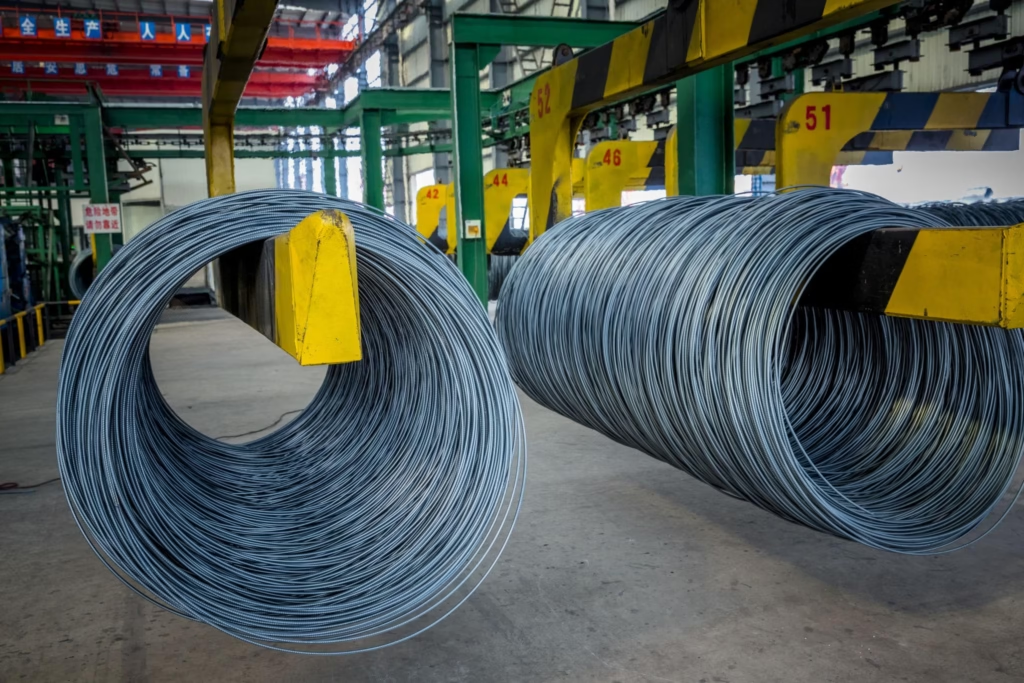
Spring Steel Wire Rod (60Si2Mn / 55CrSi / SUP7 / 9260)
Spring Steel Wire Rod is hot-rolled coiled rod in medium-to-high carbon alloy spring steel — the primary raw material for drawing spring wire and coil spring manufacturing. Diameter 5.5–40mm. Grades 60Si2Mn, 55CrSi, SUP7, SAE 9260, 51CrV4. Standard and vacuum degassed (VD) quality. Stelmor air-cooled coil. Mill test certificate provided.
| Material | Medium-to-High Carbon Silicon-Manganese / Chromium-Silicon Alloy Spring Steel Wire Rod |
|---|---|
| Grade / Standard | GB 60Si2Mn / 55CrSi / 55CrMnA / JIS SUP7 / SUP10 / SUP9 / DIN 51CrV4 (1.8159) / 54SiCr6 / SAE 9260 / 9254 / 6150 / EN 46Si7 / 54SiCr6 |
| Diameter | 5.5mm – 40mm (Rod diameter in hot-rolled coil form) |
| Length | Coil form — coil weight 500–2,500 kg typical / straight bar available for diameter >25mm |
| Delivery Condition | as_rolled |
| Surface Treatment | coated |
| MOQ | 5 Tons |
| Delivery Time | 20-40 Days / 15-25 Days (Stock) |
| Loading Port | Tianjin / Shanghai / Qingdao |
Overview of Spring Steel Wire Rod
Spring Steel Wire Rod is a hot-rolled round bar product in coiled form manufactured from medium-to-high carbon alloy spring steel, engineered as the primary raw material for drawing into spring wire, cold coiling or hot coiling into helical compression springs, tension springs, torsion bars, and the complete range of wire-form spring components serving the automotive, railway, industrial machinery, consumer goods, and aerospace industries. Distinguished from standard carbon steel wire rod by its precisely controlled chemistry — balancing high carbon content (typically 0.50–0.70%) for post-drawing and heat-treatment strength with carefully selected alloying elements — and by its stringent quality requirements for surface quality, internal cleanliness, decarburisation depth, and microstructural uniformity that are critical determinants of drawn spring wire fatigue life and finished spring service reliability.
Spring Steel Wire Rod is standardised under GB/T 4357 (Chinese spring wire and wire rod), JIS G3521 / G3561 (Japanese hard-drawn and oil-tempered spring wire), EN 10270 (European spring wire), DIN 17223 (German spring steel wire and rod), and SAE J271 / ASTM A227 / A228 / A229 (American spring wire specifications). The principal grades are categorised into silicon-manganese spring steel rod — led by GB 60Si2Mn (the dominant Chinese and export grade), SAE 9260, and JIS SUP7 (all containing 1.50–2.00% Si for enhanced elastic limit and tempering resistance) — and chromium-silicon or chromium-vanadium alloyed rod grades including GB 55CrSi, DIN 51CrV4 / 1.8159, JIS SUP10, and SAE 9254 (Si-Cr) for premium applications requiring maximum fatigue life in severe duty coil springs. Carbon content ranges from 0.52% to 0.70% across standard spring rod grades, providing tensile strength in drawn and heat-treated wire of 1,200–2,200 MPa depending on wire diameter and grade, with the silicon-manganese and chromium-silicon alloyed grades delivering superior resistance to relaxation (permanent set under sustained loading) compared to plain carbon grades — a critical performance parameter for automotive valve springs, suspension springs, and industrial precision springs operating under sustained compressive loads.
Key Features and Manufacturing Process
Spring Steel Wire Rod is produced through a carefully controlled hot rolling process commencing with continuous cast billet or forged billet of the specified spring steel chemistry, reheated to 1050–1150°C and rolled through a sequence of roughing, intermediate, and finishing stands on a high-speed rod rolling mill (Morgan-type or equivalent), achieving final rod diameters of 5.5mm to 40mm in one continuous hot rolling sequence. The coiling of the hot rod into the compact Stelmor-type laying head coil during controlled air cooling from rolling temperature — a critical step distinguishing modern spring rod production from conventional bar rolling — enables precise control of the coil microstructure and mechanical properties by programming the cooling air volume and belt speed to achieve uniform pearlite transformation throughout the rod cross-section. The resulting hot-rolled coil in patented (lead-patented equivalent microstructure) condition with fine lamellar pearlite (colony spacing 100–200nm) provides the optimal microstructure for subsequent drawing operations, combining adequate ductility for drawing area reductions of 80–95% with the strength required in the finished wire.
Surface quality is the most commercially critical quality parameter for spring steel wire rod because surface defects — seams, laps, rolled-in scale, cracks, and deep decarburisation — propagate into the drawn wire surface and act as fatigue crack initiation sites in finished springs, potentially causing catastrophic spring failure at a fraction of the expected service life. Spring rod producers control surface quality through: descaling between rolling passes; controlled roll pass design minimising surface defect generation; continuous in-line surface inspection by eddy current and laser profilometry systems on the rolling line; decarburisation depth verification per applicable standard (typically ≤0.5% of rod diameter for premium grades); and magnetic particle or eddy current inspection of finished rod coils. Internal cleanliness (non-metallic inclusion content) is verified by sulphur print macrostructure testing, longitudinal metallographic section examination per ASTM E45, and ultrasonic testing for large-diameter spring rod (above 20mm diameter).
Main Applications of Spring Steel Wire Rod
Spring Steel Wire Rod is the upstream raw material for the complete wire spring manufacturing supply chain, serving as the feedstock drawn into spring wire and subsequently formed into the entire range of wire spring products. Automotive suspension coil springs represent the largest and most technically demanding application — the helical compression springs of automotive front and rear suspension systems (MacPherson strut springs, coil-over shock absorber springs, auxiliary springs, and helper springs) are manufactured from 11–16mm diameter wire drawn and heat-treated from 60Si2Mn or 55CrSi rod, with finished spring wire achieving tensile strength of 1,700–2,000 MPa and fatigue resistance of 700–900 MPa stress amplitude for 10⁷ cycles under the stringent automotive OEM fatigue qualification requirements of SAE J1121 and equivalent standards. Automotive engine valve springs — among the most demanding spring applications in terms of fatigue performance — use premium VD (vacuum degassed) or ESR-grade 60Si2Mn or 55CrSiV rod drawn to 3–6mm wire diameter with tensile strength 2,000–2,200 MPa, operating at engine speeds of 600–6,000 rpm with 10⁸ cycles between engine overhauls.
Railway applications constitute the second-largest spring rod consumption sector, with helical coil springs for railway vehicle primary and secondary suspension systems, locomotive bogie springs, freight wagon bogie coil springs, and high-speed train primary suspension springs manufactured from 30–50mm diameter spring rod (often supplied as spring steel bar rather than rod for the largest diameters) in 60Si2Mn or 55CrSi grade. Industrial machinery applications include compression springs and tension springs for industrial valves, safety valves, and pressure relief valves; die springs for metal stamping die return systems; retraction springs for pneumatic and hydraulic cylinders; clutch and brake springs in industrial machinery; centrifugal pump impeller balance springs; agricultural machinery compression springs; and mining equipment suspension and vibration isolation springs. Consumer goods applications encompass mattress and furniture springs (Bonnell springs, pocket springs, and LFK springs for mattresses; sinuous springs for sofas), garage door torsion springs, screen door tension springs, trampolining spring sets, exercise equipment spring resistance elements, and the complete range of household and consumer mechanism springs. Precision engineering applications include instrument springs for measuring devices, clockwork mechanism springs, medical device spring components, and aerospace ground support equipment springs produced from premium clean spring rod.
Why Choose Us for Spring Steel Wire Rod
Shandong Tanglu Metal Material Co., Ltd. supplies premium Spring Steel Wire Rod sourced from leading Chinese specialty steel producers including Xingcheng Special Steel (now part of CITIC Special Steel Group) — one of China’s largest and most technically advanced spring steel producers with dedicated spring rod rolling lines and established international quality certification — alongside Baosteel Special Steel and Jiangyin Xingcheng, all operating production facilities certified to ISO 9001, ISO/TS 16949 (IATF 16949 for automotive supply), and relevant product standard requirements including GB/T 4357, JIS G3521, EN 10270, and SAE J271 / ASTM A228 equivalent. Every spring steel wire rod coil is accompanied by original mill test certificates covering full quantitative chemical composition analysis by optical emission spectrometry, mechanical property test results on rod in delivered condition (tensile strength, reduction of area, hardness), decarburisation depth measurement per applicable standard, macrostructure assessment (sulphur print or acid etch), non-metallic inclusion rating per ASTM E45 or GB/T 10561, and complete heat and coil number traceability.
We offer a comprehensive spring steel wire rod range covering rod diameters from 5.5mm to 40mm in grades GB 60Si2Mn (standard and VD vacuum degassed premium), GB 55CrSi, GB 55CrMnA, JIS SUP7 / SUP10, SAE 9260 / 9254 / 6150, DIN 51CrV4 / 1.8159, and EN 46Si7 / 54SiCr6, in standard Stelmor air-cooled coil and annealed coil delivery conditions. Vacuum degassed (VD) and electroslag remelted (ESR) premium quality available for automotive OEM valve spring and suspension spring applications. Custom surface inspection by eddy current (Magnaflux / Eddysort equivalent) and decarburisation depth guaranteed below 0.3% of diameter available for premium spring wire drawing requirements. With established monthly supply capacity of 1,500 tons of spring steel products and export relationships with spring wire drawing mills, coil spring manufacturers, automotive spring suppliers, railway spring producers, and industrial spring makers across more than 50 countries, we support both small wire drawing trial orders and large annual production rod supply contracts. Each shipment includes original mill test certificate per EN 10204 3.1, with EN 10204 3.2, decarburisation depth reports, inclusion rating reports, and third-party inspection by SGS, Bureau Veritas, or TUV available for automotive OEM and railway qualification requirements.
📐 Dimension & Size Table
| Grade | Standard | Key Alloying | Rod Diameter (mm) | Tensile Strength After HT (MPa) | Primary Application |
|---|---|---|---|---|---|
| 60Si2Mn | GB/T 4357 | C 0.56–0.64%, Si 1.50–2.00%, Mn 0.60–0.90% | 5.5–40 / 1,600–2,000 / Automotive suspension, railway springs | ||
| 60Si2MnA (VD) | GB/T 4357 Premium | C 0.56–0.64%, Si 1.50–2.00%, Mn 0.60–0.90% | 5.5–25 / 1,700–2,100 / Automotive valve springs, critical springs | ||
| 55CrSi | GB/T 4357 | C 0.51–0.59%, Si 1.20–1.60%, Cr 0.50–0.80% | 5.5–30 / 1,700–2,100 / Premium suspension springs | ||
| 55CrMnA | GB/T 4357 | C 0.52–0.60%, Mn 0.65–0.95%, Cr 0.65–0.95% | 6.0–40 / 1,400–1,800 / Heavy leaf/coil springs | ||
| SUP7 | JIS G3561 | C 0.56–0.64%, Si 1.80–2.20%, Mn 0.70–1.00% | 5.5–35 / 1,600–2,000 / Japanese market suspension springs | ||
| SUP9 / SUP9A | JIS G3561 | C 0.52–0.60%, Mn 0.65–0.95%, Cr 0.65–0.95% | 6.0–40 / 1,400–1,900 / Automotive leaf and coil springs | ||
| SUP10 | JIS G3561 | C 0.47–0.55%, Cr 0.80–1.10%, V 0.15–0.25% | 5.5–30 / 1,500–1,900 / Premium valve and suspension springs | ||
| SAE 9260 / 9260H | SAE J271 / ASTM A229 | C 0.55–0.65%, Si 1.80–2.20%, Mn 0.70–1.00% | 5.5–40 / 1,600–2,000 / American market suspension springs | ||
| SAE 9254 | SAE J271 | C 0.51–0.59%, Si 1.20–1.60%, Cr 0.60–0.80% | 5.5–25 / 1,700–2,100 / Premium Si-Cr coil springs | ||
| SAE 6150 / 6150H | SAE J271 / ASTM A231 | C 0.47–0.54%, Cr 0.80–1.10%, V 0.15% | 5.5–30 / 1,500–1,900 / Cr-V spring wire rod | ||
| 51CrV4 / 1.8159 | EN 10089 / DIN | C 0.47–0.55%, Cr 0.90–1.20%, V 0.10–0.20% | 5.5–30 / 1,500–1,900 / European Cr-V premium spring rod | ||
| 54SiCr6 / 1.8152 | EN 10089 | C 0.51–0.59%, Si 1.20–1.60%, Cr 0.50–0.80% | 5.5–25 / 1,700–2,100 / European Si-Cr premium spring rod | ||
| 46Si7 / 1.5024 | EN 10089 | C 0.42–0.50%, Si 1.50–1.80% | 8.0–40 / 1,300–1,700 / European Si spring rod, heavy springs |
* Custom sizes available upon request. Tolerances per relevant international standards.
🔬 Chemical Composition
| Element | Min | Max | Display Value | Note |
|---|---|---|---|---|
| C | 0.56 | 0.64 | 0.56–0.64 | GB 60Si2Mn / JIS SUP7 / SAE 9260 representative grade — carbon for high post-heat-treatment strength |
| Si | 1.50 | 2.00 | 1.50–2.00 | 60Si2Mn / SUP7 / 9260 — high Si for elastic limit enhancement and tempering resistance; plain carbon rod: Si 0.15–0.35% |
| Mn | 0.60 | 0.90 | 0.60–0.90 | 60Si2Mn / SUP7 — hardenability; 55CrMnA / SUP9: Mn 0.65–0.95% for through-hardening |
| P | - | 0.025 | ≤0.025 | Strictly controlled — P embrittles spring steel at grain boundaries, degrades fatigue life |
| S | - | 0.025 | ≤0.025 | Strictly controlled — MnS inclusions act as fatigue crack nucleation sites in spring wire |
| Cr | 0.50 | 0.80 | 0.50–0.80 | 55CrSi / 54SiCr6 / 9254 — Cr improves hardenability and tempering resistance; 51CrV4: Cr 0.90–1.20% |
| V | 0.10 | 0.20 | 0.10–0.20 | 51CrV4 / SUP10 / 6150 only — V refines austenite grain, improves fatigue life and tempering resistance |
| Ni | - | 0.35 | ≤0.35 | Residual element — controlled low in spring rod |
| Cu | - | 0.25 | ≤0.25 | Residual element — Cu promotes surface hot shortness during rolling if excessive |
| Al | - | 0.040 | ≤0.040 | Grain refinement — controlled to prevent coarse AlN particles that initiate fatigue |
| O (Oxygen) | - | 0.0015 | ≤15 ppm | VD / ESR premium grade requirement — oxide inclusions are primary fatigue initiators in spring wire |
| H (Hydrogen) | - | 0.0002 | ≤2 ppm | VD grade — vacuum degassing reduces H to prevent hydrogen-induced delayed cracking |
* Chemical composition may vary by heat, thickness and specification. Please refer to the actual mill test certificate.
⚙️ Mechanical Properties
| Property | Value | Unit | Test Condition |
|---|---|---|---|
| Tensile Strength — 60Si2Mn Rod (Hot Rolled, as-delivered) | 900–1,150 | MPa | Hot rolled Stelmor cooled condition — for reference; spring wire properties determined after drawing and HT |
| Reduction of Area — 60Si2Mn Rod (Hot Rolled) | ≥35 | % | Minimum ductility for wire drawing operations without rod fracture |
| Hardness — 60Si2Mn Rod (Hot Rolled) | ≤302 | HBW | Stelmor air-cooled condition — must be ≤302 HBW for direct wire drawing without prior annealing |
| Hardness — 60Si2Mn Rod (Annealed) | ≤241 | HBW | Annealed condition for severe cold forming or multi-pass drawing of smaller diameters |
| Tensile Strength — Spring Wire from 60Si2Mn (10mm dia, after Q+T) | 1,600–1,900 | MPa | Representative drawn and oil-tempered wire — final property depends on wire diameter and drawing reduction |
| Tensile Strength — Spring Wire from 60Si2Mn (4mm dia, after Q+T) | 1,900–2,100 | MPa | Smaller diameter wire achieves higher tensile strength — standard relationship in spring wire production |
| Tensile Strength — Spring Wire from 55CrSi / 9254 (6mm dia, after Q+T) | 1,800–2,100 | MPa | Premium Si-Cr grade — superior hot hardness and relaxation resistance vs 60Si2Mn |
| Elastic Limit Ratio (τ₀/τ_u) — Finished Spring Wire | 0.85–0.92 | - | Ratio of torsional elastic limit to torsional ultimate strength in finished spring wire |
| Fatigue Limit — Automotive Suspension Spring Wire (R = 0.1) | 700–900 | MPa | Stress amplitude at 10⁷ cycles per SAE J1121; shot peened, set removed spring wire |
| Relaxation Resistance (60Si2Mn vs Plain Carbon) | 30–50% improvement | - | Si addition significantly reduces permanent set under sustained compressive load at 100–150°C |
| Decarburisation Depth (Rod Surface) | ≤0.5 | % of rod diameter | Per GB/T 4357 / JIS G3561 — total decarburisation depth limit critical for wire fatigue |
| Non-metallic Inclusion Rating | ≤2.0 (A+B+C+D) | ASTM E45 grade | Standard quality; VD grade: ≤1.5 total; ESR: ≤1.0 total — lower is better for fatigue life |
* Values shown are minimum requirements unless otherwise stated.
📦 Commercial Information
| Packaging | Standard seaworthy export packing for Spring Steel Wire Rod. Rod coils supplied in Stelmor-cooled or annealed condition banded with steel strapping (4–6 wraps per coil) at regular intervals around the coil circumference to maintain coil integrity during handling. Coil outer surface wrapped with moisture-resistant polyethylene film to prevent atmospheric oxidation of rod surface during ocean transit and port storage — surface oxidation (red rust) of spring rod is commercially unacceptable as it interferes with downstream wire drawing pickling and phosphating operations. Coil inner surface similarly wrapped or protected with cardboard tube liner to prevent inner coil rod damage from handling equipment contact. Each coil tagged on strapping with individual coil identification showing: heat number, coil number, grade designation (60Si2Mn / SUP7 / 9260 / 51CrV4), rod diameter (mm), coil weight (kg gross and net), delivery condition (Stelmor / annealed / VD), and applicable standard (GB/T 4357 / JIS G3561 / SAE). Multiple coils stacked on timber export pallets with steel banding through pallet to coil — maximum 3 coil layers high depending on coil weight and OD. Pallet gross weight typically 3–8 tons. Desiccant sachets placed inside PE film coil wrapping for high-humidity destination markets (Southeast Asia, tropical regions). For premium VD quality rod, additional inner layer of VCI anti-corrosion paper before PE film provides enhanced surface protection during extended transit times. Container loading: 20FT FCL typically 20–22 tons of rod coils; 40HQ for large-diameter rod coils (OD >800mm) that cannot be accommodated in 20FT container. Break-bulk vessel loading for very large tonnage orders. Mill test certificate, decarburisation report, and inclusion rating report included in container documentation package for customs and quality receiving inspection. |
|---|---|
| Payment Terms | T/T (Telegraphic Transfer),L/C (Letter of Credit),D/P (Documents against Payment),Western Union,PayPal |
| Price Term | FOB,CFR,CIF,EXW |
| Supply Capacity | 1,500 Tons/Month (Spring Steel Products) |
| Loading Port | Tianjin / Shanghai / Qingdao |
Why Choose Our Spring Steel Wire Rod (60Si2Mn / 55CrSi / SUP7 / 9260)?
Mill Certified Spring Rod Quality
Spring steel wire rod supplied with original mill test certificate EN 10204 3.1/3.2 covering full quantitative chemical composition by OES, mechanical properties (tensile strength, reduction of area, hardness) in delivered condition, decarburisation depth per GB/T 4357 / JIS G3561 / EN 10089, non-metallic inclusion rating per ASTM E45 / GB/T 10561, macrostructure assessment, and complete heat and coil number traceability.
Comprehensive Grade & Diameter Range
Rod diameter 5.5mm to 40mm covering all standard wire drawing and coil spring manufacturing sizes. Full grade range from GB 60Si2Mn / 55CrSi (Chinese standard), JIS SUP7 / SUP9 / SUP10 (Japanese), SAE 9260 / 9254 / 6150 (American), to DIN 51CrV4 / 54SiCr6 (European). Standard Stelmor air-cooled and annealed coil delivery. VD vacuum degassed premium quality for automotive OEM applications.
Superior Elastic Limit & Relaxation Resistance
High silicon (1.5–2.0%) and chromium-silicon alloying in 60Si2Mn / 55CrSi / 9260 / 9254 grades delivers 30–50% superior relaxation resistance versus plain carbon spring grades — springs maintain designed load under sustained compression without permanent set, critical for automotive suspension and precision industrial spring applications. Enables drawn wire tensile strength 1,600–2,100 MPa after oil tempering.
Multi-Standard International Grade Coverage
Available in GB 60Si2Mn / 55CrSi / 55CrMnA (Chinese GB/T 4357), JIS SUP7 / SUP9 / SUP10 (Japanese G3561), SAE 9260 / 9254 / 6150 (American), DIN 51CrV4 / 54SiCr6 / 46Si7 (European EN 10089). Standard and vacuum degassed (VD) / ESR premium quality for automotive and railway OEM qualification supply.
Reliable Spring Rod Supply Chain
Common grades (60Si2Mn, SUP7, 9260) in standard diameters (5.5–20mm) maintained in stock for 15–25 days dispatch. Special grades and large diameters 25–40 days production cycle. Container loading 20–22 tons per 20FT FCL; break-bulk vessel for large tonnage orders. Established export logistics to spring wire mills and coil spring manufacturers worldwide.
🏭 Applications of Spring Steel Wire Rod (60Si2Mn / 55CrSi / SUP7 / 9260)
Spring Steel Wire Rod serves as the fundamental upstream raw material for the global spring manufacturing industry, providing the hot-rolled coil feedstock that spring wire drawing mills process into the complete range of spring wire products consumed by coil spring manufacturers, progressive die spring stampers, and wire form fabricators. Automotive suspension coil spring manufacturing is the single largest and most technically demanding application for spring rod, with automotive Tier 1 suspension spring suppliers drawing 11–16mm rod diameter from 60Si2Mn or 55CrSi grade through multiple wire drawing reduction steps to the final spring wire diameter, then oil-tempering (austenitise and oil quench in a continuous heat treatment line) to achieve tensile strength of 1,700–2,000 MPa and torsional fatigue performance meeting SAE J1121 S-N curve requirements for 10⁷ cycle durability at stress amplitudes of 700–900 MPa, followed by cold coiling on CNC coiling machines, stress relief tempering, shot peening for compressive surface stress introduction, presetting (scragging) for permanent set elimination, and powder coat or epoxy coating for corrosion protection before delivery to vehicle assembly lines. Automotive engine valve spring production represents the most technically demanding application for spring rod cleanliness and surface quality — engine valve springs operate at 6,000+ rpm in passenger car engines, accumulating 10⁸ fatigue cycles between engine overhauls, at temperatures of 150–250°C due to proximity to combustion chambers, under combined torsional and bending stresses that exceed 600 MPa stress amplitude in high-performance engines. These extreme requirements mandate vacuum degassed (VD) or electroslag remelted (ESR) premium grade 60Si2MnA or 55CrSiV rod with guaranteed oxygen content below 15 ppm (eliminating oxide inclusion fatigue initiators), minimum reduction of area 50% in rod, eddy current surface inspection with guaranteed freedom from seams exceeding 0.05mm depth, and decarburisation depth below 0.3% of rod diameter — quality levels achievable only through dedicated spring rod production with specialised metallurgical controls beyond those applied to standard structural or engineering steel rod. Railway suspension spring manufacturing consumes large quantities of 60Si2Mn and 55CrSi rod in diameters of 25–40mm (at this size boundary, rod transitions into spring bar form) for primary and secondary suspension helical springs in passenger rail car bogies, locomotive bogies, freight wagon bogies, and high-speed train primary suspension springs — applications requiring spring wire tensile strength of 1,400–1,700 MPa combined with exceptional toughness to resist the shock loading from rail joints and track irregularities during normal operation, with fatigue life requirements of 10–20 years at typical railway loading frequencies. Industrial valve and safety valve spring production uses 60Si2Mn rod in 6–16mm diameter range for compression springs in industrial gate valves, globe valves, check valves, safety relief valves, and pressure control valves across oil and gas, chemical processing, water treatment, and power generation industries where spring reliability is a safety-critical requirement. Agricultural machinery springs including tillage implement cushion springs, seeder toolbar down-pressure springs, harvester feeder chain tension springs, and combine harvester concave adjustment springs are produced from 8–25mm 60Si2Mn or 55CrMnA rod requiring adequate fatigue life under the variable shock loading of field operation over seasonal life of 10–20 years. Industrial die springs for metal stamping die applications — produced as precisely dimensioned rectangular cross-section springs from round wire drawn from spring rod — use 60Si2Mn or 65Mn rod in 6–14mm diameter range. Consumer mattress and furniture spring production uses large quantities of plain carbon or lightly alloyed spring rod in 1.8–5.0mm diameter range for Bonnell spring coiling, pocketed coil spring production, and LFK continuous spring wire forming, representing the highest volume but lowest unit value spring rod application. Mining equipment springs for vibrating screen spring isolators, crusher counterbalance springs, and conveyor tensioner springs use large-diameter 25–40mm rod in 60Si2Mn or 55CrSi for the high load capacity and corrosion-resistant coating systems required in harsh mining environments.
📋 Quality & Certification
Our Certifications
- ✅ ISO 9001:2015
- ✅ CE Marking
- ✅ ABS
- ✅ DNV GL
- ✅ Lloyd's Register (LR)
- ✅ Bureau Veritas (BV)
- ✅ SGS Certified
Mill Certificate Type
- 📋 EN 10204 3.1
- 📋 EN 10204 3.2
- 📋 Original Mill Certificate
- 📋 Third Party Inspection Available
- 📋 Certificate of Origin
❓ Frequently Asked Questions
What is spring steel wire rod and how does it differ from spring steel plate and spring steel bar?
Spring steel wire rod, plate, and bar are three distinct product forms of spring steel serving different segments of the spring manufacturing industry, differentiated by dimensions, delivery form, manufacturing process, and downstream application. Spring steel wire rod is a small-diameter (5.5–40mm) hot-rolled round product supplied in coiled form (Stelmor-cooled or annealed coil), serving as the raw material for wire drawing mills that reduce the rod diameter through a series of drawing dies to produce spring wire of the required final diameter for coil spring winding. The coiled delivery form of rod provides continuous feedstock for high-speed wire drawing operations without frequent material changes. Spring steel plate is a wide flat product (width 100–2000mm, thickness 1–30mm) supplied in cut lengths, serving as the raw material for automotive leaf springs, truck suspension leaf springs, railway suspension leaf springs, and large flat springs — applications where the flat shape of the spring element directly corresponds to the flat plate cross-section. Spring steel bar is a larger round, square, or rectangular cross-section product (diameter or thickness >40mm) supplied in straight lengths, serving as raw material for torsion bars, stabiliser bars, and very large coil springs that are hot-coiled from heated bar rather than cold-coiled from drawn wire. The key distinctions are therefore: wire rod → drawing → spring wire → cold coiling → coil springs (small to medium springs); plate → hot forming or cold stamping → leaf springs and flat springs; bar → hot coiling or hot forming → large springs and torsion bars. Specifications and quality requirements differ accordingly — wire rod emphasises surface quality and internal cleanliness (for wire drawing performance and fatigue life), plate emphasises through-thickness mechanical property uniformity and decarburisation control, and bar emphasises dimensional accuracy and hardenability for through-hardening of large cross-sections.
What is the difference between 60Si2Mn, 55CrSi, SUP7, and SAE 9260 spring wire rod grades?
60Si2Mn, 55CrSi, SUP7, and SAE 9260 represent the most important spring wire rod grades globally, each designated under a different national standard but closely related in alloy design. 60Si2Mn (GB/T 4357) is the Chinese standard silicon-manganese spring steel with carbon 0.56–0.64%, silicon 1.50–2.00%, and manganese 0.60–0.90% — the dominant grade in Chinese spring production and one of the most widely exported Chinese specialty steel grades globally. The high silicon content (1.5–2.0%) is the defining alloying feature, providing solid solution strengthening of the ferrite matrix, significantly increasing elastic limit and tempering resistance compared to plain carbon spring steels, and improving relaxation resistance under sustained compressive loading — critical for maintaining designed spring load after millions of fatigue cycles in automotive suspension applications. SUP7 (JIS G3561) is the Japanese standard equivalent to 60Si2Mn with identical alloying intent — carbon 0.56–0.64%, silicon 1.80–2.20%, manganese 0.70–1.00% — the slight difference in silicon range (JIS specifies higher minimum Si) reflecting the Japanese preference for maximum elastic limit in premium spring applications. SAE 9260 (SAE J271 / ASTM A229) is the American standard silicon-manganese spring steel with carbon 0.55–0.65%, silicon 1.80–2.20%, manganese 0.70–1.00% — essentially identical to SUP7 in composition and directly interchangeable for spring wire drawing purposes. For most spring manufacturing applications, 60Si2Mn / SUP7 / SAE 9260 are functionally identical and fully interchangeable when supplied to the same mechanical property specification. 55CrSi (GB/T 4357) and its equivalents SAE 9254, DIN 54SiCr6 are premium silicon-chromium grades adding 0.50–0.80% chromium to the silicon-manganese base, providing superior hardenability for through-hardening of larger spring wire diameters (above 14mm where Si-Mn grades struggle to achieve full hardening), improved tempering resistance at temperatures above 450°C, and better hot relaxation resistance at elevated temperatures (150–200°C) — making 55CrSi the preferred grade for automotive suspension springs in premium vehicle platforms and for springs operating in elevated-temperature environments.
What is vacuum degassed (VD) spring rod and when is it required?
Vacuum degassed (VD) spring steel wire rod is a premium quality material produced by subjecting the liquid steel to vacuum degassing treatment in a ladle degasser or vacuum induction degasser before casting — a secondary metallurgical refining step that removes dissolved hydrogen, oxygen, and nitrogen from the molten steel to levels below those achievable by conventional ladle refining alone. The commercial designation VD (or VD quality, or Grade A in some standards) refers to rod produced with this additional process step, resulting in specified maximum limits for dissolved gas content (typically oxygen ≤15 ppm, hydrogen ≤2 ppm) and correspondingly improved non-metallic inclusion cleanliness (total inclusion rating ≤1.5 per ASTM E45 versus ≤2.5 for standard quality). The metallurgical significance of VD treatment for spring rod is direct and critical: dissolved oxygen in steel steel forms oxide inclusions (Al₂O₃, SiO₂, complex oxides) during solidification and cooling — these hard, brittle particles, even at sizes of 5–20μm, act as stress concentration sites in drawn spring wire that initiate fatigue cracks under the cyclic torsional and bending stresses of spring service. The relationship between inclusion content and spring wire fatigue life is well established in the spring engineering literature: reducing oxygen from 30 ppm (standard quality) to 10 ppm (VD quality) typically improves spring wire fatigue life (stress at 10⁷ cycles per rotating bending fatigue test) by 15–25%. VD quality rod is specified and required for: automotive engine valve springs operating at 10⁸ cycles at high stress amplitudes (above 550 MPa stress amplitude) where standard quality spring wire cannot meet fatigue life requirements; premium automotive suspension springs for luxury and performance vehicle platforms with extended fatigue life specifications; aerospace ground support equipment springs; medical device spring applications; and precision instrument springs where spring failure consequences are safety-critical. VD quality carries a price premium of 15–30% over standard quality rod and should be specified only when the application fatigue life and reliability requirements genuinely demand it. For standard automotive suspension springs, railway springs, and industrial springs, standard quality 60Si2Mn rod with guaranteed inclusion rating and decarburisation depth is entirely adequate.
What is the Stelmor cooling process and why does it matter for spring steel rod quality?
The Stelmor controlled cooling process is a continuous in-line cooling system integrated at the exit of hot rod rolling mills — the rod exits the final rolling pass at approximately 900–1050°C, is formed into open loops by the laying head (spinning the rod into coils that lie on a moving belt), and then cooled by controlled volumes of forced air through fans positioned along the length of the Stelmor cooling belt, with the air volume and belt speed programmed to control the rod cooling rate and the resulting microstructural transformation from austenite to the target product microstructure. The significance of Stelmor cooling for spring rod quality is substantial and multifaceted. Microstructure control is the primary function — by cooling the austenitic rod at a precisely controlled rate through the pearlite transformation temperature range (650–720°C for spring steel compositions), the Stelmor process produces a fine lamellar pearlite microstructure (interlamellar spacing 100–200nm) throughout the rod cross-section. This fine pearlite microstructure is the optimal starting condition for wire drawing operations: it provides adequate ductility (reduction of area typically 35–55% for spring rod) to enable the large area reductions of 80–95% required in wire drawing, while the high carbon content of the pearlite provides the work-hardening response that builds drawn wire strength progressively through each drawing pass. Mechanical property control is the second function — Stelmor cooling parameters are programmed to achieve consistent hardness (typically 280–320 HBW for 60Si2Mn) across all coils in a production campaign, ensuring consistent drawing behaviour and uniform wire drawing die wear. Decarburisation minimisation is the third function — faster Stelmor cooling rates reduce the time spent at temperatures where carbon diffuses from the rod surface to form CO/CO2 (the decarburisation mechanism), but must be balanced against the microstructure requirements. For spring rod, Stelmor is typically programmed for moderate cooling rates (5–15°C/second through the transformation range) that produce fine pearlite without bainite formation (which would increase hardness and reduce drawability) or coarse pearlite (which would reduce drawing performance and finished wire fatigue life). The temperature uniformity of the Stelmor process across the full coil ring width ensures all rod in the coil receives the same thermal history — eliminating the hardness non-uniformity that was characteristic of older pit-cooled or batch-annealed rod products.
What rod surface quality requirements are critical for spring wire drawing from spring rod?
Surface quality of spring steel wire rod is the most commercially sensitive quality parameter for wire drawing mills and spring manufacturers, because rod surface defects are preserved and can be amplified during drawing, emerging as surface flaws in the drawn wire that initiate fatigue cracks in finished springs — potentially at a fraction of the designed fatigue life with potentially catastrophic consequences in automotive suspension and valve spring applications. The critical surface quality parameters for spring rod are: Surface Seams and Laps — longitudinal linear defects generated during rolling by folded metal, rolled-in scale, or guide marks from rolling pass guiding equipment. Seam depth in spring rod is typically limited to ≤0.1% of rod diameter per international standards (JIS G3561 Table 3, EN 10017) — for 10mm rod, this means seams must be ≤0.01mm deep. Seams deeper than this limit propagate into the drawn wire surface during the drawing area reduction (a 0.1mm surface seam in 10mm rod becomes approximately 0.1mm deep in drawn 4mm wire after 84% area reduction — at the rod surface, proportional depth is preserved while absolute depth increases with drawing reduction). Decarburisation depth is the second critical parameter — the carbon-depleted ferrite layer at the rod surface has dramatically lower hardness and fatigue resistance than the core, and must not exceed the limit specified per applicable standard (typically total decarburisation ≤0.5% of rod diameter for standard quality, ≤0.3% for VD quality per automotive OEM specifications). Surface scale adhesion — loosely adherent mill scale that is not completely removed during acid pickling can be rolled into the drawn wire surface during drawing, creating embedded scale inclusions that initiate fatigue cracks. Rod surface must be free from severe scale adherence and blister scale (raised scale blisters trapped beneath a thin skin layer) that resists pickling removal. Inspection methods used to verify rod surface quality include: eddy current inline inspection on the rolling line (detecting near-surface defects to approximately 0.1mm depth); magnetic flux leakage (MFL) testing for longitudinal seams and laps; metallographic cross-section examination of rod sample for decarburisation depth measurement per ISO 3887 or ASTM E1077; and sulphur print macrostructure for internal soundness verification. When sourcing spring rod for automotive valve spring or premium suspension spring wire drawing, request supplier documentation of the surface inspection method applied, the defect detection threshold, and the percentage of rod inspected (100% inline is preferred over sampling for critical applications).
Get a Quote for
Spring Steel Wire Rod (60Si2Mn / 55CrSi / SUP7 / 9260)
Submit your requirements and receive a competitive price quote within 24 hours.
- ✓ Fast response within 24 hours
- ✓ Competitive factory-direct pricing
- ✓ Free technical consultation
- ✓ Mill test certificate provided
- ✓ Flexible payment terms available
⏱ Response within 24 hours
Send Your Inquiry
All fields marked with * are required