
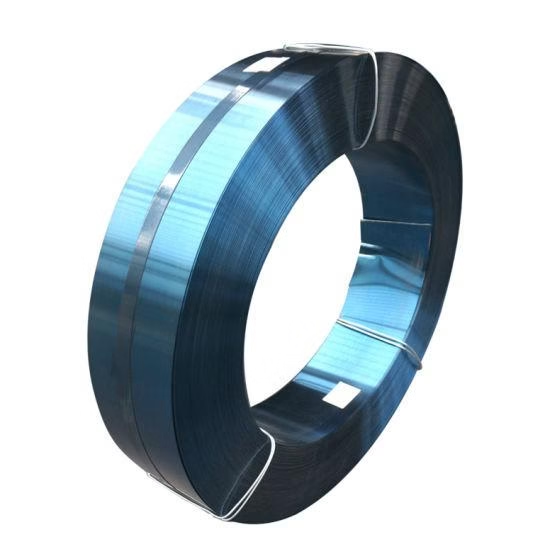
Spring Steel Strip (65Mn / 60Si2Mn / C75S / SUP9 / 51CrV4)
Spring Steel Strip is precision cold-rolled narrow flat coil in medium-to-high carbon alloy spring steel for flat springs, snap springs, contact springs, retaining clips, and blade applications. Width 5–600mm, thickness 0.05–6.0mm. Grades 65Mn, C75S, SK5, 51CrV4, SAE 1075. Hardened & tempered HRC 40–55 or annealed supply. Mill test certificate provided.
| Material | Medium-to-High Carbon Cold-Rolled Spring Steel Strip |
|---|---|
| Grade / Standard | GB 65Mn / 60Si2Mn / EN C55S / C65S / C75S / C85S / C95S / JIS SK5 / SK7 / SUP9 / DIN 51CrV4 (1.8159) / SAE 1074 / 1075 / 1095 |
| Thickness | 0.05mm – 6.0mm (Cold Rolled) / up to 10mm (Hot Rolled Strip) |
| Width | 5mm – 600mm (Slit to order, tolerance ±0.05mm) |
| Length | Coil form (standard) / Cut length available on request |
| Delivery Condition | as_rolled |
| Surface Treatment | coated |
| MOQ | 100 kg (Narrow Strip) / 500 kg (Standard Width) |
| Delivery Time | 15-30 Days (Stock) / 25-40 Days (Custom Production) |
| Loading Port | Tianjin / Shanghai / Qingdao |
Overview of Spring Steel Strip
Spring Steel Strip is a precision cold-rolled or hot-rolled narrow flat product manufactured from medium-to-high carbon alloy spring steel, engineered specifically for the production of flat springs, clock springs, snap-action springs, retaining clips, disc springs, flexible blades, and precision elastic components that require highly consistent thickness tolerance, excellent surface finish, uniform hardness across the full strip width, and reliable fatigue performance under repeated flexing cycles. Distinguished from spring steel plate by its narrower width (typically 5mm to 600mm), thinner gauge range (0.05mm to 6.0mm), coiled delivery form enabling continuous press feeding, and the tighter dimensional tolerances achievable through cold rolling and precision slitting — spring steel strip is the preferred raw material for stamped spring components produced on progressive dies, automatic screw machines, and coil spring winding equipment in high-volume manufacturing environments.
Spring steel strip is standardised under GB/T 1222 (Chinese), JIS G4801 / G3311 (Japanese), EN 10132-4 (European cold-rolled narrow strip for springs), DIN 17222 (German), and SAE J403 (American) standards. Principal grades include GB 65Mn (Chinese general-purpose spring strip, the most widely produced and exported grade), GB 60Si2Mn (high silicon grade for heavy-duty strip springs), C75S / 1.1248 (European carbon spring steel strip per EN 10132-4), C85S / C95S (higher carbon European grades for maximum hardness), JIS SUP9 / SUP9A (chromium-manganese spring strip), SK5 / SK7 (Japanese high-carbon tool steel strip grades widely used for flat springs), DIN 51CrV4 / 1.8159 (chromium-vanadium premium grade), and SAE 1074 / 1075 / 1095 (American carbon spring steel strip grades). Carbon content ranges from 0.55% to 1.05% depending on grade, providing tensile strength from 800 MPa (annealed, for forming) to 2,200 MPa (hardened and tempered thin strip) with hardness spanning HRC 44–55 in the hardened and tempered supply condition most commonly used for direct spring production without further heat treatment by the spring manufacturer.
Key Features and Manufacturing Process
Spring Steel Strip is produced through a multi-stage manufacturing process combining hot rolling, cold rolling, heat treatment, and precision finishing operations to achieve the combination of dimensional accuracy, surface quality, and mechanical properties essential for reliable spring performance. The manufacturing sequence begins with hot-rolled coil of the specified spring steel composition, which is acid-pickled to remove mill scale, then cold-rolled in multiple passes on a reversing or tandem cold rolling mill to the required strip thickness. Each cold rolling pass work-hardens the steel, increasing yield strength and reducing ductility — for strip supplied in cold-rolled hardened and tempered (C+T) condition, the cold rolling strain is carefully controlled to complement the subsequent tempering response. Intermediate annealing between cold rolling passes is performed when required to restore ductility and enable further thickness reduction for very thin gauges (below 0.3mm).
The critical manufacturing steps distinguishing premium spring strip from commodity product are: precision slitting using carbide-tipped circular slitter blades to achieve slit width tolerance of ±0.05mm or better, eliminating the ragged edge and microcrack damage that would initiate fatigue failure; edge conditioning by roller burnishing, edge grinding, or controlled slitter blade geometry to achieve smooth, burr-free edges — since spring fatigue cracks most frequently initiate at slit edge imperfections or edge decarburisation zones; surface decarburisation control to less than 1.0% of strip thickness per side (EN 10132-4 requirement), achieved through controlled-atmosphere annealing or surface grinding; and hardness uniformity verification across the strip width and along its length to confirm consistent mechanical properties throughout the coil. Spring steel strip is supplied in annealed condition (≤210 HBW, soft for stamping and bending), hardened and tempered condition (HRC 40–55 per grade and application, for direct use as spring without further heat treatment by the customer), and normalised or quenched and tempered condition for special applications. Coil inner diameter is typically 300–600mm for processing on stamping presses and 500–900mm for coil spring winding, with outer diameter up to 1,800mm and coil weight from 50 kg (narrow precision strip) to 3,000 kg (wide production strip).
Main Applications of Spring Steel Strip
Spring Steel Strip is the primary raw material for stamped flat spring components produced in high volumes on progressive dies and transfer presses across the automotive, electronics, appliance, and hardware industries. Automotive applications dominate strip spring consumption and include contact springs and leaf spring contacts for automotive electrical connectors and relay modules, clutch diaphragm spring segments, valve spring retainer clips, fuel injector spring clips, door latch return springs, hood and trunk lid stay springs, sun visor friction springs, seat adjustment return springs, wiper blade flexor springs, automotive fuse box retaining clips, battery terminal springs, seat belt retractor springs, and the complete range of small stamped spring clips and retainers throughout vehicle assembly.
The electronics and electrical industry employs spring steel strip extensively for switch contact springs in push-button switches, toggle switches, and membrane keyboards, terminal contact springs in electrical connectors and PCB edge connectors, battery contact springs in consumer electronics (smartphones, laptops, remote controls, hearing aids), SIM card and SD card ejector springs, EMC shielding contact strips and grounding springs in electronic equipment enclosures, reed switch blades, relay armature springs, circuit breaker trip springs, and precision contact blades in high-frequency RF connectors. The consumer goods and hardware sector uses spring steel strip for snap-action mechanisms in ballpoint pens and mechanical pencils, binder clip springs, paper clip blanks, staple former springs, measuring tape recoil springs, retractable badge reel springs, clock and watch mainspring blanks, music box spring strips, mechanical toy spring mechanisms, hand tool springs (pliers jaw return springs, pruning shear springs, wire stripper springs), kitchen timer springs, and the full range of consumer mechanism springs requiring precise snap-action or constant-force spring behaviour. Industrial applications include saw blade strip for hand saws and hacksaw blades, doctor blade strips for paper and printing industry coating and metering applications, squeegee blades for screen printing, flexible scraper blades for industrial cleaning equipment, band saw blade blanks for metal cutting, woodworking band saw blade strip, cold chisel and scraper blade strip, industrial knife and blade strip for packaging and food processing cutting applications, agricultural mower blade strip, and textile machinery guide springs and tension springs.
Why Choose Us for Spring Steel Strip
Shandong Tanglu Metal Material Co., Ltd. supplies premium Spring Steel Strip sourced from major Chinese cold rolling mills and specialty steel producers including Jiangyin Xingcheng Special Steel, Baoshan Iron & Steel (Baosteel), and Zhangjiagang Pohang Stainless Steel, all operating certified production facilities meeting ISO 9001, ISO 14001, EN 10132-4, JIS G3311, and GB/T 1222 product standard requirements. Every spring steel strip coil is accompanied by original mill test certificates covering full chemical composition analysis by optical emission spectrometry, mechanical property test results (tensile strength, yield strength, hardness in HRC or HV), dimensional inspection data including strip width, thickness at multiple positions across width and along length, thickness tolerance compliance, edge burr height, surface finish verification, and decarburisation depth measurement per EN 10132-4 or GB/T 1222 requirements with complete coil number traceability.
We offer a comprehensive spring steel strip specification range covering widths from 5mm to 600mm, thicknesses from 0.05mm to 6.0mm, in grades GB 65Mn, 60Si2Mn, C55S, C65S, C75S, C85S, C95S (EN 10132-4), SK5, SK7 (JIS), DIN 51CrV4 / 1.8159, SAE 1074 / 1075 / 1095, in annealed, normalised, and hardened and tempered supply conditions. Custom slit width to ±0.05mm tolerance, edge condition (slit, roller burnished, or ground edge), coil dimensions (ID, OD, and weight), surface treatment (bare, oiled, phosphated), and special decarburisation depth requirements are available for precision spring production programmes. With established monthly supply capacity of 1,500 tons of spring steel products and export relationships with spring manufacturers, stamping companies, electronics hardware producers, automotive component suppliers, and precision parts makers across more than 50 countries, we support packages from small prototype spring material orders to large series production supply contracts. Each shipment includes original mill test certificate per EN 10204 3.1 standard, with EN 10204 3.2, decarburisation depth report, hardness survey across strip width, and third-party inspection by SGS, Bureau Veritas, or TUV available for critical automotive and electronics spring applications.
📐 Dimension & Size Table
| Grade | Standard | Carbon (%) | Thickness Range (mm) | Hardness H+T (HRC) | Typical Application |
|---|---|---|---|---|---|
| C55S | EN 10132-4 | 0.50–0.56 | 0.10–4.0 / 40–45 / Light flat springs, clips | ||
| C65S | EN 10132-4 | 0.62–0.68 | 0.10–4.0 / 44–48 / General flat springs, retainers | ||
| C75S / 1.1248 | EN 10132-4 | 0.72–0.78 | 0.05–6.0 / 46–50 / Contact springs, snap springs | ||
| C85S | EN 10132-4 | 0.82–0.88 | 0.05–4.0 / 48–52 / High-strength flat springs | ||
| C95S | EN 10132-4 | 0.90–1.00 | 0.05–3.0 / 50–55 / Maximum hardness blade springs | ||
| 65Mn | GB/T 1222 | 0.62–0.70 | 0.10–6.0 / 44–50 / General spring strip, clips | ||
| 60Si2Mn | GB/T 1222 | 0.56–0.64 | 0.50–6.0 / 46–52 / Heavy-duty strip springs | ||
| SK5 (C75) | JIS G3311 | 0.70–0.80 | 0.05–6.0 / 46–50 / Japanese market contact springs | ||
| SK7 (C85) | JIS G3311 | 0.80–0.90 | 0.05–4.0 / 48–52 / Japanese blade and spring strip | ||
| SK4 (C95) | JIS G3311 | 0.90–1.00 | 0.05–3.0 / 50–55 / High-hardness precision spring | ||
| 51CrV4 / 1.8159 | EN / DIN | 0.47–0.55 | 0.50–6.0 / 46–52 / Premium Cr-V spring strip | ||
| SAE 1074 / 1075 | SAE J403 | 0.70–0.78 | 0.10–6.0 / 44–50 / American market flat springs | ||
| SAE 1095 | SAE J403 | 0.90–1.03 | 0.05–4.0 / 50–55 / High-carbon American spring strip |
* Custom sizes available upon request. Tolerances per relevant international standards.
🔬 Chemical Composition
| Element | Min | Max | Display Value | Note |
|---|---|---|---|---|
| C | 0.70 | 0.80 | 0.70–0.80 | C75S / EN 10132-4 — representative mid-range carbon spring strip grade; C55S: 0.52–0.58%; C95S: 0.90–1.00% |
| Si | 0.15 | 0.35 | 0.15–0.35 | Standard carbon spring strip; 60Si2Mn: Si 1.50–2.00% for high elastic limit |
| Mn | 0.50 | 0.80 | 0.50–0.80 | C75S / EN 10132-4; 65Mn: Mn 0.90–1.20% |
| P | - | 0.025 | ≤0.025 | Strictly controlled — P promotes brittleness in high-carbon spring strip |
| S | - | 0.025 | ≤0.025 | Strictly controlled — S inclusions initiate fatigue cracking in strip springs |
| Cr | 0.90 | 1.20 | 0.90–1.20 | 51CrV4 / DIN 1.8159 / SUP9 — Cr for hardenability and tempering resistance |
| V | 0.10 | 0.20 | 0.10–0.20 | 51CrV4 / SUP10 only — V for grain refinement and fatigue resistance |
| Cu | - | 0.20 | ≤0.20 | Residual element — controlled low in spring strip for surface quality |
| Ni | - | 0.30 | ≤0.30 | Residual element |
| Al | - | 0.05 | ≤0.05 | Grain refinement — controlled in spring strip to prevent AlN precipitation at grain boundaries |
* Chemical composition may vary by heat, thickness and specification. Please refer to the actual mill test certificate.
⚙️ Mechanical Properties
| Property | Value | Unit | Test Condition |
|---|---|---|---|
| Tensile Strength — C55S (Hardened & Tempered) | 1,250–1,550 | MPa | Per EN 10132-4, thickness 0.5–3.0mm, H+T condition |
| Tensile Strength — C65S (Hardened & Tempered) | 1,400–1,700 | MPa | Per EN 10132-4, H+T condition |
| Tensile Strength — C75S (Hardened & Tempered) | 1,550–1,900 | MPa | Per EN 10132-4 — most widely used spring strip grade |
| Tensile Strength — C95S (Hardened & Tempered) | 1,700–2,100 | MPa | Per EN 10132-4, thin gauge ≤0.5mm achieves highest values |
| Tensile Strength — 65Mn (Hardened & Tempered) | 1,300–1,600 | MPa | Per GB/T 1222, Q+T condition |
| Tensile Strength — 51CrV4 (Hardened & Tempered) | 1,450–1,750 | MPa | Per DIN EN 10089 / EN 10132-4, premium Cr-V grade |
| Hardness — Annealed (all grades) | ≤210 | HBW | Spheroidized annealed for cold forming, stamping, and deep drawing operations |
| Hardness — Hardened & Tempered (C75S / 65Mn) | 46–50 | HRC (450–510 HV) | Standard spring service condition — balanced hardness and fatigue resistance |
| Hardness — Hardened & Tempered (C95S / SK4) | 50–55 | HRC (513–595 HV) | Maximum hardness for blade and high-strength precision spring applications |
| Elastic Limit Ratio (Re/Rm) | 0.85–0.92 | - | After H+T — high ratio essential for spring function; distinguishes spring from structural steel |
| Surface Decarburisation Depth | ≤1.0 | % of strip thickness per side | Per EN 10132-4 — critical quality parameter for strip spring fatigue life |
| Thickness Tolerance (Cold Rolled) | ±0.01–±0.05 | mm | Depending on thickness and width — tighter than plate tolerance for precision spring production |
| Width Tolerance (Precision Slit) | ±0.05 | mm | Precision slit edge — essential for progressive die feeding and spring dimensional accuracy |
| Fatigue Limit (Reversed Bending, 10⁷ cycles) | 600–800 | MPa | C75S H+T, polished surface, unnotched specimen |
* Values shown are minimum requirements unless otherwise stated.
📦 Commercial Information
| Packaging | Standard seaworthy export packing for Spring Steel Strip. Strip coils wrapped individually with VCI (Volatile Corrosion Inhibitor) anti-rust paper applied directly to strip surface to prevent oxidation of bright cold-rolled surface, followed by polyethylene stretch film overwrap providing moisture barrier and mechanical protection during ocean transit. Coil inner diameter protected with cardboard or plastic ID core liner to prevent crushing during stacking. Eye-to-sky or eye-to-wall stacking orientation selected to match customer unwinding requirements and labelled on packaging. Multiple coils of the same grade, width, and thickness banded together on timber export pallets with steel strapping (2–3 wraps per stack), with timber spacer blocks between coil layers preventing contact damage to wrapped coil OD surface. Each coil tagged with individual label inside wrapper and external strap tag showing: coil number, heat number, grade designation (65Mn / C75S / SK5 / 51CrV4 / SAE 1075 etc.), width (mm), thickness (mm), coil weight (kg), delivery condition (annealed / H+T / full hard), hardness value (HRC or HBW), and decarburisation depth (mm). For precision ground or polished spring strip, additional interleaving with non-woven protective paper between coil wraps during rewinding prevents surface contact marks. For very narrow strip coils (width below 20mm), individual coils supplied in plastic protective tubes within outer cardboard cartons. Desiccant sachets (silica gel) placed inside PE film outer wrap for humid tropical destination markets. Container loading: 20FT FCL typically 18–22 tons for standard coil strip; 40HQ for longer length or oversize OD coils. Air freight packaging with rigid outer carton and foam cushioning available for urgent prototype spring material orders. |
|---|---|
| Payment Terms | T/T (Telegraphic Transfer),L/C (Letter of Credit),D/P (Documents against Payment),Western Union,PayPal |
| Price Term | FOB,CFR,CIF,EXW |
| Supply Capacity | 1,500 Tons/Month (Spring Steel Products) |
| Loading Port | Tianjin / Shanghai / Qingdao |
Why Choose Our Spring Steel Strip (65Mn / 60Si2Mn / C75S / SUP9 / 51CrV4)?
Mill Certified Spring Strip Quality
Spring steel strip supplied with original mill test certificate EN 10204 3.1/3.2 covering full chemical composition, mechanical properties (tensile strength, hardness in HRC/HV across strip width), thickness measurement at multiple positions along coil length, decarburisation depth per EN 10132-4 / GB/T 1222, surface quality inspection, and complete coil number traceability from heat to finished coil.
Precision Slit Width & Thickness Range
Width 5mm to 600mm precision slit to ±0.05mm tolerance. Thickness 0.05mm to 6.0mm in cold-rolled form, up to 10mm hot-rolled. All standard grades from C55S light spring strip through C95S maximum hardness blade strip, SK5 / SK7 Japanese grades, 51CrV4 Cr-V premium grade, and GB 65Mn / 60Si2Mn. Coil, cut length, and custom OD / ID available.
Consistent HRC 40–55 Hardened & Tempered Supply
Hardened and tempered spring strip supplied at specified HRC 40–55 ready for direct spring stamping and forming without further heat treatment — eliminating customer heat treatment operations, distortion risk, and scale formation. Uniform hardness across full strip width (±2 HRC) and along full coil length verified by mill, ensuring consistent spring performance throughout production run.
Multi-Standard International Grade Coverage
Available in EN C55S / C65S / C75S / C85S / C95S (European EN 10132-4), JIS SK5 / SK7 / SK4 / SUP9 (Japanese), GB 65Mn / 60Si2Mn (Chinese), DIN 51CrV4 / 1.8159 (German), and SAE 1074 / 1075 / 1095 (American). Custom chemistry and property combinations for proprietary spring specifications available with minimum order quantities.
Stock Availability for Common Strip Sizes
Common grades (65Mn, C75S, SK5) in standard thicknesses (0.1–3.0mm) and widths (10–300mm) maintained in stock for 10–20 days dispatch. Custom slit widths from stock coil within 5–10 working days. Special grades and non-standard dimensions 25–40 days production cycle. Container loading for coil strip optimised to 18–22 tons per 20FT FCL.
🏭 Applications of Spring Steel Strip (65Mn / 60Si2Mn / C75S / SUP9 / 51CrV4)
Spring Steel Strip serves as the primary raw material for high-volume stamped spring component production across the complete spectrum of automotive, electronics, consumer goods, industrial machinery, and hardware manufacturing industries, where the coiled strip form enables continuous progressive die feeding at rates of 50–500 strokes per minute for economical mass production of precision spring parts. Automotive applications represent the largest consumption segment, with spring steel strip used for contact springs and brush springs in automotive alternators, starter motors, and wiper motors, clutch diaphragm spring segment blanks for manual transmission clutch assemblies, valve spring retainer clips and collets in engine valve train assemblies, fuel injector solenoid return springs, automotive relay contact spring blades in body control module and fuse box relay assemblies, door lock actuator return springs, window regulator balance springs, sun visor constant torque friction springs, seat adjustment mechanism return springs and detent springs, hood and trunk lid support stay springs, automotive antenna coil springs, airbag sensor housing spring contacts, parking brake lever return springs, and the complete range of small precision spring clips, retainers, and contact blades distributed throughout modern vehicle electrical, mechanical, and body systems. The electronics and electrical manufacturing sector employs spring steel strip as the fundamental material for switch contact blades in push-button switches, toggle switches, micro-switches, and tact switches used in consumer electronics, industrial control panels, and automotive switch assemblies; terminal contact spring blades in board-to-board, wire-to-board, and wire-to-wire electrical connectors for telecommunications, automotive, and industrial wiring harnesses; battery contact springs in AA/AAA battery holders for consumer electronics including remote controls, flashlights, wireless keyboards, and game controllers; SIM card ejector springs in mobile phones and tablets; SD card slot ejector springs in cameras and laptops; EMC electromagnetic compatibility shielding gasket strips and fingerstock springs for electronic equipment enclosure grounding; reed switch blade blanks for proximity sensors, door and window alarm contacts, and liquid level sensors; relay armature spring blades for electromechanical relay modules; circuit breaker bimetallic and snap-action spring blades for thermal overload protection in industrial motor starters and miniature circuit breakers. Consumer goods and hardware manufacturing uses spring steel strip for the snap-action mechanisms in retractable ballpoint pens and mechanical pencils, metal binder clip blanks stamped and formed from C75S strip, paper clip wire straightened from cold-drawn spring wire related strip process, staple former spring mechanisms in office staplers, tape measure recoil spring blades wound from narrow hardened strip into constant-force clock spring configuration, retractable badge reel and cable reel recoil springs, clock and watch mainspring blanks in precision-slit thin hardened strip, music box spring strips, mechanical toy clockwork spring mechanisms, hand pruning shear and loppers jaw return spring blades, wire stripper and crimping tool return spring blades, garden secateur return springs, kitchen mechanical timer mainspring blades, can opener cutting blade return springs, and domestic appliance springs including washing machine lid latch springs, refrigerator door cam springs, and microwave door latch springs. Industrial and cutting tool applications of spring steel strip include hacksaw blade blanks in M2 HSS or bimetal (spring steel backer with HSS tooth edge) for metal cutting hand saws, hand saw blade strip for wood cutting applications, doctor blade strip for paper mill and printing press coating and metering applications where the strip spring-loads a precision blade against a rotating cylinder surface, flexible scraper blade strip for industrial cleaning equipment and printing squeegee blades, band saw blade backer material for bimetal wood and metal cutting band saw blades, agricultural mower blade strip and disc mower blade blanks requiring impact-resistant high-carbon spring steel, cold chisel and scraper blade strip for industrial maintenance tools, and industrial knife and blade strip for packaging machine cutting units, food processing slicers, and textile cutting machinery where combination of hardness and spring-back prevents blade deflection during cutting.
📋 Quality & Certification
Our Certifications
- ✅ ISO 9001:2015
- ✅ CE Marking
- ✅ ABS
- ✅ DNV GL
- ✅ Lloyd's Register (LR)
- ✅ Bureau Veritas (BV)
- ✅ SGS Certified
- ✅ RINA
Mill Certificate Type
- 📋 EN 10204 3.1
- 📋 EN 10204 3.2
- 📋 Original Mill Certificate
- 📋 Third Party Inspection Available
- 📋 Certificate of Origin
❓ Frequently Asked Questions
What is spring steel strip and how does it differ from spring steel plate?
Spring steel strip and spring steel plate are both flat spring steel products but differ fundamentally in dimensions, delivery form, manufacturing process, dimensional precision, and typical application. Spring steel strip is a narrow flat product (width typically 5–600mm) produced by cold rolling and precision slitting, supplied in coiled form (continuous length wound into a coil), with tight thickness tolerances (±0.01–0.05mm) and width tolerance (±0.05mm achievable by precision slitting), bright cold-rolled surface finish, and often supplied in hardened and tempered condition (HRC 40–55) ready for direct spring stamping or winding without further heat treatment by the customer. The coiled form of strip enables continuous automated progressive die feeding at high press speeds (50–500 strokes per minute) for economical mass production of small stamped spring components. Spring steel plate is a wider, thicker flat product (width typically 100–2000mm, thickness 1–30mm) produced by hot rolling, supplied in cut lengths on pallets, with wider dimensional tolerances acceptable for the larger spring components it serves, and typically requiring heat treatment (quench and temper) by the spring manufacturer after forming — making it suitable for large components like automotive leaf springs, truck suspension springs, and industrial machinery leaf springs where individual spring dimensions are large enough to justify handling cut pieces rather than a continuous coil. The core material chemistry and spring performance requirements are similar between strip and plate, but the strip's tighter dimensional tolerances, better surface finish, coiled form factor, and pre-hardened supply condition make it essential for small precision spring components where plate would be impractical.
What is the difference between C75S, 65Mn, SK5, and SAE 1075 spring steel strip grades?
C75S, 65Mn, SK5, and SAE 1075 are the four most widely used spring steel strip grades globally, each designated under a different national standard but all representing nominally 0.70–0.80% carbon spring steel strip with similar target mechanical properties. C75S (EN 10132-4) is the European standard designation for narrow cold-rolled strip for springs with carbon 0.72–0.78%, manganese 0.50–0.80%, specified per EN 10132-4 which also defines dimensional tolerances, surface quality, decarburisation limits, and delivery conditions — the dominant specification for European automotive and electronics OEM spring supplier quality systems. 65Mn (GB/T 1222) is the Chinese standard spring steel with carbon 0.62–0.70% (slightly lower than C75S) and higher manganese 0.90–1.20% — the additional manganese compensates for the lower carbon in strengthening the steel and improving hardenability, and 65Mn is the most cost-competitive globally available spring strip grade produced in the largest volumes by Chinese cold rolling mills. SK5 (JIS G3311) is the Japanese standard spring steel strip with carbon 0.70–0.80%, manganese 0.25–0.60% — specified for Japanese automotive and electronics OEM suppliers following JIS quality systems, with equivalent performance to C75S in hardened and tempered condition. SAE 1075 (SAE J403) is the American specification with carbon 0.70–0.80%, manganese 0.40–0.70% — specified for North American OEM applications and is commercially interchangeable with C75S and SK5 in mechanical performance. For most spring stamping applications, these four grades are functionally interchangeable in the hardened and tempered supply condition at the same specified hardness (HRC 46–50), and the choice is typically determined by the applicable OEM specification or customer quality system requirements rather than technical performance differences.
What delivery conditions are available for spring steel strip and which should I specify?
Spring steel strip is supplied in five principal delivery conditions, each suited to different spring manufacturing processes and facility capabilities. Annealed (Soft) condition (≤210 HBW per EN 10132-4 / GB/T 1222) is the softest form, produced by spheroidised annealing at 690–720°C to convert lamellar pearlite to spheroidised carbides in a soft ferritic matrix, enabling maximum formability for complex stamping, deep drawing, bending around very small radii, and cold coiling without cracking. Annealed strip requires complete hardening and tempering heat treatment by the customer after spring forming to achieve final spring properties — this adds process steps but enables the most severe forming operations. Normalised condition (approximately 250–320 HBW) is produced by heating above Ac3 and air cooling, giving a uniform fine pearlite structure with intermediate hardness and ductility — suitable for moderate cold bending operations where annealed softness is unnecessary but full hardness is not required before forming. Cold Rolled Full Hard condition (work-hardened from cold rolling without subsequent annealing, tensile strength 1,200–1,600 MPa depending on grade and thickness reduction ratio) provides high strength through cold-work strengthening without heat treatment — economical for applications where the as-rolled strength is adequate (battery contacts, light spring clips) though the directional anisotropy and lack of tempered toughness limits suitability for high-fatigue applications. Hardened and Tempered (H+T) condition is the most commercially important supply condition for spring strip — strip is hardened (austenitized and quenched) then tempered at the steel mill to the specified hardness (HRC 40–55 per grade and customer specification), producing a uniform tempered martensitic microstructure with optimised combination of strength, hardness, and toughness for spring service. H+T strip enables direct spring stamping and forming without customer heat treatment, eliminating scale formation, distortion, and decarburisation risk in the customer's manufacturing process. Pre-Tempered (also termed Pre-Hardened or Spring Temper) is sometimes used synonymously with H+T for strip supplied in the final tempered spring condition. For most high-volume spring stamping operations in automotive and electronics manufacturing, Hardened and Tempered is the preferred specification as it enables direct progressive die production with consistent spring properties without additional heat treatment investment.
Why is edge condition important for spring steel strip and what edge options are available?
Edge condition is a critical quality parameter for spring steel strip because strip spring fatigue failures — particularly in high-cycle applications such as automotive relay contact springs, electronic connector springs, and constant-force clock springs — most frequently initiate at strip edge imperfections including microcracks, edge burrs, tool marks, and decarburised edge zones generated during slitting. The strip edge is simultaneously the zone of maximum bending stress in a transversely flexed flat spring and the region most susceptible to surface defects from the slitting process — making edge quality directly critical to spring service life. Four principal edge conditions are available for spring steel strip: Slit Edge (also called mill edge or as-slit edge) is produced by circular slitter blades cutting the strip to width from a wider master coil, resulting in a square-cut edge with a small burr (typically 0.01–0.05mm height depending on strip thickness and slitter condition). Slit edge is acceptable for applications where edge stresses are low (wide strips bent about their long axis) or where the edge will be tumbled, deburred, or surface-treated after stamping. Deburred Slit Edge applies a deburring operation after slitting (wire brush, tumbling, or abrasive belt) to remove the slit burr without modifying edge geometry — suitable for moderate fatigue duty applications. Roller Burnished Edge (or rolled edge) passes the slit edge through hardened roller burnishing tools that plastically compress and smooth the edge surface, introducing beneficial compressive residual stress in the edge zone (similar to shot peening effect on the strip face) and eliminating micro-cracks from slitting — this is the preferred edge condition for high-fatigue spring applications including automotive contact springs and precision electronic springs. Ground Edge is produced by edge grinding on an abrasive wheel or belt to remove the slit edge zone completely, achieving a smooth, square, burr-free edge with controlled edge radius and eliminating decarburised edge material — the highest quality edge condition for the most demanding spring fatigue applications in aerospace and medical device contact springs. When ordering spring strip for fatigue-critical applications, always specify roller burnished or ground edge and verify decarburisation depth at strip edge as well as strip face.
What coil dimensions and weight should I specify when ordering spring steel strip?
Specifying coil dimensions correctly is important for ensuring compatibility with your press feeding equipment, coil handling systems, and production efficiency when ordering spring steel strip. The key coil parameters to specify are inner diameter (ID), maximum outer diameter (OD), maximum coil weight, and winding direction. Inner Diameter (ID) must match your coil reel or decoiler mandrel diameter — common standard IDs are 300mm (for small strip widths up to approximately 50mm width processed on small precision presses), 400mm (medium strip, common for Japanese and Korean market equipment), 500mm (standard for most European and Chinese production press lines), 600mm (large coil handling systems, heavy press lines), and 760mm / 30-inch (North American market standard). Specifying an ID outside your equipment range requires an adaptor or cannot be used at all — always confirm ID before ordering. Maximum Outer Diameter (OD) is governed by your coil car or coil reel capacity — common maximum ODs are 1,000mm, 1,200mm, 1,500mm, and 1,800mm. Larger OD means more strip length per coil and fewer coil changes during production, improving efficiency, but requires adequate coil handling equipment capacity. Maximum Coil Weight must be within the rated capacity of your coil reel or decoiler — typical ratings are 500 kg (small precision decoilers), 1,000–2,000 kg (standard production press coil reels), 3,000–5,000 kg (heavy press line decoilers). For narrow strip widths (5–50mm) at thin gauges (0.1–1.0mm), coil weight per reel is naturally limited by the total strip length achievable within the OD constraint — specify maximum weight and let the mill optimise coil length. For wide thick strip, maximum weight is the binding constraint. Winding Direction specifies whether the free end of the strip exits from the top or bottom of the coil — specify 'eye to sky' (coil standing upright with axis vertical, strip exits from OD) or 'eye to wall' (coil lying on side with axis horizontal) to match your decoiler configuration. Custom coil splicing to produce extra-long coils (strip-to-strip welding) and traverse-wound (oscillate-wound) coils for very narrow strip widths are available for specialist applications requiring very long continuous strip runs between coil changes.
Get a Quote for
Spring Steel Strip (65Mn / 60Si2Mn / C75S / SUP9 / 51CrV4)
Submit your requirements and receive a competitive price quote within 24 hours.
- ✓ Fast response within 24 hours
- ✓ Competitive factory-direct pricing
- ✓ Free technical consultation
- ✓ Mill test certificate provided
- ✓ Flexible payment terms available
⏱ Response within 24 hours
Send Your Inquiry
All fields marked with * are required