
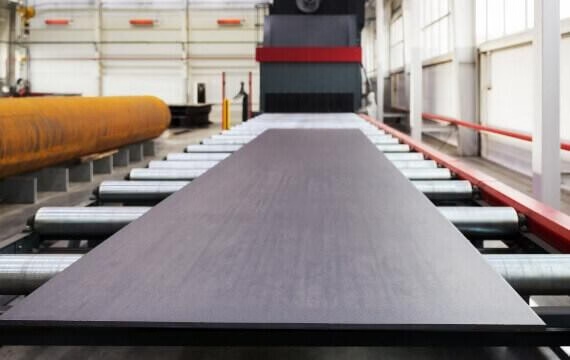
Spring Steel Plate (65Mn / 60Si2Mn / SUP9 / 51CrV4)
Spring steel plate is medium-to-high carbon alloy steel for leaf springs, flat springs, disc springs, and elastic components. Available in 65Mn, 60Si2Mn, SUP9, SUP10, 51CrV4 grades. Hot rolled (0.1-30mm) or cold rolled (0.05-3.0mm). Achieves tensile 1300-1900 MPa after Q+T. Mill test certificate provided.
| Material | Medium-to-High Carbon Alloy Spring Steel |
|---|---|
| Grade / Standard | GB 65Mn / 60Si2Mn / JIS SUP9 / SUP10 / DIN 51CrV4 (1.8159) / SAE 9260 |
| Thickness | Hot Rolled: 0.1-30mm / Cold Rolled: 0.05-3.0mm |
| Width | Hot Rolled: up to 2000mm / Cold Rolled: 5-1000mm |
| Length | 1m - 12m (Plate) / Coil Form Available |
| Delivery Condition | hot_rolled / cold_rolled / normalized / quenched_tempered |
| Surface Treatment | coated |
| MOQ | 1 Ton |
| Delivery Time | 20-35 Days / 15-25 Days (Stock) |
| Loading Port | Tianjin / Shanghai / Qingdao |
Overview of Spring Steel Plate
Spring steel plate is a specialized category of medium-to-high carbon alloy steel designed specifically for manufacturing flat springs, leaf springs, disc springs, snap rings, and elastic components requiring repeated deformation without permanent set. Unlike structural steels which prioritize yield strength and ductility, spring steel emphasizes high elastic limit (typically 80-90% of tensile strength), exceptional fatigue resistance under cyclic loading (10^6 to 10^7 cycles), and the ability to maintain elastic properties under sustained loading at moderate temperatures. Specified primarily under GB/T 1222 (Chinese), JIS G4801 (Japanese), DIN EN 10089 (European), and SAE J403/J404 (American) standards, spring steel plates have become essential materials for automotive suspension systems, railway equipment, industrial machinery springs, and a wide range of mechanical components requiring elastic energy storage capability.
The most widely used spring steel grades worldwide include GB 65Mn (Chinese standard, the international benchmark for general-purpose spring applications), GB 60Si2Mn (Chinese standard, silicon-manganese spring steel for heavy-duty applications), JIS SUP9 (Japanese standard, chromium-manganese spring steel equivalent to AISI 5160H), JIS SUP10 (Japanese standard, chromium-vanadium spring steel for high-stress applications), DIN 51CrV4 / 1.8159 (European standard, chromium-vanadium spring steel for premium applications), and SAE 9260 (American standard, silicon-manganese spring steel). These grades typically contain 0.50-0.70% carbon for high tensile strength after heat treatment, plus alloying elements like silicon (1.50-2.00% in 60Si2Mn), manganese (0.70-1.00% in 65Mn), chromium (0.80-1.10% in 51CrV4), and vanadium (0.10-0.20% in SUP10/51CrV4) for hardenability, fatigue resistance, and elastic limit enhancement. After proper heat treatment (austenitizing at 820-870°C, oil quenching, and tempering at 380-500°C), spring steel plates achieve tensile strength of 1300-1900 MPa with yield strength exceeding 1100 MPa and Brinell hardness HB 380-450, providing the optimal combination of high elastic limit and adequate ductility for spring applications.
Key Features and Heat Treatment
Spring steel plate features carefully balanced chemistry that maximizes elastic limit while maintaining sufficient ductility for forming and shock loading resistance. The medium-to-high carbon content (0.50-0.70%) provides high tensile strength after quenching and tempering, while alloying elements enhance specific properties: silicon increases yield strength and elastic limit through solid solution strengthening (especially 60Si2Mn with 1.5-2.0% Si), chromium improves hardenability and tempering resistance for uniform properties through cross-section, vanadium refines grain structure and provides secondary hardening through carbide precipitation, and manganese contributes to hardenability and overall strength.
The steel is supplied in multiple product forms including hot rolled plates (thickness 0.1-30mm, width up to 2000mm) for leaf springs and large flat springs, cold rolled strips (thickness 0.05-3.0mm, width 5-1000mm) for precision flat springs and clips, and annealed sheets (thickness 0.1-5.0mm) for stamping operations. Standard delivery conditions include hot rolled (mill scale surface), cold rolled (bright surface), spheroidized annealed (≤210 HBW for forming), normalized (250-300 HBW for moderate stress applications), and quenched & tempered (final heat treated to customer specification, typically HRC 40-50 / HB 380-450). Surface conditions include bare/black mill finish, pickled and oiled (P&O), edge trimmed (mill edge or slit edge), polished (cold rolled bright surface), and shot peened for fatigue enhancement. Each spring steel plate undergoes mandatory chemical composition analysis, mechanical property testing including tensile, yield, elongation, hardness, and surface decarburization depth verification per applicable standards, microstructure inspection ensuring uniform pearlitic or sorbitic structure for fatigue performance, dimensional inspection per applicable standards, and surface quality verification for cracks, laps, and decarburization defects that could initiate spring failure.
Main Applications of Spring Steel Plate
Spring steel plate is the primary material for automotive suspension leaf springs used in passenger cars, light trucks, heavy commercial vehicles, trailers, and off-highway equipment, where multi-leaf and parabolic leaf spring designs require high fatigue strength under cyclic loading from road shocks. The railway industry uses spring steel plates extensively for railway car suspension springs, locomotive truck springs, freight car bogie springs, passenger car suspension components, and damping springs requiring 10-20 year service life under millions of loading cycles. Heavy duty truck and trailer manufacturers employ spring steel plates for trailer leaf springs, semi-trailer suspension systems, mining truck suspension, and specialized vehicle suspension components handling extreme loads.
The agricultural and construction equipment industries use spring steel plates for agricultural implement leaf springs (tillage equipment, harvesters), construction equipment suspension (excavator undercarriage components, loader components), and mining equipment springs requiring durability in harsh operating environments. The industrial machinery sector employs spring steel plates for press brake springs and counterbalance systems, machine tool clamping springs, conveyor return springs, vibration damping springs in heavy machinery, disc springs for industrial valves and pressure equipment, snap rings and retaining rings, hand tool springs (pliers, pruning shears, wire cutters), and machine guards. Other major applications include lawn mower blade flexing components, agricultural mower blades, grass trimmer line guides, garden tool springs, kitchen utensil springs (mechanical timers, can openers), bed mattress springs and box springs, sofa and furniture springs, automotive clutch diaphragm springs, retaining clips for hydraulic and pneumatic equipment, marine equipment springs, electrical contact springs, household appliance springs (washing machine drum suspension, refrigerator door seals), and a comprehensive range of mechanical engineering applications requiring elastic energy storage and consistent performance under repeated loading cycles.
Why Choose Us for Spring Steel Plate
Shandong Tanglu Metal Material Co., Ltd. supplies premium spring steel plate sourced from major Chinese specialty steel mills with proven international export experience and certified production facilities meeting ISO 9001, ISO 14001, ASME, and PED requirements. Every spring steel plate undergoes mandatory chemical composition analysis verified by optical emission spectrometry, mechanical property testing including tensile, yield, elongation, and hardness verification, surface decarburization depth inspection (critical for spring fatigue life), microstructure verification ensuring uniform pearlitic or sorbitic structure, ultrasonic testing for internal defects in thick plates, dimensional inspection per GB/T 1222 / JIS G4801 / EN 10089 latest revision, and surface quality verification for cracks, laps, and inclusions that could initiate spring failure.
We offer comprehensive spring steel plate range covering all major international grades including GB 65Mn, GB 60Si2Mn, JIS SUP9, SUP10, DIN 51CrV4 / 1.8159, SAE 9260, plus equivalent grades for specific market requirements. Available in hot rolled plates (0.1-30mm thick × up to 2000mm wide), cold rolled strips (0.05-3.0mm thick × 5-1000mm wide), and custom processed shapes per customer specification. Multiple delivery conditions including spheroidized annealed for cold forming operations, normalized, and quenched & tempered for finished spring applications. With monthly supply capacity of 1,500 tons of premium spring steel and established export relationships with automotive spring manufacturers, railway suspension producers, agricultural equipment makers, industrial machinery builders, and OEM clients in over 40 countries, we support both small prototype orders and large series production requirements. Each shipment includes original mill test certificate (MTC) conforming to EN 10204 3.1 standard, with EN 10204 3.2, surface decarburization reports, microstructure photographs, and third-party inspection (SGS, BV, TUV) available for critical spring applications requiring enhanced documentation.
📐 Dimension & Size Table
| Product Form | Thickness Range | Width Range | Typical Application |
|---|---|---|---|
| Cold Rolled Strip - Ultra Thin | 0.05-0.30mm | 5-200mm | Precision clips, snap rings |
| Cold Rolled Strip - Thin | 0.30-1.00mm | 10-300mm | Flat springs, retaining rings |
| Cold Rolled Strip - Medium | 1.00-2.00mm | 20-600mm | Disc springs, flexures |
| Cold Rolled Strip - Thick | 2.00-3.00mm | 50-1000mm | Heavy disc springs, brake springs |
| Hot Rolled Plate - Light | 1.0-3.0mm | 100-1500mm | Light leaf springs, mower blades |
| Hot Rolled Plate - Standard | 3.0-8.0mm | 100-1800mm | Automotive leaf springs (passenger car) |
| Hot Rolled Plate - Heavy | 8.0-16mm | 100-2000mm | Truck leaf springs, trailer springs |
| Hot Rolled Plate - Extra Heavy | 16-25mm | 100-2000mm | Heavy truck springs, railway suspension |
| Hot Rolled Plate - Ultra Heavy | 25-30mm | 100-1800mm | Mining equipment, heavy industrial springs |
* Custom sizes available upon request. Tolerances per relevant international standards.
🔬 Chemical Composition
| Element | Min | Max | Display Value | Note |
|---|---|---|---|---|
| C | 0.62 | 0.70 | 0.62-0.70 | GB 65Mn per GB/T 1222 |
| Si | 0.17 | 0.37 | 0.17-0.37 | 65Mn standard composition |
| Mn | 0.90 | 1.20 | 0.90-1.20 | Strengthening element in 65Mn |
| P | - | 0.035 | ≤0.035 | Impurity limit |
| S | - | 0.035 | ≤0.035 | Impurity limit |
| Cr (in 51CrV4) | 0.90 | 1.20 | 0.90-1.20 | Chromium in 51CrV4 / SUP10 grades |
| V (in 51CrV4 / SUP10) | 0.10 | 0.20 | 0.10-0.20 | Vanadium for grain refinement |
| Si (in 60Si2Mn) | 1.50 | 2.00 | 1.50-2.00 | High silicon for elastic limit enhancement |
| Cu | - | 0.25 | ≤0.25 | Residual element |
| Ni | - | 0.35 | ≤0.35 | Residual element |
* Chemical composition may vary by heat, thickness and specification. Please refer to the actual mill test certificate.
⚙️ Mechanical Properties
| Property | Value | Unit | Test Condition |
|---|---|---|---|
| Tensile Strength (65Mn, Q+T) | ≥980 (1300-1500) | MPa | Quenched 820°C oil + Tempered 480°C |
| Yield Strength (65Mn, Q+T) | ≥785 | MPa | Quenched & Tempered |
| Elongation (65Mn) | ≥8 | % | Gauge length 5d |
| Reduction of Area (65Mn) | ≥30 | % | Quenched & Tempered |
| Tensile Strength (60Si2Mn, Q+T) | ≥1275 (1500-1900) | MPa | Quenched 870°C oil + Tempered 450°C |
| Yield Strength (60Si2Mn, Q+T) | ≥1175 | MPa | High elastic limit grade |
| Tensile Strength (51CrV4 / SUP10, Q+T) | ≥1350 (1500-1700) | MPa | Premium spring steel grade |
| Elastic Limit Ratio | 0.85-0.90 | Re/Rm | After standard heat treatment |
| Hardness (Annealed) | ≤210 | HBW | Spheroidized annealed for forming |
| Hardness (Quenched & Tempered) | 380-450 | HBW (HRC 40-48) | Standard spring service condition |
| Surface Decarburization Depth | ≤1.5 | % of thickness | Per GB/T 1222 quality requirement |
| Fatigue Limit (Reversed Bending) | 550-700 | MPa | After Q+T, polished surface, 10^7 cycles |
* Values shown are minimum requirements unless otherwise stated.
📦 Commercial Information
| Packaging | Standard seaworthy export packing for spring steel products. Hot rolled plates bundled in stacks with steel strapping (3-5 wraps per bundle), wooden separators between layers to prevent surface damage, anti-rust oil coating to prevent corrosion during transit, typical bundle weight 2-5 tons depending on plate dimensions. Cold rolled strips supplied in coiled form (typical coil weight 500-2000 kg) wrapped with PE film for surface protection, then bundled with steel strapping with eye protection rings. Each package clearly tagged with heat number, grade designation (65Mn / 60Si2Mn / SUP9), thickness, width, length (for plates) or coil weight (for strips), and delivery condition (annealed / Q+T). Custom packaging including waterproof shrink wrapping, individual sheet anti-rust paper, and wooden crates available for premium polished surfaces and air shipment requirements. For Q+T condition products, special handling and packaging used to prevent any deformation that could affect spring properties. |
|---|---|
| Payment Terms | T/T (Telegraphic Transfer),L/C (Letter of Credit),D/P (Documents against Payment),Western Union,PayPal |
| Price Term | FOB,CFR,CIF,EXW |
| Supply Capacity | 1,500 Tons/Month (Spring Steel Products) |
| Loading Port | Tianjin / Shanghai / Qingdao |
Why Choose Our Spring Steel Plate (65Mn / 60Si2Mn / SUP9 / 51CrV4)?
Mill Certified Spring Steel Quality
Spring steel plate supplied with original mill test certificate EN 10204 3.1/3.2, including chemical analysis, mechanical properties (tensile, yield, elongation, hardness), surface decarburization depth measurement (critical for spring fatigue life), microstructure verification, and complete metallurgical traceability per GB/T 1222 / JIS G4801 / EN 10089 standards.
Comprehensive Form & Size Range
Hot rolled plates from 0.1mm to 30mm thickness with width up to 2000mm for leaf springs and large flat springs. Cold rolled strips from 0.05mm to 3.0mm thickness with width 5-1000mm for precision flat springs and clips. Available in plate, sheet, strip, and coil forms with custom slitting service.
High Elastic Limit & Fatigue Resistance
After standard heat treatment (austenitize 820-870°C, oil quench, temper 380-500°C), achieves tensile strength 1300-1900 MPa with elastic limit ratio 0.85-0.90, providing exceptional fatigue resistance for repeated loading cycles up to 10^6-10^7 in spring applications.
Multi-Standard International Grades
Available in international spring steel grades including GB 65Mn / 60Si2Mn (Chinese), JIS SUP9 / SUP10 (Japanese), DIN 51CrV4 / 1.8159 (German), SAE 9260 (American), and equivalent grades. Specialized grades for automotive, railway, agricultural, and industrial spring applications.
Reliable Spring Steel Production
Standard plates and strips delivery 15-25 days from stock. Custom dimensions and heat treatment production cycle 25-35 days. Container loading 22-25 tons per 20FT FCL or 25-27 tons per 40FT FCL with proper bundling and anti-rust protection. Established export logistics to spring manufacturers worldwide.
🏭 Applications of Spring Steel Plate (65Mn / 60Si2Mn / SUP9 / 51CrV4)
Spring steel plate is the primary material for automotive suspension leaf springs used in passenger cars, light trucks, heavy commercial vehicles, semi-trailers, and off-highway equipment, where multi-leaf and parabolic leaf spring designs require high fatigue strength under cyclic loading from road shocks, with typical service life expectations of 100,000-300,000 km depending on load conditions and spring design. The railway industry uses spring steel plates extensively for railway car suspension springs, locomotive truck springs, freight car bogie suspension components, passenger car suspension dampers, and damping springs requiring 10-20 year service life under millions of loading cycles in demanding railway operating environments. Heavy duty truck and trailer manufacturers employ spring steel plates for trailer leaf spring assemblies, semi-trailer suspension systems, mining truck heavy-duty suspension, military vehicle suspension, off-road vehicle suspension, and specialized vehicle suspension components handling extreme loads up to 50+ tons per axle. The agricultural and construction equipment industries use spring steel plates for agricultural implement leaf springs (tillage equipment cushioning, harvester components, planter mechanisms), construction equipment suspension (excavator undercarriage components, loader frame components), and mining equipment springs requiring durability in harsh operating environments with abrasive dust, vibration, and impact loading. The industrial machinery sector employs spring steel plates for press brake counterbalance springs and tonnage absorption systems, machine tool clamping springs, conveyor system return springs, vibration damping springs in heavy industrial machinery, disc springs (Belleville washers) for industrial valves and pressure equipment seals, snap rings and retaining rings for shaft assemblies, hand tool spring components (pliers, pruning shears, wire cutters, garden tools), and machine guards with spring-return mechanisms. Other major applications include lawn mower blade flexing components, agricultural mower blades requiring impact resistance, grass trimmer line guides, garden tool springs (loppers, hedge trimmers), kitchen utensil springs (mechanical timers, spring-loaded can openers, food packaging machinery), bed mattress springs (Bonnell springs, pocket springs, continuous springs), sofa and furniture springs (sinuous springs, zigzag springs), automotive clutch diaphragm springs, retaining clips for hydraulic and pneumatic equipment, marine equipment springs requiring corrosion-resistant variants, electrical contact springs in switches and circuit breakers, household appliance springs (washing machine drum suspension, refrigerator door seals, microwave latches), printing equipment springs, textile machinery springs, and a comprehensive range of mechanical engineering applications requiring elastic energy storage capability and consistent performance under repeated loading cycles.
📋 Quality & Certification
Our Certifications
- ✅ ISO 9001:2015
- ✅ CE Marking
- ✅ ABS
- ✅ DNV GL
- ✅ Lloyd's Register (LR)
- ✅ Bureau Veritas (BV)
- ✅ SGS Certified
- ✅ NK
- ✅ RINA
Mill Certificate Type
- 📋 EN 10204 3.1
- 📋 EN 10204 3.2
- 📋 Original Mill Certificate
- 📋 Third Party Inspection Available
- 📋 Certificate of Origin
❓ Frequently Asked Questions
What is spring steel plate and what makes it different from regular carbon steel?
Spring steel plate is a specialized category of medium-to-high carbon alloy steel (typically 0.50-0.70% carbon) designed specifically for manufacturing flat springs, leaf springs, disc springs, and elastic components requiring repeated deformation without permanent set. The defining characteristics that distinguish spring steel from regular carbon steel include: high elastic limit (typically 80-90% of tensile strength vs 50-60% for regular carbon steel), exceptional fatigue resistance under cyclic loading capable of 10^6 to 10^7 cycles, ability to maintain elastic properties under sustained loading at moderate temperatures up to 200°C, controlled chemical composition with specific alloying elements (Si, Mn, Cr, V) optimized for spring performance, strict surface quality control with limited decarburization depth (≤1.5% of thickness) to prevent fatigue failure initiation, and uniform microstructure (typically pearlitic or sorbitic after heat treatment) for consistent performance. After heat treatment (quenching at 820-870°C in oil + tempering at 380-500°C), spring steel achieves tensile strength of 1300-1900 MPa with hardness HRC 40-48, providing the optimal combination of strength and toughness for spring applications. Regular carbon steel cannot match this combination of properties and would fail prematurely under cyclic spring loading.
What is the difference between 65Mn, 60Si2Mn, SUP9, SUP10, and 51CrV4?
These grades are all spring steels with different alloying strategies for specific applications. GB 65Mn (Chinese standard) is the most widely used economical spring steel with 0.62-0.70% C and 0.9-1.2% Mn, providing good balance of performance and cost - typical applications include light leaf springs, flat springs, and general purpose springs. GB 60Si2Mn (Chinese standard) features high silicon content (1.5-2.0%) which significantly increases yield strength and elastic limit through solid solution strengthening - preferred for heavy-duty springs, automotive suspension leaf springs, and high-stress applications requiring tensile strength up to 1900 MPa. JIS SUP9 (Japanese standard, equivalent to AISI 5160) is chromium-manganese spring steel with 0.55-0.65% C, 0.65-0.95% Mn, 0.65-0.95% Cr, providing excellent through-hardenability for thick automotive leaf springs and railway suspension components. JIS SUP10 (Japanese standard, equivalent to AISI 6150) is chromium-vanadium spring steel with 0.47-0.55% C, 0.80-1.10% Cr, 0.15% V, used for premium spring applications requiring high fatigue resistance and dimensional stability. DIN 51CrV4 / 1.8159 (European standard, equivalent to AISI 6150) is the European premium chromium-vanadium spring steel with similar properties to SUP10, widely used in European automotive industry for high-performance suspension springs. For most applications, 65Mn is the economical choice for general purposes, 60Si2Mn for high-stress applications, while SUP9/SUP10/51CrV4 are preferred for premium automotive and railway applications with specific quality requirements.
What heat treatment is required to convert spring steel plate into finished springs?
Spring steel plate heat treatment depends on the spring manufacturing process and final application requirements. The standard process for finished springs from quenched & tempered (Q+T) plates includes: forming the spring shape from annealed condition material (≤210 HBW), then performing the complete heat treatment cycle. For 65Mn springs: Austenitize at 800-820°C for 30 minutes per inch of cross-section, oil quench, then temper at 480°C for 1-2 hours achieving tensile strength 1280-1500 MPa and hardness HRC 42-46. For 60Si2Mn springs: Austenitize at 850-870°C, oil quench, temper at 460°C achieving tensile strength 1500-1700 MPa and hardness HRC 45-48. For SUP9 / SUP10 / 51CrV4 springs: Austenitize at 830-860°C, oil quench, temper at 400-450°C achieving tensile strength 1400-1700 MPa and hardness HRC 44-50. Critical processing requirements include: avoiding overheating during austenitizing (causes grain growth and reduced fatigue life), using proper quenching medium (oil quench for distortion control vs water quench risks cracking), prompt tempering within 1-2 hours after quenching to prevent residual stress cracking, and surface treatments after heat treatment such as shot peening (induces compressive surface stress for 30-50% fatigue life improvement) and surface coating (zinc plating, paint, or oil for corrosion protection). For complex spring geometries, intermediate stress relieving and controlled cooling rates are essential for dimensional stability.
Why is surface decarburization control critical for spring steel?
Surface decarburization is one of the most critical quality parameters for spring steel because the carbon-depleted surface layer dramatically reduces spring fatigue life, with severe consequences for spring service performance and safety. During hot rolling and heat treatment processes at temperatures above 700°C, carbon in the surface layer can react with oxygen in the atmosphere to form CO/CO2, creating a carbon-depleted ferrite or low-carbon steel layer at the surface that has dramatically lower hardness (typically HV 200-300 vs HV 600+ for the core), much lower yield strength (300-500 MPa vs 1200+ MPa for the core), and significantly reduced fatigue resistance (often 50-70% reduction). Since spring failures typically initiate at the surface where stresses are highest in bending applications, even thin decarburized layers can cause premature spring fatigue failure leading to vehicle suspension collapse, railway derailments, or industrial machinery failures with serious safety consequences. International standards strictly limit surface decarburization depth: GB/T 1222 specifies maximum total decarburization ≤1.5% of nominal thickness on each side, JIS G4801 specifies ≤1.5%, EN 10089 requires ≤1.0% for premium quality. To control decarburization, manufacturers use protective atmosphere heat treatment (vacuum, nitrogen, or controlled atmosphere furnaces), salt bath heat treatment (eliminates atmospheric oxygen exposure), grinding off the decarburized surface layer (common for premium spring steel strips), and shot peening (introduces compressive residual stress and partially compensates for decarburization effects). When ordering spring steel, always specify decarburization requirements and verify through metallographic inspection per ISO 3887 or ASTM E1077.
What product forms and surface treatments are available for spring steel plate?
Spring steel is available in multiple product forms to suit different spring manufacturing requirements. Hot Rolled Plates are supplied in thickness from 0.1mm to 30mm and width up to 2000mm, in lengths up to 12 meters, primarily used for leaf springs and large flat springs where surface finish is not critical (will be ground or shot peened during processing). Cold Rolled Strips are supplied in thickness from 0.05mm to 3.0mm and width from 5mm to 1000mm in coiled form (typical coil weight 500-2000 kg), used for precision flat springs, snap rings, retaining rings, and disc springs requiring tight dimensional tolerance and bright surface finish. Annealed Sheets in thickness 0.1-5.0mm provide soft material for stamping operations and complex forming. Spring Steel Wire (sometimes referenced) is available separately for coil springs and torsion springs. Custom processed shapes per customer specification including pre-cut plates and pre-formed leaf spring blanks. Standard surface treatments include: Bare/Black Mill Surface (most economical for hot rolled, requires processing before use), Pickled and Oiled (P&O - clean surface ready for heat treatment), Polished/Bright Cold Rolled (smooth surface for direct use in finished springs), Shot Peened (mandatory for high-performance automotive and aerospace springs, induces 30-50% fatigue life improvement through compressive surface stress), Anti-rust Oil Coated (for shipping and storage protection), and Phosphated/Painted (for corrosion protection in finished springs). Standard delivery conditions include Hot Rolled (mill scale, requires further processing), Cold Rolled (bright surface, can be used directly for some applications), Spheroidized Annealed (≤210 HBW for cold forming operations), Normalized (250-300 HBW for moderate stress applications), and Quenched & Tempered (final heat treated to customer specification, typically HRC 40-50 / HB 380-450 for finished spring use).
Get a Quote for
Spring Steel Plate (65Mn / 60Si2Mn / SUP9 / 51CrV4)
Submit your requirements and receive a competitive price quote within 24 hours.
- ✓ Fast response within 24 hours
- ✓ Competitive factory-direct pricing
- ✓ Free technical consultation
- ✓ Mill test certificate provided
- ✓ Flexible payment terms available
⏱ Response within 24 hours
Send Your Inquiry
All fields marked with * are required