
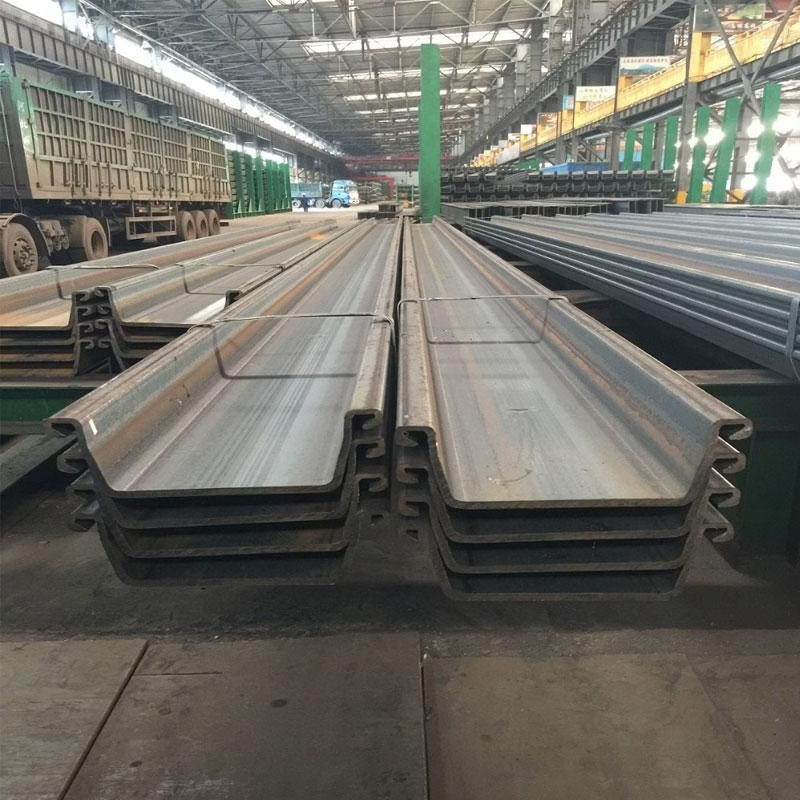
Sheet Pile Steel (U-Type)
U-Type Sheet Pile steel (Larssen pile) is hot-rolled interlocking steel section with U-shaped profile and neutral-axis clutches suitable for temporary excavation, cellular cofferdams, and permanent retaining walls. AU/GU/PU series, widths 400–750mm, lengths 6–24m. Grades S355GP, S430GP, A572 Gr50, A690. Mill test certificate provided.
| Material | Carbon Structural Steel / Low Alloy High Strength Sheet Piling Steel |
|---|---|
| Grade / Standard | EN S270GP / S355GP / S390GP / S430GP / ASTM A572 Grade 50 / A690 / JIS SY295 / SY390 / GB Q345B / Q355B |
| Section Size | AU 14 to AU 25 / GU 6N to GU 32N / PU 12 to PU 32 | Section height 150mm – 450mm | Single pile width 400mm – 750mm |
| Flange Width | 400mm – 750mm (single pile), 800mm – 1,500mm (double pile combined wall) |
| Web Height | 150mm – 450mm (section height) |
| Web Thickness | 7mm – 19mm |
| Length | 6m – 24m (Custom up to 30m) |
| Delivery Condition | hot_rolled / normalized / tmcp / as_rolled |
| Surface Treatment | shot_blasting / galvanized / coated |
| MOQ | 10 Tons |
| Delivery Time | 20-40 Days / In Stock |
| Loading Port | Tianjin / Shanghai / Qingdao |
Overview of U-Type Sheet Pile Steel
U-Type Sheet Pile steel, widely known as Larssen sheet pile after its inventor Tryggve Larssen who patented the interlocking profile in 1902, is the world’s most extensively used hot-rolled steel sheet piling section. Its characteristic U-shaped cross-section features a central web flanked by two symmetric flanges, with thumb-and-finger interlocking clutches positioned at the flange tips — which coincide with the neutral axis of the combined wall when piles are threaded together in pairs. This geometry allows individual piles to be driven and interlocked sequentially, or driven as pre-clutched pairs, making U-piles highly adaptable to varied installation conditions including restricted headroom, curved plan alignments, and cellular cofferdam configurations that require crimped or welded watertight interlocks.
U-Type sheet piles are manufactured under AU / GU designation (ArcelorMittal global reference), PU designation (European metric series), Larssen LX / FSP series (Japanese JIS A5528 standard), and SY series equivalents under GB/T 20933 (Chinese national standard), with structural performance specified per EN 10248 (European hot-rolled sheet piling), ASTM A572 / A690 (American practice), and JIS A5528. Section modulus values for combined walls range from approximately 400 cm³/m (light AU 14 / GU 6N series) to over 3,500 cm³/m (heavy GU 32N series), with steel grades spanning S270GP, S355GP, S390GP, and S430GP under EN 10248. The versatility of the U-pile interlock — capable of being crimped shut, continuously welded, or fitted with sealant injection systems — makes it the preferred section for watertight cellular cofferdams, groundwater cut-off barriers, contaminated land containment walls, and circular shaft construction where the plan curvature of the wall requires the interlock to accept angular deviation between adjacent piles.
Key Features and Manufacturing Process
U-Type sheet piles are produced by hot rolling at temperatures of 1100–1250°C on universal rolling mills with profiled horizontal and vertical rolls that simultaneously shape the central web, symmetric flanges, and thumb-and-finger interlocks in a single continuous rolling pass. The interlock geometry is precision-rolled to maintain consistent clutch dimensions across the full pile length, ensuring reliable field threading with controlled resistance and consistent gap closure for watertight performance. Dimensional tolerances — section height, flange width, web thickness, flange thickness, straightness, and interlock gap width — are controlled per EN 10248-2 or JIS A5528, with interlock profile gauging conducted on every production batch to verify field compatibility with adjacent sections from different heats or supply sources.
U-piles are supplied in standard single-pile widths of 400mm to 750mm, with combined double-pile wall widths of 800mm to 1,500mm depending on series, in standard mill lengths of 6m to 24m with custom lengths available up to 30m for deep excavation and marine applications. Common steel grades include EN S270GP (yield 270 MPa, temporary works), S355GP (yield 355 MPa, standard permanent works grade), S390GP (yield 390 MPa, high-efficiency permanent walls), S430GP (yield 430 MPa, premium high-strength grade for section optimisation), and ASTM A572 Grade 50 / A690 (yield 345 MPa, American and marine corrosion-resistant practice). The interlock clutch design of U-piles accommodates crimping with hydraulic crimping tools to create a mechanically locked watertight joint, continuous fillet welding of the clutch from the pile toe to head for permanent watertight walls, or injection grouting of the interlock gap with polyurethane or cement-based sealants for groundwater cut-off retrofitting. All U-pile production undergoes mandatory chemical composition analysis, mechanical property verification including yield strength, tensile strength, elongation and optional Charpy V-notch impact testing at 0°C and −20°C, dimensional inspection per EN 10248-2 / JIS A5528, and interlock profile gauging.
Main Applications of U-Type Sheet Pile Steel
U-Type sheet piles are the dominant section for temporary deep excavation support in urban construction environments including basement excavation for high-rise residential and commercial buildings, underground car park construction, metro station box excavations for urban rail transit, cut-and-cover tunnel construction for road and rail infrastructure, pump station and water treatment plant excavations, deep utility trench support for large-diameter water mains and sewer interceptors, and foundation pit retention for bridges and industrial facilities where extraction and reuse of temporary sheet piles is an important cost consideration — U-piles are more readily extracted than Z-piles in many soil conditions due to lower driving resistance at the interlock location.
Cellular cofferdam construction is a unique application where U-piles are unmatched — circular cells formed by connecting U-piles in a plan circle with crimped or welded interlocks, filled with granular material, provide gravity retaining structures for river diversion during dam and weir construction, temporary dry working areas for underwater bridge pier foundations, permanent port and harbour breakwater structures, and land reclamation dykes. Other major applications include permanent river training and flood protection walls along embankments, waterfront quay walls for smaller craft and inland waterways where cellular U-pile structures offer cost advantages, canal lock chambers and pound walls, groundwater cut-off barriers for contaminated land remediation where watertight interlock sealing is required, landfill leachate containment perimeter walls, slope stabilisation retaining walls for highway and railway embankments, bridge abutment wing walls and approach retaining walls, circular shaft construction for access shafts, caisson sinking, and underground utility chambers, soldier pile and lagging walls using U-piles as soldier elements, noise barrier wall foundations along transport corridors, and marine and waterfront applications including small craft marina bulkheads, fishing port harbour walls, river ferry terminal structures, and inland port quay walls where U-pile wall systems with tie rods and anchor piles provide economical permanent retaining solutions.
Why Choose Us for U-Type Sheet Pile Steel
Shandong Tanglu Metal Material Co., Ltd. supplies premium U-Type sheet pile steel sourced from leading Chinese steel mills including Maanshan Steel — China’s largest and most experienced sheet pile producer with decades of export history — alongside HBIS and Laiwu Steel, all operating certified production facilities complying with ISO 9001, ISO 14001, EN 10248, JIS A5528, and GB/T 20933 quality management and product standards. Every U-pile shipment is accompanied by original mill test certificates in EN 10204 3.1 format covering full chemical composition, mechanical property test results including yield strength, tensile strength, elongation and optional Charpy V-notch impact values, dimensional inspection data per EN 10248-2, and complete heat number traceability enabling individual bundle identification throughout the supply chain and on site.
We offer a comprehensive specification range covering AU 14 through AU 25 and GU 6N through GU 32N series, PU 12 through PU 32 metric equivalents, and JIS FSP-III through FSP-VIL Larssen series, in grades S270GP, S355GP, S390GP, S430GP (EN 10248), ASTM A572 Gr50, A690 marine grade, JIS SY295, SY390, and GB Q345B / Q355B. Standard lengths 6m to 24m available with custom mill orders up to 30m, and full surface treatment options including bare mill surface, shot blasting to Sa2.5, coal tar epoxy coating (250–400μm DFT), hot-dip galvanizing, and VCI protective packaging for humid climate storage. With a monthly supply capacity of 5,000 tons of sheet pile sections and established export relationships with geotechnical contractors, civil engineering firms, port and marine construction companies, and infrastructure project developers across more than 50 countries, we support packages from small temporary excavation projects to large permanent waterfront infrastructure contracts. Third-party inspection by SGS, Bureau Veritas, ABS, DNV GL, and Lloyd’s Register is readily arranged for critical permanent works and marine projects requiring enhanced quality documentation.
📐 Dimension & Size Table
| Section (GU/AU) | Width per Pile (mm) | Section Height (mm) | Web Thickness (mm) | Flange Thickness (mm) | Section Modulus (cm³/m) | Weight (kg/m²) |
|---|---|---|---|---|---|---|
| GU 6N | 600 | 163 / 7.0 / 9.5 | 400 / 57.0 | |||
| GU 7N | 600 | 164 / 7.5 / 10.0 | 480 / 63.0 | |||
| GU 8N | 600 | 165 / 8.0 / 10.5 | 560 / 69.0 | |||
| GU 10N | 600 | 250 / 8.0 / 10.5 | 750 / 76.0 | |||
| GU 12N | 600 | 252 / 9.0 / 12.0 | 940 / 88.0 | |||
| GU 14N | 600 | 254 / 10.0 / 13.5 | 1,130 / 100.5 | |||
| GU 16N | 600 | 360 / 9.0 / 11.5 | 1,280 / 97.0 | |||
| GU 18N | 600 | 362 / 10.0 / 13.0 | 1,500 / 110.0 | |||
| GU 20N | 600 | 364 / 11.0 / 14.5 | 1,720 / 122.5 | |||
| GU 21N | 630 | 420 / 9.0 / 12.0 | 1,720 / 107.0 | |||
| GU 23N | 630 | 422 / 10.2 / 13.5 | 1,970 / 120.0 | |||
| GU 25N | 630 | 424 / 11.5 / 15.0 | 2,210 / 134.0 | |||
| GU 27N | 630 | 440 / 12.5 / 16.0 | 2,450 / 146.0 | |||
| GU 28N | 750 | 422 / 10.5 / 14.0 | 2,280 / 120.5 | |||
| GU 30N | 750 | 424 / 11.5 / 15.0 | 2,500 / 130.0 | |||
| GU 32N | 750 | 426 / 12.5 / 16.5 | 2,720 / 141.0 | |||
| AU 14 | 500 | 380 / 9.0 / 12.0 | 1,390 / 108.0 | |||
| AU 16 | 500 | 382 / 10.0 / 13.5 | 1,610 / 122.0 | |||
| AU 18 | 500 | 384 / 11.0 / 15.0 | 1,830 / 136.0 | |||
| AU 20 | 500 | 444 / 10.0 / 13.5 | 2,000 / 130.0 | |||
| AU 23 | 500 | 447 / 11.5 / 15.5 | 2,360 / 149.0 | |||
| AU 25 | 500 | 450 / 12.5 / 17.0 | 2,640 / 163.0 |
* Custom sizes available upon request. Tolerances per relevant international standards.
🔬 Chemical Composition
| Element | Min | Max | Display Value | Note |
|---|---|---|---|---|
| C | - | 0.24 | ≤0.24 | EN S355GP / S430GP per EN 10248-1 |
| Si | - | 0.55 | ≤0.55 | |
| Mn | 0.80 | 1.70 | 0.80–1.70 | Strengthening element |
| P | - | 0.035 | ≤0.035 | |
| S | - | 0.030 | ≤0.030 | |
| V | - | 0.20 | ≤0.20 | Microalloying element |
| Nb | - | 0.06 | ≤0.06 | Microalloying element |
| Ti | - | 0.05 | ≤0.05 | Microalloying element |
| Cr | - | 0.30 | ≤0.30 | Residual element |
| Cu | - | 0.55 | ≤0.55 | A690 marine grade: Cu ≥0.20% for corrosion resistance |
| Ni | - | 0.40 | ≤0.40 | Residual element |
* Chemical composition may vary by heat, thickness and specification. Please refer to the actual mill test certificate.
⚙️ Mechanical Properties
| Property | Value | Unit | Test Condition |
|---|---|---|---|
| Yield Strength (S270GP) | ≥270 | MPa | Per EN 10248-1, temporary works grade |
| Tensile Strength (S270GP) | ≥410 | MPa | Per EN 10248-1 |
| Yield Strength (S355GP) | ≥355 | MPa | Per EN 10248-1, standard permanent works grade |
| Tensile Strength (S355GP) | ≥480 | MPa | Per EN 10248-1 |
| Yield Strength (S390GP) | ≥390 | MPa | Per EN 10248-1, high-efficiency grade |
| Tensile Strength (S390GP) | ≥490 | MPa | Per EN 10248-1 |
| Yield Strength (S430GP) | ≥430 | MPa | Per EN 10248-1, premium high-strength grade |
| Tensile Strength (S430GP) | ≥510 | MPa | Per EN 10248-1 |
| Elongation (all GP grades) | ≥17 | % | Gauge length 80mm, per EN 10248-1 |
| Yield Strength (ASTM A572 Gr50 / A690) | ≥345 | MPa (50 ksi) | American piling / marine grade |
| Tensile Strength (ASTM A572 Gr50 / A690) | ≥450 | MPa (65 ksi) | Per ASTM A572 / A690 |
| Yield Strength (JIS SY295 / SY390) | ≥295 / ≥390 | MPa | Per JIS A5528, Japanese piling standard |
| Tensile Strength (JIS SY295 / SY390) | ≥490 / ≥540 | MPa | Per JIS A5528 |
| Impact Energy (GP grades, 0°C) | ≥27 | J | Charpy V-notch at 0°C, optional per EN 10248-1 |
| Impact Energy (Cold Service, −20°C) | ≥27 | J | Charpy V-notch at −20°C, optional cold-weather service |
* Values shown are minimum requirements unless otherwise stated.
📦 Commercial Information
| Packaging | Standard seaworthy export packing for U-Type sheet pile steel sections. Piles bundled in nested stacks — U-piles are nested one inside the other to maximise bundle density and minimise transport volume — with steel strapping (3–5 wraps per bundle), typical bundle weight 3–8 tons depending on section size and pile length. Each bundle clearly tagged with heat number, grade designation (S355GP, A572 Gr50, Q345B, etc.), section designation (GU 18N, AU 20, PU 25, etc.), length, single pile width, and quantity. Wooden dunnage separators placed between bundle layers to prevent surface damage and deformation of interlock clutches during ocean transport. Interlock profiles protected with plastic end caps on both pile ends to prevent threading damage during storage and handling. For long lengths over 18m and heavy sections (GU 28N and above), individual bundle handling with steel chocks, wire rope slings, and spreader beams is provided to prevent permanent bowing. Custom packaging options including individual section wrapping with anti-rust paper, polyethylene stretch film, and VCI (Volatile Corrosion Inhibitor) inner packaging available for projects in tropical climates or requiring extended outdoor storage before installation. |
|---|---|
| Payment Terms | T/T (Telegraphic Transfer),L/C (Letter of Credit),D/P (Documents against Payment),Western Union,PayPal |
| Price Term | FOB,CFR,CIF,EXW |
| Supply Capacity | 5,000 Tons/Month (Sheet Pile Steel Sections) |
| Loading Port | Tianjin / Shanghai / Qingdao |
Why Choose Our Sheet Pile Steel (U-Type)?
Mill Certified Piling Quality
U-Type sheet pile supplied with original mill test certificate EN 10204 3.1/3.2, covering full chemical composition, mechanical properties (yield, tensile, elongation, Charpy V-notch impact at 0°C and −20°C optional), dimensional inspection per EN 10248-2 / JIS A5528, interlock profile gauging, and complete heat number traceability for full batch identification on site.
Comprehensive GU / AU / PU Series Range
Full coverage of GU 6N through GU 32N and AU 14 through AU 25 series, plus PU 12–PU 32 metric equivalents and JIS FSP / Larssen LX series. Section modulus 400–2,720 cm³/m combined wall. Single pile widths 400–750mm. Standard lengths 6m–24m with custom mill orders up to 30m.
Neutral-Axis Clutch — Ideal for Cellular Cofferdams
U-pile interlock clutches positioned at the wall neutral axis enable angular deviation between adjacent piles in curved plan alignments, making U-piles the only standard hot-rolled section suitable for circular cellular cofferdam construction. Interlocks can be crimped, continuously welded, or sealant-injected for watertight groundwater cut-off performance.
Multiple Standards & Grades
Available in international piling grades EN S270GP / S355GP / S390GP / S430GP (European), ASTM A572 Gr50 / A690 (American / marine), JIS SY295 / SY390 (Japanese), and GB Q345B / Q355B (Chinese). Cold-weather Charpy impact at −20°C and marine A690 copper-bearing steel options available for aggressive service environments.
Reliable Project Supply with Nested Packing Efficiency
Common GU and AU series sections maintained in stock for 15–25 days dispatch. Custom sections and premium grades 30–45 days production cycle. Nested bundle packing maximises container utilisation — up to 25 tons per 20FT FCL for sections up to 12m; break-bulk vessel for large quantities and lengths up to 24m.
🏭 Applications of Sheet Pile Steel (U-Type)
U-Type sheet piles serve as the primary earth retention solution for temporary deep excavation support across a wide range of urban construction projects including basement excavation for high-rise residential towers, commercial office buildings, and mixed-use developments, underground car park construction in city centres, metro station box excavations for urban mass transit systems, cut-and-cover tunnel construction for road, rail, and utility corridors, pump station and water treatment plant deep excavations, utility trench support for large-diameter water mains, sewer interceptors and district heating tunnels, and foundation pit retention for bridges, flyovers, and industrial processing facilities. The extractable nature of U-piles in many soil conditions makes them the preferred temporary works section where pile recovery and reuse across multiple projects is a programme and cost consideration for geotechnical contractors. Cellular cofferdam construction represents a uniquely suited application for U-type sheet piles — circular cells formed by connecting U-piles in curved plan alignments with crimped or welded watertight interlocks and filled with granular material provide gravity retaining structures for river diversion during dam, weir, and barrage construction, temporary dry working areas for underwater bridge pier and abutment foundations, permanent port breakwater and jetty head structures, and land reclamation perimeter dykes where the curved plan geometry of the retaining structure requires the pile interlock to accommodate angular deviation between adjacent elements. Permanent waterfront and river training applications include flood protection and river embankment walls, quay walls for inland waterways and smaller coastal ports, canal walls and lock pound structures, tidal barrier and surge protection walls, riverside promenade retaining walls, and marina and fishing harbour bulkheads. Infrastructure and transportation sector applications include highway and railway embankment retaining walls, bridge abutment wing walls, approach ramp containment structures, noise barrier foundations along transport corridors, and temporary access road construction over soft ground. Environmental and geotechnical engineering applications include groundwater cut-off barriers for contaminated land remediation with sealed interlocks, landfill leachate containment perimeter walls, slope stabilisation walls for steep cut faces, circular access shaft construction for underground utility chambers and tunnel ventilation shafts, caisson sinking perimeter walls, and combined retaining wall systems using U-piles as soldier pile elements with timber or concrete lagging.
📋 Quality & Certification
Our Certifications
- ✅ ISO 9001:2015
- ✅ CE Marking
- ✅ ABS
- ✅ DNV GL
- ✅ Lloyd's Register (LR)
- ✅ Bureau Veritas (BV)
- ✅ SGS Certified
- ✅ NK
- ✅ RINA
Mill Certificate Type
- 📋 EN 10204 3.1
- 📋 EN 10204 3.2
- 📋 Original Mill Certificate
- 📋 Third Party Inspection Available
- 📋 Certificate of Origin
❓ Frequently Asked Questions
What is a U-Type (Larssen) sheet pile and what makes it different from a Z-Type sheet pile?
A U-Type sheet pile, historically known as a Larssen pile after inventor Tryggve Larssen, is a hot-rolled interlocking steel section with a symmetric U-shaped cross-section comprising a central web, two equal flanges, and thumb-and-finger interlocking clutches at the flange tips. The defining structural characteristic is that these clutches are positioned at the neutral axis of the combined wall cross-section when piles are paired and interlocked — not at the extreme fiber as in Z-type piles. This neutral axis clutch position has two important design consequences: first, shear forces transferred through the interlock between adjacent piles at the neutral axis generate relative longitudinal slip between the two piles of a pair, and most design codes apply an interlock efficiency factor (commonly 0.7–0.9 depending on interlock type and design standard) to reduce the effective combined section modulus below the theoretical value; second, the interlock at the neutral axis experiences minimal bending stress, which means it can accept angular deviation between adjacent piles in plan without generating high contact stresses — this makes U-piles uniquely suitable for curved plan alignments and circular cellular cofferdam construction that Z-piles cannot achieve. Z-type piles have their clutches at the extreme fiber (outermost point of the combined wall), which eliminates interlock slip effects and delivers higher effective section modulus per unit weight for straight retaining wall applications, but prevents use in tight-radius curved alignments. In practice, U-piles dominate temporary works and cellular cofferdam applications while Z-piles are preferred for permanent high-efficiency straight retaining walls and quay structures.
What is the difference between GU, AU, and PU designation series for U-Type sheet piles?
The GU, AU, and PU designations represent different product families within the U-type sheet pile category, primarily differentiated by pile width and section geometry optimisation. GU series (ArcelorMittal designation, 600–750mm wide single piles) is the most widely used global series, with GU 6N through GU 32N covering section moduli from 400 to 2,720 cm³/m for the combined double-pile wall. The GU series features a relatively wide pile width (600mm standard) that reduces the number of piles required per metre of wall, improving installation productivity. GU N-series (e.g. GU 16N, GU 18N, GU 20N) are the current production standard with optimised geometry for improved section modulus efficiency compared to older non-N suffix sections. AU series (ArcelorMittal, 500mm wide single piles) provides deeper section heights (up to 450mm) for a given wall width, delivering higher section moduli suitable for deeper excavations and heavier permanent walls with fewer metres of interlock per metre of wall — AU 14 through AU 25 cover section moduli from 1,390 to 2,640 cm³/m. AU series piles are well suited for anchor wall systems with large free height. PU series (metric designation, 400–600mm wide) are produced primarily by European mills including Maanshan Steel equivalents under EN 10248, covering PU 12 through PU 32 with section moduli 600–3,200 cm³/m — directly comparable to GU series in structural performance but with slightly different dimensional profiles that require confirmation of interlock compatibility when mixing sections from different manufacturers. Japanese FSP series (JIS A5528, FSP-III through FSP-VIL) are the equivalent U-pile standard for Japanese construction practice. Section selection should be based on required wall section modulus from structural analysis, available pile lengths for the required wall depth, site pile driving plant capabilities, and interlock compatibility with adjacent sections.
How do you achieve a watertight U-pile sheet wall for groundwater cut-off applications?
U-type sheet pile walls provide inherent groundwater retardation through the close-fitting thumb-and-finger interlock geometry, but achieving true watertightness for contaminated land cut-off, dewatered excavations, and environmental containment requires additional measures to seal the interlock gap. Four principal methods are used: (1) Interlock Crimping — after pile installation, hydraulic crimping tools compress the interlock clutch from the exposed pile head downward, mechanically deforming the clutch to close the gap along the full pile length. Effective for temporary dewatering applications but requires accessible pile head and may not achieve full depth sealing in hard or obstructed ground. (2) Continuous Interlock Welding — fillet welding of the interlock contact zone from pile toe to head before driving (pre-welding pairs) or after driving (post-weld of exposed head section) permanently closes the interlock. Pre-welded pairs are driven as a unit, ensuring watertightness of the welded joint along the full driven length. Suitable for permanent groundwater cut-off walls and contaminated land barriers designed for 25–50 year service life. (3) Sealant Injection — injection of two-component polyurethane foam sealant or cement-bentonite grout into the interlock gap from the pile head using pressure injection equipment after pile installation. The sealant flows downward through the clutch under injection pressure, filling voids and setting to form a flexible or rigid watertight seal. Effective for retrofitting sealing to existing walls and for long pile walls where pre-welding is impractical. (4) Water-Activated Sealant Strips — neoprene, bentonite-impregnated rubber, or hydrophilic polyurethane sealant strips factory-inserted into the interlock clutch before pile driving; the strip expands on contact with groundwater to seal the interlock gap without post-installation treatment. Suitable for moderate hydraulic gradients and temporary to semi-permanent cut-off applications. Watertightness specification and testing should follow EN 12063 or project-specific permeability requirements, typically expressed as allowable seepage rate in litres per metre of wall per day.
What are cellular cofferdams and why are U-type sheet piles used instead of Z-type?
Cellular cofferdams are gravity retaining structures formed by connecting sheet piles in closed circular or diaphragm cell plan configurations, filling the enclosed cells with granular material (sand, gravel, or crushed stone), and relying on the weight and internal friction of the fill — rather than the bending resistance of the piles — to resist lateral earth and water pressures. Common cellular cofferdam types include: (1) Circular Cells — independent circular plan cells of U-piles connected by arc-shaped connecting piles, suitable for straight or gently curved alignments such as river diversion cofferdams, navigation lock approaches, and offshore island construction; (2) Diaphragm Cells — main circular arcs connected by straight diaphragm walls of U-piles, providing continuous aligned structures suitable for port bulkheads, quay walls, and breakwater structures; (3) Cloverleaf Cells — larger diameter cells with internal cross walls for very wide cellular structures requiring high lateral load resistance. U-type sheet piles are the only standard hot-rolled section used for cellular cofferdam construction for a fundamental geometric reason: the clutch at the neutral axis can accommodate the angular deviation (plan curvature) between adjacent piles as the wall follows its circular plan shape — in a typical circular cell of 12–20m diameter, each interlock must accept 5–15 degrees of angular deviation between adjacent piles. Z-type piles have their clutches at the extreme fiber under high contact stress, and the Z-profile geometry physically prevents angular deviation between adjacent piles beyond approximately 1–2 degrees, making them unsuitable for circular cellular construction. The tensile hoop forces generated in the cell perimeter piles by the internal fill pressure are resisted by the interlock in direct tension — interlock tensile capacity and watertight sealing of the interlock (by crimping or welding) are therefore the critical design parameters for cellular cofferdam U-pile selection.
What lengths are available and can U-type sheet piles be extracted and reused after temporary works?
U-type sheet piles are available in standard mill lengths from 6m to 24m, with most production in 0.5m or 1m increments. Custom lengths up to 30m are available as special mill orders with minimum quantity requirements. For temporary excavation works requiring pile embedment plus retained height exceeding 24m, splicing by full penetration butt welding per EN 1011-1 / AWS D1.1 is the standard practice, with splice joints located at low-moment positions and staggered between adjacent piles. Extraction and reuse is a major economic advantage of steel sheet piles over competing systems such as secant pile walls, contiguous bored pile walls, and diaphragm walls, which are non-recoverable. Successful U-pile extraction depends on soil type and pile surface condition: extraction is most straightforward in cohesionless soils (sands and gravels) and soft to firm clays where piles have not been driven to refusal on hard stratum. Extraction becomes progressively more difficult in stiff to hard clays, dense sands, and cohesive fills where soil adhesion and negative skin friction resist upward extraction force. Pile extraction is performed using vibratory pile extractors (reversing the driving process) or hydraulic pile pullers applying static upward force combined with water jetting to break soil adhesion on the pile surface. Extracted U-piles are typically cleaned, straightened if bent, and inspected for interlock damage before reuse — interlock damage during driving or extraction reduces reuse value and may require local welded repairs. Typical reuse cycles for U-piles in temporary works applications range from 3 to 8 uses depending on soil conditions, pile handling care, and extraction method. Mill surface coating with anti-rust oil prior to first installation reduces surface corrosion during storage between uses and slightly reduces driving resistance and extraction force in cohesive soils.
Get a Quote for
Sheet Pile Steel (U-Type)
Submit your requirements and receive a competitive price quote within 24 hours.
- ✓ Fast response within 24 hours
- ✓ Competitive factory-direct pricing
- ✓ Free technical consultation
- ✓ Mill test certificate provided
- ✓ Flexible payment terms available
⏱ Response within 24 hours
Send Your Inquiry
All fields marked with * are required