
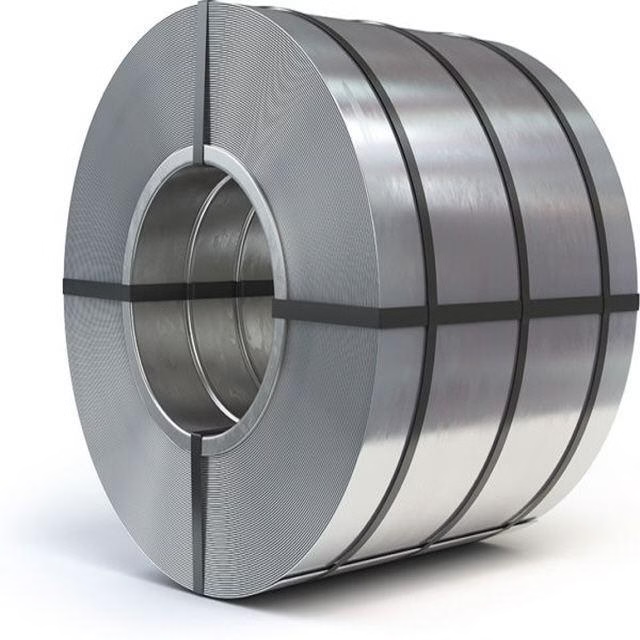
Martensitic Steel (MS1200 / MS1300 / MS1500 / MS1700)
Martensitic Steel (MS1200 / MS1300 / MS1500 / MS1700) is Ultra High Strength Automotive Steel (UHSS) with 90–100% martensitic microstructure achieving tensile strength 1,200–2,000 MPa for B-pillar reinforcements, bumper beams, door intrusion beams, and EV battery enclosure structural sections. Thickness 0.5–3.5mm, width 600–2,100mm. EN 10346 / VDA 239-100 / JFS A2001 certified. IATF 16949. PPAP support.
| Material | Ultra High Strength Automotive Sheet Steel — Cold-Rolled / Hot-Dip Galvanized Martensitic Steel (MS / MHSS) |
|---|---|
| Grade / Standard | MS1200 / MS1300 / MS1470 / MS1500 / MS1700 / MS1900 / MS2000 (per VDA 239-100 / EN 10346 / JFS A2001 / SAE J2340) |
| Thickness | 0.5mm – 3.5mm (Cold Rolled and Hot-Dip Galvanized) |
| Width | 600mm – 2,100mm (Slit to custom widths) |
| Inner Diameter (ID) | 508mm / 610mm (Standard automotive coil ID) |
| Coil Weight | 10–25 Tons (Standard 15–22 Tons for automotive supply) |
| Surface Treatment | galvanized |
| MOQ | 5 Tons (Sample / Prototype) / 20 Tons (Standard Production Order) |
| Delivery Time | 30-50 Days (Standard Production) / 20-35 Days (Stock Available Grades) |
| Loading Port | Tianjin / Shanghai / Qingdao |
Overview of Martensitic Steel (MS)
Martensitic Steel (MS), also designated as Martensitic High Strength Steel (MHSS) or full martensite Ultra High Strength Steel (UHSS), is the highest-strength cold-formable automotive sheet steel product family, achieving tensile strengths from 1,200 MPa to 2,000 MPa and beyond through a predominantly or fully martensitic microstructure produced by rapid quenching from the austenite phase on the continuous annealing line or continuous galvanizing line. Unlike Dual Phase (DP) steel which contains a soft ferrite matrix with martensite islands typically comprising 10–30% volume fraction, martensitic steel consists of 90–100% martensite — producing the highest possible yield and tensile strength achievable in a cold-rolled, continuously processed automotive sheet steel without requiring a separate press-hardening or quench-and-temper operation at the part manufacturing stage. This essentially single-phase martensitic microstructure eliminates the soft ferrite phase that limits the upper tensile strength achievable in DP steel, enabling martensitic steel to deliver tensile strengths of 1,200–2,000 MPa from conventional cold-rolled strip in the 0.5–4.0mm gauge range, providing automotive engineers with the highest strength-to-weight ratio available in formable sheet steel and enabling structural component gauge reduction of 30–50% versus conventional HSLA structural steel at equivalent load-carrying capacity.
Martensitic steel is standardised under EN 10346 (hot-dip coated martensitic steels: HDT1200M, HDT1300M, HDT1470M, HDT1500M), VDA 239-100 (German automotive industry: CR1200M, CR1300M, CR1500M, CR1700M, CR1900M, CR2000M), JFS A2001 / JFS A2011 (Japanese automotive: JSC1270C, JSC1470C, JSC1500C, JSC1800C), SEW 094 (German Steel Institute specification), and GB/T 20887 (Chinese automotive steel specification). The grade designation system follows the tensile strength level: MS1200 denotes minimum tensile strength 1,200 MPa, MS1300 denotes 1,300 MPa minimum, MS1500 denotes 1,500 MPa minimum, and MS1700 / MS1900 / MS2000 denote corresponding higher strength levels — with each grade step achieved by increasing the martensite volume fraction, adjusting carbon content and alloying for hardenability control, and refining the intercritical annealing and quenching cycle to achieve complete or near-complete martensitic transformation throughout the strip cross-section at the production line cooling rates achievable on industrial continuous annealing lines. The chemical composition strategy for martensitic steel grades focuses on providing sufficient hardenability to achieve complete martensitic transformation through the full strip thickness at production-realistic cooling rates — requiring carefully balanced Mn (1.5–2.5%), Cr (0.10–0.50%), Mo (0–0.30%), B (0–0.003%) additions that increase the martensite start temperature (Ms) band and suppress competing bainite and ferrite transformation reactions during quenching.
Key Features and Manufacturing Process
Martensitic steel manufacturing employs a precisely controlled full-austenitisation and rapid quenching sequence on a continuous annealing line (CAL) or continuous galvanizing line (CGL) that achieves complete or near-complete austenite-to-martensite transformation throughout the strip thickness without the intercritical temperature soak used for Dual Phase steel production. The manufacturing sequence begins with cold-rolled ultra-low to low carbon substrate (C 0.08–0.20% depending on target tensile strength grade) with manganese, chromium, molybdenum, and boron alloying selected to provide sufficient hardenability for complete martensite transformation at achievable industrial strip quenching rates. The strip is heated to full austenitisation temperature (Ac3+50°C to Ac3+100°C, typically 830–900°C) on the heating section of the CAL — above the Ac3 temperature ensures complete dissolution of all carbides and nitrogen compounds into austenite, providing maximum hardenability and a homogeneous martensitic microstructure after quenching. The austenitised strip then undergoes rapid quenching — either by water quenching (spray or immersion, achieving very high cooling rates of 100–500°C/s at the strip surface), gas quenching (nitrogen or helium jet cooling, achieving 30–100°C/s), or water-mist/fog quenching (intermediate cooling rates) — to a strip temperature below the martensite finish temperature (Mf, typically 100–200°C depending on composition) before the martensite transformation would reverse on slow cooling. The fully martensitic microstructure after quenching is extremely hard and brittle; a low-temperature tempering stage (typically 150–250°C for 20–60 seconds on the overaging section of the line) partially tempers the martensite to restore minimum specified elongation (A80 ≥3–6%) and toughness while retaining the maximum tensile strength — the balance between retained strength and improved ductility being the key quality control parameter of the MS steel production process.
Martensitic steel is supplied in cold-rolled bare (CR-MS), hot-dip galvanized (GI/GA-MS), and electrogalvanized (EG/ZE-MS) surface conditions in thicknesses from 0.5mm to 3.5mm and widths from 600mm to 2,100mm, with standard coil weights of 10–25 tons and inner diameter 508mm or 610mm. The cold-rolled martensitic strip surface requires careful handling in automotive stamping plants — the very high tensile strength creates large springback in simple bending operations (requiring die compensation of 5–15° per bend for MS1300, increasing to 10–25° for MS1500), and the limited elongation (3–8% A80 depending on grade) restricts forming severity to operations that can be executed within this strain limit — principally roll forming of simple sections, simple stamping of shallow components, and laser cutting of blanks. For galvanized MS steel production on continuous galvanizing lines (CGL), the strip must be quenched after the zinc bath at the exit of the galvanizing section to complete martensitic transformation below the zinc coating solidification temperature (~420°C) — a technically challenging operation requiring the CGL exit equipment to apply the required quench rate while the fresh zinc coating is still in a formable solid state.
Main Applications of Martensitic Steel (MS)
Automotive safety cage and body structure applications requiring maximum strength in minimum material volume or minimum gauge are the primary applications for martensitic steel, driven by the automotive industry’s simultaneous imperatives of crash safety improvement, vehicle weight reduction for fuel economy and electric vehicle range extension, and cost-effective material processing within existing stamping plant infrastructure. B-pillar reinforcements represent the most technically critical application for MS1300 and MS1500, where the very high tensile strength (1,300–1,500 MPa) enables reduction of B-pillar reinforcement cross-section and gauge versus DP780 or DP980 while maintaining equivalent or superior side impact intrusion resistance — particularly in the upper B-pillar zone where maximum stiffness at minimum volume is critical for door opening geometry and roof crush resistance. The high strength of MS1500 allows the upper B-pillar to remain as a narrow section accommodating the door glass run channel while simultaneously providing the structural strength required for IIHS Top Safety Pick+ roof crush and side impact ratings.
Door intrusion beams in the tubular rolled format are a major application for MS1200 and MS1300, where the beam must resist side impact intrusion force while being roll-formed from flat MS strip into a tubular cross-section — the primary formability constraint for MS steel being the requirement that roll forming operations generate only the small incremental bending strains achievable within the limited elongation of the fully martensitic microstructure without fracture. Front and rear bumper beams (the high-strength structural beam immediately behind the bumper fascia providing the primary impact energy management structure) extensively use MS1300 and MS1500, produced by roll forming MS strip into hat-section or box-section profiles — the very high tensile strength enabling thin-wall rolled sections that meet RCAR, Euro NCAP, and IIHS low-speed bumper impact standards at minimum beam weight. Roof bow reinforcements, header reinforcements, and roof rail inner sections from MS1200/1300 provide high stiffness and crush resistance for rollover protection (FMVSS 220 roof crush test) at the minimum gauge and weight allowable by the martensitic steel’s formability limits. Side sill inner reinforcements and door ring sections from MS1200 contribute to the vehicle’s overall structural ring system providing combined resistance to side impact, frontal offset, and rollover loading. Battery enclosure structural frame and cross member sections for electric vehicles (EVs) represent a rapidly growing application, where MS1200 to MS1500 roll-formed sections provide the structural protection of the high-voltage battery pack against bottom intrusion from road debris and side impact from vehicle collisions at the minimum total structural weight that maximises EV driving range per charge. Other applications include seat structural brackets and recliner components from MS1200 providing maximum seat anchorage strength per unit weight, door latch reinforcement brackets from MS1300, suspension cross-member attachment reinforcements, engine cradle mounting reinforcements, and the complete range of automotive structural attachment brackets where maximum tensile strength at minimum material volume enables packaging within increasingly tight vehicle design envelopes.
Why Choose Us for Martensitic Steel (MS)
Shandong Tanglu Metal Material Co., Ltd. supplies premium Martensitic Steel sourced from China’s most technically advanced automotive AHSS producers including Baoshan Iron & Steel (Baosteel) — operating dedicated continuous annealing and galvanizing lines with ultra-rapid quenching capability for MS1200 through MS1900 grade production — and HBIS Group, all with full IATF 16949 automotive quality management system certification and proven supply relationships with global automotive Tier 1 suppliers and OEM purchasing organisations. Every MS steel coil is accompanied by original mill test certificates covering complete chemical composition analysis including all alloying elements (C, Mn, Cr, Mo, B, Si, P, S, Al, Nb, Ti) with carbon equivalent (Pcm) reported, mechanical property test results (tensile strength Rm, upper yield strength ReH or 0.2% proof stress Rp0.2, total elongation A80, bending test results per minimum bend radius specification), microstructure assessment (martensite volume fraction by metallographic examination), surface quality inspection per automotive Class B structural surface requirements, coating weight verification (g/m²) for galvanized variants, and complete heat, slab, and coil traceability.
We offer a comprehensive martensitic steel specification range covering MS1200, MS1300, MS1470, MS1500, MS1700, MS1900 grades in cold-rolled bare (CR) per VDA 239-100 and JFS A2001, hot-dip galvanized (GI/GA) per EN 10346 HDT1200M through HDT1500M, and electrogalvanized (EG/ZE) conditions, in thicknesses from 0.5mm to 3.5mm and widths from 600mm to 2,100mm. PPAP (Production Part Approval Process) documentation support including OEM-specific Material Certificates (GMW, Ford WSS, VDA, BMW GS, Mercedes-Benz MBN), bending formability data (minimum bend radius per grade and thickness), springback characterisation data for stamping and roll-forming die development, forming simulation material cards (sigma-epsilon curve, kinematic hardening parameters) for FEA crash and forming simulation, and laser cutting parameter recommendations for MS steel blank preparation. With established monthly supply capacity of 5,000 tons of automotive AHSS and export relationships with automotive Tier 1 structural component suppliers, roll-forming companies, stamping plants, and automotive OEM purchasing organisations across more than 40 countries, we support packages from prototype development material orders to high-volume production programme coil supply contracts requiring just-in-time delivery scheduling. Each shipment includes original mill test certificate per EN 10204 3.1, with EN 10204 3.2 and third-party inspection by SGS, Bureau Veritas, TUV, or equivalent available for automotive OEM qualification requirements.
📐 Dimension & Size Table
| Grade (VDA / EN) | Tensile Strength (MPa) | Yield Strength Rp0.2 (MPa) | Elongation A80 (%) | Microstructure | Primary Automotive Application |
|---|---|---|---|---|---|
| MS1200 / CR1200M / HDT1200M | 1,200–1,500 | 900–1,200 | ≥4 / ≥90% Martensite / Bumper beams, door intrusion beams, B-pillar lower | ||
| MS1300 / CR1300M / HDT1300M | 1,300–1,600 | 1,000–1,300 | ≥3 / ≥92% Martensite / B-pillar reinforcement, bumper beam, roof bow | ||
| MS1470 / CR1470M / HDT1470M | 1,470–1,700 | 1,150–1,450 | ≥3 / ≥93% Martensite / High-strength bumper beam, B-pillar upper, EV battery frame | ||
| MS1500 / CR1500M / HDT1500M | 1,500–1,800 | 1,200–1,500 | ≥3 / ≥95% Martensite / Upper B-pillar, premium bumper beam, critical safety reinforcements | ||
| MS1700 / CR1700M | 1,700–2,000 | 1,400–1,750 | ≥3 / ≥97% Martensite / Ultra-lightweight safety structures, advanced B-pillar | ||
| MS1900 / CR1900M | 1,900–2,200 | 1,550–1,950 | ≥3 / ≥98% Martensite / Advanced ultra-lightweight structural members | ||
| MS2000 / CR2000M | ≥2,000 | ≥1,600 | ≥3 / ~100% Martensite / Maximum strength cold-rolled automotive sheet steel |
* Custom sizes available upon request. Tolerances per relevant international standards.
🔬 Chemical Composition
| Element | Min | Max | Display Value | Note |
|---|---|---|---|---|
| C | 0.08 | 0.20 | 0.08–0.20 | Primary hardening element — MS1200/1300: C ~0.10–0.14%; MS1500: C ~0.14–0.18%; MS1900/2000: C ~0.17–0.22%; higher C increases martensite hardness |
| Si | 0.10 | 0.50 | 0.10–0.50 | Solid solution strengthening of martensite; Si >0.3% in galvanized MS requires pre-oxidation control for Zn coating adhesion on CGL |
| Mn | 1.50 | 2.50 | 1.50–2.50 | Critical hardenability element — Mn suppresses ferrite and bainite transformation, ensuring complete martensite at industrial cooling rates; higher Mn for higher MS grades |
| P | - | 0.020 | ≤0.020 | Very strictly controlled — P segregates to martensite lath boundaries and prior austenite grain boundaries, severely embrittling the martensitic microstructure |
| S | - | 0.010 | ≤0.010 | Very low S — MnS inclusions are principal void nucleation sites in martensitic fracture; critical for minimum specified elongation in MS steel |
| Cr | 0.10 | 0.50 | 0.10–0.50 | Hardenability element — Cr retards ferrite and bainite formation during quenching, enabling complete martensite even in thicker gauges at moderate cooling rates |
| Mo | - | 0.30 | ≤0.30 | Strong hardenability element for MS1500–MS2000 — Mo very effectively suppresses bainite, enables complete martensite in thicker gauges and on slower-quench CGLs |
| B | - | 0.003 | ≤0.003 | Ultra-trace hardenability element — even 10–20 ppm B at austenite grain boundaries dramatically increases hardenability, enabling thinner Cr/Mo additions |
| Nb | - | 0.050 | ≤0.050 | Austenite grain refinement — NbC pins prior austenite grain boundaries during full austenitisation, refining martensite packet and lath size for improved toughness |
| Ti | - | 0.030 | ≤0.030 | Austenite grain size control (TiN at high temperature) and B protection (Ti fixes N as TiN preventing N from consuming B at austenite grain boundaries) |
| Al | 0.020 | 0.060 | 0.020–0.060 | Deoxidiser, grain control; Al combines with N as AlN protecting available B for hardenability where Ti is not used |
| Pcm (Cold Cracking Parameter) | - | 0.30 | ≤0.30 | Pcm = C + Si/30 + Mn/20 + Cu/20 + Ni/60 + Cr/20 + Mo/15 + V/10 + 5B — weldability index; MS steel requires specific resistance spot welding parameter adjustment due to high Pcm |
* Chemical composition may vary by heat, thickness and specification. Please refer to the actual mill test certificate.
⚙️ Mechanical Properties
| Property | Value | Unit | Test Condition |
|---|---|---|---|
| Tensile Strength — MS1200 (CR) | 1,200–1,500 | MPa | Per VDA 239-100 CR1200M / EN 10346 HDT1200M — minimum 1,200 MPa |
| Yield Strength Rp0.2 — MS1200 | 900–1,200 | MPa | High yield ratio 0.75–0.80 characteristic of martensitic steel (contrast DP: YR 0.54–0.70) |
| Total Elongation A80 — MS1200 | ≥4 | % | Minimum elongation after tempering — limits forming severity to roll forming and simple shallow draws |
| Tensile Strength — MS1300 (CR) | 1,300–1,600 | MPa | Per VDA 239-100 CR1300M — dominant grade for B-pillar and bumper beam applications |
| Yield Strength Rp0.2 — MS1300 | 1,000–1,300 | MPa | Very high yield ratio; large springback requires significant die compensation in bending |
| Total Elongation A80 — MS1300 | ≥3 | % | Limited forming; primarily roll forming and simple bending operations |
| Tensile Strength — MS1500 (CR) | 1,500–1,800 | MPa | Per VDA 239-100 CR1500M / EN 10346 HDT1500M — high-performance safety component grade |
| Yield Strength Rp0.2 — MS1500 | 1,200–1,500 | MPa | Near-tensile yield — very limited plastic deformation range before fracture |
| Total Elongation A80 — MS1500 | ≥3 | % | Very limited forming; laser cutting for blank preparation recommended over shear blanking |
| Tensile Strength — MS1700 (CR) | 1,700–2,000 | MPa | Per VDA 239-100 CR1700M — ultra-high strength for maximum weight reduction |
| Tensile Strength — MS1900 / MS2000 (CR) | 1,900–2,200 / ≥2,000 | MPa | Highest cold-rolled MS grades; primarily roll-formed sections and laser-cut blanks |
| Bake Hardening Response (BH2 — MS1300) | 20–40 | MPa | MS steel exhibits mild BH response from C in tempered martensite — additional strength after 170°C paint bake |
| Minimum Bend Radius — MS1300 (t = 1.5mm) | 2.5–3.0 × t | - | Minimum bend radius without fracture; increases with grade: MS1500 requires 3.5–5.0 × t |
| Springback Angle — MS1300 (90° target) | 8–15° | degrees | Elastic springback per 90° bend; requires equivalent die over-bend compensation — 2–3× DP780 springback |
| Hardness — MS1300 (Vickers) | 380–450 | HV10 | Consistent through-thickness hardness confirming uniform martensite transformation |
* Values shown are minimum requirements unless otherwise stated.
📦 Commercial Information
| Packaging | Premium automotive-grade seaworthy export packing for Martensitic Steel coils — MS steel requires especially careful handling and packaging due to its extreme hardness (HV 380–550) and the risk of surface damage from coil-to-coil contact or coil strapping that would not damage softer steel grades. Each coil individually wrapped with VCI (Volatile Corrosion Inhibitor) polyethylene film applied directly to the coil OD surface — mandatory for MS steel which must be protected from atmospheric moisture and chloride contamination during ocean transit and automotive plant storage of typically 3–6 months without surface corrosion that would affect resistance spot welding quality and cathodic coating adhesion. Plastic-coated non-marking steel strapping (minimum 4–6 wraps per coil at equal circumferential spacing) chosen to prevent surface indentation marks — standard uncoated steel strapping would leave surface impressions in the soft coil wrapping that could reflect through to the MS steel surface, unacceptable for automotive surface quality requirements. Heavy-duty steel eye protection rings on both inner diameter bore and outer OD face to prevent telescoping (inner turn axial displacement during handling) — especially important for high-hardness MS coils where telescoping damage is more severe than in softer steel. Each coil tagged with durable metal identification tag including: heat number, MS grade designation (MS1200/1300/1500/1700, VDA CR grade reference, EN HDT grade reference), steel chemistry classification (C content, Pcm value), surface condition (CR/GI/GA/EG), Zn coating weight (g/m²) for galvanized, thickness (mm), width (mm), coil weight (net kg), inner diameter (mm), outer diameter (mm), production date, and customer PO reference with part number for automotive supply chain traceability. Multiple coils loaded on same container on individual timber cradle supports with hardwood dunnage blocks between adjacent coils preventing surface-to-surface contact marks. Container load distribution verified for vessel stability — MS steel coils of equal dimension are heavier than mild steel equivalents due to similar density but potential for higher gauge. For galvanized MS steel (GA-MS for spot welding compatibility), additional moisture-barrier packaging prevents white rust formation during transit. Complete material documentation package (EN 10204 3.1 mill test certificate, VDA 239-100 material certificate, OEM-specific material certificate, PPAP elements, bending formability data, springback characterisation, laser cutting parameter table, forming simulation material card if ordered) in waterproof document pouch sealed to container exterior for receiving inspection access. |
|---|---|
| Payment Terms | T/T (Telegraphic Transfer),L/C (Letter of Credit),D/P (Documents against Payment),Western Union,PayPal |
| Price Term | FOB,CFR,CIF,EXW |
| Supply Capacity | 5,000 Tons/Month (Automotive AHSS / Martensitic Steel) |
| Loading Port | Tianjin / Shanghai / Qingdao |
Why Choose Our Martensitic Steel (MS1200 / MS1300 / MS1500 / MS1700)?
IATF 16949 Certified — Full Martensite UHSS Quality
MS steel supplied from IATF 16949 certified production facilities with EN 10204 3.1/3.2 mill test certificate covering full composition (including C, Mn, Cr, Mo, B, Pcm), tensile strength, yield strength (Rp0.2), elongation A80, bending formability (minimum bend radius per thickness), martensite volume fraction metallographic assessment, surface quality, and coating weight for galvanized grades. PPAP documentation, OEM Material Certificates (VDA 239-100, GMW, Ford WSS, BMW GS, Mercedes MBN), and forming simulation material cards provided.
Complete MS Grade Range 1,200–2,000 MPa
Full martensitic steel range: MS1200 / MS1300 / MS1470 / MS1500 / MS1700 / MS1900 / MS2000 in cold-rolled bare (CR), hot-dip galvanized GI/GA (EN 10346 HDT grades), and electrogalvanized (EG/ZE) surface conditions. Thickness 0.5–3.5mm, width 600–2,100mm. Laser cutting parameter data, springback characterisation, and roll-forming process guidance provided for each grade and thickness combination.
Highest Strength Cold-Rolled Automotive Sheet — 1,200–2,000 MPa
MS steel achieves tensile strength 1,200–2,000 MPa in as-delivered cold-rolled coil — 3–5× conventional mild steel, 50–100% higher than DP780 Dual Phase steel — enabling 30–50% gauge reduction versus HSLA structural steel and 20–30% gauge reduction versus DP780 at equivalent load-carrying capacity. Essential for B-pillar and bumper beam weight reduction targets where DP steel strength ceiling is insufficient.
Multi-OEM Automotive Specification Compliance
MS steel meeting VDA 239-100 (German VDA CR1200M–CR2000M), EN 10346 HDT1200M–HDT1500M (European galvanized), JFS A2001 JSC1270C–JSC1800C (Japanese), SAE J2340 (American), GB/T 20887 (Chinese), GMW3032 (General Motors), Ford WSS-M1A367 (Ford), BMW GS 90009, Mercedes-Benz MBN 10336, Stellantis MS-12.001, and equivalent major Chinese OEM (SAIC, BYD, Geely, Great Wall) specifications.
Automotive JIT Supply with Forming Process Support
MS1200 and MS1300 standard grades from stock: 20–30 days. MS1470/1500 and galvanized variants: 30–45 days. MS1700/1900/2000 special production: 45–60 days. Forming process engineering support provided: springback compensation values, minimum bend radius tables, laser cutting parameters, RSW welding schedules, and FEA material card data for roll-forming and crash simulation.
🏭 Applications of Martensitic Steel (MS1200 / MS1300 / MS1500 / MS1700)
Martensitic Steel serves as the highest-strength cold-rolled sheet material in the automotive body-in-white (BIW) material portfolio — applied specifically to safety-critical structural components where the combined requirements of maximum tensile strength, minimum structural volume, compatibility with conventional or modified cold forming operations, and standard cathodic protection coating systems create a design space that no other cold-rolled sheet steel can fully address. B-pillar reinforcement systems represent the most technically and commercially significant application for MS1300 and MS1500 in modern passenger vehicles, where the B-pillar structural performance is directly measured by IIHS Side Impact (MDB) test and IIHS Pole test ratings that define the vehicle's overall safety rating class — the upper B-pillar zone between the door belt line and roof rail requiring a structural member of maximum stiffness and minimum width to simultaneously accommodate the door glass run channel and provide the structural resistance to lateral intrusion that protects the far-side passenger in a side impact event. MS1500 enables the upper B-pillar reinforcement cross-section to be reduced by 25–35% versus equivalent DP980 designs at the same structural performance level, providing packaging space for additional sound insulation, glass sealing systems, or driver assistance sensor packages within the door aperture while simultaneously maintaining the structural integrity required for IIHS Top Safety Pick+ ratings. Automotive roll-formed structural sections in MS1200 and MS1300 represent the most commercially important forming application for martensitic steel — the roll-forming process generates only incremental small-strain bending at each roll pair station, keeping the total material strain at each point along the section length within the 3–8% elongation limit of the MS microstructure while building up the complete hat-section, channel, or tube profile required for the structural component. This roll-forming compatibility makes MS1200/1300 the standard material for: front and rear bumper beams produced by roll-forming MS strip into box-section or hat-section profiles of 10–30mm wall thickness that provide the primary impact energy management structure meeting RCAR, Euro NCAP, and IIHS low-speed front and rear impact ratings at beam weights 15–25% lower than equivalent DP780 beams of same structural performance; door intrusion beams in tubular roll-formed format (typically 25–35mm OD tube roll-formed from MS1200/1300 flat strip then longitudinally welded) providing side door intrusion protection in passenger vehicles at minimum weight; roof bow structural reinforcements spanning the full width of the vehicle roof between the A, B, and C-pillars, providing the distributed roof crush resistance required by FMVSS 220 (1.5× vehicle weight crush load for 127mm maximum deformation) and IIHS roof crush tests at minimum component mass; and structural side sill reinforcements (the structural section at the base of the B-pillar and door sill, continuously loaded in side impact events) where MS1200 enables sill section thickness reduction versus DP780 alternatives. Electric vehicle (EV) battery pack structural protection represents a rapidly growing and technically demanding application for MS steel — the battery enclosure perimeter frame and bottom guard plate must simultaneously withstand the static load of the battery pack weight (200–500 kg for typical EV battery), the dynamic impact loads of road debris bottom strike (USCAR, Euro NCAP, IIHS protocols specifying minimum energy absorption before battery system intrusion), and the structural loads transmitted through the battery enclosure as part of the vehicle floor structure (contributing to body stiffness and crash load paths). MS1200 to MS1500 roll-formed perimeter frame sections and laser-cut-and-welded bottom guard plate assemblies provide the required structural performance at minimum enclosure mass — every kilogram of structural mass saved in the battery enclosure directly increases the battery capacity available for driving range within the vehicle's target gross weight. Seat structural components from MS1200 — seat back frames, recliner mechanism housings, and seatbelt anchor brackets — provide the maximum structural strength per unit volume for anchorage of the seat assembly to the vehicle floor structure in frontal and rear collisions per FMVSS 207 (seat anchorage) and FMVSS 210 (seatbelt anchorage and installation), within the extremely tight packaging constraints of modern low-floor vehicle interior designs. Engine cradle attachment reinforcements, transmission cross-member bracket stampings, and suspension tower top plates from MS1200 provide maximum fatigue life and minimum mass for high-cycle loaded structural bracket applications where the component is fabricated by laser cutting blanks from MS strip rather than by press forming (exploiting the high tensile strength for fatigue resistance without requiring the formability needed for deep stamping operations). Military and defence vehicle structural applications including MRAP vehicle blast protection floor plates, armoured vehicle door reinforcement panels, and helicopter structural attachment fittings from MS1500 and MS1700 exploit the highest available tensile strength in cold-rolled sheet form for maximum ballistic and blast resistance at minimum structural weight — critical for mobility and payload capacity of military ground vehicles and aircraft.
📋 Quality & Certification
Our Certifications
- ✅ ISO 9001:2015
- ✅ CE Marking
- ✅ DNV GL
- ✅ Lloyd's Register (LR)
- ✅ Bureau Veritas (BV)
- ✅ SGS Certified
Mill Certificate Type
- 📋 EN 10204 3.1
- 📋 EN 10204 3.2
- 📋 Original Mill Certificate
- 📋 Third Party Inspection Available
- 📋 Certificate of Origin
❓ Frequently Asked Questions
What is Martensitic Steel (MS) and how does it differ from Dual Phase (DP) and Press Hardening Steel (PHS)?
Martensitic Steel (MS), Dual Phase Steel (DP), and Press Hardening Steel (PHS / boron steel) are all Advanced High-Strength Steels (AHSS) used in automotive BIW structural applications, but they differ fundamentally in microstructure, production process, achievable strength, formability, and application method. Martensitic Steel (MS) has a microstructure of 90–100% martensite produced by full austenitisation and rapid quenching on a continuous annealing line (CAL) or continuous galvanizing line (CGL) — a conventional steel mill process that delivers the strip in the final high-strength condition as a coil, ready for cutting and roll-forming operations at the automotive part supplier without any additional thermal processing. MS achieves tensile strength 1,200–2,000 MPa from this mill-delivered condition, with limited elongation (A80 3–8%) restricting forming to roll-forming and simple bending. Dual Phase Steel (DP) has a microstructure of soft ferrite (70–90%) with hard martensite islands (10–30%) produced by intercritical annealing and quenching — the ferrite phase provides ductility (A80 12–24%) enabling complex deep-drawing operations while the martensite phase provides strength (tensile 590–1,180 MPa). DP steel is the dominant choice for structural components requiring press forming into complex three-dimensional shapes — B-pillar inner and outer stampings, crash rails, floor cross members, and door ring structures. Press Hardening Steel (PHS, also called Hot Stamping Steel or boron steel, specification 22MnB5) achieves the highest tensile strength of any automotive sheet steel (1,500–2,000 MPa) by a fundamentally different process at the part manufacturing stage: the PHS blank is heated to full austenitisation (900–950°C) in a furnace, immediately transferred to a water-cooled die, and simultaneously formed and quenched in the die ('die quenching') to achieve the required complex three-dimensional part shape (impossible in cold martensitic state) and martensitic microstructure simultaneously. PHS enables forming of complex geometries at the highest strength levels (equal to or exceeding MS1500) but requires a dedicated hot stamping press line with heated furnace and water-cooled die — substantial capital investment versus conventional cold stamping. Selection principle: use DP steel for complex-geometry press-formed structural components (B-pillar stampings, crash rails, floor structures); use MS steel for roll-formed sections and simple-geometry stampings requiring very high strength (bumper beams, door beams, roof bows); use PHS for complex-geometry parts requiring maximum tensile strength (1,500–2,000 MPa) where DP steel's maximum ~1,180 MPa is insufficient.
What is the difference between MS1200, MS1300, MS1470, MS1500, and MS1700 grades?
MS1200, MS1300, MS1470, MS1500, and MS1700 are distinguished by minimum tensile strength level and corresponding differences in carbon content, alloying, martensite volume fraction, yield strength, elongation, formability, and application suitability. MS1200 (CR1200M per VDA 239-100, tensile 1,200–1,500 MPa, A80 ≥4%): The most formable martensitic steel grade with approximately 90–92% martensite volume fraction. The lowest carbon variant (~0.10–0.14% C) provides the minimum specified martensite hardness, allowing 4% total elongation — making MS1200 the most practical MS grade for roll-formed structural sections where some plastic deformation is unavoidable during the roll-forming pass. MS1200 is the standard specification for roll-formed bumper beams in the 1,200–1,400 MPa tensile range, door intrusion beams, and B-pillar lower reinforcements where geometry allows. MS1300 (CR1300M, tensile 1,300–1,600 MPa, A80 ≥3%): The most widely specified and commercially dominant martensitic steel grade — approximately 92–95% martensite, C ~0.13–0.16%. MS1300 is the standard material for premium bumper beams achieving the lowest possible beam weight for a given impact performance requirement, upper and lower B-pillar reinforcements in mainstream and premium vehicles, roof bow reinforcements, and roof rail inner reinforcements. The 300 MPa higher tensile versus MS1200 enables 15–20% further gauge reduction at equivalent structural performance. MS1470 (CR1470M, tensile 1,470–1,700 MPa, A80 ≥3%): An intermediate grade specification used by some OEMs providing a strength level between MS1300 and MS1500 that can be achieved with intermediate carbon and chromium levels, reducing alloying cost versus MS1500. Used for similar applications as MS1300/1500 depending on OEM-specific design optimisation. MS1500 (CR1500M per VDA 239-100, tensile 1,500–1,800 MPa, A80 ≥3%): The most demanding standard martensitic grade in widespread automotive production use — approximately 95–98% martensite, C ~0.15–0.18%. MS1500 is specified for upper B-pillar zones where maximum intrusion resistance in the narrow section accommodating the door glass channel is critical for IIHS side impact ratings, for the highest-performance bumper beams in luxury and performance vehicles, and for EV battery enclosure frame sections where maximum strength per unit volume minimises battery enclosure structural weight. MS1700 / MS1900 / MS2000: Ultra-high-strength grades with essentially 100% martensite and C content approaching or exceeding 0.20%, providing tensile strength 1,700–2,000+ MPa at reduced elongation (A80 ≥3%). Applied to the most weight-critical structural sections where MS1500 is the next limiting strength level — primarily advanced B-pillar designs, military vehicle structural panels, and aerospace ground support equipment.
How is martensitic steel formed and what are the key process limitations for automotive components?
Martensitic steel forming is fundamentally constrained by its very limited elongation (A80 3–8% versus 18–24% for DP780) and very high yield ratio (Rp0.2/Rm = 0.75–0.85 versus 0.54–0.70 for DP) — constraints that prevent deep drawing, severe stamping, and complex three-dimensional forming operations achievable with softer steel grades, but allow specific forming processes that work within these material limits. Roll forming is the primary and most important forming process for martensitic steel — MS strip is fed through a progressive series of contoured roll pairs that incrementally bend the strip cross-section from flat strip to the final required profile shape (hat-section, channel, tube, box beam) with each roll pair adding only a small incremental bending strain that stays within the 3–4% local strain limit of the MS microstructure. The key design principle for roll-forming MS steel is that each forming station must apply only a small strain increment, requiring more roll forming stations than would be needed for mild steel of the same section geometry. Typical roll-formed MS components include bumper beams (box or hat section profile), door intrusion beams (typically round or D-shaped tube produced by roll-forming strip and longitudinally welding the seam), side sill reinforcements, roof bow reinforcements, and seat cross-member sections. Laser cutting is the recommended and increasingly dominant blank preparation method for MS steel — replacing conventional mechanical blanking (punch and die) that generates significant edge damage, microcracking, and deformation in the cut edge of MS strip due to the high cutting forces required for the 1,200–2,000 MPa material. Laser-cut edges in MS steel have substantially lower crack initiation susceptibility than shear-cut edges, enabling use of the MS strip's limited elongation in the part forming operation rather than consuming it in damage repair during edge trimming. Simple bending and hemming operations are possible within strict minimum bend radius limits: MS1200 at 1.5mm thickness requires minimum bend radius 2.5–3.0 × t (approximately 3.75–4.5mm internal radius); MS1300 at same thickness requires 3.0–4.0 × t; MS1500 requires 4.0–5.0 × t; bend radii tighter than these limits cause fracture at the outer bend radius. Hydroforming of tubular MS1200/1300 sections (expanding a pre-bent tube into a die using internal hydraulic pressure) is used for some three-dimensional bumper beam and structural member shapes that cannot be achieved by simple roll forming, exploiting the high biaxial strength of the MS tube while the limited elongation restricts the achievable hydroforming expansion ratio. Springback compensation in MS steel tooling requires substantially more die over-bending than for mild or DP steel: a 90° target bend in MS1300 springs back approximately 10–15° when the forming tool releases, requiring the die to be designed to form 100–105° to produce the final 90° part angle — approximately 3–5× the springback compensation needed for DP780, and significantly greater than DP1180. Accurate springback prediction for MS steel die design requires FEA forming simulation using material models with kinematic hardening (combined isotropic-kinematic hardening models) rather than simple isotropic hardening models — kinematic hardening models accurately capture the Bauschinger effect important in MS steel's high-ratio loading-unloading-reloading cycle during press forming.
What are the special resistance spot welding requirements for martensitic steel?
Resistance spot welding (RSW) of martensitic steel requires specifically developed and validated welding schedules because the high carbon content (0.10–0.20% C) and hardenability alloying (Mn 1.5–2.5%, Cr 0.1–0.5%, Mo 0–0.3%, B 0–0.003%) of MS steel produce extremely hard, brittle weld nugget and heat-affected zone (HAZ) microstructures at the rapid cooling rates of resistance spot welding if conventional mild steel welding parameters are applied. The principal failure modes requiring special consideration for MS steel spot welds are: (1) HAZ cracking / hydrogen-induced cold cracking (HICC) — the weld HAZ in MS steel transforms to fresh untempered martensite of extremely high hardness (HV 450–600 for MS1500 HAZ versus HV 180–220 for mild steel HAZ) during the rapid cooling of the RSW cycle. In the presence of diffusible hydrogen from surface contamination or coating moisture, this high-hardness HAZ is susceptible to hydrogen-induced cold cracking that can cause plug fracture or interfacial fracture under peel and coach-peel test loading, failing the minimum weld performance requirements of automotive welding standards (AWS D8.1, ISO 18278). (2) HAZ softening — in contrast to cold cracking in the hard HAZ zone, the sub-critical HAZ in MS steel (the zone heated below Ac1 during welding and cooled slowly enough to temper the base metal martensite) is significantly softer than the surrounding base metal, creating a strength-reduced zone adjacent to the weld nugget similar to the HAZ softening in DP steel but potentially more severe due to the higher base metal strength. Required RSW schedule modifications for MS steel: (a) Use multi-pulse welding schedules (2 or 3 current pulses with cooling time between pulses) rather than single-pulse schedules, allowing partial tempering of the HAZ between pulses and reducing peak HAZ hardness by 50–80 HV; (b) Apply a post-heat current pulse (lower current level after main welding pulse) that tempers the fresh HAZ martensite in-situ during the welding cycle — the most effective method for preventing HAZ cold cracking; (c) Increase electrode force above mild steel levels to maintain contact pressure during nugget formation in the high-yield-strength MS material; (d) Allow minimum 24 hours before peel and cross-tension weld quality testing to ensure hydrogen-induced cold cracking (which may develop progressively after welding) has stabilised; (e) Use dry, clean MS coil surfaces — zinc-based coating (GA or EG) is preferred over bare CR for MS steel RSW because the zinc coating acts as a hydrogen trap reducing diffusible hydrogen availability in the HAZ during and after welding. Minimum nugget diameter specifications for MS steel are typically equal to or slightly larger than DP requirements (5√t for MS1200/1300, 5.5√t for MS1500) to ensure failure by plug mode rather than interfacial mode in peel tests. Electrode type recommendations: dome-radius copper-chromium-zirconium (CuCrZr) electrodes of RWMA Class 2 material with 6–8mm tip contact diameter provide adequate current density for MS steel welding without excessive electrode mushrooming.
What documentation and automotive OEM approvals are required for martensitic steel supply?
Martensitic steel supply to automotive Tier 1 suppliers and OEMs requires comprehensive quality and technical documentation packages reflecting the safety-critical function and the demanding forming, welding, and coating processes applied to MS steel structural components in vehicle production. Essential documentation for all MS steel shipments: (1) Mill Test Certificate (MTC) per EN 10204 3.1 (minimum standard) or 3.2 (with third-party witness inspection for enhanced quality assurance) covering: full chemical composition including all alloying elements (C, Si, Mn, P, S, Al, Cr, Mo, B, Nb, Ti) with Pcm (cold cracking parameter) reported; mechanical properties (tensile strength Rm, 0.2% proof stress Rp0.2, total elongation A80, yield ratio Rp0.2/Rm, bending test results per minimum radius specification); martensite volume fraction verification from metallographic examination (typically ≥90% for MS1200, ≥95% for MS1500); surface quality inspection per automotive Class B structural surface requirements; coating weight verification (g/m²) for galvanized variants with zinc alloy layer composition for GA variants; dimensional inspection (thickness, width, coil weight, flatness); and heat and coil number traceability. (2) VDA 239-100 Material Certificate confirming the specific grade designation (CR1200M, CR1300M, CR1500M, etc.) with all specification-required properties verified — this is the primary technical specification document for all European automotive OEM supply chains. (3) EN 10346 Compliance Certificate for hot-dip galvanized MS variants (HDT1200M, HDT1300M, HDT1500M) confirming zinc coating weight, coating type (GI or GA), and mechanical properties per EN 10346 specification tables. PPAP documentation for new program launches (Level 3 standard): Production Part Approval Process documentation per AIAG PPAP manual (4th edition) or IATF 16949 requirements including Design Records (material specification with all property requirements), Process FMEA for steelmaking and coating, Control Plan, Measurement System Analysis, Initial Process Studies (Ppk for Rm, Rp0.2, A80, coating weight), and Part Submission Warrant. Technical support documentation provided to facilitate MS steel processing at customer facilities: Bending formability data table showing minimum bend radius (as multiple of thickness t) for each MS grade at each commercial thickness — essential for tooling engineers designing roll-forming tools and press-braking operations; Springback characterisation data showing expected elastic springback angle per 90° target bend for each grade and thickness combination — essential for stamping die compensation; Laser cutting parameter recommendations (laser power, cutting speed, assist gas pressure for nitrogen or oxygen assist) for clean-edge blank preparation without thermal HAZ formation; RSW welding parameter recommendations (current profile, pulse count and timing, electrode force, hold time) developed and validated specifically for each MS grade and thickness combination; FEA material cards (sigma-epsilon true stress-true strain curve, Lankford r-value anisotropy parameters, Voce-Chaboche kinematic hardening parameters for accurate springback simulation) compatible with AUTOFORM, PAM-STAMP, LS-DYNA, and ABAQUS/Explicit simulation software platforms — provided upon request for automotive engineering digital twin and virtual prototype development programmes.
Get a Quote for
Martensitic Steel (MS1200 / MS1300 / MS1500 / MS1700)
Submit your requirements and receive a competitive price quote within 24 hours.
- ✓ Fast response within 24 hours
- ✓ Competitive factory-direct pricing
- ✓ Free technical consultation
- ✓ Mill test certificate provided
- ✓ Flexible payment terms available
⏱ Response within 24 hours
Send Your Inquiry
All fields marked with * are required