
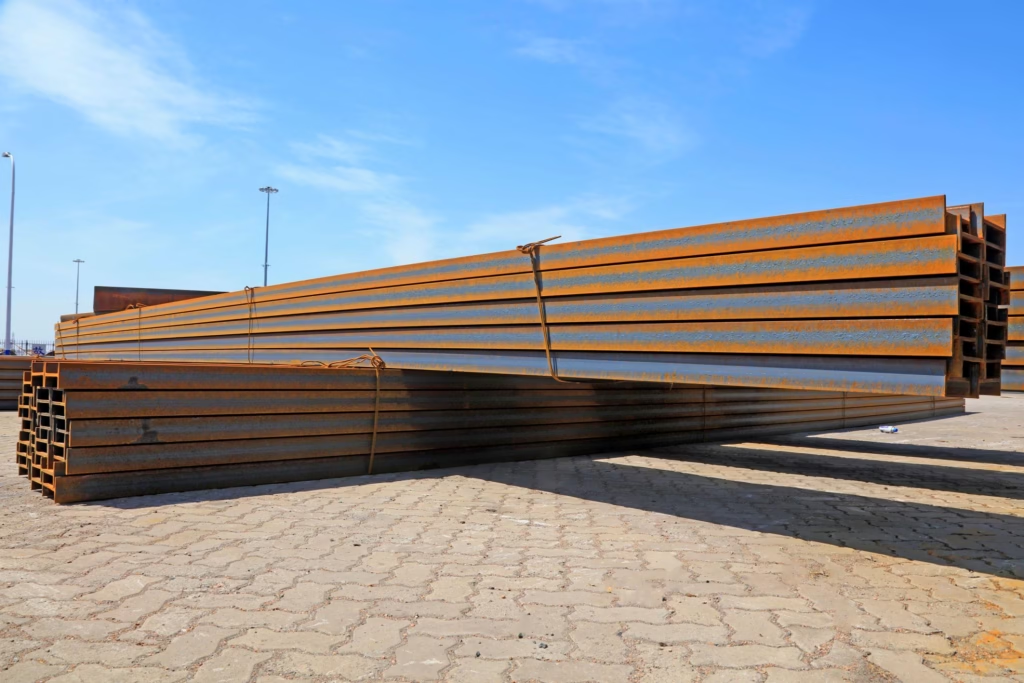
H-Pile Steel
H-Pile steel (Bearing Pile / HP Section) is specialized hot-rolled structural section with equal flange and web thickness designed for deep foundation engineering. Section depths 200-460mm, lengths 12m/18m. Grades A572 Gr50, SY295, Q345B. Splicing service available. Mill test certificate provided.
| Material | Carbon Structural Steel / Low Alloy High Strength Piling Steel |
|---|---|
| Grade / Standard | ASTM A572 Grade 50 / A992 / JIS SY295 / SY390 / GB Q345B / Q355B / EN S355JR |
| Section Size | HP8 (203×203mm) to HP18 (457×457mm) | Metric: 200×200 to 460×460mm |
| Flange Width | 200mm - 460mm |
| Web Height | 200mm - 460mm |
| Web Thickness | 8mm - 28mm (Equal to Flange Thickness) |
| Length | 12m / 18m (Custom up to 24m, splicing for longer) |
| Delivery Condition | hot_rolled / normalized / tmcp / as_rolled |
| Surface Treatment | shot_blasting / galvanized / coated |
| MOQ | 10 Tons |
| Delivery Time | 20-40 Days / In Stock |
| Loading Port | Tianjin / Shanghai / Qingdao |
Overview of H-Pile Steel
H-Pile steel, also known as bearing pile or HP section, is a specialized hot-rolled structural steel section designed specifically for deep foundation engineering applications. Unlike standard H-beams used in above-ground construction, H-piles feature equal flange and web thicknesses to provide superior driving characteristics, uniform load-bearing capacity, and resistance to local buckling during pile driving operations. Specified primarily under ASTM A572 / A6 (American HP series) and JIS A5526 / EN 10025 standards, H-piles have become the preferred deep foundation solution for bridge abutments, building foundations on poor soil, retaining walls, and offshore platforms worldwide.
The American HP designation system uses nominal depths from HP8 (203mm) to HP18 (457mm), with weights ranging from 36 lb/ft (53.6 kg/m) to 204 lb/ft (304 kg/m), providing structural designers with a comprehensive selection for various load-bearing requirements and pile driving conditions. H-piles offer significant advantages over precast concrete piles and pipe piles including: high tensile strength suitable for hard driving conditions, ability to penetrate dense soil layers and obstructions, easy splicing for extending pile length to required bearing strata, smaller soil displacement reducing impact on adjacent structures, and excellent resistance to bending stresses during driving and service loads. The smaller cross-sectional area also reduces driving resistance, enabling deeper penetration into bearing strata.
Key Features and Manufacturing Process
H-Pile steel is manufactured through hot rolling at temperatures of 1100-1250°C using universal rolling mills with horizontal and vertical rolls that simultaneously form parallel flanges with equal web and flange thickness, distinguishing it from standard H-beam sections. This balanced thickness design provides uniform stress distribution during pile driving and prevents premature failure at flange-web junctions when encountering hard subsurface obstructions. The robust cross-section enables H-piles to withstand high impact loads from pile driving hammers without local buckling or flange separation.
H-Piles are supplied in section depths from 200mm to 460mm with standard lengths of 12 meters and 18 meters, with extension splices available for total pile lengths up to 60 meters or more. Standard steel grades for piling applications include ASTM A572 Grade 50 (yield strength 345 MPa, the most common American piling grade), ASTM A992 (yield 345 MPa, for steel construction), JIS SY295 (yield 295 MPa, Japanese piling standard), JIS SY390 (yield 390 MPa for high-load applications), GB Q345B / Q355B (Chinese equivalent), and EN S355JR (European structural grade). All H-piles undergo mandatory chemical composition analysis, mechanical property testing including yield, tensile, elongation, and Charpy V-notch impact verification at -40°C for cold weather installations, dimensional inspection per ASTM A6 / JIS A5526, and ultrasonic testing for internal defect detection in critical bearing applications.
Main Applications of H-Pile Steel
H-Pile steel is the primary deep foundation solution for bridge construction including highway bridge abutments, pier foundations, viaduct supports, pedestrian bridges, and railway bridge foundations where pile loads must be transferred through soft surface soils to deep bearing strata. The high-rise building construction industry uses H-piles extensively for foundation systems supporting office towers, residential apartments, hospitals, and commercial complexes built on poor soil conditions, soft clay deposits, or near coastal areas where traditional shallow foundations are inadequate.
The infrastructure sector employs H-piles for highway construction projects including overpass foundations, sound barrier walls, retaining wall support, slope stabilization, and noise barrier walls along highways. Marine and waterfront applications include port terminal pier foundations, dock structures, marina pile supports, breakwater foundations, ferry terminal foundations, and offshore platform jacket leg supports requiring corrosion-resistant marine-grade steel. Other major applications include industrial facility foundations for refineries and chemical plants, power plant foundations including nuclear and conventional thermal facilities, wind turbine foundations both onshore and offshore, anchor pile systems for retaining walls and tunnel construction, temporary cofferdam structures during bridge and underwater construction, ground anchor systems for slope stabilization, energy industry applications including LNG terminal foundations, and a comprehensive range of geotechnical engineering projects requiring deep pile foundations capable of transferring heavy structural loads through unstable soil layers to competent bearing strata.
Why Choose Us for H-Pile Steel
Shandong Tanglu Metal Material Co., Ltd. supplies premium H-Pile steel sourced from major Chinese steel mills including Maanshan Steel, HBIS, Shougang, and Laiwu Steel with proven international export experience and certified production facilities meeting ISO 9001, ISO 14001, ASME, and PED requirements. Every H-Pile undergoes mandatory chemical composition analysis, mechanical property testing including tensile, yield, elongation, and Charpy V-notch impact verification at +20°C and -40°C for cold weather applications, dimensional inspection per ASTM A6 / JIS A5526 / GB/T 11263 latest revision, ultrasonic testing for internal defect detection, and surface quality inspection.
We offer comprehensive specification range covering all major H-Pile sizes from HP8×36 (203×203mm, 53.6 kg/m) to HP18×204 (457×457mm, 304 kg/m) plus metric equivalents in standard piling grades ASTM A572 Grade 50, A992, JIS SY295, SY390, GB Q345B, Q355B, and EN S355JR. Standard lengths 12m and 18m available with custom cut-to-length and pile splicing service for total pile lengths up to 60 meters. With monthly supply capacity of 5,000 tons of H-Pile sections and established export relationships with construction contractors, geotechnical engineering firms, marine construction companies, bridge contractors, and infrastructure project owners in over 50 countries, we support both small foundation projects and large infrastructure supply contracts. Each shipment includes original mill test certificate (MTC) conforming to EN 10204 3.1 standard, with EN 10204 3.2, ultrasonic testing reports, and third-party inspection (SGS, BV, ABS, DNV, LR) available for critical foundation projects requiring enhanced documentation.
📐 Dimension & Size Table
| Section (HP) | Depth × Width (mm) | Web/Flange Thickness (mm) | Weight (kg/m) |
|---|---|---|---|
| HP8×36 | 203 × 203 | 10.5 / 10.5 | 53.6 |
| HP10×42 | 246 × 256 | 10.5 / 10.5 | 62.5 |
| HP10×57 | 254 × 260 | 14.4 / 14.4 | 84.8 |
| HP12×53 | 299 × 308 | 11.0 / 11.0 | 78.9 |
| HP12×63 | 302 × 310 | 13.1 / 13.1 | 93.7 |
| HP12×74 | 306 × 311 | 15.5 / 15.5 | 110 |
| HP12×84 | 310 × 313 | 17.5 / 17.5 | 125 |
| HP13×60 | 346 × 327 | 11.4 / 11.4 | 89.3 |
| HP13×73 | 350 × 330 | 13.7 / 13.7 | 108.6 |
| HP13×87 | 354 × 332 | 16.4 / 16.4 | 129.5 |
| HP13×100 | 359 × 335 | 18.8 / 18.8 | 148.8 |
| HP14×73 | 344 × 373 | 12.7 / 12.7 | 108.6 |
| HP14×89 | 351 × 376 | 15.5 / 15.5 | 132.4 |
| HP14×102 | 356 × 378 | 17.5 / 17.5 | 151.8 |
| HP14×117 | 361 × 379 | 19.7 / 19.7 | 174.0 |
| HP16×88 | 393 × 403 | 13.1 / 13.1 | 131.0 |
| HP16×101 | 398 × 405 | 15.0 / 15.0 | 150.3 |
| HP16×121 | 404 × 408 | 18.0 / 18.0 | 180.0 |
| HP16×141 | 411 × 411 | 20.9 / 20.9 | 209.8 |
| HP16×162 | 418 × 414 | 23.9 / 23.9 | 241.0 |
| HP18×135 | 445 × 451 | 16.5 / 16.5 | 200.9 |
| HP18×157 | 451 × 454 | 19.3 / 19.3 | 233.6 |
| HP18×181 | 458 × 457 | 22.4 / 22.4 | 269.4 |
| HP18×204 | 465 × 460 | 25.4 / 25.4 | 303.6 |
* Custom sizes available upon request. Tolerances per relevant international standards.
🔬 Chemical Composition
| Element | Min | Max | Display Value | Note |
|---|---|---|---|---|
| C | - | 0.23 | ≤0.23 | ASTM A572 Gr50 / A992 |
| Si | - | 0.40 | ≤0.40 | |
| Mn | 0.50 | 1.50 | 0.50-1.50 | Strengthening element |
| P | - | 0.035 | ≤0.035 | |
| S | - | 0.045 | ≤0.045 | |
| V | - | 0.15 | ≤0.15 | Microalloying element |
| Nb | - | 0.05 | ≤0.05 | Microalloying element |
| Cr | - | 0.30 | ≤0.30 | Residual element |
| Cu | - | 0.40 | ≤0.40 | Residual element |
| Ni | - | 0.40 | ≤0.40 | Residual element |
* Chemical composition may vary by heat, thickness and specification. Please refer to the actual mill test certificate.
⚙️ Mechanical Properties
| Property | Value | Unit | Test Condition |
|---|---|---|---|
| Yield Strength (A572 Gr50 / A992) | ≥345 (≥50,000) | MPa (psi) | Per ASTM A572 / A992 |
| Tensile Strength (A572 Gr50 / A992) | ≥450 (≥65,000) | MPa (psi) | Per ASTM A572 / A992 |
| Elongation (A572 Gr50) | ≥21 | % | Gauge length 200mm (8 inches) |
| Yield Strength (JIS SY295) | ≥295 | MPa | Per JIS A5526, Japanese piling standard |
| Tensile Strength (JIS SY295) | ≥490 | MPa | Per JIS A5526 |
| Yield Strength (JIS SY390) | ≥390 | MPa | High-load piling grade |
| Tensile Strength (JIS SY390) | ≥540 | MPa | Per JIS A5526 |
| Yield Strength (Q345B / Q355B) | ≥345 / ≥355 | MPa | Per GB/T 1591, t≤16mm |
| Tensile Strength (Q345B / Q355B) | 470-630 | MPa | Per GB/T 1591 |
| Impact Energy (B grade) | ≥27 | J | Charpy V-notch at +20°C |
| Impact Energy (Cold Service) | ≥27 | J | Charpy V-notch at -40°C, optional |
* Values shown are minimum requirements unless otherwise stated.
📦 Commercial Information
| Packaging | Standard seaworthy export packing for H-Pile steel sections. Piles bundled in stacks with steel strapping (3-5 wraps per bundle), typical bundle weight 3-8 tons depending on section size and length. Each bundle clearly tagged with heat number, grade designation (A572 Gr50, SY295, Q345B), section designation (HP12×74, HP14×89, etc.), length, and quantity. Wooden separators between layers prevent damage during transport. For long lengths (over 12m) and large sections (over HP14), individual handling with steel chocks and wire rope slings is provided. Pile splicing accessories including splice plates, bolts, and welding consumables can be supplied as separate shipment for field assembly. Custom packaging including individual section wrapping with anti-rust paper available for premium foundation projects requiring extended outdoor storage before installation. |
|---|---|
| Payment Terms | T/T (Telegraphic Transfer),L/C (Letter of Credit),D/P (Documents against Payment),Western Union,PayPal |
| Price Term | FOB,CFR,CIF,EXW |
| Supply Capacity | 5,000 Tons/Month (H-Pile Steel Sections) |
| Loading Port | Tianjin / Shanghai / Qingdao |
Why Choose Our H-Pile Steel?
Mill Certified Foundation Quality
H-Pile supplied with original mill test certificate EN 10204 3.1/3.2, including chemical composition, mechanical properties (tensile, yield, elongation, impact at +20°C and -40°C), ultrasonic testing report for internal defect detection, dimensional inspection per ASTM A6 / JIS A5526, and complete heat number traceability.
Comprehensive HP Series Range
Complete coverage of American HP series from HP8×36 (203mm depth) to HP18×204 (457mm depth) plus metric equivalents. Standard lengths 12m and 18m, with pile splicing service for total pile lengths up to 60 meters or more for deep foundation requirements.
Equal Flange-Web Thickness Design
Specialized H-Pile design with equal flange and web thickness provides uniform stress distribution during pile driving, prevents local buckling at flange-web junctions, and enables driving through hard soil layers and obstructions without premature failure - essential for deep foundation success.
Multiple Standards & Grades
Available in international piling grades including ASTM A572 Grade 50 / A992 (American), JIS SY295 / SY390 (Japanese), GB Q345B / Q355B (Chinese), and EN S355JR (European). Cold-weather impact testing at -40°C available for Arctic and northern climate installations.
Reliable Foundation Project Supply
Common HP sections maintained in stock for 15-25 days dispatch. Custom sections and grades production cycle 30-45 days. Container loading 22-25 tons per 20FT FCL or break-bulk vessel for large quantities and oversized sections up to 18m length.
🏭 Applications of H-Pile Steel
H-Pile steel is the primary deep foundation solution for bridge construction including highway bridge abutments, pier foundations supporting main bridge spans, viaduct structures, pedestrian bridge foundations, and railway bridge foundations where pile loads must be transferred through soft surface soils to deep bearing strata for reliable structural support. The high-rise building construction industry uses H-piles extensively for foundation systems supporting office towers, residential apartments, hospitals, hotels, and commercial complexes built on poor soil conditions, soft clay deposits, expansive soils, or near coastal areas where traditional shallow foundations are inadequate to support heavy structural loads. The infrastructure sector employs H-piles for highway construction projects including overpass foundations, sound barrier walls along highways, retaining wall support systems, slope stabilization for cuts and embankments, noise barrier walls, and bridge approach ramps. Marine and waterfront applications include port terminal pier foundations, container terminal gantry crane supports, dock structures, marina pile supports for floating piers, breakwater foundations, ferry terminal foundations, fishing port infrastructure, and offshore platform jacket leg supports for oil and gas installations requiring corrosion-resistant marine-grade coatings and design considerations. Other major applications include industrial facility foundations for petroleum refineries, petrochemical plants, and chemical processing facilities, power plant foundations for nuclear power stations, conventional thermal plants, combined cycle facilities, and renewable energy installations, wind turbine foundations both onshore (pile group with cap) and offshore (jacket leg supports), anchor pile systems for retaining walls and tunnel construction, sheet pile wall systems combined with H-pile soldier piles, temporary cofferdam structures during bridge and underwater construction, ground anchor systems for slope stabilization in mountainous terrain, mine shaft and headframe foundations for mining operations, energy industry applications including LNG terminal foundations, oil tank farm foundations, pipeline support structures, military installation foundations, and a comprehensive range of geotechnical engineering projects requiring deep pile foundations capable of transferring heavy structural loads through unstable soil layers to competent bearing strata such as bedrock, dense sand, or hard clay.
📋 Quality & Certification
Our Certifications
- ✅ ISO 9001:2015
- ✅ CE Marking
- ✅ ABS
- ✅ DNV GL
- ✅ Lloyd's Register (LR)
- ✅ Bureau Veritas (BV)
- ✅ SGS Certified
- ✅ NK
- ✅ RINA
Mill Certificate Type
- 📋 EN 10204 3.1
- 📋 EN 10204 3.2
- 📋 Original Mill Certificate
- 📋 Third Party Inspection Available
- 📋 Certificate of Origin
❓ Frequently Asked Questions
What is H-Pile steel and how is it different from regular H-beam?
H-Pile steel (also called bearing pile or HP section) is a specialized hot-rolled structural steel section designed specifically for deep foundation applications. The key difference from regular H-beam is that H-Pile has equal flange and web thickness, while standard H-beams typically have thicker flanges than webs to optimize bending performance for above-ground beam applications. The equal thickness design of H-Piles provides several critical advantages for pile driving: uniform stress distribution during impact loading from pile driving hammers, resistance to local buckling at the flange-web junction when encountering hard soil layers or obstructions, ability to penetrate dense soils and bedrock without premature failure, and efficient transfer of axial loads from the pile head through the entire cross-section. H-Piles are designated by HP series (American: HP8 to HP18 by depth in inches) and carry stricter material specifications including mandatory impact testing for cold weather installations.
What is the difference between HP8, HP10, HP12, HP14, HP16, and HP18 sections?
HP series designations refer to the nominal depth of the H-Pile section in inches per the American HP standard (ASTM A6). HP8 (203mm depth, 53.6 kg/m) is the smallest standard H-Pile used for light foundations, residential basement support, and small bridge abutments where pile loads are 200-400 kN. HP10 (254mm depth, 62.5-84.8 kg/m) is used for medium foundations and small commercial buildings with loads 400-600 kN. HP12 (302mm depth, 78.9-125 kg/m) is the most common size for general foundation work, bridge piers, and commercial buildings with loads 600-1200 kN. HP14 (351mm depth, 108.6-174 kg/m) handles heavy commercial and industrial foundations with loads 1200-1800 kN. HP16 (398mm depth, 131-241 kg/m) is used for major bridges, industrial facilities, and high-rise buildings with loads 1800-2500 kN. HP18 (445mm depth, 200.9-303.6 kg/m) is the largest standard H-Pile for major infrastructure projects, offshore platforms, and bridges with loads 2500-3500 kN. Selection depends on structural loads, soil conditions, and required pile depth - consult a geotechnical engineer for site-specific design.
Can H-Piles be spliced for longer pile lengths?
Yes, H-Pile splicing is a standard construction practice for achieving pile lengths exceeding standard 12m or 18m mill lengths, with total spliced pile lengths up to 60m or more commonly used for deep foundations. Two splicing methods are widely used: (1) Bolted Splicing with prefabricated splice plates bolted to both flanges and web using high-strength structural bolts (ASTM A325 or A490), providing quick field installation and easy quality verification. (2) Welded Splicing using full penetration butt welds at flange and web junctions per AWS D1.1 welding code, providing superior load transfer continuity and is preferred for high-stress applications. Splices should be located at points of low stress (typically near pile depth midpoints) and staggered in pile groups to avoid simultaneous splice failures. Each splice must be designed to transfer 100% of pile axial capacity plus bending moments, and proper quality control including visual inspection, ultrasonic testing for welded splices, and bolt torque verification for bolted splices is essential. We can supply splicing accessories including precision-machined splice plates, high-strength bolts, and recommended welding consumables to match project requirements.
What is the equivalent grade of ASTM A572 Grade 50 for H-Piles?
ASTM A572 Grade 50 is the most widely used American H-Pile steel grade with minimum yield strength of 50,000 psi (345 MPa). Its international equivalents for piling applications include: ASTM A992 (essentially identical chemistry and properties, specifically for W-shape and HP sections used in steel construction with minimum yield 50 ksi), JIS SY295 (Japanese piling standard JIS A5526 with yield 295 MPa - slightly lower strength), JIS SY390 (high-strength Japanese piling grade with yield 390 MPa - higher than A572 Gr50), GB Q345B / Q355B (Chinese low-alloy structural steel with yield 345-355 MPa - direct equivalent), and EN S355JR (European structural steel per EN 10025-2 with yield 355 MPa - direct equivalent). All these grades share similar yield and tensile strengths suitable for typical pile loads, with minor differences in chemical composition limits and impact testing requirements. For project compliance, exact substitution must be verified against project specifications, applicable building codes (ACI, AISC, BS, EN), and local regulatory requirements - particularly impact testing temperature requirements for cold-weather installations.
What surface treatments are available for H-Piles in marine or corrosive environments?
H-Pile surface treatments are selected based on installation environment and design service life requirements. Bare/Mill Surface (as-rolled with mill scale) is the most economical option for piles fully embedded in soil where atmospheric corrosion is not a concern, typical for foundations more than 1.5m below grade. Shot Blasting (Sa2.5 grade per ISO 8501) removes mill scale and prepares surface for subsequent coating, common for piles requiring corrosion protection. Coal Tar Epoxy Coating (typical 250-400μm DFT in 2-3 coats) is the most common protection for marine H-piles in splash zone, immersion zone, and tidal range areas, providing 15-25 years service life with proper application. Hot-dip Galvanizing (per ASTM A123 with 600-1000 g/m² zinc coating) provides 25-40 years protection for above-ground portions in atmospheric corrosion environments. For severe marine environments, Cathodic Protection systems (sacrificial anode or impressed current) combined with protective coatings provide 50+ year service life for offshore platform piles and major marine structures. Custom protection systems including thermal-sprayed aluminum, fusion-bonded epoxy, and special primer systems available for specific corrosive environments such as acidic soils, sulfate-rich groundwater, or industrial contamination zones. Cathodic protection design should follow NACE SP0169 or ISO 15589 guidelines for proper anode sizing and current distribution.
Get a Quote for
H-Pile Steel
Submit your requirements and receive a competitive price quote within 24 hours.
- ✓ Fast response within 24 hours
- ✓ Competitive factory-direct pricing
- ✓ Free technical consultation
- ✓ Mill test certificate provided
- ✓ Flexible payment terms available
⏱ Response within 24 hours
Send Your Inquiry
All fields marked with * are required