
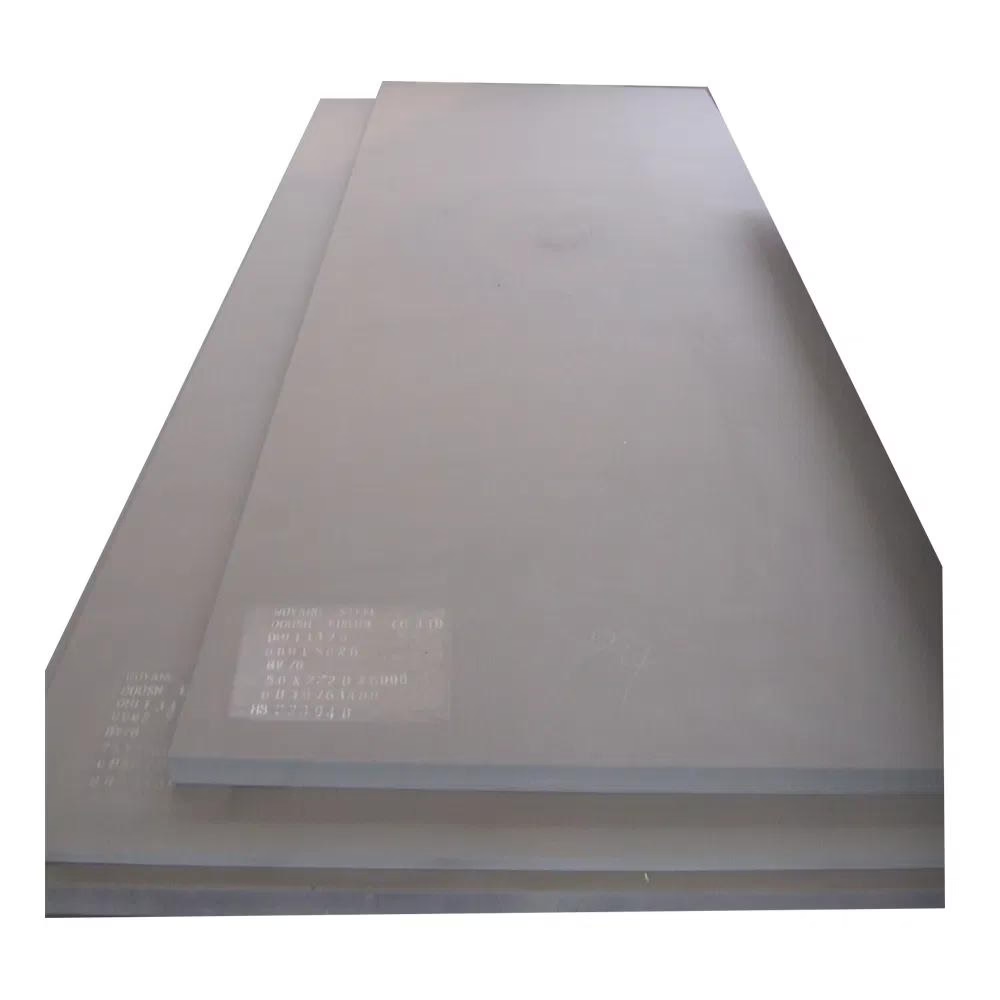
GB 16MnDR Steel Plate
GB 16MnDR is a specialized low-temperature pressure vessel steel plate (Normalized) offering guaranteed impact toughness at -40°C per GB 3531 / GB 713 standards.
| Material | Low Temperature Pressure Vessel Steel |
|---|---|
| Grade / Standard | GB 3531 / GB 713 16MnDR |
| Thickness | 6mm - 200mm |
| Width | 1500mm - 4020mm |
| Length | 3000mm - 18000mm |
| Delivery Condition | normalized |
| Surface Treatment | shot_blasting / painting |
| MOQ | 1 Piece / 5 Tons |
| Delivery Time | 15-30 Days / In Stock |
| Loading Port | Tianjin / Shanghai / Qingdao |
Overview of GB 16MnDR Steel Plate
GB 16MnDR is the premier low-temperature pressure vessel steel grade specified under the Chinese standard GB 3531 (integrated into GB 713 series). The “16” represents a nominal carbon content of 0.16%, “Mn” indicates its manganese-alloyed composition, “D” stands for Low Temperature (Diwen), and “R” signifies its certification for Pressure Vessels (Rongqi). Specifically engineered for service environments down to -40°C, 16MnDR provides an exceptional combination of high yield strength and superior low-temperature notch toughness, making it indispensable for cryogenic storage and energy infrastructure.
Shandong Tanglu Metal Material Co., Ltd. specializes in supplying high-purity GB 16MnDR plates that exceed standard industrial requirements. Our plates are produced using advanced vacuum degasification and fine-grain practice to ensure a homogenous microstructure. This grade is vital for B2B buyers in the LNG, petrochemical, and gas processing sectors where material failure at sub-zero temperatures is not an option. Each plate is delivered in a strictly Normalized (N) condition, accompanied by full Mill Test Certificates (MTC) and documented Charpy V-notch impact test results.
Key Features and Cryogenic Advantages
The defining engineering advantage of GB 16MnDR is its reliable impact energy absorption at -40°C. By strictly controlling the Carbon Equivalent (CEV) and utilizing high Aluminum (Al) content for grain refinement, this steel maintains its ductility and resists brittle fracture even in extreme cold. The extremely low Sulfur (S) and Phosphorus (P) content further enhances the material’s internal cleanliness, ensuring high-integrity performance in pressurized systems.
From a fabrication perspective, GB 16MnDR offers excellent weldability and cold-forming characteristics. It is highly responsive to precision CNC plasma and flame cutting, and its fine-grain structure ensures that the mechanical properties remain stable after rolling or bending into vessel shells. For technical safety, we provide optional HIC (Hydrogen-Induced Cracking) testing and Z-direction testing (Z15/Z25/Z35) to prevent lamellar tearing in complex welded structures. Choosing Tanglu’s 16MnDR means securing a material that combines proven cryogenic safety with outstanding industrial workability.
Main Applications of GB 16MnDR Steel
GB 16MnDR is the foundational material for equipment operating in cold climates or processing cryogenic fluids. Its primary use is in the fabrication of low-temperature separators, heat exchangers, and storage tanks for liquefied petroleum gas (LPG) and other pressurized gases. In the petrochemical industry, it is widely used for ammonia synthesis equipment and various pressurized vessels that undergo low-temperature thermal cycling.
Beyond petrochemical plants, 16MnDR is essential for the construction of road and rail tankers designed for the safe transport of hazardous liquefied gases. It is also a preferred choice for offshore platforms and arctic engineering projects where structural components must withstand severe sub-zero temperatures. Due to its specialized low-temperature certification, GB 16MnDR is the trusted global standard for high-safety, low-temperature pressure vessel applications.
📐 Dimension & Size Table
| Thickness (mm) | Width (mm) | Length (mm) | Weight (kg/m²) |
|---|---|---|---|
| 6 | 2000 | 6000-12000 | 47.1 |
| 10 | 2000 | 6000-12000 | 78.5 |
| 16 | 2500 | 6000-12000 | 125.6 |
| 20 | 2500 | 6000-12000 | 157.0 |
| 40 | 3000 | 6000-12000 | 314.0 |
| 60 | 3000 | 6000-12000 | 471.0 |
| 100 | 2000 | 6000 | 785.0 |
| 150 | 2000 | 4000 | 1177.5 |
* Custom sizes available upon request. Tolerances per relevant international standards.
🔬 Chemical Composition
| Element | Min | Max | Display Value | Note |
|---|---|---|---|---|
| C | - | 0.20 | ≤0.20 | Per GB 3531 |
| Mn | 1.20 | 1.60 | 1.20-1.60 | - |
| Si | 0.15 | 0.50 | 0.15-0.50 | - |
| P | - | 0.025 | ≤0.025 | - |
| S | - | 0.010 | ≤0.010 | Ultra-low sulfur for toughness |
| Al (Total) | 0.020 | - | ≥0.020 | Grain refinement required |
* Chemical composition may vary by heat, thickness and specification. Please refer to the actual mill test certificate.
⚙️ Mechanical Properties
| Property | Value | Unit | Test Condition |
|---|---|---|---|
| Yield Strength | ≥350 | MPa | t ≤ 16mm (Decreases with thickness) |
| Tensile Strength | 490 - 620 | MPa | - |
| Elongation | ≥21 | % | High sub-zero ductility |
| Impact Test | -40°C | KV2 / J | ≥34J (Guaranteed toughness) |
* Values shown are minimum requirements unless otherwise stated.
📦 Commercial Information
| Packaging | Standard seaworthy export packing, bundled with high-strength steel strips, angle iron edge protection, and waterproof identification tags for full material traceability. |
|---|---|
| Payment Terms | T/T (Telegraphic Transfer),L/C (Letter of Credit),D/P (Documents against Payment),Western Union,PayPal |
| Price Term | FOB / CFR / CIF / EXW |
| Supply Capacity | 10,000 Tons/Month |
| Loading Port | Tianjin / Shanghai / Qingdao |
Why Choose Our GB 16MnDR Steel Plate?
Cryogenic Impact Safety
Guaranteed impact toughness at -40°C, essential for safe sub-zero pressurized storage.
Normalized Fine-Grain Structure
Strict Normalized (N) heat treatment ensures a refined, uniform grain for maximum fracture resistance.
High Purity & Cleanliness
Ultra-low Sulfur (S ≤ 0.010) and Phosphorus (P) levels minimize inclusions and enhance ductility.
PED 2014/68/EU Compliance
Meets international pressure equipment directives for European and global engineering projects.
Advanced Z-Direction Testing
Z15/Z25/Z35 testing available to prevent lamellar tearing in safety-critical welded joints.
MTC 3.1 & Full Traceability
Original Mill Test Certificates per EN 10204 3.1 provided with every shipment.
🏭 Applications of GB 16MnDR Steel Plate
GB 16MnDR is the industry standard for low-temperature safety, vital for LPG tanks, ammonia reactors, and arctic engineering.
📋 Quality & Certification
Our Certifications
- ✅ ISO 9001:2015
- ✅ CE Marking
- ✅ ABS
- ✅ DNV GL
- ✅ Lloyd's Register (LR)
- ✅ Bureau Veritas (BV)
- ✅ SGS Certified
Mill Certificate Type
- 📋 EN 10204 3.1
- 📋 Original Mill Certificate
❓ Frequently Asked Questions
What does the 'D' stand for in 16MnDR?
'D' stands for 'Diwen' (Low Temperature), indicating it is specifically tested for cryogenic service.
At what temperature is 16MnDR impact tested?
Standard 16MnDR is impact tested at -40°C, providing guaranteed energy absorption (usually ≥34J) at that temperature.
Is 16MnDR equivalent to ASTM A516 Gr 70?
They are functionally similar, but 16MnDR must be Normalized and tested at -40°C, which makes it more equivalent to A537 Class 1 or A516-70 with specific Low-Temp testing (Supplementary S5).
Why is 16MnDR used for LPG tanks?
Liquefied Petroleum Gas is often stored under pressure at low temperatures; 16MnDR prevents brittle fracture which could lead to catastrophic failure in cold environments.
Can you provide thicker plates for 16MnDR?
Yes, we can provide 16MnDR plates up to 200mm thickness, with yield strength adjustments according to the GB 3531 standard.
Get a Quote for
GB 16MnDR Steel Plate
Submit your requirements and receive a competitive price quote within 24 hours.
- ✓ Fast response within 24 hours
- ✓ Competitive factory-direct pricing
- ✓ Free technical consultation
- ✓ Mill test certificate provided
- ✓ Flexible payment terms available
⏱ Response within 24 hours
Send Your Inquiry
All fields marked with * are required