
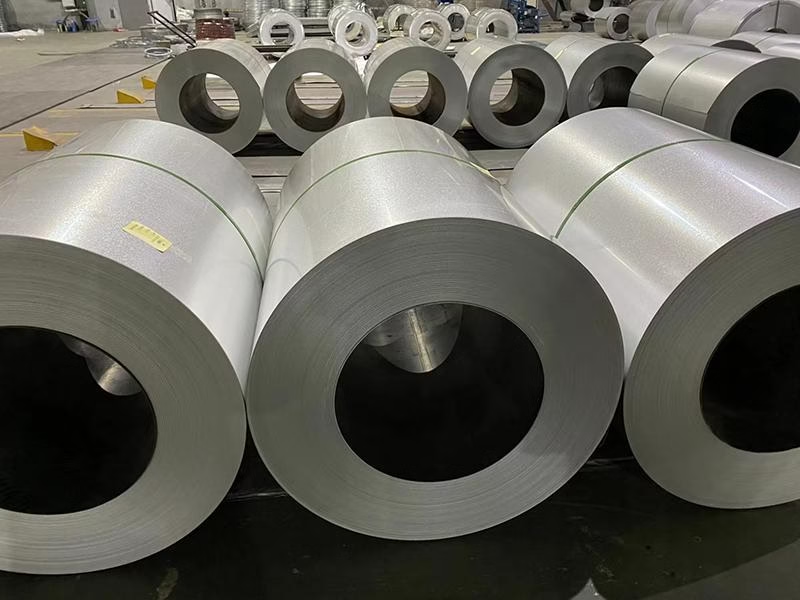
Dual Phase Steel (DP590 / DP780 / DP980 / DP1180)
Dual Phase Steel (DP590 / DP780 / DP980 / DP1180) is Advanced High-Strength Steel (AHSS) with ferrite-martensite dual-phase microstructure for automotive structural safety components. Tensile strength 590–1,180 MPa, excellent formability, high crash energy absorption. Thickness 0.5–4.0mm, width 600–2,100mm. IATF 16949 certified. PPAP support. Mill test certificate provided.
| Material | Advanced High-Strength Steel (AHSS) — Cold-Rolled / Hot-Dip Galvanized Dual Phase Steel |
|---|---|
| Grade / Standard | DP590 / DP780 / DP980 / DP1180 (per EN 10338 / VDA 239-100 / SAE J2340 / JFS A2001) |
| Thickness | 0.5mm – 4.0mm (Cold Rolled) / 0.8mm – 3.5mm (Hot-Dip Galvanized) |
| Width | 600mm – 2,100mm (Slit to custom widths) |
| Inner Diameter (ID) | 508mm / 610mm (Standard automotive coil ID) |
| Coil Weight | 10–30 Tons (Standard 15–25 Tons for automotive supply) |
| Surface Treatment | galvanized |
| MOQ | 5 Tons (Sample / Development) / 25 Tons (Standard Production Order) |
| Delivery Time | 30-50 Days (Custom Production) / 15-30 Days (Stock Grades) |
| Loading Port | Tianjin / Shanghai / Qingdao |
Overview of Dual Phase Steel (DP)
Dual Phase Steel (DP) is a category of Advanced High-Strength Steel (AHSS) characterised by a two-phase microstructure consisting of a soft, ductile ferrite matrix interspersed with hard martensite islands, typically comprising 10–30% martensite by volume fraction — a microstructural architecture that delivers the defining mechanical property combination of high tensile strength, low initial yield strength relative to tensile strength (low yield ratio of 0.50–0.70), continuous yielding behaviour without a yield point elongation, high initial work hardening rate, and excellent uniform elongation that makes DP steel the dominant structural and safety steel in modern automotive body-in-white (BIW) construction worldwide. Specified primarily under EN 10338 (European hot-rolled DP steel), EN 10346 (European galvanized DP steel), EN 10268 / VDA 239-100 (European cold-rolled AHSS), JFS A2001 (Japanese automotive steel), SEW 094 (German Steel Institute specification), ASTM A1078 / SAE J2340 (American automotive), and GB/T 20887 (Chinese automotive steel) standards, Dual Phase Steel has become the preferred material for automotive structural reinforcement members, safety cage components, and chassis load-bearing elements where crash energy absorption, weight reduction, and manufacturing compatibility must be simultaneously achieved across vehicle platforms from entry-level economy cars to premium luxury electric vehicles.
The most widely used Dual Phase Steel grades span an exceptional range of tensile strength — from DP590 (minimum tensile strength 590 MPa, the entry-level grade for moderate structural duty), through DP780 (780 MPa, the dominant workhorse grade for B-pillar reinforcements and crash beams), DP980 (980 MPa, for high-performance safety components), to DP1180 (1,180 MPa, representing the upper limit of conventional DP steel for ultra-lightweight structural applications) — with each grade providing the specific combination of strength, ductility, and formability required by the target component’s structural function, manufacturing process constraints, and crash performance requirements. The characteristic low yield ratio of DP steel (yield strength typically 340–750 MPa at tensile strength 590–1,180 MPa) is a direct consequence of the martensite phase creating back stresses in the surrounding ferrite during initial loading, delaying the onset of macroscopic yielding while the hard martensite particles act as barriers to dislocation motion increasing work hardening rate — a combination that provides both the high uniform elongation needed for press forming of structural components and the high post-forming strength needed for crash energy absorption in vehicle impact events.
Key Features and Manufacturing Process
Dual Phase Steel is manufactured through a precisely controlled intercritical annealing and quenching process that creates the characteristic dual-phase ferrite-martensite microstructure responsible for its exceptional mechanical properties. The manufacturing sequence begins with basic oxygen furnace (BOF) or electric arc furnace (EAF) steelmaking with ladle refining and vacuum degassing to achieve the required low-carbon alloying chemistry — typically C 0.06–0.15%, Mn 1.0–2.5%, Si 0.10–0.50%, with Cr, Mo, and Nb additions for hardenability enhancement in higher-strength grades. The steel is continuous cast, hot rolled at controlled finishing temperatures, and cold rolled with reduction ratios of 40–70% to develop the required substrate microstructure and surface quality before the critical heat treatment stage. The distinguishing manufacturing step for DP steel is the intercritical annealing cycle on a continuous annealing line (CAL) or continuous galvanizing line (CGL) — the cold-rolled strip is heated to the intercritical temperature range between the AC1 (eutectoid temperature, ~720°C) and AC3 (full austenitisation temperature, ~870°C) where austenite and ferrite coexist, typically 760–830°C depending on the grade and target martensite volume fraction. At this temperature, austenite nucleates and grows at ferrite grain boundaries and pearlite colony boundaries — the volume fraction of austenite formed is directly controlled by the intercritical temperature and determines the final martensite volume fraction. The strip is then rapidly cooled (quenched) through the martensite transformation temperature range (Ms ~400–450°C, Mf ~200–250°C) at cooling rates of 30–100°C/s on the strip surface, transforming the austenite phase to hard martensite while the ferrite matrix remains substantially unchanged. For hot-dip galvanized DP steel produced on CGLs, the strip passes through the zinc bath at approximately 460°C after intercritical annealing, requiring quenching at the exit of the zinc bath to complete martensite transformation.
DP steel is supplied in cold-rolled bare (CR-DP), electrogalvanized (ZE-DP or EG-DP), and hot-dip galvanized (GI-DP or GA-DP) surface conditions, in thicknesses from 0.5mm to 4.0mm for automotive applications, widths from 600mm to 2,100mm, and standard coil weights of 10–30 tons with inner diameter 508mm or 610mm. The as-delivered microstructure — ferrite matrix with martensite island distribution characterised by martensite volume fraction, martensite island size (typically 2–10μm), and morphology (blocky versus elongated) — determines the steel’s mechanical property combination, and is verified by metallographic examination of each production heat. Each DP steel coil undergoes mandatory chemical composition analysis, mechanical property testing (tensile strength, yield strength in lower yield point or 0.2% proof stress for continuous yielding grades, total elongation A80, n-value, r-value), hole expansion ratio (HER / λ) testing per ISO 16630 for stretch-flanging performance assessment, surface quality inspection per automotive Class A and Class B surface requirements, dimensional inspection per EN 10131 / EN 10051, and springback characterisation for stamping die development support.
Main Applications of Dual Phase Steel (DP)
Automotive safety cage and structural reinforcement applications represent the dominant use of Dual Phase Steel, where the combination of high tensile strength, good formability, and high crash energy absorption (a function of the area under the stress-strain curve from yield to fracture — high for DP steel due to its high uniform elongation) make it the preferred material over conventional high-strength steels for components that must withstand vehicle collision loads while being manufactured by conventional stamping operations. B-pillar reinforcements — the structural members connecting the roof to the floor sill between the front and rear doors, the most critical passenger safety structure in side impact collisions — use DP780 and DP980 for the inner and outer reinforcement panels, providing the combination of tensile strength (780–980 MPa) and ductility needed to absorb side impact energy without fracture while being stamped from flat coil stock into complex hat-section profiles with multiple flanges and holes.
Front and rear crash rail structures (longitudinal rails) for controlled frontal and rear crash energy absorption use DP590 and DP780, where the high work hardening rate of DP steel causes progressive strengthening during axial crash deformation that improves energy absorption compared to conventional high-strength steels of equivalent initial yield strength. Door impact beams — both straight tubular beams and stamped reinforcement beams in door cavities providing side intrusion protection — use DP590 and DP780, with the good elongation of DP steel enabling tube-forming (for tubular beams) and press-forming (for stamped beams) at practical forming speeds. Roof rails and roof crush resistance structures use DP590/DP780 for the combination of rollover crush resistance and formability needed to produce the complex cross-section profiles of roof rail components. Seat cross members and seat back frames from DP590/DP780 provide the strength for passenger retention in frontal and rear collisions while being formed into the complex profiles of seat structural components. Floor cross members and tunnel reinforcements use DP590 for stiffness and crash energy management in the vehicle floor structure. Wheel arch reinforcements and suspension tower top plates use DP780/DP980 for the high localised loads at suspension attachment points. High-strength bumper beams (the impact energy absorbing beam behind the front and rear bumper fascia) use DP780, DP980, and DP1180 for maximum impact resistance at minimum beam cross-section weight. Other structural applications include engine mount brackets (DP780/DP980), battery enclosure structural members for electric vehicles (DP780/DP980/DP1180), body hinge reinforcements, door ring structural members connecting A-pillar, B-pillar, roof rail, and floor sill into a continuous structural ring for side impact resistance, and the complete range of automotive structural stampings where weight reduction through higher-strength steel enabling thinner gauge, combined with adequate formability for stamping and crash ductility for energy absorption, are the primary design objectives driving material selection.
Why Choose Us for Dual Phase Steel (DP)
Shandong Tanglu Metal Material Co., Ltd. supplies premium Dual Phase Steel sourced from China’s leading automotive steel producers including Baoshan Iron & Steel (Baosteel) — operating one of the world’s most advanced cold rolling and continuous annealing lines for AHSS production — HBIS Group (Hesteel), Shougang Group, and Angang Steel, all with dedicated DP steel production capability and certified production facilities meeting IATF 16949 automotive quality management system, ISO 9001, ISO 14001 requirements, and approved supplier status for major global automotive OEMs including Volkswagen Group, General Motors, Ford, Toyota, Honda, BMW Group, Mercedes-Benz, and major Chinese OEMs (SAIC, BYD, Geely, Great Wall). Every DP steel coil is accompanied by original mill test certificates covering complete chemical composition analysis by optical emission spectrometry, mechanical property test results (tensile strength, yield strength, elongation A80, n-value in the 10–20% strain range for forming assessment, r-value, hole expansion ratio HER/λ per ISO 16630), microstructure verification including martensite volume fraction assessment by metallographic examination, surface quality inspection results, dimensional measurement data, and complete heat and coil number traceability.
We offer a comprehensive Dual Phase Steel specification range covering DP590, DP780, DP980, and DP1180 grades in cold-rolled bare (CR), electrogalvanized (EG/ZE), and hot-dip galvanized (GI/GA) surface conditions per EN 10338, EN 10346, VDA 239-100, JFS A2001, SAE J2340, and GB/T 20887 standards. Thicknesses from 0.5mm to 4.0mm, widths from 600mm to 2,100mm, standard and custom coil weights. PPAP (Production Part Approval Process) documentation support for automotive supply chain integration including Initial Sample Inspection Reports (ISIR), Material Certificates per OEM-specific specifications, BH response characterisation for DP steel grades exhibiting post-forming bake hardening, and forming simulation material cards (sigma-epsilon curve data, yield locus parameters) for automotive engineering finite element analysis (FEA) and virtual forming simulation. With established monthly supply capacity of 5,000 tons of automotive sheet steel and export relationships with automotive Tier 1 suppliers, stamping companies, automotive OEM purchasing organisations, and steel service centres across more than 40 countries, we support packages from prototype development material orders through high-volume production programmes requiring just-in-time delivery scheduling. Each shipment includes original mill test certificate per EN 10204 3.1, with EN 10204 3.2 and third-party inspection by SGS, Bureau Veritas, or TUV available for automotive OEM qualification requirements.
📐 Dimension & Size Table
| Grade (EN / JFS) | Tensile Strength (MPa) | Yield Strength (MPa) | Elongation A80 (%) | Yield Ratio | Primary Automotive Application |
|---|---|---|---|---|---|
| DP590 / HCT590X / JSC590R | 590–700 | 330–440 | ≥24 / 0.56–0.65 / Longitudinal crash rails, floor cross members, door impact beams | ||
| DP780 / HCT780X / JSC780R | 780–900 | 420–550 | ≥18 / 0.54–0.65 / B-pillar reinforcements, bumper beams, roof rails (dominant grade) | ||
| DP980 / HCT980X / JSC980R | 980–1,130 | 550–700 | ≥12 / 0.56–0.65 / High-strength B-pillar, side sill, wheel arch reinforcements | ||
| DP1180 / HCT1180X / JSC1180R | 1,180–1,380 | 700–950 | ≥8 / 0.59–0.70 / Ultra-lightweight bumper beams, EV battery enclosure structure | ||
| DP590+Z / HCT590X+Z | 590–700 | 330–440 | ≥24 / 0.56–0.65 / GI galvanized crash rails, corrosion-protected structural members | ||
| DP780+Z / HCT780X+Z | 780–900 | 420–550 | ≥18 / 0.54–0.65 / GI/GA galvanized B-pillar, structural components requiring corrosion protection | ||
| DP980+Z / HCT980X+Z | 980–1,130 | 550–700 | ≥12 / 0.56–0.65 / GA galvanized high-strength structural reinforcements | ||
| DP1180+Z / HCT1180X+Z | 1,180–1,380 | 700–950 | ≥8 / 0.59–0.70 / GA ultra-high-strength structural with full corrosion protection |
* Custom sizes available upon request. Tolerances per relevant international standards.
🔬 Chemical Composition
| Element | Min | Max | Display Value | Note |
|---|---|---|---|---|
| C | 0.06 | 0.15 | 0.06–0.15 | DP590/780: ~0.07–0.10%; DP980/1180: ~0.10–0.15% — C controls martensite hardness and fraction; higher C for higher strength grades |
| Si | 0.10 | 0.50 | 0.10–0.50 | Solid solution strengthening of ferrite; Si >0.3% in galvanized DP requires pre-oxidation control for zinc adhesion |
| Mn | 1.00 | 2.50 | 1.00–2.50 | Primary hardenability element — stabilises austenite during intercritical annealing, suppresses ferrite during quenching |
| P | - | 0.020 | ≤0.020 | Strictly controlled — P embrittles martensite grain boundaries, reduces toughness in DP steel; P grain boundary segregation hazardous |
| S | - | 0.010 | ≤0.010 | Very low S — MnS inclusions act as void nucleation sites in crash fracture; critical for high-strength DP980/1180 toughness |
| Al | 0.020 | 0.060 | 0.020–0.060 | Deoxidiser; Al controls N as AlN preventing dynamic strain ageing during stamping |
| Cr | 0.10 | 0.60 | 0.10–0.60 | Hardenability addition — Cr suppresses bainite formation during quenching, ensuring full martensite transformation; typical in DP780+ |
| Mo | - | 0.20 | ≤0.20 | Hardenability supplement for DP980/1180 — Mo strongly suppresses ferrite and bainite, enabling high martensite fraction |
| Nb | - | 0.050 | ≤0.050 | Grain refinement — NbC precipitation during hot rolling refines prior austenite grain size improving toughness and formability |
| Ti | - | 0.030 | ≤0.030 | Grain refinement and N stabilisation — TiN pins grain boundaries at intercritical annealing temperature |
| N | - | 0.008 | ≤0.008 | Controlled as interstitial — free N causes strain ageing during stamping; must be combined as AlN or TiN |
* Chemical composition may vary by heat, thickness and specification. Please refer to the actual mill test certificate.
⚙️ Mechanical Properties
| Property | Value | Unit | Test Condition |
|---|---|---|---|
| Tensile Strength — DP590 | 590–700 | MPa | Per EN 10338 HCT590X / JFS JSC590R / SAE J2340 DP590 |
| Yield Strength — DP590 (0.2% Rp) | 330–440 | MPa | Continuous yielding (no yield point elongation); low yield ratio 0.56–0.65 |
| Total Elongation — DP590 (A80) | ≥24 | % | Good formability for roll-formed and stamped structural components |
| Tensile Strength — DP780 | 780–900 | MPa | Per EN 10338 HCT780X — dominant AHSS grade for B-pillar and structural reinforcements |
| Yield Strength — DP780 (0.2% Rp) | 420–550 | MPa | Low yield ratio 0.54–0.65 enabling post-forming work hardening for crash performance |
| Total Elongation — DP780 (A80) | ≥18 | % | Adequate for complex stamped structural profiles |
| Tensile Strength — DP980 | 980–1,130 | MPa | Per EN 10338 HCT980X — high-performance structural grade for weight-optimised safety components |
| Yield Strength — DP980 (0.2% Rp) | 550–700 | MPa | Higher yield than DP780 reflecting higher martensite volume fraction |
| Total Elongation — DP980 (A80) | ≥12 | % | Adequate for moderate forming complexity; avoid severe draw operations |
| Tensile Strength — DP1180 | 1,180–1,380 | MPa | Per EN 10338 HCT1180X — ultra-high strength for maximum weight reduction in critical safety zones |
| Yield Strength — DP1180 (0.2% Rp) | 700–950 | MPa | High strength; limited formability requires careful die design and process control |
| Total Elongation — DP1180 (A80) | ≥8 | % | Limited elongation; primarily for roll-formed sections and simple stampings |
| n-value (DP780, strain 10–20%) | 0.13–0.18 | - | Strain hardening exponent — high n-value enables post-forming strength increase during crash crushing |
| Hole Expansion Ratio (HER λ) — DP590 | ≥30 | % | Per ISO 16630 — stretch-flanging performance; DP has lower HER than CP/TRIP steels of same tensile strength |
| Hole Expansion Ratio (HER λ) — DP780 | ≥20 | % | HER decreases with increasing strength grade — design flanges accordingly in DP780/980/1180 components |
| Bake Hardening Response (BH2 — DP780) | 20–40 | MPa | DP steel exhibits moderate BH response from C in solution — additional strength after paint baking cycle |
* Values shown are minimum requirements unless otherwise stated.
📦 Commercial Information
| Packaging | Premium automotive-grade seaworthy export packing for Dual Phase Steel coils. Each coil individually wrapped with VCI (Volatile Corrosion Inhibitor) polyethylene film applied directly to the coil surface — mandatory for DP steel which must be protected from atmospheric moisture during ocean transit and automotive plant storage of typically 3–6 months without corrosion or surface degradation affecting surface quality for structural component stamping and resistance spot welding performance. Plastic-coated steel strapping (4–6 wraps per coil) avoiding direct metal-to-metal contact with the coil surface. Steel eye protection rings on both inner diameter and outer OD face prevent telescoping (coil axial displacement of inner turns) during crane and forklift handling — telescoping is especially important to prevent in high-strength DP coils which can retain significant residual stress from the continuous annealing and quenching process. Each coil tagged with permanent metal identification tag including heat number, DP grade designation (DP590/DP780/DP980/DP1180), EN/JFS/VDA specification reference, surface condition (CR/GI/GA/EG), thickness (mm), width (mm), zinc coating weight (g/m²) for galvanized variants, coil weight (kg net and gross), inner diameter (mm), outer diameter (mm), production date, and customer purchase order reference with part number. For galvanized DP steel (GI-DP, GA-DP), additional moisture-barrier packaging is applied because galvanized surfaces are susceptible to wet storage staining (white rust) that can affect spot weld quality and lacquer adhesion at automotive plants. Multiple coils shipped on the same container are secured with timber cradle supports between coils preventing contact-induced surface marking, with overall container load distribution verified for vessel stability. Complete material documentation package (mill test certificate per EN 10204 3.1, OEM-specific material certificate per GMW/Ford WSS/VDA 239-100, PPAP documentation elements, forming simulation data cards if requested, packing list, Certificate of Origin) provided in waterproof document pouch. Container loading: 20FT FCL typically 22–25 tons of DP steel coils; 40HQ for wider coils or mixed-gauge mixed-grade shipments to automotive Tier 1 suppliers. |
|---|---|
| Payment Terms | T/T (Telegraphic Transfer),L/C (Letter of Credit),D/P (Documents against Payment),Western Union,PayPal |
| Price Term | FOB,CFR,CIF,EXW |
| Supply Capacity | 5,000 Tons/Month (Automotive AHSS / Dual Phase Steel) |
| Loading Port | Tianjin / Shanghai / Qingdao |
Why Choose Our Dual Phase Steel (DP590 / DP780 / DP980 / DP1180)?
IATF 16949 Automotive Certified — PPAP Support
DP steel supplied from IATF 16949 certified production facilities with full PPAP (Production Part Approval Process) documentation including EN 10204 3.1/3.2 mill test certificate, mechanical property verification (Rm, Rp0.2, A80, n-value, HER/λ per ISO 16630), microstructure assessment (martensite volume fraction), surface quality inspection, OEM-specific Material Certificates (GMW, Ford WSS, VDA 239-100), and forming simulation material cards (FLC, sigma-epsilon data) for automotive engineering FEA support.
Complete DP Grade & Surface Condition Range
Full range DP590 / DP780 / DP980 / DP1180 in cold-rolled bare (CR), hot-dip galvanized (GI/GA), and electrogalvanized (EG/ZE) surface conditions. Thickness 0.5–4.0mm, width 600–2,100mm. CR-DP: EN 10338 HCT series. GI/GA-DP: EN 10346. EV battery enclosure grades and tailor-welded blank (TWB) compatible material also available.
High Strength + Formability + Crash Energy Absorption
DP steel uniquely delivers: tensile strength 590–1,180 MPa (4–8× conventional mild steel); continuous yielding without Lüders band formation (essential for Class B structural surface quality); low yield ratio 0.54–0.70 providing forming reserve and post-forming work hardening for crash; elongation A80 8–24% enabling stamping of complex structural profiles; high UTS × A80 product (product of strength and ductility) for superior crash energy absorption per unit weight.
Multi-OEM Specification Compliance
DP steel meeting EN 10338/10346 (European), VDA 239-100 (German VDA), JFS A2001 (Japanese), SAE J2340 (American), GB/T 20887 (Chinese), GMW3032 (General Motors), Ford WSS-M1A367 (Ford), FCA MS-12.001 (Stellantis), BMW GS 90009 (BMW Group), Mercedes-Benz MBN 10336 (Mercedes), and major Chinese OEM steel specifications (SAIC, BYD, Geely, Great Wall).
Just-in-Time Automotive Supply Capability
Standard DP590 and DP780 CR and GA grades from stock: 15–30 days dispatch. DP980 and DP1180, special widths, custom coil weights: 35–50 days production. Flexible scheduling support for automotive JIT inventory management. Forming simulation support (material cards for AUTOFORM, PAM-STAMP, DYNAFORM) provided for die development. Container loading 22–25 tons per 20FT FCL.
🏭 Applications of Dual Phase Steel (DP590 / DP780 / DP980 / DP1180)
Dual Phase Steel serves as the primary Advanced High-Strength Steel for automotive body-in-white (BIW) structural and safety components across the global automotive industry — components where the unique combination of high tensile strength, continuous yielding behaviour, good formability, and exceptional crash energy absorption simultaneously meets the weight reduction, manufacturing processability, and vehicle safety performance requirements that drive modern vehicle development programmes. B-pillar inner and outer reinforcements represent the most technically critical application for DP780 and DP980, where the B-pillar is the structural member connecting the roof rail to the floor sill between the front and rear doors and provides the primary resistance to passenger cabin intrusion in side impact collisions — the FMVSS 214 side impact test and IIHS side impact ratings directly measure B-pillar structural performance, and the high tensile strength of DP780/980 combined with adequate elongation enables the complex hat-section profiles and curved geometries of modern B-pillar reinforcements to be stamped from flat coil stock while providing the crash resistance that determines vehicle safety ratings. Front longitudinal rails (crash rails) for controlled frontal crash energy absorption use DP590 and DP780 in the axially loaded sections designed to fold progressively in frontal impacts, absorbing crash energy before the load path reaches the passenger compartment — the high work-hardening rate characteristic of DP steel (n-value 0.13–0.18) causes the rail cross-section to strengthen progressively during axial crush deformation, increasing energy absorption per unit length compared to conventional high-strength steel of the same initial yield strength. Roof reinforcements and anti-intrusion structure for rollover protection (FMVSS 220 roof crush test) uses DP590/DP780 for the inner and outer roof rail components, header reinforcements, and cross-member bracing that maintain passenger cabin space during vehicle rollover events — the combination of high tensile strength and adequate elongation enables the stamped roof structural members to absorb the distributed crush load without fracture or sudden collapse. Door intrusion beams protecting passengers from side impacts use DP590 and DP780 in both straight tubular beam formats (formed by roll forming DP strip into tube sections, then welded longitudinally) and stamped reinforcement beam profiles — the good cold formability of DP590 enables tube-forming without cracking, while the high strength (590–900 MPa) resists intrusion of the striking object into the passenger compartment. Seat structural cross members and seat back frames from DP590/DP780 provide the strength for passenger restraint in frontal (FMVSS 208) and rear (FMVSS 301) collision tests, with the complex cross-section profiles of seat structural members stamped from DP coil stock on automated transfer press lines. High-strength front and rear bumper beams — the impact energy absorbing cross-beams immediately behind the front and rear bumper fascia — use DP780, DP980, and DP1180 for maximum bumper beam load capacity at minimum beam cross-section and weight, with roll-formed tube profiles or hat-section stampings providing the structural efficiency needed to meet low-speed impact standards (RCAR, IIHS low-speed bumper) at minimum mass addition to the vehicle front and rear end structure. Floor cross members connecting the longitudinal floor rails to the centre tunnel and rocker sills use DP590 for the combination of bending stiffness for noise-vibration-harshness (NVH) performance and crash load carrying capacity, formed by roll forming or stamping from DP590 coil stock into hat-section profiles spanning the floor width. Electric vehicle (EV) battery enclosure structural frames — the load-bearing perimeter frame and cross-member structure of the high-voltage battery pack that must provide structural protection against side impact intrusion, bottom intrusion from road debris, and crash load paths in frontal and rear collisions — have emerged as a major new application for DP780, DP980, and DP1180 in the rapidly growing EV market, where the battery enclosure simultaneously serves as a structural member in the vehicle floor, a protective housing for the most expensive and safety-critical component of the EV powertrain, and a contributor to overall vehicle structural stiffness replacing the structural contribution of the fuel tank and exhaust system removed in the EV architecture. Roll-formed structural profiles from DP590 and DP780 — continuous roll-formed open and closed sections producing door guard rails, seat rail profiles, sill reinforcement sections, and structural brackets at high production rates — use the good roll-forming compatibility of DP590/780 to produce lightweight high-strength structural components more economically than press forming equivalent sections from the same-strength steel, with DP steel's continuous yielding behaviour preventing Lüders-band surface marking on the roll-formed surface that would require additional operations to remove before assembly. Tailor-welded blank (TWB) and tailor-rolled blank (TRB) applications combine DP steel with mild steel or other AHSS grades to create stamping blanks with locally optimised properties — DP780 in the upper B-pillar area where the highest strength is needed for roof crush resistance blended with DP590 or mild steel in the lower attachment area where formability is needed for flange forming — enabling a single-piece B-pillar stamping to achieve grade-specific mechanical properties at each position along the pillar length without a separate reinforcement piece.
📋 Quality & Certification
Our Certifications
- ✅ ISO 9001:2015
- ✅ CE Marking
- ✅ DNV GL
- ✅ Lloyd's Register (LR)
- ✅ Bureau Veritas (BV)
- ✅ SGS Certified
Mill Certificate Type
- 📋 EN 10204 3.1
- 📋 EN 10204 3.2
- 📋 Original Mill Certificate
- 📋 Third Party Inspection Available
- 📋 Certificate of Origin
❓ Frequently Asked Questions
What is Dual Phase Steel and what makes it different from conventional high-strength steel?
Dual Phase (DP) steel is an Advanced High-Strength Steel (AHSS) characterised by a two-phase microstructure consisting of a soft ferrite matrix with hard martensite islands — typically 10–30% martensite by volume — that delivers a fundamentally different mechanical behaviour from conventional high-strength steels (HSLA, rephosphorised steels) of equivalent yield strength. The defining mechanical characteristics of DP steel are: (1) Continuous yielding behaviour — DP steel exhibits no distinct yield point or Lüders band (Portevin-Le Chatelier effect) because the martensite islands create internal back stresses that suppress the sudden macroscopic yielding and Lüders band propagation observed in conventional steels. This continuous yielding produces smooth, defect-free surface quality in stamped parts without the surface markings (stretcher strain marks) that would require additional operations to remove before painting on automotive body components. (2) Low yield ratio (Rp0.2/Rm = 0.50–0.70) — the yield strength is significantly lower than the tensile strength in DP steel because the internal back stresses from martensite delay the onset of macroscopic yielding, while the martensite phase provides the high ultimate tensile strength. This low yield ratio means the steel work-hardens rapidly from initial yielding to fracture, providing substantial post-forming strength increase through the forming operation itself. In an automotive component stamped to 10–15% effective strain, DP780 may achieve locally as high as 900–1,000 MPa local flow stress at the heavily strained areas. (3) High initial work hardening rate (n-value 0.13–0.20) — the combination of soft ferrite deformation and constraint from hard martensite islands produces rapid work hardening that enables DP steel to maintain good distributed deformation during press forming, reducing the risk of local thinning and necking failure compared to single-phase steels. (4) High crash energy absorption — the area under the stress-strain curve from yield to fracture (proportional to the product Rm × total elongation) is maximised by DP steel's combination of high tensile strength and relatively good elongation compared to other steels at equivalent strength. Conventional HSLA steel of 590 MPa tensile strength achieves this strength through precipitation hardening at a yield ratio of 0.80–0.90 — the resulting lower work hardening and lower elongation reduce crash energy absorption versus DP590 at the same tensile strength.
What is the difference between DP590, DP780, DP980, and DP1180, and which should I specify for my application?
DP590, DP780, DP980, and DP1180 are differentiated primarily by tensile strength (and corresponding martensite volume fraction), with significant consequences for formability, springback, and application suitability. DP590 (tensile 590–700 MPa, yield 330–440 MPa, A80 ≥24%): The most formable DP grade, comparable to mild steel in elongation, with adequate strength for crash rail structures that require axial crush folding without fracture. Best choice for: longitudinal crash rails, floor cross members, sill inner reinforcements, door intrusion beams (tubular type formed by roll forming), seat structural members, and any component requiring moderately complex stamping at high strength levels where DP780 is too difficult to form. Weight saving versus mild steel: approximately 30–40% gauge reduction for equivalent stiffness-driven designs. DP780 (tensile 780–900 MPa, yield 420–550 MPa, A80 ≥18%): The dominant workhorse AHSS grade in automotive BIW, balancing high strength with adequate formability for the majority of structural reinforcement applications. Best choice for: B-pillar inner and outer reinforcements, roof rail inner panels, front and rear bumper beams (stamped profile type), front rail reinforcements, door ring structural members, suspension towers, battery enclosure cross members. DP780 represents approximately 50–60% of total DP steel consumption globally. Weight saving versus mild steel: approximately 40–50% gauge reduction for strength-driven designs. DP980 (tensile 980–1,130 MPa, yield 550–700 MPa, A80 ≥12%): High-performance structural grade for weight-optimised safety-critical components, used where DP780 provides insufficient strength for the required gauge. Formability is significantly reduced versus DP780 — springback increases substantially and component design must avoid severe flanging, sharp internal radii, and complex draw geometry. Best choice for: upper B-pillar reinforcement (where highest intrusion resistance is required), side sill inner reinforcement, wheel arch reinforcement, seatbelt anchor reinforcement, tunnel cross member in high-loaded positions. Weight saving versus DP780: additional 10–15% gauge reduction. DP1180 (tensile 1,180–1,380 MPa, yield 700–950 MPa, A80 ≥8%): Ultra-high-strength grade for maximum weight reduction in defined crush zone structural members and battery protection. Very limited formability — primarily suitable for roll-formed sections and simple press-formed components with minimal draw depth. Requires careful die design, warm forming in some applications, and specific joint design for resistance spot welding (modified welding schedules). Best choice for: high-strength bumper beams (roll-formed tube), side impact protection beams, EV battery enclosure perimeter frame sections, and critical structural members where minimum cross-section is mandatory for packaging within tight design envelopes.
What are the special welding considerations for Dual Phase Steel in automotive assembly?
Dual Phase Steel presents specific welding challenges compared to mild steel and conventional HSLA that must be addressed in automotive assembly welding procedure development and production monitoring. Resistance Spot Welding (RSW) — the dominant automotive assembly joining process: DP steel requires modified welding schedules (higher current, shorter weld time, or multi-pulse current profiles) versus mild steel because the higher carbon and alloy content of DP steel produces harder, more brittle weld nugget microstructures (martensite in the weld nugget and HAZ) at conventional mild steel welding parameters. Key RSW considerations for DP steel: (1) Current range (weld window) — DP780 and DP980 have a narrower weld current range between minimum acceptable nugget size and expulsion current than mild steel, requiring tighter current control in production. (2) HAZ softening — the heat affected zone (HAZ) adjacent to the weld nugget in DP steel is softened ('tempered HAZ' or 'subcritical HAZ') because the annealing heat of the welding cycle tempers the martensite in a ring around the nugget, reducing local hardness and tensile strength. HAZ softening in DP980 can reduce local strength by 15–25% within 1–3mm of the nugget edge, creating a weak zone that fails preferentially in cross-tension and coach-peel weld tests. (3) Nugget diameter — the minimum nugget diameter specification for DP steels is typically higher than for mild steel (minimum nugget diameter 5√t or 6√t for DP980/1180 versus 4√t for mild steel per VDA recommendations) to compensate for the HAZ soft zone by ensuring the weld shear failure path is through the nugget rather than the HAZ. (4) Electrode force — higher electrode force is required for DP steel to achieve intimate contact pressure and prevent expulsion at higher currents. Laser Welding and Laser-MIG Hybrid Welding: Used for tailored blank (TWB) applications joining DP steel to mild steel or other AHSS grades at the blank stage before forming. Laser welding of DP steel produces a narrow HAZ and full-penetration weld with minimal distortion — the narrow HAZ is advantageous in minimising HAZ softening zone width versus resistance spot welding. GMAW (MIG/MAG) and FCAW arc welding: Used for structural assembly of thicker-section DP components where resistance spot welding cannot achieve joint access. Preheat of 75–150°C may be required for DP980/1180 sections above 3mm to reduce HAZ brittleness. Use low-hydrogen filler metals (E70T-1C/M or equivalent) and limit heat input to minimum necessary for fusion to minimise HAZ extent. Cold metal transfer (CMT) welding reduces spatter and heat input versus conventional GMAW, beneficial for thin-gauge DP steel joining.
How does springback in DP steel affect tooling design and what compensation methods are used?
Springback is a significantly greater challenge with Dual Phase Steel than with conventional mild steel or HSLA, because the combination of high yield strength (particularly in DP780, DP980, and DP1180), high elastic modulus (essentially identical to mild steel at ~210 GPa), and the continuous yielding behaviour that causes the entire strained region to store elastic energy creates substantially larger elastic recovery after the forming load is released. Springback magnitude in DP steel: DP590 has approximately 2–3× the springback of equivalent-gauge mild steel in typical automotive stamping operations; DP780 has 4–5× mild steel springback; DP980 has 6–8× mild steel springback. This means that a B-pillar die designed for mild steel would produce DP780 panels with several degrees of angular springback (wall opening) and significant cross-bow curvature that would prevent assembly to adjacent parts without rework or re-striking. Tooling compensation methods for DP steel: (1) Die compensation — the die surface geometry is intentionally deformed opposite to the expected springback direction ('over-bent') so that when the part springs back, it arrives at the specified geometry. Die compensation is determined by forming simulation (FEA using accurate DP steel material model with kinematic hardening capability — isotropic hardening models significantly underpredict springback in DP steel) followed by die tryout and iterative correction. For DP780, typical compensation values are 5–10° angular over-bend and 10–30mm cross-section geometry modification. (2) Drawing addendum and blank holder force control — increased blank holder force (BHF) during the draw phase creates more material tension that reduces springback by shifting the stress state further into the plastic regime. Optimised draw beads increase material restraint and reduce springback, but must balance against increased tearing risk in DP materials with lower elongation. (3) Bottoming / coining — applying elevated punch load at end-of-stroke to locally exceed the material yield strength in the bend radius area, reducing the through-thickness stress gradient responsible for springback. Effective for simple bends but impractical for large complex panels. (4) Warm forming — preheating DP980 and DP1180 blanks to 150–300°C reduces yield strength and springback while maintaining the martensite microstructure required for final part strength. Used in production for specific components where room-temperature springback is excessive. (5) Part design modification — increasing flange length, adding flanges, embossing stiffening features into the panel geometry, and designing self-locking assembly flanges all reduce effective springback by constraining the part geometry through the formed shape itself — collaborative part design between OEM and Tier 1 stamper is the most effective springback control strategy for DP AHSS panels.
What automotive documentation and OEM specifications are required for Dual Phase Steel supply?
Dual Phase Steel supply to automotive Tier 1 suppliers and OEMs requires comprehensive quality documentation meeting the automotive industry's most stringent material certification requirements, reflecting the safety-critical function of DP steel structural components in vehicle crash performance. Standard documentation for all DP steel shipments: (1) Mill Test Certificate (MTC) per EN 10204 3.1 (minimum for Tier 1 suppliers) or 3.2 (for OEM direct supply or enhanced quality confirmation with independent witness) covering: heat chemistry (all specified elements per applicable standard), mechanical properties (Rm, Rp0.2, A80, n-value, r-value, HER/λ where specified), surface condition and coating weight (for galvanized variants), dimensional inspection (thickness, width, coil weight), heat and coil number for full traceability; (2) Material Certificate matching the specific OEM or Tier 1 specification designation — not simply 'EN 10338 HCT780X' but the specific customer specification number such as 'GMW3032 Mtype DP780 CR' or 'Ford WSS-M1A367-A3 DP780' or 'BMW GS 90009 HCT780X' with all specification-specific properties verified. PPAP documentation for new program launches: (1) Production Part Approval Process Level 3 documentation (standard for new automotive steel supply programs in Europe and North America) including Design Records, Engineering Change Documents (if applicable), Customer Engineering Approval, Design FMEA (steel producer responsible for material design risks), Process Flow Diagram showing steelmaking, casting, rolling, annealing, and coating steps, Process FMEA, Control Plan, Measurement System Analysis (MSA) for all measurement systems used in material qualification, Initial Process Studies (Ppk capability analysis for key properties: Rm, Rp0.2, A80, coating weight), Qualified Laboratory Documentation (mill test laboratory accreditation), Appearance Approval Report if applicable, Sample Parts (initial sample coils from the qualified production equipment and process), Master Sample records, Checking Aids verification, Customer-Specific Requirements compliance, and Part Submission Warrant (PSW) signed by the steel supplier quality manager; (2) Initial Sample Inspection Report (ISIR) or First Article Inspection Report (FAIR) demonstrating the material meets all requirements; (3) Forming Limit Curve (FLC) and full material characterisation data including sigma-epsilon curve (true stress versus true strain), r-value as a function of strain, yield locus determination, and kinematic hardening parameters for accurate springback prediction in FEA simulation — provided as material cards compatible with AUTOFORM, PAM-STAMP, and ABAQUS/Explicit forming and crash simulation software. Industry-specific certification documents: For VW Group: VDA 6.3 process audit pass certificate required from steel producer; For BMW Group: BMW-GS approval and GS 90009 compliance; For Renault-Nissan-Mitsubishi: specific RNBV material approval process; For Chinese OEMs (SAIC, BYD, Geely): GB/T 20887 compliance and individual OEM material library registration in their corporate material standards system.
Get a Quote for
Dual Phase Steel (DP590 / DP780 / DP980 / DP1180)
Submit your requirements and receive a competitive price quote within 24 hours.
- ✓ Fast response within 24 hours
- ✓ Competitive factory-direct pricing
- ✓ Free technical consultation
- ✓ Mill test certificate provided
- ✓ Flexible payment terms available
⏱ Response within 24 hours
Send Your Inquiry
All fields marked with * are required