
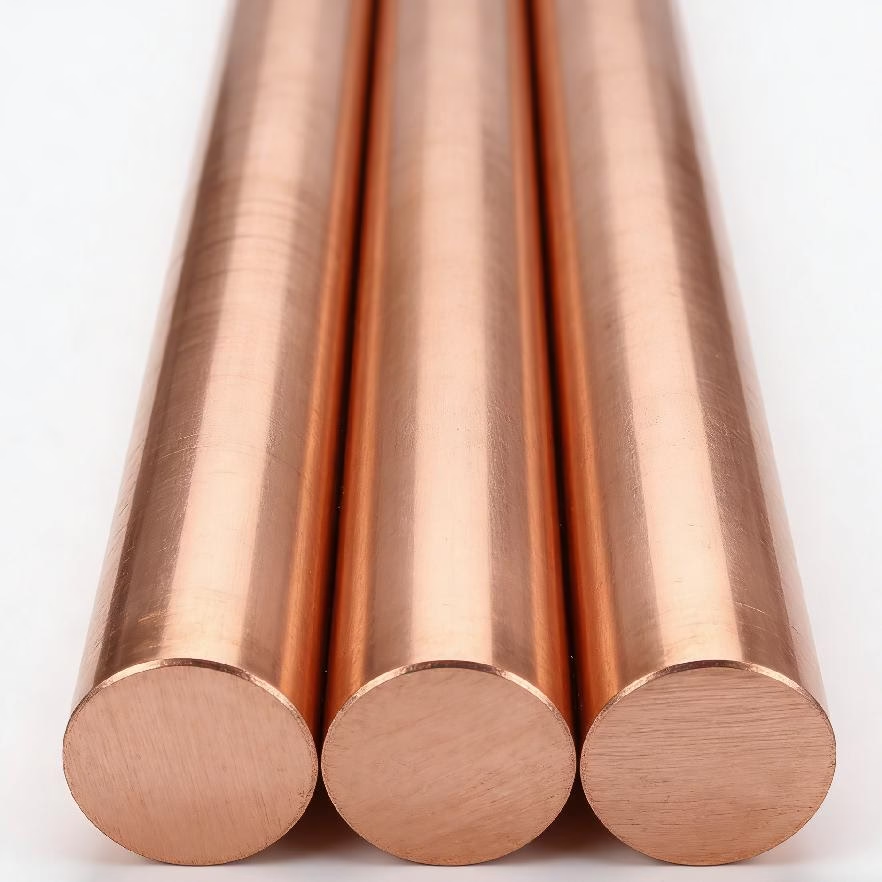
Copper Alloy Bar (Brass / Bronze / Cupronickel)
Copper Alloy Bar in free-cutting brass C36000, naval brass C46400, phosphor bronze C54400, aluminium bronze C63200, silicon bronze C65500, cupronickel C70600/C71500, beryllium copper C17200, and pure copper. Round, hex, flat bar. Diameter / A/F 3–300mm. ASTM B16/B21/B150/B196, EN 12163/12164. Mill test certificate provided.
| Material | Copper-Zinc / Copper-Tin / Copper-Aluminium / Copper-Nickel / Copper-Beryllium Alloy Bar and Rod |
|---|---|
| Grade / Standard | C36000 (CuZn39Pb3) / C46400 (CuZn38Sn) / C51000 (CuSn5) / C54400 (CuSn4Pb1) / C62300 (CuAl9Fe) / C63200 (CuAl10Ni5) / C65500 (CuSi3Mn) / C70600 (CuNi10) / C71500 (CuNi30) / C17200 (CuBe2) / C11000 |
| Diameter | Round Bar: 3mm – 300mm | Hexagonal Bar: 3mm – 100mm A/F | Flat Bar: 10×3mm to 300×50mm |
| Length | 3m / 6m standard lengths / Coiled rod up to Ø12mm for screw machine / Cut-to-length service |
| MOQ | 10 kg (Small Diameter / Specialty Alloy) / 100 kg (Standard Bar Stock) |
| Delivery Time | 15-30 Days (Stock) / 25-45 Days (Custom Production) |
| Loading Port | Tianjin / Shanghai / Qingdao |
Overview of Copper Alloy Bar
Copper Alloy Bar encompasses round bars, hexagonal bars, flat bars, and square bars manufactured from the full family of copper-based alloys — including brass (copper-zinc), bronze (copper-tin, copper-aluminium, copper-silicon, copper-beryllium), cupronickel (copper-nickel), and copper-lead free machining alloys — engineered to deliver the optimal combination of machinability, corrosion resistance, electrical and thermal conductivity, bearing performance, and mechanical strength required by the precision machining, plumbing, electrical, marine, and general engineering industries. Copper alloy bar is the primary stock form for CNC turning, automatic screw machine production, milling, drilling, and grinding of precision components — from simple turned fittings to complex multi-feature machined parts — where the inherent machinability of copper alloys (particularly free-cutting brass which machines at up to 100% of the machinability reference standard) combined with the physical properties of the alloy family provides economical precision component production at rates unmatched by most engineering materials.
Copper alloy bar is standardised under ASTM B16 (free-cutting brass rod, bar and shapes), ASTM B21 (naval brass rod, bar and shapes), ASTM B98 (copper-silicon alloy rod, bar and shapes), ASTM B138 (manganese bronze rod, bar and shapes), ASTM B150 (aluminium bronze rod, bar and shapes), ASTM B164 (Monel alloy bar — nickel-copper), ASTM B196 (beryllium copper rod and bar), EN 12163 (copper and copper alloys — rod for general purposes), EN 12164 (copper and copper alloys — rod for free machining purposes), EN 12167 (copper and copper alloys — profiles and rectangular bar for general purposes), JIS H3250 (copper and copper alloy rods and bars), and GB/T 4423 (copper and copper alloy drawn rod and bar). Principal grades range from C36000 / CuZn39Pb3 free-cutting brass (the benchmark 100% machinability rating alloy, the most widely machined bar material globally) through naval brass C46400, phosphor bronze C54400, aluminium bronze C62300 / C63200, silicon bronze C65500, beryllium copper C17200, and cupronickel C70600 / C71500, each serving distinct application requirements in the plumbing, automotive, electrical, marine, and precision engineering industries.
Key Features and Manufacturing Process
Copper alloy bar is produced through hot extrusion, hot rolling, or cold drawing manufacturing routes depending on alloy family, cross-section size, dimensional tolerance requirements, and surface finish specification. For the most important commercial grade — free-cutting brass C36000 — production begins with continuous casting of brass billet (typically 120–200mm diameter), followed by hot extrusion at 650–800°C to produce extruded rod in the 20–100mm diameter range, and then cold drawing in one or more passes through precision tungsten carbide or steel dies to achieve the final diameter tolerance of h9 or h11 (ISO 286-1) with the bright surface finish characteristic of drawn brass rod. Smaller diameters (below 20mm) are produced by cold drawing from wire rod through multiple die passes with intermediate annealing where required. Hexagonal bar is produced by extruding or rolling through hexagonal section rolls, then cold drawing through hexagonal dies to precise across-flats (A/F) dimensions in standard hexagonal wrench sizes (4mm to 100mm A/F).
For higher-alloy and higher-performance copper alloy bars — aluminium bronze (C63200), silicon bronze (C65500), cupronickel (C70600/C71500), and beryllium copper (C17200) — hot extrusion is the primary production route, as the higher flow stress and reduced ductility of these alloys at room temperature makes cold drawing impractical for larger diameters. Hot-extruded bars in the as-extruded condition have somewhat lower dimensional accuracy and rougher surface finish than cold-drawn bars; precision turned (peeled) or centreless-ground surface finishing is applied to achieve the dimensional tolerance and surface quality required for direct machining. Aluminium bronze bars require careful control of extrusion temperature (800–900°C) and cooling rate to achieve the required microstructure and avoid stress corrosion cracking susceptibility. Beryllium copper bars are solution annealed at 780–800°C after extrusion to provide maximum ductility for subsequent machining before age hardening. Standard bar lengths are 3 meters and 6 meters, with custom cut-to-length service. Coiled rod in diameters up to 12mm is available for automatic screw machine and CNC Swiss lathe bar feed applications.
Main Applications of Copper Alloy Bar
Free-cutting brass bar (C36000 / CuZn39Pb3 / CW614N) is the world’s most widely machined non-ferrous bar material, consumed in enormous quantities by automatic screw machines and CNC turning centres producing the complete range of brass fittings, valves, and precision components in the plumbing, HVAC, automotive, and electrical industries. Plumbing and water fitting applications include compression fittings (olives, coupling nuts, adapters), push-fit fittings, gate valve and ball valve bodies, angle stop valve bodies, mixer tap bodies and cartridges, hose nipples and connectors, pressure gauge adaptors, and water meter bodies — all produced from C36000 brass bar on multi-spindle automatic screw machines or CNC turning centres at high production rates. Electrical applications include terminal blocks and bus bar connecting studs, grounding clamps and lugs, electrical connector pins and contacts, lamp bases and sockets, fuse holders, panel mounting hardware, and precision turned electrical components where the combination of adequate electrical conductivity (26–28% IACS for C36000) and exceptional machinability enables economical production of complex electrical components.
Naval brass bar (C46400 / CuZn38Sn / CW712R) is the standard marine hardware material for machined valve trim, seawater strainer components, sea cock fittings, propeller shaft nuts and cap nuts, underwater hull fittings, and marine instrument components where dezincification resistance (achieved by tin addition) provides longer service life in seawater compared to standard yellow brass. Aluminium bronze bar (C62300 / CuAl9Fe3 and C63200 / CuAl10Ni5Fe4) provides the highest strength and seawater erosion-corrosion resistance of any copper alloy for marine pump impellers, propeller shaft sleeves and bearings, seawater valve bodies for offshore platforms, and heavily loaded marine bearing applications. Phosphor bronze bar (C54400 / CuSn4Pb1 and C51900 / CuSn6P) provides superior bearing and wear properties combined with good strength for plain bearings, bushings, thrust washers, worm gears, and gear blanks in slow-speed high-load industrial machinery. Beryllium copper bar (C17200 / CuBe2) in age-hardened condition achieves the maximum strength of any copper alloy for aerospace connector pins, precision scientific instrument components, oil well electrical feed-through pins, and non-sparking tool production in explosive environments. Silicon bronze bar (C65500 / CuSi3Mn) is used for marine bolts and fasteners, architectural hardware, chemical plant fittings, and pump components where atmospheric and marine corrosion resistance is required with better machinability than aluminium bronze. Cupronickel bar (C70600 and C71500) is machined into seawater piping fittings, marine heat exchanger components, offshore platform valve bodies, and naval vessel system components requiring maximum seawater corrosion resistance.
Why Choose Us for Copper Alloy Bar
Shandong Tanglu Metal Material Co., Ltd. supplies premium Copper Alloy Bar sourced from leading Chinese copper alloy producers including Ningbo Jintian Copper — one of China’s largest and most technically advanced copper alloy rod and bar producers — Chinalco Luoyang Copper, Hailiang Group, and Zhejiang Fuda Alloy Materials, all operating continuous casting, hot extrusion, and cold drawing production lines certified to ISO 9001, ASTM B16 / B21 / B150 / B196, EN 12163 / 12164 / 12167, JIS H3250, and GB/T 4423 product standard requirements. Every copper alloy bar lot is accompanied by original mill test certificates covering full OES chemical composition analysis of all principal alloying elements and controlled impurities, mechanical property test results (tensile strength, yield strength, elongation, hardness) per applicable standard, dimensional inspection data (diameter, across-flats, width, length, straightness) to applicable tolerance class, and complete heat and lot number traceability.
We offer a comprehensive copper alloy bar range covering C36000 / CuZn39Pb3 free-cutting brass (round, hex, flat — the most economically important copper alloy bar grade), C37700 / CuZn38Pb2 forging brass, C46400 / CuZn38Sn naval brass, C51000 / CuSn5 phosphor bronze, C54400 / CuSn4Pb1 leaded phosphor bronze, C62300 / CuAl9Fe aluminium bronze, C63200 / CuAl10Ni5Fe4 high-strength aluminium bronze, C65500 / CuSi3Mn silicon bronze, C70600 / CuNi10 cupronickel, C71500 / CuNi30 cupronickel, C17200 / CuBe2 beryllium copper, and pure copper C11000 / C10200 bus bar. Diameters / across-flats from 3mm to 300mm in round and hexagonal sections, flat bar width 10mm to 300mm, in standard cold-drawn (h9/h11 tolerance), hot-extruded (h11/h13), and peeled / turned surface conditions. Standard lengths 3m and 6m with cut-to-length service and coiled rod for automatic screw machine applications. With established monthly supply capacity and export relationships with precision machining companies, plumbing fitting manufacturers, marine hardware producers, electrical component makers, and bearing producers across more than 50 countries, we support packages from small sample orders to large annual production bar supply contracts. Each shipment includes original mill test certificate per EN 10204 3.1, with EN 10204 3.2 and third-party inspection by SGS, Bureau Veritas, or equivalent available for marine, aerospace, and critical industrial applications.
📐 Dimension & Size Table
| Alloy Grade (UNS/EN) | Common Name | Machinability (%) | Diameter / A/F Range | Standard Tolerance | Key Properties & Application |
|---|---|---|---|---|---|
| C36000 / CW614N | Free-Cutting Brass (CuZn39Pb3) | 100% | Ø3–300mm / h9(CD)/h11 / Plumbing fittings, valves, electrical, instruments | ||
| C37700 / CW608N | Forging Brass (CuZn38Pb2) | 90% | Ø20–200mm / h11 / Hot-forged fittings, valve bodies, complex shapes | ||
| C27200 / CW508L | Yellow Brass (CuZn37) | 60% | Ø5–100mm / h9/h11 / Turned hardware, lower-lead applications | ||
| C46400 / CW712R | Naval Brass (CuZn38Sn) | 40% | Ø10–200mm / h11 / Marine hardware, sea cocks, propeller fittings, dezincification-resistant | ||
| C48200 / CW712R var. | Naval Brass Leaded (CuZn37Sn1Pb) | 70% | Ø10–150mm / h11 / Machined marine fittings, improved machinability | ||
| C51000 / CW451K | Phosphor Bronze 5% (CuSn5) | 30% | Ø5–80mm / h11 / Electrical springs, bearings, worm gear blanks | ||
| C54400 / CW456K | Leaded Phosphor Bronze (CuSn4Pb1) | 80% | Ø10–200mm / h11 / Bearings, bushings, thrust washers, gear blanks | ||
| C62300 / CW304G | Aluminium Bronze 9% (CuAl9Fe3) | 50% | Ø10–200mm / h11/h13 / Marine fittings, industrial valves, bearings | ||
| C63200 / CW307G | High-Str. Al Bronze (CuAl10Ni5Fe4) | 40% | Ø10–300mm / h11/h13 / Propeller shafts, pump impellers, offshore valves | ||
| C65500 / CW116C | Silicon Bronze (CuSi3Mn) | 30% | Ø10–150mm / h11 / Marine bolts, architectural hardware, chemical fittings | ||
| C70600 / CW352H | Cupronickel 90/10 (CuNi10Fe1) | 30% | Ø10–200mm / h11 / Marine piping fittings, seawater valves, heat exchanger components | ||
| C71500 / CW354H | Cupronickel 70/30 (CuNi30Fe1) | 25% | Ø10–200mm / h11 / Naval, offshore, severe marine machined components | ||
| C17200 / CW101C | Beryllium Copper (CuBe2) | 20% (SA) / 50% (TH) | Ø5–150mm / h11 / Aerospace connectors, non-sparking tools, precision springs | ||
| C11000 / CW004A | ETP Copper Bus Bar | 20% | Flat bar: 10–300mm wide / h11 / Electrical bus bar, transformer connections, switchgear |
* Custom sizes available upon request. Tolerances per relevant international standards.
🔬 Chemical Composition
| Element | Min | Max | Display Value | Note |
|---|---|---|---|---|
| Cu (C36000 Free-Cutting Brass) | 60.0 | 63.0 | 60.0–63.0 | Per ASTM B16 / EN CW614N — 60/40 base with lead addition for machinability |
| Zn (C36000 Free-Cutting Brass) | Bal. | - | Balance (~35–38%) | Zinc provides yellow colour and strength |
| Pb (C36000 Free-Cutting Brass) | 2.5 | 3.7 | 2.5–3.7 | Lead — chips breaker providing 100% machinability rating; note: restricted in drinking water fittings in some markets |
| Cu (C46400 Naval Brass) | 59.0 | 62.0 | 59.0–62.0 | Per ASTM B21 / EN CW712R — copper base for corrosion resistance |
| Sn (C46400 Naval Brass) | 0.50 | 1.00 | 0.50–1.00 | Tin addition — provides dezincification resistance in seawater service |
| Cu (C63200 Al Bronze) | Bal. | - | Balance (~79–82%) | Per ASTM B150 / EN CW307G — copper matrix for corrosion resistance and ductility |
| Al (C63200 Al Bronze) | 9.0 | 11.0 | 9.0–11.0 | Aluminium — primary strengthening and corrosion resistance element |
| Ni (C63200 Al Bronze) | 4.0 | 5.5 | 4.0–5.5 | Nickel — further improves strength, toughness, and seawater corrosion resistance |
| Fe (C63200 Al Bronze) | 3.0 | 5.0 | 3.0–5.0 | Iron — grain refiner and solid solution strengthener |
| Ni (C70600 Cupronickel) | 9.0 | 11.0 | 9.0–11.0 | Per ASTM B122 / EN CW352H — nickel for seawater corrosion resistance |
| Fe (C70600 Cupronickel) | 1.0 | 1.8 | 1.0–1.8 | Iron critical for erosion-corrosion resistance in turbulent seawater |
| Be (C17200 Beryllium Copper) | 1.80 | 2.00 | 1.80–2.00 | Per ASTM B196 / EN CW101C — age-hardening element; maximum strength copper alloy |
| Co+Ni (C17200 Beryllium Copper) | 0.20 | 0.60 | 0.20–0.60 | Controls grain growth during age hardening heat treatment |
| Pb (Lead-free / Low-Lead Alloys) | - | 0.25 | ≤0.25 | NSF 61 / EU RoHS / California AB1953 low-lead drinking water compliance; specify explicitly |
* Chemical composition may vary by heat, thickness and specification. Please refer to the actual mill test certificate.
⚙️ Mechanical Properties
| Property | Value | Unit | Test Condition |
|---|---|---|---|
| Tensile Strength — C36000 Brass (H04 Cold Drawn) | 415–540 | MPa | Per ASTM B16 — cold drawn round / hex bar standard condition |
| Yield Strength — C36000 Brass (H04 Cold Drawn) | 310–380 | MPa | 0.5% extension under load per ASTM B16 |
| Elongation — C36000 Brass (H04 Cold Drawn) | ≥18 | % | Gauge length 2 inches per ASTM B16 |
| Machinability Rating — C36000 Free-Cutting Brass | 100 | % (Reference Standard) | The universal 100% machinability reference for all metals; all other alloys rated relative to C36000 |
| Tensile Strength — C46400 Naval Brass (Extruded) | 380–490 | MPa | Per ASTM B21 — hot extruded rod, as-extruded condition |
| Machinability Rating — C46400 Naval Brass | 40 | % (vs C36000) | Lower machinability than free-cutting brass due to absence of lead chip breaker |
| Tensile Strength — C54400 Leaded Ph. Bronze (Extruded) | 310–415 | MPa | Per ASTM B139 — good bearing properties, moderate strength |
| Machinability Rating — C54400 Leaded Phosphor Bronze | 80 | % (vs C36000) | Lead addition improves machinability of phosphor bronze significantly |
| Tensile Strength — C63200 Al Bronze (Extruded) | 620–760 | MPa | Per ASTM B150 — highest strength standard copper alloy bar |
| Yield Strength — C63200 Al Bronze (Extruded) | 275–380 | MPa | 0.5% extension under load — approaches medium-strength steel |
| Hardness — C63200 Al Bronze | 159–196 | HBW | Brinell hardness of hot-extruded aluminium bronze bar |
| Tensile Strength — C70600 Cupronickel 90/10 (Extruded) | 300–415 | MPa | Per ASTM B122 — annealed/extruded condition for marine fittings |
| Tensile Strength — C17200 Be Copper (Solution Annealed) | 415–540 | MPa | Per ASTM B196 — soft condition for machining before age hardening |
| Tensile Strength — C17200 Be Copper (Age-Hardened TH04) | 1,140–1,380 | MPa | After cold draw H04 + age harden 315°C/3h — highest strength copper alloy |
| Electrical Conductivity — C11000 Copper Bus Bar | ≥100 | % IACS | Reference standard for electrical conductivity — 100% IACS |
| Electrical Conductivity — C36000 Free-Cutting Brass | 26–28 | % IACS | Adequate for electrical terminal and grounding hardware applications |
* Values shown are minimum requirements unless otherwise stated.
📦 Commercial Information
| Packaging | Standard seaworthy export packing for copper alloy bar. Round and hexagonal bars in diameters up to 30mm bundled in hexagonal close-packed arrangements with steel strapping (3–5 wraps per bundle, maximum 500 kg per bundle) — hexagonal packing maximises bundle density for container loading efficiency. Bars in diameters 30–100mm bundled in single-layer or double-layer rectangular stacks with timber dunnage separators between bar layers and steel strapping securing the complete bundle. Large-diameter bars (above 100mm) packed individually or in small groups with steel strapping through individual bar-to-bar stacking with timber chocks between bars to prevent rolling and mutual damage. All bars coated with anti-tarnish BTA (benzotriazole) oil treatment or wrapped with anti-tarnish VCI paper before bundling to prevent atmospheric tarnishing of bright drawn or machined surfaces during ocean transit — untreated brass and copper alloy surfaces can develop surface tarnish and staining within days of exposure to humid salty marine atmosphere, making surface protection mandatory for export shipments. End faces of all bars protected with plastic or cardboard end caps to prevent moisture entry into bar bundle ends and protect bore surfaces (important for hollow or partially bored bar). Flat copper bus bar and flat bar stacked with anti-tarnish paper separators between each bar, secured with plastic strapping on timber pallets. Each bundle tagged with alloy designation (C36000, C63200, etc.), EN designation (CW614N, CW307G, etc.), UNS number, bar form (round/hex/flat), size (diameter/A-F/width×thickness in mm), length, weight (kg), applicable standard (ASTM B16, EN 12164, etc.), heat number, and lot number. Beryllium copper bar (C17200) requires additional hazardous material labelling per GHS/OSHA regulations with Safety Data Sheet (SDS) included in every shipment. Container loading: 20FT FCL typically 18–22 tons of standard brass bar; 40HQ for long bars (6m length). LCL consolidation available for mixed alloy bar orders from stock. Air freight available for urgent small sample or prototype orders (10–100 kg) with secure palletised packaging. |
|---|---|
| Payment Terms | T/T (Telegraphic Transfer),L/C (Letter of Credit),D/P (Documents against Payment),Western Union,PayPal |
| Price Term | FOB,CFR,CIF,EXW |
| Supply Capacity | 500 Tons/Month (Copper Alloy Bar and Rod) |
| Loading Port | Tianjin / Shanghai / Qingdao |
Why Choose Our Copper Alloy Bar (Brass / Bronze / Cupronickel)?
Mill Certified Copper Alloy Bar Quality
Copper alloy bar supplied with original mill test certificate EN 10204 3.1/3.2 covering full OES/ICP chemical composition of all principal alloying elements and controlled impurities (including lead content for regulatory compliance), mechanical properties (tensile strength, yield strength, elongation, hardness) per applicable standard, dimensional inspection (diameter/A-F, straightness, length), and complete heat and lot number traceability per ASTM B16/B21/B150/B196, EN 12163/12164.
Comprehensive Alloy, Form & Size Range
Full copper alloy bar range: free-cutting brass C36000, forging brass C37700, naval brass C46400, phosphor bronze C51000/C54400, aluminium bronze C62300/C63200, silicon bronze C65500, cupronickel C70600/C71500, beryllium copper C17200, pure copper C11000. Round bar Ø3–300mm, hexagonal bar 3–100mm A/F, flat bar 10×3 to 300×50mm. Standard 3m and 6m lengths; coiled rod for screw machine.
100% Machinability Benchmark — Free-Cutting Brass
C36000 / CuZn39Pb3 free-cutting brass is the universal machinability reference at 100% rating — the fastest-machining engineering metal, enabling CNC turning at 2–4× the cutting speed of stainless steel, 3–5× aluminium bronze, and producing clean, short-breaking chips ideal for high-productivity automatic screw machine and CNC turning centre production of precision brass components.
Multi-Standard International Grade Coverage
Available per ASTM B16/B21/B98/B138/B150/B196 (American), EN 12163/12164/12167 (European CW designations), JIS H3250 (Japanese), and GB/T 4423 (Chinese) standards. NSF 61 / California AB1953 low-lead brass grades (C69300, CuZn21Si3P) available for drinking water compliance. Lead-free alternatives for RoHS and REACH regulated markets.
Stock Availability for Common Grades
C36000 free-cutting brass round and hex bar (Ø6–100mm), C63200 aluminium bronze (Ø20–150mm), C70600 cupronickel (Ø10–100mm), and C17200 beryllium copper (Ø10–80mm) maintained in stock for 15–25 days dispatch. Custom diameters and specialty alloys 25–45 days production. Coiled rod for screw machine available in C36000 up to Ø12mm.
🏭 Applications of Copper Alloy Bar (Brass / Bronze / Cupronickel)
Copper alloy bar serves as the essential machining stock for precision component production across the plumbing, marine, electrical, bearing, and general engineering industries, with each alloy in the copper family selected for the specific combination of machinability, corrosion resistance, mechanical strength, and physical properties required by the target application. Free-cutting brass (C36000 / CuZn39Pb3 / CW614N) is by far the largest-volume copper alloy bar grade, consumed in enormous quantities by multi-spindle automatic screw machines, Swiss-type CNC lathes, and CNC turning centres producing the complete range of precision brass components at production rates of 500–5,000 parts per hour. Plumbing and HVAC applications account for the majority of C36000 consumption, including compression fitting bodies (straight couplings, elbows, tees, reducers), compression ring olives, push-fit fitting bodies, ball valve and gate valve bodies and stems, angle stop valve bodies for water service, pressure-reducing valve bodies, thermostatic mixing valve bodies, backflow preventer bodies, hose nipples and barbs, water meter body blanks, radiator valves, underfloor heating manifold components, boiler pressure vessel fittings, and the complete range of copper alloy fittings and valve trim for domestic plumbing, commercial HVAC systems, and industrial process water systems. The electrical and electronics industry produces terminal block connecting studs and bolts, grounding clamp hardware, electrical connector housings, lamp holder bodies and caps, fuse holder contacts, panel-mounting hardware, power distribution bus connector blocks, automotive battery terminal clamps, cable gland bodies, and precision turned electrical components from C36000 bar — all benefiting from the 26–28% IACS electrical conductivity that provides adequate current-carrying capacity for terminal applications combined with the 100% machinability that enables economical production of complex terminal geometries on high-speed CNC equipment. Automotive applications include carburetor and fuel system fittings (historical applications now partly replaced by plastics), air conditioning system fittings and connectors, power steering system fittings, hydraulic brake line connections, instrument panel fittings and bezels, and precision turned hydraulic and pneumatic fitting components. Naval brass bar (C46400 / CuZn38Sn / CW712R) machined into marine hardware represents one of the oldest and most technically important copper alloy bar applications — seacock fittings, through-hull fittings, sea water strainer caps and bodies, propeller shaft cap nuts and lock nuts, rudder shaft components, underwater hull drain plugs, depth sounder transducer housings, and seawater intake valve trim components in naval brass provide significantly longer service life than standard yellow brass in marine environments because the 0.5–1.0% tin addition inhibits dezincification — the selective leaching of zinc from the brass alloy that occurs in certain seawater conditions, leaving a porous copper-rich sponge with no structural integrity. Aluminium bronze bar (C63200 / CuAl10Ni5Fe4 / CW307G) machined into heavy-duty marine and offshore components represents the highest-performance standard copper alloy bar application by mechanical loading — marine pump impeller bodies, impeller rings, and diffuser casing components for seawater service pumps in naval vessels and offshore platforms benefit from the tensile strength of 620–760 MPa (approaching medium-strength structural steel) combined with near-zero seawater corrosion rate, outstanding resistance to velocity-accelerated erosion-corrosion at high pump flow rates, and the self-lubricating bearing properties of aluminium bronze that allow dry-run survival during seawater pump priming. Propeller shaft bearing sleeves and stern tube bushings in aluminium bronze provide the combination of strength and seawater corrosion resistance required at the rotating shaft-to-hull interface of marine propulsion systems. Offshore oil platform seawater lift pump impellers, fire water pump impellers, ballast water pump components, and seawater injection pump trim in C63200 are specified by oil company engineering standards including Shell DEP, Total GS-EP-ECP, and Chevron ENGEDs where aluminium bronze is the standard material for seawater pump internals subject to abrasion, cavitation erosion, and chloride stress corrosion. Leaded phosphor bronze bar (C54400 / CuSn4Pb1) machined into plain bearings, bushings, thrust washers, and worm gear blanks for slow-speed high-load industrial machinery represents a major traditional application where the combination of good anti-galling properties against steel shafts, adequate compressive strength to support high unit loads, good embeddability allowing fine grit and hard particles to sink into the soft alloy surface without scoring the steel shaft, thermal conductivity for bearing heat dissipation, and lead-improved machinability for economical production of complex bearing bores makes phosphor bronze the standard journal bearing material for textile machinery, paper mill equipment, marine deck winches, agricultural machinery gearboxes, automotive transmission bushings, and general industrial low-speed bearing applications where rolling element bearings are impractical or uneconomical. Silicon bronze bar (C65500 / CuSi3Mn) produced marine fasteners — bolts, nuts, screws, and rod used for wooden boat planking, deck hardware attachment, and keel bolting — is a traditional application exploiting silicon bronze's outstanding atmospheric and seawater corrosion resistance (forming a tight adherent oxide film in marine environments), good strength (tensile ~517 MPa cold drawn), and freedom from dezincification that makes it superior to brass for exposed marine fastener applications. Cupronickel bar (C70600 90/10 and C71500 70/30) machined into marine piping system fittings — flanged elbows, tees, reducers, valves, and flow instrument bodies for seawater piping systems on naval vessels, cruise ships, desalination plants, and offshore platforms — provides the highest seawater corrosion resistance of any standard copper alloy for machined fittings, with service life typically exceeding 25–30 years in clean seawater service without corrosion-related maintenance. Beryllium copper bar (C17200 / CuBe2) machined in the solution-annealed condition then age-hardened achieves tensile strength of 1,140–1,380 MPa for aerospace electrical connector contact pins, precision instrument components, oil well electrical penetrator pins in high-pressure well completions, and non-sparking tools (wrenches, hammers, chisels, screwdrivers) for potentially explosive environments in petroleum refineries, chemical plants, grain elevators, and munitions handling facilities where standard steel tools could ignite flammable vapours through impact-generated sparks.
📋 Quality & Certification
Our Certifications
- ✅ ISO 9001:2015
- ✅ CE Marking
- ✅ ABS
- ✅ DNV GL
- ✅ Lloyd's Register (LR)
- ✅ Bureau Veritas (BV)
- ✅ SGS Certified
- ✅ NK
- ✅ RINA
Mill Certificate Type
- 📋 EN 10204 3.1
- 📋 EN 10204 3.2
- 📋 Original Mill Certificate
- 📋 Third Party Inspection Available
- 📋 Certificate of Origin
❓ Frequently Asked Questions
What is free-cutting brass and why does it have 100% machinability rating?
Free-cutting brass (C36000 / CuZn39Pb3 / EN CW614N / JIS C3604) is a copper-zinc-lead alloy containing approximately 61.5% copper, 35.5% zinc, and 3.0% lead that holds the distinction of being rated at 100% machinability — the universal reference standard against which the machinability of all other engineering metals and alloys is measured. The 100% machinability rating means that C36000 can be machined at the fastest cutting speeds, with the lowest cutting forces, producing the finest surface finishes, consuming the least cutting tool wear, and generating the shortest most manageable chips of any standard engineering metal — performance that translates directly into the highest production rates and lowest per-part machining costs in automated screw machine and CNC turning production. The metallurgical explanation for this exceptional machinability lies in the role of lead: lead is essentially insoluble in the copper-zinc brass matrix and exists as discrete globules (1–40μm diameter) uniformly distributed throughout the alloy microstructure. During cutting, these lead globules perform three critical chip-control functions: (1) they act as chip-breakers — as the machining chip forms at the tool cutting edge, the chip encounters lead globules that cause the chip to break into short segments (typically 1–5mm length) rather than forming long continuous stringy chips that would wrap around the tool, workpiece, or machine spindle causing machine stoppages and operator safety hazards; (2) they act as solid lubricants — lead has very low shear strength (yield stress ~7 MPa versus brass ~200 MPa) and melts at only 327°C (well below the 400–500°C tool-chip interface temperatures generated during fast brass machining), forming a thin liquid lead film at the tool-chip interface that dramatically reduces friction and heat generation, protecting the cutting edge and enabling very high cutting speeds; (3) they produce a smooth built-up edge free surface — the liquid lead film prevents the brass from adhering to the tool rake face (built-up edge formation), ensuring consistently clean, sharp cuts producing excellent surface finish without periodic tool edge cleaning or tool changes. In practice, C36000 free-cutting brass is machined at cutting speeds of 150–300 m/min on CNC turning centres (versus 50–100 m/min for 316 stainless steel and 80–120 m/min for aluminium alloys), enabling production rates 3–6× higher per machine-hour than equivalent stainless steel components of the same geometry.
What is the difference between free-cutting brass C36000 and lead-free brass for drinking water applications?
Free-cutting brass C36000 (containing 2.5–3.7% lead) has been the standard plumbing fitting material for over a century, providing exceptional machinability that enables economical production of the complex internal geometries of valve bodies, compression fittings, and water meter components. However, regulatory concerns about lead leaching from brass fittings into drinking water — particularly during extended stagnation in household plumbing — have driven significant regulatory action and material substitution toward low-lead and lead-free brass alloys in recent years. Key regulations affecting lead content in drinking water plumbing: United States — NSF/ANSI 61 (Drinking Water System Components) limits lead extractability from plumbing components; California Health & Safety Code Section 116875 (Proposition 65 / AB1953, 'California low-lead law' effective 2010) limits 'weighted average lead content' to ≤0.25% by weight for wetted surface components — this essentially bans standard C36000 (3% lead) from drinking water service in California; US Federal 'Reduction of Lead in Drinking Water Act' effective January 2014 extended similar ≤0.25% weighted average lead content requirements to all US states for pipes, fittings, and fixtures used in potable water systems. European Union — EU Regulation (EU) 2020/1849 under the Drinking Water Directive restricts lead in materials in contact with drinking water; Germany has particularly strict DIN 50930-6 requirements; UK has adopted similar restrictions. Lead-free and low-lead brass alternatives include: C69300 / CuZn21Si3P (bismuth/silicon brass, called 'EnviroBrass' or 'Eco Brass') — a silicon-bismuth-phosphorus alloyed brass with <0.1% lead achieving ~85% machinability relative to C36000, NSF 61 certified, now widely used by US and European plumbing fitting manufacturers; C87850 silicon brass (Cu ~82%, Si ~4%, Zn ~14%) — very low lead (<0.1%), excellent corrosion resistance, NSF 61 compliant; C89833 bismuth-selenium brass — another C36000 replacement with acceptable machinability for drinking water fittings; DZR (Dezincification-Resistant) brass per EN 12165 — low-lead formulations with arsenic addition for dezincification resistance in soft water areas. When specifying brass bar for plumbing applications, always confirm the lead content specification complies with the regulatory requirements of the destination market and end-use application.
What is the difference between C62300, C63200, and C95800 aluminium bronze bar grades?
Aluminium bronze bar grades differ in aluminium, nickel, iron, and manganese content, resulting in distinct combinations of strength, corrosion resistance, and toughness optimised for different application severity levels. C62300 (CuAl9Fe3, EN CW302G) is a binary aluminium bronze containing approximately 87% copper, 8.5–9.5% aluminium, and 2.0–4.0% iron, producing tensile strength of 480–620 MPa (extruded) with good seawater corrosion resistance, moderate strength, and adequate toughness for general marine fittings, industrial valve trim, pump components in moderate service, and bearing applications where strength above phosphor bronze is required but the highest performance of complex aluminium bronzes is not justified. C62300 has better machinability than the more complex grades and lower cost, making it suitable for general marine hardware production. C63200 (CuAl10Ni5Fe4, EN CW307G) is the high-performance nickel-aluminium bronze containing approximately 79–82% copper, 9–11% aluminium, 4–5.5% nickel, and 3–5% iron, achieving tensile strength of 620–760 MPa (extruded) — approaching medium-strength steel — with superior seawater corrosion resistance (including resistance to crevice corrosion and stress corrosion cracking), excellent erosion-corrosion resistance at high flow velocities, good cavitation resistance for pump impeller applications, and adequate toughness for shock-loaded marine components. C63200 is the standard material for: marine propulsion pump impellers and casings for naval vessels and offshore platforms; propeller shaft bearing sleeves and stern tube bushings; seawater valve bodies for critical offshore platform service (NACE MR0175 compliant); marine equipment components where simultaneous seawater corrosion resistance and structural loading are primary requirements. C95800 (nickel aluminium bronze, SAE J462 specification) is essentially the cast alloy equivalent of C63200 wrought bar, containing similar Cu-Al-Ni-Fe chemistry but produced by casting rather than extrusion. C95800 castings and C63200 extruded bar are frequently used together in the same pump or valve assembly — the complex geometry of impellers and valve bodies is cast in C95800, while straight-geometry components (shafts, sleeves, stem extensions) are machined from C63200 bar. The primary selection criteria: C62300 for general moderate-service marine fittings and cost-sensitive applications; C63200 for high-performance seawater pump components, heavily loaded bearings, propeller shaft components, and offshore critical service where maximum seawater resistance and mechanical performance justify the higher cost.
What surface tolerance and dimensional accuracy standards apply to copper alloy bar?
Copper alloy bar dimensional tolerances follow ISO 286-1 fundamental deviation and tolerance grade system for shaft dimensions (outside diameter), with specific tolerance class selection depending on manufacturing process and application. Cold-drawn copper alloy bar (the standard for free-cutting brass C36000 in diameters up to approximately 100mm) achieves: diameter tolerance h9 (ISO 286-1) — the standard commercial tolerance for drawn brass bar up to approximately 50mm diameter, providing tolerance range of 0 to −0.062mm for 20mm bar and 0 to −0.087mm for 50mm bar. This tolerance is suitable for direct use on CNC lathes with minimal setup-dependent diameter scatter. Diameter tolerance h11 is the alternative standard for drawn bar above 50mm and for hot-extruded bar of all alloys, providing approximately 3× wider tolerance than h9 (e.g., 0 to −0.160mm for 50mm bar in h11). Hot-extruded bar of aluminium bronze, silicon bronze, cupronickel, and beryllium copper is typically supplied in h11/h13 tolerance as the extrusion process cannot achieve the dimensional precision of cold drawing. Peeled and turned bar (OD turned by a fixed-knife peeling lathe or centreless turning machine) achieves h10/h11 tolerance with a bright machined surface free from extrusion surface defects — specified when hot-extruded bar dimensional accuracy must be improved without the full dimensional precision of centreless grinding. Centreless ground bar achieves h6/h7/h8 tolerance (high precision) with a ground surface finish of Ra 0.4–0.8μm — specified for directly machinable bar applications requiring minimum tool runout compensation and where bar OD straightness (≤0.5mm per 1,000mm length for h7 ground bar) is critical for CNC Swiss-type lathe bar feed applications. Hexagonal bar across-flats tolerance follows the same tolerance grade system with h9 and h11 the standard commercial tolerances for cold-drawn and extruded hex respectively. Straightness tolerance for straight-length copper alloy bar is specified as maximum bow (deviation from straight line) per unit length: cold-drawn bar typically ≤1.5mm per 1,000mm length (1.5 mm/m maximum bow); hot-extruded bar typically ≤3mm per 1,000mm. For precision CNC Swiss lathe and multi-spindle screw machine bar feed applications, straightness ≤1.0mm per 1,000mm is commonly specified and achievable by rotary straightening of cold-drawn bar as a secondary operation.
How is aluminium bronze bar used in offshore oil and gas applications and what specifications apply?
Aluminium bronze bar — specifically C63200 (CuAl10Ni5Fe4) and equivalent grades — is widely specified in offshore oil and gas platform topside and subsea equipment where the combination of seawater corrosion resistance, mechanical strength, and non-sparking properties addresses specific safety and reliability requirements of offshore production environments. Principal offshore applications include: Seawater pump components — C63200 extruded bar is machined into impeller hubs, pump sleeves, shaft couplings, and bearing surfaces for offshore platform seawater lift pumps, fire water pump impellers, produced water injection pump trim, and seawater cooling system pump components. Offshore oil company engineering standards including Shell DEP 31.38.01.32 (Materials for seawater systems), Total GS-EP-ECP-05 (Copper alloys for offshore use), and Chevron ENGEDS all specify nickel aluminium bronze (equivalent to C63200/C95800) as the standard material for seawater pump internals subject to velocity-accelerated erosion-corrosion and cavitation. Non-sparking tools — aluminium bronze (C63200) and beryllium copper (C17200) bars are machined into non-sparking hand tools including open-end wrenches, combination spanners, hammers, chisels, screwdrivers, and pipe wrenches for use in classified Zone 1 and Zone 2 hazardous areas on offshore platforms where flammable hydrocarbon vapours are present and standard steel tool impact sparks could ignite an explosive atmosphere. ATEX Directive 2014/34/EU and IECEx standards for equipment in explosive atmospheres classify aluminium bronze as a non-sparking material suitable for Group IIA, IIB, and IIC hazardous area tools. Valve trim and manifold fittings — seawater system gate valve discs, ball valve balls, globe valve plugs, check valve discs, and strainer element housings in C63200 for offshore platform seawater injection, cooling, and fire suppression systems requiring long service life (25-year design life per DNV GL offshore platform standards) without seawater corrosion-related failures. NACE MR0175 / ISO 15156 compliance — for offshore applications in sour service environments containing H2S, C63200 aluminium bronze is generally compliant with NACE MR0175 requirements for copper alloy components in sour service at the hardness levels achievable after standard extrusion and annealing (typically HRC <24, well within the NACE limit) — this compliance enables use of C63200 fittings in combined sweet/sour service areas on production platforms without the dezincification or stress corrosion concerns that would limit use of brass or standard copper alloys in sour service. Applicable specifications for offshore aluminium bronze: ASTM B150 (rod and bar), ASTM B505/B505M (continuous castings), EN CW307G (EN 12163 profile), DNV GL Material Technology Circular 2018-02, and Lloyd's Register Rules for Naval Ships Chapter 10 (copper alloys for marine service).
Get a Quote for
Copper Alloy Bar (Brass / Bronze / Cupronickel)
Submit your requirements and receive a competitive price quote within 24 hours.
- ✓ Fast response within 24 hours
- ✓ Competitive factory-direct pricing
- ✓ Free technical consultation
- ✓ Mill test certificate provided
- ✓ Flexible payment terms available
⏱ Response within 24 hours
Send Your Inquiry
All fields marked with * are required