
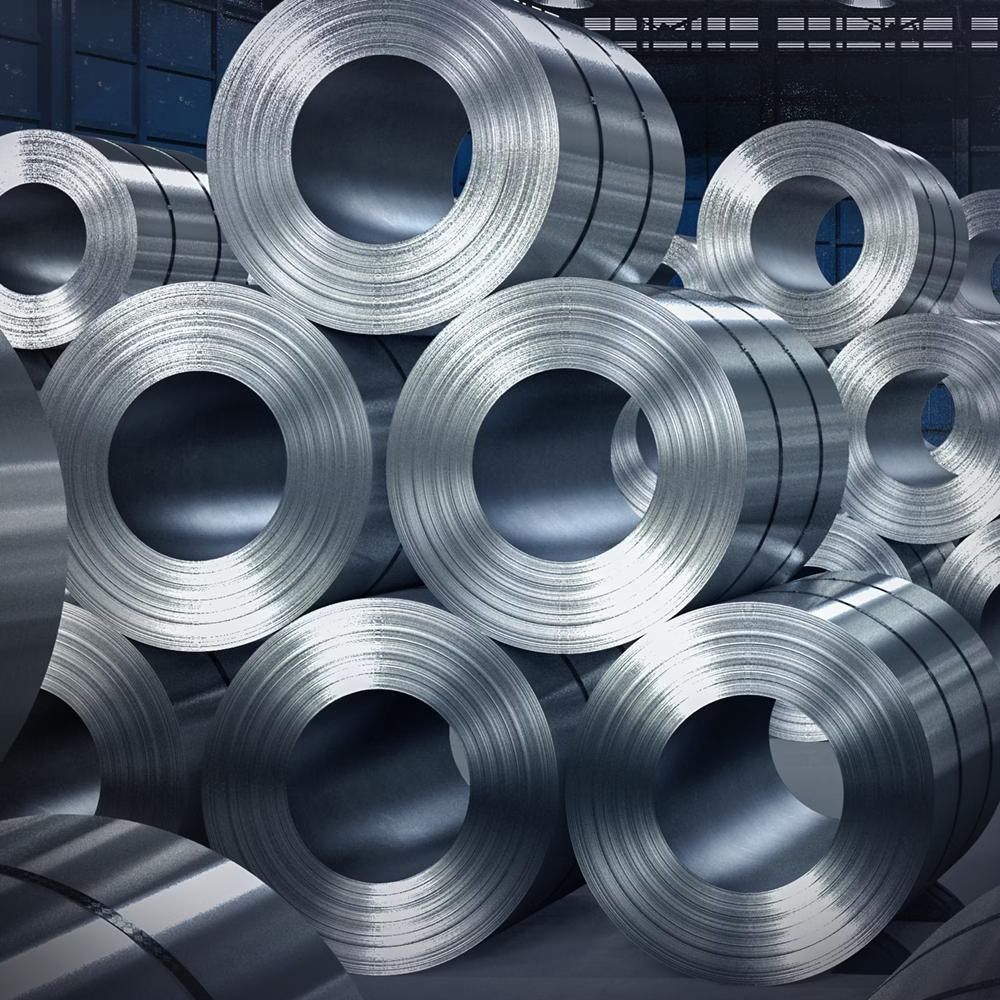
Complex Phase Steel (CP800 / CP1000 / CP1200)
Complex Phase Steel (CP800 / CP1000 / CP1200 / CP1400) is advanced high-strength multiphase steel for automotive structural and safety components combining tensile strength 800-1400 MPa with superior hole expansion ratio (HER ≥50%) for excellent edge stretchability and crash energy absorption. Thickness 0.5-8.0mm, width 600-1900mm. IATF 16949 certified.
| Material | Advanced High-Strength Steel (AHSS) — Complex Phase Multiphase Microstructure |
|---|---|
| Grade / Standard | CP800 / CP1000 / CP1200 / CP1400 (per EN 10338 / VDA 239-100) |
| Thickness | 0.5mm - 8.0mm (CR: 0.5-3.0mm / HR: 1.5-8.0mm) |
| Width | 600mm - 1900mm |
| Inner Diameter (ID) | 508mm / 610mm |
| Coil Weight | 8-30 Tons (Standard 12-22 Tons) |
| Delivery Condition | hot_rolled / cold_rolled / annealed |
| Surface Treatment | galvanized / coated |
| MOQ | 5 Tons |
| Delivery Time | 30-45 Days (Custom) / 15-25 Days (Stock) |
| Loading Port | Tianjin / Shanghai / Qingdao |
Overview of Complex Phase Steel (CP)
Complex Phase Steel (CP) is an advanced high-strength steel (AHSS) characterized by an extremely fine multiphase microstructure consisting of a ferrite and bainite matrix with small amounts of martensite, retained austenite, and pearlite, often further strengthened by precipitation hardening through microalloying additions of niobium, titanium, and/or vanadium. Specified under EN 10338 (European cold-rolled AHSS), EN 10346 (hot-dip coated AHSS), VDA 239-100 (German automotive), and equivalent SAE J2340 / GMW standards, CP steel occupies a unique position in the advanced high-strength steel family by combining very high strength (tensile strength 800-1200 MPa) with remarkable residual deformation capacity and high energy absorption — properties critical for automotive structural and safety components subjected to crash loading. Unlike Dual Phase (DP) steel which is optimized for a balance of strength and uniform elongation, CP steel is specifically engineered for maximum strength with superior hole expansion ratio (HER/λ), edge stretchability, and resistance to edge cracking during flanging and roll-forming operations.
The most widely specified CP steel grades include CP800 (tensile strength ≥800 MPa, the entry-level CP grade for structural reinforcements), CP1000 (tensile strength ≥1000 MPa, the most commonly used CP grade for automotive B-pillar reinforcements, side sill reinforcements, and bumper beams), CP1200 (tensile strength ≥1200 MPa, the ultra-high-strength CP grade for weight-critical structural components), and CP1400 (tensile strength ≥1400 MPa, the highest CP grade for premium safety applications). Per EN 10338 designation system, CP grades are identified as HCT780C, HCT980C, HCT1180C, and equivalent designations. The critical mechanical property differentiating CP steel from other AHSS is the hole expansion ratio (HER/λ ≥ 50-80% depending on grade and test method ISO 16630), which quantifies edge stretchability and resistance to edge cracking — a property essential for automotive components manufactured by punching, laser cutting, and subsequent flanging or hem-flanging operations. Tanglu Group supplies CP steel grades from leading Chinese automotive steel mills including Baosteel, HBIS, and Shougang, with full material certification and PPAP documentation support meeting global automotive OEM requirements.
Key Features and Manufacturing Process
Complex Phase Steel is produced through a precisely controlled thermo-mechanical processing route that generates the unique complex multiphase microstructure responsible for its exceptional combination of high strength, edge stretchability, and crash energy absorption. The manufacturing process begins with electric arc furnace or basic oxygen furnace steelmaking with microalloying additions of niobium (0.02-0.08%), titanium (0.010-0.060%), and/or vanadium (0.05-0.15%) carefully controlled to provide precipitation strengthening and grain refinement. Carbon content is maintained at a moderate level (0.05-0.14%) — higher than BH or IF steels but lower than martensitic grades — to enable the controlled formation of martensite and bainite phases during heat treatment. The hot-rolling process applies precisely controlled finish rolling temperatures (850-950°C) and coiling temperatures (20-500°C depending on target microstructure) to initiate the complex multiphase transformation. For cold-rolled CP grades, hot-rolled strip is further cold-reduced (40-60% reduction) and subjected to continuous annealing at intercritical temperatures (750-900°C) with controlled rapid cooling through the bainitic transformation range, producing the characteristic fine ferrite-bainite matrix with dispersed martensite and retained austenite islands that provide the unique CP steel properties.
The finished CP steel is supplied in both hot-rolled (HR) and cold-rolled (CR) coil forms. Hot-rolled CP steel is available in thickness range 1.5mm to 8.0mm, width 900mm to 1650mm, with coil weight 8-30 tons. Cold-rolled CP steel is available in thickness 0.5mm to 3.0mm, width 600mm to 1900mm, with coil weight 8-25 tons. Surface treatments include pickled and oiled (P&O) for hot-rolled grades, cold-rolled bright surface, electrogalvanized (ZE coating), and hot-dip galvanized (GI/GA coating) for corrosion-resistant structural applications. Each CP steel coil undergoes comprehensive quality testing including chemical composition analysis by optical emission spectrometry, tensile and yield strength verification, total elongation, hole expansion ratio (HER/λ) testing per ISO 16630 (the critical CP steel quality parameter), bending test (minimum bending radius verification), surface quality inspection, dimensional inspection per EN 10131 / EN 10051 latest revision, and weldability verification (spot welding and laser welding parameter qualification). The multiphase microstructure is verified by metallographic examination to confirm the correct phase balance (ferrite, bainite, martensite fractions) required for the specified mechanical properties. Tanglu Group supplies CP steel with complete automotive documentation including original mill test certificates, PPAP support, and third-party inspection by SGS, BV, or TUV as required by automotive OEM specifications.
Main Applications of Complex Phase Steel
Complex Phase Steel is extensively used across automotive structural and safety-critical applications where the unique combination of very high strength, superior edge stretchability, and high crash energy absorption cannot be matched by conventional high-strength steels or standard dual phase grades. The primary automotive application is B-pillar reinforcements (center pillar inner and outer reinforcements) for passenger cars and SUVs, where CP1000 and CP1200 provide the critical combination of high tensile strength for occupant protection during side impact collisions and sufficient hole expansion ratio (HER ≥50%) for the punched attachment holes and complex flanging operations used in B-pillar assembly — applications where DP steel of equivalent strength would exhibit edge cracking during flanging operations that CP steel resists due to its superior microstructure. Side sill (rocker) reinforcements and side impact door beams extensively use CP800 and CP1000 for the high-energy absorption required in side crash protection while maintaining formability for roll-forming and press-hardening alternative manufacturing routes.
Bumper systems represent another major CP steel application, including front and rear bumper beams and crash boxes (energy absorbers) using CP800 and CP1000 for high-strength crash energy absorption with excellent progressive deformation behavior — CP steel bumper beams absorb crash energy through controlled folding rather than brittle fracture, a critical performance requirement for both occupant safety and low-speed crash repair cost management. Longitudinal rails (front and rear crash rails) use CP800 for axial crush energy absorption in frontal crashes, where CP steel provides better crash performance than conventional HSLA due to higher strength-to-weight ratio and superior energy absorption per unit mass. Seat cross members, seat back frames, and safety belt anchors increasingly use CP800 to reduce weight while meeting increasingly stringent global NCAP (New Car Assessment Program) crash test requirements. Floor cross members, tunnel reinforcements, and roof rails in body-in-white (BIW) structural design benefit from CP steel’s high strength for weight reduction without sacrificing the formability and edge quality required for roll-forming and stamping operations. Wheel disk and wheel rim applications for light commercial vehicles and trucks use CP800 for weight reduction compared to conventional steel while maintaining fatigue resistance and impact resistance under dynamic loading conditions. Agricultural equipment structural frames, construction equipment boom arms and structural members, mining equipment impact-resistant wear parts, crane boom sections, forklift mast sections, and heavy truck chassis cross members represent industrial applications of CP steel where high strength combined with toughness and resistance to fatigue cracking provides performance advantages over conventional structural steels. The wind energy sector uses CP steel for tower flanges and structural connections, while the railway industry applies CP steel for bogie frames and structural components requiring high fatigue resistance. Tanglu Group supplies CP steel for all these applications with technical support for grade selection, forming parameter optimization, and welding procedure qualification.
Why Choose Us for Complex Phase Steel
Shandong Tanglu Metal Material Co., Ltd. supplies premium Complex Phase Steel sourced from major Chinese automotive and specialty steel mills including Baosteel (Baoshan Iron & Steel), HBIS (Hesteel Group), and Shougang, all operating IATF 16949 (International Automotive Task Force) certified quality management systems with proven international export experience and complete compliance with global automotive OEM material specifications. Every CP steel coil undergoes mandatory quality verification including chemical composition analysis by optical emission spectrometry and carbon/sulfur combustion analysis, full mechanical property testing (tensile strength, yield strength, total elongation, uniform elongation), hole expansion ratio (HER/λ) testing per ISO 16630 (the critical CP steel quality differentiator), minimum bending radius testing for flanging and roll-forming qualification, surface quality inspection meeting automotive structural component requirements, dimensional inspection per EN 10131 / EN 10051 latest revision, and microstructure verification by metallographic analysis. All testing documented with full heat traceability for automotive PPAP submissions and warranty period records retention.
We offer comprehensive CP steel range covering all major grades (CP800, CP1000, CP1200, CP1400) in both hot-rolled and cold-rolled forms, with surface treatment options including pickled and oiled, electrogalvanized (ZE coated), and hot-dip galvanized (GI/GA coated) variants for corrosion-critical structural applications. Available thickness 0.5mm to 8.0mm (cold-rolled 0.5-3.0mm, hot-rolled 1.5-8.0mm), width 600mm to 1900mm, in coil form with 8-30 ton coil weights or cut-to-length sheets per customer specification. With monthly supply capacity of 3,000 tons of advanced high-strength steel and established relationships with automotive Tier 1 structural component suppliers, roll-forming companies, tube manufacturers, and automotive OEM purchasing organizations in over 30 countries, Tanglu Group supports prototype development, trial production, and high-volume programs. Each shipment includes original mill test certificate (MTC) per EN 10204 3.1 standard, with EN 10204 3.2 inspection available, PPAP packages meeting AIAG/VDA PPAP 4th edition requirements, Material Data Sheets for forming and welding process engineers, and third-party inspection (SGS, BV, TUV) for automotive OEM direct applications requiring full compliance verification per VDA 6.3, IATF 16949, and applicable customer-specific requirements (CSR) from VW, BMW, Mercedes-Benz, Toyota, Ford, General Motors, and other global automotive OEMs.
📐 Dimension & Size Table
| Grade | Tensile Strength | Yield Strength (Min) | Typical Application |
|---|---|---|---|
| CP800 | ≥800 MPa | ≥640 MPa | Side sill reinforcements, crash rails, structural members |
| CP1000 | ≥1000 MPa | ≥780 MPa | B-pillar reinforcements, bumper beams, door impact beams |
| CP1200 | ≥1200 MPa | ≥960 MPa | Ultra-high-strength structural reinforcements, crash boxes |
| CP1400 | ≥1400 MPa | ≥1100 MPa | Premium safety-critical components, weight-optimized BIW |
| CP800 (GI/GA coated) | ≥800 MPa | ≥640 MPa | Corrosion-resistant structural reinforcements, sill outers |
| CP1000 (ZE coated) | ≥1000 MPa | ≥780 MPa | Electrogalvanized B-pillar, exposed structural components |
| CP1200 (HR) | ≥1200 MPa | ≥960 MPa | Hot-rolled heavy-gauge structural frames, chassis members |
* Custom sizes available upon request. Tolerances per relevant international standards.
🔬 Chemical Composition
| Element | Min | Max | Display Value | Note |
|---|---|---|---|---|
| C | 0.05 | 0.14 | 0.05-0.14 | Controlled carbon for bainite/martensite phase formation |
| Si | 0.10 | 0.80 | 0.10-0.80 | Solid solution strengthening, retained austenite stabilization |
| Mn | 1.00 | 2.50 | 1.00-2.50 | Primary strengthening element, hardenability control |
| P | - | 0.020 | ≤0.020 | Strict control for toughness and weldability |
| S | - | 0.010 | ≤0.010 | Low sulfur for edge stretchability and HER performance |
| Al | 0.015 | 0.060 | 0.015-0.060 | Deoxidizer, grain refiner |
| Nb | 0.020 | 0.080 | 0.020-0.080 | Precipitation strengthening, grain refinement |
| Ti | 0.010 | 0.060 | 0.010-0.060 | Precipitation hardening, grain boundary pinning |
| V | - | 0.150 | ≤0.150 | Optional precipitation strengthening for higher grades |
| Cr | - | 0.800 | ≤0.800 | Hardenability, phase transformation control |
| Mo | - | 0.300 | ≤0.300 | Optional, hardenability for higher CP grades |
| B | - | 0.0050 | ≤0.0050 | Optional trace addition for hardenability in CP1200/1400 |
* Chemical composition may vary by heat, thickness and specification. Please refer to the actual mill test certificate.
⚙️ Mechanical Properties
| Property | Value | Unit | Test Condition |
|---|---|---|---|
| Tensile Strength (CP800) | 800-950 | MPa | Per EN 10338 / VDA 239-100 specification |
| Yield Strength (CP800, Rp0.2) | ≥640 | MPa | 0.2% proof strength, cold-rolled condition |
| Tensile Strength (CP1000) | 1000-1200 | MPa | Per EN 10338 / VDA 239-100 specification |
| Yield Strength (CP1000, Rp0.2) | ≥780 | MPa | 0.2% proof strength, cold-rolled condition |
| Tensile Strength (CP1200) | 1200-1450 | MPa | Per EN 10338 ultra-high strength specification |
| Yield Strength (CP1200, Rp0.2) | ≥960 | MPa | 0.2% proof strength, cold-rolled condition |
| Total Elongation (A80, CP800) | ≥10 | % | Gauge length 80mm, longitudinal direction |
| Total Elongation (A80, CP1000) | ≥8 | % | Gauge length 80mm, longitudinal direction |
| Total Elongation (A80, CP1200) | ≥6 | % | Gauge length 80mm, longitudinal direction |
| Hole Expansion Ratio (HER/λ, CP800) | ≥60 | % | Per ISO 16630, the critical CP steel quality parameter |
| Hole Expansion Ratio (HER/λ, CP1000) | ≥50 | % | Per ISO 16630, superior edge stretchability vs DP steel |
| Hole Expansion Ratio (HER/λ, CP1200) | ≥40 | % | Per ISO 16630, excellent for ultra-high strength grade |
| Minimum Bending Radius (CP800) | 1.0 × t | - | t = sheet thickness, 90° V-bending test |
| Minimum Bending Radius (CP1000) | 1.5 × t | - | t = sheet thickness, 90° V-bending test |
| Yield Strength (CP1400, Rp0.2) | ≥1100 | MPa | Premium ultra-high strength CP grade |
* Values shown are minimum requirements unless otherwise stated.
📦 Commercial Information
| Packaging | Industrial-grade packing optimized for CP steel coils supplying automotive structural component manufacturers and roll-forming operations. Each coil wrapped with VCI (volatile corrosion inhibitor) paper providing minimum 12-month corrosion protection during ocean transit and indoor storage at automotive Tier 1 supplier facilities. Heavy-duty steel strapping (5-7 wraps per coil, 32mm × 1.2mm galvanized strapping) with plastic edge protectors at contact points to prevent strapping from marking the steel surface. Robust steel eye protection rings on inner diameter and reinforced outer diameter protection bands to prevent telescoping and mechanical damage during crane and forklift handling in automotive stamping and roll-forming plants. Each coil tagged with permanent metal identification plate including heat number, CP grade designation (CP800/CP1000/CP1200/CP1400), EN 10338 grade designation (HCT780C/HCT980C/HCT1180C), thickness, width, coil weight, surface treatment code, customer purchase order reference, and automotive part number. Additional durable barcode labels and QR code traceability labels for integration with automotive Tier 1 supplier ERP and inventory management systems. Stacked coil configurations use heavy wooden cradles (minimum 200mm × 200mm section) rated for coil weights up to 30 tons, with wooden separators between coil layers to prevent surface damage. Waterproof shrink wrapping provides additional moisture protection for long ocean transit routes (Asia to Europe 25-30 days, Asia to North America 15-20 days). Custom packaging including individual wooden crates for high-value CP1200/CP1400 grades, enhanced metal ID plates, SGS weight verification, and packing list in waterproof envelopes attached to each coil available per automotive OEM direct-shipment requirements. All wood packaging materials treated per ISPM-15 international phytosanitary standards with official treatment markings. |
|---|---|
| Payment Terms | T/T (Telegraphic Transfer),L/C (Letter of Credit),D/P (Documents against Payment),Western Union,PayPal |
| Price Term | FOB,CFR,CIF,EXW |
| Supply Capacity | 3,000 Tons/Month (Advanced High-Strength Steel AHSS) |
| Loading Port | Tianjin / Shanghai / Qingdao |
Why Choose Our Complex Phase Steel (CP800 / CP1000 / CP1200)?
IATF 16949 Certified with Full PPAP Support
CP steel supplied from IATF 16949 certified production facilities with comprehensive automotive documentation including original mill test certificate EN 10204 3.1/3.2, hole expansion ratio (HER/λ) testing per ISO 16630, bending test results, microstructure verification report, and complete PPAP (Production Part Approval Process) packages for automotive Tier 1 structural component suppliers. Full traceability from steelmaking heat to delivered coil with warranty-period documentation retention.
Full CP Grade Range — HR and CR Available
Complete range of CP steel grades from CP800 to CP1400 in both hot-rolled (HR, 1.5-8.0mm) and cold-rolled (CR, 0.5-3.0mm) forms. Available bare, electrogalvanized (ZE), and hot-dip galvanized (GI/GA) for corrosion-resistant structural applications. Width 600-1900mm, coil weight 8-30 tons, or cut-to-length sheets per customer specification.
Superior Hole Expansion Ratio vs DP Steel
CP steel's defining advantage over DP steel of equivalent tensile strength is the superior hole expansion ratio (HER/λ ≥ 40-60% vs DP steel 20-30% at same strength level), enabling edge stretchability for punched holes, flanging operations, and roll-forming of structural components where DP steel would exhibit edge cracking. This HER advantage directly enables weight reduction through thinner gauge CP steel replacing thicker DP or conventional HSLA components.
Global Automotive Standard Compliance
CP steel meeting global automotive industry standards including EN 10338 / EN 10346 (European), VDA 239-100 (German automotive), JFS A2001 (Japan), GMW 3032 (General Motors), Ford WSS-M1A365-A (Ford), and equivalent specifications for Chinese OEMs (SAIC, BYD, Geely). Grade-equivalent cross-reference documentation provided to simplify multi-market automotive supply chain qualification.
Reliable Supply for High-Volume Structural Programs
Standard CP800/CP1000 grades available from stock for prototype development, 15-25 days delivery. Production volume CP1200/CP1400 orders scheduled 30-45 days with reliable mill production planning. Monthly capacity 3,000 tons AHSS supporting just-in-time delivery to automotive Tier 1 stamping and roll-forming operations. 20FT FCL optimized at 22-25 tons, 40FT FCL at 25 tons with proper coil bracing and VCI protection for global ocean transit.
🏭 Applications of Complex Phase Steel (CP800 / CP1000 / CP1200)
Complex Phase Steel is the preferred advanced high-strength steel for automotive structural and safety-critical applications where its unique combination of very high tensile strength (800-1400 MPa), superior hole expansion ratio (HER ≥40-60%), and high crash energy absorption provides performance advantages over both conventional HSLA steels and dual phase (DP) steels of equivalent strength. B-pillar reinforcements (center pillar inner and outer reinforcements) represent the single most important application for CP steel in automotive body-in-white design, where CP1000 and CP1200 grades have replaced heavier DP steel or thicker conventional HSLA in premium European vehicles (Volkswagen, BMW, Mercedes-Benz, Volvo, Renault), Japanese vehicles (Toyota, Honda, Nissan, Subaru), American vehicles (Ford, GM, Stellantis), and Korean vehicles (Hyundai, Kia) undergoing lightweighting programs to meet global CO2 emission reduction regulations. The B-pillar application requires CP steel's superior HER for the numerous punched attachment holes for interior trim clips, wiring harnesses, and airbag curtain mounting brackets — holes which must be subsequently flanged without edge cracking, a requirement that eliminates DP steel of equivalent strength from consideration. Side sill (rocker) outer and inner reinforcements using CP800 and CP1000 provide protection against side impact loading from pole and barrier impacts (IIHS side impact tests, Euro NCAP MDB tests) while the high HER of CP steel accommodates the complex roll-formed cross-section geometries and punched drainage holes that characterize modern sill reinforcement designs. Bumper beam and crash absorber (crash box) systems represent a high-volume CP steel application where CP800 and CP1000 provide the optimal combination of high strength for low-speed impact (RCAR/IIHS bumper tests) and controlled progressive deformation during crash energy absorption in high-speed collisions — CP steel crash boxes exhibit superior progressive folding versus DP steel which can exhibit more irregular deformation modes. Front longitudinal rail (front side member) assemblies in body-in-white structures use CP800 for controlled axial crush during frontal impact tests (IIHS small overlap, NCAP full-width), where CP steel's ability to absorb energy through progressive folding while maintaining structural integrity in the cabin zone provides weight reduction versus conventional HSLA without the springback challenges of DP steel in complex rail geometries. Door impact beam applications for side door intrusion protection use CP1000 and CP1200 for maximum strength-to-weight ratio in space-constrained door cavity applications, where CP steel tubes or stamped beams provide equivalent protection at lower mass compared to DP steel or conventional boron steel in non-press-hardened applications. Seat structural components including seat track rails, recliner mechanisms, cross members, and seat back frames use CP800 for weight reduction meeting FMVSS 207/210 seat and belt anchorage loading requirements, with CP steel's superior HER accommodating the punched attachment features and flanged connections throughout seat structural assemblies. Floor cross members, tunnel reinforcements, and underbody structural members increasingly specify CP800 as a balance point between formability for complex cross-section stamping and high strength for weight reduction meeting front and rear crash performance targets. Commercial truck and trailer structural applications including chassis cross members, outriggers, drop-deck sections, and kingpin reinforcements use hot-rolled CP800 (1.5-8.0mm) as a high-strength alternative to conventional SSAB Domex / Strenx structural steels, providing comparable strength with better formability for punched attachment holes and flanged connections in trailer body construction. Agricultural equipment structural frames including combine harvester main frames, tractor front axle beams, and loader attachment frames use CP800 for weight reduction and improved fatigue performance compared to S355 structural steel. Construction equipment applications including telehandler boom sections, excavator arm structural members, and aerial work platform structural components benefit from CP steel's high strength-to-weight ratio for extended reach and load capacity without increasing structural mass. Wind turbine tower flange rings and structural connections are increasingly manufactured from CP800 plate as an alternative to S420/S460 structural steel, leveraging CP steel's superior HER for the large bolt-hole arrays in flange connections. Tanglu Group provides comprehensive technical support for CP steel applications including grade selection consultation, forming parameter guidance, welding procedure qualification support, and coating process recommendations for automotive and industrial CP steel structural programs worldwide.
📋 Quality & Certification
Our Certifications
- ✅ ISO 9001:2015
- ✅ CE Marking
- ✅ ABS
- ✅ DNV GL
- ✅ Lloyd's Register (LR)
- ✅ Bureau Veritas (BV)
- ✅ SGS Certified
- ✅ NK
- ✅ RINA
Mill Certificate Type
- 📋 EN 10204 3.1
- 📋 EN 10204 3.2
- 📋 Original Mill Certificate
- 📋 Third Party Inspection Available
- 📋 Certificate of Origin
❓ Frequently Asked Questions
What is Complex Phase (CP) Steel and what makes it different from other advanced high-strength steels?
Complex Phase (CP) Steel is an advanced high-strength steel (AHSS) distinguished by its unique multiphase microstructure consisting of a fine ferrite and bainite matrix with dispersed martensite islands, small amounts of retained austenite, and precipitation hardening from microalloying elements (niobium, titanium, vanadium). This complex microstructure — achieved through precisely controlled thermo-mechanical processing and continuous annealing with rapid controlled cooling — is what gives CP steel its defining combination of properties: very high tensile strength (800-1400 MPa), superior hole expansion ratio (HER/λ ≥ 40-60%), and excellent crash energy absorption through progressive deformation without brittle fracture.
The key differentiator of CP steel compared to other AHSS families is the hole expansion ratio (HER/λ), which quantifies edge stretchability and resistance to edge cracking during punching, flanging, and roll-forming operations. At equivalent tensile strength levels: CP steel achieves HER ≥50% (CP1000), while DP steel (DP1000) typically achieves HER of only 20-30% — meaning CP steel can withstand significantly more edge deformation before cracking. This is because DP steel's dual-phase microstructure (soft ferrite + hard martensite islands) creates stress concentrations at ferrite-martensite phase boundaries during edge deformation, initiating micro-cracks that propagate to edge fractures. CP steel's more homogeneous bainite-dominant matrix with finer, more uniformly distributed martensite provides much more uniform deformation around punched edges and flanges.
Compared to TRIP (Transformation-Induced Plasticity) steel, CP steel has higher tensile strength but lower total elongation — TRIP steel is optimized for deep drawing applications requiring very high uniform elongation, while CP steel is optimized for high-strength structural components with edge stretchability requirements. Compared to martensitic (MS/MART) steel, CP steel has lower tensile strength but significantly better formability and HER — MS steel achieves 1200-1700 MPa tensile strength but has very limited formability and is primarily used in press-hardened (hot-formed) boron steel applications. CP steel occupies the performance space requiring very high strength (exceeding DP) with superior edge quality (exceeding DP) and better crash energy absorption than martensitic grades.
What is the difference between CP800, CP1000, CP1200, and CP1400 grades?
CP steel grades are designated by minimum tensile strength, with each grade serving different automotive structural applications based on strength requirements, weight reduction targets, and formability constraints:
CP800 (Tensile ≥800 MPa, Yield ≥640 MPa, HER ≥60%): The entry-level CP grade providing the best formability within the CP family. Used for side sill reinforcements, longitudinal crash rails, seat cross members, floor cross members, and structural members where high strength is needed but complex forming operations (deep draws, complex flanges) must be accommodated. Excellent choice when transitioning from S550/S600 HSLA steel to AHSS for weight reduction, offering familiar processing characteristics with significantly improved performance. Total elongation ≥10% allows more complex stamped geometries.
CP1000 (Tensile ≥1000 MPa, Yield ≥780 MPa, HER ≥50%): The most commonly specified CP grade representing the primary application material for automotive B-pillar reinforcements, bumper beams, crash absorbers, and door impact beams across global automotive programs. The balance of ≥1000 MPa tensile strength with HER ≥50% and elongation ≥8% satisfies both structural performance (crash test requirements) and manufacturing requirements (punched hole flanging, roll-formed cross-sections) for the widest range of automotive structural components. CP1000 is the primary CP grade for European premium automotive manufacturers (VW Group, BMW Group, Daimler) and is increasingly adopted by Asian and American OEMs.
CP1200 (Tensile ≥1200 MPa, Yield ≥960 MPa, HER ≥40%): The ultra-high-strength CP grade for weight-critical structural applications in premium and performance vehicles. Used for B-pillar outer reinforcements in top-safety-pick vehicles, A-pillar reinforcements, roof rails, and safety-critical structural members in electric vehicles where total vehicle weight reduction is critical for battery range optimization. More challenging to process than CP1000 due to higher strength (increased springback, higher press tonnage requirements), but provides 15-20% weight reduction opportunity versus CP1000 for equivalent structural performance.
CP1400 (Tensile ≥1400 MPa, Yield ≥1100 MPa, HER ≥30%): The premium ultra-high-strength CP grade competing with press-hardened (hot-formed) boron steel for the most demanding structural applications. Limited to specialized structural components where the cold-forming capability of CP steel provides manufacturing cost advantages over press-hardening, accepting the lower total elongation (≥5%) and requiring precise forming parameter control. Best suited for roll-formed profiles (tubes, open sections) rather than complex stamped parts.
Grade selection guideline: Specify CP800 when replacing S500-S600 HSLA for weight reduction with moderate complexity forming. Specify CP1000 for mainstream automotive structural components (B-pillars, bumpers, impact beams) — this is the 'workhorse' CP grade. Specify CP1200 for lightweight optimization of structural components in premium vehicles. Specify CP1400 only for roll-formed structural profiles in the most demanding safety applications.
How does CP steel compare to DP steel for automotive structural applications?
CP (Complex Phase) and DP (Dual Phase) steel are both critical AHSS families for automotive structural applications, but they serve different needs based on distinct microstructures and resulting property profiles. Understanding the comparison is essential for optimal grade selection:
Microstructure: DP steel has a two-phase microstructure of soft ferrite matrix (70-80%) with hard martensite islands (20-30%), creating a bimodal hardness distribution. CP steel has a complex multiphase microstructure of bainite/ferrite matrix with finely distributed martensite, retained austenite, and precipitation hardening — a more homogeneous hardness distribution across the microstructure.
Strength vs. Elongation Trade-off: DP steel optimizes the balance of strength and uniform elongation — DP780 provides tensile 780 MPa with total elongation 14-18%, excellent for stamped structural components requiring both strength and stretch forming. CP steel of equivalent tensile strength provides less total elongation (CP800: ≥10%) but this apparent disadvantage is offset by the key CP advantage: hole expansion ratio.
Hole Expansion Ratio (HER) — The Critical Difference: This is the most important practical difference between CP and DP. At equivalent tensile strength: CP800 achieves HER ≥60% while DP780 achieves HER ~35-45%. CP1000 achieves HER ≥50% while DP980 achieves HER ~20-30%. The reason: DP steel's hard martensite islands surrounded by soft ferrite create stress concentration sites at phase boundaries during edge deformation. CP steel's more homogeneous bainite-rich matrix distributes deformation more uniformly, providing much better edge stretchability. Practically, this means CP steel can withstand flanging operations on punched holes that would cause edge cracking in equivalent-strength DP steel — a critical requirement for B-pillars, bumper beams, and structural members with numerous attachment holes.
Crash Energy Absorption: Both CP and DP steel exhibit excellent crash energy absorption, but CP steel tends to show more controlled progressive deformation (more regular folding during axial crush) while DP steel can exhibit more variable deformation modes. For crash boxes (progressive folding absorbers), CP steel provides more consistent energy absorption performance.
Springback: At equivalent tensile strength, CP steel typically shows slightly higher springback than DP steel due to higher yield-to-tensile ratio (Rp0.2/Rm ratio ~0.80 for CP versus ~0.55-0.65 for DP). DP steel's lower yield-to-tensile ratio means more deformation occurs beyond yield before springback, resulting in better dimensional accuracy for complex stamped shapes.
Application Selection Summary: Choose DP steel for complex stamped structural components (longitudinal rails, floor panels, pillars with complex contours) where deep drawing/stretch forming is the primary manufacturing challenge and punch-hole flanging requirements are limited. Choose CP steel for structural components with numerous punched attachment holes requiring subsequent flanging, roll-formed structural profiles, and bumper/crash systems where HER and edge quality are critical. Many advanced automotive body-in-white structures use both DP and CP steels in a 'material mosaic' approach, assigning each material type to the components where its specific property advantages are most needed.
What are the welding requirements and weldability characteristics of CP steel?
CP steel weldability is an important consideration for automotive structural assembly and requires understanding of how the high-strength multiphase microstructure responds to the thermal cycles of various welding processes. Proper welding parameter control ensures structural joint integrity and avoids softening of the heat-affected zone (HAZ) which can reduce overall structural performance.
Resistance Spot Welding (RSW) — The Primary Automotive Assembly Process: CP steel can be resistance spot welded using conventional automotive welding equipment, but requires adjusted parameters compared to mild steel or HSLA. Key requirements: 1) Welding current: 8-12 kA depending on sheet thickness and grade (CP1200/CP1400 require higher current than CP800 due to higher electrical resistivity of the microstructure); 2) Electrode force: 3.5-5.5 kN (higher than HSLA due to higher yield strength of CP steel, which requires higher force to achieve intimate contact and proper electrode indentation); 3) Weld time: 200-400 ms (similar to DP steel, adjusted for thickness); 4) Electrode type: Class F (domed) Cu-Cr-Zr alloy electrodes with 6-8mm face diameter for standard CP steel gauges; 5) Electrode dressing frequency: More frequent than mild steel due to higher contact pressures and resistivity. HAZ softening in CP steel is minimal compared to press-hardened boron steel (where HAZ softening can reduce strength 30-40%), typically limited to 5-15% strength reduction in the subcritical HAZ — acceptable for automotive structural performance.
Laser Beam Welding (LBW): CP steel welds well with fiber laser or disk laser systems (1 μm wavelength), which are increasingly standard in automotive body shop assembly lines. Laser welding produces narrow, high-quality welds with minimal HAZ width and less HAZ softening than RSW due to the concentrated heat input. Welding speed 3-8 m/min for typical 1.0-2.0mm CP steel gauges. Laser-welded CP steel joints approach 90-95% of base metal tensile strength.
MIG/MAG Welding (GMAW): Used for automotive structural assembly repairs, trailer and commercial vehicle manufacturing. CP steel requires low-hydrogen welding consumables (ER70S-6 or ER80S-D2 wire) with matching or undermatching strength. Preheat requirements: CP800 typically no preheat required for t ≤ 6mm; CP1000 may require 50-100°C preheat for t > 4mm; CP1200/CP1400 require 100-150°C preheat to prevent hydrogen-assisted cold cracking in the HAZ. Interpass temperature control and post-weld treatment recommendations depend on joint configuration and service loading.
Carbon Equivalent (CE): CP steel has moderate to high carbon equivalent values — CP800 CE ~0.30-0.40, CP1000 CE ~0.35-0.45, CP1200 CE ~0.40-0.50 (calculated per EN ISO 17632 or IIW formula). Higher CE values of CP1200/CP1400 require careful hydrogen management during welding to prevent cold cracking. Tanglu Group provides welding procedure qualification support and can supply CP steel mill data including carbon equivalent calculations for customer welding engineering teams. Complete welding parameter sheets for RSW and laser welding applications are available upon request with CP steel ordering documentation.
What documentation and PPAP requirements are needed for CP steel in automotive structural applications?
CP steel for automotive structural and safety-critical component applications requires a comprehensive quality documentation package meeting global automotive industry PPAP (Production Part Approval Process) requirements and applicable customer-specific requirements (CSR) from major automotive OEMs. The documentation requirements for structural CP steel are generally more stringent than outer panel BH steel due to the safety-critical nature of structural components.
Standard Documentation Package (all CP steel shipments): 1) Original Mill Test Certificate per EN 10204 3.1 including: chemical composition by heat (optical emission spectrometry + combustion analysis for C and S), mechanical properties (tensile strength, yield strength Rp0.2, total elongation A80, uniform elongation Ag), hole expansion ratio (HER/λ) per ISO 16630 — mandatory for CP steel, minimum bending radius test results, surface quality inspection, dimensional inspection, heat number and coil traceability; 2) IATF 16949 Quality Management System Certificate of producing mill; 3) EN 10204 3.2 third-party inspection certificates available from SGS, BV, or TUV for automotive OEM direct applications.
Automotive PPAP Documentation (Level 3 for new programs): 1) Design Records including material specification cross-reference (customer drawing requirement vs. EN 10338 / VDA 239-100 / GMW grade designation); 2) Engineering Change Documentation; 3) Customer Engineering Approval; 4) Process FMEA (Failure Mode Effects Analysis) for CP steel processing at supplier; 5) Process Flow Diagram; 6) Control Plan including mechanical property verification frequency, HER testing plan, dimensional inspection plan; 7) Measurement System Analysis (MSA/Gage R&R) for critical measurements; 8) Initial Process Study (Cpk analysis of tensile strength, yield strength, HER, thickness); 9) Qualified Laboratory Documentation (IATF 16949 accredited test laboratory); 10) Appearance Approval Report if applicable; 11) Sample Production Parts with dimensional layout; 12) Master Sample retention; 13) Checking Aids documentation; 14) Records of Compliance with customer requirements; 15) Part Submission Warrant (PSW) signed by authorized supplier representative.
Customer-Specific Requirements (CSR) for Major OEMs: VW Group: VDA 239-100 grade compliance, VDA 6.3 process audit at steel mill, Q1/Q2/Q3 quality level documentation, ISIR (Initial Sample Inspection Report) per VDA volume; BMW Group: BMW GS 90009 material specification compliance, BMW specific tensile test elongation gauge length requirements, BMW approved supplier list requirements; Mercedes-Benz: DBL specification compliance, MBN test requirements; Ford: Ford WSS-M1A365-A compliance, GPDS documentation system, Ford Q1 or Q1 Preferred Status requirements for Tier 1 structural suppliers; General Motors: GMW 3032 material specification, APQP (Advanced Product Quality Planning) Gate compliance, GMW 14724 weld testing requirements for welded structural assemblies.
Tanglu Group provides complete documentation support for CP steel PPAP submissions with experienced quality engineering staff familiar with VDA, AIAG, and customer-specific PPAP requirements. We maintain retained heat samples and documentation for minimum 15 years (vehicle production life + warranty period) per IATF 16949 record retention requirements for safety-critical automotive structural material documentation.
Get a Quote for
Complex Phase Steel (CP800 / CP1000 / CP1200)
Submit your requirements and receive a competitive price quote within 24 hours.
- ✓ Fast response within 24 hours
- ✓ Competitive factory-direct pricing
- ✓ Free technical consultation
- ✓ Mill test certificate provided
- ✓ Flexible payment terms available
⏱ Response within 24 hours
Send Your Inquiry
All fields marked with * are required