
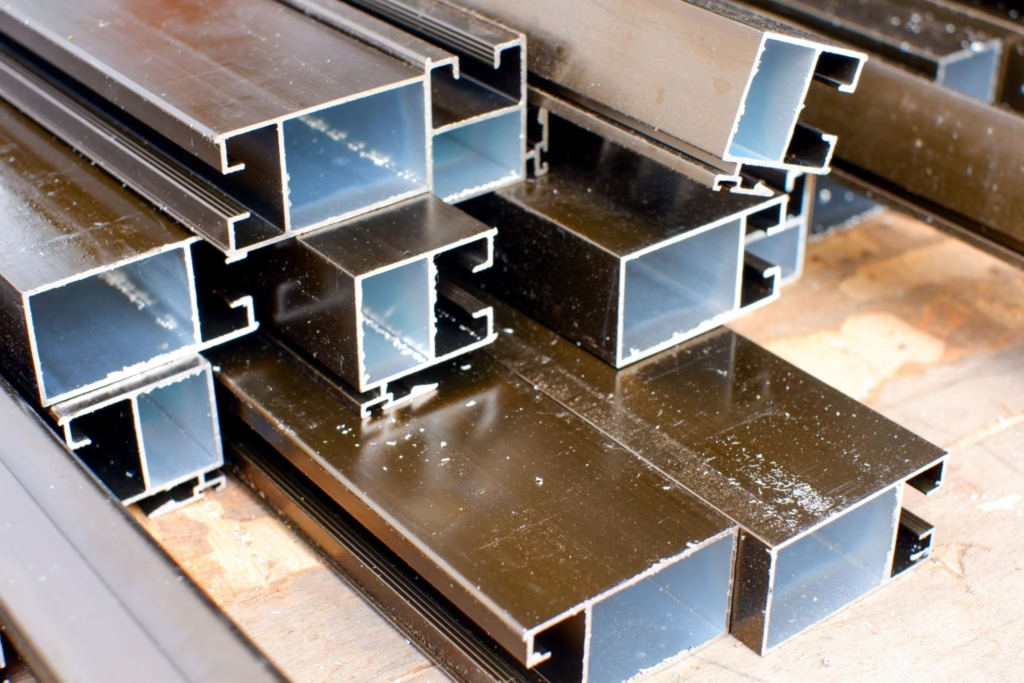
Aluminum Profile & Extrusion — 6061 / 6063 / 6082 / 7075 / 2024
Aluminum Profile & Extrusion — 6061 / 6063 / 6082 / 7075 / 6005A — custom and standard cross-section aluminum extrusions in T5 / T6 / T6511 temper for architectural, structural, industrial, automotive, and electrical applications. Circumscribing circle diameter 10-500mm, length up to 12m. Mill finish, anodized, powder coated. EN 755 / ASTM B221 certified. Custom die design available.
| Material | Aluminum Alloy Extrusion — 6xxx Series (6061/6063/6082/6005A), 7xxx Series (7075/7005), 2xxx Series (2024), 5xxx Series (5083), 1xxx Series (1050/1350) |
|---|---|
| Grade / Standard | 6063-T5 / 6063-T6 / 6061-T6 / 6082-T6 / 6005A-T5 / 7075-T6 / 7075-T73 / 2024-T3 / 5083-H112 / 1350-T1 |
| Thickness | Wall Thickness: 0.8mm - 25mm (profile dependent) |
| Width | Circumscribing Circle: 10mm - 500mm (press capacity dependent) |
| MOQ | 500 kg (Standard Profile) / 1,000 kg (Custom Die Profile) |
| Delivery Time | 15-25 Days (Stock Standard Profiles) / 30-60 Days (Custom Die + Extrusion) |
| Loading Port | Tianjin / Shanghai / Qingdao / Guangzhou |
Overview of Aluminum Profile & Extrusion
Aluminum Profile & Extrusion represents one of the most versatile and rapidly growing categories of aluminum products, produced by forcing heated aluminum billets through precisely shaped steel dies to create continuous lengths of complex cross-sectional profiles that would be impossible or prohibitively expensive to manufacture by any other metalworking process. The aluminum extrusion process exploits aluminum’s unique combination of low extrusion temperature (typically 450-520°C for 6xxx series alloys, compared to 1100-1250°C for steel), excellent die-filling capability, and intrinsic corrosion resistance to produce structural profiles, architectural sections, thermal management components, transportation structural members, and industrial functional profiles with cross-sectional complexity — including hollow sections, multiple internal voids, thin-wall sections, complex asymmetric shapes, and integrated functional features — in a single manufacturing operation that requires no subsequent machining or joining of separately formed elements. The global aluminum extrusion market, valued at approximately USD 90-100 billion annually, produces over 30 million tons of extruded profiles per year serving the construction, transportation, industrial, electrical, and consumer products sectors as the primary driver of aluminum demand growth globally.
Aluminum extrusion alloys are classified within the 1xxx (pure aluminum), 2xxx (aluminum-copper), 3xxx (aluminum-manganese), 5xxx (aluminum-magnesium), 6xxx (aluminum-magnesium-silicon), and 7xxx (aluminum-zinc) alloy families, with the 6xxx series — particularly 6061, 6063, 6082, and 6005A — representing 70-75% of global extrusion production due to their optimal balance of extrudability (ability to be extruded at high speed through complex dies), mechanical strength, corrosion resistance, surface quality, and anodizing response. Grade 6063 (0.2-0.6% Mg, 0.2-0.6% Si) is the most widely extruded alloy globally, providing excellent surface finish and anodizing quality for architectural applications at moderate strength (tensile strength 150-240 MPa depending on temper). Grade 6061 (0.8-1.2% Mg, 0.4-0.8% Si) provides higher strength (tensile strength 260-310 MPa in T6 temper) for structural applications. Grade 6082 (0.6-1.2% Mg, 0.7-1.3% Si) is the European preferred high-strength 6xxx alloy (tensile strength 310-340 MPa in T6) for structural engineering. Grade 7075 (5.1-6.1% Zn, 2.1-2.9% Mg) represents the premium aerospace-grade aluminum extrusion with tensile strength 500-570 MPa for applications requiring maximum strength-to-weight ratio. Tanglu Group supplies aluminum extrusion profiles from qualified Chinese aluminum extrusion manufacturers and mills covering all major alloy grades, tempers, surface treatments, and custom cross-sectional profiles for architectural, structural, industrial, transportation, and specialty applications worldwide.
Key Features and Manufacturing Process
Aluminum Profile & Extrusion manufacturing begins with the production of high-purity aluminum alloy billets through direct chill (DC) casting — the dominant casting process for extrusion billet production — where molten aluminum alloy of precisely controlled composition is continuously cast into cylindrical billets of 4-14 inch diameter and 500-1500mm length. Billet homogenization heat treatment (soaking at 540-580°C for 4-12 hours) is performed after casting to dissolve non-equilibrium phases formed during solidification, homogenize the chemical composition across the billet cross-section, and spheroidize the intermetallic particles — a step critical for achieving maximum extrudability and consistent mechanical properties throughout the extruded profile length. The extrusion process itself involves: induction heating of the billet to the target extrusion temperature (450-520°C for 6063, 480-530°C for 6061/6082, dependent on alloy and die complexity); loading the heated billet into the extrusion press container; applying hydraulic ram pressure (typically 600-4,000 ton press capacity for industrial extrusion presses) to force the plasticized aluminum through the hardened H13 tool steel die; and puling the extruded profile out through the runout table at controlled speed (0.5-50 m/min depending on alloy, die complexity, and profile wall thickness). The die design is the critical engineering element of aluminum extrusion — solid dies produce solid (non-hollow) profiles such as angles, channels, and solid bars, while porthole dies (bridge dies) produce hollow profiles by splitting the aluminum flow around bridge supports and rewelding under pressure in the welding chamber before exiting through the die bearing, enabling the production of complex hollow profiles (rectangular tubes, multi-void LED heatsink profiles, window frame sections) in a single extrusion operation without any joining seams in the final profile.
Post-extrusion processing determines the final mechanical properties and surface condition of the extruded profile through the temper designation system: T1 (air cooled from extrusion temperature, naturally aged — lowest strength, maximum formability); T4 (solution heat treated and naturally aged — medium strength, good formability); T5 (press quenched immediately after extrusion by forced air or water mist quenching on the runout table, then artificially aged at 160-180°C for 6-8 hours — the most common temper for 6063 architectural profiles, providing tensile strength 150-185 MPa); T6 (solution heat treated in a separate furnace + water quenched + artificially aged — the highest strength temper for 6061 and 6082, providing tensile strength 260-340 MPa); and T73 (overaged condition for 7075, providing improved stress corrosion cracking resistance at slightly reduced strength versus T6). Straightening by stretching (typically 1-3% permanent elongation) is performed after quenching to correct the distortion caused by non-uniform cooling, producing straight profiles within the straightness tolerances of EN 755-3 or ASTM B221. Precision cutting to length (±1mm tolerance), end finishing (deburring, chamfering), and quality inspection (dimensional measurement, visual surface inspection, mechanical property verification by tensile testing of sample pieces) complete the manufacturing process. Surface treatment options available for aluminum extrusions include: mill finish (as-extruded, natural aluminum surface — lowest cost, industrial applications); anodizing (electrochemical aluminum oxide layer 5-25 μm thick for decorative and protective applications — clear anodize, color anodize in bronze/black/champagne/custom colors per Qualanod standard); powder coating (polyester or PVDF powder coating in RAL standard colors, 60-100 μm dry film — the dominant surface finish for architectural aluminum in construction); liquid paint (PVDF Kynar 500 fluoropolymer paint for premium architectural applications meeting AAMA 2605 standard); and electrophoretic coating (epoxy e-coat for automotive applications). Tanglu Group supplies aluminum extrusion profiles with any required surface treatment, precision cut to length, with custom fabrication including CNC machining, drilling, punching, and assembly as required by customer specifications.
Main Applications of Aluminum Profile & Extrusion
Aluminum Profile & Extrusion serves as the primary structural and functional material for an extraordinary range of applications across construction, transportation, industrial, electrical, and consumer product sectors, with each application leveraging the unique combination of aluminum extrusion’s complex cross-sectional capability, light weight, corrosion resistance, and surface quality. The construction and architectural sector is the dominant consumer of aluminum extrusion globally, accounting for approximately 35-40% of total extrusion consumption, with 6063-T5 and 6063-T6 alloy profiles forming the complete structural and aesthetic envelope of modern building facades, window and door systems, curtain wall systems, and interior architectural elements. Aluminum window frames and door frames use 6063-T5 extruded profiles in complex hollow multi-chamber cross-sections (typically 3-5 internal chambers for thermal break systems) that simultaneously provide structural rigidity for glass retention, thermal insulation through polyamide thermal break inserts, weathertight sealing through integrated rubber gasket channels, and aesthetic aluminum exterior and interior surfaces for anodizing or powder coating — all in a single extruded section that cannot be replicated in any other material or manufacturing process. Curtain wall systems (glass and metal building facades) use 6063-T6 mullion and transom profiles of complex cross-section with integrated drainage channels, pressure equalization chambers, and structural alignment features for high-rise commercial building applications where wind loads, thermal expansion, and water management requirements demand the full engineering capability of extruded aluminum section design.
The solar energy sector has become one of the fastest-growing applications for aluminum extrusion, with 6063-T5 and 6005A-T5 alloy aluminum solar panel mounting frames, rail systems, module frames, and ground mounting structures representing a rapidly expanding market driven by global solar photovoltaic installation growth. Solar panel frames — the aluminum extrusion surrounds that border and protect the glass-encapsulated PV cell laminate — use lightweight, corrosion-resistant 6063-T5 extruded profiles with anodized or mill-finish surface for 25-30 year outdoor service life without maintenance, providing the mechanical support and electrical grounding path for solar modules in both rooftop and utility-scale ground-mount installations. Transportation applications represent the second major market for aluminum extrusion, with the automotive, rail, aerospace, and marine sectors collectively consuming approximately 25-30% of global extrusion production. Automotive aluminum extrusion applications include crash management systems (front and rear bumper beams in 6082-T6 or 7003-T5 for energy absorption in low-speed impacts), roof rails and roof rack systems (6063-T5/T6 for passenger cars and SUVs), door sill trim profiles, seat rail tracks, battery tray frames for electric vehicles (6061-T6 rectangular and complex hollow sections forming the structural perimeter of EV battery enclosures), heat exchanger headers for radiators and charge air coolers (3003 or 6061 alloy multi-port extrusions), and structural body-in-white aluminum extrusions for space-frame vehicle architectures. The electric vehicle sector has been transformational for automotive aluminum extrusion, with the battery enclosure (battery tray, battery module frames, battery cooling plates) of battery electric vehicles representing 15-25 kg of aluminum extrusion per vehicle — compared to essentially zero in conventional ICE vehicles — driving extraordinary growth in automotive aluminum extrusion demand. Rail transportation uses 6005A-T5 and 6082-T6 aluminum extrusions for high-speed rail car body panels (large-format wide-profile extrusions up to 600mm width × 6mm minimum wall, friction stir welded into carbody floor panels and side panels), metro and suburban rail car structural sections, train interior floor profiles, seat track extrusions, and luggage rack structural profiles. Aerospace aluminum extrusion uses 2024-T3, 7075-T6, and 7050-T73 high-strength aluminum alloys for fuselage stringer profiles, wing spar caps, floor beam sections, seat track rails, and structural framework extrusions where the maximum strength-to-weight ratio and aerospace material certification (per AMS 2770, NADCAP requirements) justify the significant alloy cost premium over 6xxx series architectural grades. Industrial machinery and equipment applications consume 6061-T6 and 6082-T6 aluminum extrusion profiles for machine frames (T-slot framing systems for modular industrial automation and CNC machine enclosures), conveyor structural frames and guide rails, pneumatic cylinder profiles, hydraulic manifold blocks, linear motion guide rail housings, and structural support frames for industrial equipment where the combination of high specific strength, machinability, and corrosion resistance provides advantages over steel at 1/3 the density. T-slot aluminum profile systems (20×20mm, 30×30mm, 40×40mm, 45×45mm, 80×80mm profile series in metric and imperial dimensions) have become the universal modular framing system for industrial automation, CNC routing machine enclosures, 3D printer frames, laboratory equipment stands, and custom machine building, enabling rapid construction of rigid structural frames from standard extruded sections connected by T-slot nuts and bolts without welding. Electrical and electronics applications use 6063 and 1050 (pure aluminum) extrusions for LED lighting heatsink profiles (complex fin-array cross-sections maximizing convective heat transfer surface area from compact profiles), electrical bus bar profiles (high-conductivity 1350 alloy or 6101 alloy for power distribution bus bars in switchgear and power distribution panels), electrical conduit and cable tray profiles, heat spreader profiles for power electronics, and enclosure profiles for electrical equipment housings. Marine applications use 5083 and 6061 alloy extrusions for boat hull structural sections, mast extrusions, deck hardware profiles, and offshore platform structural members where maximum marine corrosion resistance is required. Consumer product applications for aluminum extrusion include bicycle frames (7005-T6 and 6061-T6 tube extrusions for lightweight bicycle frame construction), camera tripod legs (6061-T6 round tube extrusions), furniture frame profiles, display stand systems, picture frame profiles, and sporting goods structural components. Tanglu Group supplies aluminum extrusion profiles for all these application sectors with custom cross-section die design, complete surface treatment options, precision fabrication services, and comprehensive material certification.
Why Choose Us for Aluminum Profile & Extrusion
Shandong Tanglu Metal Material Co., Ltd. supplies Aluminum Profile & Extrusion from qualified Chinese aluminum extrusion manufacturers operating ISO 9001 and ISO 14001 certified production facilities with modern 500-4,500 ton extrusion presses covering the full range of profile sizes from micro-extrusions (minimum circle circumscribing diameter 10mm) to wide structural profiles (maximum circumscribing circle diameter 500mm for standard presses, 800mm for wide-profile presses). Our manufacturing partner network includes extrusion facilities certified to EN 755 (aluminum extrusion standard), ASTM B221 (American standard), and AS/NZS 1734 (Australian/New Zealand standard), with die design and manufacturing capability for both standard catalog profiles and fully custom cross-sections. Custom die design is offered as a standard service — customer-provided 2D DXF cross-section drawings are reviewed by our die engineering team for extrudability assessment, wall thickness optimization, and die design recommendations, with first-run sample extrusions typically produced within 3-4 weeks of die order confirmation for standard-complexity profiles.
Our aluminum extrusion supply range covers all major structural alloys (6063, 6061, 6082, 6005A for standard architectural and structural applications; 7075, 7005, 2024 for high-strength aerospace and performance applications; 5083, 5052 for marine applications; 1050, 1350, 6101 for electrical applications), all standard tempers (T1, T4, T5, T6, T51, T52, T6511, T73), profile cross-sectional complexity from simple solid bar and round tube to complex multi-hollow architectural window sections and multi-fin LED heatsink profiles, standard lengths 1-6 meters (or custom lengths up to 12 meters for structural profiles on large presses), and the complete range of surface treatment options including mill finish, anodizing (5-25 μm natural or color anodize per EN 12373 / Qualanod standard), powder coating (RAL or custom color polyester or PVDF per EN 12206 / AAMA 2605), electrophoretic coating, and sublimation wood-grain finish for architectural applications. Precision fabrication services available include CNC machining (milling, drilling, tapping, countersinking), punching, notching, cutting (circular saw, cold saw, band saw), bending (profile bending on section bending rolls and stretch bending machines for curved architectural profiles), assembly with hardware insertion (T-slot nuts, rubber gaskets, thermal break inserts), and complete assembly of window and door frame kits. Every shipment includes material test certificate per EN 10204 3.1 reporting chemical composition by optical emission spectrometry per EN ISO 18278 / ASTM E1251, mechanical properties (tensile strength, 0.2% proof strength, elongation per EN ISO 6892-1 / ASTM E8), hardness (HB or HV), dimensional inspection per EN 755-2/3/4 or ASTM B221, and surface treatment quality verification (anodize coating thickness per EN ISO 2360, powder coat adhesion per EN ISO 2409, color measurement per CIE L*a*b* system). Monthly supply capacity 500 tons of aluminum extrusion profiles, with stock availability of standard architectural 6063-T5/T6 sections and industrial 6061-T6 sections enabling 15-25 day delivery, and 30-60 day lead time for custom die profiles including die manufacturing and first-run qualification.
📐 Dimension & Size Table
| Alloy / Grade | Temper | Tensile Strength | Primary Application |
|---|---|---|---|
| 6063 | T5 | 150-185 MPa | Architectural profiles, window frames, door frames, curtain wall, solar frames |
| 6063 | T6 | 205-240 MPa | Higher-strength architectural, furniture profiles, consumer products |
| 6061 | T6 | 260-310 MPa | Structural engineering, machine frames, automotive, marine, tooling |
| 6082 | T6 | 310-340 MPa | High-strength structural, European structural engineering, crane rail, transport |
| 6005A | T5 / T61 | 195-260 MPa | Rail car body, ladder profiles, automotive trim, solar mounting |
| 7075 | T6 | 500-570 MPa | Aerospace structural, high-performance sporting goods, defense |
| 7075 | T73 | 435-505 MPa | Aerospace SCC-resistant structural members, aircraft fittings |
| 2024 | T3 / T4 | 400-470 MPa | Aerospace fuselage, wing structure, high-fatigue structural applications |
| 5083 | H112 | 270-350 MPa | Marine structural, shipbuilding, offshore, cryogenic applications |
| 1350 | T1 / H12 | 55-95 MPa | Electrical bus bar, power conductor, overhead transmission line |
* Custom sizes available upon request. Tolerances per relevant international standards.
🔬 Chemical Composition
| Element | Min | Max | Display Value | Note |
|---|---|---|---|---|
| Si (6063) | 0.20 | 0.60 | 0.20-0.60 | Lower Si than 6061 — enables better surface finish and anodizing quality |
| Mg (6063) | 0.45 | 0.90 | 0.45-0.90 | Mg₂Si precipitation strengthening — primary strengthening mechanism in 6xxx |
| Si (6061) | 0.40 | 0.80 | 0.40-0.80 | Higher Si than 6063 — contributes to higher strength in T6 condition |
| Mg (6061) | 0.80 | 1.20 | 0.80-1.20 | Higher Mg than 6063 — Mg₂Si precipitation provides T6 tensile ≥260 MPa |
| Cu (6061) | 0.15 | 0.40 | 0.15-0.40 | Copper addition — solid solution strengthening, distinguishes 6061 from 6063 |
| Cr (6061) | 0.04 | 0.35 | 0.04-0.35 | Chromium — grain growth inhibitor, improves stress corrosion resistance |
| Si (6082) | 0.70 | 1.30 | 0.70-1.30 | Higher Si for maximum Mg₂Si precipitation strengthening in T6 |
| Mn (6082) | 0.40 | 1.00 | 0.40-1.00 | Manganese — grain refinement, dispersoid strengthening, key 6082 element |
| Zn (7075) | 5.10 | 6.10 | 5.10-6.10 | Primary strengthening element in 7xxx — MgZn₂ (η phase) precipitation |
| Mg (7075) | 2.10 | 2.90 | 2.10-2.90 | Magnesium — forms MgZn₂ precipitates with zinc for ultra-high strength |
| Cu (7075) | 1.20 | 2.00 | 1.20-2.00 | Copper — improves strength and stress corrosion cracking resistance |
| Fe (all grades) | - | 0.350 | ≤0.350 | Controlled iron — Fe intermetallics reduce ductility and anodizing quality |
* Chemical composition may vary by heat, thickness and specification. Please refer to the actual mill test certificate.
⚙️ Mechanical Properties
| Property | Value | Unit | Test Condition |
|---|---|---|---|
| Tensile Strength (6063-T5) | 150-185 | MPa | Per EN 755-2 / ASTM B221 — press quenched + artificially aged |
| 0.2% Proof Strength (6063-T5) | ≥110 | MPa | Minimum yield strength for architectural profile design |
| Elongation (6063-T5) | ≥8 | % | A50mm gauge length — adequate for architectural profile fabrication |
| Tensile Strength (6063-T6) | 205-240 | MPa | Solution treated + artificially aged — higher strength architectural grade |
| Tensile Strength (6061-T6) | 260-310 | MPa | Per EN 755-2 / ASTM B221 — standard structural aluminum grade |
| 0.2% Proof Strength (6061-T6) | ≥240 | MPa | Minimum yield — key design parameter for structural engineering calculations |
| Elongation (6061-T6) | ≥8 | % | A50mm gauge length |
| Tensile Strength (6082-T6) | 310-340 | MPa | Highest strength standard 6xxx extrusion alloy per EN 755-2 |
| 0.2% Proof Strength (6082-T6) | ≥260 | MPa | Per EN 755-2 — preferred European structural aluminum specification |
| Tensile Strength (7075-T6) | 500-570 | MPa | Ultra-high strength aerospace grade extrusion |
| 0.2% Proof Strength (7075-T6) | ≥430 | MPa | Approaching structural steel strength at 1/3 the density (2.81 g/cm³) |
| Tensile Strength (7075-T73) | 435-505 | MPa | Overaged — improved stress corrosion cracking resistance vs T6 |
| Tensile Strength (2024-T3) | 400-470 | MPa | High-strength aerospace grade with excellent fatigue resistance |
| Hardness (6061-T6) | 60-65 | HB | Brinell hardness — good machinability indicator |
| Density (all 6xxx alloys) | 2.70 | g/cm³ | Approximately 1/3 density of steel (7.85 g/cm³) — key weight advantage |
| Elastic Modulus (all aluminum) | 69-70 | GPa | Young's modulus — 1/3 of steel (210 GPa); design for stiffness requires geometry optimization |
* Values shown are minimum requirements unless otherwise stated.
📦 Commercial Information
| Packaging | Professional export packaging for aluminum extrusion profiles designed to protect the surface finish — particularly anodized and powder coated profiles where surface damage is a costly quality defect — during ocean freight transit, port handling, and delivery to construction sites, fabrication shops, and manufacturing plants. Individual profile protection begins at the extrusion plant where profiles are protected with surface wrap immediately after surface treatment: mill finish and anodized profiles are wrapped in low-tack polyethylene film (self-adhesive protective film, minimum 50 μm, tack level selected for surface finish — matte anodize requires lower tack to prevent adhesive marking, high-gloss powder coat requires moderate tack for secure adhesion without surface damage) applied immediately after cooling and quality inspection, covering the full profile length on all visible surfaces. Powder coated profiles additionally receive edge protection on cut ends using foam end caps or cardboard edge protectors to prevent scratching of adjacent profiles during bundle handling. Individual profile-to-profile contact within bundles is prevented by polyethylene foam interleaving strip (10-15mm wide, 2-3mm thick foam) inserted between profiles at every 0.5-1.0m interval along the bundle length, preventing surface contact and abrasion between profiles during transit vibration. Profiles are bundled in rectangular or square cross-section bundle packs of 10-50 profiles per bundle depending on profile size and weight, with bundle weight limited to maximum 2,000 kg for forklift handling and maximum 500 kg for manual handling operations. Bundle end protection uses purpose-designed steel or heavy cardboard end frames (profile bundle end frames) that protect the cut ends of all profiles in the bundle from mechanical impact and prevent telescoping of individual profiles during lifting and transport. Bundles are secured with steel or PET banding straps (minimum 19mm width, minimum 3 straps per bundle at quarter-length intervals) with plastic corner protectors at all strapping contact points on the outer profile layer — metal-to-metal contact between strapping and profile surface is strictly avoided to prevent surface marking. Bundled profiles are loaded on wooden pallets (heat-treated per ISPM-15, minimum 1,200mm length pallet for standard 6m profiles) with profiles oriented horizontally and supported at minimum 3 contact points per bundle to prevent sag-induced permanent deformation during storage and transit. Vertical transport (profiles standing on end) is not permitted for profiles exceeding 2m length due to buckling risk. Standard export pallet configuration places profiles in layers with non-marking rubber pads between layers, total pallet stack height not exceeding 2.0m for stability, total pallet weight not exceeding 3,000 kg for standard warehouse forklift capacity. Full pallet wrap with UV-stabilized polyethylene stretch film (minimum 200% stretch, 4-6 wrap layers) provides waterproof outer protection and maintains bundle integrity during ocean transit. Container loading: 20FT FCL accommodates profiles up to 5.8m length, 40FT FCL accommodates profiles up to 11.8m length — profiles extending beyond container dimension require special OOG (out of gauge) shipment arrangement. Desiccant bags placed in container at loading to control humidity during sealed transit. Each bundle labeled with alloy/grade, temper, surface treatment, profile reference number, dimensions, bundle weight, piece count, and purchase order reference. Complete documentation (EN 10204 3.1 MTC, dimensional inspection report, surface treatment certificate, CoO, packing list) in waterproof envelope attached to each pallet and electronically transmitted upon shipment. |
|---|---|
| Payment Terms | T/T (Telegraphic Transfer),L/C (Letter of Credit),D/P (Documents against Payment),Western Union,PayPal |
| Price Term | FOB,CFR,CIF,EXW |
| Supply Capacity | 500 Tons/Month (Aluminum Extrusion Profiles — All Alloys and Surface Treatments) |
| Loading Port | Tianjin / Shanghai / Qingdao / Guangzhou |
Why Choose Our Aluminum Profile & Extrusion — 6061 / 6063 / 6082 / 7075 / 2024?
EN 755 / ASTM B221 Certified with Full Mechanical Property Testing
Every aluminum extrusion shipment includes EN 10204 3.1 mill test certificate reporting chemical composition by OES per EN ISO 18278 / ASTM E1251, mechanical properties (tensile strength, 0.2% proof strength, elongation) per EN ISO 6892-1 / ASTM E8, hardness, and dimensional inspection per EN 755-2/3/4 or ASTM B221 tolerances. Surface treatment certificates: anodize coating thickness per EN ISO 2360, powder coat adhesion per EN ISO 2409, color measurement per CIE L*a*b* for color-critical architectural applications.
Custom Die Design — Any Cross-Section Possible
Complete custom die design and manufacturing service for any required aluminum profile cross-section. Submit 2D DXF drawing or PDF cross-section sketch — our die engineering team provides extrudability review, wall thickness optimization recommendations, and die cost/lead time quotation within 48 hours. Standard-complexity die manufacturing 15-20 days, first-run profile samples 25-35 days from die order. Die tooling cost amortized over production runs — competitive for quantities from 500 kg upward. Circumscribing circle 10-500mm diameter, minimum wall 0.8mm for standard alloys.
Full Surface Treatment Range — Anodize, Powder Coat, PVDF Paint
Complete in-house surface treatment capability at partner facilities: natural and color anodizing (5-25 μm, Qualanod certified, bronze/black/champagne/custom), powder coating (RAL standard and custom colors, polyester or PVDF resin, 60-100 μm, QUALICOAT certified), PVDF liquid paint (Kynar 500, AAMA 2605 compliant for premium architectural facades), wood grain sublimation finish, and electropolishing for decorative and food contact applications. Color matching to Pantone, RAL, or customer standard.
Fabrication Services — CNC Machining, Cutting, Bending
Value-added fabrication services available: precision CNC milling, drilling, tapping, and countersinking to customer drawings; circular saw and cold saw cutting to length (±0.5mm tolerance); profile bending (roller bending and stretch bending for curved architectural profiles); punching and notching; thermal break insertion (polyamide thermal break for window frame profiles); hardware assembly; and kitting (window/door frame component sets assembled and packaged per installation sequence). Reduces customer fabrication time and ensures dimensional consistency.
Stock Profiles for Fast Delivery — Custom Production 30-60 Days
Standard architectural 6063-T5/T6 profiles (angles, channels, square and rectangular tubes, flat bars, T-sections, standard window frame sections) and industrial 6061-T6 sections (round bar, square bar, rectangular bar, standard T-slot profiles 20×20 to 80×80mm) available from stock for 15-25 day delivery. Custom die profiles: 30-60 days total including die manufacturing (15-20 days), extrusion and aging (5-10 days), surface treatment (5-15 days), and quality inspection. Monthly capacity 500 tons accommodating both stock orders and custom production programs.
🏭 Applications of Aluminum Profile & Extrusion — 6061 / 6063 / 6082 / 7075 / 2024
Aluminum Profile & Extrusion serves as the backbone structural and functional material for modern construction, transportation, renewable energy, industrial, and consumer product applications, with the exceptional versatility of the extrusion process enabling complex cross-sectional geometries that deliver integrated structural, thermal, aesthetic, and functional performance in a single lightweight, corrosion-resistant aluminum section. Architectural and construction applications represent the largest and most established market for aluminum extrusion, with the global construction industry consuming approximately 12-14 million tons of aluminum extrusion profiles annually for window and door systems, curtain wall facades, structural glazing systems, roofing and cladding systems, solar shading (brise-soleil) systems, interior partitions, shopfront systems, canopy and pergola structures, and architectural hardware. Modern high-performance window and door systems for commercial and residential buildings use 6063-T5 or 6063-T6 multi-chamber hollow extruded profiles (typically 3-5 air chambers in the frame cross-section, with polyamide thermal break inserts in thermally broken systems) that simultaneously provide the structural rigidity to retain double or triple glazing under wind loads, the thermal insulation performance to meet building energy codes (Uf values ≤ 1.0-1.8 W/m²K for thermally broken systems), the weathertight sealing through integrated EPDM gasket channels, the drainage through integrated water management channels, and the surface quality for anodizing or powder coating in architectural colors — performance integration impossible in wood, PVC, or steel window frame alternatives at equivalent weight. The LEED, BREEAM, and Green Star building certification programs increasingly drive specification of aluminum window and curtain wall systems incorporating recycled content aluminum (aluminum's 95% energy saving in secondary smelting versus primary production makes recycled aluminum one of the most sustainable structural materials available) with powder coating or anodizing finishes that provide 40+ year service life without repainting, contributing to building sustainability credentials. Solar energy infrastructure has emerged as one of the fastest-growing aluminum extrusion applications globally, with photovoltaic (PV) solar panel installations consuming approximately 2-3 million tons of aluminum extrusion annually for module frames, mounting rail systems, ground mounting structures, and roof mounting hardware. PV module frames — the 6063-T5 aluminum extrusion surrounds that border all four sides of the glass-laminated solar module — are one of the highest-volume single-profile extrusion applications globally (approximately 25-30 million tons of solar modules installed annually, each requiring approximately 1.5-2.0 kg of aluminum frame per module), with the frame providing mechanical support, water-tight sealing to the module laminate via rubber gasket channels, electrical grounding through the anodized or mill-finish aluminum surface, and a standardized interface for mounting hardware attachment. Ground-mounted utility-scale solar farms (multi-megawatt PV installations using steel pile foundations or concrete ballast foundations) use aluminum rail extrusions (6005A-T5 or 6063-T5 in Ω-shaped, C-shaped, or Z-shaped cross-sections) spanning between solar tracker or fixed-tilt support piers to carry the weight and wind/snow loading of solar panel arrays — the aluminum rails' corrosion resistance eliminates the hot-dip galvanizing cost required for equivalent steel structural systems in outdoor solar environments. The electric vehicle (EV) revolution is transforming automotive aluminum extrusion demand, with battery electric vehicles requiring substantially more aluminum extrusion per vehicle than conventional ICE vehicles — primarily for battery enclosure structures. The battery tray (battery enclosure base) of a typical BEV contains 15-30 kg of aluminum extrusion in the perimeter frame (rectangular hollow sections or complex multi-chamber sections in 6061-T6 or 6082-T6), cross members (I-sections, hat sections), and module mounting rails that form the structural box protecting the battery modules from road impacts, side impacts, and underfloor intrusion while maintaining the sealed, watertight enclosure required for battery thermal management and electrical safety. EV bumper beam systems use 6082-T6 or 7003-T5 aluminum extrusion crash absorber profiles and bumper beams that provide lighter-weight alternatives to steel bumper beams with equivalent or superior crash energy absorption in low-speed impacts — critical for EV range optimization where every kilogram of body structure weight directly reduces battery range. Crash box (energy absorber) extrusions for EV front and rear bumper systems use thin-wall hollow rectangular sections in 6063-T5 or 6005A-T5 (selected for progressive axial folding behavior superior to higher-strength alloys in crash box applications), positioned between the bumper beam and the longitudinal structural rails to absorb low-speed crash energy (RCAR/IIHS bumper tests) through controlled progressive folding without involving the main structural rails. Industrial machine building and automation represents a high-growth application for aluminum extrusion, driven by the global expansion of manufacturing automation, collaborative robotics (cobots), CNC machining centers, additive manufacturing (3D printing), and custom machine construction where the T-slot aluminum profile system (also called item profile, bosch profile, or 80/20 profile after the pioneer North American supplier) has become the universal modular framing system. T-slot profiles in 6063-T5 or 6061-T6 (20×20mm miniature through 160×160mm heavy-duty series, with single, double, and triple T-slot configurations) enable engineers and machine builders to rapidly construct rigid, adjustable structural frames for CNC routing machine enclosures, laser cutting machine frames, robot work cell guards and enclosures, conveyor system frames, assembly station structures, laboratory equipment stands, photographic and video production rigs, and custom machinery structural frameworks — using only T-slot nuts, bolts, and standard connector hardware without welding, grinding, or painting, with the ability to reconfigure, extend, or modify the frame structure after initial construction. Rail vehicle body manufacturing for high-speed trains (TGV, ICE, Shinkansen, Fuxing speed), metro systems, light rail transit, and commuter rail represents a major aluminum extrusion application where 6005A-T5 and 6082-T6 large-profile extrusions (up to 600mm wide, 6-8mm minimum wall, 15-25 meter length) are friction stir welded (FSW) into full-length carbody structural panels (floor panels, side wall panels, roof panels) for lightweight rail vehicle construction achieving 30-50% weight reduction versus conventional steel carbody — directly reducing energy consumption per passenger-kilometer and enabling higher operating speeds with existing infrastructure. The marine sector uses 5083-H112 and 6061-T6 aluminum extrusions for high-speed pleasure craft and patrol boat structural frames, marine ladder rungs and railings, offshore platform structural members, boat mast extrusions, and deck equipment structural supports where the exceptional marine corrosion resistance of 5083 (highest corrosion resistance of any structural aluminum alloy in seawater) eliminates the continuous maintenance required for steel alternatives in marine environments. Aerospace structural applications for 7075-T6 and 7075-T73 aluminum extrusions — fuselage longeron members, wing spar cap extrusions, floor beam profiles, seat track extrusions, and structural frame members — represent the highest-value aluminum extrusion segment where the exceptional strength-to-weight ratio of 7075 (approaching 500-570 MPa tensile strength at density 2.81 g/cm³) enables structural weight reduction critical for aircraft fuel efficiency, with NADCAP and AS9100 quality certifications required for aerospace extrusion supply programs. Tanglu Group provides comprehensive technical support for aluminum extrusion profile selection, custom die design consultation, surface treatment specification, mechanical property verification, and complete export documentation for customers worldwide.
📋 Quality & Certification
Our Certifications
- ✅ ISO 9001:2015
- ✅ CE Marking
- ✅ DNV GL
- ✅ Bureau Veritas (BV)
- ✅ SGS Certified
Mill Certificate Type
- 📋 EN 10204 3.1
- 📋 EN 10204 3.2
- 📋 Original Mill Certificate
- 📋 Third Party Inspection Available
- 📋 Certificate of Origin
❓ Frequently Asked Questions
What is the difference between 6063 and 6061 aluminum extrusion alloys, and which should I choose?
6063 and 6061 are both 6xxx series aluminum-magnesium-silicon alloys and the two most widely used extrusion alloys globally, but they have distinctly different property profiles optimized for different applications:
6063 Aluminum (AlMgSi0.5):
Composition: 0.20-0.60% Si, 0.45-0.90% Mg (lower alloy content than 6061)
Strength: T5 temper — tensile 150-185 MPa, yield ≥110 MPa; T6 temper — tensile 205-240 MPa, yield ≥170 MPa
Key advantages: Superior surface finish quality — the lower iron, silicon, and copper content of 6063 produces a finer, more uniform grain structure with minimal intermetallic particles that could cause surface roughness, streaks, or 'pick-up' during extrusion die bearing contact. This superior surface enables higher-quality anodizing (deeper, more uniform anodize color, better color consistency) and powder coating (smoother, more uniform substrate). 6063 also has better extrudability than 6061 — can be extruded at higher speed through more complex dies, reducing extrusion cost for complex multi-hollow architectural sections. The combination of good anodizing response, excellent surface quality, and adequate strength (sufficient for window frames, architectural profiles, furniture profiles, solar frames) makes 6063 the standard architectural extrusion alloy worldwide.
Limitations: Lower strength than 6061 — not suitable for structural engineering applications where member cross-sections are governed by strength rather than stiffness. 6063-T5 yield strength (≥110 MPa) is approximately half that of 6061-T6 (≥240 MPa).
6061 Aluminum (AlMg1SiCu):
Composition: 0.40-0.80% Si, 0.80-1.20% Mg, 0.15-0.40% Cu (higher alloy content + copper addition)
Strength: T6 temper — tensile 260-310 MPa, yield ≥240 MPa (approximately 2× the strength of 6063-T5)
Key advantages: Substantially higher strength enabling thinner wall profiles at equivalent load capacity, or higher load capacity at equivalent wall thickness. The copper addition (not present in 6063) provides additional solid solution strengthening. 6061-T6 is suitable for structural engineering design (bridges, structural framing, loading platforms, machine frames, vehicle structural members) where member sections are governed by strength requirements. 6061 also has excellent machinability (one of the most machinable aluminum alloys) for CNC-machined extruded components, and good weldability using MIG/TIG with appropriate filler alloy (ER4043 or ER5356).
Limitations: Slightly inferior surface finish and anodizing quality versus 6063 — the higher silicon and copper content produces slightly more surface intermetallics that can cause minor anodize color non-uniformity. Not suitable for high-appearance anodizing applications requiring perfectly uniform color. Also has lower extrudability than 6063 — extrusion speed is typically 30-50% lower than equivalent 6063 profiles, increasing extrusion cost for complex sections.
Selection Guide:
- Architectural profiles (windows, doors, curtain walls, facades, furniture): 6063-T5 or 6063-T6 — surface quality and anodizing response are critical
- Structural engineering (structural frames, bridges, machine bases, transport structural members): 6061-T6 — strength governs design
- Solar panel frames and mounting rails: 6063-T5 — good surface, adequate strength, cost-effective
- CNC machining applications: 6061-T6 — excellent machinability with tight tolerances
- European structural engineering: 6082-T6 — the preferred European standard offering higher strength than 6061
What do aluminum temper designations T5, T6, T6511, T73 mean for extruded profiles?
Aluminum temper designations describe the thermal and mechanical treatment history that determines the final mechanical properties of the extruded profile. The correct temper specification is critical because the same alloy in different tempers can have dramatically different strength, ductility, and stress corrosion behavior.
T5 — Artificially Aged (Press Quenched):
Process: The profile is cooled rapidly immediately after exiting the extrusion die by forced air quenching or water mist quenching on the extrusion press runout table (press quenching), retaining supersaturated solid solution formed at extrusion temperature. The profile is then artificially aged in a furnace at 160-180°C for 6-8 hours to precipitate fine Mg₂Si particles that provide strength through precipitation hardening.
Properties (6063-T5): Tensile 150-185 MPa, yield ≥110 MPa, elongation ≥8%
Advantage: More economical than T6 because no separate solution heat treatment furnace is required — the heat from the extrusion process serves as the solution treatment step (for alloys with adequate solutionizing at extrusion temperature, primarily 6063 and 6005A). Suitable for 6063, 6005A, and thin-wall 6061 profiles.
Limitation: Cannot achieve the full T6 strength for thicker-section 6061 or 6082 profiles where the press quench cooling rate through the section thickness is insufficient to retain the full supersaturated solid solution.
T6 — Solution Heat Treated + Artificially Aged:
Process: After extrusion and straightening, the profile is separately solution heat treated in a dedicated furnace (540-560°C for 6061, 530-545°C for 6082, held for time sufficient for complete dissolution of all Mg₂Si) and then immediately water quenched to retain the solid solution, followed by artificial aging at 160-180°C for 8-12 hours.
Properties (6061-T6): Tensile 260-310 MPa, yield ≥240 MPa, elongation ≥8%
Advantage: Provides maximum strength for 6061, 6082, and 7075 alloys — 40-60% higher yield strength than T5 for 6061. Required for structural applications where maximum specific strength is needed. Standard temper for 7075-T6 (tensile 500-570 MPa).
Limitation: Requires additional furnace heat treatment step, increasing production time and cost by 15-25% versus T5 production. Water quench can cause residual stress in complex-section profiles and some distortion requiring re-straightening.
T6511 — Stretched + Artificially Aged:
Process: After solution heat treatment and quenching, the profile is stretched 1-3% permanent elongation before artificial aging. The stretching relieves quench-induced residual stresses and re-straightens the profile.
Properties: Essentially same tensile properties as T6 but with significantly lower residual stress levels — critical for machined components where residual stress relief is needed to prevent distortion after material removal during CNC machining. The '11' suffix specifically indicates that both stretching and minor straightening were performed.
Application: Preferred temper for aluminum extrusion profiles that will be extensively CNC machined after delivery (machine frames, tooling blocks, jig components) where distortion-free machining requires low residual stress in the incoming material.
T73 — Overaged (Stress Corrosion Resistant):
Process: Applied primarily to 7075 and other 7xxx alloys. Overaging at higher temperature (160-175°C for first step + 100-120°C for second step, dual-stage aging) than T6 produces coarser precipitate structure with reduced peak strength but dramatically improved resistance to stress corrosion cracking (SCC) — a critical failure mode for 7075-T6 in humid or marine environments under sustained tensile stress.
Properties (7075-T73): Tensile 435-505 MPa, yield ≥370 MPa — approximately 15-20% lower than T6 but with SCC threshold stress increased by 3-5× compared to T6.
Application: Required for 7075 structural members in aerospace applications where sustained tensile stress in the short-transverse (through-thickness) grain direction could cause SCC in T6 temper — fuselage frame members, aircraft structural fittings, and any 7075 application in humid or salt spray environment.
Temper Selection Summary:
- Architectural profiles (6063): T5 is standard and cost-effective
- Structural profiles (6061/6082) requiring maximum strength: T6
- Profiles for extensive CNC machining: T6511
- High-strength 7075 in corrosive or stressed environment: T73
How does the aluminum extrusion die design process work, and what information is needed to order a custom profile?
Custom aluminum extrusion die design and manufacturing is a standard service that enables customers to obtain exactly the cross-sectional profile geometry required for their specific application — from simple solid bars and standard tubes to complex multi-hollow architectural sections, multi-fin heatsink profiles, and intricate industrial functional sections. Understanding the die design process helps customers plan project timelines and prepare the necessary technical information.
Step 1 — Cross-Section Drawing Submission:
The customer provides a 2D cross-section drawing of the required profile. Acceptable formats: DXF (preferred — directly importable into die design CAD software), DWG, PDF with dimension annotations, or hand sketch with key dimensions. The drawing should show: all external dimensions, all internal void dimensions (for hollow profiles), all wall thicknesses, all corner radii (minimum recommended 0.5mm for standard alloys), and any specific tolerances required for critical dimensions. If no cross-section drawing exists yet, Tanglu Group's die engineering team can assist with cross-section design optimization based on the functional requirements (load capacity, thermal performance, fit-up with mating components).
Step 2 — Extrudability Review and Die Design Feasibility:
Our die engineering team reviews the submitted cross-section for extrudability — the ability to consistently produce the profile at acceptable extrusion speed and quality:
Minimum wall thickness: Typically 0.8mm minimum for 6063, 1.0mm for 6061/6082 in standard die design. Ultra-thin walls (0.5-0.8mm) are possible in specialized precision extrusion but require higher die cost and slower extrusion speed.
Circumscribing circle (CC): Maximum diameter that circumscribes the complete profile cross-section. CC must be within the press capacity: small presses (500-800 ton): CC ≤ 150mm; medium presses (1,000-2,000 ton): CC ≤ 250mm; large presses (2,500-4,500 ton): CC ≤ 400-500mm. Very wide profiles (CC > 250mm) are producible but require larger presses and may incur significant cost premium.
Tongue ratio (for hollow sections): The ratio of the unsupported die tongue length to its thickness must be within structural limits to prevent die deflection and dimensional non-uniformity in hollow section profiles.
Shape factor: Profiles with very thin walls combined with large overall dimensions, or profiles with significant weight asymmetry across the cross-section, may require die design adjustments to ensure uniform metal flow rate across the die bearing — non-uniform flow causes camber, twist, or waviness in the extruded profile.
Step 3 — Die Cost and Lead Time Quotation:
Die cost depends on complexity: solid single-void profiles (angles, bars, channels, simple tubes): die cost USD 300-800 per die; moderate complexity hollow profiles (multi-chamber window sections, dual-void sections): USD 600-1,500; complex multi-hollow profiles (multi-fin heatsinks, complex architectural sections): USD 1,200-3,000; specialty large-profile or ultra-thin-wall dies: USD 2,000-5,000+. Die lead time: standard complexity 15-20 days, complex 20-30 days. Die tooling cost is a one-time investment — the die remains the property of the customer for the life of the die (typically 50-200 tons of profile production before die replacement depending on alloy and complexity).
Step 4 — First-Run Samples and Approval:
First-run sample extrusions (typically 3-5 meters of profile) are produced from the new die and sent to customer for dimensional verification, surface quality inspection, and functional fit-up testing. If dimensional adjustments are needed, die correction (die bearing adjustment, die polishing, or bearing length modification) is performed before full production. Typical total timeline from die order to first approved samples: 25-40 days.
Information Required for Die Quote:
1) 2D cross-section DXF drawing with all dimensions
2) Alloy specification (6063 / 6061 / 6082 / other)
3) Temper requirement (T5 / T6 / T6511)
4) Dimensional tolerances for critical features
5) Surface treatment requirement (mill finish / anodize / powder coat)
6) Required length (and length tolerance)
7) Estimated annual quantity (for amortization planning)
8) Any special requirements (conductivity, weldability, specific mechanical properties)
Contact Tanglu Group with the above information for a die design feasibility assessment and quotation within 48 hours.
What are the differences between anodizing and powder coating for aluminum extrusion, and which is best for my application?
Anodizing and powder coating are the two dominant surface treatment systems for aluminum extrusion profiles in architectural and industrial applications, each providing corrosion protection and decorative finish through fundamentally different mechanisms with distinct performance characteristics, aesthetic qualities, and application suitability:
Anodizing (Electrochemical Aluminum Oxide):
Process: Aluminum profiles are immersed in sulfuric acid electrolyte solution and connected as the anode in a DC electrical circuit. Current passed through the electrolyte causes controlled oxidation of the aluminum surface, growing an aluminum oxide (Al₂O₃) layer from the aluminum substrate outward — typically 5-25 μm thickness for architectural anodizing. The oxide layer is then sealed (hot water seal or dichromate seal) to close the micro-pores and complete corrosion protection. Color anodizing (bronze, champagne, black, custom colors) is achieved by electrolytic coloring — depositing inorganic metal salts (tin, cobalt, nickel) into the oxide pores before sealing.
Key Properties:
- Integral surface: The anodic oxide is an integral part of the aluminum — it cannot peel, chip, or flake because it is not a coating on the surface but a converted layer growing from within the aluminum. This provides outstanding impact resistance and resistance to surface mechanical damage versus powder coat.
- Hardness: Anodic oxide is extremely hard (Vickers hardness 350-500 HV versus aluminum substrate 40-90 HV) — highly resistant to scratching and abrasion. Hard anodize (30-50 μm) is used for wear-resistant applications (architectural hardware, mechanical components).
- Metallic appearance: Anodizing retains the metallic character of aluminum — the brushed, satin, or specular aluminum surface is enhanced by anodizing into a sophisticated metallic finish impossible to replicate with powder coat. Natural (silver) anodize is the signature finish of high-end architectural aluminum.
- Durability: 15-25 μm architectural anodize per Qualanod specification provides 20-40+ year exterior durability without visible corrosion or color change in typical architectural environments (Class 15 for inland exposure, Class 20 for marine environments, Class 25 for extreme exposure per Qualanod classification).
- Electrical insulation: Anodic oxide is electrically insulating (breakdown voltage 300-400 V/μm) — relevant for electrical component applications requiring surface insulation.
Limitations: Limited color range versus powder coat — standard colors are natural silver, champagne (light bronze), medium bronze, dark bronze, black, and some specialty colors. Deep solid colors (red, blue, green, yellow) with consistent batch-to-batch color matching are difficult to achieve by anodizing. Color consistency across different profile cross-sections and extrusion lots can vary with alloy chemistry and surface condition.
Powder Coating (Organic Polymer Coating):
Process: Aluminum profiles are pre-treated (chromate conversion coating or chrome-free alternative for adhesion and corrosion resistance), then electrostatic powder spray guns apply dry thermoplastic or thermoset polymer powder to the aluminum surface. The powder-coated profiles are conveyed through a baking oven (180-200°C for polyester powder, 230-250°C for PVDF powder) where the powder melts, flows, and cures into a uniform, adherent polymer film (60-100 μm dry film thickness for standard architectural applications).
Key Properties:
- Color range: Unlimited color range — any RAL standard color (213 standard colors in RAL Classic), Pantone color, or custom color matching. Consistent, repeatable color matching across production batches. The ability to specify any RAL color makes powder coating the preferred choice for architectural projects requiring coordination with specific project color palettes (building facade color schemes, corporate brand colors, urban design color requirements).
- Surface texture: Wide range of surface textures available — smooth gloss, semi-gloss, matte, fine texture, coarse texture, metallic effect (with aluminum flake particles in powder), and wood grain appearance (via sublimation transfer after powder coat base). Texture options enable aesthetic differentiation impossible with anodizing.
- Film thickness: 60-100 μm powder coat provides a protective organic barrier significantly thicker than anodizing — beneficial in aggressive environments where the organic barrier provides additional protection beyond the chromate conversion pretreatment.
- Durability (standard polyester): 10-15 year exterior durability for standard polyester powder coat in typical architectural environments — adequate for most residential and light commercial applications. Chalking and color fading occur gradually over time in UV-intensive climates.
- Durability (PVDF/Kynar 500): PVDF (polyvinylidene fluoride) powder or liquid paint provides 20-30+ year exterior durability with minimal color fade and chalking resistance — specified for premium architectural facades meeting AAMA 2605 specification (major color change ΔE ≤5.0 after 10 years Florida south exposure, gloss retention ≥50% after 10 years).
Limitations: Coating on surface — can chip at sharp impacts (versus integral anodize), requires repair of chips to prevent corrosion progression from exposed aluminum. Slightly lower scratch resistance than hard anodize. Powder coat on aluminum profiles requires minimum 100 μm radius on all external corners for adequate coating thickness at edges — very sharp corners are coating adhesion weak points.
Selection Guide:
- Natural metallic appearance, high-end aesthetics, scratch resistance: Anodizing
- Specific color matching (RAL/Pantone), wide color range, cost-effective for most applications: Powder coating
- Coastal/marine architectural exposure (Class 20/25 Qualanod): Anodizing (superior metallic durability in salt spray)
- Premium commercial building facades, 30-year color guarantee: PVDF powder coat or PVDF liquid paint (AAMA 2605)
- Industrial and mechanical applications requiring surface hardness: Hard anodize
- Residential and general commercial: Either — specify based on aesthetic preference and budget
What dimensional tolerances apply to aluminum extrusion profiles, and how are they verified?
Aluminum extrusion dimensional tolerances are defined by international standards that specify acceptable variation in cross-sectional dimensions, straightness, twist, flatness, and length — parameters that directly affect how accurately the extruded profile fits with mating components in window assemblies, machine frames, structural connections, and precision fabrication applications. Understanding the applicable tolerance standards and verification methods ensures correct specification and receiving inspection of aluminum extrusion deliveries.
Applicable Dimensional Tolerance Standards:
EN 755-2 (Extruded bar, rod, and tube), EN 755-3 (Extruded square, rectangular, and hexagonal tube), EN 755-4 (Other hollow profiles), EN 755-7 (Open profiles) — the comprehensive European standard for aluminum extrusion tolerances, applicable to all standard profiles. Published by the European Aluminium Association and widely adopted as the international standard.
ASTM B221 (Standard Specification for Aluminum and Aluminum-Alloy Extruded Bars, Rods, Wire, Profiles, and Tubes) — the North American standard, with similar dimensional tolerance system to EN 755 but some differences in specific tolerance values.
AS/NZS 1734 — Australian/New Zealand standard, aligned with EN 755.
Key Dimensional Tolerance Categories (EN 755 framework):
1) Cross-Sectional Dimensions (Wall Thickness, Width, Height, Diameter):
Tolerance class A (standard): Generally ±(0.20-0.50mm) for typical architectural profile dimensions, increasing with profile dimension magnitude. Example: 100mm nominal wall width — tolerance ±0.30mm for Class A.
Tolerance class B (precision): Approximately 50% tighter than Class A — specified when close-fit requirements between extruded profiles and mating parts demand tighter dimensional control. Precision tolerance requires slower extrusion speed, increasing cost 15-25%.
Corner radius tolerance: External corners ±0.5mm, internal corners ±1.0mm on nominal radius (minimum recommended radius 0.5mm for standard die design).
2) Straightness (Bow/Camber):
Maximum straightness deviation for standard profiles: ≤0.30% of total profile length (EN 755-3), equivalent to 3.0mm maximum bow in 1,000mm length. After stretching and straightening: typically ≤0.20% for standard quality, ≤0.10% for precision straightness.
Method: Place profile on flat reference surface, measure maximum gap between profile and reference surface at any point along profile length using feeler gauge.
3) Twist:
Maximum twist for hollow profiles: ≤1°/m for standard quality (1° of rotation per meter of profile length).
Method: Place profile end on flat surface, measure height difference between two opposite corners at the other end after 1 meter distance — height difference / width = tangent of twist angle.
4) Flatness (for flat open profiles and sheet-like sections):
Maximum flatness deviation: ≤0.50% of flange width for standard quality flanges and open sections.
Method: Lay profile on flat surface, measure maximum gap between profile and reference surface using feeler gauge.
5) Length Tolerance:
Standard cut-to-length tolerance: ±10mm for lengths up to 6m (saw cutting). Precision cutting: ±1mm with cold saw or circular saw with stop gauge. Length 0 to -5mm for profiles subject to customer further cutting.
6) Surface Finish:
Mill finish profiles: Visual inspection for extrusion die lines (minor), handling marks, and surface inclusions. EN 755 surface quality classification distinguishes class A (no surface defects), class B (minor surface defects acceptable for anodizing applications), and class C (general industrial quality).
Verification Methods at Customer Receiving Inspection:
- Cross-sectional dimensions: Vernier caliper (±0.01mm resolution) for accessible dimensions; CMM (coordinate measuring machine) for complex profiles with multiple critical dimensions; go/no-go gauges for mating components with tight fit requirements.
- Wall thickness: Ultrasonic thickness gauge (non-contact, through wall measurement for hollow sections); direct caliper on accessible walls.
- Straightness: Steel straight edge on reference surface; laser alignment measurement for long structural profiles.
- Anodize thickness: Eddy current coating thickness gauge (Elcometer, Fischer) — non-destructive measurement of anodic oxide thickness to verify compliance with specified μm range (e.g., 15-25 μm for Class 20 architectural anodize per EN 12373).
- Powder coat thickness: Magnetic induction gauge for polyester powder coat on aluminum substrate.
- Mechanical properties: Tensile test on sample piece cut from production lot per EN ISO 6892-1 — required for structural applications, with hardness testing (Webster hardness or Brinell) as faster alternative for production lot verification.
Tanglu Group provides dimensional inspection reports with key dimension measurements for all custom profile orders and can arrange third-party dimensional verification (SGS, BV, TUV) for critical dimensional requirements in structural and precision applications.
Get a Quote for
Aluminum Profile & Extrusion — 6061 / 6063 / 6082 / 7075 / 2024
Submit your requirements and receive a competitive price quote within 24 hours.
- ✓ Fast response within 24 hours
- ✓ Competitive factory-direct pricing
- ✓ Free technical consultation
- ✓ Mill test certificate provided
- ✓ Flexible payment terms available
⏱ Response within 24 hours
Send Your Inquiry
All fields marked with * are required