
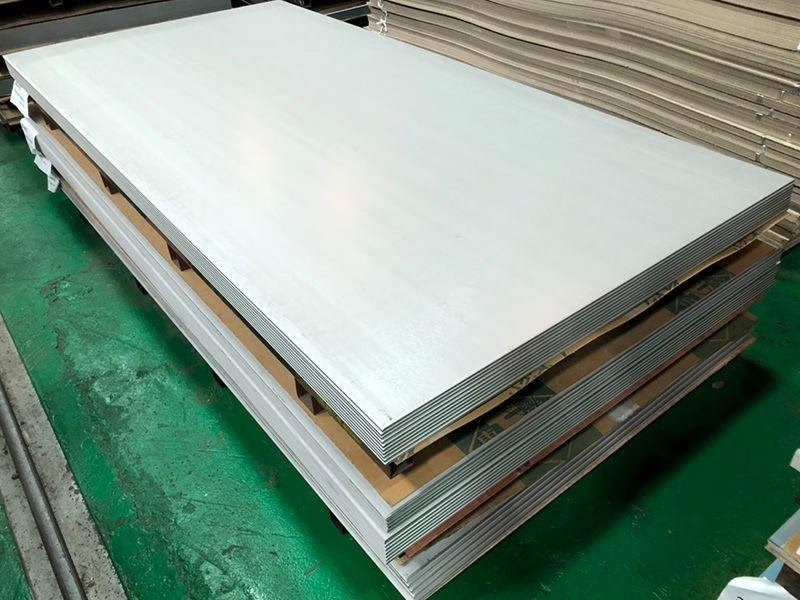
317L Stainless Steel Plate
AISI 317L (UNS S31703) high-molybdenum (3.0-4.0% Mo) austenitic stainless steel plate with superior resistance to sulfuric acid, phosphoric acid, and chlorides. Thickness 3-100mm, ASTM A240 certified. Key material for Flue Gas Desulfurization (FGD), chemical tanks, and pulp & paper equipment.
| Material | Austenitic Stainless Steel (High Mo Grade) |
|---|---|
| Grade / Standard | AISI 317L / UNS S31703 |
| Thickness | 3mm - 100mm (plate), 0.5mm - 6mm (sheet) |
| Width | 1000mm - 2500mm |
| Length | 2000mm - 12000mm (plate), 2000mm - 6000mm (sheet) |
| Delivery Condition | hot_rolled / cold_rolled / quenched_tempered |
| Surface Treatment | bare / polished |
| MOQ | 1 Ton |
| Delivery Time | 20-40 Days / Limited Stock for Common Sizes |
| Loading Port | Tianjin / Shanghai / Qingdao |
Expert advice on 317L for FGD and Chemical Service - Response within 24 hours
Overview of 317L Stainless Steel Plate
AISI 317L is a low-carbon, high-molybdenum austenitic stainless steel designed to provide superior resistance to chemical attack, particularly pitting and crevice corrosion in chloride-containing environments. Compared to the widely used 316L grade, 317L features a significantly higher content of molybdenum (3.0-4.0%), chromium (18.0-20.0%), and nickel (11.0-15.0%), resulting in enhanced resistance to sulfuric acid, sulfurous acid, phosphoric acid, and other acidic media. The low carbon content (≤0.030%) minimizes carbide precipitation during welding, making it suitable for heavy-gauge welded components without the need for post-weld annealing.
Widely specified for flue gas desulfurization (FGD) systems, chemical and petrochemical processing equipment, pulp and paper mills, and food processing plants, 317L stainless steel plate offers a long service life in harsh environments where standard austenitic grades would fail prematurely. Compared to 316L, 317L provides a 50-70% improvement in pitting resistance and significantly lower corrosion rates in reducing acids, making it the material of choice for critical services such as sour gas scrubbers, condensers in fossil-fueled power plants, and tall oil distillation columns.
Key Features and Surface Finishes
317L stainless steel plate is manufactured through hot rolling for thicker gauges (typically over 6mm) or cold rolling for thinner sheets, followed by solution annealing at 1040-1120°C with rapid water quenching to achieve optimal corrosion resistance. The low carbon content prevents chromium carbide precipitation in the heat-affected zones of welds, ensuring maximum intergranular corrosion resistance. The high molybdenum and chromium content significantly increases the critical pitting temperature (CPT) and critical crevice temperature (CCT), making 317L suitable for use in environments with high chloride levels such as seawater and acidic brines.
The plate undergoes rigorous quality control including chemical composition verification via optical emission spectroscopy, mechanical property testing (tensile, yield, elongation, hardness), corrosion testing per ASTM G48 or customer specifications, and 100% dimensional inspection. Standard surface finishes offered include No.1 (hot rolled, annealed, descaled) for industrial vessels and structural applications, 2B (cold rolled, annealed, pickled) for a smooth matte finish, No.4 (brushed satin) for architectural or sanitary applications, and BA (bright annealed) for specialized uses. Thickness ranges from 3mm to 100mm, with widths up to 2500mm and lengths up to 12 meters, supported by in-house plasma, laser, and water-jet cutting services.
Main Applications of 317L Stainless Steel Plate
317L is the primary material for flue gas desulfurization (FGD) units in coal-fired power plants, where it resists the highly corrosive mixture of sulfurous and sulfuric acids generated during the wet scrubbing process. Chemical and petrochemical industries use 317L for reactors, heat exchangers, and storage tanks handling sulfuric acid, phosphoric acid, and organic acids. The pulp and paper industry relies on 317L for digesters, bleaching equipment, and tall oil distillation units due to its resistance to acidic cooking liquors and corrosive byproducts.
Food and beverage processing plants utilize 317L for acidic food handling and sterilization equipment. Textile and dyeing industries specify 317L for equipment exposed to aggressive dyestuffs and acidic solutions. Other critical applications include offshore platform splash zone components, marine heat exchangers, pharmaceutical manufacturing equipment, and nuclear waste containment vessels where pitting and stress-corrosion cracking resistance is paramount.
Why Choose Us for 317L Stainless Steel Plate
Shandong Tanglu Metal Material Co., Ltd. supplies premium 317L stainless steel plate from ISO 9001, ISO 14001, and PED certified mills with extensive experience in corrosion-resistant alloy applications. Every 317L plate is supplied with an EN 10204 3.1 Mill Test Certificate as standard, detailing the complete chemical analysis, mechanical properties, and heat treatment condition. For safety-critical applications, we offer EN 10204 3.2 certificates with third-party witness testing by SGS, BV, or TÜV.
We offer a full thickness range from 3mm to 100mm in multiple surface finishes, with in-house fabrication capabilities including precision cutting, beveling, and edge preparation. With a robust supply capacity of 2,000 tons per month for specialty stainless steel plates, we support both urgent maintenance orders and large-scale capital projects for the power generation, chemical, and pulp & paper industries across over 50 countries. Each bundle is tagged with grade, heat number, and dimensions for full traceability, and we can arrange additional documentation including Positive Material Identification (PMI) reports upon request.
📐 Dimension & Size Table
| Thickness (mm) | Width (mm) | Length (mm) | Weight (kg/m²) |
|---|---|---|---|
| 3.0 | 1000-2000 | 2000-6000 | 24.09 |
| 4.0 | 1000-2000 | 2000-6000 | 32.12 |
| 5.0 | 1000-2000 | 2000-6000 | 40.15 |
| 6.0 | 1000-2000 | 2000-6000 | 48.18 |
| 8.0 | 1000-2200 | 2000-8000 | 64.24 |
| 10.0 | 1000-2200 | 2000-8000 | 80.30 |
| 12.0 | 1500-2200 | 3000-8000 | 96.36 |
| 16.0 | 1500-2200 | 3000-8000 | 128.48 |
| 20.0 | 1500-2500 | 3000-10000 | 160.60 |
| 25.0 | 1500-2500 | 3000-10000 | 200.75 |
| 30.0 | 1500-2500 | 3000-10000 | 240.90 |
| 40.0 | 1500-2500 | 3000-12000 | 321.20 |
| 50.0 | 1500-2500 | 3000-12000 | 401.50 |
| 60.0 | 1500-2200 | 3000-12000 | 481.80 |
| 80.0 | 1500-2200 | 3000-10000 | 642.40 |
| 100.0 | 1500-2000 | 3000-8000 | 803.00 |
* Custom sizes available upon request. Tolerances per relevant international standards.
🔬 Chemical Composition
| Element | Min | Max | Display Value | Note |
|---|---|---|---|---|
| C | - | 0.030 | ≤0.030 | Low carbon for weldability |
| Si | - | 0.75 | ≤0.75 | |
| Mn | - | 2.00 | ≤2.00 | |
| P | - | 0.045 | ≤0.045 | |
| S | - | 0.030 | ≤0.030 | |
| Cr | 18.00 | 20.00 | 18.00-20.00 | KEY ELEMENT - Corrosion resistance |
| Ni | 11.00 | 15.00 | 11.00-15.00 | Austenite stabilizer |
| Mo | 3.00 | 4.00 | 3.00-4.00 | KEY ELEMENT - Pitting & acid resistance |
| N | - | 0.10 | ≤0.10 | |
| Fe | - | - | Balance |
* Chemical composition may vary by heat, thickness and specification. Please refer to the actual mill test certificate.
⚙️ Mechanical Properties
| Property | Value | Unit | Test Condition |
|---|---|---|---|
| Tensile Strength (Rm) | ≥515 | MPa | Solution annealed, per ASTM A240 |
| Yield Strength (Rp0.2) | ≥205 | MPa | 0.2% proof stress |
| Elongation (A) | ≥40 | % | Gauge length 50mm |
| Brinell Hardness (HBW) | ≤217 | HBW | Solution annealed |
| Rockwell Hardness (HRB) | ≤95 | HRB | Solution annealed |
| Density | 8.03 | g/cm³ | Reference value |
| Pitting Resistance Equivalent (PRE) | ≥30 | – | PRE = %Cr + 3.3 × %Mo + 16 × %N |
| Critical Pitting Temperature (CPT) | 35-45 | °C | Per ASTM G48 Method A |
* Values shown are minimum requirements unless otherwise stated.
📦 Commercial Information
| Packaging | Standard seaworthy export packing for stainless steel plates. Thinner sheets (≤10mm) are wrapped in PE film with interleaving paper, then bundled with steel strapping and a protective wooden frame. Thicker plates (>10mm) are bundled with edge protectors and weather-resistant wrapping. Each bundle is tagged with heat number, grade (317L / S31703 / 1.4438), dimensions, and weight. ISPM-15 fumigated wooden packaging is standard for international shipments. VCI wrapping available upon request for long-duration ocean freight. |
|---|---|
| Payment Terms | T/T (Telegraphic Transfer),L/C at Sight (Letter of Credit),D/P (Documents against Payment) |
| Price Term | FOB,CFR,CIF,EXW |
| Supply Capacity | 2,000 Tons/Month (Specialty Stainless Steel Plates) |
| Loading Port | Tianjin / Shanghai / Qingdao |
Why Choose Our 317L Stainless Steel Plate?
Superior Acid & Pitting Resistance
Contains 3.0-4.0% molybdenum, providing significantly enhanced resistance to sulfuric acid, phosphoric acid, and chloride-induced pitting and crevice corrosion compared to 316L. Ideal for FGD scrubbers, chemical reactors, and marine environments where standard 18Cr-8Ni grades fail.
Excellent As-Welded Corrosion Resistance
Low carbon content (≤0.030%) prevents chromium carbide precipitation in heat-affected zones, eliminating the risk of intergranular corrosion in heavy-gauge welded fabrications without requiring post-weld annealing. Reduces fabrication costs and ensures structural integrity.
Certified Mill Test Reports
Supplied with EN 10204 3.1 or 3.2 Mill Certificates documenting full chemical analysis, mechanical properties, corrosion test results (if requested), and PMI verification to ensure you receive genuine, specification-compliant 317L alloys.
Full Plate Size Range
Thickness from 3mm to 100mm, widths up to 2500mm, and lengths up to 12 meters. Available in multiple surface finishes including No.1, 2B, and No.4. Custom plasma, laser, and water-jet cutting to final dimensions readily available.
Global Logistics for Project Supply
Dedicated inventory programs and rapid mill production for large-scale FGD and chemical projects. Professional heavy-lift handling and seaworthy packaging ensure your high-value alloy plates arrive in perfect condition ready for fabrication.
🏭 Applications of 317L Stainless Steel Plate
317L is the preferred material for Flue Gas Desulfurization (FGD) absorber vessels, outlets, and chimney liners in coal-fired power plants due to its resistance to sulfuric/sulfurous acid condensation. Chemical process industries specify 317L for acetic acid columns, polymerization reactors, and acetylene handling equipment. Pulp and paper mills use 317L for digesters, bleaching equipment, and liquor handling tanks to combat acidic sulfide liquors. Additional applications include textile dyeing tanks, photographic chemical equipment, and pharmaceutical fermentation vessels where high-purity process streams require exceptional corrosion resistance.
📋 Quality & Certification
Our Certifications
- ✅ ISO 9001:2015
- ✅ Bureau Veritas (BV)
- ✅ SGS Certified
Mill Certificate Type
- 📋 EN 10204 3.1
- 📋 EN 10204 3.2
- 📋 Certificate of Origin
❓ Frequently Asked Questions
What is the difference between 317L and 316L stainless steel?
The primary difference lies in the molybdenum content. 317L contains 3.0-4.0% molybdenum, compared to 2.0-3.0% for 316L. This higher molybdenum level gives 317L significantly superior resistance to pitting and crevice corrosion in chloride environments, and markedly better resistance to sulfuric acid, phosphoric acid, and sulfurous acid. Consequently, 317L is often specified for aggressive chemical environments (like FGD scrubbers and chemical reactors) where 316L would not provide adequate service life.
What is the maximum operating temperature for 317L plates?
317L can be used in intermittent service up to 870°C (1600°F) and continuous service up to 925°C (1700°F). However, unlike high-temperature grades like 310S, 317L is primarily chosen for its corrosion resistance at ambient to moderately elevated temperatures. For prolonged exposure above 500°C, careful consideration must be given to the formation of sigma phase, which can embrittle the material and reduce ductility.
Can 317L be welded without post-weld heat treatment?
Yes. The 'L' designation stands for low carbon (≤0.030%), which prevents the formation of chromium carbides at grain boundaries during welding. This allows standard austenitic welding with ER317L (or similar) filler metal without the risk of sensitization or intergranular corrosion. Post-weld annealing is generally not required for corrosion resistance, making 317L highly suitable for heavy-gauge, welded field-fabricated vessels.
What kind of corrosion testing is recommended for 317L?
For critical chemical applications, the ASTM G48 Method A or C test is commonly used to evaluate pitting and crevice corrosion resistance. 317L typically exhibits a critical pitting temperature (CPT) of 35-45°C in ferric chloride solutions. For sulfuric acid environments, weight loss coupon tests per ASTM A262 or specific industry standards (e.g., NACE TM0169) are recommended.
What are the most common applications for 317L plate?
The most widespread use of 317L plate is in Flue Gas Desulfurization (FGD) units in power plants and industrial boilers. Other critical applications include: storage and processing tanks for sulfuric and phosphoric acids; tall oil distillation columns in pulp and paper mills; petrochemical reactor vessels; textile dyeing equipment; food processing vats for acidic foods; and pharmaceutical sterile processing equipment.
Get 317L Plate Quote for
317L Stainless Steel Plate
Submit your requirements and receive a competitive price quote within 24 hours.
- ✓ Fast response within 24 hours
- ✓ Competitive factory-direct pricing
- ✓ Free technical consultation
- ✓ Mill test certificate provided
- ✓ Flexible payment terms available
⏱ Expert advice on 317L for FGD and Chemical Service - Response within 24 hours
Send Your Inquiry
All fields marked with * are required