
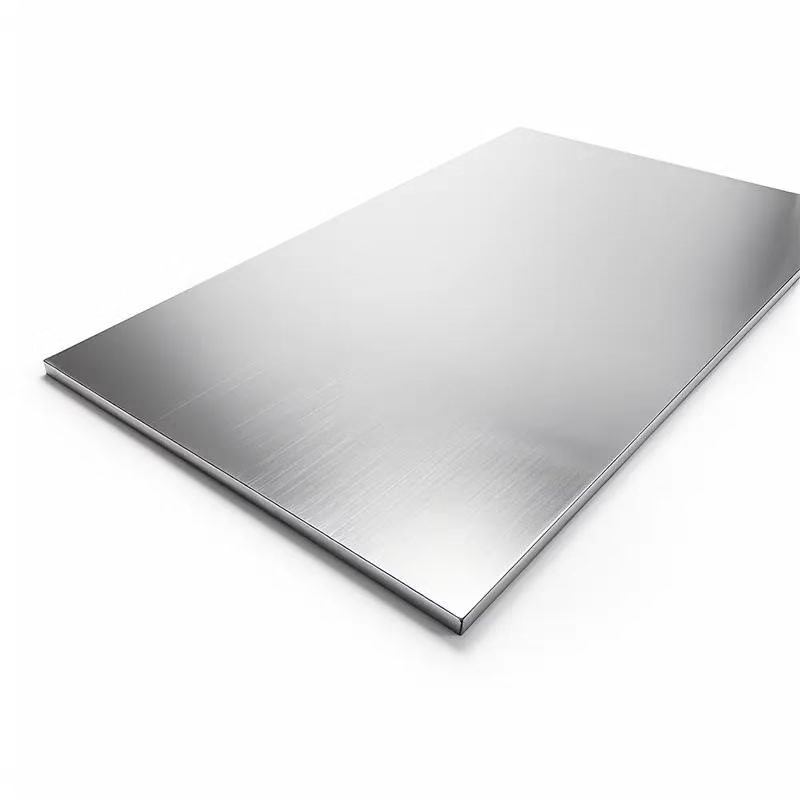
304L Stainless Steel Plate
AISI 304L (UNS S30403) low-carbon austenitic stainless steel plate with maximum 0.030% carbon, offering superior weldability and resistance to intergranular corrosion. Ideal for welded fabrications. Thickness 3-200mm, width up to 2500mm, multiple surface finishes. Mill test certificate with carbon verification provided.
| Material | Austenitic Stainless Steel (Low Carbon) |
|---|---|
| Grade / Standard | AISI 304L / UNS S30403 |
| Thickness | 3mm - 200mm |
| Width | 1000mm - 2500mm |
| Length | 2000mm - 12000mm |
| Delivery Condition | hot_rolled / cold_rolled |
| Surface Treatment | bare / polished |
| MOQ | 1 Ton |
| Delivery Time | 10-30 Days / In Stock for Common Sizes |
| Loading Port | Tianjin / Shanghai / Qingdao |
Overview of 304L Stainless Steel Plate
AISI 304L is the low-carbon variant of the industry-standard 304 austenitic stainless steel, specifically engineered to prevent intergranular corrosion in welded fabrications. Specified under ASTM A240 / EN 10088-2 standards with UNS designation S30403, 304L stainless steel plate maintains the excellent corrosion resistance, formability, and weldability of standard 304, while offering superior weldability due to its reduced carbon content (maximum 0.030% vs 0.08% for 304). The ‘L’ designation stands for ‘Low carbon,’ which eliminates the risk of carbide precipitation during welding or prolonged exposure to temperatures in the sensitization range of 425-815°C.
304L stainless steel plate contains nominally 18% chromium and 8% nickel, providing the characteristic non-magnetic austenitic microstructure with exceptional toughness from cryogenic temperatures to 870°C. This grade has become the preferred choice for heavy-section welded equipment, chemical processing vessels, pharmaceutical tanks, and any application where post-weld heat treatment is impractical or undesirable. The low carbon content ensures that chromium remains in solution rather than forming chromium carbides at grain boundaries, maintaining corrosion resistance in heat-affected zones adjacent to welds. 304L plate is supplied in comprehensive thickness range from 3mm to 200mm with multiple surface finishes to meet demanding fabrication and sanitary requirements.
Key Features and Surface Finishes
304L stainless steel plate is manufactured through hot rolling for thicker gauges (typically over 6mm) or cold rolling for thinner sheets, followed by solution annealing at 1010-1120°C with rapid cooling to achieve optimal low-carbon microstructure and superior intergranular corrosion resistance per ASTM A262 Practice E. The reduced carbon content (≤0.030%) provides exceptional weldability without requiring post-weld heat treatment for most applications, making 304L the mandatory specification for thick-section welded structures, pressure vessels, and sanitary process equipment.
The plate is available in multiple surface finishes including No.1 (hot rolled, annealed, descaled — typical for thicker plates and structural applications), 2B (cold rolled, annealed, pickled, light cold rolled — most common for general fabrication and sanitary equipment), No.4 (brushed satin finish for architectural and food processing applications), BA (bright annealed mirror finish for pharmaceutical and semiconductor equipment), and No.8 (mirror polish for decorative and high-purity applications). Thickness range spans 3mm to 200mm with widths up to 2500mm and standard lengths of 6 meters, with custom cut-to-length service available. Each plate undergoes mandatory chemical composition verification (with special focus on carbon content control), mechanical property testing, intergranular corrosion testing per ASTM A262 Practice A or E, and dimensional inspection to ensure full compliance with ASTM A240 / EN 10088-2 latest revision.
Main Applications of 304L Stainless Steel Plate
304L stainless steel plate is the mandatory material for welded food and beverage processing equipment including large-capacity dairy processing tanks, brewery fermentation and storage vessels, wine production equipment, food storage silos, commercial kitchen fabrications, meat processing tanks, and beverage bottling plant equipment where superior weldability, FDA compliance, and zero risk of weld decay corrosion are essential. The pharmaceutical and biotechnology industries specify 304L for large welded biopharmaceutical reactors, sterile processing tanks, WFI (Water For Injection) storage systems, clean room equipment, and vaccine production vessels requiring 3A sanitary standards, ASME BPE compliance, and validated CIP/SIP cleanability.
The chemical processing industry extensively uses 304L plate for welded storage tanks handling organic acids, alkalis, fertilizer solutions, and industrial chemicals, as well as reactor vessels, distillation columns, and process piping systems where post-weld heat treatment is impractical. Nuclear power plants specify 304L for safety-related pressure boundary components, containment vessel internals, and spent fuel pool structures to eliminate sensitization concerns. Pulp and paper processing plants use 304L for digesters, bleaching equipment, and chemical recovery systems. Other critical applications include cryogenic storage tanks for liquefied gases, automotive exhaust systems requiring complex welded assemblies, pressure vessels for industrial gases, water treatment plant equipment with extensive welding, desalination plant components (in controlled environments), and architectural structures requiring both aesthetic appeal and weld integrity without visible heat-affected zone discoloration.
Why Choose Us for 304L Stainless Steel Plate
Shandong Tanglu Metal Material Co., Ltd. supplies premium 304L stainless steel plate sourced from certified Chinese stainless steel mills including Tisco (Taiyuan Iron & Steel), Baosteel Stainless, and Lisco with strict carbon content control (verified ≤0.030%), proven international project experience, and certified production facilities meeting ISO 9001, ISO 14001, ASME Section VIII, ASME BPE (for bioprocessing equipment), and PED 2014/68/EU requirements. Every 304L plate undergoes mandatory chemical composition analysis with special verification of carbon content control, PMI (Positive Material Identification) verification available, mechanical property testing including tensile, yield, elongation and hardness verification, intergranular corrosion testing per ASTM A262 Practice E (Copper-Copper Sulfate-Sulfuric Acid Test) confirming freedom from sensitization, surface finish quality inspection, and dimensional inspection per ASTM A240 / EN 10088-2 latest revision.
We offer comprehensive thickness range from 3mm to 200mm in multiple surface finishes (No.1, 2B, No.4, BA, No.8) with standard widths up to 2500mm and lengths up to 12 meters, plus precision water jet cutting, plasma cutting, and laser cutting services for complex fabrication requirements. With monthly supply capacity of 5,000 tons of stainless steel plates and established export experience to food processing, pharmaceutical, chemical processing, nuclear, pressure vessel fabrication, and sanitary equipment OEM clients in over 50 countries, we support both small trial orders for equipment prototypes and large project supply contracts for turnkey plant construction. Each shipment includes original mill test certificate (MTC) conforming to EN 10204 3.1 standard with verified low carbon content documentation, with EN 10204 3.2, PMI report, ASTM A262 intergranular corrosion test report, and third-party inspection (SGS, BV, TÜV, ABS, DNV, LR) available for critical applications requiring enhanced documentation and code compliance verification.
📐 Dimension & Size Table
| Thickness (mm) | Width (mm) | Length (mm) | Weight (kg/m²) |
|---|---|---|---|
| 3 | 1000-2000 | 2000-6000 | 23.95 |
| 4 | 1000-2000 | 2000-6000 | 31.93 |
| 5 | 1000-2000 | 2000-6000 | 39.92 |
| 6 | 1000-2000 | 2000-6000 | 47.90 |
| 8 | 1000-2200 | 2000-8000 | 63.86 |
| 10 | 1000-2200 | 2000-8000 | 79.83 |
| 12 | 1500-2200 | 3000-8000 | 95.79 |
| 16 | 1500-2200 | 3000-8000 | 127.72 |
| 20 | 1500-2500 | 3000-10000 | 159.65 |
| 25 | 1500-2500 | 3000-10000 | 199.56 |
| 30 | 1500-2500 | 3000-10000 | 239.48 |
| 40 | 1500-2500 | 3000-12000 | 319.30 |
| 50 | 1500-2500 | 3000-12000 | 399.13 |
| 60 | 1500-2500 | 3000-12000 | 478.95 |
| 80 | 1500-2200 | 3000-12000 | 638.60 |
| 100 | 1500-2200 | 3000-12000 | 798.25 |
| 150 | 1500-2000 | 3000-10000 | 1197.38 |
| 200 | 1500-2000 | 3000-8000 | 1596.50 |
* Custom sizes available upon request. Tolerances per relevant international standards.
🔬 Chemical Composition
| Element | Min | Max | Display Value | Note |
|---|---|---|---|---|
| C | - | 0.030 | ≤0.030 | Low carbon - key difference from 304 |
| Si | - | 0.75 | ≤0.75 | |
| Mn | - | 2.00 | ≤2.00 | |
| P | - | 0.045 | ≤0.045 | |
| S | - | 0.030 | ≤0.030 | |
| Cr | 18.00 | 20.00 | 18.00-20.00 | Corrosion resistance element |
| Ni | 8.00 | 12.00 | 8.00-12.00 | Austenite stabilizer |
| N | - | 0.10 | ≤0.10 | Optional |
| Fe | - | - | Balance | Base element |
* Chemical composition may vary by heat, thickness and specification. Please refer to the actual mill test certificate.
⚙️ Mechanical Properties
| Property | Value | Unit | Test Condition |
|---|---|---|---|
| Tensile Strength (Rm) | ≥485 | MPa | Solution annealed, per ASTM A240 |
| Yield Strength (Rp0.2) | ≥170 | MPa | 0.2% proof stress (lower than 304 due to reduced carbon) |
| Elongation (A) | ≥40 | % | Gauge length 50mm |
| Brinell Hardness (HBW) | ≤201 | HBW | Solution annealed |
| Rockwell Hardness (HRB) | ≤92 | HRB | Solution annealed |
| Vickers Hardness (HV) | ≤210 | HV | Solution annealed |
| Impact Energy (KV2) | ≥150 | J | Charpy V-notch at +20°C |
| Density | 7.93 | g/cm³ | Reference value |
| Magnetic Permeability | ≤1.02 | μ | Non-magnetic austenitic structure |
* Values shown are minimum requirements unless otherwise stated.
📦 Commercial Information
| Packaging | Standard seaworthy export packing for stainless steel plates with enhanced protection for welding-grade material. Thinner plates (≤6mm) individually wrapped with PE film, then bundled with steel strapping and protective wooden frame to prevent edge damage. Thicker plates (>6mm) bundled with heavy-duty steel strapping and corner edge protectors, with weather-resistant interleaving paper between plates to prevent surface scratching and contamination. Bundle weight typically 3-5 tons depending on plate dimensions. Each bundle clearly tagged with heat number, grade designation (304L / S30403), verified carbon content, dimensions, surface finish, and quantity. For pharmaceutical and food processing applications, vacuum-sealed packaging with desiccant available. Special packaging for BA and No.8 polished surfaces includes protective PE film with anti-scratch coating. Wooden crates available for air shipment and high-value polished plates. |
|---|---|
| Payment Terms | T/T (Telegraphic Transfer),L/C at Sight (Letter of Credit),D/P (Documents against Payment),Western Union,PayPal (for small orders) |
| Price Term | FOB,CFR,CIF,EXW,DDP |
| Supply Capacity | 5,000 Tons/Month (Stainless Steel Plates) |
| Loading Port | Tianjin / Shanghai / Qingdao |
Why Choose Our 304L Stainless Steel Plate?
Certified Low Carbon Content
304L plate with verified carbon content ≤0.030% supplied with mill test certificate EN 10204 3.1/3.2 including chemical analysis (with carbon content verification), mechanical properties, mandatory intergranular corrosion testing per ASTM A262 Practice E, PMI verification, and complete heat number traceability per ASTM A240 and ASME specifications.
Superior Weldability Without PWHT
Low carbon content eliminates carbide precipitation during welding, preventing intergranular corrosion in heat-affected zones. No post-weld heat treatment required for most applications, making 304L ideal for thick-section welded structures, pressure vessels per ASME Section VIII, and sanitary equipment per ASME BPE standards.
Full Thickness Range with Precision Cutting
Comprehensive thickness range from 3mm precision sheets to 200mm heavy plates for pressure vessel construction, widths up to 2500mm, lengths up to 12 meters. Precision water jet cutting, plasma cutting, and laser cutting services available with dimensional tolerance per ASTM A480 for complex fabrication requirements.
Multi-Industry Code Compliance
FDA CFR 21 compliant for food contact, ASME BPE compliant for bioprocessing equipment, ASME Section VIII Division 1 & 2 compliant for pressure vessels, 3A Sanitary Standards certified for dairy equipment. ISO 9001, CE/PED 2014/68/EU, ABS, DNV GL, Lloyd's Register, BV, TÜV, SGS, and RINA certifications for international projects.
Stock Availability & Fast Delivery
Common welding-grade thicknesses (6mm-30mm) in 2B and No.4 finishes maintained in large stock for 10-15 days dispatch. Thicker pressure vessel plates (40mm-100mm) production cycle 25-35 days. Container loading optimized for 25-27 tons per 20FT FCL or 27-29 tons per 40FT FCL with proper edge protection and moisture control.
🏭 Applications of 304L Stainless Steel Plate
304L stainless steel plate is the mandatory specification for welded food and beverage processing equipment including large-capacity storage tanks (5,000+ gallon), brewery fermentation vessels, wine production equipment, dairy processing tanks, meat processing equipment, vegetable oil storage tanks, beverage syrup storage, and CIP (Clean-In-Place) systems where superior weldability, FDA compliance (CFR 21), and zero risk of weld decay corrosion are essential. The pharmaceutical and biotechnology industries specify 304L for GMP-compliant biopharmaceutical reactors, sterile processing vessels, WFI (Water For Injection) storage and distribution systems, buffer preparation tanks, cell culture bioreactors, vaccine production equipment, and clean room fabrications requiring ASME BPE finish standards, 3A sanitary polishing, and validated CIP/SIP (Steam-In-Place) cleanability without crevice corrosion concerns. Chemical processing plants extensively use 304L for welded storage tanks handling organic acids (acetic, citric, lactic), caustic solutions, fertilizer production equipment (urea, ammonium nitrate), petrochemical intermediate storage, reactor vessels, distillation columns, and process piping systems where post-weld heat treatment is impractical or economically prohibitive. Nuclear power generation facilities specify 304L for safety-related ASME Section III Class 2 and 3 components including containment vessel internals, spent fuel pool structures, radwaste processing tanks, and auxiliary systems to eliminate intergranular stress corrosion cracking concerns. Pulp and paper processing plants use 304L for digesters, bleaching towers, chemical recovery systems, and white liquor storage tanks. Cryogenic applications include LNG (Liquefied Natural Gas) storage tank inner shells, liquid nitrogen vessels, liquid oxygen tanks, and cryogenic transport equipment operating at -196°C. Other critical applications include ASME Section VIII Division 1 & 2 pressure vessels for industrial gas storage (nitrogen, argon, CO2), automotive exhaust manifolds and catalytic converter housings requiring complex welded assemblies, desalination plant evaporator shells and brine heaters, water treatment clarifiers and filtration vessels, architectural structures with extensive welding (curtain walls, structural columns, bridge components), heat exchanger shells for food and pharmaceutical industries, and marine applications including ship fuel tanks, ballast water treatment systems, and offshore platform utility systems where weld integrity and corrosion resistance are critical for safety and operational reliability.
📋 Quality & Certification
Our Certifications
- ✅ ISO 9001:2015
- ✅ ABS
- ✅ DNV GL
- ✅ Lloyd's Register (LR)
- ✅ Bureau Veritas (BV)
- ✅ SGS Certified
- ✅ NK
- ✅ RINA
Mill Certificate Type
- 📋 EN 10204 3.1
- 📋 EN 10204 3.2
- 📋 Certificate of Origin
❓ Frequently Asked Questions
What is the difference between 304 and 304L stainless steel plate?
The primary difference is carbon content: 304 has maximum carbon of 0.08%, while 304L has maximum carbon of 0.030% (the 'L' stands for 'Low carbon'). This reduced carbon content in 304L provides critical advantages for welded fabrications: (1) Superior resistance to intergranular corrosion (also called sensitization or weld decay) in heat-affected zones after welding, (2) Elimination of carbide precipitation at grain boundaries during welding or exposure to 425-815°C sensitization temperature range, (3) No requirement for post-weld solution annealing for most applications, making 304L the mandatory choice for thick-section welded equipment (typically over 6mm), pressure vessels per ASME Section VIII, chemical processing tanks, and any fabrication where post-weld heat treatment is impractical. The trade-off is slightly lower mechanical properties in 304L (yield strength 170 MPa vs 205 MPa for 304) due to reduced carbon strengthening, but corrosion resistance and weldability are superior. For welded equipment, pharmaceutical vessels, food processing tanks, and chemical storage vessels, 304L is the specified grade; for non-welded applications like fasteners, machined parts, and thin stampings, standard 304 is acceptable and more economical.
Why is 304L preferred for welded stainless steel fabrications?
304L is preferred for welded fabrications because its low carbon content (≤0.030%) prevents chromium carbide precipitation at grain boundaries during welding, eliminating the risk of intergranular corrosion (also called sensitization or weld decay). When standard 304 (with higher carbon up to 0.08%) is welded, the heat-affected zone (HAZ) adjacent to the weld can reach the sensitization temperature range of 425-815°C, causing chromium to combine with carbon and form chromium carbides (Cr23C6) at grain boundaries. This depletes chromium content in areas adjacent to grain boundaries below the critical 12% level needed for corrosion resistance, creating a pathway for intergranular attack in corrosive environments. 304L's low carbon content means insufficient carbon is available to form significant carbide precipitation, maintaining chromium in solution and preserving corrosion resistance throughout the welded structure. This makes 304L mandatory for: (1) Thick-section welded equipment where cooling rates promote sensitization, (2) Pressure vessels per ASME Section VIII that cannot be solution annealed after welding, (3) Chemical processing equipment exposed to corrosive media, (4) Pharmaceutical and food processing tanks requiring sanitary welds per ASME BPE, (5) Large storage tanks where post-weld heat treatment is impractical, and (6) Any welded structure where long-term corrosion resistance in heat-affected zones is critical for safety and service life.
What are the equivalent international grades for AISI 304L?
AISI 304L has the following equivalent grades in major international standards: UNS S30403 (US Unified Numbering System), ASTM A240 304L (American specification for plate, sheet and strip), EN 1.4307 with designation X2CrNi18-9 (European standard EN 10088-2, note the 'X2' prefix indicates extra-low carbon), JIS SUS304L (Japanese Industrial Standard JIS G4304), GB 022Cr19Ni10 or 00Cr19Ni10 (Chinese standard GB/T 4237, with '022' or '00' prefix indicating low carbon), DIN X2CrNi19-11 (German standard, now superseded by EN but still referenced), and AFNOR Z3CN18-10 (French standard, with 'Z3' indicating low carbon). All these equivalent grades share virtually identical chemical composition with maximum carbon of 0.030%, chromium 18-20%, and nickel 8-12%, making them interchangeable for engineering specifications. EN 1.4307 is the most commonly referenced equivalent in European Union projects and PED (Pressure Equipment Directive) certified equipment, while SUS304L is the standard designation for Japanese pharmaceutical and food processing equipment manufacturers. When specifying 304L for international projects, it's advisable to reference both the AISI designation and the applicable local standard (e.g., 'AISI 304L / EN 1.4307') to ensure clear material identification across global supply chains.
Is post-weld heat treatment required for 304L stainless steel plate?
Post-weld heat treatment (PWHT) is generally NOT required for 304L stainless steel welded fabrications due to the grade's low carbon content (≤0.030%), which prevents chromium carbide precipitation and intergranular corrosion in heat-affected zones. This is the primary advantage of 304L over standard 304 for welded construction. However, specific applications may still require PWHT for other reasons: (1) Solution annealing at 1010-1120°C followed by rapid cooling may be specified for ASME Section VIII Division 1 pressure vessels over certain thickness or for critical corrosive service to ensure complete dissolution of any residual carbides and stress relief, (2) Stress relief heat treatment at 870-900°C (below the sensitization range) may be required for large welded structures to reduce residual stresses and improve dimensional stability, though this is less common for 304L, (3) Special nuclear code applications per ASME Section III may mandate PWHT regardless of carbon content for fracture toughness verification, (4) Some petrochemical specifications require solution annealing for equipment exposed to polythionic acid stress corrosion cracking environments. For the vast majority of 304L applications including food processing tanks, pharmaceutical vessels, chemical storage tanks, architectural fabrications, and general industrial welded equipment, no PWHT is necessary after welding, which significantly reduces fabrication costs and lead times compared to standard 304. Always consult applicable design codes (ASME, PED, AD2000) and end-user specifications to confirm PWHT requirements for specific projects, but 304L's elimination of mandatory post-weld solution annealing is its key technical and economic advantage for welded stainless steel construction.
What surface finishes are recommended for 304L pharmaceutical and food processing equipment?
For pharmaceutical and food processing equipment fabricated from 304L stainless steel plate, the recommended surface finishes depend on specific sanitary and regulatory requirements: (1) 2B finish (cold rolled, annealed, pickled) with Ra ≤0.8 μm is the minimum acceptable finish for general food contact surfaces per FDA CFR 21 and basic 3A Sanitary Standards applications, providing smooth surface for cleanability, (2) No.4 brushed finish with 120-150 grit polish achieving Ra 0.4-0.6 μm is widely used for food processing tanks, brewery vessels, and commercial kitchen equipment requiring good cleanability with visual appeal, (3) Sanitary polished finish per ASME BPE with Ra ≤0.4 μm (SF4 level) is specified for pharmaceutical equipment, bioreactors, sterile processing tanks, and WFI (Water For Injection) systems requiring CIP/SIP validation, (4) Electropolished finish achieving Ra ≤0.2 μm is required for high-purity pharmaceutical applications, semiconductor process equipment, and critical bioprocessing vessels to minimize bacterial adhesion, protein binding, and facilitate sterilization validation, (5) BA (Bright Annealed) finish with mirror-like appearance and Ra ≤0.5 μm is common for pharmaceutical storage tanks and clean room equipment combining cleanability with aesthetic requirements. Additional surface treatments may include passivation per ASTM A967 to enhance corrosion resistance and remove free iron contamination, and electropolishing per ASTM B912 to remove surface irregularities and create a chromium-enriched passive layer. For ASME BPE compliance (mandatory for many pharmaceutical applications), surface finish requirements are strictly defined: SF1 (Ra ≤1.0 μm) for general bioprocessing, SF4 (Ra ≤0.4 μm) for sterile applications, and SF7 (Ra ≤0.2 μm) for high-purity water systems. The selection should be based on the specific product contact requirements, cleaning protocols (CIP frequency and chemistry), sterilization methods (SIP temperature cycles), and applicable regulations (FDA, EMA, GMP Annex 1) for the intended pharmaceutical or food processing application.
Can 304L stainless steel plate be used for cryogenic applications?
Yes, 304L stainless steel plate is widely used for cryogenic applications and is one of the preferred materials for equipment operating at temperatures down to -196°C (liquid nitrogen temperature) and even lower to -269°C (liquid helium). The austenitic face-centered cubic (FCC) crystal structure of 304L does not undergo ductile-to-brittle transition at cryogenic temperatures, unlike ferritic or martensitic stainless steels and carbon steels which become brittle. Key advantages of 304L for cryogenic service include: (1) Excellent impact toughness maintained at cryogenic temperatures (Charpy impact energy typically >150J at -196°C), (2) Increased tensile and yield strength at lower temperatures (yield strength can increase from 170 MPa at room temperature to over 400 MPa at -196°C), (3) Superior weldability for fabricating cryogenic tanks and vessels without post-weld heat treatment requirements, (4) Non-magnetic properties important for certain scientific and medical cryogenic applications. Common cryogenic applications for 304L plate include: inner shells of LNG (Liquified Natural Gas) storage tanks, liquid nitrogen storage vessels and transport dewars, liquid oxygen tanks for medical and industrial gas applications, liquid argon storage for semiconductor manufacturing, cryogenic piping systems, superconducting magnet cryostats, space launch vehicle fuel tanks, and cryogenic processing equipment for food freeze-drying. For critical cryogenic pressure vessels, ASTM A240 specifies supplementary requirements S1 (mandatory Charpy impact testing) to verify toughness at design temperature. While 304L performs well in many cryogenic applications, for the most demanding cryogenic service at -269°C (liquid helium) or where higher strength is required, austenitic grades with higher nickel content such as 310S (25% Ni) or specially developed cryogenic grades like 304LN (nitrogen strengthened) may offer superior performance. For LNG containment, 9% nickel steel or aluminum 5083 are common alternatives, but 304L remains cost-effective for secondary containment and piping systems.
Request Quote for 304L Plate for
304L Stainless Steel Plate
Submit your requirements and receive a competitive price quote within 24 hours.
- ✓ Fast response within 24 hours
- ✓ Competitive factory-direct pricing
- ✓ Free technical consultation
- ✓ Mill test certificate provided
- ✓ Flexible payment terms available
⏱ Technical support within 24 hours
Send Your Inquiry
All fields marked with * are required