
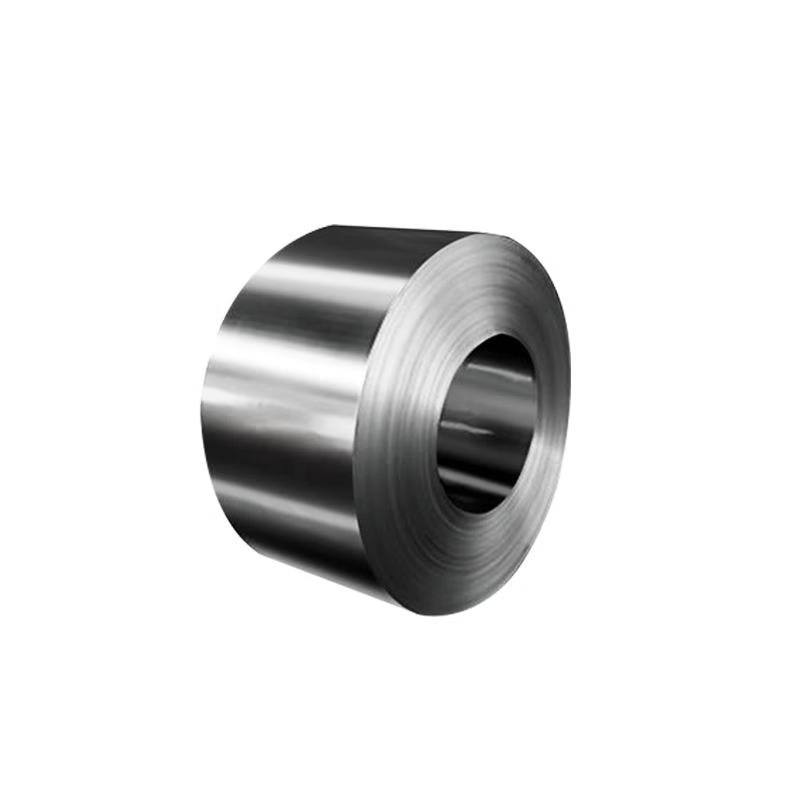
301 Stainless Steel Coil
AISI 301 (UNS S30100) is a high-strength austenitic stainless steel coil with superior work-hardening capability and excellent corrosion resistance. Contains 16-18% Cr and 6-8% Ni. Available in multiple tempers (annealed to full-hard: 515-1200+ MPa). Thickness 0.15-6mm, width 600-1500mm. Ideal for automotive suspension, aerospace fasteners, precision springs. Mill test certificate with mechanical property verification.
| Material | Austenitic Stainless Steel (High-strength work-hardened, Chromium-Nickel) |
|---|---|
| Grade / Standard | AISI 301 / UNS S30100 |
| Thickness | 0.15mm - 6mm |
| Width | 600mm - 1500mm |
| Inner Diameter (ID) | 508mm / 610mm |
| Coil Weight | 2-6 Tons (Max 8 Tons) |
| Surface Treatment | bare / polished |
| MOQ | 3 Tons (or specialty combination) |
| Delivery Time | 20-30 Days / Specialty Production |
| Loading Port | Tianjin / Shanghai / Qingdao |
Overview of 301 Stainless Steel Coil
AISI 301 is a high-strength austenitic stainless steel grade widely used in applications requiring superior work-hardening capability combined with excellent corrosion resistance, accounting for approximately 5-8% of global austenitic stainless steel coil production in specialized industrial and automotive markets. Specified under ASTM A240 / EN 10088-2 standards with UNS designation S30100, 301 stainless steel coil offers an exceptional combination of moderate corrosion resistance comparable to 304, superior work-hardening characteristics enabling high-strength through cold rolling, excellent formability for complex fabrication, and spring-back properties ideal for precision components. Containing nominally 16-18% chromium and 6-8% nickel (lower nickel than 304 but higher than 201), the grade provides the characteristic non-magnetic austenitic microstructure with outstanding strain-hardening capability enabling tensile strength increase from 515 MPa (annealed) to 1100+ MPa (fully hard condition) without secondary heat treatment.
301 stainless steel coil is the preferred raw material for high-strength specialized manufacturing applications requiring excellent corrosion resistance combined with controlled spring-back, elasticity, and fatigue resistance. Available in both hot rolled (HR) and cold rolled (CR) conditions with multiple tempers (annealed, quarter-hard, half-hard, three-quarter-hard, full-hard), the coil is widely used by automotive component manufacturers (seat belt webbing, suspension clips, trim fasteners), aerospace engineers, precision instrument makers, electrical equipment manufacturers, and specialized industrial fabricators worldwide. The grade exhibits superior resilience and fatigue resistance enabling use in dynamic applications, vibration-resistant components, and precision springs requiring both strength and corrosion resistance. 301 resists corrosion in atmospheric environments, fresh water, mild industrial chemicals, and general service conditions comparable to 304, making it indispensable for automotive clips, fasteners, suspension components, seat assemblies, and specialized industrial applications where strength, elasticity, and durability must be optimized simultaneously.
Key Features and Coil Manufacturing
301 stainless steel coil is manufactured through hot rolling for thicker gauges (typically 2mm to 6mm) or cold rolling for thinner gauges (0.15mm to 3mm) with controlled temperature profiles to optimize work-hardening characteristics. Unlike austenitic 304 which remains relatively soft after annealing, 301’s chromium-to-nickel ratio (approximately 2.3-2.5 vs 304’s 2.0-2.1) positions it at the boundary between austenitic and martensitic transformation, enabling dramatic strength increase through cold rolling without phase transformation. Cold rolled coils are supplied in multiple temper conditions: annealed (soft, maximum ductility for forming), quarter-hard (40% cold reduction), half-hard (50% cold reduction for intermediate strength), three-quarter-hard (60% cold reduction), and full-hard (maximum cold reduction for maximum strength). Each temper condition provides specific combinations of tensile strength, yield strength, elongation, and springback characteristics optimized for different application requirements.
Manufacturing process includes precision rolling with controlled reduction rates to achieve specific work-hardening levels, solution annealing at 1010-1120°C for annealed condition, followed by controlled cooling and optional stress-relief annealing to relieve residual stresses from cold rolling without significantly reducing strength. Pickling and skin pass rolling provide smooth, consistent surface finish with minimal surface oxidation. The coil is supplied in standard widths from 600mm to 1500mm with thickness ranging from 0.15mm (precision foil) to 6mm, with custom slitting and recoiling services available including edge trimming, slitting to ultra-narrow widths, and specialty temper combinations.
Multiple surface finishes are available including 2B (cold rolled, annealed, pickled, light cold rolled — most common for industrial use), polished finishes for aesthetic applications, and custom finishes for specialty requirements. Standard inner diameter is 508mm or 610mm, with coil weight typically ranging from 2 to 6 tons depending on thickness and width. Each coil undergoes mandatory chemical composition analysis (PMI verification available), mechanical property testing including tensile strength, yield strength, elongation, hardness verification at specific temper conditions, springback characteristic measurement, stress-relief verification, and fatigue resistance assessment to ensure full compliance with ASTM A240 and customer specifications for critical applications.
Main Applications of 301 Stainless Steel Coil
301 stainless steel coil is the primary raw material for specialized high-strength manufacturing applications requiring superior work-hardening capability combined with excellent corrosion resistance and controlled elasticity. Automotive component manufacturers use 301 coil extensively for seat belt webbing attachments, suspension clips, constant-force springs, retaining fasteners, seat frame components, trim clips, and precision fasteners where combination of high strength, corrosion resistance, and fatigue durability is critical for vehicle safety and longevity. Superior springback and elasticity enable precision suspension clips that maintain tension through temperature cycling and mechanical stress without permanent deformation.
Aerospace and defense industries employ 301 coil for fastening clips, electrical connectors, structural fasteners, and precision components requiring superior fatigue resistance, corrosion resistance, and reliability in demanding service environments. The combination of excellent corrosion resistance and high strength at reduced weight is critical for aerospace applications. Electrical and electronics equipment manufacturers use 301 coil for connector terminals, spring contacts, circuit breaker components, electrical switching equipment, and precision electrical components where excellent conductivity, corrosion resistance, spring force maintenance, and fatigue durability enable reliable long-term electrical performance.
Precision instrument and control equipment industries rely on 301’s superior work-hardening for manufacturing precision springs, control linkages, mechanical sensors, measuring instruments, and fine mechanical components requiring high strength combined with excellent dimensional stability and corrosion resistance. Medical and surgical equipment manufacturers utilize 301 for surgical instrument springs, bone plates, implant fasteners, and surgical clips where superior corrosion resistance, strength, and biocompatibility support patient safety and instrument reusability. Industrial fastener manufacturers use 301 half-hard and three-quarter-hard tempers for high-strength fasteners, spring washers, lock washers, and tensioning hardware where controlled strength and springback characteristics are essential. Other applications include door hinge springs, lock mechanisms, machinery springs, vibration-isolation clips, precision agriculture equipment, textile machinery components, appliance springs, and specialized industrial components requiring simultaneous optimization of strength, elasticity, fatigue resistance, and corrosion resistance.
Why Choose Us for 301 Stainless Steel Coil
Shandong Tanglu Metal Material Co., Ltd. supplies premium 301 stainless steel coil sourced from major Chinese and international stainless steel mills with specialized expertise in work-hardened and tempered materials, certified production facilities meeting ISO 9001, ASTM standards, and aerospace/automotive specifications. Every 301 coil undergoes rigorous quality verification including mandatory chemical composition analysis (PMI verification available), comprehensive mechanical property testing at specified temper conditions (tensile strength, yield strength, elongation, hardness), springback and elasticity measurements, residual stress assessment, and fatigue resistance evaluation to ensure full compliance with ASTM A240 specifications and customer application requirements.
We offer comprehensive specification range covering thickness from 0.15mm precision foils to 6mm heavy gauge and width from 600mm to 1500mm in multiple temper conditions (annealed, quarter-hard, half-hard, three-quarter-hard, full-hard) with flexible coil weight options from 2 to 6 tons to match different processing requirements for precision manufacturing. With monthly supply capacity of 8,000 tons of stainless steel coils including 600 tons of 301 specialty grades and established export relationships with automotive tier-1 suppliers, aerospace manufacturers, precision instrument makers, and electrical equipment suppliers in over 50 countries, we support both small specialty orders and large volume contracts for critical applications. Specialty services include custom temper development, precision slitting to ultra-narrow widths (down to 5mm for electronic components), edge trimming, edge rounding, tension control for precision feeding, and specific springback verification. Each shipment includes original mill test certificate (MTC) conforming to EN 10204 3.1 standard with mechanical property verification at specified temper condition, with EN 10204 3.2, detailed property testing, stress-relief verification, and third-party inspection (SGS, BV, ABS, DNV, TÜV) available for critical automotive and aerospace applications.
301 Temper Conditions and Property Guide
301 stainless steel coil is supplied in multiple temper conditions enabling optimization for specific application requirements: Annealed condition offers maximum ductility (minimum 45% elongation) with tensile strength ≥515 MPa, ideal for deep drawing, complex forming, and applications requiring extreme formability before service. Quarter-hard (40% reduction) provides intermediate properties with tensile strength 650-750 MPa and elongation 20-30%, suitable for moderately stressed components. Half-hard (50% reduction) offers tensile strength 850-950 MPa with elongation 15-20%, widely used for suspension clips, fasteners, and moderately high-strength applications. Three-quarter-hard (60% reduction) provides tensile strength 1000-1100 MPa with elongation 8-12%, ideal for high-strength fasteners and heavily stressed clips where maximum strength is balanced with controlled ductility. Full-hard (maximum reduction) achieves tensile strength 1100-1200+ MPa with elongation 3-8%, used for maximum strength applications including highly stressed fasteners and wear-resistant components. Selection of appropriate temper requires careful analysis of application stress levels, forming requirements, and in-service conditions.
📐 Dimension & Size Table
| Thickness (mm) | Width (mm) | Inner Dia (mm) | Coil Weight (T) | Typical Temper |
|---|---|---|---|---|
| 0.15 | 600-1000 | 508 | 2-3 | |
| 0.20 | 600-1000 | 508 | 2-3 | |
| 0.25 | 600-1250 | 508 | 2-3 | |
| 0.30 | 600-1250 | 508 | 2-4 | |
| 0.4 | 600-1500 | 508 | 2-4 | |
| 0.5 | 600-1500 | 508 | 3-4 | |
| 0.6 | 600-1500 | 508 | 3-5 | |
| 0.8 | 600-1500 | 508 | 3-5 | |
| 1.0 | 600-1500 | 508 / 610 | 3-5 | |
| 1.2 | 600-1500 | 508 / 610 | 4-6 | |
| 1.5 | 600-1500 | 508 / 610 | 4-6 | |
| 2.0 | 1000-1500 | 610 | 4-6 | |
| 2.5 | 1000-1500 | 610 | 5-6 | |
| 3.0 | 1000-1500 | 610 | 5-8 | |
| 4.0 | 1000-1500 | 610 | 5-8 | |
| 5.0 | 1000-1500 | 610 | 5-8 | |
| 6.0 | 1000-1500 | 610 | 5-8 |
* Custom sizes available upon request. Tolerances per relevant international standards.
🔬 Chemical Composition
| Element | Min | Max | Display Value | Note |
|---|---|---|---|---|
| C | - | 0.15 | ≤0.15 | Per ASTM A240 301 |
| Si | - | 1.00 | ≤1.00 | |
| Mn | - | 2.00 | ≤2.00 | |
| P | - | 0.045 | ≤0.045 | |
| S | - | 0.030 | ≤0.030 | |
| Cr | 16.00 | 18.00 | 16.00-18.00 | Corrosion resistance element |
| Ni | 6.00 | 8.00 | 6.00-8.00 | Austenite stabilizer (lower than 304's 8-10.5%) |
| Mo | - | - | - | Not present |
| N | - | 0.10 | ≤0.10 | Optional |
| Fe | - | - | Balance | Base element |
* Chemical composition may vary by heat, thickness and specification. Please refer to the actual mill test certificate.
⚙️ Mechanical Properties
| Property | Value | Unit | Test Condition |
|---|---|---|---|
| Tensile Strength - Annealed | ≥515 | MPa | Soft condition, maximum ductility |
| Tensile Strength - Quarter-Hard | 650-750 | MPa | 40% cold reduction |
| Tensile Strength - Half-Hard | 850-950 | MPa | 50% cold reduction (most common) |
| Tensile Strength - 3/4-Hard | 1000-1100 | MPa | 60% cold reduction (high strength) |
| Tensile Strength - Full-Hard | 1100-1200+ | MPa | Maximum cold reduction (maximum strength) |
| Yield Strength (Rp0.2) - Annealed | ≥205 | MPa | Annealed condition |
| Yield Strength (Rp0.2) - Half-Hard | 650-750 | MPa | Half-hard condition |
| Elongation - Annealed | ≥45 | % | Gauge length 50mm (maximum ductility) |
| Elongation - Half-Hard | 15-20 | % | Intermediate ductility |
| Elongation - Full-Hard | 3-8 | % | Limited ductility for further forming |
| Work-Hardening Rate | Superior | - | Highest strength gain per cold reduction (superior to 304) |
| Springback Capability | Excellent | - | Outstanding elastic recovery for springs and clips |
| Fatigue Resistance | Superior | - | Excellent endurance limit for dynamic loading |
| Density | 7.93 | g/cm³ | Reference value |
| Magnetic Permeability | ≤1.02 | μ | Non-magnetic austenitic (may show slight magnetism when work-hardened) |
* Values shown are minimum requirements unless otherwise stated.
📦 Commercial Information
| Packaging | Premium export packing for precision work-hardened stainless steel coils. Each coil wrapped with PE film for corrosion protection, then bundled with stainless steel strapping (4-6 wraps per coil), with eye protection rings on inner diameter and weatherproof outer wrap. Coils labeled with heat number, grade designation (301 / S30100), thickness, width, coil weight, surface finish, and specified temper condition (annealed/half-hard/full-hard). Specialized handling required for full-hard material to prevent coil damage during loading. Standard loading: coil eye horizontal or vertical per container requirement. For precision applications, additional protective measures including individual cardboard separators, tension control documentation, and residual stress verification available. |
|---|---|
| Payment Terms | T/T (Telegraphic Transfer),L/C (Letter of Credit),D/P (Documents against Payment),Western Union,PayPal |
| Price Term | FOB,CFR,CIF,EXW |
| Supply Capacity | 8,000 Tons/Month (Stainless Steel Coils) | 600 Tons/Month (301 High-strength Specialty) |
| Loading Port | Tianjin / Shanghai / Qingdao |
Why Choose Our 301 Stainless Steel Coil?
Superior Work-Hardening: 515-1200+ MPa Tensile Range
Outstanding strain-hardening capability enables tensile strength increase from 515 MPa (annealed) to 1100-1200+ MPa (full-hard) without secondary heat treatment. Superior work-hardening rate compared to 304 grade. Multiple temper conditions (annealed, quarter, half, 3/4, full-hard) enable optimization for specific strength and formability requirements.
Exceptional Spring and Elasticity Properties
Outstanding springback and elastic recovery characteristics ideal for suspension clips, constant-force springs, fasteners, and precision components requiring controlled elasticity and fatigue resistance. Superior resilience maintains tension through temperature cycling and mechanical stress without permanent deformation.
Superior Fatigue and Dynamic Load Resistance
Excellent endurance limit and fatigue resistance for dynamic loading applications including automotive suspension components, vibration-resistant fasteners, and mechanical components experiencing cyclic stress. Combines strength with durability for long-service-life critical applications.
Precision Foil to Heavy Gauge Capability
Available from 0.15mm ultra-precision foil for electronic components to 6mm heavy gauge for structural fasteners. Custom slitting to ultra-narrow widths (down to 5mm), edge rounding, and tension control for precision feeding available. Supports diverse application requirements from micro-electronics to automotive engineering.
Aerospace & Automotive Grade Quality Assurance
Comprehensive mechanical property verification at specified temper conditions (tensile, yield, elongation, hardness), springback measurement, stress-relief verification, and fatigue assessment. EN 10204 3.1/3.2 mill test certificates with detailed property documentation. Third-party inspection (SGS, BV, DNV, TÜV) available for critical automotive and aerospace applications.
🏭 Applications of 301 Stainless Steel Coil
301 stainless steel coil is the primary raw material for specialized high-strength manufacturing applications requiring superior work-hardening capability combined with excellent corrosion resistance and controlled elasticity across automotive, aerospace, electrical, and precision instrument industries. Automotive component manufacturers use 301 coil extensively for seat belt webbing attachments, suspension clips, constant-force springs, retaining fasteners, seat frame components, and trim clips where the combination of high strength achieved through work-hardening, excellent corrosion resistance comparable to 304, superior fatigue resistance, and controlled springback characteristics enable safe, durable vehicle components. Half-hard and three-quarter-hard tempers are preferred for suspension applications requiring specific strength-to-weight ratios and predictable elastic behavior through vehicle service life. Aerospace and defense industries employ 301 coil for critical fastening clips, structural fasteners, electrical connectors, and precision components requiring superior fatigue resistance, excellent corrosion resistance in pressurized cabin environments, and lightweight high-strength properties essential for aircraft performance and safety.
Electrical and electronics equipment manufacturers use 301 coil for connector terminals, spring contacts, circuit breaker components, electrical switching equipment, and precision electrical components where excellent electrical conductivity maintained through work-hardening, superior corrosion resistance, and spring force maintenance enable reliable long-term electrical performance under thermal cycling and mechanical stress. Precision instrument and control equipment industries rely on 301's superior work-hardening for manufacturing precision springs, control linkages, mechanical sensors, measuring instruments, and fine mechanical components requiring high strength combined with excellent dimensional stability and consistent corrosion resistance throughout service life. Medical and surgical equipment manufacturers utilize 301 for surgical instrument springs, bone plates, joint implant fasteners, and surgical clips where superior corrosion resistance, biocompatibility, strength, and fatigue resistance enable safe patient outcomes and instrument reusability through multiple sterilization cycles.
Industrial fastener manufacturers use 301 half-hard, three-quarter-hard, and full-hard tempers for manufacturing high-strength fasteners, spring washers, lock washers, tension fasteners, and tensioning hardware where controlled strength, elasticity, and springback characteristics enable reliable fastening with consistent locking force maintenance. Fastener manufacturers value 301's superior work-hardening enabling achievement of required strength without secondary heat treatment, reducing manufacturing cost and production time. Heavy equipment and machinery manufacturers employ 301 for machinery springs, vibration-isolation clips, suspension hardware, and mechanical linkages requiring simultaneous optimization of strength, elasticity, and durability. Agricultural equipment manufacturers use 301 for springs, clips, and load-bearing fasteners in high-vibration environments. Appliance manufacturers use 301 for high-strength springs and fasteners in washing machines, dishwashers, and precision equipment. Textile machinery manufacturers rely on 301 for component springs and fasteners. Other specialized applications include door hinge springs, high-security lock mechanisms, precision control systems, and industrial equipment where material reliability and performance consistency are non-negotiable for equipment availability and safety.
📋 Quality & Certification
Our Certifications
- ✅ ISO 9001:2015
- ✅ ABS
- ✅ DNV GL
- ✅ Bureau Veritas (BV)
- ✅ SGS Certified
Mill Certificate Type
- 📋 EN 10204 3.1
- 📋 EN 10204 3.2
- 📋 Original Mill Certificate
- 📋 Third Party Inspection Available
- 📋 Certificate of Origin
❓ Frequently Asked Questions
What is 301 stainless steel coil and how does it differ from 304?
301 is a high-strength austenitic stainless steel grade specified under ASTM A240 / EN 10088-2 (equivalent EN 1.4310) with UNS designation S30100. Unlike 304 which is optimized for general-purpose corrosion resistance and formability, 301 is specifically designed for applications requiring superior work-hardening capability (strength increase through cold rolling) combined with excellent corrosion resistance. Key differences: (1) Nickel content — 301 contains 6-8% Ni vs 304's 8-10.5%, positioning 301 closer to the austenitic-martensitic boundary and enabling superior strain-hardening without phase transformation. (2) Work-hardening — 301 exhibits significantly superior work-hardening (strain-hardening) capability compared to 304, enabling tensile strength increase from 515 MPa (annealed) to 1100-1200+ MPa (full-hard) vs 304's more modest strength increase. (3) Springback — 301 provides exceptional springback and elastic recovery ideal for springs, clips, and components requiring controlled elasticity; 304 is less suitable for applications requiring precise springback. (4) Fatigue resistance — 301 offers superior fatigue resistance and endurance limit for dynamic loading applications; 304 is adequate for static loading. (5) Temper availability — 301 is supplied in multiple temper conditions (annealed, quarter, half, 3/4, full-hard) each with specific strength/ductility combinations; 304 is primarily supplied annealed. (6) Corrosion resistance — 301 offers corrosion resistance comparable to 304 in most environments, though 304 is slightly superior in some aggressive chloride conditions. (7) Cost — 301 typically costs 10-15% more than 304 due to specialized processing and temper control required. (8) Applications — 301 is optimal for automotive suspension, aerospace fasteners, precision springs, and high-strength components; 304 is better for general industrial, food equipment, and corrosion-critical applications.
What are the different temper conditions for 301 stainless steel and how are they selected?
301 stainless steel coil is supplied in five primary temper conditions, each representing specific levels of cold work (reduction percentage) resulting in different combinations of tensile strength, yield strength, elongation, and elasticity. Understanding temper selection is critical for optimizing component performance and manufacturability. Annealed (soft) condition: 0% cold reduction, tensile strength ≥515 MPa, elongation ≥45%, minimum hardness. Used for applications requiring maximum formability for deep drawing, complex bending, and intricate forming operations before service. Selected when components will be subjected to minimal stress or when secondary forming is anticipated. Quarter-hard: 40% cold reduction, tensile strength 650-750 MPa, elongation 25-35%. Intermediate condition providing balance between strength and formability. Selected for moderately stressed components and applications requiring some forming after material receipt. Half-hard: 50% cold reduction, tensile strength 850-950 MPa, elongation 15-20%, optimum balance of strength and some residual ductility. Most widely used condition for suspension clips, fasteners, and components requiring high strength with controlled elasticity. Ideal for automotive applications where strength is critical but some component flexibility is beneficial. Three-quarter-hard: 60% cold reduction, tensile strength 1000-1100 MPa, elongation 8-12%. High-strength condition for applications requiring maximum strength while retaining minimal residual ductility for emergency forming. Used for heavily stressed fasteners, lock washers, and components experiencing high mechanical stress. Full-hard: Maximum cold reduction, tensile strength 1100-1200+ MPa, elongation 3-8%, maximum hardness. Maximum strength condition with minimal remaining ductility, unsuitable for additional forming. Used only for applications requiring absolute maximum strength where no post-receipt forming is anticipated. Selection guidance: (1) If component requires drawing, bending, or forming after coil receipt → select annealed. (2) If component requires high strength with moderate elasticity (automotive suspension, suspension clips) → select half-hard. (3) If component requires maximum strength and minimal elasticity (fasteners, lock washers) → select 3/4 or full-hard. (4) If uncertain → specify half-hard as most versatile condition. Incorrect temper selection can result in component failure (too soft = insufficient strength, too hard = cannot form component shape).
Why is 301 preferred for automotive suspension and fastening applications?
301 stainless steel coil is the preferred material for automotive suspension clips, constant-force springs, seat fasteners, and related components due to unique combination of properties unavailable in competing materials: (1) Superior work-hardening — 301's exceptional strain-hardening capability enables achievement of high tensile strength (850-1100+ MPa in half-hard to 3/4-hard conditions) without secondary heat treatment, reducing manufacturing cost and enabling rapid production. (2) Springback and elasticity — Exceptional elastic recovery enables suspension clips and fasteners to maintain tension and position through repeated mechanical stress, temperature cycling (-40°C to +80°C typical automotive range), and millions of vibration cycles over vehicle service life. 304 and other austenitic grades lack this controlled springback. (3) Fatigue resistance — Superior endurance limit enables 301 components to survive millions of cyclic stress cycles (constant acceleration/deceleration, suspension movement) without crack initiation, essential for vehicle safety and reliability. (4) Corrosion resistance — Equivalent to 304 in most automotive environments (protected by paint systems, occasional salt exposure); superior to ferritic 430 for underbody applications. (5) Non-magnetic properties — Maintains austenitic non-magnetic characteristics even when work-hardened, important for electronic sensor compatibility in modern vehicles. (6) Strength-to-weight ratio — High strength enables use of thinner gauge material compared to lower-strength alternatives, reducing component weight and improving vehicle fuel economy. (7) Consistency — Supplier-controlled temper ensures consistent strength and springback properties across multiple production batches, critical for automotive OEM quality control. (8) Cost optimization — While more expensive than 304 or 430, 301's superior properties enable reduced component weight and simplified manufacturing, potentially offsetting material cost premium in high-volume production. Automotive engineers specify 301 half-hard or 3/4-hard for suspension because the combination of high strength, excellent springback, outstanding fatigue resistance, and reliable material consistency is unmatched by competing grades. Component failure in suspension systems creates unacceptable safety risk and vehicle liability, making 301's proven reliability non-negotiable despite higher material cost.
What are the limitations and cautions for 301 stainless steel use?
While 301 stainless steel offers exceptional properties for specific applications, important limitations and cautions must be understood to prevent material misapplication: (1) Strength retention at elevated temperature — While 301 retains strength better than austenitic grades, prolonged exposure above 425°C (800°F) can cause strength loss through stress relief of work-hardened structure; not suitable for high-temperature applications. (2) Corrosion resistance in seawater — 301's corrosion resistance is comparable to 304, NOT suitable for seawater or high-chloride environments where 316L is required. Chloride-containing environments cause pitting corrosion even in work-hardened condition. (3) Limited ductility in full-hard condition — Full-hard 301 has very limited ductility (3-8% elongation), making it unsuitable for additional forming or bending after coil receipt; must use annealed condition if secondary forming is required. (4) Work-hardening brittleness — Full-hard 301 exhibits reduced impact toughness compared to annealed condition; not suitable for applications subject to shock loading or impact stress. (5) Stress corrosion cracking risk — 301 can be susceptible to stress corrosion cracking in concentrated chloride solutions combined with tensile stress above 50% yield strength; not recommended for applications combining high stress and chloride exposure. (6) Surface embrittlement — Rapid cooling from elevated temperature can cause surface embrittlement (sigma phase formation) at temperatures 650-900°C; slow cooling required. (7) Sensitization risk — While less prone than 304, 301 can experience intergranular corrosion if heated to 650-900°C without rapid cooling; avoid this temperature range. (8) Difficult machining in full-hard condition — Full-hard 301 exhibits poor machinability due to work hardening; machining operations must use soft (annealed) material, then re-harden if required. (9) Spring relaxation — Even work-hardened 301 experiences slight spring relaxation (strength loss) at elevated operating temperatures and over extended service periods (measured in single-digit percentage range). (10) Cost premium — 301 costs approximately 10-15% more than 304 due to specialized processing and temper control; cost must be justified by application requirements. Critical rule: Never specify 301 for seawater/marine applications (use 316L), extremely high-temperature applications (use 310S), or applications where material cannot be stress-relieved or cooled rapidly (risk of sensitization/embrittlement).
How does 301 stainless steel compare to spring steel for fastening and spring applications?
301 stainless steel coil is frequently compared to carbon spring steel (ASTM A227, A228) and alloy spring steel (ASTM A229, A230) for fastening and spring applications. Key comparison: (1) Corrosion resistance — 301's major advantage is superior corrosion resistance (304-equivalent) vs carbon/alloy spring steel's poor corrosion resistance requiring protective coating (zinc, cadmium, paint). Uncoated spring steel rusts rapidly in outdoor/underbody automotive environments. (2) Operating temperature — Carbon spring steel maintains properties to approximately 200°C; 301 reliable to approximately 425°C, enabling higher-temperature service. (3) Strength — Carbon/alloy spring steel (1400-1900 MPa) exceeds 301's maximum strength (1200 MPa); if maximum strength is only criterion, spring steel is superior. However, 301's corrosion resistance typically outweighs this slight strength advantage. (4) Cost — Carbon spring steel costs 30-40% less than 301; lowest-cost option when corrosion is not a concern. (5) Non-magnetic — 301 (non-magnetic austenitic) vs spring steel (ferromagnetic), important for sensor compatibility in modern vehicles. (6) Fatigue — Both materials offer excellent fatigue resistance; 301 slightly superior in higher-temperature fatigue. (7) Environmental acceptance — 301 (stainless) is preferred for environmental/RoHS compliance; spring steel requires coating materials. Practical guidance: Use 301 for outdoor/underbody automotive suspension, marine/coastal applications, and corrosive environments. Use carbon spring steel for indoor/protected applications (interior automotive, appliances) where corrosion is not a concern and cost minimization is critical. Use alloy spring steel for extremely high-strength requirements exceeding 301's capability. For critical automotive applications (suspension safety), 301's combination of proven reliability, corrosion resistance, and fatigue durability typically justifies cost premium over spring steel despite protective coatings.
Request Specification Quote for
301 Stainless Steel Coil
Submit your requirements and receive a competitive price quote within 24 hours.
- ✓ Fast response within 24 hours
- ✓ Competitive factory-direct pricing
- ✓ Free technical consultation
- ✓ Mill test certificate provided
- ✓ Flexible payment terms available
⏱ Expert temper selection for critical applications
Send Your Inquiry
All fields marked with * are required