
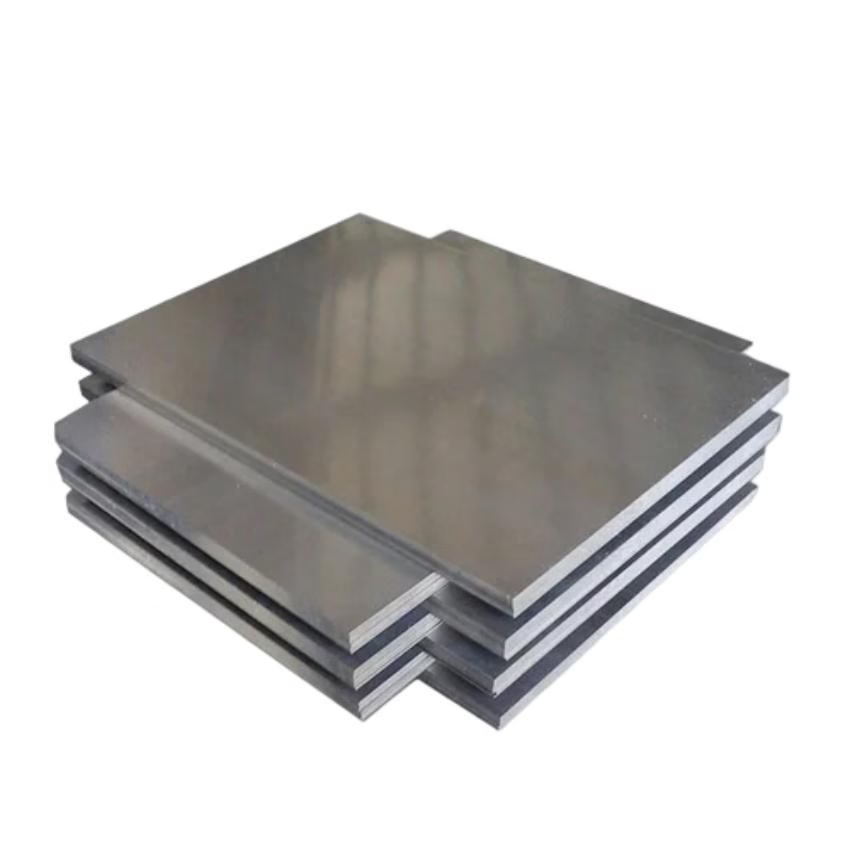
2507 Super Duplex Stainless Steel Plate
2507 (UNS S32750/EN 1.4410) super duplex stainless steel plate with 25% Cr, 7% Ni, 4% Mo, and high nitrogen. Minimum yield strength 550 MPa, PRE ≥ 40 for superior pitting and SCC resistance. Thickness 3-80mm, NACE MR0175 certified. Ideal for subsea, chemical, and desalination equipment.
| Material | Super Duplex Stainless Steel (Austenitic-Ferritic, High Alloy) |
|---|---|
| Grade / Standard | 2507 / UNS S32750 / EN 1.4410 |
| Thickness | 3mm - 80mm (plate), 0.5mm - 3mm (sheet) |
| Width | 1000mm - 3000mm |
| Length | 2000mm - 12000mm (plate), 2000mm - 6000mm (sheet) |
| Delivery Condition | hot_rolled / cold_rolled |
| Surface Treatment | bare / polished / coated |
| MOQ | 1 Ton |
| Delivery Time | 25-45 Days / Limited Stock for Common Thicknesses |
| Loading Port | Tianjin / Shanghai / Qingdao |
Highest corrosion resistance & strength – Response within 24 hours
Overview of 2507 Super Duplex Stainless Steel Plate
2507 is a premium super duplex stainless steel containing approximately 25% chromium, 7% nickel, 4% molybdenum, and 0.27% nitrogen, designed to deliver exceptional strength and corrosion resistance in the most aggressive chloride-rich environments. Specified under ASTM A240 with UNS designation S32750 (and also referenced as EN 1.4410), 2507 super duplex stainless steel plate offers a minimum yield strength of 550 MPa—over 2.5 times that of standard austenitic grades such as 304L—and a Pitting Resistance Equivalent (PRE) number exceeding 40, providing outstanding resistance to pitting, crevice corrosion, and chloride stress corrosion cracking (SCC). The balanced ferritic-austenitic microstructure ensures high toughness at sub-zero temperatures, good weldability with proper procedures, and reliable performance in sour service conditions.
2507 super duplex plate is the material of choice for critical components in seawater cooling systems, offshore oil and gas topside and subsea equipment, chemical process reactors handling aggressive acids, pollution control scrubbers, and structural parts for marine and coastal construction. The plate is supplied in the solution-annealed condition and is certified to NACE MR0175/ISO 15156 for sour gas applications, making it suitable for the most demanding energy industry projects. Typical plate thicknesses range from 3mm to 80mm, with widths up to 3000mm and lengths to 12000mm, finished to No.1 or 2B surfaces.
Key Features and Manufacturing Process
2507 super duplex stainless steel plate is manufactured through electric arc furnace melting with AOD (argon-oxygen decarburization) refining to achieve precise control of high nitrogen content. Continuous casting into slabs is followed by hot rolling to the required plate thickness. The material is then solution-annealed at 1040–1120°C and rapidly water-quenched to create a uniform 50/50 ferrite-austenite duplex microstructure, free from detrimental intermetallic phases like sigma and chi.
Quality assurance involves rigorous chemical composition verification including PRE calculation (minimum 40 per ASTM A240), tensile, yield, elongation, and Charpy V-notch impact testing at the specified minimum design temperature (commonly -46°C or -50°C), metallographic examination to confirm ferrite content typically between 35% and 55% (per ASTM E562), and corrosion testing to ASTM G48 Method A or C for pitting and crevice corrosion resistance. The plate is also supplied with NACE MR0175/ISO 15156 documentation for sour service. All plates receive ultrasonic inspection to ASTM A435 or EN 10160, and physical certification to EN 10204 3.1 or 3.2 as required.
Main Applications of 2507 Super Duplex Stainless Steel Plate
2507 super duplex plate is extensively used in offshore oil and gas production for subsea manifolds, wellhead components, flowline connectors, seawater lift pumps, and fire water systems where the combination of high strength, weldability, and resistance to high-chloride seawater is essential. In chemical processing, it is specified for phosphoric acid reactors, sulfuric acid dilution coolers, organic acid heat exchangers, and piping in chloride-containing process streams. The pulp and paper industry uses 2507 for bleach plant washers, filtrate tanks, and pressure diffusers handling hot, acidic, chloride-laden liquors.
Desalination plants use 2507 for high-pressure reverse osmosis (RO) brine piping, multi-stage flash (MSF) evaporator shells, and brine heaters. Pollution control equipment such as flue gas desulfurization (FGD) absorbers and stack liners rely on 2507 to resist the mixed sulfuric/hydrochloric acid condensation found in coal-fired power plant scrubbers. Structural and architectural applications include bridge cables, marine fasteners, and concrete reinforcing bar (rebar) for coastal infrastructure where long-term durability and zero maintenance are required. Other applications include geothermal power plant heat exchangers, marine propeller shafts, and high-pressure chemical injection systems.
Why Choose Us for 2507 Super Duplex Stainless Steel Plate
Shandong Tanglu Metal Material Co., Ltd. supplies premium 2507 super duplex stainless steel plate from ISO 9001, PED, and NORSOK M-650 qualified mills with extensive experience in high-alloy duplex production. Each plate is supplied with a comprehensive EN 10204 3.1 Mill Test Certificate detailing chemical composition with PRE verification, mechanical properties including yield and tensile strength, elongation, and Charpy impact values at -46°C or lower, microstructure ferrite content (35-55%), and, when requested, corrosion test reports per ASTM G48. For critical oil & gas and pressure vessel applications, we provide EN 10204 3.2 certification with independent third-party testing by SGS, TÜV, BV, or Lloyd’s Register.
Our inventory covers a wide thickness range from 3mm to 80mm, in widths up to 3000mm and lengths to 12 meters, with No.1 and 2B finishes. We provide in-house processing including plasma cutting, oxy-fuel cutting, beveling, and edge preparation. With a monthly supply capacity of over 800 tons of super duplex stainless steel plates and a proven track record of supplying EPC contractors and operators in the offshore, chemical, and desalination sectors across more than 40 countries, we support both small-batch requirements and large project volumes. Each shipment is engineered for safe ocean transit with heavy-duty edge protection, corrosion-inhibiting wrapping, and permanent heat number identification, ensuring complete material traceability.
📐 Dimension & Size Table
| Thickness (mm) | Width (mm) | Length (mm) | Weight (kg/m²) |
|---|---|---|---|
| 3.0 | 1000-2000 | 2000-6000 | 23.4 |
| 5.0 | 1000-2500 | 2000-8000 | 39.0 |
| 6.0 | 1000-2500 | 2000-8000 | 46.8 |
| 8.0 | 1500-2500 | 3000-8000 | 62.4 |
| 10.0 | 1500-2500 | 3000-10000 | 78.0 |
| 12.0 | 1500-2500 | 3000-10000 | 93.6 |
| 16.0 | 1500-3000 | 3000-12000 | 124.8 |
| 20.0 | 1500-3000 | 3000-12000 | 156.0 |
| 25.0 | 1500-3000 | 3000-12000 | 195.0 |
| 30.0 | 1500-3000 | 3000-12000 | 234.0 |
| 40.0 | 1500-2500 | 3000-12000 | 312.0 |
| 50.0 | 1500-2500 | 3000-12000 | 390.0 |
| 60.0 | 1500-2000 | 3000-10000 | 468.0 |
| 80.0 | 1500-2000 | 3000-8000 | 624.0 |
* Custom sizes available upon request. Tolerances per relevant international standards.
🔬 Chemical Composition
| Element | Min | Max | Display Value | Note |
|---|---|---|---|---|
| C | - | 0.030 | ≤0.030 | Per ASTM A240 UNS S32750 |
| Mn | - | 1.20 | ≤1.20 | |
| Si | - | 0.80 | ≤0.80 | |
| P | - | 0.035 | ≤0.035 | |
| S | - | 0.020 | ≤0.020 | Low sulfur for toughness & NACE |
| Cr | 24.00 | 26.00 | 24.00-26.00 | KEY ELEMENT – corrosion resistance |
| Ni | 6.00 | 8.00 | 6.00-8.00 | Provides austenite balance |
| Mo | 3.00 | 5.00 | 3.00-5.00 | Pitting & crevice corrosion resistance |
| N | 0.24 | 0.32 | 0.24-0.32 | Austenite stabilizer, strength & pitting resistance |
| Fe | - | - | Balance |
* Chemical composition may vary by heat, thickness and specification. Please refer to the actual mill test certificate.
⚙️ Mechanical Properties
| Property | Value | Unit | Test Condition |
|---|---|---|---|
| Tensile Strength (Rm) | ≥795 | MPa | Solution annealed, per ASTM A240 |
| Yield Strength (Rp0.2) | ≥550 | MPa | 0.2% proof stress – 2.5× 316L |
| Elongation (A50mm) | ≥15 | % | Gauge length 50mm |
| Reduction of Area (Z) | ≥45 | % | Typical |
| Brinell Hardness (HBW) | ≤310 | HBW | Solution annealed |
| Charpy V-notch Impact (KV2) | ≥45 | J | At -46°C (typical requirement) |
| Density | 7.80 | g/cm³ | Reference value |
| Pitting Resistance Equivalent (PRE) | ≥40 | – | PRE = %Cr + 3.3×(%Mo+0.5×%W) + 16×%N |
| Critical Pitting Temperature (CPT) | ≥65 | °C | Per ASTM G48 Method C (typical) |
| Ferrite Content | 35-55 | % | Per ASTM E562, balanced microstructure |
* Values shown are minimum requirements unless otherwise stated.
📦 Commercial Information
| Packaging | Seaworthy export packing for high-value super duplex plate. Plates interleaved with protective paper or PE sheet, bundled with reinforced edge guards and steel strapping. Each bundle or individual piece is wrapped in a weatherproof moisture barrier (VCI or PE) and secured to ISPM-15 fumigated wooden pallets. Identification includes grade (2507 / S32750 / 1.4410), heat number, thickness, and weight. For large single-plate shipments (>10 tons), wooden cradles with steel angle protection are used. Custom identification with project tags and barcodes available. |
|---|---|
| Payment Terms | T/T (Telegraphic Transfer),L/C at Sight (Letter of Credit),D/P (Documents against Payment) |
| Price Term | FOB,CFR,CIF,EXW |
| Supply Capacity | 800 Tons/Month (Super Duplex Stainless Steel Plates) |
| Loading Port | Tianjin / Shanghai / Qingdao |
Why Choose Our 2507 Super Duplex Stainless Steel Plate?
Ultra-High Strength & Toughness
Minimum yield strength of 550 MPa allows for significant down-gauging and weight savings. Maintains excellent Charpy impact toughness at sub-zero temperatures (≥45 J at -46°C), suitable for harsh offshore structural requirements.
Outstanding Pitting & Crevice Corrosion Resistance
With PRE ≥ 40, 2507 resists severe chloride pitting, crevice corrosion, and stress corrosion cracking in warm seawater, acidic brines, and chemical environments that would rapidly attack 2205 or 316L. Often eliminates the need for nickel-based alloys.
Fully NACE & NORSOK Compliant
Supplied with EN 10204 3.1/3.2 certs to NACE MR0175/ISO 15156 for sour gas/oil. Microstructure is audited for ferrite content (35-55%) and freedom from sigma phase. ASTM G48 corrosion test reports provided to guarantee reliability.
Engineered for Weldability
Readily welded using ER2594 filler metal with controlled heat input (0.2-1.5 kJ/mm) and interpass temperature (<150°C). No post-weld heat treatment needed for most applications, ensuring fabrication cost efficiency.
Global Project Supply & Technical Support
We maintain a strategic mill allocation for 2507 plate to support critical EPC schedules in oil & gas and desalination. Expert technical advice on forming, welding, and testing ensures your project success. Fast worldwide logistics.
🏭 Applications of 2507 Super Duplex Stainless Steel Plate
2507 super duplex stainless steel plate is the go-to material for subsea manifolds, wellhead housings, and topside seawater handling systems in the oil & gas industry. It is the standard for chemical process equipment exposed to hot chlorides and acids, such as sulfuric acid coolers and phosphoric acid reactors. Pulp & paper mills rely on it for bleach plant filtrate tanks and pressure diffusers. Desalination plants select 2507 for high-pressure RO brine piping and MSF brine heaters to avoid SCC. In FGD systems, 2507 is used for absorber vessel wallpapers and inlet ducts. Additionally, 2507 is increasingly specified for coastal bridge reinforcing, marine fasteners, and structural profiles for 100-year design life.
📋 Quality & Certification
Our Certifications
- ✅ ISO 9001:2015
- ✅ ABS
- ✅ DNV GL
- ✅ Lloyd's Register (LR)
- ✅ SGS Certified
Mill Certificate Type
- 📋 EN 10204 3.1
- 📋 EN 10204 3.2
- 📋 Certificate of Origin
❓ Frequently Asked Questions
What is the difference between 2507 super duplex and 2205 duplex?
2507 contains higher chromium (25% vs 22%), nickel (7% vs 5%), molybdenum (4% vs 3%), and nitrogen (0.24-0.32% vs 0.14-0.20%). This results in a significantly higher PRE number (≥40 vs ≥34) and yield strength (≥550 MPa vs ≥450 MPa). In practical terms, 2507 can withstand higher chloride levels, higher temperatures, and more acidic conditions than 2205. It is specified where 2205 would be marginal for pitting or SCC, such as in warm seawater injection, hot acid process streams, or aggressive FGD environments.
What are the typical temperature limits for 2507 plate?
2507 is generally rated for continuous service from -50°C to +300°C. Long-term exposure above 300°C can lead to precipitation of sigma and chi phases, which cause embrittlement and loss of corrosion resistance. For high-temperature applications above 250°C, design verification is recommended. For sub-zero temperatures, Charpy impact testing verifies toughness down to -50°C; for lower temperatures, specialized qualification is needed.
Is 2507 suitable for sour service (H2S containing environments)?
Yes, 2507 is approved per NACE MR0175/ISO 15156 for sour service within specific hardness and temperature limits. Typically, the maximum hardness is controlled to HRC 32 or HBW 310 in solution-annealed condition. 2507 offers excellent resistance to sulfide stress cracking (SSC) in production environments, making it ideal for wellhead components, downhole tools, and flowlines. Always confirm exact limits with the specific material test certificate.
What filler metal should be used for welding 2507?
The recommended filler metal is ER2594 (AWS A5.9), which matches or over-matches the composition of 2507. This ensures the weld metal has equivalent PRE and strength. Nickel-based fillers like Alloy 625 (ERNiCrMo-3) may also be used for joining 2507 to dissimilar metals, but using over-matched nickel filler is not recommended for process-exposed welds without engineering evaluation. Control of heat input and interpass temperature is essential to preserve the duplex structure.
What testing is mandatory for 2507 super duplex plate?
A typical test plan includes: 1) Heats chemistry analysis verifying PRE ≥ 40. 2) Tensile and yield testing at room temperature. 3) Charpy impact testing at the specified design temperature (commonly -46°C). 4) Corrosion test to ASTM G48 Method A (pitting) or C (critical pitting temperature). 5) Metallographic examination for ferrite content (35-55%) and absence of sigma phase. 6) 100% ultrasonic inspection per ASTM A435. PMI is strongly recommended to avoid material mix-ups. All tests are documented in an EN 10204 3.1 or 3.2 certificate.
Get 2507 Super Duplex Quote for
2507 Super Duplex Stainless Steel Plate
Submit your requirements and receive a competitive price quote within 24 hours.
- ✓ Fast response within 24 hours
- ✓ Competitive factory-direct pricing
- ✓ Free technical consultation
- ✓ Mill test certificate provided
- ✓ Flexible payment terms available
⏱ Highest corrosion resistance & strength – Response within 24 hours
Send Your Inquiry
All fields marked with * are required