
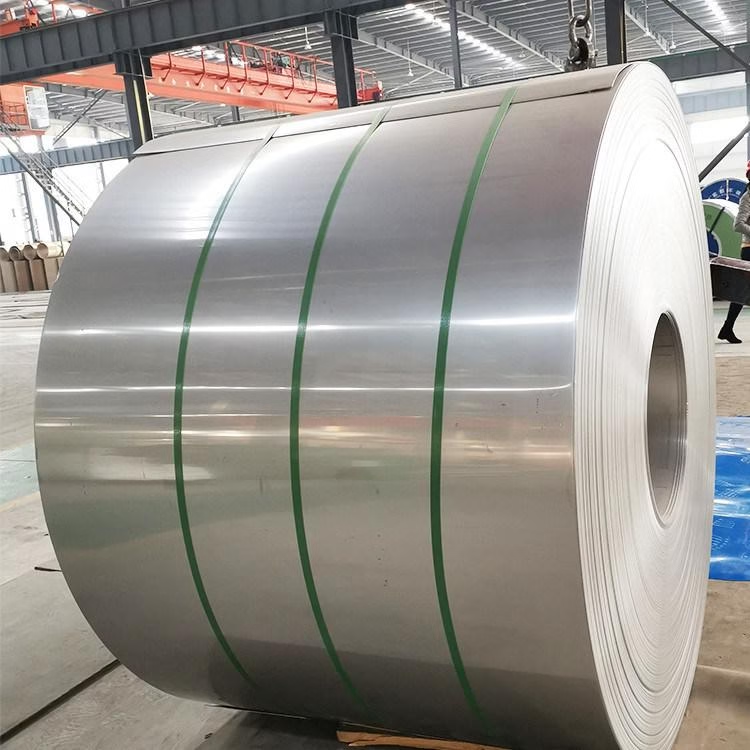
201 Stainless Steel Coil
AISI 201 (UNS S20100) is a cost-effective austenitic stainless steel coil with 16-18% Cr, 3.5-5.5% Ni, and 5-7.5% Mn, offering 20-35% lower cost than 304. Excellent work-hardening for springs and fasteners. Thickness 0.3-6mm, width 600-1500mm. Non-magnetic. Mill test certificate provided.
| Material | Austenitic Stainless Steel (Manganese-stabilized, Cost-optimized) |
|---|---|
| Grade / Standard | AISI 201 / UNS S20100 |
| Thickness | 0.3mm - 6mm |
| Width | 600mm - 1500mm |
| Inner Diameter (ID) | 508mm / 610mm |
| Coil Weight | 3-6 Tons (Max 8 Tons) |
| Delivery Condition | hot_rolled / cold_rolled |
| Surface Treatment | bare / polished |
| MOQ | 5 Tons |
| Delivery Time | 5-12 Days / Stock Available |
| Loading Port | Tianjin / Shanghai / Qingdao |
Overview of 201 Stainless Steel Coil
AISI 201 is a cost-effective austenitic stainless steel grade that serves as an economical alternative to 301/302 stainless steels, accounting for approximately 8-12% of global austenitic stainless steel coil production in cost-sensitive markets. Specified under ASTM A240 / EN 10088-2 standards with UNS designation S20100, 201 stainless steel coil offers a balance of moderate corrosion resistance, excellent formability, superior cold work hardening capability, and significantly lower material cost compared to standard 304 austenitic grade. Containing nominally 16-18% chromium and 3.5-5.5% nickel with 5-7.5% manganese as a cost-effective austenite stabilizer (replacing expensive nickel in 304), the grade provides the characteristic non-magnetic austenitic microstructure with exceptional cold formability for deep drawing, roll forming, stamping, and work-hardening applications.
201 stainless steel coil is the preferred raw material for high-volume cost-sensitive manufacturing where moderate corrosion resistance is acceptable and material cost optimization is critical. Available in both hot rolled (HR) and cold rolled (CR) conditions with multiple surface finishes, the coil is widely used by consumer goods manufacturers, kitchen appliance OEMs, industrial equipment fabricators, jewelry makers, automotive component suppliers, and budget-conscious manufacturing facilities worldwide. The grade offers excellent work-hardening characteristics enabling strength increase through cold rolling without intermediate annealing, making it ideal for springs, clips, fasteners, and high-strength formed components. 201 resists corrosion in dry atmospheric environments, indoor applications, food packaging at moderate temperatures, and general industrial environments, making it suitable for consumer appliances, kitchenware, decorative fixtures, and cost-constrained industrial fabrication where aesthetic appeal and moderate corrosion resistance must be balanced against material cost limitations.
Key Features and Coil Manufacturing
201 stainless steel coil is manufactured through hot rolling for thicker gauges (typically 2mm to 8mm) or cold rolling for thinner gauges (0.3mm to 4mm), followed by solution annealing at 1010-1120°C with rapid cooling to achieve optimal corrosion resistance and remove work-hardening. The manganese-based austenite stabilization system replaces 25-30% of the expensive nickel content required in 304, resulting in 20-35% lower material cost while maintaining non-magnetic austenitic structure. Cold rolled coils undergo additional pickling and skin pass rolling to achieve precise thickness tolerance and smooth surface quality. The coil is supplied in standard widths from 600mm to 1500mm with thickness ranging from 0.3mm to 6mm (thicker gauges less common), with custom slitting and recoiling services available.
Multiple surface finishes are available including 2B (cold rolled, annealed, pickled, light cold rolled — most common for general use), BA (bright annealed for decorative applications), No.4 (brushed satin finish for higher-end consumer products), and polished finishes for specialty applications. Standard inner diameter is 508mm or 610mm, with coil weight typically ranging from 3 to 6 tons depending on thickness and width. Exceptional work-hardening characteristic allows 201 to achieve high strength levels through cold rolling, enabling use in spring applications, fasteners, and stressed components without additional heat treatment. Each coil undergoes mandatory chemical composition analysis (PMI verification available), mechanical property testing including tensile, yield, elongation, and work-hardening characteristics, corrosion resistance verification per ASTM A240, and surface quality inspection to ensure full compliance with international standards. 201 coil is NOT recommended for food contact applications in most countries due to higher manganese content; verification of specific regulatory requirements is essential before use in food-related equipment.
Main Applications of 201 Stainless Steel Coil
201 stainless steel coil is the primary raw material for cost-sensitive high-volume manufacturing of austenitic stainless steel products where moderate corrosion resistance is acceptable and material cost optimization is critical. Consumer appliance manufacturers use 201 coil for cabinet panels, decorative trim, fastener components, hinges, springs, latches, and hardware where cost control directly impacts product profitability and appearance is secondary to cost efficiency. Kitchen and tableware producers employ 201 coil for cutlery handles, decorative utensils, pot and pan handles, serving trays, and household accessories where work-hardening capability enables strong formed components without intermediate annealing.
Jewelry and fashion accessories manufacturers utilize 201 coil for chains, pendants, brooches, costume jewelry frames, decorative hardware, and fashion accessories where excellent cold formability and cost advantage enable high-volume production of complex designs. Automotive component suppliers use 201 coil for fasteners, clips, springs, trim components, and decorative parts where work-hardening capability enables strength without secondary heat treatment and cost control is essential for automotive supply contracts. Industrial fastener and spring manufacturers rely on 201’s superior work-hardening characteristics for high-strength springs, clips, fasteners, and mechanical components where strength increase through cold rolling reduces or eliminates annealing operations. Decorative and architectural applications include interior trim, decorative panels, ornamental fixtures, door hardware, window frames, and building decorations where cost-effective material enables wider aesthetic application.
Electrical and electronics components include connector terminals, spring contacts, battery brackets, and electronic device housings where excellent formability and work-hardening support complex micro-component designs. Miscellaneous industrial fabrication includes storage containers, industrial ductwork for low-corrosion environments, HVAC components, general machinery components, and a comprehensive range of fabricated products where cost efficiency is prioritized over maximum corrosion resistance. Import/export markets and developing nations extensively use 201 stainless steel coil for kitchenware, home appliances, and consumer goods where cost advantage enables market penetration and customer affordability.
Why Choose Us for 201 Stainless Steel Coil
Shandong Tanglu Metal Material Co., Ltd. supplies cost-optimized 201 stainless steel coil sourced from major Chinese stainless steel mills including Tisco (Taiyuan Iron & Steel), Baosteel Stainless, and specialized 201-grade producers with proven cost-control manufacturing expertise and certified production facilities meeting ISO 9001 and international quality standards. Every 201 coil undergoes mandatory chemical composition analysis (PMI verification available), mechanical property testing including tensile, yield, elongation, and work-hardening characteristic verification, corrosion resistance assessment per ASTM A240, and surface finish quality inspection to ensure full compliance with specifications and cost-effective performance.
We offer comprehensive specification range covering thickness from 0.3mm to 6mm and width from 600mm to 1500mm in multiple surface finishes (2B, BA, No.4) with flexible coil weight options from 3 to 6 tons to match different processing line requirements for high-volume cost-sensitive manufacturing. With monthly supply capacity of 8,000 tons of stainless steel coils including 1,500 tons of 201 economical grades and established export relationships with consumer appliance manufacturers, jewelry makers, fastener suppliers, and cost-conscious OEM manufacturers in over 80 countries, we support large-volume container shipments optimized for cost and consistent supply. 201 coil availability from stock enables rapid delivery of 5-12 days for standard specifications, with custom sizes available within 15-20 days. Each shipment includes original mill test certificate (MTC) conforming to EN 10204 3.1 standard with mechanical property verification and cost-effective documentation, with PMI report and third-party inspection available upon request for quality assurance.
Maximum Cost Advantage for High-Volume Manufacturing
201 stainless steel coil delivers maximum cost advantage compared to 304 austenitic grade (typically 20-35% lower material cost depending on thickness and volume), making it the optimal choice for high-volume cost-sensitive manufacturing. Manganese-based austenite stabilization replaces expensive nickel, achieving cost savings without losing non-magnetic austenitic benefits. Superior work-hardening capability (highest among stainless steels) enables strength increase through cold rolling alone, potentially eliminating intermediate annealing operations that increase processing cost. Excellent formability reduces scrap rates during stamping, forming, and drawing operations compared to less ductile grades. Compatibility with high-speed stamping and automatic forming equipment enables rapid production cycles and reduced labor cost per unit. Material cost savings of 20-35% directly improve profitability for high-volume consumer goods manufacturers.
📐 Dimension & Size Table
| Thickness (mm) | Width (mm) | Inner Dia (mm) | Coil Weight (T) |
|---|---|---|---|
| 0.3 | 600-1250 | 508 | 3-4 |
| 0.4 | 600-1250 | 508 | 3-4 |
| 0.5 | 600-1500 | 508 | 3-5 |
| 0.6 | 600-1500 | 508 | 3-5 |
| 0.8 | 600-1500 | 508 | 3-5 |
| 1.0 | 600-1500 | 508 / 610 | 3-6 |
| 1.2 | 600-1500 | 508 / 610 | 3-6 |
| 1.5 | 600-1500 | 508 / 610 | 4-6 |
| 2.0 | 600-1500 | 508 / 610 | 4-6 |
| 2.5 | 1000-1500 | 610 | 5-6 |
| 3.0 | 1000-1500 | 610 | 5-6 |
| 4.0 | 1000-1500 | 610 | 5-8 |
| 5.0 | 1000-1500 | 610 | 5-8 |
| 6.0 | 1000-1500 | 610 | 5-8 |
* Custom sizes available upon request. Tolerances per relevant international standards.
🔬 Chemical Composition
| Element | Min | Max | Display Value | Note |
|---|---|---|---|---|
| C | - | 0.15 | ≤0.15 | Per ASTM A240 201 |
| Si | - | 1.00 | ≤1.00 | |
| Mn | 5.50 | 7.50 | 5.50-7.50 | Cost-effective austenite stabilizer (replaces Ni) |
| P | - | 0.060 | ≤0.060 | |
| S | - | 0.030 | ≤0.030 | |
| Cr | 16.00 | 18.00 | 16.00-18.00 | Corrosion resistance element |
| Ni | 3.50 | 5.50 | 3.50-5.50 | Reduced nickel content vs 304 (8-10.5%) |
| N | - | 0.25 | ≤0.25 | Optional (increases strength/PREN) |
| Fe | - | - | Balance | Base element |
* Chemical composition may vary by heat, thickness and specification. Please refer to the actual mill test certificate.
⚙️ Mechanical Properties
| Property | Value | Unit | Test Condition |
|---|---|---|---|
| Tensile Strength (Rm) | ≥515 | MPa | Solution annealed, per ASTM A240 |
| Yield Strength (Rp0.2) | ≥205 | MPa | 0.2% proof stress (annealed state) |
| Elongation (A) | ≥45 | % | Gauge length 50mm (higher than 304) |
| Brinell Hardness (HBW) | ≤201 | HBW | Solution annealed |
| Rockwell Hardness (HRB) | ≤92 | HRB | Solution annealed |
| Vickers Hardness (HV) | ≤210 | HV | Solution annealed |
| Impact Energy (KV2) | ≥150 | J | Charpy V-notch at +20°C |
| Work Hardening Rate | Highest | - | Fastest strength increase through cold rolling (best among stainless steels) |
| Density | 8.02 | g/cm³ | Reference value (slightly higher than 304's 7.93 due to Mn) |
| Magnetic Permeability | ≤1.02 | μ | Non-magnetic austenitic structure |
* Values shown are minimum requirements unless otherwise stated.
📦 Commercial Information
| Packaging | Standard economical export packing for cost-optimized stainless steel coils. Each coil wrapped with PE film for basic moisture protection, then bundled with standard steel strapping (4-5 wraps per coil), with eye protection rings on inner diameter and basic outer wrap. Coils labeled with heat number, grade designation (201 / S20100), thickness, width, coil weight, and surface finish. Standard loading: coil eye horizontal or vertical based on container requirement. Cost-optimized packaging reduces overall material cost while maintaining adequate transit protection. Coils can be densely loaded per container due to cost-effective shipment optimization. |
|---|---|
| Payment Terms | T/T (Telegraphic Transfer),L/C (Letter of Credit),D/P (Documents against Payment),Western Union,PayPal |
| Price Term | FOB,CFR,CIF,EXW |
| Supply Capacity | 8,000 Tons/Month (Stainless Steel Coils) | 1,500 Tons/Month (201 Cost-optimized Grade) |
| Loading Port | Tianjin / Shanghai / Qingdao |
Why Choose Our 201 Stainless Steel Coil?
20-35% Cost Advantage vs 304 Austenitic
201 stainless steel coil offers exceptional cost savings of 20-35% compared to standard 304 austenitic grade through manganese-based austenite stabilization replacing expensive nickel content. Ideal for high-volume cost-sensitive manufacturing where material cost directly impacts product profitability and competitiveness in price-sensitive markets.
Superior Work-Hardening Capability
Exceptional work-hardening characteristics enable strength increase through cold rolling alone (fastest strength gain among all stainless steels), potentially eliminating intermediate annealing operations. Ideal for springs, fasteners, clips, and high-strength formed components requiring significant strength without additional heat treatment.
Excellent Cold Formability
Outstanding formability for deep drawing, stamping, and complex forming operations with higher elongation (≥45% vs 304's ≥40%) enabling intricate component geometries. Superior ductility reduces scrap rates during high-speed forming, improving yield and profitability for high-volume operations.
Non-Magnetic Austenitic Structure
Non-magnetic properties maintain austenitic benefits while delivering ferritic-grade cost savings. Ideal for applications where non-magnetic characteristics are required and cost control is essential, avoiding need for expensive 304 while achieving functional austenitic properties.
Rapid Stock Availability for High-Volume Orders
Common 201 specifications maintained in large stock for 5-12 days rapid dispatch, fastest among cost-optimized austenitic grades. High production volume and consistent supply support continuous high-volume manufacturing lines for consumer goods, appliances, and fastener production.
🏭 Applications of 201 Stainless Steel Coil
201 stainless steel coil is the primary raw material for cost-sensitive high-volume manufacturing of austenitic stainless steel products across consumer goods, appliance, jewelry, and industrial sectors where moderate corrosion resistance is acceptable and material cost optimization is critical. Consumer appliance manufacturers use 201 coil for cabinet panels, decorative trim, fastener components, hinges, springs, latches, and hardware where cost control is essential to maintain profit margins and appearance is secondary to affordability. Superior work-hardening capability enables spring fasteners to achieve required strength through cold rolling without intermediate annealing, reducing production cost. Kitchen and tableware producers employ 201 coil for cutlery handles, decorative utensils, pot and pan handles, serving trays, and household accessories where excellent cold formability and cost advantage enable high-volume production of complex decorative designs with acceptable corrosion resistance for indoor use and dishwashing applications.
Jewelry and fashion accessories manufacturers utilize 201 coil extensively for chains, pendants, brooches, costume jewelry frames, decorative hardware, and fashion accessories where excellent cold formability, work-hardening capability for strength, and cost advantage enable high-volume production of intricate designs. The combination of non-magnetic austenitic properties and lowest cost among austenitic grades makes 201 optimal for fashion jewelry production in price-sensitive markets. Automotive component suppliers use 201 coil for fasteners, springs, clips, trim components, and decorative parts where work-hardening enables strength without secondary heat treatment and material cost control is essential for maintaining automotive supply contract profitability. Industrial fastener and spring manufacturers rely on 201's superior work-hardening characteristics for manufacturing high-strength springs, tension clips, retaining fasteners, and mechanical components where strength increase through cold rolling reduces or eliminates annealing operations, lowering manufacturing cost per component.
Decorative and architectural applications include interior trim, decorative wall panels, ornamental fixtures, door hardware, window frames, and building decorations where cost-effective material enables wider aesthetic application and competitive pricing. Electrical and electronics components include connector terminals, spring contacts, battery brackets, circuit breaker components, and electronic device housings where excellent formability and work-hardening support complex micro-component designs and automated assembly. Miscellaneous industrial fabrication includes storage containers, industrial ductwork for low-corrosion environments, HVAC system components, general machinery components, household fixtures, and a comprehensive range of fabricated products where cost efficiency is prioritized and corrosion resistance requirements are moderate. Import/export markets and developing nations extensively use 201 stainless steel coil for kitchenware, home appliances, consumer goods, and mass-market products where cost advantage enables market penetration, customer affordability, and competitive product pricing essential for volume market success.
📋 Quality & Certification
Our Certifications
- ✅ ISO 9001:2015
- ✅ Bureau Veritas (BV)
- ✅ SGS Certified
Mill Certificate Type
- 📋 EN 10204 3.1
- 📋 EN 10204 3.2
- 📋 Original Mill Certificate
- 📋 Certificate of Origin
❓ Frequently Asked Questions
What is 201 stainless steel coil and how does it differ from 304?
201 is a cost-optimized austenitic stainless steel grade specified under ASTM A240 / EN 10088-2 (equivalent EN 1.4372) with UNS designation S20100. Unlike 304 which uses expensive nickel (8-10.5%) as the austenite stabilizer, 201 replaces approximately 50-60% of nickel with less expensive manganese (5.5-7.5%), reducing material cost by 20-35% while maintaining non-magnetic austenitic microstructure. Key differences: (1) Cost — 201 costs 20-35% less than 304 due to reduced nickel content and manganese substitution, making it ideal for high-volume cost-sensitive manufacturing. (2) Work-hardening — 201 exhibits superior work-hardening capability (fastest strength increase through cold rolling among all stainless steels), enabling high-strength components without annealing; 304 work-hardens more slowly. (3) Nickel content — 201 contains 3.5-5.5% Ni vs 304's 8-10.5%, exposing 201 to nickel price volatility but significantly reducing cost. (4) Manganese content — 201 contains 5.5-7.5% Mn (vs 304's ≤2%) which contributes to work-hardening but can increase manganese dissolution in aggressive acidic environments. (5) Elongation — 201 has higher elongation (≥45% vs 304's ≥40%) enabling deeper drawing and more complex forming. (6) Corrosion resistance — 201 offers moderate corrosion resistance similar to 304 in atmospheric and mild aqueous environments but slightly inferior in chloride-rich conditions due to lower chromium-to-nickel ratio. (7) Food contact — 201 is NOT suitable for food contact applications in most countries (FDA/EU restrictions due to manganese content); 304 is food-grade approved. 201 is optimal for cost-conscious manufacturing; 304 is preferred for food applications and superior corrosion resistance.
Why is 201 preferred for springs, fasteners, and high-strength components?
201 stainless steel is the preferred grade for springs, fasteners, clips, and high-strength formed components due to exceptional work-hardening capability (highest among all stainless steels) combined with cost advantage: (1) Superior work-hardening — 201 exhibits the fastest strength increase through cold rolling among all stainless steel grades (strain-hardening rate ~40-50% higher than 304), enabling achievement of high tensile strength through cold work alone without requiring secondary annealing or precipitation hardening. (2) Cost efficiency — High-strength achieved through cold rolling alone eliminates expensive intermediate annealing operations required for other grades, reducing manufacturing cost per component by 20-30%. (3) Spring properties — 201's work-hardening characteristic combined with non-magnetic austenitic structure and springback characteristics make it ideal for spring manufacturing, tension clips, retaining clips, and mechanical components. (4) Fastener manufacturing — Superior formability during cold heading and thread rolling combined with work-hardening reduces or eliminates heat treatment, lowering fastener production cost. (5) Strength levels — 201 can achieve tensile strength of 800-1000+ MPa through cold rolling (vs annealed state of 515 MPa) without losing ductility, enabling high-strength components. (6) Scrap reduction — Superior formability reduces scrap rates during stamping and forming operations compared to lower-ductility grades. (7) Cost-strength combination — Unmatched combination of cost advantage, formability, work-hardening, and corrosion resistance makes 201 optimal for high-volume spring and fastener production where cost control is critical. Manufacturing fasteners and springs from 201 versus annealed 304 can reduce material and processing cost by 30-40%, directly improving profitability.
What are the limitations of 201 stainless steel regarding food contact?
201 stainless steel is NOT suitable for food contact applications in most jurisdictions due to regulatory restrictions on manganese content and corrosion behavior in aggressive food processing environments: (1) FDA food contact regulations — FDA limits manganese in food contact materials to specific maximum levels; 201's 5.5-7.5% manganese content exceeds FDA food contact material restrictions, making it unsuitable for direct food contact in USA. (2) European Union regulations — EU Regulation 1935/2004 restricts manganese migration from food contact materials; 201 typically exceeds these migration limits. (3) Manganese dissolution risk — In acidic food environments (citrus, vinegar, tomato products) or certain beverage conditions, manganese can dissolve from 201 material, risking food contamination. (4) Pitting resistance — 201 has slightly lower pitting resistance than 304 in salt-containing food environments due to lower chromium-to-nickel ratio, restricting use in seafood processing or salt-curing operations. (5) Regulatory testing required — Using 201 for food contact requires specific regulatory testing and certification demonstrating manganese migration compliance; 304 passes standard food contact regulations without additional testing. If food contact applications are planned: Always specify 304 or 304L (food-contact approved), never 201. Use 201 ONLY for non-food applications including consumer appliances (non-food contact surfaces), decorative kitchenware (handles, trim), cutlery handles (non-contact surfaces), pot and pan handles, and any application where the material does NOT directly contact food. For food processing equipment, food storage containers, kitchen sink bowls, and any direct-food-contact application, ONLY 304/304L is acceptable.
What surface finishes are available for 201 stainless steel coil?
201 stainless steel coil is available in three primary surface finishes optimized for different aesthetic and cost requirements: (1) 2B finish — cold rolled, annealed, pickled, and lightly cold rolled with smooth semi-reflective appearance; most economical finish and most common for consumer appliances, fasteners, and general industrial applications where aesthetic appearance is secondary to cost. (2) BA finish (bright annealed) — bright polished appearance achieved through annealing in protective atmosphere; used for higher-end consumer products, decorative appliance panels, and kitchenware where aesthetic appeal is important; costs approximately 10-15% more than 2B. (3) No.4 finish (brushed satin) — linearly brushed surface with matte satin appearance; used for premium consumer products, jewelry components, decorative fixtures, and applications combining aesthetic appeal with practical utility; costs approximately 15-20% more than 2B. 201 is NOT typically offered in polished (No.8 mirror) finish as austenitic manganese-based stainless steels do not achieve high-gloss polish comparable to 304 due to work-hardening characteristics. Cost-conscious manufacturers typically select 2B finish (most economical); higher-end consumer products select BA or No.4 finishes. Surface finish selection should balance aesthetic requirements against cost implications, as 2B is most budget-friendly while BA and No.4 require premium pricing.
Why is 201 widely used in developing markets and cost-sensitive regions?
201 stainless steel coil dominates developing markets and price-sensitive regions worldwide due to unique combination of cost advantage, functionality, and suitability for high-volume mass-market manufacturing: (1) Material cost savings — 20-35% lower cost than 304 directly enables lower product pricing, improving customer affordability and market competitiveness in price-sensitive economies where stainless steel adoption is price-limited. (2) Manufacturing economics — Exceptional work-hardening reduces secondary processing steps, lower material cost per unit reduces overall product cost, enabling profitable manufacturing at lower price points. (3) Consumer goods accessibility — Cost advantage enables stainless steel kitchenware, appliances, and household products to reach mass markets where 304-based products are unaffordable, expanding stainless steel penetration in developing regions. (4) High-volume appliance manufacturing — Appliance manufacturers in cost-competitive markets (Asia, Latin America, Africa) extensively use 201 for cabinet panels, trim, and components where cost control directly affects product retail price and market share. (5) Jewelry and fashion production — 201's cost advantage combined with excellent formability makes it dominant in costume jewelry and fashion accessories production, particularly in countries with large jewelry manufacturing sectors. (6) Cutlery and tableware — 201 enables affordable stainless steel cutlery, trays, and tableware production for price-sensitive markets, making stainless steel products accessible to middle-income consumers. (7) Automotive component supply — 201 enables lower-cost fasteners and components for automotive suppliers in cost-competitive regions, supporting export competitiveness. (8) Regulatory environment — Developing nations often have less restrictive food-contact regulations, enabling broader 201 application range compared to USA/EU markets. As developing markets grow and income increases, manufacturers increasingly migrate to 304 for superior corrosion resistance and broader regulatory acceptance; 201 remains dominant in price-sensitive mass markets where cost is primary driver.
Request Cost Quote for
201 Stainless Steel Coil
Submit your requirements and receive a competitive price quote within 24 hours.
- ✓ Fast response within 24 hours
- ✓ Competitive factory-direct pricing
- ✓ Free technical consultation
- ✓ Mill test certificate provided
- ✓ Flexible payment terms available
⏱ Maximum savings for high-volume orders
Send Your Inquiry
All fields marked with * are required