
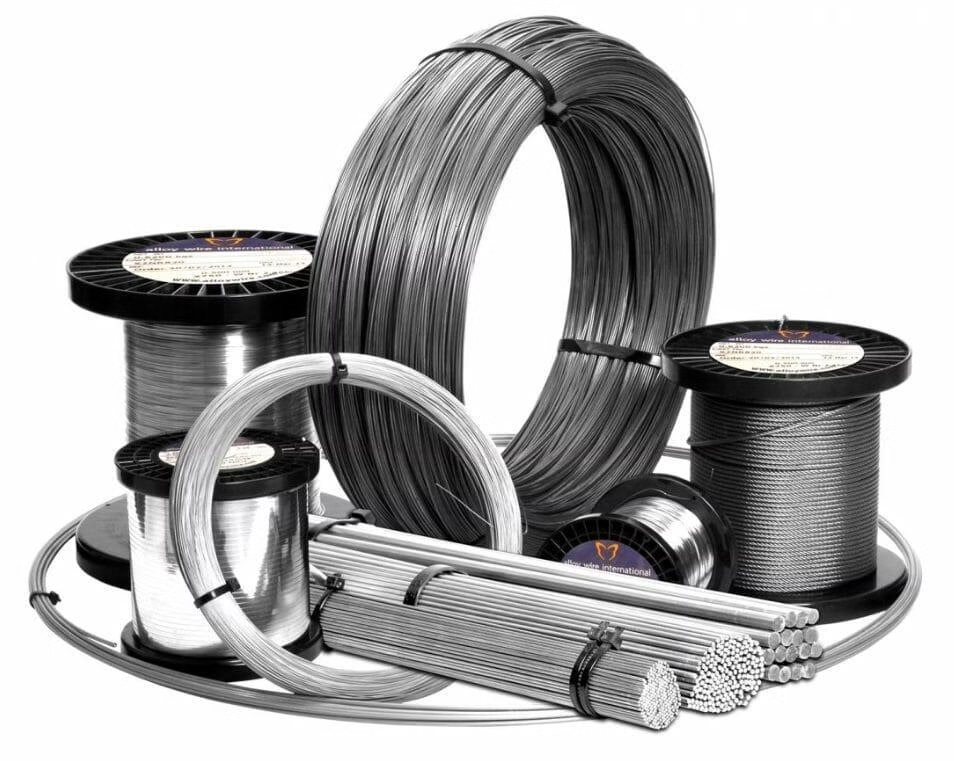
Stainless Steel Wire — 304 / 316 / 316L / 430 / 201
Stainless Steel Wire — Grade 304 / 316 / 316L / 430 / 201 — bright drawn, annealed, or electro-polished stainless wire in diameter 0.02mm to 12.0mm for springs, wire rope, mesh weaving, medical devices, welding wire, and architectural applications. Free coils, spools, and straight lengths. ISO 9001 certified with full EN 10204 3.1 material certification.
| Material | Stainless Steel Wire — Austenitic (304/316/316L/321/310S), Ferritic (430/409), Martensitic (410/420), Duplex (2205) |
|---|---|
| Grade / Standard | 304 / 304L / 316 / 316L / 321 / 310S / 430 / 410 / 420 / 201 / 202 / 2205 |
| Delivery Condition | as_rolled |
| Surface Treatment | coated |
| MOQ | 50 kg (per diameter / grade / temper combination) |
| Delivery Time | 15-30 Days (Stock) / 30-45 Days (Custom Drawing) |
| Loading Port | Tianjin / Shanghai / Qingdao |
Overview of Stainless Steel Wire
Stainless Steel Wire is one of the most versatile and widely consumed forms of stainless steel, produced by drawing stainless steel rod (wire rod) through progressively smaller tungsten carbide or diamond drawing dies to achieve the required final diameter, mechanical properties, and surface finish for a diverse range of industrial, commercial, and consumer applications. The defining characteristic of stainless steel wire — corrosion resistance through the formation of a passive chromium oxide (Cr₂O₃) surface layer — combined with the manufacturing flexibility of the wire drawing process makes stainless steel wire the preferred material for applications requiring simultaneous corrosion resistance, mechanical strength, aesthetic appearance, and complex formed geometry across industries ranging from food processing and medical devices to architectural decoration and automotive exhaust systems. Stainless steel wire is produced from all major stainless steel alloy families: austenitic grades (304, 304L, 316, 316L, 321, 310S — the dominant stainless wire grades representing 70-75% of global production), ferritic grades (430, 430F, 409 — lower cost for magnetic applications), martensitic grades (410, 420 — for high-strength spring and cutting wire applications), and duplex grades (2205, 2507 — for ultra-high corrosion resistance in chemical processing).
The most widely used stainless steel wire grades globally are Grade 304 (18% Cr, 8% Ni austenitic — the universal stainless wire grade covering the broadest range of general industrial and consumer applications), Grade 316 and 316L (18% Cr, 10% Ni, 2% Mo — superior marine and chemical corrosion resistance with molybdenum addition for chloride resistance), Grade 430 (17% Cr ferritic — lower cost magnetic stainless wire for decorative and filtration applications), and Grade 201 (16% Cr, 4% Ni, 6% Mn — lower-nickel austenitic for cost-sensitive applications). Wire diameters span an extraordinary range from ultra-fine wire at 0.02mm (20 microns, finer than human hair) used for medical device coils and electronic components to heavy-gauge wire at 12mm and above used for fencing, cable reinforcement, and structural applications — with the full range covered by standard stainless wire production from Tanglu Group’s qualified mill network. Stainless steel wire is supplied in multiple surface conditions (bright drawn, annealed, electro-polished, PVC coated) and forms (straight lengths, coils, spools, drums, reels) to match the specific requirements of downstream wire forming, weaving, knitting, spring coiling, welding, and fabrication processes. Tanglu Group supplies stainless steel wire from qualified Chinese stainless wire mills including Baosteel, Tisco, Yongjin, Jiuquan, and specialty wire drawing facilities, with complete material certification meeting international standards EN 10270-3, ASTM A313/A580, JIS G 4314, and ISO 6931.
Key Features and Manufacturing Process
Stainless Steel Wire manufacturing begins with stainless steel wire rod (typically 5.5mm or 6.5mm diameter) produced by hot rolling stainless steel billets and subsequently patented (heat treated) to optimize the microstructure for cold drawing. The wire drawing process involves pulling the wire rod through a series of progressively smaller tungsten carbide drawing dies — each die reducing the wire cross-sectional area by 15-25% per pass in a process called cold reduction — with intermediate annealing treatments performed every 70-85% total cross-sectional area reduction to restore ductility and prevent work hardening from accumulating to the point of wire fracture. For austenitic grades (304, 316), the cold drawing process simultaneously work hardens the austenite (increasing tensile strength from 600-800 MPa in annealed condition to 1200-2000 MPa in fully hard-drawn condition) and induces partial martensitic transformation (in 304 grade, cold drawing produces 20-60% martensite depending on reduction ratio, making fully drawn 304 wire slightly magnetic). The drawing speed ranges from 5 m/s for heavy-gauge wire (>3mm diameter) to 40+ m/s for fine wire (<0.5mm diameter) on dedicated fine wire drawing machines, with extensive lubrication (dry soap lubricants, wet drawing oils, or phosphate-soap systems depending on wire diameter and alloy) to control die temperature and surface quality during the high-speed drawing process. The surface condition of stainless steel wire is determined by the final processing step after the last drawing pass: Bright Drawn (BD) wire retains the smooth, reflective surface produced by the final die pass with residual drawing lubricant oil, providing the highest dimensional accuracy and smoothest surface for spring coiling, weaving, and precision formed wire applications. Annealed wire (soft/annealed condition) undergoes final bright annealing in a hydrogen-nitrogen protective atmosphere furnace (continuous strand annealing or batch coil annealing) after the final drawing pass, restoring full ductility (elongation >30% for 304 annealed) while maintaining dimensional accuracy and bright surface finish — required for applications requiring maximum formability such as wire mesh weaving, wire rope stranding, and medical wire forming. Electro-polished wire receives an electrochemical surface treatment after drawing and annealing that removes the outer 5-20 microns of material, eliminating all surface defects, inclusions, and cold-working artifacts to produce the ultra-smooth, ultra-clean surface required for medical implant wire, pharmaceutical processing wire, and food contact applications. Specialty surface treatments include PVC coating (colored or clear), nylon coating, and PTFE coating for decorative and electrical insulation applications. Wire is supplied in coil form (free coils 1-50 kg for fine wire, machine coils on spools for fine and medium wire, large coils on carriers for heavy wire), on spools (plastic, steel, or wooden spools, 1-500 kg per spool depending on diameter), on drums (200-500 kg for heavy industrial wire), or in straight-cut lengths for precision component manufacturing. Each production lot undergoes comprehensive quality testing including chemical composition verification by X-ray fluorescence (XRF) or optical emission spectrometry, tensile strength and elongation testing per EN ISO 6892-1, hardness testing (HV, HRB, or HRC depending on strength level), diameter measurement by laser micrometer to ±0.001mm tolerance, surface inspection for seams, laps, slivers, and pits under 10× magnification, and coil/spool winding quality inspection for overlapping, kinking, and tangles that affect downstream processing efficiency. Tanglu Group provides complete material certification including chemical composition, mechanical properties, dimensional verification, and surface quality reports with full heat traceability for all stainless steel wire orders.
Main Applications of Stainless Steel Wire
Stainless Steel Wire serves an extraordinarily diverse range of end-use applications spanning virtually every major industry sector, with the specific grade, diameter, temper, and surface condition selected to match the unique combination of corrosion resistance, mechanical strength, formability, and aesthetic requirements of each application. Spring manufacturing represents the single largest industrial application for stainless steel wire globally, with Grade 304 and Grade 316 bright drawn wire in the diameter range 0.1mm to 6.0mm used for compression springs, extension springs, torsion springs, and wire forms across automotive (valve springs, seat mechanism springs, sunroof springs), medical device (catheter guide wire springs, surgical staple springs, orthopedic fixation springs), consumer electronics (keyboard springs, camera shutter springs), and general industrial (precision instrument springs, appliance springs, industrial valve springs) applications — the precise tensile strength, elastic limit, and dimensional accuracy of bright drawn stainless wire are critical for consistent spring rate and fatigue life in high-cycle spring applications.
Wire rope and cable manufacturing uses Grade 304 and Grade 316 stainless wire in diameters 0.2mm to 5.0mm for stranding into multi-wire ropes and cables for marine standing rigging (shrouds, stays, forestays for sailing vessels), architectural cable systems (cable railings, cable facades, tensile roof structures), lifting and hoisting equipment in corrosive environments (offshore platforms, swimming pool hoists, chemical plant lifting), aerospace control cables, and suspension bridge cable systems where zinc-galvanized carbon steel wire would corrode in aggressive environments. Wire mesh and wire cloth manufacturing is a major application for annealed stainless wire in diameters 0.025mm to 3.0mm, with 304 and 316 annealed wire woven into square mesh, twill weave, and Dutch weave configurations for industrial filtration (liquid filtration, gas filtration, fine particle classification), food processing screens (pasta dies, bread crumb screens, sugar and salt classifiers), pharmaceutical processing (tablet granulation screens, API filtration), architectural decorative mesh (building facades, interior partitions, elevator cabs, security screens), and technical mesh for aerospace composite manufacturing and printed circuit board production. Welding wire represents a significant stainless wire application segment, with 308L, 309L, 316L, and 347 grade stainless MIG wire and TIG filler wire used for welding stainless steel fabrications in food and beverage processing equipment, chemical processing vessels, pharmaceutical manufacturing equipment, architectural stainless fabrications, and automotive exhaust system welded assemblies. Medical device manufacturing relies on precision stainless wire — primarily Grade 316L (low carbon austenitic, UNS S31603) and specialty grades 17-7PH and MP35N — for surgical suture wire, orthopedic bone fixation wire, intravascular guide wires, cardiovascular stent strands, dental orthodontic wire (0.2-0.8mm diameter), endoscopic instrument actuation wires, and laparoscopic instrument cable assemblies requiring biocompatibility (ISO 10993 compliant), precise dimensional tolerances (±0.001mm on fine medical wire), and surface cleanliness meeting FDA and EU Medical Device Regulation (MDR 2017/745) requirements. Architectural and decorative applications use Grade 304 and Grade 316 stainless wire for balustrade infill wire panels, cable railing systems (horizontal wire runs between stainless steel posts), decorative wire mesh partitions, sculptural wire art installations, decorative wire woven panels for furniture and interior design, garden wire trellising, and wire plant support systems where the combination of corrosion resistance and aesthetic brightness meets both functional and visual requirements. Food processing and food handling equipment uses Grade 304 and Grade 316 stainless wire extensively for conveyor belt wire mesh (flat wire conveyor belts, balanced weave belts, spiral wire belts for freezer tunnels and ovens), food basket and tray wire fabrications, dish washing rack wire frames, barbecue grill grates, kitchen utensil wire (whisks, strainers, skimmers), and food display rack wire structures where FDA food contact compliance (meeting FDA 21 CFR regulations and EU 1935/2004 food contact materials regulation) is mandatory. The automotive industry uses stainless steel wire in exhaust system flexible bellows and braided hoses (316 grade for high temperature corrosion resistance), seat spring assemblies (304 hard-drawn wire), windshield wiper blade spring elements, fuel line support clips, and sensors wire harness protective braiding. Agricultural and horticultural applications include vineyard trellis wire, greenhouse plant training wire, orchard support wire, agricultural fencing reinforcement wire, and livestock containment wire where Grade 304 stainless provides 20-30+ year service life in outdoor agricultural environments — far exceeding zinc-galvanized wire service life in high-rainfall and chemical spray environments. Tanglu Group supplies stainless steel wire for all these applications from qualified mill sources with complete grade-specific certifications and technical support for wire selection, dimensional specification, and testing requirement definition.
Why Choose Us for Stainless Steel Wire
Shandong Tanglu Metal Material Co., Ltd. supplies Stainless Steel Wire from qualified Chinese stainless wire mills — including Baosteel Stainless, Tisco (Taiyuan Iron & Steel), Yongjin Metal Technology, and specialist stainless wire drawing facilities — operating ISO 9001 and ISO 13485 (for medical-grade wire) certified quality management systems with proven international export experience supplying stainless wire to spring manufacturers, wire rope fabricators, mesh weavers, medical device manufacturers, and architectural fabricators in over 40 countries. Our stainless wire supply range covers all major grades (201, 202, 304, 304L, 316, 316L, 316Ti, 321, 310S, 430, 410, 420, 2205) in diameter range 0.02mm to 12.0mm, with surface conditions including bright drawn, annealed (soft), 1/4 hard, 1/2 hard, 3/4 hard, full hard tempers for spring wire applications, electro-polished for medical and pharmaceutical applications, and coated variants (PVC, nylon, PTFE). Supply forms include free coils (0.5-50 kg), precision spools (0.5-500 kg on plastic, steel, or wooden spools), drums (100-500 kg for heavy industrial wire), and straight cut lengths per customer specification.
Every stainless wire shipment includes original mill test certificate (MTC) per EN 10204 3.1 reporting chemical composition (all major and minor elements by OES), mechanical properties (tensile strength, elongation, hardness), diameter measurement with tolerance verification (±0.01mm standard, ±0.005mm for precision spring wire on request), surface quality inspection, and coil/spool winding quality confirmation. EN 10204 3.2 third-party inspection by SGS, BV, or TUV available for medical, aerospace, and critical industrial applications requiring enhanced certification. Specialty documentation for medical-grade wire includes biocompatibility statement (ISO 10993 compliance), lot traceability per FDA 21 CFR Part 820, material certification per ASTM F138 (surgical implant wire), and surface cleanliness verification. For spring wire applications, fatigue life data from rotating beam fatigue testing and spring coiling trial reports are available from qualified spring wire production lots. With monthly supply capacity of 500 tons of stainless steel wire across all grades and diameters, established logistics for international shipment of wire coils and spools (standard export packaging with moisture protection, proper spool orientation for transit), and technical support for grade selection, temper specification, and quality requirement definition, Tanglu Group provides reliable stainless steel wire supply for both development quantities (minimum 50 kg per diameter/grade/temper combination) and high-volume production programs requiring consistent quality across multiple production lots.
📐 Dimension & Size Table
| Grade | Diameter Range | Common Temper / Condition | Primary Application |
|---|---|---|---|
| Grade 304 | 0.02mm - 12.0mm | Bright Drawn / Annealed / Spring Temper | Springs, wire mesh, wire rope, general industrial, food processing |
| Grade 304L | 0.05mm - 8.0mm | Annealed / Bright Drawn | Welding wire, low-carbon applications, pharmaceutical mesh |
| Grade 316 | 0.05mm - 10.0mm | Bright Drawn / Annealed / Spring Temper | Marine, chemical, pharmaceutical springs, wire rope |
| Grade 316L | 0.02mm - 8.0mm | Annealed / Electro-Polished | Medical devices, surgical implants, welding wire, food contact |
| Grade 321 | 0.1mm - 6.0mm | Annealed / Bright Drawn | High temperature, exhaust system, aerospace wire applications |
| Grade 310S | 0.1mm - 5.0mm | Annealed | Furnace wire, high temperature industrial heating elements |
| Grade 430 | 0.1mm - 8.0mm | Annealed / Bright Drawn | Decorative wire, filtration, magnetic applications, lower cost |
| Grade 410 | 0.1mm - 6.0mm | Hardened / Tempered | High-strength spring wire, cutting wire, wear-resistant applications |
| Grade 201 | 0.1mm - 10.0mm | Bright Drawn / Annealed | Cost-sensitive general applications, decorative wire, mesh |
| Grade 2205 Duplex | 0.5mm - 8.0mm | Annealed | Chemical processing, offshore, seawater applications |
* Custom sizes available upon request. Tolerances per relevant international standards.
🔬 Chemical Composition
| Element | Min | Max | Display Value | Note |
|---|---|---|---|---|
| C (Grade 304) | - | 0.080 | ≤0.080 | Low carbon for corrosion resistance; 304L ≤0.030% |
| C (Grade 316L) | - | 0.030 | ≤0.030 | Ultra-low carbon prevents sensitization in weld HAZ |
| Cr (Grade 304) | 18.00 | 20.00 | 18.00-20.00 | Primary corrosion resistance element — passive Cr₂O₃ layer |
| Cr (Grade 316/316L) | 16.00 | 18.00 | 16.00-18.00 | Chromium for base corrosion resistance in 316 family |
| Ni (Grade 304) | 8.00 | 10.50 | 8.00-10.50 | Nickel stabilizes austenite phase, improves corrosion resistance |
| Ni (Grade 316/316L) | 10.00 | 14.00 | 10.00-14.00 | Higher Ni than 304 for improved corrosion resistance |
| Mo (Grade 316/316L) | 2.00 | 3.00 | 2.00-3.00 | CRITICAL for 316 — molybdenum provides chloride pitting resistance |
| Mn | - | 2.00 | ≤2.00 | Austenite stabilizer; higher in Grade 201 (5.5-7.5% Mn replaces Ni) |
| Si | - | 1.00 | ≤1.00 | Deoxidizer, slight corrosion resistance improvement |
| P | - | 0.045 | ≤0.045 | Impurity — controlled for ductility and weldability |
| S | - | 0.030 | ≤0.030 | Impurity — low S for wire drawing ductility and surface quality |
| Ti (Grade 321) | 5×C | 0.700 | 5×C min, ≤0.70 | Titanium stabilizer prevents sensitization in Grade 321 |
| Cr (Grade 430) | 16.00 | 18.00 | 16.00-18.00 | Ferritic grade — chromium only, no nickel addition |
| N (Grade 2205) | 0.08 | 0.20 | 0.08-0.20 | Nitrogen strengthens duplex structure, enhances pitting resistance |
* Chemical composition may vary by heat, thickness and specification. Please refer to the actual mill test certificate.
⚙️ Mechanical Properties
| Property | Value | Unit | Test Condition |
|---|---|---|---|
| Tensile Strength (304, Annealed) | 520-750 | MPa | Fully annealed condition, per EN 10270-3 / ASTM A580 |
| Tensile Strength (304, Bright Drawn / 1/2 Hard) | 860-1100 | MPa | Cold drawn to 1/2 hard temper — typical spring wire supply condition |
| Tensile Strength (304, Spring Temper / Full Hard) | 1300-2000 | MPa | Heavily cold drawn — strength varies with wire diameter (finer = stronger) |
| Tensile Strength (316L, Annealed) | 490-690 | MPa | Fully annealed, per ASTM A580 / EN 10270-3 |
| Tensile Strength (316, Spring Temper) | 1200-1900 | MPa | Heavily cold drawn spring wire — diameter dependent |
| Tensile Strength (430, Annealed) | 450-650 | MPa | Ferritic grade, annealed condition |
| Tensile Strength (410, Hardened) | 1000-1400 | MPa | Martensitic grade, hardened and tempered condition |
| Elongation (304, Annealed) | ≥35 | % | A = 50mm gauge length, fully annealed wire |
| Elongation (316L, Annealed) | ≥35 | % | A = 50mm gauge length, fully annealed condition |
| Hardness (304, Annealed) | ≤88 | HRB | Rockwell B, annealed condition per ASTM A580 |
| Hardness (316, Spring Temper) | 30-45 | HRC | Rockwell C, heavily cold drawn spring wire |
| Diameter Tolerance (Standard) | ±0.010 | mm | Standard commercial tolerance for wire >0.5mm diameter |
| Diameter Tolerance (Precision Spring Wire) | ±0.005 | mm | Precision tolerance for spring and medical wire applications |
| Diameter Tolerance (Ultra-Fine Wire) | ±0.002 | mm | Ultra-precision tolerance for wire <0.1mm diameter |
| Magnetic Permeability (304, Annealed) | ~1.02 | μ | Essentially non-magnetic; cold drawn 304 wire: μ up to 1.5-2.0 |
* Values shown are minimum requirements unless otherwise stated.
📦 Commercial Information
| Packaging | Export-grade packaging for stainless steel wire designed to protect surface quality, prevent tangling and kinking, maintain dimensional accuracy, and provide secure transit for ocean freight shipment to wire spring manufacturers, mesh weavers, rope fabricators, and industrial wire users worldwide. Fine wire (diameter ≤1.0mm) is wound on precision plastic or steel spools with controlled tension and layer winding (precision traverse winding) to ensure tangle-free payoff during spring coiling machines, wire weaving looms, and other automated wire processing equipment — spool winding quality is critical as tangled or overlapping wire layers cause machine stoppages and production waste at customer facilities. Spool weights range from 0.5 kg to 30 kg per spool depending on diameter, with individual spools sealed in polyethylene bags with silica gel desiccant packets (minimum 5g per spool) to prevent surface corrosion and discoloration during ocean transit and warehouse storage. Multiple spools of the same grade and diameter are packed in corrugated cardboard cartons (double-wall, burst strength ≥200 PSI) with foam cushioning separating individual spools to prevent damage, maximum carton weight 25 kg for manual handling compliance. Medium-gauge wire (1.0-4.0mm diameter) is supplied as free coils (inner diameter 200-400mm, outer diameter 400-600mm, coil weight 5-50 kg) or on heavy-duty steel or wooden spools (50-500 kg per spool) for industrial wire rope, mesh weaving, and welding wire applications. Free coils are secured with multiple wire ties (minimum 4 ties per coil) to prevent uncoiling and surface scratching during transit, then wrapped in polyethylene stretch film and VCI paper for corrosion protection. Heavy-gauge wire (>4.0mm diameter) is supplied as large free coils on wire reel carriers (metal ring carriers for safe handling by forklift) with strapping and VCI wrapping. Electro-polished wire for medical applications is individually packaged in clean-room grade polyethylene bags, heat-sealed, with lot number and certificate number matching documentation for full traceability. Each package clearly labeled with grade (304/316L/etc.), diameter, temper/condition, net weight, heat/lot number, and applicable standard designation. Complete export documentation includes original MTC per EN 10204 3.1, packing list, commercial invoice, certificate of origin, and specialty certificates (biocompatibility, food contact compliance, RoHS) as required by customer application. Desiccant indicators visible through packaging window show moisture exposure during transit. All packaging compliant with ISPM-15 for any wood components. |
|---|---|
| Payment Terms | T/T (Telegraphic Transfer),L/C (Letter of Credit),D/P (Documents against Payment),Western Union,PayPal |
| Price Term | FOB,CFR,CIF,EXW |
| Supply Capacity | 500 Tons/Month (Stainless Steel Wire — All Grades and Diameters) |
| Loading Port | Tianjin / Shanghai / Qingdao |
Why Choose Our Stainless Steel Wire — 304 / 316 / 316L / 430 / 201?
Full EN 10204 3.1 Certification with Dimensional Verification
Every stainless steel wire shipment includes original mill test certificate per EN 10204 3.1 reporting chemical composition by optical emission spectrometry (all elements including Cr, Ni, Mo, Mn, C, N), mechanical properties (tensile strength, elongation, hardness), and diameter verification by laser micrometer to stated tolerance (±0.010mm standard, ±0.005mm precision spring wire). EN 10204 3.2 third-party inspection by SGS, BV, or TUV available for medical, aerospace, and critical applications. Full heat-to-spool traceability maintained.
Ultra-Fine to Heavy-Gauge — 0.02mm to 12.0mm
Complete diameter range from 0.02mm (20 microns — ultra-fine medical and electronic wire) to 12.0mm (heavy industrial wire) in all major stainless grades (201, 304, 304L, 316, 316L, 321, 310S, 430, 410, 420, 2205). All temper conditions available: fully annealed (soft), 1/4 hard, 1/2 hard, 3/4 hard, full hard (spring temper), and electro-polished. Supply forms: precision spools (0.5-500 kg), free coils, and straight cut lengths per specification.
All Surface Conditions for Every Application
Bright drawn wire for spring coiling and precision wire forming requiring maximum surface smoothness and dimensional accuracy. Bright annealed wire for mesh weaving, wire rope stranding, and forming applications requiring maximum ductility. Electro-polished wire for medical devices, pharmaceutical processing, and food contact applications requiring ultra-clean, ultra-smooth surfaces meeting FDA and EU food contact/medical device regulatory requirements. Coated variants (PVC, nylon, PTFE) for decorative and electrical insulation applications.
Grade 316L Biocompatible Medical Wire Available
Grade 316L (UNS S31603) stainless wire meeting ASTM F138 (surgical implant steel), ISO 10993 biocompatibility, and EU Medical Device Regulation (MDR 2017/745) requirements for medical device and surgical implant applications. Electro-polished surface, precision diameter tolerance ±0.002-0.005mm, clean-room packaging with lot traceability per FDA 21 CFR Part 820, and full chemical composition certification including trace element verification (Cu ≤0.50%, As ≤0.003% per ASTM F138 implant grade requirements).
Stock Availability — Fast Delivery for Standard Grades
Standard stainless wire grades (304 bright drawn, 304 annealed, 316L annealed) in common diameters (0.1-5.0mm) maintained in stock at Tanglu Group warehouse for 15-30 day delivery to support urgent spring manufacturing, mesh weaving, and prototype programs. Custom diameter, non-standard temper, or specialty grade orders produced to order in 30-45 days. Minimum order quantity 50 kg per diameter/grade/condition combination for stock grades, 200 kg for custom-drawn orders.
🏭 Applications of Stainless Steel Wire — 304 / 316 / 316L / 430 / 201
Stainless Steel Wire serves as a critical raw material across an exceptional breadth of industrial, commercial, medical, and consumer applications where the combination of corrosion resistance, mechanical strength, surface quality, and forming flexibility of stainless wire provides performance advantages over carbon steel wire, galvanized wire, copper wire, and engineering plastic alternatives. Spring manufacturing is the dominant industrial application for stainless steel wire globally, with Grade 304 and Grade 316 bright drawn wire accounting for the majority of stainless spring wire consumption in diameters ranging from 0.05mm (miniature precision springs for medical and electronic instruments) to 6.0mm (heavy-duty industrial valve springs and suspension springs for corrosive environments). The spring wire drawing process optimizes tensile strength through cold work hardening: fine wire (0.05-0.5mm) achieves tensile strength 1800-2200 MPa for high-stress miniature spring applications, medium wire (0.5-3.0mm) achieves 1400-1800 MPa for standard precision spring applications, and heavy wire (3.0-6.0mm) achieves 1200-1500 MPa for industrial spring and wire form applications — all while maintaining the elastic limit, fatigue resistance, and corrosion immunity needed for long-service spring applications in automotive, medical, and industrial environments where carbon steel spring wire would corrode or require galvanic protection coatings incompatible with the application environment. Automotive spring applications include seat recliner mechanism springs (316 grade for corrosion resistance in vehicle interior humidity environments), sunroof motor springs, door latch springs, window regulator springs, trunk lid assist springs, fuel cap springs, various sensor spring elements, and electrical contact springs throughout vehicle control systems — all specified in stainless wire to eliminate the warranty failures caused by rust-seized carbon steel springs in vehicle interior humidity, underhood heat-moisture, and trunk water ingress environments. Wire rope and cable fabrication is the second major stainless wire application, with Grade 304 (general purpose) and Grade 316 (marine and chemical environments) annealed wire stranded into 1×7, 1×19, 7×7, and 7×19 wire rope constructions for architectural cable railing systems (the fastest-growing stainless wire rope application — horizontal wire cable balustrade systems between stainless steel posts for residential, commercial, and public building applications meeting IBC building code load requirements), marine standing rigging for offshore sailing vessels and racing yachts where the combination of corrosion resistance (10+ years in salt spray environment without degradation) and high tensile strength (breaking load 15-80 kN depending on rope diameter) makes Grade 316 stainless wire rope the universally specified material, suspension cable systems for architectural tensile structures (cable-supported roofs, cable facade systems, cable-stayed bridges for pedestrian and light traffic), lifting and hoisting wire rope for marine offshore lifting equipment, davit systems, window cleaning systems on high-rise buildings, and theatrical rigging where stainless wire rope eliminates the lubrication and inspection requirements of galvanized carbon steel wire rope in accessible applications. Industrial wire mesh and filtration cloth weaving consumes substantial volumes of fine stainless wire (0.025-2.0mm diameter) in annealed condition for weaving on shuttle looms, rapier looms, and wire weaving machines into square mesh, twill weave, Dutch weave, and reverse Dutch weave cloth configurations for industrial liquid filtration (oil filtration, hydraulic fluid filtration, polymer melt filtration, beverage filtration), industrial gas filtration and dust collection, food processing screens (flour sieving, pasta die plates, sugar classification, cocoa grinding screens), pharmaceutical manufacturing (API crystallization filtration, tablet granulation screens, sterile filtration), chemical processing filtration, and fine particle classification in mining and mineral processing — applications where Grade 316L provides superior chemical compatibility with the filtered media compared to polypropylene or polyester filter media at elevated temperatures and with organic solvent-containing streams. Medical device wire manufacturing represents the highest-value stainless wire application segment, where Grade 316L (low carbon, extra low carbon for surgical implants per ASTM F138) and specialty grades (17-7PH precipitation hardening stainless for high-strength catheter guide wires, MP35N cobalt-chromium-nickel for maximum fatigue life intravascular implant applications) are drawn to ultra-precise diameters (tolerance ±0.002mm or tighter) with electro-polished surfaces for guide wire coils (0.025-0.35mm diameter wire wound into helical coils forming the flexible distal tip of intravascular guide wires for cardiac catheterization and endovascular procedures), surgical suture wire (0.05-0.8mm diameter for sternal closure wire in cardiac surgery, orthopedic cerclage wire for bone fracture fixation, skin closure wire in certain neurosurgical procedures), orthodontic arch wire (0.3-0.8mm diameter in round or rectangular cross-section for tooth alignment in fixed orthodontic appliance treatment), dental ligature wire (0.25-0.35mm for bracket ligation), endoscopic instrument actuation cable (multi-strand 316L cable 0.8-2.0mm diameter for endoscope bending section control and laparoscopic instrument jaw actuation), cardiovascular stent strands (0.06-0.18mm diameter for laser cutting or braiding into coronary and peripheral vascular stents), and neurovascular coil wire (0.05-0.10mm diameter platinum-tungsten or 316L wire for coiling into aneurysm occlusion devices) — applications where the ISO 13485 quality system, ASTM F138 material certification, FDA 510(k) or PMA traceability, and USP Class VI biocompatibility documentation provided by Tanglu Group's medical-grade wire supply program meet the most stringent regulatory requirements of global medical device manufacturers. Architectural and decorative stainless wire applications represent a fast-growing market segment driven by the aesthetic appeal of stainless steel in contemporary building design, with Grade 304 and Grade 316 wire used for cable railing infill wire systems in residential decks, commercial balconies, staircases, and mezzanine barriers (1×19 or 7×7 wire rope in 3-5mm diameter is the standard infill element for cable railing systems meeting IBC 42-inch height and 200-pound concentrated load requirements), decorative wire mesh partitions for office interiors, retail store displays, hotel lobby separators, and restaurant design elements (woven stainless wire mesh in various weave patterns creates visually striking semi-transparent partitions with excellent durability and minimal maintenance), sculptural wire installations for public art, corporate lobbies, and gallery exhibitions, green wall trellis wire systems for living plant facades on commercial buildings (Grade 316 for longevity in outdoor exposure with irrigation water contact), vineyard trellis and espalier fruit tree training wire for premium viticulture and orcharding operations where the 20-30+ year service life of Grade 304 stainless wire without rust staining of fruit significantly justifies the cost premium over galvanized wire. Welding consumable manufacturing uses Grade 308L, 309L, 316L, 347, and 2209 duplex stainless wire in 0.8-3.2mm diameter on precision spools (5-15 kg for MIG welding, 2.5 kg for TIG filler wire coils) for GMAW and GTAW welding of stainless steel fabrications in food and beverage processing equipment (tanks, vessels, piping), pharmaceutical manufacturing bioreactors and process equipment, chemical processing pressure vessels and heat exchangers, architectural stainless steel fabrications, and automotive exhaust system components — the low carbon content (≤0.030% for 308L, 316L welding wire) prevents sensitization (carbide precipitation at grain boundaries causing intergranular corrosion) in the weld heat-affected zone, ensuring corrosion resistance of welded joints equals that of the base material. Agricultural and horticultural applications for stainless wire continue growing as awareness of stainless wire's long-term total cost advantage over galvanized wire becomes established among commercial growers and viticulturists — Grade 304 stainless wire for vineyard trellis catch wires and cordon wires provides 25-40 year service life without replacement versus 8-15 years for Class 3 galvanized wire in high-rainfall viticultural regions, with the additional benefit of eliminating rust staining of grape berries from corroding galvanized wire that can cause quality rejections in premium wine production. Tanglu Group provides comprehensive technical support for stainless wire grade selection, diameter specification, temper selection, packaging specification, and quality documentation requirements for all application segments, with application engineering consultation available for customers developing new stainless wire applications or optimizing existing specifications for cost reduction or performance improvement.
📋 Quality & Certification
Our Certifications
- ✅ ISO 9001:2015
- ✅ CE Marking
- ✅ ABS
- ✅ DNV GL
- ✅ Lloyd's Register (LR)
- ✅ Bureau Veritas (BV)
- ✅ SGS Certified
- ✅ RINA
Mill Certificate Type
- 📋 EN 10204 3.1
- 📋 EN 10204 3.2
- 📋 Original Mill Certificate
- 📋 Third Party Inspection Available
- 📋 Certificate of Origin
❓ Frequently Asked Questions
What is the difference between Grade 304 and Grade 316 stainless steel wire, and which should I choose?
Grade 304 and Grade 316 are both austenitic stainless steel wire grades providing excellent corrosion resistance, non-magnetic properties in annealed condition, and similar mechanical strength — but they differ critically in their resistance to chloride-induced pitting and crevice corrosion, which determines their appropriate application environments.
Grade 304 Stainless Wire (18% Cr, 8-10.5% Ni, no molybdenum):
The universal stainless wire grade — the most widely produced and lowest-cost austenitic stainless wire grade. Excellent corrosion resistance in atmospheric environments, fresh water, most foods and beverages, mild acids, and general industrial environments. Passive chromium oxide layer provides self-repairing corrosion protection in most oxidizing environments. Limitation: susceptible to pitting and crevice corrosion in chloride-containing environments (seawater, de-icing salt, swimming pool water, chloride-containing cleaning chemicals) — chloride ions penetrate and destabilize the passive oxide layer, causing localized pitting that progresses to through-wire corrosion in severe chloride exposure. Grade 304 is acceptable for coastal atmospheric exposure (within 1-5 km of sea in mild climates) but not for direct seawater or salt spray contact.
Grade 316 Stainless Wire (16-18% Cr, 10-14% Ni, 2-3% Mo):
The marine-grade stainless wire, where the 2-3% molybdenum addition dramatically enhances chloride pitting resistance by stabilizing the passive oxide layer against chloride attack. Pitting resistance equivalent number (PREN = %Cr + 3.3×%Mo + 16×%N) of Grade 316 is approximately 24-26 versus 18-20 for Grade 304 — a meaningful increase in chloride resistance. Grade 316 is specified for direct seawater exposure (marine wire rope, offshore platform wire, tidal zone wire applications), swimming pool and spa environments (constant chloride water contact), de-icing salt exposure (wire railing in cold climates where road salt splash contacts wire), chloride-containing chemical processing environments, and coastal architectural wire where severe salt spray (within 500m of breaking waves) is anticipated. Grade 316L (low carbon variant, ≤0.030% C) is specified when welding is involved — the lower carbon content prevents sensitization (chromium carbide precipitation in weld HAZ) that would cause intergranular corrosion in the heat-affected zone of Grade 316 standard carbon welds.
Decision Guide:
- Indoor applications, non-chloride environments, food contact (non-saline), general industrial: Grade 304 — lower cost, fully adequate
- Marine environments, seawater contact, swimming pools, chloride chemical exposure, coastal architectural in severe marine zones: Grade 316 / 316L — molybdenum essential
- Welded assemblies in any corrosive environment: Grade 316L (low carbon) — prevents weld sensitization
- Maximum corrosion resistance in aggressive chloride (offshore seawater, chemical processing): Grade 2205 Duplex — highest chloride resistance at premium cost
Cost perspective: Grade 316 wire typically costs 20-35% more than Grade 304 wire of equivalent diameter and temper, reflecting the higher nickel (10-14% vs 8-10.5%) and molybdenum (2-3%) content. Tanglu Group provides technical consultation to help select the most cost-effective grade for your specific application environment and service life requirements.
What do the different temper designations mean for stainless steel wire (annealed, 1/4 hard, 1/2 hard, full hard)?
Stainless steel wire temper designations describe the degree of cold work hardening applied during the wire drawing process, which directly determines the wire's tensile strength, hardness, elongation, and suitability for different end-use applications. Understanding temper designations is essential for correct wire specification.
Fully Annealed (Soft / 0 Temper):
Wire that has been drawn to final diameter and then subjected to a final annealing heat treatment (bright annealing at 1050-1120°C in hydrogen-nitrogen atmosphere for austenitic grades) that fully recrystallizes the cold-worked microstructure, restoring maximum ductility and minimum strength. Properties (304 grade): Tensile strength 520-750 MPa, elongation ≥35%, hardness ≤88 HRB, essentially non-magnetic (low martensite content from drawing is dissolved during annealing). Applications: wire mesh weaving (requires maximum ductility for bending around loom wires without breaking), wire rope stranding (requires bending flexibility during rope lay operation), medical wire forming (requires maximum formability for catheter coiling, suture needle forming), and all applications requiring maximum cold forming capability after wire delivery.
1/4 Hard Temper:
Wire cold drawn after annealing to approximately 10-15% cross-sectional area reduction, providing moderate strength increase above annealed. Properties (304): Tensile ~760-900 MPa, elongation ~25-30%, slightly magnetic. Applications: wire forms requiring moderate strength with good formability, architectural wire products requiring stiffness for shape retention.
1/2 Hard Temper:
Wire cold drawn to approximately 20-30% reduction after final anneal, providing balanced strength and ductility. Properties (304): Tensile ~900-1100 MPa, elongation ~15-20%, moderately magnetic due to deformation-induced martensite. Applications: springs requiring moderate stress levels, wire clips and fasteners, formed wire components requiring strength with ability to be bent in tooling without cracking.
3/4 Hard Temper:
Wire drawn to approximately 35-45% reduction after anneal. Properties (304): Tensile ~1100-1350 MPa, elongation ~10-15%, significantly magnetic. Applications: medium-stress springs, formed wire components requiring higher strength.
Full Hard / Spring Temper:
Wire drawn to maximum practical reduction (typically 60-80% cumulative reduction) after the last intermediate anneal, achieving maximum tensile strength through maximum cold work hardening. Properties (304, diameter-dependent): Fine wire (0.1-0.5mm): tensile 1800-2200 MPa; Medium wire (0.5-3.0mm): 1400-1800 MPa; Heavy wire (3-6mm): 1200-1500 MPa. Elongation 3-8%, significantly or strongly magnetic. This is the standard supply condition for stainless steel spring wire — the wire is coiled directly from spring temper stock on CNC spring coiling machines without any further heat treatment (unlike carbon steel spring wire which requires post-coiling stress relief at 300-400°C). Applications: compression springs, extension springs, torsion springs, wire forms requiring maximum elastic stress capacity and fatigue resistance in corrosive environments.
Important note for spring applications: The tensile strength of spring-temper stainless wire decreases as wire diameter increases — this is because larger diameter wire requires fewer drawing passes to reach final diameter from rod, accumulating less total cold work per unit volume. Always specify the required tensile strength range (not just 'spring temper') when ordering stainless spring wire for critical spring designs, and verify the actual tensile against your spring stress calculations.
Why does stainless steel wire sometimes become slightly magnetic, and does this affect corrosion resistance?
The appearance of magnetic behavior in stainless steel wire — particularly in Grade 304 wire — is a well-documented phenomenon related to deformation-induced martensitic transformation during cold wire drawing, and is a normal characteristic of austenitic stainless wire that does not indicate material defect or reduced corrosion resistance.
The Mechanism — Deformation-Induced Martensite:
Austenitic stainless steel (Grades 304, 316, 321) is normally non-magnetic (relative permeability μ ≈ 1.01-1.03) in the annealed condition because the face-centered cubic (FCC) austenite crystal structure is paramagnetic. However, when austenitic stainless steel is cold deformed (as occurs during wire drawing), mechanical energy can trigger a partial phase transformation from austenite (FCC, non-magnetic) to martensite (body-centered tetragonal, BCC-T, ferromagnetic) in the most severely deformed regions of the microstructure. This deformation-induced martensite is the same hard martensitic phase present in martensitic stainless steels (Grade 410, 420) but forms spontaneously during cold work in metastable austenitic grades rather than through quenching.
Factors Affecting Martensite Formation During Drawing:
1) Grade chemistry: Grade 304 is metastable austenite with a relatively high martensite start temperature under stress (Md30 temperature approximately +10 to +50°C for typical 304 chemistry) — meaning it transforms readily during cold work at room temperature. Grade 316 has lower Md30 (approximately -70 to -30°C) due to higher nickel and molybdenum content that stabilizes austenite more strongly, making Grade 316 wire significantly more resistant to deformation-induced martensite formation. This is why Grade 316 wire remains nearly non-magnetic even in heavily drawn spring temper condition, while Grade 304 wire becomes noticeably magnetic.
2) Degree of cold work: More cold reduction = more martensite. Annealed 304 wire: ~0-5% martensite (essentially non-magnetic). 1/2 hard 304 wire: ~20-40% martensite (weakly magnetic). Full hard 304 spring wire: ~40-70% martensite (clearly magnetic, but not as strongly as carbon steel).
3) Drawing temperature: Lower drawing temperature increases martensite formation rate. High-speed drawing generates heat that slightly suppresses martensite formation in later drawing passes.
Effect on Corrosion Resistance:
The critical question — does deformation-induced martensite reduce corrosion resistance? The answer is generally NO for atmospheric and most industrial environments, YES in highly aggressive chloride environments. The chromium content of the martensite phase is essentially identical to the austenite phase (chromium is not selectively partitioned during mechanical transformation, unlike thermal martensite which can reduce local chromium in adjacent austenite), so the passive Cr₂O₃ layer and bulk corrosion resistance are maintained. However, the martensite phase in cold-drawn 304 is slightly less corrosion resistant than austenite in the most aggressive environments (concentrated chlorides, strong acids), and the martensite-austenite phase boundaries can be preferential sites for pitting initiation under severe conditions. For applications in aggressive chloride environments where Grade 316 is required, the superior austenite stability of Grade 316 (resisting deformation-induced martensite even in heavily drawn condition) provides both magnetic cleanliness and better corrosion resistance.
Practical implication: For applications requiring non-magnetic stainless wire (MRI-compatible medical devices, electronic shielding applications, precision balance components, certain food processing equipment with magnetic separation systems), specify either: Grade 316L fully annealed wire (minimum martensite, highest austenite stability), or specify 'non-magnetic verified' with maximum permeability limit (typically μ ≤1.05 for medical MRI compatibility), or specify high-manganese austenitic grade (Grade 201 or specialty grades Nitronic 40, Grade 316LN with nitrogen addition for enhanced austenite stability in drawn condition).
What are the diameter tolerances and surface quality requirements for stainless spring wire versus medical wire versus weaving wire?
Diameter tolerance and surface quality requirements for stainless steel wire vary significantly between application categories, reflecting the critical functional requirements of each end use. Understanding and correctly specifying these requirements ensures wire performance in your application while avoiding unnecessary cost from over-specification.
Stainless Steel Spring Wire Diameter and Surface Requirements:
Diameter tolerance: Standard spring wire per EN 10270-3 or ASTM A313: ±0.010mm for diameters 0.5-5.0mm, ±0.008mm for 0.1-0.5mm, ±0.005mm for premium precision spring wire specified for tight spring rate tolerance springs. The diameter tolerance directly affects spring rate consistency (spring rate varies with wire diameter to the 4th power in compression springs — a 1% diameter variation causes ~4% spring rate variation, so tight diameter tolerance is critical for precision spring rate control).
Surface quality: Spring wire surface must be free from seams, laps, slivers, pits, and drawing cracks that would act as fatigue crack initiation sites under cyclic spring loading. Standard specification: no surface defects deeper than 0.5% of wire diameter per EN 10270-3. Bright drawn surface (smooth die-finished surface with residual drawing lubricant film) is standard for spring wire — electro-polishing is not standard for spring wire and may reduce fatigue life by removing the beneficial compressive residual stress layer from the wire surface introduced during final drawing pass.
Temper: Spring temper (full hard) with specified tensile strength range per wire diameter — always verify against spring stress calculations. Fatigue testing (rotating beam fatigue per EN 10270-3) available on request for critical spring programs.
Medical Grade Stainless Wire (316L, ASTM F138) Requirements:
Diameter tolerance: ±0.002-0.005mm for standard medical wire (guide wires, surgical wire), ±0.001mm for ultra-precision medical wire (stent strands, micro-coil wire) — tighter tolerances than spring wire reflecting the dimensional precision required for catheter ID fits, anastomosis clip sizing, and stent cell geometry.
Surface quality: Electro-polished surface required for most medical applications — removes all surface defects, cold-work artifacts, inclusions, and organic contamination from drawing lubricants. Electro-polish removes 5-20 microns from the surface, producing Ra surface roughness typically 0.05-0.20 μm (versus 0.2-0.8 μm for bright drawn wire). Surface cleanliness verified by water break test (clean electro-polished surface shows continuous water film; oil or organic contamination causes water beading). Biocompatibility: ISO 10993 assessment, USP Class VI testing, ASTM F138 chemical composition including trace elements (Cu ≤0.50%, As ≤0.003%, Pb not detected per ASTM F138 surgical implant requirements).
Packaging: Clean-room packaging (clean polyethylene bags, heat-sealed), lot traceability to each spool, FDA 21 CFR Part 820 documentation system.
Stainless Mesh Weaving Wire Requirements:
Diameter tolerance: ±0.010-0.015mm for standard mesh weaving wire — slightly relaxed versus spring wire because mesh aperture size depends primarily on wire spacing (set by loom) rather than wire diameter alone. However, very tight diameter consistency (not just tolerance, but consistency within a production lot) is important for mesh uniformity.
Surface quality: Annealed condition is mandatory for weaving wire — the wire must bend repeatedly around loom wires at 90° without fracturing, requiring full ductility (elongation ≥35%). Bright annealed surface preferred for clean mesh appearance. Freedom from kinks, bends, and set in the wire coil is critical for uniform loom feed — kinked wire causes loom stops and defective weave pattern.
Coil winding: Precision level-wound (traverse-wound) on spools for consistent, tangle-free payoff on weaving looms — free-coil weaving wire is acceptable only for heavier-gauge mesh wire (>2mm diameter) where manual feeding is used.
General Industrial Wire (Wire Rope, Fencing, Tie Wire):
Diameter tolerance: ±0.015-0.020mm — broadest tolerance, cost-optimized for commodity wire applications where slight diameter variation does not affect performance.
Surface: Bright drawn or annealed per application, no special surface cleanliness requirements.
Tanglu Group advises customers on the correct tolerance and surface specification for each wire application during the inquiry and order confirmation process, ensuring optimal wire quality at competitive pricing without unnecessary over-specification.
What packaging formats are available for stainless steel wire and how should I specify them for my application?
Stainless steel wire packaging format selection is critically important for ensuring efficient and trouble-free payoff of wire on automated processing equipment — wrong packaging format causes machine stoppages, wire tangling, spool runout waste, and productivity losses that quickly exceed any cost savings from lower-price wire. The correct packaging must be specified based on the wire diameter, the wire processing equipment type, and the required wire payoff rate.
Precision Spools (Level-Wound / Traverse-Wound):
Description: Wire wound in precise controlled layers on plastic (for fine wire), steel (for medium wire), or wooden (for heavy industrial wire) spool cores using computer-controlled traverse winding machines that precisely place each wire layer to achieve smooth, level, tangle-free winding. The controlled traverse pattern allows smooth wire payoff from the spool at high speed without tangling or pulling adjacent layers.
Spool core sizes: 50mm (micro spools for ultra-fine wire 0.02-0.1mm, 50-500g), 100mm (small spools 0.1-0.5mm wire, 0.2-2.0 kg), 152mm / 200mm (standard precision spools 0.5-2.0mm wire, 1-15 kg), 300mm / 400mm (large spools 2.0-5.0mm wire, 15-100 kg).
Applications: CNC spring coiling machines (require precision spool for controlled payoff tension), fine wire weaving looms, medical wire processing machines, MIG welding wire dispensing, and all automated wire processing equipment with fixed spool holders and constant-tension payoff systems. Critical: specify spool core diameter to match your machine spool holder, and specify spool flange diameter to ensure spool fits inside machine guards.
Free Coils (Bunched / Random Wound):
Description: Wire coiled without precision traverse winding, forming a free coil held together by multiple tie wires. Wire payoff by pulling from the inside or outside of the coil.
Diameter range: Typically used for wire >2.0mm diameter where spring-back keeps the coil stable without precision winding.
Coil dimensions: Inner diameter 150-400mm, outer diameter 300-700mm, coil weight 5-100 kg.
Applications: Manual wire rope fabrication (pulling individual wire strands by hand for small rope assemblies), architectural wire installation (pulling wire rope through cable railing fittings on-site), construction tie wire, agricultural fencing wire — applications where wire is dispensed manually at low speed. Not suitable for automated high-speed processing.
Drums (Large Industrial Reels):
Description: Wire wound on large steel or wooden drums (barrel-type reels) for high-volume industrial applications requiring large payoff weight without spool changes.
Drum capacity: 100-500 kg per drum, diameter range 3-12mm.
Applications: Industrial MIG welding wire for high-productivity welding operations (drums eliminate frequent spool changes in continuous welding), wire rope fabrication on industrial stranding machines (drums feed stranding equipment continuously), heavy industrial wire processing operations.
Straight Cut Lengths:
Description: Wire cut to precise lengths (tolerance ±1-5mm) and bundled in straight form.
Applications: Medical suture wire cut to specific lengths for packaging, wire for automatic heading machines (fastener manufacturing), welding electrode wire cut to length (TIG filler wire 1000mm lengths), spoke wire for bicycle and motorcycle wheel building, and any application requiring individual wire pieces rather than continuous wire payoff.
Specifying Packaging Correctly:
When ordering stainless wire, always specify: 1) Packaging type (precision spool / free coil / drum / straight length); 2) Spool core inner diameter in mm (must match your machine spool holder); 3) Spool flange outer diameter maximum (must fit your machine's spool compartment); 4) Weight per spool or coil (determines changeover frequency — balance between fewer changes and coil handling weight limit for operators); 5) Winding type (level-wound precision traverse or random wound). Tanglu Group standard spool range covers core diameters 50mm, 100mm, 152mm, 200mm, 300mm in standard flange sizes — custom spool dimensions available for specific machine requirements. Contact our technical team with your wire processing equipment specifications for packaging recommendation.
Get a Quote for
Stainless Steel Wire — 304 / 316 / 316L / 430 / 201
Submit your requirements and receive a competitive price quote within 24 hours.
- ✓ Fast response within 24 hours
- ✓ Competitive factory-direct pricing
- ✓ Free technical consultation
- ✓ Mill test certificate provided
- ✓ Flexible payment terms available
⏱ Response within 24 hours
Send Your Inquiry
All fields marked with * are required