
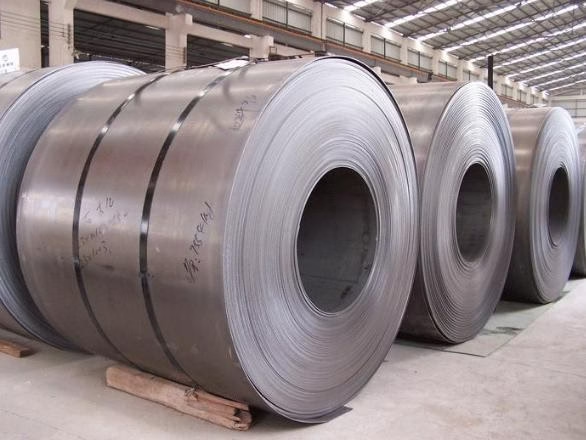
High Strength Low Alloy Steel (HSLA)
High Strength Low Alloy Steel (HSLA) achieves yield strength 315–700 MPa through microalloying (Nb, V, Ti) and TMCP without expensive heat treatment. Available as structural plate (S355–S690), automotive coil (S315MC–S700MC), pressure vessel plate (P355NH–P460NH), and offshore grades (API 2W/2Y). Thickness 1.5–200mm. EN 10025 / ASTM A572 / API 2W certified. Mill test certificate provided.
| Material | Microalloyed High Strength Low Alloy (HSLA) Structural and Automotive Steel — Hot-Rolled Plate and Coil |
|---|---|
| Grade / Standard | S355JR / S355J2 / S355M / S420M / S460M / S460ML / S500MC / S550MC / S700MC / ASTM A572 Gr.50 / Gr.60 / Q345B / Q460 / Q690 / API 2W Gr.50 |
| Thickness | Coil: 1.5mm – 25.4mm / Plate: 6mm – 200mm (alloy grade dependent) |
| Width | Coil: 600mm – 2,100mm / Plate: up to 4,800mm (wide plate mill) |
| Delivery Condition | tmcp |
| Surface Treatment | coated |
| MOQ | 1 Ton (Plate Cut-to-Size) / 5 Tons (Standard Coil) |
| Delivery Time | 15-35 Days (Stock) / 30-60 Days (Custom / Special Grade) |
| Loading Port | Tianjin / Shanghai / Qingdao |
Overview of High Strength Low Alloy Steel (HSLA)
High Strength Low Alloy Steel (HSLA) is a category of engineered structural and automotive steel achieving yield strengths from 315 MPa to 700 MPa through the synergistic combination of grain refinement, precipitation hardening, and solid solution strengthening mechanisms — rather than the high alloy additions and complex heat treatments required by conventional alloy steels of equivalent strength — delivering a material that provides substantially higher strength-to-weight ratio than plain carbon structural steel at modest cost premium, with excellent weldability, good formability, and reliable toughness performance across a broad temperature range from arctic to tropical service environments. The designation ‘high strength low alloy’ precisely captures the fundamental metallurgical strategy: strength is achieved at low total alloy content (typically 0.5–2.0% total alloying elements) through optimised microalloying additions of niobium (Nb), vanadium (V), titanium (Ti), and combinations thereof at levels of 0.01–0.15%, which perform grain boundary pinning during hot rolling and recrystallisation control, precipitation hardening of the ferrite matrix through fine carbonitride particle precipitation, and dislocation density enhancement — mechanisms that collectively develop fine-grained (ASTM grain size 9–13) ferritic-pearlitic microstructures providing yield strength 315–700 MPa at carbon content typically below 0.15%, enabling carbon equivalent values (CEV or Pcm) well within the weldability thresholds of standard structural welding codes (AWS D1.1, EN ISO 15614) without preheat requirements for most joint configurations and thicknesses.
HSLA steel is standardised under EN 10025-4 (thermomechanically rolled fine-grain structural steels: S315MC through S700MC), EN 10149-2 / 10149-3 (hot-rolled flat products for cold forming), EN 10028-3 (fine-grain pressure vessel steels P275NH / P355NH / P460NH), ASTM A572 (high-strength low-alloy columbium-vanadium structural steel, Grades 42, 50, 55, 60, 65), ASTM A1011 (steel sheet and strip in coil for general structural and cold-forming applications, HSLA Grades 340, 380, 410, 450, 480, 550), ASTM A606 (steel sheet and strip, high-strength, low-alloy with improved atmospheric corrosion resistance), API 2W / 2Y (offshore structural steel), and JIS G3134 (hot-rolled high yield strength steel plates for welded structures), with equivalent Chinese standards GB/T 1591 (Q345B/Q390/Q420/Q460/Q500/Q550/Q620/Q690) forming the basis of China’s vast structural steel consumption. The most widely recognised HSLA designations in international structural engineering practice are the European S-series (S355MC through S700MC for automotive structural coil, S355J2 through S460M for building and bridge structural plate), the American A572 Grade 50 / Grade 60 / Grade 65 series, and the high-strength end represented by S500MC, S550MC, S600MC, S650MC, and S700MC for ultra-lightweight automotive chassis, trailer, and crane structures.
Key Features and Manufacturing Process
HSLA steel manufacturing employs thermomechanical controlled processing (TMCP) — a precisely engineered combination of controlled hot rolling parameters and accelerated cooling that replaces the expensive conventional normalising, quenching, and tempering heat treatments required by earlier high-strength steel technologies. The TMCP production sequence begins with continuous casting of a slab with the required microalloyed composition, which is reheated to 1150–1250°C to dissolve all microalloy carbonitrides into solution and achieve the homogeneous austenite starting condition for controlled rolling. The critical TMCP stages are: roughing rolling above the austenite recrystallisation stop temperature (Tnr, typically 950–1000°C) to refine the austenite grain size through repeated recrystallisation cycles; finish rolling below Tnr in the non-recrystallisation region (typically 800–900°C) where austenite is work-hardened by rolling without recrystallising, creating pancaked austenite grains with greatly increased grain boundary area per unit volume for transformation nucleation; and accelerated cooling from the finish rolling temperature at controlled rates of 5–30°C/s to suppress pearlite formation and promote precipitation of fine Nb(C,N), V(C,N), and Ti(C,N) particles in the ferrite during and after transformation, contributing precipitation hardening of 50–150 MPa to the overall yield strength.
HSLA steel is supplied in hot-rolled coil form (thickness 1.5–25.4mm, width 600–2,100mm, coil weight 10–30 tons) for automotive chassis, agricultural equipment, construction machinery, and general fabrication applications, and as hot-rolled or thermomechanically rolled plate (thickness 6–200mm, width up to 4,800mm for wide plate mill production) for structural, pressure vessel, offshore, and bridge applications. Standard mechanical properties are guaranteed to be met in the as-delivered TMCP or normalised condition without further heat treatment by the fabricator — a critical commercial advantage over conventional quenched-and-tempered high-strength steels that require the fabricator to arrange heat treatment. Surface conditions include black mill scale (as-rolled, standard for structural applications where paint or corrosion protection will be applied), shot-blasted Sa2.5 (for immediate painting or coating), and weathering steel variants (ASTM A588, EN S355J2W, Corten A/B) that develop a stable protective rust patina eliminating paint requirements for atmospheric-exposure structural applications. All HSLA production undergoes mandatory chemical composition analysis, tensile and yield property testing at ambient and sub-zero temperatures per ASTM A370 / EN ISO 6892-1, Charpy V-notch impact testing at specified temperatures per EN ISO 148-1 for J-grade and M/ML-grade steel with guaranteed minimum absorbed energy, weld heat-affected zone (HAZ) toughness verification for offshore and nuclear applications, and dimensional inspection per applicable standard tolerance tables.
Main Applications of High Strength Low Alloy Steel (HSLA)
Structural steel construction is the primary application for HSLA plate and heavy coil, with S355 (EN 10025-2 / 10025-3 / 10025-4) and ASTM A572 Grade 50 providing the dominant structural steel grades for multi-storey building frames, long-span roof structures, industrial buildings and warehouses, stadiums and arena roofs, convention centre and exhibition hall structures, airport terminal structures, railway station canopies, and bridge superstructures worldwide — the 50 MPa (or 50 ksi) yield strength advantage over S235 / A36 mild steel enabling 20–30% reduction in structural steel weight at equivalent load-carrying capacity, directly reducing material costs, foundation loads, and total construction cost. Bridge construction extensively uses HSLA plate grades from S355 through S460 and S500 for main girder webs and flanges, cross girders, stiffeners, diaphragms, deck plates, and box girder sections of highway and railway bridges — the controlled weldability of HSLA structural steels enabling efficient field welding of bridge sections at construction sites worldwide.
Automotive chassis and structural applications consume large quantities of HSLA coil — particularly the thermomechanically rolled grades S315MC through S500MC per EN 10149-2 and equivalent ASTM A1011 HSLA grades — for truck chassis longitudinal rails and cross-members, trailer frame structural members, agricultural tractor and implement frames, construction machinery structural boom and stick components, crane boom sections, forklift mast sections, and bus and coach body frames where HSLA’s combination of high yield strength (315–500 MPa), good elongation (15–26%), and weldability enables lightweight structures that carry heavy loads within stringent dimensional constraints. Heavy transport and mining industry applications include dumper truck body panels (S355MC / S460MC for resistance to wear and impact from rock loading), mining equipment structural frames (S460MC / S500MC for high strength at reduced weight), and earthmoving equipment components (S355MC for consistent formability in roll-formed and press-formed structural sections). Pressure vessel and boiler applications use HSLA fine-grain pressure vessel grades per EN 10028-3 (P275NH, P355NH, P460NH) and ASTM A516 Grade 70 for storage vessels, pressure reactors, heat exchanger shells, storage tank shells, and boiler drums where the controlled carbon and phosphorus content provides both adequate strength and guaranteed toughness at sub-zero temperatures. Offshore oil and gas platform fabrication uses high-quality HSLA structural plate (S355G8+M, S355G10+M, API 2W Grade 50) for jacket legs, braces, deck beams, and offshore structural members requiring guaranteed impact toughness at −40°C combined with the structural strength and weldability needed for efficient offshore fabrication.
Why Choose Us for High Strength Low Alloy Steel
Shandong Tanglu Metal Material Co., Ltd. supplies premium High Strength Low Alloy Steel from China’s leading integrated steel producers including Baoshan Iron & Steel (Baosteel), HBIS Group (Hesteel), Shougang Group, Angang Steel, and Wuhan Iron & Steel (WISCO), all operating dedicated TMCP (Thermomechanical Controlled Processing) production lines for hot-rolled plate and coil with automated composition control, online mechanical property prediction, and full EN 10025 / ASTM A572 / API 2W product standard compliance certified to ISO 9001, ISO 14001, and relevant classification society approvals (ABS, DNV GL, Lloyd’s Register, Bureau Veritas, NK, RINA) for offshore and marine structural applications. Every HSLA coil and plate is accompanied by original mill test certificates covering complete chemical composition analysis by optical emission spectrometry, mechanical property test results (yield strength, tensile strength, elongation in both longitudinal and transverse directions), Charpy V-notch impact energy at specified temperatures (0°C, −20°C, −40°C, −50°C depending on grade sub-designation), dimensional inspection, and complete heat and slab/coil number traceability enabling full batch identification throughout fabrication, welding, and construction.
We offer a comprehensive HSLA specification range covering structural plate grades S235JR through S690QL per EN 10025 family; thermomechanically rolled coil S315MC through S700MC per EN 10149-2; pressure vessel grades P265GH through P460NH per EN 10028-3; ASTM A572 Grade 42 / 50 / 55 / 60 / 65; ASTM A1011 HSLA Grades 340 / 380 / 410 / 450 / 480 / 550; API 2W Grade 42 / 50 / 50T and API 2Y Grade 42 / 50 / 60 for offshore; GB/T 1591 Q345B / Q390 / Q420 / Q460 / Q500 / Q550 / Q620 / Q690; and weathering steel ASTM A588 / EN S355J2W / EN S355K2W (Corten A/B equivalent). Thicknesses from 1.5mm thin coil through 200mm heavy structural plate, widths up to 4,800mm wide plate, in as-rolled (AR), normalised (N), thermomechanically rolled (M), quenched and tempered (Q+T), and accelerated cooled (AcC) delivery conditions. With established monthly supply capacity of 10,000 tons of HSLA structural and automotive steel and export relationships with construction contractors, structural steel fabricators, bridge builders, automotive frame manufacturers, pressure vessel fabricators, offshore platform constructors, and heavy equipment manufacturers across more than 60 countries, we support packages from small fabrication material orders to large project structural steel supply contracts. Each shipment includes original mill test certificate per EN 10204 3.1, with EN 10204 3.2, ultrasonic testing reports for thick plate, and third-party inspection by SGS, Bureau Veritas, ABS, DNV GL, or Lloyd’s Register available for offshore, nuclear, and critical structural applications.
📐 Dimension & Size Table
| Grade | Standard | Min. Yield Strength (MPa) | Min. Tensile Strength (MPa) | Charpy Impact Temp. | Primary Application |
|---|---|---|---|---|---|
| S355JR / S355J0 | EN 10025-2 | 355 / 355 | 510–680 / +20°C / +0°C / General structural steel — buildings, frames, general fabrication | ||
| S355J2 / S355K2 | EN 10025-2 | 355 / 355 | 510–680 / −20°C / −20°C / Structural — bridges, cranes, outdoor structures | ||
| S355N / S355NL | EN 10025-3 (normalised) | 355 / 355 | 490–630 / −20°C / −50°C / Fine-grain normalised structural, toughness at low temperature | ||
| S355M / S355ML | EN 10025-4 (TMCP) | 355 / 355 | 470–630 / −20°C / −50°C / TMCP structural, offshore, bridge deck plates | ||
| S420N / S420NL | EN 10025-3 (normalised) | 420 / 420 | 520–680 / −20°C / −50°C / Higher yield normalised structural plate | ||
| S420M / S420ML | EN 10025-4 (TMCP) | 420 / 420 | 500–660 / −20°C / −50°C / TMCP — offshore jacket, crane boom, heavy fabrication | ||
| S460N / S460NL | EN 10025-3 (normalised) | 460 / 460 | 550–720 / −20°C / −50°C / High-strength normalised structural plate | ||
| S460M / S460ML | EN 10025-4 (TMCP) | 460 / 460 | 530–720 / −20°C / −50°C / TMCP structural — bridges, offshore, heavy construction | ||
| ASTM A572 Grade 50 | ASTM A572 | 345 / N/A | 450 minimum / No impact req. standard / Buildings, bridges, US standard structural | ||
| ASTM A572 Grade 60 | ASTM A572 | 415 / N/A | 520 minimum / No impact req. standard / High-strength US structural steel | ||
| ASTM A572 Grade 65 | ASTM A572 | 450 / N/A | 550 minimum / No impact req. standard / Highest A572 grade — crane booms, automotive frames | ||
| S315MC / S355MC | EN 10149-2 (automotive coil) | 315 / 355 | 390–510 / 430–550 / No Charpy req. / Automotive chassis, truck frames, agricultural equipment | ||
| S420MC / S460MC / S500MC | EN 10149-2 (automotive coil) | 420 / 460 / 500 | 480–620 / 520–670 / 550–700 / No Charpy req. / High-strength automotive chassis, trailer frame, crane | ||
| S550MC / S600MC / S650MC | EN 10149-2 (automotive coil) | 550 / 600 / 650 | 600–760 / 650–820 / 700–880 / No Charpy req. / Ultra-high strength trailer, crane boom, lifting | ||
| S700MC | EN 10149-2 (automotive coil) | 700 | 750–950 / No Charpy req. / Ultra-lightweight truck and trailer frame, crane boom tip section | ||
| API 2W Grade 50 / API 2Y Grade 50 | API 2W / API 2Y | 345 / 345 | 483 min / 483 min / −20°C Charpy / Offshore platform structural — jacket legs, braces, deck | ||
| Q345B / Q390B / Q420B / Q460B | GB/T 1591 | 345 / 390 / 420 / 460 | 470–630 / 490–650 / 520–680 / 550–720 / +20°C / Chinese structural steel — buildings, bridges, infrastructure |
* Custom sizes available upon request. Tolerances per relevant international standards.
🔬 Chemical Composition
| Element | Min | Max | Display Value | Note |
|---|---|---|---|---|
| C | - | 0.15 | ≤0.15 | S355M / S460M TMCP per EN 10025-4 — low C for weldability; higher grades S500MC–S700MC: C ≤0.12%; ASTM A572 Gr.50: C ≤0.23% |
| Si | - | 0.55 | ≤0.55 | Solid solution strengthening; Si >0.40% may affect submerged arc weld quality and HAZ toughness |
| Mn | 0.80 | 1.70 | 0.80–1.70 | Primary strengthening element in HSLA — Mn strengthening ~35 MPa per 1% Mn addition; S700MC: Mn ≤2.10% |
| P | - | 0.025 | ≤0.025 | Strictly controlled — P causes temper embrittlement and reduces low-temperature toughness; offshore grades: P ≤0.020% |
| S | - | 0.015 | ≤0.015 | Low S for lamellar tearing resistance in thick plate; offshore S-class: S ≤0.010% with through-thickness (Z-grade) guarantee |
| Nb | 0.010 | 0.090 | 0.010–0.090 | Primary grain refinement microalloy — Nb(C,N) precipitation pins grain boundaries and hardens ferrite; ~50 MPa per 0.05% Nb |
| V | - | 0.120 | ≤0.120 | Precipitation hardening microalloy — V(C,N) precipitates in ferrite providing 100–200 MPa strengthening at controlled levels |
| Ti | - | 0.050 | ≤0.050 | Grain boundary pinning as TiN at high temperature — Ti ≥0.010% stabilises austenite grain during rolling, refines final grain |
| Al | 0.015 | 0.060 | 0.015–0.060 | Deoxidiser — Al-killed fine-grain steel per EN 10025; Al combines with N as AlN, preventing strain ageing |
| Cr | - | 0.30 | ≤0.30 | Hardenability addition in higher strength grades S550MC–S700MC; weathering grades: Cr 0.40–0.65% for Cu-Cr-Ni patina |
| Mo | - | 0.10 | ≤0.10 | Hardenability supplement in S650MC / S700MC grades; controlled low for weldability in standard structural grades |
| CEV / Pcm | - | 0.43 / 0.25 | CEV ≤0.43 / Pcm ≤0.25 | Carbon equivalent for weldability: S355M: CEV ≤0.39; S460M: CEV ≤0.43; S700MC: Pcm ≤0.25 (low-carbon Pcm formula) |
* Chemical composition may vary by heat, thickness and specification. Please refer to the actual mill test certificate.
⚙️ Mechanical Properties
| Property | Value | Unit | Test Condition |
|---|---|---|---|
| Yield Strength — S355J2 (t ≤16mm) | ≥355 | MPa | Per EN 10025-2 — the most widely used structural HSLA grade globally |
| Tensile Strength — S355J2 | 510–680 | MPa | Per EN 10025-2, thickness dependent range |
| Elongation — S355J2 (A, longitudinal) | ≥22 | % | Gauge length 5.65√S₀; good formability for structural fabrication |
| Charpy Impact — S355J2 (−20°C) | ≥27 | J | Absorbed energy, transverse CVN specimen at −20°C — standard structural toughness requirement |
| Yield Strength — S420M (t ≤16mm, TMCP) | ≥420 | MPa | Per EN 10025-4 thermomechanically rolled — 18% higher than S355 enabling significant weight reduction |
| Charpy Impact — S420ML (−50°C) | ≥27 | J | L suffix = low temperature — guaranteed toughness at −50°C for arctic and offshore service |
| Yield Strength — S460M (t ≤16mm, TMCP) | ≥460 | MPa | Per EN 10025-4 — 30% higher than S355; enables 23% weight saving in strength-limited designs |
| Yield Strength — S500MC (automotive coil, TMCP) | ≥500 | MPa | Per EN 10149-2 — for automotive chassis, trailer frame, crane boom structural coil applications |
| Elongation — S500MC (A80) | ≥16 | % | Gauge length 80mm — adequate for roll-forming and press-forming structural sections |
| Yield Strength — S700MC (automotive coil, TMCP) | ≥700 | MPa | Per EN 10149-2 — highest standard HSLA coil grade for ultra-lightweight truck and trailer frames |
| Yield Strength — ASTM A572 Grade 50 | ≥345 (50 ksi) | MPa (ksi) | Per ASTM A572 — US standard structural HSLA, equivalent to S355; most common US structural grade |
| Yield Strength — ASTM A572 Grade 65 | ≥450 (65 ksi) | MPa (ksi) | Per ASTM A572 — highest standard A572 grade, similar to S420/S460 EN |
| Charpy Impact — API 2W Grade 50 (−20°C) | ≥40 (longitudinal) / ≥27 (transverse) | J | Per API 2W — enhanced toughness requirement for offshore platform structural applications |
| Through-Thickness Properties (Z-Grade, EN 10164) | Z15 / Z25 / Z35 | Reduction of Area (%) | Optional for thick structural plate where lamellar tearing in weld joints must be prevented — Z35: RA ≥35% |
* Values shown are minimum requirements unless otherwise stated.
📦 Commercial Information
| Packaging | Standard seaworthy export packing for HSLA structural plate and coil. Structural plate (thickness ≥6mm) stacked in flat bundles on timber export pallets with steel strapping (3–5 wraps per bundle), wooden dunnage separators between plate layers at maximum 2m spacing to prevent plate deflection, anti-rust oil applied to all bare mill scale plate surfaces for corrosion protection during ocean transit. For primer-coated or shot-blasted plate, additional PE film wrap protects the coating surface from abrasion. Large structural plates (length >6m, width >3m) loaded individually on open-top containers or break-bulk vessel flat deck with timber blocking, wire rope lashing per IMO cargo securing requirements, and waterproof tarpaulin cover. Each plate marked by paint stencil on plate surface showing: heat number, grade designation (S355J2 / S460M / A572 Gr.50), thickness × width × length (mm), plate weight (kg), applicable standard, delivery condition (N / M / Q+T), and customer PO reference. HSLA coil (thickness ≤25mm) wrapped with VCI anti-corrosion paper and PE film, coil ID and OD face protectors applied, plastic-coated steel strapping (4–6 wraps), stacked on hardwood export pallets with timber dunnage between coil layers. Each coil tagged with metal identification card showing grade, dimensions, coating/surface condition, coil weight, heat number, and customer reference. Offshore and classified society approved material shipments include additional documentation in waterproof pouch: original mill certificate with third-party inspection stamp, ultrasonic testing report, charpy impact test report at specified temperature, dimensional inspection data, and certificate of origin. Container loading: 20FT FCL typically 22–25 tons of plate; break-bulk vessel for long plate and large project structural steel supply contracts. |
|---|---|
| Payment Terms | T/T (Telegraphic Transfer),L/C (Letter of Credit),D/P (Documents against Payment),Western Union,PayPal |
| Price Term | FOB,CFR,CIF,EXW |
| Supply Capacity | 10,000 Tons/Month (HSLA Structural and Automotive Steel) |
| Loading Port | Tianjin / Shanghai / Qingdao |
Why Choose Our High Strength Low Alloy Steel (HSLA)?
Mill Certified Structural & Offshore Quality
HSLA plate and coil supplied with EN 10204 3.1/3.2 mill test certificate covering complete chemical composition including microalloy elements (Nb, V, Ti) and carbon equivalent (CEV/Pcm), mechanical properties (yield, tensile, elongation) in longitudinal and transverse directions, Charpy V-notch impact energy at specified temperature (0°C to −50°C per sub-grade), ultrasonic testing per EN 10160 for thick plate, and complete heat and slab traceability. ABS, DNV, LR, BV, NK, RINA classification society approved for offshore and marine structural applications.
Complete Grade & Thickness Range
Full HSLA range: EN 10025-2 S355JR/J2/K2; EN 10025-3 S355N/NL through S460N/NL; EN 10025-4 S355M/ML through S460M/ML; EN 10149-2 S315MC through S700MC automotive coil; ASTM A572 Gr.42/50/55/60/65; API 2W/2Y offshore grades; GB/T 1591 Q345B–Q690; weathering ASTM A588/S355J2W. Coil 1.5–25mm, plate 6–200mm.
TMCP — High Strength Without Post-Mill Heat Treatment
Thermomechanical Controlled Processing (TMCP) produces HSLA grades S355M through S700MC achieving yield strength 355–700 MPa in the as-delivered condition without normalising, quenching, or tempering by the fabricator — enabling direct cutting, welding, and erection after delivery. TMCP HSLA provides 20–50% weight saving versus S235/A36 mild steel at equivalent structural load capacity, reducing material cost, foundation requirements, and total project cost.
Multi-Standard International Compliance
EN 10025-2/3/4 (European structural), EN 10149-2 (automotive coil), ASTM A572/A1011/A588 (American), API 2W/2Y (offshore), JIS G3134/G3106 (Japanese), GB/T 1591 (Chinese). Classification society approvals: ABS, DNV GL, Lloyd's Register, Bureau Veritas, NK, RINA, CCS for offshore, marine, and pressure vessel applications. Z15/Z25/Z35 through-thickness properties per EN 10164 for lamellar tearing prevention.
Stock Availability & Project Supply
S355J2, S355M, A572 Grade 50, and S500MC standard thicknesses from stock: 15–25 days. Special grades, offshore quality, and wide plate: 30–60 days production. Full project structural steel supply packages including cutting list optimisation, plate marking, and just-in-time delivery scheduling for major construction and offshore projects. Break-bulk vessel loading for large tonnage structural plate supply.
🏭 Applications of High Strength Low Alloy Steel (HSLA)
High Strength Low Alloy Steel serves as the primary structural material across the broadest range of load-bearing applications in global civil, industrial, offshore, and automotive engineering — applications where the combination of higher yield strength than mild steel (enabling weight reduction) and reliable weldability without complex preheating or post-weld heat treatment procedures (enabling economical fabrication) creates a material selection advantage that no other widely available engineering steel can match across this breadth of applications and structural requirements. Building and construction structural steel framework consumes the largest aggregate tonnage of HSLA plate globally, with S355J2 and ASTM A572 Grade 50 as the dominant grades for multi-storey building columns and beams, industrial building portal frames, warehouse structural frames, sports stadium roof structures, airport terminal structural frames, railway station structures, convention centre and exhibition hall long-span roof systems, and the complete range of commercial and institutional building structural steel elements where the 355/345 MPa yield strength enables approximately 35% weight reduction versus S235/A36 mild steel in strength-governed designs — reducing column sizes, beam depths, foundation loads, and total structural steel tonnage with direct construction cost benefits. Bridge construction and highway infrastructure engineering represents the technically most demanding structural HSLA application, with S355M/ML, S420M/ML, and S460M/ML thermomechanically rolled plates used for bridge main girder webs (6–50mm thickness) and flanges (15–80mm thickness), transverse cross-girders, stiffener plates, deck plates welded to girder top flanges, box girder diaphragm plates, and suspension bridge cable anchor and pylon connection plates — all applications where the combination of guaranteed low-temperature toughness (down to −50°C for ML sub-grade), controlled weldability (CEV ≤0.43 enabling welding without mandatory preheat in most plate thicknesses), and high strength (enabling thinner, lighter bridge cross-sections) directly determines the structural performance, durability, and construction economy of long-span highway and railway bridges. Offshore oil and gas platform structural fabrication uses API 2W Grade 50 and equivalent S355G8+M / S355G10+M offshore structural plates for jacket leg chord plates, brace and horizontal stringer structural sections, tubular node fabrication plates, topside structural deck beams, crane pedestal structures, and conductor guide framing — all components exposed to the combined demands of North Sea, Gulf of Mexico, or South China Sea wave loading, deck gravity loads, crane dynamic loads, and hurricane or typhoon-force wind loads at service temperatures down to −20°C or −40°C for arctic regions. The automotive truck, trailer, and heavy transport chassis sector is the dominant application for high-strength HSLA coil grades (S355MC through S700MC per EN 10149-2 and equivalent ASTM A1011 HSLA grades), with the truck chassis longitudinal rail — the primary structural backbone running the full length of the truck frame — produced from S420MC (Class 8 heavy trucks, minimum frame rail yield 420 MPa), S500MC (premium heavy-duty trucks and high-cube van trailers where weight saving is critical for payload maximisation), and S550MC–S700MC (specialist ultra-lightweight trailer frames and crane boom sections where every kilogram of structural weight saves equivalent payload capacity or enables longer reach at rated load). Construction machinery structural applications include excavator boom and stick structures from S420MC/S460MC/S500MC (the primary structural members transmitting digging forces from the bucket to the slewing ring, designed for both static digging load and dynamic impact fatigue from rock breaking operations), crane lattice boom chord and diagonal sections from S500MC/S550MC/S700MC (the highest-strength requirement in construction equipment where lattice boom reach and lifting capacity is directly limited by boom structural weight and material strength), mobile crane upper structure (superstructure) rotating frames, concrete pump boom lattice arm sections, and aerial work platform (AWP) structural boom elements where maximum strength-to-weight enables greatest working height or outreach at rated load within transport axle load limits. Agricultural machinery applications include tractor drawbar and three-point linkage structural components from S355MC/S420MC, combine harvester feeder house and header frame structures, potato harvester and sugar beet harvester frame sections, and the structural frames of large farm machinery where field operation generates both sustained static loads and repeated impact loads from ground engagement tools. Mining and materials handling equipment uses S460MC through S700MC for dumper truck body shells (designed for high resistance to rock impact loading from blasted ore), conveyor gantry structural frames, stackers and reclaimer structural arms, large bucket wheel excavator structural members, mine shaft headframe structural sections, and crusher support frames where extreme cyclic fatigue loading combined with high static loads under the most severe operating conditions demands the highest available structural steel strength with adequate toughness. Railway rolling stock and passenger vehicle structural frame construction uses EN 10025-4 TMCP grades S355M/ML and S420M/ML for freight wagon underframe longitudinal and cross-member structures, flatcar centre sill sections, tank wagon shell and frame structural members, and passenger coach body shell floor frame, side frame, and roof structure — all fabricated by submerged arc welding (SAW) or metal active gas (MAG) welding with the TMCP HSLA providing guaranteed weld joint toughness at the low temperature conditions (down to −40°C for arctic freight operation) encountered in northern latitude railway service. Pressure vessel and storage tank fabrication uses fine-grain normalised HSLA grades P355NH, P460NH per EN 10028-3 and ASTM A516 Grade 70 for vessel shells, heads, nozzle necks, and support structures of pressure vessels operating in low-temperature petroleum refinery, chemical plant, and LNG terminal service where the guaranteed minimum Charpy impact energy at −20°C to −50°C ensures freedom from brittle fracture under the combined effects of internal pressure and thermal shock during startup, emergency shutdown, and cold pressure testing operations.
📋 Quality & Certification
Our Certifications
- ✅ ISO 9001:2015
- ✅ CE Marking
- ✅ ABS
- ✅ DNV GL
- ✅ Lloyd's Register (LR)
- ✅ Bureau Veritas (BV)
- ✅ SGS Certified
- ✅ NK
- ✅ RINA
Mill Certificate Type
- 📋 EN 10204 3.1
- 📋 EN 10204 3.2
- 📋 Original Mill Certificate
- 📋 Third Party Inspection Available
- 📋 Certificate of Origin
❓ Frequently Asked Questions
What is High Strength Low Alloy (HSLA) steel and how does it achieve high strength without high alloy content?
High Strength Low Alloy (HSLA) steel achieves yield strengths of 315–700 MPa through the synergistic combination of three metallurgical strengthening mechanisms — grain refinement, precipitation hardening, and solid solution strengthening — operating simultaneously at very low total alloy addition (typically 0.5–2.0% total alloying elements). The 'low alloy' descriptor is technically accurate and commercially significant: HSLA achieves equivalent or greater yield strength versus conventional alloy steels (containing 3–10% total alloy additions requiring quenching and tempering heat treatment) at substantially lower material cost and with far better weldability. Grain refinement is the most important strengthening mechanism, governed by Hall-Petch relationship (σy ≈ σ₀ + k/√d) where decreasing grain diameter d increases yield strength — a halving of grain diameter from d=20μm (ASTM grain size 8) to d=10μm (ASTM grain size 10) increases yield strength by approximately 50 MPa. HSLA achieves fine grain (ASTM 9–13) through: (1) Niobium (Nb, 0.01–0.09%) additions forming NbC and Nb(C,N) precipitates that pin austenite grain boundaries, preventing grain growth during hot rolling and retaining fine austenite for ferrite transformation into fine-grain ferrite; (2) Thermomechanical controlled processing (TMCP) finishing below the austenite recrystallisation stop temperature, work-hardening austenite grains without recrystallisation to create a fine, heavily deformed austenite structure that transforms into ultra-fine ferrite on cooling. Precipitation hardening contributes 100–200 MPa additional yield strength from nanosized (3–15nm diameter) V(C,N) or Nb(C,N) or Ti(C,N) precipitates that form in the ferrite during and after transformation from austenite, impeding dislocation motion through particle dispersion hardening. Solid solution strengthening from manganese (0.80–1.70%) contributes approximately 35 MPa per 1% Mn through lattice distortion that resists dislocation glide. The combined effect of these mechanisms achieves 355–700 MPa yield strength at carbon content ≤0.15% — well below the carbon content that would embrittle welds and heat-affected zones — enabling straightforward welding without preheat in most plate thicknesses under standard structural welding codes.
What is the difference between S355JR, S355J2, S355N, and S355M, and which should I specify?
All four designations denote steel with minimum yield strength 355 MPa and tensile strength 510–680 MPa, but they differ critically in guaranteed low-temperature impact toughness (Charpy V-notch test temperature), microstructural refinement method, weldability, and plate thickness capability. S355JR (EN 10025-2, 'J' = Charpy guaranteed, 'R' = +20°C test temperature): The basic structural grade meeting minimum 27J Charpy only at +20°C — suitable for indoor structural applications and moderate-temperature outdoor structures where the design service temperature remains above approximately 0°C. Very economical, widely available in standard thicknesses. Not suitable for structures that will experience temperatures approaching or below 0°C in service, or where fatigue loading requires verified fracture toughness. S355J2 (EN 10025-2, '2' = −20°C test temperature): Same yield strength as S355JR but with guaranteed minimum 27J Charpy at −20°C — the standard specification for outdoor structural steel in European temperate climate engineering (bridges, cranes, stadiums, transmission towers, offshore platform deck structures in mild environments). The −20°C Charpy guarantee ensures freedom from brittle fracture at the winter ambient temperatures experienced throughout most of Europe, North America, and Asia in structural service conditions. S355J2 is the most widely specified structural HSLA grade globally and the appropriate default choice for most outdoor structural applications in temperate climates. S355N (EN 10025-3, 'N' = normalised): Same mechanical strength as S355J2 but produced by normalising heat treatment (heating above AC3, holding, air cooling) that produces a refined equiaxed ferrite-pearlite microstructure with guaranteed Charpy 27J at −20°C AND improved through-thickness mechanical properties and weld HAZ toughness. S355N provides better Z-direction (through-thickness) ductility for thick plates (>25mm) in highly restrained welded joints prone to lamellar tearing. Preferred for complex thick-plate welded structures including crane girder webs, heavy connection plates, and thick-section bridge components. S355M (EN 10025-4, 'M' = thermomechanically rolled): Achieved by TMCP rather than normalising, providing the same or better mechanical properties versus S355N with lower carbon equivalent (CEV ≤0.39 versus ≤0.43 for S355N) — improving weldability and allowing thicker plates to be welded without preheat. TMCP also produces higher guaranteed toughness at the same temperature level. S355M is the preferred modern specification for offshore structural steel (often enhanced as S355G8+M for offshore jack-up structures), bridges requiring highest weld quality, and any structure where preheat-free welding is commercially important. S355ML adds guaranteed Charpy at −50°C for arctic and sub-zero service environments. Selection guide: Ambient indoor structures → S355JR; Standard outdoor structural → S355J2; Thick-plate complex welded joints → S355N; Offshore, bridges, cold climates, weld-intensive → S355M or S355ML.
What are the S-series automotive HSLA coil grades (S315MC through S700MC) and what applications do they serve?
The S-series automotive HSLA coil grades (S315MC through S700MC) per EN 10149-2 are thermomechanically rolled high-strength steel in coil form specifically engineered for automotive chassis, trailer frame, crane boom, and structural section roll-forming and press-forming applications where high yield strength (315–700 MPa) enables significant gauge reduction and weight saving versus conventional structural steel while maintaining adequate formability for industrial forming operations. The 'MC' designation suffix indicates: 'M' = thermomechanically rolled (TMCP process, no post-mill heat treatment required), 'C' = for cold forming (the as-delivered coil can be directly cold-formed by roll forming or press braking without annealing). The grade number indicates the minimum yield strength in MPa — so S500MC means minimum yield strength 500 MPa guaranteed in the as-delivered TMCP coil condition. S315MC and S355MC (yield ≥315 / ≥355 MPa, tensile 390–510 / 430–550 MPa, A80 ≥23% / ≥22%): Entry-level HSLA coil with good formability for moderately complex roll-formed structural sections, agricultural machinery frames, utility trailer structural members, and general fabrication where mild steel would be too heavy but higher-strength grades are unnecessary. S420MC and S460MC (yield ≥420 / ≥460 MPa, tensile 480–620 / 520–670 MPa, A80 ≥19% / ≥17%): The most widely used automotive HSLA coil grades for heavy truck chassis longitudinal rails and cross-members (Class 6/7/8 trucks), full-trailer and semi-trailer frame structural members, tipper body side panels, and agricultural equipment (combine harvester, tractor) structural frames — providing approximately 25–30% gauge reduction versus S355MC at equivalent structural load capacity, directly reducing vehicle tare weight and increasing payload. S500MC and S550MC (yield ≥500 / ≥550 MPa, tensile 550–700 / 600–760 MPa, A80 ≥16% / ≥14%): Premium truck and trailer structural grades for weight-critical applications — refrigerated trailer frames, flat deck trailer structural members, crane boom chord and diagonal sections, and specialty transport equipment where maximum structural weight reduction is critical for payload and transport permit compliance. S600MC, S650MC, and S700MC (yield ≥600 / ≥650 / ≥700 MPa, tensile 650–820 / 700–880 / 750–950 MPa, A80 ≥12% / ≥10% / ≥10%): Ultra-high-strength coil for the most weight-sensitive structural applications — crane lattice boom sections (where boom self-weight directly limits lift capacity and boom length), lightweight trailer frame designs targeting maximum payload under transport axle weight regulations, specialist lifting equipment structural members, and ultra-lightweight construction machinery booms and stick arms. S700MC represents the practical upper limit for cold-formable HSLA coil without requiring warm forming or press-hardening processes. All S-MC grades have no Charpy impact requirement (unlike structural plate grades with N/NL and M/ML sub-designations) as automotive chassis and trailer frame service temperatures rarely approach the ductile-to-brittle transition of these fine-grain TMCP steels.
What is weathering steel (Corten / S355J2W) and what are its advantages and limitations?
Weathering steel (commercial designation Corten, formal designations ASTM A588 in the USA and S355J2W / S355K2W in Europe per EN 10025-5) is a copper-chromium-nickel low alloy steel that develops a protective, adherent, tightly bonded rust patina (patina composition primarily α-FeOOH goethite) on atmospheric exposure over 2–5 years, which then acts as a barrier to further corrosion — dramatically reducing and eventually eliminating ongoing corrosion rate compared to conventional carbon steel exposed to the same environment. The patina-forming chemistry involves the interaction of small additions of copper (0.25–0.55%), chromium (0.40–0.65%), and nickel (0.40–0.65%) (plus manganese and phosphorus) with atmospheric oxygen and moisture cycling to form a denser, more adherent and less porous rust layer than the loose, powdery rust of plain carbon steel that would flake off and expose fresh metal to continued corrosion. The annual thickness loss of weathering steel in a temperate atmosphere after the protective patina is established is approximately 0.005–0.025mm/year — compared to 0.05–0.20mm/year for unprotected carbon steel in the same environment — representing a factor 5–10 reduction in corrosion rate that eliminates periodic repainting over a 30–50 year structure service life. Primary advantages of weathering steel: (1) Elimination of paint and repainting cost — for a major bridge, the lifecycle painting cost savings (initial painting, periodic repainting every 10–20 years, traffic management during repainting) can exceed the initial steel cost premium, providing total lifecycle cost advantages of 20–40% versus painted carbon steel; (2) Distinctive aesthetic — the warm orange-brown patina colour is architecturally valued for exposed structures, sculptures, and architectural features where a natural, organic visual character is desired; (3) Zero painting disruption — repainting of painted bridges typically requires lane closures, scaffolding, and environmental controls for paint removal, all eliminated with unpainted weathering steel. Critical limitations and unsuitable environments: (1) Marine and coastal environments within approximately 300m of saltwater — chloride ions disrupt the patina formation process, producing a porous, non-protective rust layer and actual corrosion acceleration versus plain carbon steel with paint. Weathering steel is not recommended within 300m of saltwater coast or marine tidal zones; (2) Continuously wet environments — the patina requires alternating wet and dry cycles for formation. Locations where moisture is trapped permanently (at drainage zones, within hollow sections without drainage, under bridge deck drains) develop unprotected rust rather than protective patina; (3) Industrial pollution areas with high SO₂ concentration — atmospheric sulfur dioxide significantly increases corrosion rate even for weathering steel; (4) Connection zones at bolted splices and bearings must be painted as the patina cannot form under covered surfaces; (5) Initial aesthetic phase — during the first 1–3 years of exposure, brownish staining runs wash from the steel surface onto concrete, masonry, and paving below — this 'rust run-off' staining can be severe and must be managed in the design (by drainage planning) and construction contract (by expectation management with the client).
What is the carbon equivalent (CEV / Pcm) and how does it determine HSLA steel weldability?
The carbon equivalent (CE or CEV) is a calculated index that combines the effects of all alloying elements on the hardenability of a steel's heat-affected zone (HAZ) during welding into a single number that predicts weldability — specifically, the risk of hydrogen-induced cold cracking (HICC, also called hydrogen-assisted cracking or HAC) in the HAZ immediately adjacent to the weld fusion boundary, where the rapid heating and cooling cycle of welding produces hard, brittle martensite that can crack in the presence of diffusible hydrogen absorbed from the welding consumable (moisture in flux, electrode coating humidity). Two carbon equivalent formulas are in common use for structural steels: The IIW (International Institute of Welding) carbon equivalent formula: CEV = C + Mn/6 + (Cr+Mo+V)/5 + (Ni+Cu)/15. This formula is standardised in EN 10025, ISO 3580, and AWS D1.1 and is applicable to conventional structural carbon and low-alloy steels with C ≥0.12%. Lower CEV values indicate better weldability: CEV ≤0.35: excellent weldability, no preheat required for most conditions; CEV ≤0.42: good weldability, no preheat required for thin plates and low-hydrogen welding processes; CEV 0.42–0.50: preheat required for thicker sections (typically 50–100°C depending on joint thickness and hydrogen potential); CEV >0.50: high preheat requirements (100–200°C or higher) limiting efficiency of site welding operations. The Ito-Bessyo cold cracking parameter (Pcm) formula: Pcm = C + Si/30 + Mn/20 + Cu/20 + Ni/60 + Cr/20 + Mo/15 + V/10 + 5B. This formula is more appropriate for modern low-carbon HSLA steels (C <0.12%) including S355M through S700MC where the IIW CEV formula overestimates cracking risk because the C coefficient dominates at low C content. For TMCP automotive HSLA grades (S355MC through S700MC), Pcm ≤0.25 is the typical specification, enabling welding without preheat using low-hydrogen consumables (H5 or better hydrogen level) even in plate thicknesses up to 25mm. The practical significance for structural engineers and fabricators: selecting S355M or S460M (CEV ≤0.39–0.43) over normalised S355J2 or S460N (CEV typically 0.41–0.47 for the same thickness) enables preheat-free welding in a wider range of joint configurations, reducing welding time, energy consumption, and field welding cost — particularly important for site-welded connections in tall building columns, bridge field splices, and offshore platform jacket assembly where preheating is operationally complex and time-consuming.
Get a Quote for
High Strength Low Alloy Steel (HSLA)
Submit your requirements and receive a competitive price quote within 24 hours.
- ✓ Fast response within 24 hours
- ✓ Competitive factory-direct pricing
- ✓ Free technical consultation
- ✓ Mill test certificate provided
- ✓ Flexible payment terms available
⏱ Response within 24 hours
Send Your Inquiry
All fields marked with * are required