
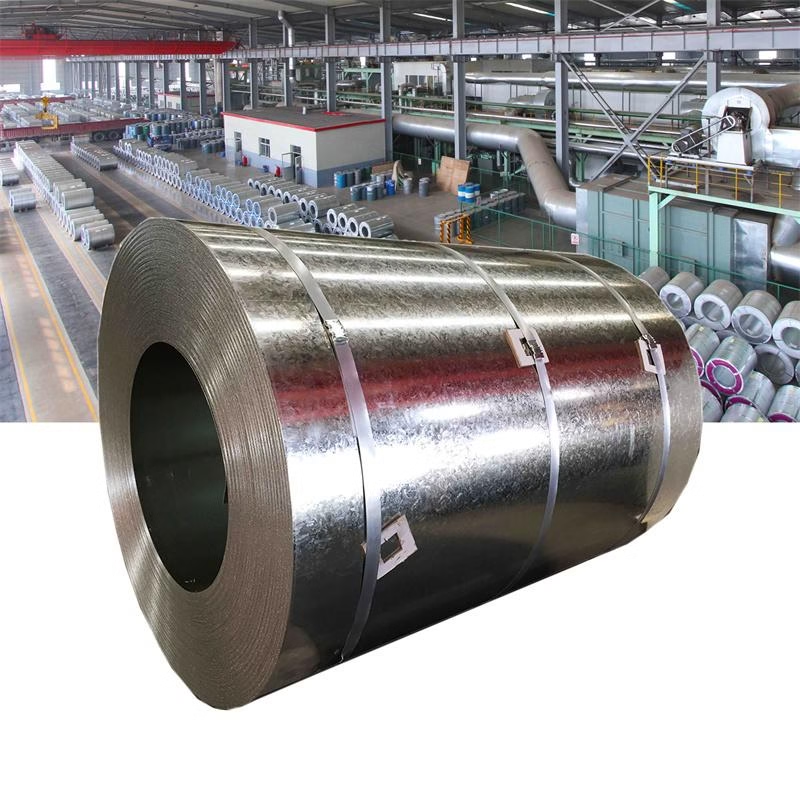
High Edge Ductility Steel (HEdge 690 / HEdge 780 / HEdge 980)
High Edge Ductility Steel (HEdge 690 / HEdge 780 / HEdge 980) is next-generation AHSS combining tensile strength 690-980 MPa with extraordinary hole expansion ratio (HER ≥60-80%) through a homogeneous bainite-dominant microstructure, enabling reliable edge forming, flanging, and punched hole applications impossible with conventional DP steel. Thickness 0.6-3.0mm. IATF 16949 certified.
| Material | Advanced High-Strength Steel (AHSS) — High Edge Ductility Bainite-Dominant Microstructure |
|---|---|
| Grade / Standard | HEdge 690 / HEdge 780 / HEdge 980 (Tata Steel HEdge® designation) / Equivalent High-HER CP Grades |
| Thickness | 0.6mm - 3.0mm (CR) / 1.5mm - 6.0mm (HR) |
| Width | 600mm - 1800mm |
| Inner Diameter (ID) | 508mm / 610mm |
| Coil Weight | 8-25 Tons (Standard 10-20 Tons) |
| Delivery Condition | hot_rolled / cold_rolled |
| Surface Treatment | galvanized |
| MOQ | 5 Tons |
| Delivery Time | 30-45 Days (Custom) / 15-25 Days (Stock) |
| Loading Port | Tianjin / Shanghai / Qingdao |
Overview of High Edge Ductility Steel (HEdge)
High Edge Ductility Steel (HEdge) is a next-generation advanced high-strength steel (AHSS) specifically engineered to overcome the edge cracking limitation that restricts the application of conventional dual phase (DP) and other multiphase steels in automotive structural components with punched holes, sheared edges, and complex flanging operations. Developed and commercialized primarily by Tata Steel under the HEdge® brand designation, and equivalent grades produced by other major steel mills under designations such as HDT (High Ductility Transformation) and optimized CP variants, HEdge steel achieves a unique combination of high tensile strength (690-980 MPa and above) with extraordinary hole expansion ratio (HER/λ typically 80-120%, significantly exceeding conventional CP steel at equivalent strength levels) through a proprietary microstructure design featuring an extremely homogeneous bainite-dominant matrix with minimal hard martensite phase fraction and precise control of microstructural heterogeneity — the root cause of edge cracking in conventional AHSS.
The fundamental technical innovation of HEdge steel lies in eliminating the microstructural hardness gradients between phases that cause premature void nucleation and crack initiation at sheared or punched edges during forming operations. Conventional DP steel derives strength from the large hardness contrast between soft ferrite (80-120 HV) and hard martensite islands (500-600 HV), which creates intense stress concentrations at phase boundaries during edge deformation — resulting in the characteristic low HER (20-35%) that limits DP steel application in flanged structural components. HEdge steel achieves high strength through a bainite-dominant microstructure with much smaller hardness differences between microstructural constituents (typically less than 100 HV hardness range across the microstructure versus 400+ HV in DP steel), enabling dramatically improved edge deformation without cracking. HEdge grades are specified and supplied per customer-specific automotive OEM requirements, VDA 239-100 equivalent designations, and EN 10338 framework specifications, with Tata Steel’s commercial HEdge grades covering HEdge 690 (tensile ≥690 MPa), HEdge 780 (tensile ≥780 MPa), and HEdge 980 (tensile ≥980 MPa) as the primary commercial range. Tanglu Group supplies HEdge-equivalent high edge ductility steel grades from qualified Chinese and international steel mills meeting full automotive OEM material specifications with comprehensive PPAP documentation support.
Key Features and Manufacturing Process
High Edge Ductility Steel is produced through an advanced thermo-mechanical processing route that is fundamentally distinguished from conventional DP or standard CP steel manufacturing by the precise control of bainitic transformation kinetics to achieve the homogeneous microstructure responsible for the extraordinary edge ductility performance. The steelmaking process begins with precisely controlled alloying — carbon content is maintained at carefully balanced levels (typically 0.04-0.10%) lower than standard CP steel, with higher manganese (1.5-2.5%) and chromium (0.3-0.8%) additions to enable the required hardenability for bainite formation during controlled cooling without excessive martensite formation. Molybdenum (0.1-0.3%) additions further refine the bainitic transformation window, while microalloying with niobium (0.02-0.06%) and titanium (0.01-0.04%) provide grain refinement and additional precipitation strengthening contributing to the target tensile strength without requiring the high martensite fractions that degrade edge ductility. Silicon content is carefully balanced (0.05-0.50%) to avoid excessive surface oxidation issues during continuous annealing while providing some retained austenite stabilization in the most advanced HEdge variants.
The critical manufacturing step is the continuous annealing thermal cycle, which must be precisely engineered to achieve the target bainite-dominant microstructure: austenitization at temperatures of 800-880°C followed by rapid cooling to the bainitic transformation temperature range (350-500°C) and controlled isothermal or near-isothermal holding to complete bainitic transformation before final cooling to room temperature. This bainitic transformation control — analogous to the austempering heat treatment used for austempered ductile iron — produces the characteristic lower bainite microstructure with fine carbide distributions within bainite laths and minimal retained martensite that defines HEdge steel’s microstructural homogeneity. Any residual martensite present is carefully controlled to be fine and dispersed (typically less than 5-8% volume fraction versus 15-25% in equivalent-strength DP steel), minimizing the hardness contrast that causes edge cracking. The finished HEdge steel is supplied primarily in cold-rolled coil form with thickness range 0.6mm to 3.0mm and width 600mm to 1800mm, with standard coil inner diameter 508mm or 610mm and coil weight 8-25 tons. Hot-rolled HEdge-equivalent grades are available in thickness 1.5mm to 6.0mm for heavier structural applications. Surface treatment options include bare cold-rolled, pickled and oiled for hot-rolled grades, electrogalvanized (ZE coating, typically 20/20 to 50/50 g/m² zinc coating weight), and hot-dip galvanized (GI/GA, 45/45 to 100/100 g/m² zinc coating weight) for corrosion-resistant structural applications in exposed body-in-white locations. Each HEdge steel coil undergoes comprehensive quality verification including chemical composition analysis, full mechanical property testing (tensile, yield, elongation), and critically, mandatory hole expansion ratio (HER/λ) testing per ISO 16630 which is the primary quality indicator for HEdge steel and must consistently meet the specified minimum HER values (typically HER ≥80% for HEdge 690, HER ≥70% for HEdge 780, HER ≥60% for HEdge 980) that differentiate HEdge from standard CP steel. Microstructural verification by scanning electron microscopy (SEM) and hardness mapping is performed on qualification lots to confirm microstructural homogeneity. Tanglu Group provides complete quality documentation including original mill test certificates, HER test reports, microstructure verification, and full automotive PPAP packages.
Main Applications of High Edge Ductility Steel
High Edge Ductility Steel is specifically targeted at automotive structural applications where the combination of high tensile strength and exceptional edge formability enables either direct substitution of heavier gauge conventional steels for weight reduction, or replacement of conventional AHSS grades that cannot meet edge quality requirements without process modifications such as laser cutting (replacing punching), reaming (improving punched hole quality), or reduced forming severity (compromising part geometry). The flagship application driving HEdge steel development is the B-pillar inner reinforcement for passenger vehicles, where HEdge 780 and HEdge 980 enable stamped B-pillar reinforcements with numerous punched attachment holes (typically 8-15 holes per B-pillar for seat belt anchors, trim clips, wiring harness grommets, and airbag curtain brackets) that must be flanged to ±90° without edge cracking — an operation that consistently causes edge cracking failures with DP780 or DP980 steel but is reliably achieved with HEdge grades due to the 2-3× higher HER performance at equivalent strength levels.
A-pillar inner and outer reinforcements represent a growing HEdge application where the complex cross-section geometry combining deep draws with multiple punched holes for windshield attachment, roof attachment, and electrical connector grommets requires both stretch forming capability and edge stretchability simultaneously — HEdge steel’s combination of adequate elongation (12-16%) with extraordinary HER provides the balanced formability profile needed for this challenging component. Roof rail reinforcements (both inner and outer) for SUVs and crossovers use HEdge 690 and HEdge 780 to achieve the long, complex roll-formed or stamped sections with punched attachment holes for headliner clips and roof rack mounting features without the edge cracking that limits conventional HSLA or DP steel application. Side sill (rocker) structural reinforcements including both inner reinforcements and sill outer panels use HEdge 690 for improved weight efficiency versus conventional CP800 while providing superior HER for the punched drainage holes, attachment points, and flanged connections throughout the sill assembly. Rear longitudinal rail (rear side member) assemblies for both conventional and electric vehicles use HEdge 690 and HEdge 780 for the combination of crash energy absorption and manufacturing feasibility for the complex stamped cross-sections with multiple punched features. Cross member assemblies including front and rear subframe cross members, suspension cross members, and underbody structural cross members use HEdge steel for weight reduction while accommodating the punched bolt holes, bracket attachment features, and flanged connection points integral to cross member design. Seat structural applications including seat track rails, seat riser brackets, seat back frames, and recliner reinforcement brackets use HEdge 690 and HEdge 780 where the numerous punched and flanged holes for adjustment mechanisms, recliner pivots, and harness routing require the superior edge ductility that differentiates HEdge from DP steel. Floor panel reinforcements, battery tray structural frames for electric vehicles (where the battery enclosure perimeter frame requires numerous punched bolt holes for battery module attachment with subsequent flanging operations), suspension tower reinforcements, and strut tower brackets represent additional automotive applications where HEdge steel’s unique edge formability enables designs impossible with conventional AHSS. Beyond automotive applications, HEdge steel is also applied in commercial vehicle structural frames where high strength with good hole expansion is required for bracket and attachment point fabrication, agricultural equipment structural components requiring high-strength materials with reliable hole flanging for hydraulic fittings and attachment brackets, construction equipment structural members with punched connection features, industrial storage rack systems requiring high-strength upright sections with punched slot features, and heavy-duty shelving and material handling equipment where high-strength steel with excellent punched hole quality reduces fabrication cost and improves structural reliability.
Why Choose Us for High Edge Ductility Steel
Shandong Tanglu Metal Material Co., Ltd. supplies High Edge Ductility Steel and equivalent high-HER advanced high-strength steel grades from qualified steel mills with demonstrated production capability for the precise microstructural control required to achieve consistent HER ≥60-80% at tensile strength 690-980 MPa. Our sourcing network includes mills with dedicated continuous annealing lines engineered for the precise bainitic transformation heat treatment cycles that produce the homogeneous microstructure defining HEdge-equivalent steel properties, operating under IATF 16949 certified quality management systems with full process control and traceability from steelmaking heat through final coil shipment. Every HEdge steel shipment includes mandatory hole expansion ratio (HER/λ) testing per ISO 16630 — the critical quality verification that confirms the homogeneous microstructure has been achieved and the material will perform as required in customer flanging and edge-forming operations — alongside standard chemical composition, full mechanical property testing (tensile, yield, total elongation, uniform elongation), bending test results (minimum bending radius), surface quality inspection, and dimensional verification per applicable EN 10338 / EN 10346 or customer-specific material specifications.
We provide comprehensive technical support for HEdge steel applications including grade selection consultation (comparing HEdge 690/780/980 options versus CP, DP, or conventional HSLA alternatives for specific component requirements), forming process parameter guidance (press tonnage estimation, blank holder force recommendations, lubrication specifications for high-strength steel stamping), springback compensation guidance for tooling design, welding procedure qualification support (RSW parameters, laser welding parameters, HAZ softening assessment), and surface treatment recommendations for corrosion protection in specific body-in-white locations. Our quality engineering team supports full automotive PPAP (Production Part Approval Process) submissions at Level 1 through Level 3 as required by customer programs, with experience in VW Group, BMW Group, Mercedes-Benz, Toyota, Ford, and General Motors customer-specific requirements (CSR). Available thickness 0.6mm to 3.0mm (cold-rolled) and 1.5mm to 6.0mm (hot-rolled), width 600mm to 1800mm, in coil form or cut-to-length sheets. Surface options include bare cold-rolled, electrogalvanized, and hot-dip galvanized variants. Monthly supply capacity 2,000 tons of high edge ductility AHSS, with stock availability for standard HEdge 690 and HEdge 780 grades enabling 15-25 day delivery for prototype and development programs, and 30-45 day lead time for full production volume orders with mill scheduling. All shipments documented with original mill test certificate per EN 10204 3.1, with EN 10204 3.2 third-party inspection (SGS, BV, TUV) available for automotive OEM direct-supply applications requiring enhanced certification.
📐 Dimension & Size Table
| Grade | Tensile Strength | Hole Expansion Ratio (HER) | Typical Application |
|---|---|---|---|
| HEdge 690 | ≥690 MPa | ≥80% (ISO 16630) | Sill reinforcements, roof rails, seat cross members, rear rails |
| HEdge 780 | ≥780 MPa | ≥70% (ISO 16630) | B-pillar inner reinforcements, A-pillar reinforcements, door beams |
| HEdge 980 | ≥980 MPa | ≥60% (ISO 16630) | Ultra-high-strength B-pillar, safety-critical structural members |
| HEdge 690 (ZE coated) | ≥690 MPa | ≥80% (ISO 16630) | Corrosion-resistant sill reinforcements, exposed structural members |
| HEdge 780 (GI/GA) | ≥780 MPa | ≥70% (ISO 16630) | Galvanized B-pillar, corrosion-critical structural applications |
| HEdge 980 (CR) | ≥980 MPa | ≥60% (ISO 16630) | Premium lightweight BIW structural components, EV battery frames |
| HR HEdge Equivalent | 690-980 MPa | ≥60-80% (ISO 16630) | Heavy-gauge structural members, commercial vehicle frames |
* Custom sizes available upon request. Tolerances per relevant international standards.
🔬 Chemical Composition
| Element | Min | Max | Display Value | Note |
|---|---|---|---|---|
| C | 0.04 | 0.10 | 0.04-0.10 | Carefully controlled — lower than CP for improved edge ductility |
| Si | 0.05 | 0.50 | 0.05-0.50 | Balanced for retained austenite stability and surface quality |
| Mn | 1.50 | 2.50 | 1.50-2.50 | Primary hardenability element for bainite transformation control |
| P | - | 0.015 | ≤0.015 | Very strict control for toughness, weldability, and edge ductility |
| S | - | 0.008 | ≤0.008 | Ultra-low sulfur critical for hole expansion ratio performance |
| Al | 0.015 | 0.060 | 0.015-0.060 | Deoxidizer, grain refiner |
| Cr | 0.30 | 0.80 | 0.30-0.80 | Hardenability for bainitic transformation, key HEdge alloying element |
| Mo | 0.10 | 0.30 | 0.10-0.30 | Bainite transformation refinement, suppresses martensite formation |
| Nb | 0.020 | 0.060 | 0.020-0.060 | Grain refinement, precipitation strengthening contribution |
| Ti | 0.010 | 0.040 | 0.010-0.040 | Grain boundary pinning, precipitation hardening |
| N | - | 0.006 | ≤0.006 | Controlled for grain refinement and aging resistance |
| B | - | 0.003 | ≤0.003 | Optional trace addition for hardenability in HEdge 980 grade |
* Chemical composition may vary by heat, thickness and specification. Please refer to the actual mill test certificate.
⚙️ Mechanical Properties
| Property | Value | Unit | Test Condition |
|---|---|---|---|
| Tensile Strength (HEdge 690) | 690-850 | MPa | Per VDA 239-100 / customer specification |
| Yield Strength (HEdge 690, Rp0.2) | ≥500 | MPa | 0.2% proof strength, cold-rolled condition |
| Tensile Strength (HEdge 780) | 780-950 | MPa | Per VDA 239-100 / customer specification |
| Yield Strength (HEdge 780, Rp0.2) | ≥550 | MPa | 0.2% proof strength, cold-rolled condition |
| Tensile Strength (HEdge 980) | 980-1180 | MPa | Per VDA 239-100 / customer specification |
| Yield Strength (HEdge 980, Rp0.2) | ≥700 | MPa | 0.2% proof strength, cold-rolled condition |
| Total Elongation (A80, HEdge 690) | ≥14 | % | Gauge length 80mm, key formability indicator |
| Total Elongation (A80, HEdge 780) | ≥12 | % | Gauge length 80mm, superior to equivalent CP steel |
| Total Elongation (A80, HEdge 980) | ≥10 | % | Gauge length 80mm, excellent for ultra-high strength grade |
| Hole Expansion Ratio (HER/λ, HEdge 690) | ≥80 | % | Per ISO 16630 — vs DP780 ~35%, CP800 ~60% |
| Hole Expansion Ratio (HER/λ, HEdge 780) | ≥70 | % | Per ISO 16630 — vs DP780 ~30%, CP800 ~55% |
| Hole Expansion Ratio (HER/λ, HEdge 980) | ≥60 | % | Per ISO 16630 — vs DP980 ~20%, CP1000 ~50% |
| Minimum Bending Radius (HEdge 690) | 0.5 × t | - | t = sheet thickness, 90° V-bending, superior to standard CP |
| Minimum Bending Radius (HEdge 780) | 1.0 × t | - | t = sheet thickness, 90° V-bending test |
| Yield-to-Tensile Ratio (YR) | 0.70-0.82 | - | Moderate YR enabling good crash energy absorption capacity |
* Values shown are minimum requirements unless otherwise stated.
📦 Commercial Information
| Packaging | Advanced automotive-grade packaging specifically designed for High Edge Ductility Steel coils supplying automotive Tier 1 structural stamping and roll-forming operations worldwide. Each coil wrapped with multi-layer VCI (volatile corrosion inhibitor) paper system providing minimum 18-month corrosion protection — essential for HEdge steel coils which may require extended storage during automotive model changeovers and production scheduling gaps at customer plants. VCI paper is selected for compatibility with electrogalvanized and hot-dip galvanized surface variants without white rust risk during ocean transit (Asia-Europe 25-30 days, Asia-North America 15-20 days). Heavy-duty galvanized steel strapping (32mm × 1.2mm, 6-8 wraps per coil) with purpose-designed plastic edge protectors preventing strapping contact damage on cold-rolled surface — critical as HEdge steel surface quality affects edge condition which impacts HER performance in customer forming operations. Precision steel inner diameter protection rings and heavy outer diameter reinforcement bands prevent telescoping under the high contact pressures during container stacking and ship loading. Each coil permanently tagged with laser-engraved metal identification including heat number, HEdge grade designation (HEdge 690/780/980), EN equivalent designation, actual HER test result from production lot, thickness and width, coil weight, surface treatment, production date for storage age tracking, customer purchase order reference, and automotive program part number. Barcode and 2D matrix code labels for integration with customer automotive plant material traceability systems per IATF 16949 requirements. Container loading performed with precision coil bracing systems (hardwood blocking and steel strapping anchors) engineered for container ocean transit dynamic loads, with maximum 3 coils high per stack and coil weight per container verified against container floor loading limits. All wood packaging ISPM-15 treated with official certification markings. Complete material documentation package (original MTC, HER test report, PPAP documents, CoO) included in waterproof sealed envelopes attached to each shipment and electronically transmitted to customer quality system upon dispatch. |
|---|---|
| Payment Terms | T/T (Telegraphic Transfer),L/C (Letter of Credit),D/P (Documents against Payment),Western Union,PayPal |
| Price Term | FOB,CFR,CIF,EXW |
| Supply Capacity | 2,000 Tons/Month (High Edge Ductility AHSS) |
| Loading Port | Tianjin / Shanghai / Qingdao |
Why Choose Our High Edge Ductility Steel (HEdge 690 / HEdge 780 / HEdge 980)?
Mandatory HER Testing Per ISO 16630
Every HEdge steel shipment includes mandatory hole expansion ratio (HER/λ) testing per ISO 16630 — the critical quality verification confirming the homogeneous bainite-dominant microstructure that delivers HER ≥60-80% performance. This testing requirement, combined with full mechanical property verification and microstructure qualification on initial production lots, ensures consistent edge forming performance at customer stamping plants and eliminates edge cracking failures that cause costly tooling damage and production downtime.
2-3× Higher HER vs Equivalent DP Steel
HEdge steel delivers 2-3× higher hole expansion ratio compared to dual phase (DP) steel at equivalent tensile strength: HEdge 780 achieves HER ≥70% versus DP780's typical HER of 25-35%. This extraordinary edge ductility advantage directly enables automotive structural components with punched holes and flanging operations that are manufacturing-feasible with HEdge steel but cause consistent edge cracking failures with DP steel, eliminating the need for expensive laser cutting or reaming operations.
Homogeneous Bainite Microstructure Innovation
HEdge steel's superior edge ductility originates from its engineered homogeneous bainite-dominant microstructure featuring minimal hardness contrast between microstructural phases (less than 100 HV range versus 400+ HV in DP steel). This microstructural homogeneity eliminates the stress concentration at ferrite-martensite phase boundaries that initiates edge cracking in conventional AHSS, enabling reliable edge deformation during flanging, hemming, and roll-forming of high-strength structural components.
Full Automotive OEM Specification Compliance
HEdge-equivalent grades supplied meeting VDA 239-100 high edge ductility designations, EN 10338 framework specifications, and customer-specific automotive OEM material requirements. Grade equivalency documentation provided for VW Group, BMW Group, Mercedes-Benz, Toyota, Ford, and General Motors programs. Complete PPAP support including ISIR, PSW, and ongoing production monitoring per IATF 16949 requirements.
Development to Production Supply Capability
Stock availability of standard HEdge 690 and HEdge 780 grades enables 15-25 day delivery for prototype development and feasibility studies. Production volume programs supported with 30-45 day lead times and reliable mill scheduling. Monthly capacity 2,000 tons AHSS with technical engineering support for forming process development, springback compensation, and welding procedure qualification throughout vehicle program development phases.
🏭 Applications of High Edge Ductility Steel (HEdge 690 / HEdge 780 / HEdge 980)
High Edge Ductility Steel is specifically engineered for automotive structural and safety-critical applications where the extraordinary combination of high tensile strength (690-980 MPa) and superior hole expansion ratio (HER ≥60-80%) enables component designs and manufacturing processes that conventional AHSS grades cannot reliably support. The defining application driving HEdge steel commercialization is the B-pillar inner reinforcement — the single most safety-critical body-in-white structural component for side impact occupant protection — where modern automotive designs require 8-15 punched holes per B-pillar assembly for seat belt anchors (FMVSS 210 regulated), trim attachment clips, wiring harness grommets, and roof airbag curtain mounting brackets, all requiring post-punch flanging operations to ±90° for bracket retention and water drainage. This combination of high-strength structural requirement (meeting IIHS side impact, Euro NCAP pole impact) and severe edge-forming requirement (multiple flanged holes) creates the technical dilemma that HEdge steel uniquely resolves: DP780 or DP980 provides the strength but fails by edge cracking during flanging of punched holes, while conventional CP1000 provides adequate HER but at higher initial yield strength (780-960 MPa) that increases press tonnage and springback challenges. HEdge 780 delivers the optimal solution — tensile strength ≥780 MPa for structural performance, HER ≥70% for reliable flanging, and total elongation ≥12% for complex contour forming, all within a single material without special process accommodations. A-pillar inner and outer reinforcements for passenger cars and SUVs represent a rapidly growing HEdge steel application where the complex geometry combining deep-drawn contours with multiple punched holes for windshield adhesive bond flange access, roof attachment, and electrical harness routing demands simultaneous stretch forming capability and edge stretchability — a multi-dimensional forming challenge that falls within HEdge steel's broader formability envelope but exceeds the capability of standard CP steel. Roof side rail reinforcements for SUV and crossover vehicles extensively use HEdge 690 as the optimal combination of strength for rollover roof crush resistance (FMVSS 216 / IIHS roof strength) and edge ductility for the punched features required along the roof rail length for headliner attachment, roof rack mounting, and sun visor anchor points. Side sill (rocker) structural reinforcements including inner reinforcements, outer reinforcements, and closing plates use HEdge 690 to achieve weight reduction versus conventional CP800 while improving manufacturing reliability for the drainage hole flanging and bracket attachment features throughout sill assembly. The electric vehicle (EV) sector represents a major emerging growth application for HEdge steel, where battery tray structural frames require high-strength steel perimeter frames with numerous punched bolt holes for battery module attachment and thermal management system connections — the HER performance of HEdge 780 enables flanged bolt holes in the battery tray frame that improve assembly efficiency and structural rigidity compared to welded nut alternatives, while the high tensile strength provides the structural integrity needed for battery protection in underfloor impact scenarios. Suspension tower reinforcements and strut tower brackets use HEdge 780 for weight reduction while accommodating the complex punched attachment features for suspension upper mount bolts and body attachment points that require HEdge's edge ductility in the severe deformation zones around these critical attachment locations. Front subframe (front cradle) structural members and rear subframe assemblies use HEdge 690 for weight reduction meeting global NCAP frontal crash compatibility requirements while maintaining manufacturing feasibility for the numerous punched and flanged suspension attachment points, exhaust hanger brackets, and body mounting features integral to subframe designs. Seat structural assemblies including seat track outer rails with numerous punched adjustment slots, recliner bracket flanges, height adjuster reinforcements, and seat back cross member assemblies with punched harness routing holes represent high-volume HEdge applications where the superior edge ductility eliminates edge cracking at punched slot ends — a failure mode that requires laser cutting (expensive) or reduced forming severity (compromising function) when using DP steel for these components. Commercial vehicle applications including medium-duty truck cab structural reinforcements, trailer side rail structural sections with punched stake pocket features, agricultural tractor frame structural members with punched hydraulic fitting mounting holes, and construction equipment structural boom sections with flanged attachment features represent industrial applications where HEdge steel's high-HER property directly reduces fabrication cost by enabling conventional punching and flanging processes without the precision laser cutting or reaming operations required for conventional AHSS at equivalent strength levels. Tanglu Group provides comprehensive application engineering support to help customers identify the optimal HEdge grade and process parameters for their specific structural forming applications, maximizing the weight reduction and manufacturing reliability benefits of this advanced steel technology.
📋 Quality & Certification
Our Certifications
- ✅ ISO 9001:2015
- ✅ CE Marking
- ✅ ABS
- ✅ DNV GL
- ✅ Lloyd's Register (LR)
- ✅ Bureau Veritas (BV)
- ✅ SGS Certified
- ✅ NK
- ✅ RINA
Mill Certificate Type
- 📋 EN 10204 3.1
- 📋 EN 10204 3.2
- 📋 Original Mill Certificate
- 📋 Third Party Inspection Available
- 📋 Certificate of Origin
❓ Frequently Asked Questions
What is High Edge Ductility Steel (HEdge) and why was it developed?
High Edge Ductility Steel (HEdge) is a next-generation advanced high-strength steel (AHSS) developed specifically to solve the edge cracking problem that limits the application of conventional dual phase (DP) steel and standard complex phase (CP) steel in automotive structural components requiring both high strength and excellent edge formability for punched holes and flanging operations.
The development motivation: As automotive manufacturers pursue vehicle weight reduction to meet increasingly stringent global CO2 emission regulations (Euro 7, China 6, US CAFE standards), they specify higher-strength steels (780-980 MPa tensile) for structural body-in-white components to enable gauge reduction (thinner steel = less weight). However, conventional DP780 and DP980 steels — while providing high tensile strength — exhibit poor hole expansion ratio (HER ~20-35%), causing systematic edge cracking failures during flanging of punched holes in B-pillars, A-pillars, and other structural reinforcements with multiple attachment holes. Automotive engineers faced an impossible choice: accept edge cracking and switch to expensive laser cutting for all holes (cost penalty ~€5-15 per component), redesign parts to eliminate holes (function compromised), use heavier-gauge lower-strength steel that can be punched and flanged (weight reduction target lost), or accept production rejects and rework (quality cost). HEdge steel was developed by Tata Steel (and equivalent grades by other advanced steel producers) to resolve this dilemma by delivering tensile strength ≥690-980 MPa WITH hole expansion ratio ≥60-80% — enabling conventional punching and flanging operations that are impossible with equivalent-strength DP steel.
The solution is microstructural: HEdge steel replaces DP steel's bimodal soft ferrite + hard martensite microstructure (which creates stress concentrations at phase boundaries causing edge cracking) with a homogeneous bainite-dominant microstructure featuring much smaller hardness differences between microstructural phases (less than 100 HV range versus 400+ HV in DP steel). This microstructural homogeneity distributes deformation uniformly around punched edges and flanges, enabling 2-3× higher HER at equivalent tensile strength. The result is a steel that enables weight-reduced automotive structural designs with conventional manufacturing processes, eliminating the cost and complexity penalties of working around DP steel's edge cracking limitation.
How is Hole Expansion Ratio (HER) tested and why is it critical for HEdge steel?
Hole Expansion Ratio (HER, also designated λ in European standards) is the standardized mechanical test that quantifies a steel's resistance to edge cracking during deformation of a punched or sheared hole — the critical property that differentiates HEdge steel from conventional AHSS and determines whether a given steel grade can be reliably used for structural components with punched holes requiring subsequent flanging operations.
HER Test Method (ISO 16630 / JIS Z 2256): 1) A circular hole of standardized diameter (d₀ = 10mm per ISO 16630, or 20mm per some automotive standards) is punched through the steel sheet specimen using a punch/die clearance of 12.5% of sheet thickness (simulating production punching conditions). The punched edge condition — influenced by punch/die clearance, punch sharpness, and sheet microstructure — is critical as production punching creates a deformed edge zone where cracks initiate; 2) A conical punch (60° cone angle per ISO 16630) is pushed through the hole from the burr side (the direction that stresses the deformed edge zone most severely) while the specimen is clamped under controlled blank holder force; 3) The test is stopped when the first through-thickness crack appears at the hole edge, and the hole diameter at fracture (d_f) is measured; 4) HER (λ) = [(d_f - d₀) / d₀] × 100% — expressing the percentage increase in hole diameter achieved before edge fracture.
Interpretation and significance: Higher HER means better edge stretchability and lower risk of edge cracking in production flanging operations. Typical HER values by steel type (all at ~780 MPa tensile strength for comparison): Mild steel (DC04): HER ~90-120%; HSLA 340: HER ~70-90%; DP780: HER ~25-40%; CP800: HER ~55-65%; HEdge 780: HER ≥70%. The relationship between HER and production risk: HER ≥80% = reliable flanging with standard tooling and normal process variation; HER 50-80% = acceptable for most flanging operations with controlled process parameters; HER 30-50% = edge cracking risk requiring tight punch/die clearance control and sharp tooling; HER <30% = systematic edge cracking in production flanging operations requiring laser cutting or reaming.
For HEdge steel, mandatory HER testing per ISO 16630 on every production lot is the primary quality verification — it directly confirms that the target bainite-dominant microstructure has been achieved and the material will perform reliably in customer flanging operations. This is why Tanglu Group includes HER test results as mandatory documentation with every HEdge steel shipment, reported per heat number with actual measured values (not just pass/fail against minimum specification).
What is the difference between HEdge steel and CP (Complex Phase) steel?
HEdge (High Edge Ductility) steel and CP (Complex Phase) steel are both high-strength bainite-containing steels with superior hole expansion ratio compared to DP steel, and they are sometimes described interchangeably in automotive engineering discussions. However, there are meaningful technical differences between them:
Microstructure: Standard CP steel (per EN 10338 HCT grades) is defined as having a complex multiphase microstructure of ferrite + bainite + martensite + possible retained austenite, with martensite typically comprising 10-20% volume fraction. HEdge steel is specifically engineered for a more homogeneous bainite-dominant microstructure with martensite volume fraction minimized to typically less than 5-8%, and with finer, more uniformly distributed martensite particles where present. The more homogeneous microstructure of HEdge is the key differentiator for superior HER performance.
Hole Expansion Ratio Performance: At equivalent tensile strength, HEdge consistently delivers higher HER than standard CP steel: At ~800 MPa tensile: Standard CP800 achieves HER ~55-65% while HEdge 780 achieves HER ≥70-80%. At ~1000 MPa tensile: Standard CP1000 achieves HER ~45-55% while HEdge 980 achieves HER ≥60%. This HER advantage of 10-20 percentage points at equivalent strength reflects the more homogeneous microstructure of HEdge versus standard CP.
Standardization: CP steel grades are defined in EN 10338 (HCT780C, HCT980C, HCT1180C) with specified minimum HER values as part of the standard definition. HEdge is a proprietary product designation (Tata Steel HEdge®) not currently defined in a general public standard, requiring customer-specific material specifications for PPAP purposes. This means CP steel has straightforward standard cross-referencing across global automotive OEMs, while HEdge requires bespoke specification documentation.
Alloying: HEdge steel typically uses higher Cr and Mo additions compared to standard CP to suppress martensite formation during cooling and achieve the more homogeneous bainite structure — this has cost implications (Cr, Mo are higher-cost alloying elements) but enables the superior HER performance.
Practical application guidance: For automotive structural applications where CP steel's standard HER (55-65% at 800 MPa) is sufficient for the flanging operations involved, specify CP800 per EN 10338 for straightforward standard procurement. For applications where edge cracking is occurring or at high risk with CP800 and a step-change HER improvement is needed without increasing tensile strength (avoiding the increased springback and press tonnage of CP1000+), specify HEdge 780 or equivalent high-HER grade. HEdge steel provides the additional HER margin — at a modest cost premium over standard CP — that resolves the most challenging edge-forming applications.
What forming process parameters should be used for stamping HEdge steel?
HEdge steel forming process development requires consideration of several key parameters that differ from conventional mild steel and HSLA forming practice, reflecting the higher strength level and specific deformation characteristics of the bainite-dominant microstructure. Proper process parameter development ensures the superior HER performance of HEdge steel is fully realized in production stamping operations without introducing process-induced edge quality degradation.
Blanking and Punching (Critical for HER Performance): The edge condition produced by punching critically determines the effective HER achieved in subsequent flanging — poor punch/die clearance or worn tooling can reduce effective HER by 20-40% below the ISO 16630 laboratory test value. Recommended punch/die clearance: 10-12% of sheet thickness per side for HEdge 690/780 (tighter than the 15% sometimes used for mild steel, but looser than the 8% sometimes used for DP steel). Punch and die corner radii: 0.05-0.1mm (sharp tooling is critical — worn tooling with >0.2mm edge radius significantly degrades punched edge quality and reduces effective HER in production). Die material: Powder metallurgy (PM) tool steel (e.g., ASP2023, Vanadis 4 Extra) or cemented carbide for high-volume production to maintain sharp punch/die condition for minimum 200,000-500,000 hits without edge degradation. Punching direction: Punch from the side that will become the inside of the flange (compressive side during flanging) — this places the burr on the tensile outer surface of the flange where it is less damaging to HER performance.
Flanging Process Parameters: Flanging radius (punch nose radius): Minimum 1.0× sheet thickness for HEdge 690, 1.5× sheet thickness for HEdge 780, 2.0× sheet thickness for HEdge 980 — tighter radii than these minimums will exceed local edge strain capacity even with HEdge's superior HER and cause edge cracking. Flanging speed: 50-200 mm/s ram speed range acceptable for HEdge steel (HER performance is relatively strain-rate insensitive within typical stamping speed ranges). Lubrication: Apply forming lubricant (IRMCO, Fuchs Platidraw, or equivalent high-performance forming lubricant for AHSS) at the die-sheet contact zone to reduce friction and die wear, improving dimensional consistency of flanged features.
Springback Management: HEdge steel exhibits higher springback than equivalent-thickness mild steel due to higher yield strength (Rp0.2 ≥500-700 MPa). Expected springback angles: HEdge 690: 5-12° springback after 90° bending (versus 2-5° for DC04); HEdge 780: 8-15° springback after 90° bending. Springback compensation strategies: over-bend die geometry (standard approach), draw-bend tooling for complex contours, and bottom-die coining at critical dimensional areas. Finite element analysis (FEA) using accurate material flow curves and Bauschinger effect models is recommended for HEdge steel die design to optimize springback compensation geometry before hard tooling fabrication.
Press Tonnage Requirements: Estimate press tonnage requirement increase of approximately 2.5-3.5× versus equivalent thickness DC04 mild steel for HEdge 690, and 3.5-4.5× for HEdge 980 — verify press capacity before production part feasibility commitment. Tanglu Group provides comprehensive forming process support including material flow curve data for FEA input, forming limit curve (FLC) data for formability assessment, and engineering consultation for stamping process parameter development.
Can HEdge steel be used as a direct replacement for DP steel in existing automotive programs?
HEdge steel can serve as a direct material substitute for DP steel in many existing automotive structural programs, but the substitution requires careful technical evaluation to ensure all performance requirements are met and any process adjustments are identified and implemented before production changeover. The substitution assessment should address four key areas: structural performance equivalency, manufacturing process feasibility, welding compatibility, and corrosion protection system compatibility.
Structural Performance Assessment: HEdge 780 (tensile ≥780 MPa, yield ≥550 MPa) replacing DP780 (tensile ≥780 MPa, yield ≥450 MPa typical): The tensile strength match is direct, but HEdge has higher yield strength than DP at equivalent tensile strength (reflecting the higher yield-to-tensile ratio of bainitic versus ferrite-martensite microstructure, typically YR ~0.75-0.82 for HEdge versus ~0.55-0.65 for DP). The higher yield strength of HEdge versus DP at equivalent tensile strength slightly improves static strength of structural joints but increases springback — the structural performance impact is generally favorable (same or better crash energy absorption with slightly improved initial stiffness) and can be confirmed through crash simulation using updated material cards for HEdge mechanical properties. For direct substitution, CAE (Computer Aided Engineering) validation using HEdge material data is recommended to confirm crash simulation results before production approval.
Manufacturing Process Feasibility: For stamped components where DP steel edge cracking was not a production issue, HEdge substitution is straightforward — the superior HER provides additional margin and the similar tensile strength ensures press tonnage requirements are similar. For components where DP steel edge cracking was occurring (the primary motivation for switching to HEdge), the substitution directly resolves the problem. Key process parameter adjustments: springback compensation may need revision in dies (HEdge has higher yield strength and thus higher springback than DP at same tensile strength), blank holder forces may need adjustment (higher yield strength requires higher blank holder forces to prevent wrinkling), and draw bead geometry may require optimization for the different flow characteristics of bainitic versus ferrite-martensite microstructure. Feasibility stamping trials are strongly recommended before full production changeover, using HEdge trial material in existing tooling to identify any springback or flow issues before die modifications.
Welding Compatibility: HEdge steel has higher carbon equivalent (CE ~0.35-0.45) than DP steel of equivalent strength (CE ~0.25-0.35) due to higher Mn, Cr, and Mo content required for bainite formation. This higher CE means resistance spot welding parameters developed for DP steel may produce harder heat-affected zones (HAZ) for HEdge, potentially requiring slight parameter adjustment (reduced current or extended weld time) to achieve equivalent cross-tension strength. Laser welding parameters are typically similar but HAZ characterization is recommended. Request welding process parameter guidance from Tanglu Group when planning DP-to-HEdge substitution to minimize welding development time.
Corrosion Protection Compatibility: HEdge steel's zinc coating compatibility (electrogalvanized and hot-dip galvanized variants) is equivalent to DP steel of equivalent coating weight — no paint system or e-coat process changes are required for HEdge substitution in coated product forms. For bare cold-rolled HEdge substituting bare DP steel, identical corrosion protection processing applies. Tanglu Group provides complete substitution assessment support including material data sheets for CAE, welding parameter recommendations, forming process consultation, and PPAP documentation transition support for production changeover from DP to HEdge steel grades.
Get a Quote for
High Edge Ductility Steel (HEdge 690 / HEdge 780 / HEdge 980)
Submit your requirements and receive a competitive price quote within 24 hours.
- ✓ Fast response within 24 hours
- ✓ Competitive factory-direct pricing
- ✓ Free technical consultation
- ✓ Mill test certificate provided
- ✓ Flexible payment terms available
⏱ Response within 24 hours
Send Your Inquiry
All fields marked with * are required