
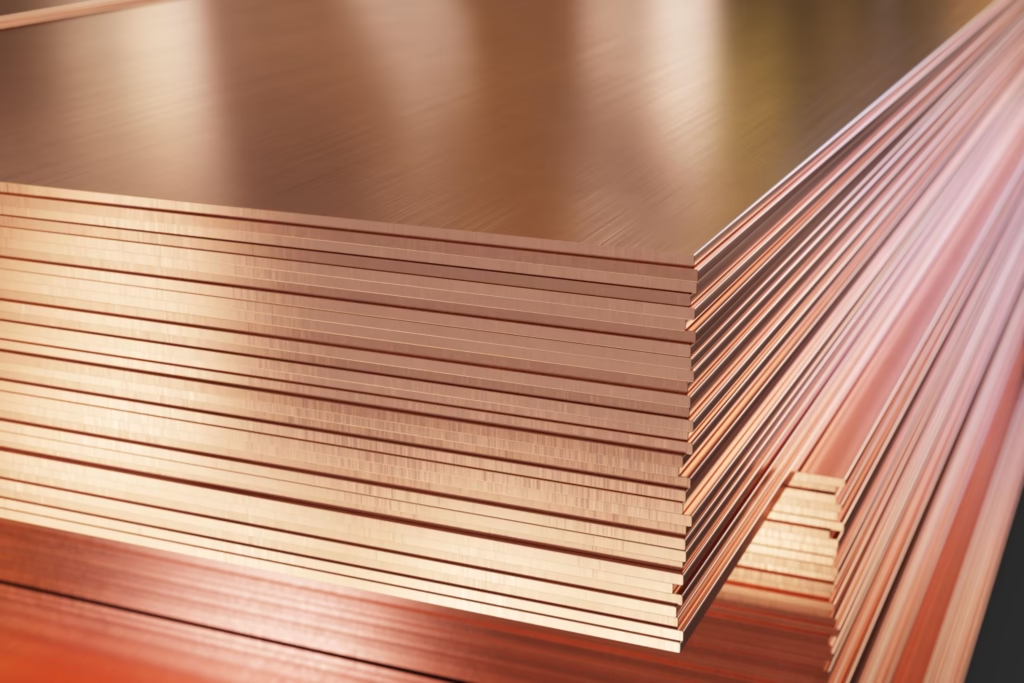
Copper Alloy Plate (Brass / Bronze / Cupronickel)
Copper Alloy Plate in brass (CuZn30/37), phosphor bronze (CuSn5/8), cupronickel (CuNi10/30), beryllium copper (CuBe2), aluminium bronze, and pure copper. Thickness 0.1–50mm, width up to 2,000mm. Multiple tempers from annealed to spring. ASTM B36/B103/B122/B171, EN 1652, JIS H3100 certified. Mill test certificate provided.
| Material | Copper-Zinc / Copper-Tin / Copper-Nickel / Copper-Beryllium Alloy Plate and Sheet |
|---|---|
| Grade / Standard | C26000 (CuZn30) / C27200 (CuZn37) / C46400 (CuZn38Sn Naval Brass) / C51000 (CuSn5) / C52100 (CuSn8) / C70600 (CuNi10) / C71500 (CuNi30) / C17200 (CuBe2) / C11000 (Pure Copper) |
| Thickness | 0.10mm – 50mm (alloy and width dependent) |
| Width | 20mm – 2,000mm (Slit coil or cut sheet, tolerance ±0.1mm) |
| Length | Coil form (thin gauge) / Cut sheet up to 4,000mm / Custom cut-to-size |
| MOQ | 50 kg (Thin Strip) / 500 kg (Standard Plate) |
| Delivery Time | 15-35 Days (Stock) / 25-45 Days (Custom Production) |
| Loading Port | Tianjin / Shanghai / Qingdao |
Overview of Copper Alloy Plate
Copper Alloy Plate encompasses a broad family of flat-rolled plate, sheet, and strip products manufactured from copper-based alloys — including brass (copper-zinc), bronze (copper-tin, copper-aluminium, copper-silicon, copper-beryllium), and cupronickel (copper-nickel) — engineered to deliver the unique combination of excellent electrical and thermal conductivity, outstanding corrosion resistance in marine and industrial environments, good machinability and formability, attractive appearance, and inherent antimicrobial properties that distinguish copper alloys from ferrous metals and make them indispensable across the electrical, marine, architectural, heat exchange, and precision engineering industries. Unlike ferrous plate which relies on alloying for corrosion protection, copper alloys develop a natural protective patina or passive film in most environments that provides self-healing corrosion resistance without additional surface treatment — a fundamental metallurgical advantage that has made copper alloys the material of choice for seawater heat exchanger tubing, marine hardware, electrical contacts, and architectural cladding for thousands of years.
Copper alloy plate and sheet is standardised under ASTM B36 (brass plate, sheet, strip and rolled bar), ASTM B103 (phosphor bronze plate, sheet, strip), ASTM B122 (copper-nickel-tin and copper-nickel-zinc alloy plate, sheet, strip), ASTM B171 (copper alloy plate and sheet for pressure vessels, condensers, and heat exchangers), ASTM B96 (copper-silicon alloy plate, sheet, strip), EN 1652 (copper and copper alloys — plate, sheet, strip and circles for general purposes), JIS H3100 (copper and copper alloy sheets, plates and strips), and GB/T 2040 (copper and copper alloy plate and sheet). Principal grades include C26000 / CuZn30 brass (70/30 cartridge brass — the most formable brass for deep drawing), C27200 / CuZn37 brass (63/37 free-cutting brass for machined components), C51000 / CuSn5 phosphor bronze (for springs and electrical contacts), C70600 / CuNi10Fe1Mn cupronickel (90/10 for seawater heat exchangers), C71500 / CuNi30Mn1Fe (70/30 cupronickel for severe marine service), and C17200 / CuBe2 beryllium copper (for highest-strength copper alloy springs and electrical contacts).
Key Features and Manufacturing Process
Copper alloy plate is produced through a carefully controlled melting, casting, hot rolling, cold rolling, and annealing sequence that achieves the precise combination of composition, grain structure, mechanical properties, and surface finish required for each alloy and application. Production begins with induction or reverberatory furnace melting of the copper alloy, with precise addition of alloying elements (zinc for brass, tin for phosphor bronze, nickel for cupronickel, beryllium for beryllium copper) under controlled atmosphere to prevent oxidation and zinc fuming. The molten alloy is cast as slab by continuous casting or into book moulds, then hot-rolled at alloy-specific temperatures (brass: 750–850°C; cupronickel: 900–1,000°C; phosphor bronze: 750–850°C) to break down the cast structure and achieve intermediate thickness, followed by scalping to remove the oxidised surface layer, then cold-rolled in multiple passes to final gauge with intermediate annealing between cold-rolling stages to restore ductility for continued reduction.
The temper (hardness) of copper alloy plate is controlled by the amount of cold work applied after the final annealing — standardised tempers include annealed (O60/O61 — softest, maximum ductility for deep drawing and severe forming), quarter-hard (H01 — slight work hardening), half-hard (H02), three-quarter hard (H03), hard (H04 — maximum practical cold-rolled hardness for most alloys), extra-hard (H06), and spring temper (H08 — maximum hardness by cold rolling, for contact springs). The relationship between temper and tensile strength is alloy-dependent: C26000 brass ranges from 300 MPa (annealed) to 620 MPa (spring temper); C51000 phosphor bronze ranges from 330 MPa (annealed) to 700 MPa (spring temper); C17200 beryllium copper achieves up to 1,380 MPa (age-hardened). All copper alloy plate and sheet undergoes mandatory chemical composition analysis by ICP or OES spectrometry, mechanical property verification (tensile strength, yield strength, elongation, hardness) per ASTM E8 or equivalent, dimensional inspection of thickness (±0.05–0.15mm tolerance), width, length, and flatness per applicable standard tolerance tables, and surface quality inspection for surface defects including pits, scratches, and seams.
Main Applications of Copper Alloy Plate
Copper alloy plate is the primary raw material for deep-drawn and stamped components in the automotive, electronics, consumer goods, and plumbing industries. Brass (C26000 / CuZn30) plate is the dominant material for deep-drawn cartridge cases for ammunition (the original application giving cartridge brass its name), automotive radiator header plates, plumbing fittings and valve bodies blanks, architectural decorative panels, musical instrument components (bells, tubes, valves), and a broad range of stamped components where the combination of good formability, attractive gold-like appearance, and corrosion resistance is required. Phosphor bronze (C51000 / CuSn5) plate and strip is the primary material for electrical contact springs in connectors, switches, and relays; precision flat springs; musical instrument string components; and bearing and bushing strip for automotive and industrial applications.
Cupronickel (C70600 90/10 Cu-Ni and C71500 70/30 Cu-Ni) plate is the standard material for marine heat exchanger tube sheets, seawater piping flanges, naval vessel hull sheathing, desalination plant components, and offshore oil platform seawater system flanges and valve trim — applications where the excellent resistance to seawater corrosion, biological fouling, and erosion-corrosion under high flow velocity distinguishes cupronickel from stainless steel and standard copper alloys. Naval brass (C46400 / CuZn38Sn) plate is used for marine hardware, propeller shaft components, and seawater valve bodies where dezincification resistance is required. Beryllium copper (C17200 / CuBe2) plate achieves the highest strength of any copper alloy (up to 1,380 MPa after age hardening) for aerospace electrical connectors, precision scientific instruments, oil and gas downhole electrical feed-throughs, and non-sparking tools for explosive environments. Other major applications include architectural copper cladding (pure copper C11000 plate) for building facades, roofing, and guttering developing the traditional green patina; electrical bus bar and power distribution plate from high-conductivity copper (C10100 / C10200 OFC); heat sink plate from high-conductivity copper for electronics thermal management; coin blank plate from various brass and cupronickel alloys; coinage cupro-nickel clad plate for national currency production; and the complete range of precision engineering components in marine, chemical, electrical, and consumer goods applications requiring the unique combination of copper alloy properties.
Why Choose Us for Copper Alloy Plate
Shandong Tanglu Metal Material Co., Ltd. supplies premium Copper Alloy Plate sourced from leading Chinese copper alloy producers including Ningbo Jintian Copper, Chinalco Luoyang Copper, Tongling Nonferrous Metals, and established copper alloy rolling mills with dedicated alloy composition control, continuous casting, and multi-stand cold rolling lines certified to ISO 9001, ISO 14001, ASTM B36 / B103 / B122 / B171, EN 1652, JIS H3100, and GB/T 2040 product standard requirements. Every copper alloy plate and sheet is accompanied by original mill test certificates covering full chemical composition analysis by OES or ICP spectrometry, mechanical property test results (tensile strength, yield strength, elongation) per applicable temper, hardness verification (Vickers or Rockwell), dimensional inspection data (thickness at multiple positions, width, length, flatness), grain size verification for annealed tempers, and complete heat and coil number traceability.
We offer a comprehensive copper alloy plate specification range covering CuZn30 / C26000 (cartridge brass 70/30), CuZn37 / C27200 (yellow brass 63/37), CuZn38Sn / C46400 (naval brass), CuSn5 / C51000 (phosphor bronze 5%), CuSn8 / C52100 (phosphor bronze 8%), CuNi10Fe1Mn / C70600 (cupronickel 90/10), CuNi30Mn1Fe / C71500 (cupronickel 70/30), CuBe2 / C17200 (beryllium copper), CuAl5 / C60800 (aluminium bronze), CuSi3 / C65500 (silicon bronze), and pure copper C11000 / C10200, in thicknesses from 0.1mm to 50mm, widths from 20mm to 2,000mm, in standard tempers from annealed (O) through spring (H08) with custom temper capability. Slit coil, cut sheet, and custom cut-to-size service available. With established monthly supply capacity and export relationships with electronics manufacturers, marine equipment fabricators, architectural cladding companies, ammunition manufacturers, heat exchanger producers, and precision parts makers across more than 50 countries, we support packages from small prototype material orders to large series production supply contracts. Each shipment includes original mill test certificate per EN 10204 3.1, with EN 10204 3.2 and third-party inspection by SGS, Bureau Veritas, or equivalent available for critical marine, aerospace, and electronics applications.
📐 Dimension & Size Table
| Alloy Grade (UNS/EN) | Common Name | Thickness Range (mm) | Width Range (mm) | Standard Temper | Key Properties & Application |
|---|---|---|---|---|---|
| C11000 / CW004A | Electrolytic Tough Pitch Copper | 0.20–25 | Up to 2,000 / Annealed-H02 / Electrical bus bar, architectural roofing, heat sinks | ||
| C10200 / CW008A | Oxygen-Free Copper (OFC) | 0.10–20 | Up to 1,500 / Annealed / Premium electronics, audio, vacuum applications | ||
| C26000 / CW505L | Cartridge Brass (70/30) | 0.10–25 | Up to 2,000 / Annealed–Spring / Deep drawing, ammunition, plumbing, musical instruments | ||
| C27000 / CW507L | Yellow Brass (65/35) | 0.30–20 | Up to 1,500 / Annealed–Hard / General forming, hardware, decorative | ||
| C27200 / CW508L | Yellow Brass (63/37) | 0.30–25 | Up to 2,000 / H02–H04 / Stamping, hinges, locks, architectural | ||
| C28000 / CW509L | Muntz Metal (60/40) | 1.5–50 | Up to 2,000 / Annealed / Heat exchanger plates, condenser plates | ||
| C46400 / CW712R | Naval Brass (60/39/1Sn) | 1.5–50 | Up to 1,500 / Annealed-H02 / Marine hardware, propeller shafts, seawater service | ||
| C51000 / CW451K | Phosphor Bronze 5% (CuSn5) | 0.10–20 | Up to 1,500 / Annealed–Spring / Electrical contacts, springs, bearings, connectors | ||
| C52100 / CW453K | Phosphor Bronze 8% (CuSn8) | 0.10–15 | Up to 1,200 / Annealed–Spring / High-strength springs, heavy-duty contacts | ||
| C60800 / CW301G | Aluminium Bronze 5% (CuAl5) | 0.50–30 | Up to 1,500 / Annealed / Chemical equipment, marine, coinage | ||
| C63000 / CW302G | Aluminium Bronze (CuAl10Ni) | 1.5–50 | Up to 1,500 / Annealed / Seawater, chemical, high-strength marine | ||
| C65500 / CW116C | Silicon Bronze (CuSi3Mn) | 0.50–25 | Up to 1,500 / Annealed-H02 / Chemical vessels, architectural, marine | ||
| C70600 / CW352H | Cupronickel 90/10 (CuNi10) | 0.50–50 | Up to 2,000 / Annealed / Marine heat exchangers, seawater piping, desalination | ||
| C71500 / CW354H | Cupronickel 70/30 (CuNi30) | 0.50–50 | Up to 2,000 / Annealed / Severe marine, naval, offshore, coinage | ||
| C17200 / CW101C | Beryllium Copper (CuBe2) | 0.10–25 | Up to 1,200 / Annealed or Age-HT / Aerospace connectors, springs, non-sparking tools |
* Custom sizes available upon request. Tolerances per relevant international standards.
🔬 Chemical Composition
| Element | Min | Max | Display Value | Note |
|---|---|---|---|---|
| Cu (C26000 Cartridge Brass) | 68.5 | 71.5 | 68.5–71.5 | Per ASTM B36 / EN CW505L — 70/30 brass, best formability of brass family |
| Zn (C26000 Cartridge Brass) | Bal. | - | Balance (~30%) | Zinc provides strength and maintains yellow colour |
| Cu (C51000 Phosphor Bronze) | 94.0 | 96.0 | 94.0–96.0 | Per ASTM B103 / EN CW451K — high copper for electrical conductivity and corrosion resistance |
| Sn (C51000 Phosphor Bronze) | 4.2 | 5.8 | 4.2–5.8 | Tin for strength, fatigue resistance, and spring characteristics |
| P (C51000 Phosphor Bronze) | 0.03 | 0.35 | 0.03–0.35 | Phosphorus deoxidant — improves strength, wear resistance, and spring properties |
| Cu (C70600 Cupronickel 90/10) | Bal. | - | Balance (~88.6%) | Per ASTM B171 / EN CW352H — copper matrix for thermal conductivity and formability |
| Ni (C70600 Cupronickel 90/10) | 9.0 | 11.0 | 9.0–11.0 | Nickel for seawater corrosion resistance and improved erosion resistance |
| Fe (C70600 Cupronickel 90/10) | 1.0 | 1.8 | 1.0–1.8 | Iron critical for erosion-corrosion resistance — distinguishes marine cupronickel from standard Cu-Ni |
| Mn (C70600 Cupronickel 90/10) | 0.5 | 1.0 | 0.5–1.0 | Manganese for deoxidation and improved corrosion resistance |
| Cu (C71500 Cupronickel 70/30) | Bal. | - | Balance (~68%) | Per ASTM B171 / EN CW354H — 70/30 for most demanding marine and naval applications |
| Ni (C71500 Cupronickel 70/30) | 29.0 | 33.0 | 29.0–33.0 | Higher Ni content for superior seawater corrosion and erosion-corrosion resistance vs 90/10 |
| Cu (C17200 Beryllium Copper) | Bal. | - | Balance (~98%) | Per ASTM B194 / EN CW101C — copper base for electrical conductivity |
| Be (C17200 Beryllium Copper) | 1.80 | 2.00 | 1.80–2.00 | Beryllium — age-hardening element providing highest strength of any copper alloy |
| Co+Ni (C17200 Beryllium Copper) | 0.20 | 0.60 | 0.20–0.60 | Cobalt or nickel addition controls grain growth during age hardening |
* Chemical composition may vary by heat, thickness and specification. Please refer to the actual mill test certificate.
⚙️ Mechanical Properties
| Property | Value | Unit | Test Condition |
|---|---|---|---|
| Tensile Strength — C26000 Brass (Annealed / O61) | 300–380 | MPa | Per ASTM B36 — maximum ductility for deep drawing of cartridge cases and complex forms |
| Tensile Strength — C26000 Brass (Half-Hard / H02) | 400–490 | MPa | Per ASTM B36 — general purpose balance of strength and formability |
| Tensile Strength — C26000 Brass (Spring / H08) | 580–680 | MPa | Per ASTM B36 — maximum work-hardened condition |
| Elongation — C26000 Brass (Annealed) | ≥66 | % | Highest elongation of commercial brass grades — enables severe deep drawing |
| Tensile Strength — C51000 Phosphor Bronze (Annealed) | 330–380 | MPa | Per ASTM B103 — annealed for severe forming of spring components |
| Tensile Strength — C51000 Phosphor Bronze (Spring / H08) | 620–760 | MPa | Per ASTM B103 — spring temper for electrical contact springs and precision springs |
| Fatigue Strength — C51000 Phosphor Bronze (H02) | 170–200 | MPa | Endurance limit at 10⁸ cycles — superior fatigue life vs brass for spring applications |
| Tensile Strength — C70600 Cupronickel 90/10 (Annealed) | 300–380 | MPa | Per ASTM B171 — annealed for tube sheet forming and marine fabrication |
| Tensile Strength — C71500 Cupronickel 70/30 (Annealed) | 380–480 | MPa | Per ASTM B171 — higher strength than 90/10 for naval and offshore pressure applications |
| Tensile Strength — C17200 Beryllium Copper (Annealed) | 415–540 | MPa | Per ASTM B194 / EN CW101C — annealed condition for forming before age hardening |
| Tensile Strength — C17200 Beryllium Copper (Age-Hardened TH04) | 1,140–1,380 | MPa | After cold rolling to H04 + age hardening at 315°C — highest strength copper alloy |
| Electrical Conductivity — C11000 Copper | ≥100 | % IACS | Electrolytic Tough Pitch copper — reference standard for electrical conductivity |
| Electrical Conductivity — C26000 Brass (Annealed) | 27–28 | % IACS | Reduced conductivity vs pure copper due to zinc solid solution scattering |
| Electrical Conductivity — C70600 Cupronickel 90/10 | ~9 | % IACS | Low conductivity — cupronickel selected for corrosion resistance not conductivity |
| Thermal Conductivity — C70600 Cupronickel 90/10 | 40–45 | W/m·K | At room temperature — adequate for heat exchanger service with seawater corrosion resistance |
* Values shown are minimum requirements unless otherwise stated.
📦 Commercial Information
| Packaging | Standard seaworthy export packing for copper alloy plate and sheet. Thin-gauge sheet and strip coils (thickness below 3mm) wrapped with anti-tarnish interleaving paper (BTA benzotriazole-treated paper) between each sheet or between coil wraps to prevent atmospheric tarnishing and surface staining of the copper alloy surface during ocean transit and storage — copper alloys are susceptible to tarnish from atmospheric moisture, sulfur compounds, and chlorides which can occur even during short ocean transit times without adequate protection. Individual sheets stacked with anti-tarnish tissue paper separators between each plate, then the full stack wrapped with moisture-barrier polyethylene film and secured with PE-coated steel strapping on timber export pallets (ISPM-15 heat-treated). Thicker plate (above 6mm) individually wrapped on all faces with PE stretch film and edge protection cardboard corner guards, then palletised with wooden dunnage separators. For bright or polished surface copper alloy plate (common for decorative and architectural applications), additional bubble wrap layer inside anti-tarnish paper prevents surface scratch damage from vibration during ocean transit. Beryllium copper plate (C17200) packed with additional biohazard labelling per OSHA and international transport regulations — machining and grinding of beryllium copper generates toxic beryllium dust requiring respiratory protection; safety data sheet (SDS) included with every beryllium copper shipment. Each plate or bundle tagged with alloy designation (C26000, C70600, etc.), EN designation (CW505L, CW352H, etc.), UNS number, temper designation (H02, O61, etc.), thickness × width × length (mm), weight (kg), applicable standard (ASTM B36, EN 1652, etc.), and heat number. Desiccant sachets placed inside PE film wrap. For architectural copper cladding plate (C11000 pure copper), protective peel-off polyethylene film laminated to one or both faces prevents surface scratch during installation handling. |
|---|---|
| Payment Terms | T/T (Telegraphic Transfer),L/C (Letter of Credit),D/P (Documents against Payment),Western Union,PayPal |
| Price Term | FOB,CFR,CIF,EXW |
| Supply Capacity | 500 Tons/Month (Copper Alloy Plate and Sheet) |
| Loading Port | Tianjin / Shanghai / Qingdao |
Why Choose Our Copper Alloy Plate (Brass / Bronze / Cupronickel)?
Mill Certified Copper Alloy Quality
Copper alloy plate supplied with original mill test certificate EN 10204 3.1/3.2 covering full OES/ICP chemical composition of all principal alloying elements and impurities, mechanical properties (tensile strength, yield strength, elongation) per applicable temper, hardness (Vickers/Rockwell), grain size for annealed tempers, dimensional inspection at multiple positions, and complete heat and coil/plate number traceability per ASTM B36/B103/B122/B171, EN 1652, JIS H3100.
Comprehensive Alloy, Temper & Size Range
Full copper alloy plate range: cartridge brass C26000, yellow brass C27200, naval brass C46400, phosphor bronze C51000/C52100, cupronickel C70600/C71500, aluminium bronze C60800/C63000, silicon bronze C65500, beryllium copper C17200, and pure copper C11000/C10200. Thickness 0.10–50mm, width up to 2,000mm. Full temper range from annealed (O) to spring (H08).
Inherent Corrosion Resistance & Biofouling Resistance
Cupronickel 90/10 (C70600) resists seawater erosion-corrosion at flow velocities up to 3 m/s, outperforming stainless steel in biofouling resistance — marine organisms do not readily colonise cupronickel surfaces, reducing heat exchanger maintenance. Phosphor bronze provides fatigue life 5–10× longer than brass at equivalent stress amplitude. Beryllium copper achieves 1,380 MPa strength — highest of any copper alloy — with maintained electrical conductivity.
Multi-Standard International Grade Coverage
Available per ASTM B36/B103/B122/B171/B194 (American), EN 1652/EN 13601 (European CW designations), JIS H3100/H3110 (Japanese), and GB/T 2040 (Chinese) standards. ASME SB-series pressure vessel equivalents for marine and pressure equipment. Custom temper, custom width slit coil, and custom alloy composition available for OEM specifications.
Stock Availability & Custom Processing
Common grades (C26000, C70600, C71500, C51000) in standard thicknesses and tempers from stock: 15–25 days dispatch. Custom slit widths from stock coil: 7–12 working days. Custom temper and non-standard alloys: 25–40 days production. Anti-tarnish packaging standard for all copper alloy plate exports. Container loading 15–20 tons per 20FT FCL.
🏭 Applications of Copper Alloy Plate (Brass / Bronze / Cupronickel)
Copper alloy plate serves as the essential flat raw material across a remarkably diverse spectrum of industries exploiting the unique combination of properties — high electrical and thermal conductivity, excellent corrosion resistance in aqueous and marine environments, antimicrobial surface properties, good formability and machinability, and attractive natural colour — that copper alloys uniquely provide. Brass plate — particularly C26000 / CuZn30 cartridge brass in annealed temper — is the dominant material for deep-drawn ammunition cartridge case production (the original application giving the alloy its 'cartridge brass' name), where the exceptional ductility (elongation ≥66% annealed) enables cup-drawing and redrawing of cartridge case blanks through multiple forming passes without intermediate annealing, producing the precise dimensional tolerances and wall thickness gradients of rifle and pistol cartridge cases. The same cartridge brass is used for deep-drawn plumbing fitting blanks, water meter body blanks, automotive radiator header plate pressings, musical instrument bell and tube blanks (trumpets, French horns, trombones, tubas), clock and watch component blanks, precision instrument housing pressings, and decorative architectural panels and trim elements in hotels, commercial interiors, and public transport facilities. Cupronickel plate — particularly C70600 (90/10 cupronickel) and C71500 (70/30 cupronickel) per ASTM B171 — is the standard material for marine heat exchanger tube sheets, with the characteristic combination of excellent seawater corrosion resistance (near-zero corrosion rate in clean seawater), high resistance to velocity-accelerated erosion-corrosion at tube inlet velocities, inherent resistance to biofouling (marine organisms do not readily attach to cupronickel surfaces releasing cupric ions toxic to marine life), and good thermal conductivity making cupronickel tube sheets the preferred material for naval vessel condensers, offshore platform seawater coolers, desalination plant heat exchangers, coastal power station condenser tube sheets, and yacht and cruise ship central cooling system heat exchangers. C71500 (70/30 cupronickel) with higher nickel content provides superior performance in highly turbulent seawater and brackish water at elevated temperatures, and is the standard material for naval warship heat exchanger tube sheets where highest reliability and service life are mandatory. Phosphor bronze plate (C51000 / CuSn5 and C52100 / CuSn8) in hard and spring tempers is the foundational material for electrical contact spring production in the connector, switch, relay, and terminal block industries — the combination of high electrical conductivity (15–20% IACS), excellent spring properties (high fatigue life under repeated flexing), good formability in annealed condition for progressive die stamping of complex contact geometries, and resistance to stress relaxation under sustained deflection at operating temperatures up to 150°C makes phosphor bronze the dominant material for PCB connector contacts, automotive electrical connector terminals, telephone handset coil springs, relay armature springs, and precision switch contact springs produced in billions of pieces annually from slit phosphor bronze strip. Aluminium bronze plate (C60800 / CuAl5 and C63000 / CuAl10Ni) provides the highest seawater corrosion and erosion resistance of any copper alloy, combined with tensile strength approaching medium-strength steel, for applications including marine propeller blade blanks (large diameter, forged from bar or plate then machined to hydrofoil profile), naval vessel sonar dome structural plates, seawater valve body blanks, pump impeller blanks for seawater and desalination duty, and offshore oil platform structural attachments in the splash zone requiring the combination of structural strength and seawater corrosion resistance that neither cupronickel nor stainless steel provides in splash zone conditions. Beryllium copper plate (C17200 / CuBe2) in age-hardened condition achieves tensile strength of 1,140–1,380 MPa — the highest of any copper alloy — with maintained electrical conductivity of 22–28% IACS, making it the mandatory material for aerospace electrical connector contact pins where the combination of high contact normal force (requiring high spring strength), low contact resistance (requiring adequate electrical conductivity), resistance to stress relaxation at operating temperatures up to 200°C, and the non-magnetic and non-sparking properties are simultaneously required. Silicon bronze plate (C65500 / CuSi3Mn) provides excellent corrosion resistance comparable to copper in most environments combined with higher tensile strength than pure copper, for applications in architectural hardware, chemical process equipment, marine hardware, and artistic sculpture where the bronze casting-like appearance and atmospheric corrosion resistance (developing an attractive green patina) are valued. Pure copper plate (C11000 electrolytic tough pitch copper) is used for architectural cladding and roofing systems that develop the traditional green verdigris patina characteristic of historic copper-clad buildings, electrical bus bar systems for power distribution in substations and industrial facilities, heat sink plates for high-power electronics thermal management, lightning protection conductor plates, chemical process equipment contact surfaces where the antimicrobial properties of copper are advantageous in food and pharmaceutical processing, and the full range of electrical and architectural applications where maximum electrical or thermal conductivity combined with natural copper corrosion resistance is required.
📋 Quality & Certification
Our Certifications
- ✅ ISO 9001:2015
- ✅ CE Marking
- ✅ ABS
- ✅ DNV GL
- ✅ Lloyd's Register (LR)
- ✅ Bureau Veritas (BV)
- ✅ SGS Certified
- ✅ NK
- ✅ RINA
Mill Certificate Type
- 📋 EN 10204 3.1
- 📋 EN 10204 3.2
- 📋 Original Mill Certificate
- 📋 Third Party Inspection Available
- 📋 Certificate of Origin
❓ Frequently Asked Questions
What are the main types of copper alloy plate and how do I choose the right one?
Copper alloy plate encompasses several distinct alloy families, each optimised for specific property combinations. The main types are: Brass (Copper-Zinc alloys, Cu 60–90%, Zn 10–40%) — the largest volume copper alloy family, offering the best formability and lowest cost among copper alloys. C26000 / CuZn30 (70/30 cartridge brass) has the highest ductility for deep drawing; C27200 / CuZn37 (63/37 yellow brass) balances formability and strength for stamped hardware; C46400 naval brass (60/39/1Sn) provides dezincification resistance for marine service. Phosphor Bronze (Copper-Tin alloys with phosphorus, Cu 92–96%, Sn 4–8%, P 0.03–0.35%) — selected for electrical contact springs and precision springs where superior fatigue life, good electrical conductivity, and resistance to stress relaxation under sustained deflection are required. C51000 / CuSn5 is the standard spring contact material; C52100 / CuSn8 provides higher strength for heavy-duty contacts. Cupronickel (Copper-Nickel alloys, Cu 70–90%, Ni 10–30%) — mandatory for marine seawater service due to outstanding resistance to seawater corrosion, biofouling, and erosion-corrosion. C70600 (90/10) for standard marine heat exchangers; C71500 (70/30) for naval and severe marine service. Aluminium Bronze (Copper-Aluminium alloys, Cu 85–95%, Al 5–10%) — highest strength and seawater erosion resistance of any copper alloy; selected for propellers, marine pumps, and splash zone structural applications. Silicon Bronze (Copper-Silicon alloys, Cu ~97%, Si 3%) — architectural and chemical equipment where atmospheric corrosion resistance and workability are required. Beryllium Copper (C17200, Cu ~98%, Be 1.8–2.0%) — highest strength copper alloy (up to 1,380 MPa age-hardened) for aerospace connectors, non-sparking tools, and precision springs where maximum mechanical performance is required. Selection criteria: seawater service → cupronickel or aluminium bronze; electrical contact springs → phosphor bronze; deep forming → C26000 brass; maximum strength → beryllium copper; architectural/decorative → brass or pure copper; chemical corrosion resistance → silicon bronze or aluminium bronze.
What is the difference between cupronickel 90/10 (C70600) and 70/30 (C71500) for marine heat exchanger applications?
Cupronickel 90/10 (C70600, UNS N/A — copper alloy not nickel alloy, EN CW352H) and 70/30 (C71500, EN CW354H) are both copper-nickel alloys widely used in marine heat exchanger applications, differing primarily in nickel content, mechanical properties, and the severity of service environment for which each is optimal. Cupronickel 90/10 (C70600) contains approximately 88–90% copper, 9–11% nickel, 1.0–1.8% iron (critical element for erosion-corrosion resistance), and 0.5–1.0% manganese. It provides excellent seawater corrosion resistance with corrosion rate typically less than 0.025 mm/year in clean seawater, acceptable erosion-corrosion resistance at tube velocities up to 3 m/s, inherent biofouling resistance, and good thermal conductivity (40–45 W/m·K) suitable for heat exchanger service. C70600 is the standard and most economical cupronickel grade for the majority of marine heat exchanger tube sheets, seawater piping flanges, and general marine service components where service conditions are normal (clean seawater, moderate velocity, operating temperatures below 100°C). Cupronickel 70/30 (C71500) contains approximately 67–70% copper, 29–33% nickel, 0.4–1.0% iron, and 0.5–1.0% manganese. The higher nickel content provides superior corrosion resistance in polluted seawater (containing sulfides, ammonia, or other contaminants that aggressively attack 90/10), higher resistance to velocity-accelerated erosion-corrosion (serviceable up to 4–5 m/s tube velocity), better performance in hot seawater applications above 60°C, superior resistance to impingement corrosion at tube inlets, and higher tensile strength (380–480 MPa annealed vs 300–380 MPa for 90/10) enabling thinner tube sheet design for the same pressure rating. C71500 is specified for naval warship heat exchangers where reliability and service life demands are highest, offshore platform seawater coolers in service environments with contaminated seawater, high-velocity seawater applications (condenser water boxes at inlet velocities above 3 m/s), desalination plant components in hot brine service above 60°C, and premium marine heat exchanger applications where extended service life justifies the approximately 25–40% material cost premium of C71500 over C70600. For most commercial marine applications including yacht cooling systems, commercial vessel condensers, and coastal power plant condensers in clean seawater, C70600 (90/10) provides fully adequate service life at lower cost.
What temper designation should I specify for copper alloy plate, and how does it affect properties?
Copper alloy plate temper designations follow the ASTM B601 system for wrought copper alloys, specifying the degree of cold working (for cold-worked tempers) or heat treatment condition (for annealed tempers). The standard temper designations and their properties are: Annealed Tempers — O60 (Soft Annealed, grain size 0.035mm), O61 (Annealed, grain size to ASTM B601 specification) — the softest possible condition achieved by recrystallisation annealing after cold rolling. Provides maximum ductility and minimum hardness for severe forming operations including deep drawing, spinning, and complex three-dimensional forming. For C26000 brass O61: tensile ~300 MPa, elongation ≥66%. Mandatory for cartridge case drawing, musical instrument tubes, and complex vessel head forming. Quarter-Hard (H01) — 10.9% cold work above O61, providing slightly increased strength with maintained good formability. Half-Hard (H02) — 20.7% cold work — the most widely used general-purpose temper for most copper alloy plate applications, balancing adequate strength (C26000: ~400 MPa) with good formability for moderate bending and forming. Suitable for architectural sheet, plumbing component blanks, heat exchanger parts, and stamped hardware. Three-Quarter Hard (H03) — 29.4% cold work — increasing stiffness for structural and spring applications. Hard (H04) — 37.1% cold work — highest strength for most alloys before spring temper, suitable for parts requiring minimal deflection under load. Extra-Hard (H06) — 50% cold work — approaching spring temper properties. Spring Temper (H08) — 60.5% cold work — maximum work hardening achievable by cold rolling, providing maximum tensile strength and elastic limit for contact spring applications. For C51000 phosphor bronze H08: tensile 620–760 MPa, elastic limit 550–700 MPa. Used for electrical contact springs, connectors, and precision instrument springs. When specifying, consider: maximum forming requirement → annealed (O61); general purpose → half-hard (H02); maximum strength without heat treatment → spring (H08); beryllium copper maximum strength → solution annealed + cold roll H04 + age-harden (TH04 designation) achieving 1,140–1,380 MPa. Always specify both alloy designation (e.g., C26000) and temper (e.g., H02) when ordering copper alloy plate to receive the correct combination of properties.
What is beryllium copper plate and what safety precautions are required when handling it?
Beryllium copper (C17200 / CuBe2 / UNS C17200, EN CW101C) is a precipitation-hardening copper alloy containing approximately 98% copper, 1.8–2.0% beryllium, and 0.2–0.6% cobalt or nickel, capable of achieving the highest tensile strength of any standard copper alloy — up to 1,380 MPa after cold rolling to H04 temper and age hardening at 315°C for 2–3 hours — while maintaining electrical conductivity of 22–28% IACS (versus 100% IACS for pure copper). This unique combination of very high strength and acceptable electrical conductivity, combined with high fatigue strength, non-magnetic properties, non-sparking characteristics (critical for explosive environment tools), and good thermal conductivity, makes beryllium copper the mandatory material for: aerospace electrical connector contact pins requiring maximum spring force and minimum contact resistance in compact connector bodies; precision scientific instrument components including X-ray equipment components and synchrotron radiation windows (beryllium has very low X-ray absorption); oil and gas downhole electrical feed-throughs in high-pressure well completions; non-sparking hand tools (wrenches, hammers, chisels) for use in explosive environments including petroleum refineries, grain elevators, and chemical plants; and precision clockwork and instrument spring components requiring maximum elastic energy storage. Critical safety information: beryllium and beryllium-containing alloys are regulated as hazardous materials because inhalation of beryllium dust, fumes, or fine particles can cause Chronic Beryllium Disease (CBD) — a potentially fatal lung condition — and lung cancer. Solid beryllium copper plate presents essentially no hazard in its as-supplied condition as beryllium is tightly bound in the alloy matrix and no beryllium is released from smooth solid surfaces during normal handling. The hazard arises during machining, grinding, cutting, welding, or abrading operations that generate fine airborne beryllium copper dust or fumes. Required safety controls for beryllium copper machining: local exhaust ventilation (LEV) capturing dust at the point of generation; HEPA-filtered respiratory protection (minimum P100 respirator for dry machining); wet machining with coolant flooding to suppress dust generation whenever possible; engineering controls including dedicated enclosed machining areas with negative pressure ventilation for beryllium copper processing; HEPA vacuum cleaning of machined areas (never sweep or blow with compressed air); worker medical surveillance including beryllium lymphocyte proliferation test (BeLPT) baseline and periodic testing per OSHA 29 CFR 1910.1024 Beryllium Standard. The SDS (Safety Data Sheet) for beryllium copper is provided with every shipment and must be reviewed before any machining operations.
How is copper alloy plate used for architectural cladding and what grades are specified?
Copper alloy plate for architectural cladding and roofing is one of the oldest and most enduring applications of copper in construction, spanning from ancient temple roofs through medieval cathedral spires to contemporary building facades, where the characteristic colour transformation from bright metallic copper through brown to the traditional blue-green verdigris patina provides an aesthetically unique building envelope material with a service life exceeding 100 years without structural maintenance. The principal grades and their architectural applications are: Electrolytic Tough Pitch Copper (C11000 / EN CW004A, ≥99.9% Cu) is the standard architectural copper in thicknesses of 0.5–3.0mm for standing seam roofing systems, copper rainwater goods (gutters, downpipes, flashings), copper fascia panels, column cladding, and dome structures in classical and contemporary architectural applications. The alloy develops the natural protective patina sequence: new copper (reddish-orange metallic) → after 1–3 years exposure brown oxide (cuprous oxide, Cu₂O) → after 10–30 years green patina (basic copper sulfate, Cu₄SO₄(OH)₆, in urban and industrial atmospheres) or blue-green basic copper chloride (in marine coastal atmospheres). Phosphorus Deoxidised Copper (C12200 / EN CW024A) is the preferred grade for copper roofing where soldering and brazing of seam joints will be used, as the very low oxygen content (unlike C11000) prevents porosity in soldered joints. Pre-patinated Copper plate is produced by controlled chemical treatment of C11000 copper to accelerate the natural patina development, providing the aged green-brown colour from new installation — used by architects specifying traditional patina appearance without the 15–30 year natural weathering period. Nordic Green, Nordic Brown, Nordic Turquoise, and Nordic Royal are proprietary pre-patinated copper surface finishes developed by Aurubis for immediate green, brown, turquoise, and gold-coloured architectural copper cladding. Architectural Brass in CuZn30 (C26000) or CuZn37 (C27200) in thicknesses of 1.0–6.0mm provides a rich gold-coloured appearance for hotel lobbies, retail shopfronts, elevator cabs, decorative wall panels, and door and window frames — the zinc content shifts the colour from reddish copper toward golden yellow. Architectural bronze (technically brass CuZn15Sn in most applications despite the traditional name 'bronze') provides darker, more reddish-brown appearance used for memorial plaques, door and window frames, handrails, and decorative column bases in institutional and monumental buildings. Specification considerations for architectural copper cladding: minimum thickness 0.5mm for vertical wall cladding, 0.6mm for low-slope roofing, 0.7–0.8mm for standing seam steep-slope roofing systems; pre-weathered or bare copper — client's preference for installation appearance; temper H01 or H02 for roofing and cladding (softer than hard temper to allow field bending at seams without cracking); EN 504 (copper for roofing and cladding) compliance for European projects; installation by specialist copper roofing contractors familiar with thermal expansion allowances (coefficient of thermal expansion 17×10⁻⁶/°C requiring expansion provision in panel designs).
Get a Quote for
Copper Alloy Plate (Brass / Bronze / Cupronickel)
Submit your requirements and receive a competitive price quote within 24 hours.
- ✓ Fast response within 24 hours
- ✓ Competitive factory-direct pricing
- ✓ Free technical consultation
- ✓ Mill test certificate provided
- ✓ Flexible payment terms available
⏱ Response within 24 hours
Send Your Inquiry
All fields marked with * are required