
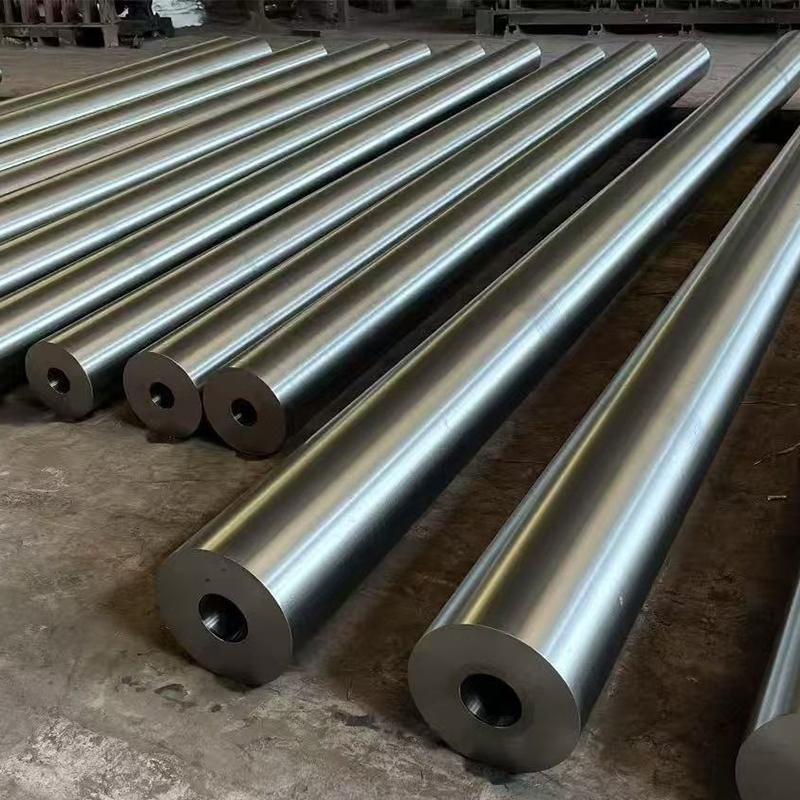
High Speed Steel (HSS)
High Speed Steel (HSS) is highly alloyed tungsten-molybdenum-chromium-vanadium tool steel retaining HRC 62–70 hardness and cutting ability at 500–600°C service temperature. M2 / M35 / M42 / T1 / W6Mo5Cr4V2 grades. Round bar 1–300mm, flat bar, ground flat stock. Ingot metallurgy (IM) and powder metallurgy (PM) available. Mill test certificate provided.
| Material | High Alloy Tungsten-Molybdenum Series Tool Steel (High Speed Steel) |
|---|---|
| Grade / Standard | AISI M2 / M35 / M42 / M4 / T1 / T15 / JIS SKH51 / SKH55 / SKH57 / GB W6Mo5Cr4V2 / W18Cr4V / W2Mo9Cr4VCo8 / DIN 1.3343 / 1.3243 / 1.3247 |
| Diameter | Round Bar: 1mm – 300mm dia / Flat Bar: 3–200mm thick × 10–300mm wide / Ground Flat Stock: precision ground h6/h7 |
| Length | 1m / 2m / 3m standard lengths (Cut-to-length service available) |
| Delivery Condition | as_rolled |
| Surface Treatment | coated |
| MOQ | 10 kg (Small Diameter Bar) / 100 kg (Standard Bar Stock) |
| Delivery Time | 10-25 Days (Stock) / 25-40 Days (Custom Production) |
| Loading Port | Tianjin / Shanghai / Qingdao |
Overview of High Speed Steel (HSS)
High Speed Steel (HSS) is a sophisticated category of highly alloyed tool steel specifically engineered to retain its hardness, cutting edge sharpness, and wear resistance at the elevated temperatures generated during high-speed metal cutting operations — temperatures at which conventional carbon and alloy tool steels rapidly soften and lose their cutting capability. The defining characteristic that distinguishes HSS from all other tool steel categories is its exceptional hot hardness retention: after heat treatment to HRC 62–70, HSS maintains effective cutting hardness of HRC 50–55 at temperatures of 500–600°C generated at the tool-workpiece interface during machining at high cutting speeds, enabling continuous metal removal at cutting speeds 2–4 times faster than the best carbon tool steels. This revolutionary capability — first demonstrated by Frederick Winslow Taylor and Maunsel White at Bethlehem Steel in 1900 — fundamentally transformed manufacturing productivity and established HSS as the foundation material for the global cutting tool industry that it remains today alongside cemented carbide.
High Speed Steel is standardised under AISI / SAE (American), JIS G4403 (Japanese), DIN EN ISO 4957 (European), and GB/T 9943 (Chinese) standards, with two principal alloying families: tungsten-series HSS represented by T1 (18% W, the original Taylor-White grade), T4, T5, and T15, and molybdenum-series HSS represented by M1, M2 (the dominant global grade), M3, M4, M7, M35, M42, and M48. Tungsten-series grades dominated HSS production until the 1940s when the molybdenum series — offering equivalent or superior performance at significantly lower raw material cost due to the molybdenum-to-tungsten substitution ratio of approximately 1:2 by weight — became the commercial standard. Today, M2 (tungsten-molybdenum balanced grade) accounts for over 60% of global HSS production and serves as the universal benchmark for cutting tool performance, while M42 (cobalt-alloyed premium grade) represents the highest-performance conventional HSS for machining difficult-to-cut materials including hardened steels, nickel superalloys, titanium alloys, and stainless steels. Chinese grades W18Cr4V (equivalent to T1), W6Mo5Cr4V2 (equivalent to M2), and W2Mo9Cr4VCo8 (equivalent to M42) follow the same alloy families under GB/T 9943 standardisation.
Key Features and Manufacturing Process
High Speed Steel derives its exceptional cutting performance from a precisely engineered alloy system containing multiple carbide-forming elements — tungsten (W), molybdenum (Mo), chromium (Cr), and vanadium (V) — in carefully balanced proportions that produce a high volume fraction (15–25% by volume) of extremely hard alloy carbides (MC-type vanadium carbides with hardness ~2800 HV, M6C-type tungsten-molybdenum carbides with hardness ~1600 HV, and M23C6-type chromium carbides) dispersed throughout a tempered martensitic matrix. This carbide microstructure provides the wear-resistant skeleton that resists abrasive wear at the cutting edge, while the cobalt additions in premium grades (M35 with 5% Co, M42 with 8% Co) dissolve in the matrix to raise the matrix solidus temperature, inhibiting carbide coarsening and dislocation movement at elevated service temperatures — the metallurgical mechanism responsible for the superior hot hardness of cobalt-alloyed HSS over standard M2.
HSS is produced through two manufacturing routes with distinctly different microstructural quality levels. Conventional melting and casting (ingot metallurgy, IM) involves electric arc furnace melting, vacuum degassing, ingot casting, and extensive hot working (forging ratio typically 6:1 to 10:1) to break down the coarse as-cast carbide network — a critical requirement as HSS solidifies with an interconnected eutectic carbide network that causes brittleness if not fully broken down by forging. The resulting IM-HSS has non-uniform carbide distribution with visible carbide banding in large cross-sections, limiting tool performance in demanding applications. Powder metallurgy HSS (PM-HSS) is produced by gas or water atomisation of the molten HSS alloy into fine powder particles (10–150μm diameter), each particle solidifying as a tiny independent ingot with fine, uniformly distributed carbides, followed by hot isostatic pressing (HIP) or hot extrusion consolidation to produce a fully dense billet with an isotropic, extremely fine and uniform carbide distribution (carbide size 1–5μm vs 20–60μm in IM-HSS). PM-HSS delivers substantially improved toughness, grindability, and wear resistance compared to IM-HSS of the same nominal composition, and enables production of high-vanadium compositions (M3/2, M4, CPM grades with V 3–5%) that are impractical to produce by conventional ingot metallurgy due to the severe segregation of vanadium carbides during solidification.
Main Applications of High Speed Steel
High Speed Steel is the foundational material for general-purpose metal cutting tools across the complete spectrum of machining operations. Twist drills represent the largest single HSS application by quantity, with M2 HSS twist drills used universally for drilling steel, cast iron, aluminium, copper alloys, and plastics in jobbing, production, and assembly environments — from precision micro-drills of 0.1mm diameter for PCB drilling through heavy-duty straight-shank and taper-shank drills up to 80mm diameter for structural steel fabrication. Taps and thread-forming tools for internal thread production in through-holes and blind holes in all engineering materials account for another major HSS application, with M2 for standard threading of carbon and alloy steels and M35 / M42 cobalt grades for stainless steel, titanium, and nickel alloy threading. Milling cutters including end mills, slot drills, face mills, form cutters, and gear cutters in HSS provide economical metal removal in general machining centres and manual milling machines where the higher brittleness of cemented carbide at interrupted cuts, complex profiles, or variable workpiece hardness makes HSS the more practical choice.
Gear cutting tools represent a technically demanding and high-value HSS application — gear hobbing cutters, gear shaping cutters, gear shaving cutters, and bevel gear generators for automotive transmission gears, industrial gearbox components, and precision instrument gears are almost exclusively manufactured from premium PM-HSS grades (M35, M42, ASP2030, ASP2060) or conventional M2 HSS, where the combination of sharp edge retention, toughness to withstand interrupted cutting across gear tooth profiles, and freedom from carbide-induced premature tool fracture makes HSS technically and commercially superior to carbide for most gear tooth generation applications. Broaching tools for internal splines, keyways, and shaped holes in automotive components and power transmission parts use M2 and M42 HSS for the combination of sharp edges, toughness against the high broaching forces, and the complex tooth profile geometry that HSS accommodates through grinding. Other major applications include reamers for precision hole finishing, counterbores and countersinks, form tools for screw machine production, parting and grooving tools for automatic screw machine production, woodworking circular saw blades and planer knives, band saw blades for metal cutting, hacksaw blades, metal cutting circular saw blades for structural steel fabrication, cold forming rolls, thread rolling dies, burnishing tools, and the complete range of precision cutting, forming, and finishing tools used across the metalworking, woodworking, plastics processing, and food processing industries.
Why Choose Us for High Speed Steel
Shandong Tanglu Metal Material Co., Ltd. supplies premium High Speed Steel sourced from major Chinese specialty steel mills with proven international export credentials including Fushun Special Steel, Baosteel Special Steel, and Tiangong International — China’s largest dedicated HSS producer and a major global HSS supplier — alongside internationally branded grades from established European and Japanese producers for projects requiring specific brand specifications. Every HSS batch undergoes mandatory chemical composition analysis by optical emission spectrometry with full quantitative reporting of all alloying elements (W, Mo, Cr, V, Co, C, Si, Mn), hardness verification at multiple cross-section positions in annealed and hardened condition, ultrasonic testing per EN 10228-3 for round bar and flat bar stock, grain size assessment per ASTM E112, carbide distribution uniformity inspection per GB/T 9943 or equivalent, dimensional inspection to applicable tolerance standards, and decarbsurisation depth measurement for products intended for direct tool manufacture without significant surface stock removal.
We offer a comprehensive HSS product range covering M2 (the universal general-purpose grade), M35 (5% cobalt for improved hot hardness), M42 (8% cobalt premium grade for difficult materials), M4 (high-vanadium wear-resistant grade), T1 (original tungsten grade), T15 (ultra-high vanadium cobalt grade), and Chinese equivalent grades W6Mo5Cr4V2, W18Cr4V, W2Mo9Cr4VCo8 in round bar (diameter 1mm to 300mm), flat bar, plate, and ground flat stock (precision ground to h6/h7 tolerance for direct tool production). Both conventional ingot metallurgy (IM) and powder metallurgy (PM-HSS / ASP grades) available for each major composition. Standard lengths 1m, 2m, 3m, and cut-to-length service for production tool making. With established monthly supply capacity and export relationships with cutting tool manufacturers, drill and tap producers, gear cutting tool makers, saw blade manufacturers, and precision tool grinding shops across more than 50 countries, we support both small prototype tool orders and large series production raw material supply contracts. Each shipment includes original mill test certificate per EN 10204 3.1, with EN 10204 3.2, hardness survey data, decarburisation depth report, and third-party inspection by SGS, Bureau Veritas, or TUV available for critical tool production quality requirements.
📐 Dimension & Size Table
| Grade (AISI / GB) | JIS Equivalent | DIN Equivalent | W (%) | Mo (%) | Co (%) | V (%) | Hardness After HT (HRC) |
|---|---|---|---|---|---|---|---|
| M2 / W6Mo5Cr4V2 | SKH51 | 1.3343 (HS6-5-2) | 6.0 / 5.0 / — / 2.0 / 62–65 | ||||
| M3/1 / W6Mo5Cr4V3 | SKH52 | 1.3344 (HS6-5-3) | 6.0 / 5.0 / — / 3.0 / 64–66 | ||||
| M3/2 / W6Mo5Cr4V3 | SKH53 | 1.3344 variant | 6.0 / 5.0 / — / 3.0 / 65–67 | ||||
| M4 / W6Mo5Cr4V4 | SKH54 | 1.3348 (HS6-5-4) | 5.5 / 4.5 / — / 4.0 / 65–67 | ||||
| M7 / W1.75Mo9Cr4V2 | — | — | 1.75 / 9.5 / — / 2.0 / 65–67 | ||||
| M35 / W6Mo5Cr4V2Co5 | SKH55 | 1.3243 (HS6-5-2-5) | 6.0 / 5.0 / 5.0 / 2.0 / 65–67 | ||||
| M42 / W2Mo9Cr4VCo8 | SKH57 | 1.3247 (HS2-9-1-8) | 1.5 / 9.5 / 8.0 / 1.15 / 67–70 | ||||
| M48 / W1.5Mo12Cr4V2Co8 | — | — | 1.5 / 12.0 / 8.0 / 2.0 / 68–70 | ||||
| T1 / W18Cr4V | SKH2 | 1.3355 (HS18-0-1) | 18.0 / — / — / 1.0 / 63–65 | ||||
| T4 / W18Cr4VCo5 | SKH3 | 1.3255 (HS18-1-2-5) | 18.0 / — / 5.0 / 2.0 / 65–67 | ||||
| T5 / W18Cr4VCo8 | SKH4 | 1.3265 (HS18-1-2-10) | 18.0 / — / 8.0 / 2.0 / 66–68 | ||||
| T15 / W12Mo3Cr4V3Co5 | SKH10 | 1.3202 (HS12-1-4-5) | 12.0 / 3.5 / 5.0 / 5.0 / 66–68 |
* Custom sizes available upon request. Tolerances per relevant international standards.
🔬 Chemical Composition
| Element | Min | Max | Display Value | Note |
|---|---|---|---|---|
| C | 0.78 | 0.88 | 0.78–0.88 | M2 / W6Mo5Cr4V2 — sufficient C to form carbides with W, Mo, Cr, V while leaving adequate C in matrix for martensite hardness |
| Si | 0.20 | 0.45 | 0.20–0.45 | Deoxidiser; controlled low to minimise carbide morphology effects |
| Mn | 0.15 | 0.40 | 0.15–0.40 | Controlled low to prevent austenite retention issues at high hardening temperatures |
| P | - | 0.030 | ≤0.030 | Strictly limited for toughness |
| S | - | 0.030 | ≤0.030 | Strictly limited; free-machining HSS grades add S 0.06–0.15% for improved machinability |
| Cr | 3.75 | 4.50 | 3.75–4.50 | All HSS grades — provides hardenability, oxidation resistance, and M23C6 carbides |
| W | 5.50 | 6.75 | 5.50–6.75 | M2 grade — forms M6C hard carbides providing wear resistance and hot hardness; T1: W 17.25–18.75% |
| Mo | 4.50 | 5.50 | 4.50–5.50 | M2 grade — partly substitutes W (1 Mo ≈ 2 W equivalent); M42: Mo 9.00–10.00% |
| V | 1.75 | 2.20 | 1.75–2.20 | M2 grade — forms very hard MC carbides (2800 HV); M4/T15 high-V grades: V 3.75–5.00% |
| Co | - | 0.25 | ≤0.25 (M2 residual) | M35: Co 4.50–5.00%; M42: Co 7.75–8.75%; Co dissolves in matrix raising hot hardness — no carbide formed |
| Ni | - | 0.30 | ≤0.30 | Residual element — controlled low |
| Cu | - | 0.25 | ≤0.25 | Residual element |
* Chemical composition may vary by heat, thickness and specification. Please refer to the actual mill test certificate.
⚙️ Mechanical Properties
| Property | Value | Unit | Test Condition |
|---|---|---|---|
| Hardness — Annealed (M2 / T1) | ≤255 | HBW | Soft annealed for machining of tool blanks per AISI / GB/T 9943 |
| Hardness — After Full Heat Treatment (M2) | 63–65 | HRC | Austenitize 1210–1230°C, oil / gas quench, triple temper 540–560°C — standard M2 HSS |
| Hardness — After Full Heat Treatment (M35, 5% Co) | 65–67 | HRC | Austenitize 1200–1220°C, triple temper 540–560°C — cobalt-enhanced hot hardness |
| Hardness — After Full Heat Treatment (M42, 8% Co) | 67–70 | HRC | Austenitize 1160–1180°C, triple temper 540–560°C — maximum hardness conventional HSS |
| Hot Hardness at 500°C (M2) | 52–55 | HRC | Retained hot hardness enabling cutting at elevated tool-chip interface temperature |
| Hot Hardness at 600°C (M42 / M35) | 50–54 | HRC | Superior hot hardness of cobalt grades — critical for hard material machining |
| Transverse Rupture Strength (M2) | 3,100–3,500 | MPa | After standard heat treatment — governs tool breakage resistance in interrupted cutting |
| Transverse Rupture Strength (M42) | 2,700–3,100 | MPa | Slightly lower TRS than M2 — higher Co content reduces toughness marginally |
| Compressive Strength (M2 / M42) | 3,800–4,200 | MPa | After standard heat treatment — resists plastic deformation at cutting edge |
| Thermal Conductivity (M2) | 19–24 | W/m·K | At room temperature — lower than cemented carbide, influences tool temperature distribution |
| Density (M2) | 8.16 | g/cm³ | Reference value for tool weight calculation |
| Density (M42 / Co grades) | 8.00–8.10 | g/cm³ | Reference value — slightly lower than M2 due to composition difference |
* Values shown are minimum requirements unless otherwise stated.
📦 Commercial Information
| Packaging | Standard seaworthy export packing for High Speed Steel. Round bars individually wrapped with VCI (Volatile Corrosion Inhibitor) anti-rust paper to prevent surface oxidation of bright annealed and peeled surfaces, then bundled in hexagonal close-packed arrangement with steel strapping (3–5 wraps per bundle). Typical bundle weight 50–500 kg depending on bar diameter and length, with plastic end caps on both bar ends to prevent bore contamination and end face damage. For precision ground round bars (OD ground to h6/h7 tolerance), additional bubble wrap layer inside VCI paper prevents surface scratch damage from vibration during transport. Ground flat stock plates wrapped individually on all six faces with VCI paper, followed by PE stretch film, and edge protection with foam corner guards; multiple plates stacked with cardboard or PE foam separators between faces to prevent contact damage. Complete bundle secured on timber export pallet with steel strapping and polyethylene shrink-wrap outer cover. Each package clearly tagged with grade designation (M2 / SKH51 / W6Mo5Cr4V2 / 1.3343), diameter or dimensions in mm, length, delivery condition (annealed / bright / peeled / ground), heat number, hardness in annealed condition (HBW), decarburisation depth, and IM or PM designation. For air freight shipment of small-diameter precision ground bar stock, vacuum-sealed individual tube packaging with desiccant sachets and rigid outer cardboard tube provides maximum surface protection. Custom marking including grade colour coding (internationally recognised colour band system: M2 = orange, M35 = yellow-orange, M42 = yellow) available for tool production inventory management. |
|---|---|
| Payment Terms | T/T (Telegraphic Transfer),L/C (Letter of Credit),D/P (Documents against Payment),Western Union,PayPal |
| Price Term | FOB,CFR,CIF,EXW |
| Supply Capacity | 300 Tons/Month (High Speed Steel) |
| Loading Port | Tianjin / Shanghai / Qingdao |
Why Choose Our High Speed Steel (HSS)?
Mill Certified HSS Quality
High Speed Steel supplied with original mill test certificate EN 10204 3.1/3.2 covering full quantitative chemical analysis of all alloying elements (W, Mo, Cr, V, Co, C) by optical emission spectrometry, hardness verification in annealed condition, decarburisation depth measurement, grain size assessment per ASTM E112, carbide distribution inspection, and complete heat number traceability per GB/T 9943 / AISI / JIS G4403.
Comprehensive Grade & Form Range
Full HSS grade range from M2 (universal general-purpose) through M35 (5% Co) and M42 (8% Co premium) to T1, T15 tungsten grades and high-vanadium M4 grade. Round bar 1–300mm diameter, flat bar, and precision ground flat stock to h6/h7 tolerance. Both conventional ingot metallurgy (IM) and powder metallurgy (PM) production routes available.
Hot Hardness HRC 62–70 at 500–600°C
After standard heat treatment (austenitize 1160–1230°C, triple temper 540–560°C), achieves HRC 62–70 with retained hot hardness HRC 50–55 at 500–600°C tool-chip interface temperature — enabling continuous metal cutting at 2–4× the speed of conventional tool steels. M42 cobalt grade maintains HRC 67–70 for machining hardened steels and nickel superalloys.
Multi-Standard International Grades
Available in AISI M2 / M35 / M42 / M4 / T1 / T15 (American), JIS SKH51 / SKH55 / SKH57 (Japanese), GB W6Mo5Cr4V2 / W18Cr4V / W2Mo9Cr4VCo8 (Chinese), DIN 1.3343 / 1.3243 / 1.3247 (European). Free-machining sulphurised grades and PM-HSS (powder metallurgy) premium grades available for high-performance cutting tool production.
Stock Availability & Precision Ground Supply
M2 / SKH51 round bar 1–100mm diameter and ground flat stock in standard sizes maintained in stock for 10–20 days dispatch. M35 and M42 cobalt grades 15–25 days. Custom production and special dimensions 25–40 days. Precision ground bar to h6/h7 tolerance available for direct tool production without further external grinding operations.
🏭 Applications of High Speed Steel (HSS)
High Speed Steel (HSS) serves as the foundational raw material for the global cutting tool industry, enabling economical high-speed metal removal across the complete spectrum of machining, forming, and cutting operations in manufacturing. Twist drills represent the single largest application by tool quantity, with M2 HSS providing the universal standard for drilling carbon steel, alloy steel, cast iron, stainless steel, aluminium alloys, copper alloys, and engineering plastics in production machining centres, assembly operations, maintenance workshops, and construction applications — covering precision micro-drills of 0.1mm diameter for PCB board drilling through heavy-duty straight-shank drills of 13mm for handheld power tools, taper-shank drills up to 80mm for structural steel fabrication, and deep-hole gun drills for oil and gas component production. M35 and M42 cobalt HSS drills are specified for drilling austenitic stainless steel, duplex stainless steel, nickel-based superalloys (Inconel, Hastelloy, Waspaloy), titanium and titanium alloys for aerospace structural components, cobalt-chrome alloys for medical implants, and hardened steels (HRC 35–50) in die and mould repair operations where the superior hot hardness of cobalt-alloyed HSS maintains cutting edge sharpness under the extreme heat generated by these difficult-to-machine materials. Taps and thread-forming tools for internal thread production in through-holes and blind holes consume large quantities of HSS raw bar stock, with M2 taps for standard CNC and manual threading of carbon and low-alloy steels and M35 / M42 taps for stainless steel, titanium, high-temperature alloys, and hardened steel tapping operations in automotive, aerospace, and oil and gas component manufacturing. Milling cutters — end mills, slot drills, face milling cutters, shell mills, and form cutters in M2 and M42 HSS — serve general-purpose milling operations in machining centres, manual knee mills, and CNC routers where the combination of toughness, chip clearance geometry, and resharpening economy of HSS makes it preferable to cemented carbide for interrupted cuts in variable-hardness workpieces, milling of thin-wall aluminium aerospace components, and profile milling of complex contours in die and mould production. Gear cutting tools represent the highest-value and most technically demanding HSS application — gear hobbing cutters for involute spur, helical, and worm gear tooth generation; gear shaper cutters for internal and external gears; gear shaving cutters for precision gear tooth finishing; bevel gear generators for spiral and straight bevel gear cutting; and spline hobbing cutters for automotive transmission and powertrain component production are almost exclusively manufactured from premium PM-HSS grades (ASP2030 equivalent to M35, ASP2060 equivalent to M42) or conventional M42 HSS for their combination of sharp edge retention through the complex involute tooth profile cutting process, toughness to withstand interrupted cutting at each tooth space, and the complex multi-flute tool geometry that HSS production grinding accommodates at lower cost than equivalent carbide alternatives. Broaching tools for automotive transmission internal splines, keyways, hexagonal bores, and shaped holes in steel and aluminium components use M2 and M42 HSS for the broach push and pull elements, with HSS providing the sharp edges, adequate toughness under the high unit forces of broaching operations, and the grinding accessibility for sharpening the complex broach tooth profile. Band saw blades for metal cutting (M42 bi-metal band saw blade teeth on carbon steel backer), hacksaw blades, cold circular saw blades for structural steel section cutting, and wood band saw blades incorporate M2 or M42 HSS teeth for sustained sharpness through thousands of cutting cycles. Thread rolling dies for cold forming external threads on bolts, screws, and studs in M2 HSS provide exceptional wear life for the high-pressure compressive contact between die flanks and workpiece surface. Woodworking tools including circular saw blades, router bits, planer and jointer knives, and boring bits in M2 HSS provide economical performance for wood, engineered wood composites, and plastic cutting where the superior toughness and resharpening economy of HSS compared to carbide-tipped tools is advantageous in small-shop and jobbing environments. Form tools, cut-off tools, and thread chasing tools for automatic screw machines and CNC turning centres producing high-volume precision turned components in M2 and M35 HSS complete the application portfolio of this versatile and indispensable tool material.
📋 Quality & Certification
Our Certifications
- ✅ ISO 9001:2015
- ✅ CE Marking
- ✅ ABS
- ✅ DNV GL
- ✅ Lloyd's Register (LR)
- ✅ Bureau Veritas (BV)
- ✅ SGS Certified
- ✅ RINA
Mill Certificate Type
- 📋 EN 10204 3.1
- 📋 EN 10204 3.2
- 📋 Original Mill Certificate
- 📋 Third Party Inspection Available
- 📋 Certificate of Origin
❓ Frequently Asked Questions
What is High Speed Steel (HSS) and what makes it different from other tool steels?
High Speed Steel (HSS) is a highly alloyed tool steel specifically engineered to retain hardness and cutting ability at the elevated temperatures — typically 500–600°C — generated at the tool-workpiece interface during high-speed metal cutting operations. The defining property distinguishing HSS from all other tool steel categories is hot hardness retention: after heat treatment to HRC 62–70 at room temperature, HSS maintains effective cutting hardness of HRC 50–55 at 500–600°C service temperature. This capability is achieved through a precisely balanced alloy system containing tungsten (W) and/or molybdenum (Mo) that form very stable M6C carbides resisting dissolution and coarsening at elevated temperature, vanadium (V) forming extremely hard MC carbides (Vickers hardness ~2800 HV) providing abrasive wear resistance at the cutting edge, and chromium (Cr) providing hardenability and oxidation resistance. In cobalt-alloyed grades (M35, M42), cobalt dissolves in the steel matrix raising its melting point and inhibiting carbide coarsening at high temperature, further improving hot hardness beyond standard M2. Cold work tool steels (D2, SKD11) have higher room-temperature hardness (HRC 58–62) but lose hardness above 200°C, making them unsuitable for cutting applications above slow speeds. Hot work tool steels (H13) have good elevated-temperature strength but are designed for die applications, not cutting. HSS uniquely combines the hardness, wear resistance, toughness, and hot hardness retention needed for continuous metal cutting at productive speeds.
What is the difference between M2, M35, and M42 HSS grades, and which should I choose?
M2, M35, and M42 represent three successive performance levels in the molybdenum-series HSS family, differentiated primarily by cobalt content and the resulting hot hardness performance. M2 (AISI M2, JIS SKH51, GB W6Mo5Cr4V2, DIN 1.3343) is the universal general-purpose HSS with composition C 0.85%, W 6%, Mo 5%, Cr 4%, V 2%, no intentional cobalt, achieving HRC 63–65 after standard heat treatment with retained hot hardness of HRC 50–52 at 500°C. M2 accounts for over 60% of global HSS production and is the correct choice for: general-purpose twist drills, taps, reamers, and milling cutters for machining carbon steel, low-alloy steel, cast iron, aluminium, copper, and engineering plastics at standard cutting speeds; form tools and broaches for production machining of easily-machinable materials; and all applications where the economics of HSS (lower cost than cobalt grades, easy resharpening) are more important than maximum performance in difficult materials. M35 (AISI M35, JIS SKH55, DIN 1.3243) adds 5% cobalt to the M2 composition, raising achievable hardness to HRC 65–67 and improving hot hardness at 500–550°C by approximately 3–5 HRC points over M2. M35 is specified for: drilling and tapping austenitic stainless steel, duplex stainless steel, and cast iron with sand inclusions; form tools for medium-hardness alloy steels; gear cutting tools for alloy steel gears; and applications where M2 tools show premature wear but M42 cost premium is not justified. M42 (AISI M42, JIS SKH57, DIN 1.3247) contains 8% cobalt plus increased molybdenum (9.5%), achieving maximum hardness of HRC 67–70 and the highest hot hardness retention of conventional (non-PM) HSS. M42 is specified for: machining nickel-based superalloys (Inconel 718, Hastelloy), titanium and titanium alloys, cobalt-chrome alloys, hardened steels (HRC 35–50), high-silicon aluminium alloys, and any difficult-to-machine material generating extreme cutting temperatures where M2 and M35 fail by rapid edge softening. M42 costs approximately 30–50% more than M2 and is slightly more brittle, so its use is justified only when the material being machined genuinely requires the elevated hot hardness.
What is the difference between Ingot Metallurgy (IM) and Powder Metallurgy (PM) High Speed Steel?
Ingot metallurgy (IM) and powder metallurgy (PM) represent two fundamentally different production routes for HSS with dramatically different microstructural quality and cutting tool performance characteristics. Ingot Metallurgy HSS (conventional / standard quality) is produced by electric arc furnace melting, vacuum degassing, casting into large ingots (typically 500–2000 kg), and extensive hot working by forging and rolling to break down the coarse as-cast carbide network. The critical limitation of IM-HSS is that HSS solidifies with a coarse eutectic carbide network (carbide particle size 20–60μm for M2, larger for high-alloy grades) that cannot be fully broken down by mechanical working — residual carbide banding is always present in IM-HSS, varying from acceptable in small cross-sections (diameter <25mm round bar) to pronounced in large cross-sections (diameter >75mm). This carbide banding causes: reduced transverse toughness (tool breakage susceptibility in the band direction), non-uniform wear across the cutting edge as alternating carbide-rich and carbide-depleted zones wear at different rates, and difficulty achieving fine surface finish when grinding complex tool geometries. Powder Metallurgy HSS (PM-HSS, Crucible CPM, Böhler-Uddeholm ASP, Carpenter Micro-Melt) is produced by gas or water atomisation of the molten HSS alloy into fine spherical powder particles (10–150μm diameter), each particle solidifying independently with an extremely fine, uniformly distributed carbide structure (carbide size 1–5μm) free of segregation. The powder is screened, packed into steel cans, and hot isostatically pressed (HIP) or hot extruded to full density, then forged and rolled to bar stock. PM-HSS provides: up to 50% improvement in transverse rupture strength versus IM-HSS of the same composition; uniform wear across the full cutting edge width; dramatically improved grindability (lower grinding forces, better wheel life, superior ground surface finish); and the ability to achieve high-vanadium compositions (V 3–5% in M3/2, M4, CPM Rex grades) impractical in IM-HSS due to severe vanadium carbide segregation during ingot solidification. PM-HSS costs 2–4× the price of equivalent IM-HSS grades and is specified for premium cutting tools where extended tool life, improved toughness, and superior surface finish justify the material cost premium — gear cutting tools, precision reamers, form tools, and end mills for difficult materials are the primary PM-HSS applications.
What heat treatment is required for M2 High Speed Steel?
M2 HSS heat treatment requires precise temperature control and multiple steps to achieve the intended microstructure of tempered martensite with dissolved carbides providing maximum hot hardness and wear resistance. The complete standard heat treatment cycle for M2 is: Soft Annealing (840–870°C, hold 2–4 hours, slow furnace cool at ≤15°C/hour to 600°C, then air cool) achieves hardness ≤255 HBW for machining tool blanks, twist drill fluting, and tap thread grinding. Pre-heating is a critical step before hardening — M2 must be preheated in two stages: first at 450–500°C (equalising soak), then at 850–870°C (intermediate preheat) — to prevent thermal shock cracking from the extreme temperature gradient when transferring to the austenitising furnace. Austenitising (hardening) temperature for M2 is 1210–1230°C — significantly higher than any other tool steel category — held for 2–5 minutes at temperature (not per unit thickness as for conventional steels, as the high alloy content means carbide dissolution is time-sensitive within a narrow optimal temperature window). Austenitising temperature is the most critical parameter in M2 heat treatment: too low (below 1200°C) leaves excessive undissolved carbides, reducing as-quenched hardness below HRC 60; too high (above 1240°C) causes grain growth and incipient melting at grain boundaries, producing a brittle tool prone to early failure. Quenching is performed by interrupted oil quenching, salt bath quenching (565°C salt bath then air cool), or high-pressure gas quenching (for vacuum furnace processing) to arrest carbide precipitation from austenite and achieve full martensitic transformation. Tempering must begin within 30 minutes of quench completion to prevent cracking from thermal stress and unstable retained austenite — M2 requires a minimum of triple tempering at 540–560°C (2 hours each cycle) to convert retained austenite to martensite through the secondary hardening reaction and achieve the final specified hardness of HRC 63–65. Sub-zero treatment at −70 to −85°C between the first and second temper cycles further reduces retained austenite and is recommended for precision tools requiring maximum dimensional stability.
What product forms and sizes are available for High Speed Steel, and what is ground flat stock?
High Speed Steel is supplied in several product forms optimised for different tool production workflows. Round Bars are the primary product form for twist drills, taps, reamers, end mills, and cylindrical tool blanks, available in diameter range from 1.0mm (micro-drill blanks) through 300mm (large form tool and broach blanks), in standard lengths of 1m, 2m, and 3m, in annealed (≤255 HBW) or bright annealed condition for machining. Small diameters (1–6mm) are commonly supplied in coil or straightened rod form. Flat Bars (rectangular bars) in thickness from 3mm to 200mm and width from 10mm to 300mm serve as blanks for form tools, cut-off blades, shaper blades, and flat tool applications where the rectangular cross-section reduces raw material waste compared to round bar. Ground Flat Stock (GFS) is a precision-processed product form of particular importance for HSS — it consists of HSS flat bars that have been surface-ground on all four faces to tight dimensional tolerances (typically h6 or h7 per ISO 286-1: for a 20mm width, h6 = 20.000/−0.013mm, h7 = 20.000/−0.021mm) and straightness (typically ≤0.1mm per 300mm length). Ground flat stock is supplied in standard width and thickness combinations from 3×10mm to 25×200mm in M2 and M42 grades, and enables direct production of form tools, shaper cutters, and flat tool blanks without external grinding operations — the tool maker saws the flat stock to length, mills or grinds the tool profile, hardens and tempers, and applies final sharpening grinding. This eliminates the setup cost of grinding to dimension from hot-rolled flat bar and reduces raw material waste to the profile grinding stock only. Annular Ring Blanks (hollow cylinders, or tube form) for shell reamers, shell end mills, and annular broach elements are available in select diameters. Custom-forged billets for gear hobs, large broaches, and special form tools exceeding standard bar stock dimensions are available with production lead time of 30–45 days.
Get a Quote for
High Speed Steel (HSS)
Submit your requirements and receive a competitive price quote within 24 hours.
- ✓ Fast response within 24 hours
- ✓ Competitive factory-direct pricing
- ✓ Free technical consultation
- ✓ Mill test certificate provided
- ✓ Flexible payment terms available
⏱ Response within 24 hours
Send Your Inquiry
All fields marked with * are required