
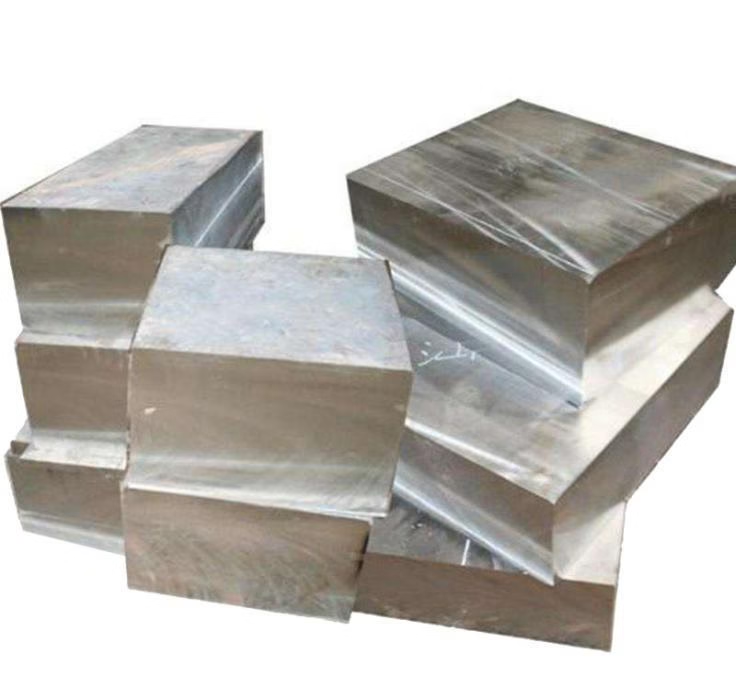
Hot Work Tool Steel (H13 / H11 / SKD61 / 4Cr5MoSiV1)
Hot work tool steel (AISI H13 / H11 / JIS SKD61 / GB 4Cr5MoSiV1 / DIN 1.2344) is chromium-molybdenum-vanadium alloy steel for die casting dies, hot forging dies, and extrusion tooling operating at 300–700°C. Achieves HRC 44–52 after heat treatment with excellent thermal fatigue resistance. Available as plate, block, round bar, and flat bar. ESR and VAR grades available.
| Material | Chromium-Molybdenum-Vanadium Hot Work Alloy Tool Steel |
|---|---|
| Grade / Standard | AISI H13 / H11 / H21 / JIS SKD61 / SKD6 / GB 4Cr5MoSiV1 / 4Cr5MoSiV / DIN 1.2344 / 1.2343 / 1.2367 |
| Diameter | Plate: 10–400mm thick × up to 1800mm wide / Round Bar: 20–800mm dia / Block: up to 50 tons single piece |
| Length | Up to 6m (Round Bar) / Custom (Plate & Block per drawing) |
| Delivery Condition | hot_rolled / as_rolled |
| Surface Treatment | painting / coated |
| MOQ | 1 Piece (Custom Block) / 1 Ton (Standard Bar & Plate) |
| Delivery Time | 20-45 Days (Custom Forging) / 15-25 Days (Stock) |
| Loading Port | Tianjin / Shanghai / Qingdao |
Overview of Hot Work Tool Steel
Hot work tool steel is a specialized category of chromium-molybdenum-vanadium alloy steel engineered specifically for dies, tooling, and components that operate at elevated temperatures ranging from 300°C to over 700°C during service — conditions that would cause conventional tool steels and structural steels to rapidly lose hardness, strength, and dimensional stability through thermal softening and fatigue. Unlike cold work tool steels which prioritize room-temperature wear resistance above all other properties, hot work tool steels must simultaneously deliver high hot hardness retention at service temperature, excellent resistance to thermal fatigue cracking (heat checking) caused by repeated heating and cooling cycles, good thermal conductivity to dissipate heat from the die surface, adequate toughness to withstand impact loading from workpiece contact, and oxidation resistance to maintain surface integrity under prolonged high-temperature exposure. Specified primarily under AISI / SAE (American), JIS G4404 (Japanese), DIN 17350 / EN ISO 4957 (German / European), and GB/T 1299 (Chinese) standards, hot work tool steels have become the indispensable material choice for die casting dies, hot forging dies, hot extrusion tooling, hot shear blades, and high-temperature forming tools across the automotive, aerospace, energy, and heavy manufacturing industries.
The most widely used hot work tool steel grades worldwide include AISI H13 (American standard, the global benchmark for die casting and hot forging applications), AISI H11 (similar to H13 with slightly lower vanadium content for enhanced toughness), JIS SKD61 (Japanese standard direct equivalent to H13), GB 4Cr5MoSiV1 (Chinese standard equivalent to H13), and DIN 1.2344 (German / European standard equivalent to H13, designated X40CrMoV5-1). These grades typically contain 0.32–0.45% carbon, 4.75–5.50% chromium, 1.10–1.75% molybdenum, and 0.80–1.20% vanadium, providing the balanced property combination of hot hardness, thermal fatigue resistance, and toughness essential for cyclic elevated-temperature service. After proper heat treatment (austenitizing at 1000–1060°C, controlled gas or oil quench, and double or triple tempering at 550–650°C), hot work tool steels achieve hardness levels of HRC 44–52 depending on tempering temperature and application requirements, with service temperatures maintaining adequate hardness up to 600–650°C.
Key Features and Heat Treatment
Hot work tool steel derives its unique high-temperature performance from a precisely balanced alloy design. The moderate carbon content (0.32–0.45%) provides sufficient hardenability for full martensitic transformation in large cross-sections while maintaining adequate toughness — too high a carbon content would increase hardness but reduce thermal shock resistance, causing catastrophic cracking in die casting applications. The 4.75–5.50% chromium content provides oxidation resistance, hardenability, and forms chromium carbides that contribute to hot hardness, while the 1.10–1.75% molybdenum content — the critical element distinguishing H13 from earlier hot work grades — dramatically improves resistance to softening at elevated temperatures (tempering resistance) by forming stable molybdenum carbides that resist coarsening at service temperatures up to 650°C. The vanadium addition (0.80–1.20%) refines grain size during austenitizing, forms very hard vanadium carbides that contribute to abrasion resistance and hot hardness, and further improves tempering resistance for sustained service at elevated temperature.
Hot work tool steel is supplied in multiple product forms including hot-rolled annealed plates (thickness 10–400mm, width up to 1800mm), forged blocks (up to 50 tons single piece for large die casting and forging die applications), round bars (diameter 20–800mm), and flat bars (custom sizes per drawing). Standard delivery condition is annealed (typically 185–229 HBW maximum) for ease of rough machining, with pre-hardened condition (HRC 28–34) available for medium-performance applications not requiring maximum die life, and quenched and tempered (HRC 44–52) condition available for components that will not undergo significant finish machining. Premium ESR (Electroslag Remelted) and VAR (Vacuum Arc Remelted) grades are available for the highest-performance die casting and aerospace forging die applications requiring maximum isotropic properties, freedom from segregation, and guaranteed ultrasonic testing cleanliness class. Each hot work tool steel product undergoes mandatory chemical composition analysis verified by optical emission spectrometry or X-ray fluorescence, hardness verification at multiple cross-section locations, ultrasonic testing per EN 10228-3 quality class 3 or better for plates and blocks, microstructure inspection for carbide distribution and grain size, and dimensional inspection per applicable tolerance standards.
Main Applications of Hot Work Tool Steel
Hot work tool steel is the primary material for die casting dies used in high-pressure die casting (HPDC) of aluminium alloys — the dominant manufacturing process for automotive engine blocks, cylinder heads, transmission housings, structural castings, and consumer electronics housings — where H13 die cavities and cores are subjected to repeated injection of aluminium at 650–720°C under pressures of 50–150 MPa, causing severe thermal cycling between injection and ejection. The automotive sector is by far the largest consumer of hot work tool steel globally, employing it for aluminium die casting dies, zinc die casting dies for hardware and decorative components, copper and brass die casting dies for plumbing and electrical fittings, hot forging dies for connecting rods, crankshafts, gear blanks, steering knuckles, suspension components, and wheel hubs produced by closed-die forging at temperatures of 1100–1250°C (for steel) and 400–500°C (for aluminium).
The aerospace and defence manufacturing sector uses hot work tool steels for precision forging dies producing turbine blades, compressor discs, structural airframe fittings, and engine casings from titanium alloys and nickel superalloys under extreme pressure and temperature conditions. Hot extrusion tooling for aluminium, copper, and steel section production employs H13 and related grades for extrusion dies, mandrels, and pressure pads operating at temperatures of 450–550°C (aluminium) and 900–1200°C (steel). Other significant applications include hot shear blades for cutting hot structural steel sections and billets in rolling mill processing lines, hot piercing punches and trimming dies in forging press operations, glass moulding dies and plungers operating at 600–700°C glass contact temperature, plastic injection mould cores and cavities for high-temperature engineering polymers, hot heading dies for fastener and valve manufacture, copper and aluminium continuous casting mould sections, hot rolling mill guides and deflectors, tube and pipe mill piercing and sizing mandrels, high-temperature pressure vessel flanges and fittings, and the comprehensive range of metalworking tooling and industrial equipment components requiring sustained mechanical performance at elevated service temperatures.
Why Choose Us for Hot Work Tool Steel
Shandong Tanglu Metal Material Co., Ltd. supplies premium hot work tool steel sourced from major Chinese specialty steel mills with proven international quality standards, including ESR (Electroslag Remelted) and VAR (Vacuum Arc Remelted) premium grades for the most demanding die casting and aerospace forging applications. Every hot work tool steel batch undergoes mandatory chemical composition analysis verified by optical emission spectrometry, hardness verification at multiple cross-section positions per ASTM A370, ultrasonic testing per EN 10228-3 quality class 3 or 4 for critical die blocks, microstructure inspection for carbide distribution uniformity and austenite grain size, dimensional inspection per applicable standard tolerances, and certification of complete metallurgical traceability from heat through all processing steps to the finished product form.
We offer a comprehensive hot work tool steel range including AISI H13, H11, H21, JIS SKD61, SKD6, GB 4Cr5MoSiV1, 4Cr5MoSiV, DIN 1.2344, 1.2343, 1.2367, and AFNOR Z40CDV5 grades in plate, block, round bar, flat bar, and custom forging forms. Pre-hardened material in HRC 28–34 and quenched and tempered in HRC 44–52 available for projects requiring no further heat treatment. With monthly supply capacity of 500 tons of premium tool steels and established export relationships with die casting tool makers, automotive forging die manufacturers, aerospace tooling companies, aluminium extrusion die producers, and glass moulding tool suppliers in over 40 countries, we support both small prototype tooling orders and large series production programmes. Each shipment includes original mill test certificate (MTC) conforming to EN 10204 3.1 standard, with EN 10204 3.2, ultrasonic testing reports, microstructure photographs, and third-party inspection (SGS, BV, TUV) available for critical die casting and aerospace forging tooling applications requiring enhanced quality documentation.
📐 Dimension & Size Table
| Product Form | Size Range | Hardness (Annealed) | Hardness (After Q+T) |
|---|---|---|---|
| Round Bar — Small | Diameter 20–50mm | ≤207 HBW | HRC 44–52 |
| Round Bar — Medium | Diameter 50–150mm | ≤207 HBW | HRC 44–52 |
| Round Bar — Large | Diameter 150–300mm | ≤215 HBW | HRC 44–52 |
| Round Bar — Heavy | Diameter 300–800mm | ≤229 HBW | HRC 42–50 |
| Flat Bar — Thin | 10–40mm thick × 50–300mm wide | ≤207 HBW | HRC 44–52 |
| Flat Bar — Medium | 40–100mm thick × 100–600mm wide | ≤215 HBW | HRC 44–52 |
| Flat Bar — Thick | 100–250mm thick × 200–1200mm wide | ≤229 HBW | HRC 44–50 |
| Plate — Standard | 10–150mm thick × 1000–1800mm wide | ≤215 HBW | HRC 44–52 |
| Plate — Heavy | 150–400mm thick × 800–1800mm wide | ≤229 HBW | HRC 44–50 |
| Forged Block — Small | 100×100×200 to 400×400×600mm | ≤229 HBW | HRC 44–52 |
| Forged Block — Medium | 400×400×600 to 800×800×1000mm | ≤229 HBW | HRC 44–52 |
| Forged Block — Large | 800×800×1000 to 2000×1500×2500mm | ≤229 HBW | HRC 44–50 |
| Forged Block — Heavy | Up to 50 tons single piece custom | ≤229 HBW | HRC 42–48 |
* Custom sizes available upon request. Tolerances per relevant international standards.
🔬 Chemical Composition
| Element | Min | Max | Display Value | Note |
|---|---|---|---|---|
| C | 0.32 | 0.45 | 0.32–0.45 | AISI H13 / SKD61 / 4Cr5MoSiV1 per AISI / JIS / GB; moderate C for balance of hardness and toughness |
| Si | 0.80 | 1.20 | 0.80–1.20 | Oxidation resistance and solid solution strengthening |
| Mn | 0.20 | 0.50 | 0.20–0.50 | |
| P | - | 0.030 | ≤0.030 | Strictly controlled for toughness |
| S | - | 0.030 | ≤0.030 | Strictly controlled for toughness |
| Cr | 4.75 | 5.50 | 4.75–5.50 | Hardenability, oxidation resistance, hot hardness |
| Mo | 1.10 | 1.75 | 1.10–1.75 | Critical element for tempering resistance and hot strength up to 650°C |
| V | 0.80 | 1.20 | 0.80–1.20 | Grain refinement, hot hardness, wear resistance |
| W | - | 0.20 | ≤0.20 (residual) | H21 tungsten grade: W 8.50–10.00%; not in standard H13/SKD61 |
| Ni | - | 0.30 | ≤0.30 | Residual element |
| Cu | - | 0.25 | ≤0.25 | Residual element |
* Chemical composition may vary by heat, thickness and specification. Please refer to the actual mill test certificate.
⚙️ Mechanical Properties
| Property | Value | Unit | Test Condition |
|---|---|---|---|
| Hardness (Annealed) | 185–229 | HBW | Soft annealed for machining per AISI H13 / DIN 1.2344 |
| Hardness (Pre-Hardened) | 28–34 | HRC | Pre-hardened condition for medium-performance applications |
| Hardness (After Q+T — Standard Die Casting) | 44–48 | HRC | Tempered at 580–620°C — optimal for aluminium die casting dies (balance of hardness and toughness) |
| Hardness (After Q+T — Hot Forging) | 48–52 | HRC | Tempered at 540–580°C — optimal for hot forging dies requiring maximum hot hardness |
| Hardness at 500°C Service Temperature | 38–42 | HRC | Retained hot hardness at 500°C — critical for die casting core pins |
| Hardness at 600°C Service Temperature | 32–36 | HRC | Retained hot hardness at 600°C — distinguishes H13 from standard tool steels |
| Tensile Strength (After Q+T, HRC 44–48) | 1,380–1,600 | MPa | Per AISI H13 standard heat treatment |
| Yield Strength (After Q+T, HRC 44–48) | 1,200–1,450 | MPa | Per AISI H13 standard heat treatment |
| Impact Energy (After Q+T, HRC 44–48) | 18–35 | J | Charpy V-notch — superior to D2 cold work steel; essential for thermal shock resistance |
| Compressive Strength (At Room Temperature) | 1,800–2,200 | MPa | After standard heat treatment |
| Thermal Conductivity | 24–28 | W/m·K | At room temperature — higher than cold work steels, aids die cooling |
| Density | 7.80 | g/cm³ | Reference value |
* Values shown are minimum requirements unless otherwise stated.
📦 Commercial Information
| Packaging | Standard seaworthy export packing for hot work tool steel. Round bars bundled with steel strapping (3–5 wraps per bundle), typical bundle weight 1–3 tons depending on diameter, with VCI anti-corrosion paper inner wrapping and PE film outer wrapping to prevent corrosion and surface damage during ocean transit and port storage. Plates and flat bars individually wrapped with VCI anti-rust paper followed by PE stretch film, then bundled with wooden dunnage separators between layers to prevent surface contact damage; steel strapping secures full bundle. Forged blocks packed individually with steel angle iron corner protectors at all block edges, VCI anti-corrosion paper lining all faces, anti-rust oil coating applied to all machined surfaces, and external waterproof polyethylene shrink wrapping. Each package clearly tagged with heat number, grade designation (H13 / SKD61 / 4Cr5MoSiV1 / 1.2344), dimensions (thickness × width × length in mm), weight, delivery condition (annealed / pre-hardened / Q+T), and ESR / VAR designation where applicable. For large forged die blocks (weight exceeding 3 tons), custom engineered wooden crates with internal steel I-beam support framework and external waterproof plywood sheathing are provided, with lifting lugs and stacking instructions stencilled on crate exterior. Vacuum-sealed packaging with desiccant sachets available for premium polished or ground surfaces requiring preservation during extended storage or air freight shipment. |
|---|---|
| Payment Terms | T/T (Telegraphic Transfer),L/C (Letter of Credit),D/P (Documents against Payment),Western Union,PayPal |
| Price Term | FOB,CFR,CIF,EXW |
| Supply Capacity | 500 Tons/Month (Premium Hot Work Tool Steel) |
| Loading Port | Tianjin / Shanghai / Qingdao |
Why Choose Our Hot Work Tool Steel (H13 / H11 / SKD61 / 4Cr5MoSiV1)?
Mill Certified Premium Tool Steel Quality
Hot work tool steel supplied with original mill test certificate EN 10204 3.1/3.2, including chemical analysis by optical emission spectrometry, hardness verification at multiple cross-section positions per ASTM A370, ultrasonic testing per EN 10228-3 quality class 3 or 4, microstructure inspection for carbide distribution and grain size, and complete metallurgical traceability from heat through all processing steps to finished product.
Comprehensive Form & Size Range
Available in plate (10–400mm thick × up to 1800mm wide), forged block (up to 50 tons single piece), round bar (20–800mm diameter), and flat bar (custom dimensions per drawing). Custom forging per customer drawings with rough machined, semi-finished, or finish machined options. Pre-hardened HRC 28–34 and Q+T HRC 44–52 condition available.
Outstanding Hot Hardness Retention HRC 44–52
After standard heat treatment (austenitize 1020–1060°C, controlled quench, double temper at 550–620°C), achieves HRC 44–52 with retained hot hardness of HRC 38–42 at 500°C and HRC 32–36 at 600°C service temperature — essential for die casting and hot forging tooling operating under sustained elevated-temperature cyclic loading.
Multi-Standard International Grades & ESR/VAR
Available in AISI H13 / H11 / H21 (American), JIS SKD61 / SKD6 (Japanese), GB 4Cr5MoSiV1 / 4Cr5MoSiV (Chinese), DIN 1.2344 / 1.2343 / 1.2367 (German / European). Premium ESR (Electroslag Remelted) and VAR (Vacuum Arc Remelted) grades available for highest die life die casting and aerospace forging applications.
Reliable Tool Steel Supply Chain
Standard round bar and plate from stock: 15–25 days dispatch. Custom forging production: 30–45 days depending on size and complexity. Established export logistics with experience handling tool steel blocks up to 50 tons single piece via 40FT flat-rack container or break-bulk vessel arrangements to die casting and forging tool makers worldwide.
🏭 Applications of Hot Work Tool Steel (H13 / H11 / SKD61 / 4Cr5MoSiV1)
Hot work tool steel is the indispensable material choice for the complete spectrum of elevated-temperature metalworking tooling applications, where H13 and its international equivalents (SKD61, 4Cr5MoSiV1, 1.2344) dominate due to their unmatched combination of hot hardness retention, thermal fatigue resistance, and adequate toughness for cyclic loading at temperatures up to 650°C. Die casting tooling represents the largest global application by volume, with H13 steel used for die casting die cavities, cores, core pins, slides, ejector pins, sprue bushings, and shot sleeves in high-pressure die casting (HPDC) of aluminium alloys for automotive engine blocks, cylinder heads, automatic transmission housings, structural chassis castings, electric vehicle battery housing frames, and consumer electronics enclosures where die cavities are subjected to repeated injection of molten aluminium at 650–720°C under 50–150 MPa pressure, creating severe thermal cycling that causes heat checking (surface cracking from thermal fatigue) as the primary failure mechanism. Zinc die casting tooling for automotive door handles, lock bodies, bathroom hardware, decorative fittings, and electronic connector housings employs H13 at slightly lower service temperatures (420–450°C zinc liquidus) but with very high cycle rates exceeding 500 shots per hour that impose extreme thermal fatigue demands. Copper and brass die casting for plumbing fittings, electrical connectors, and decorative hardware requires H13 at higher temperatures (900–1000°C copper liquidus) with even more demanding thermal shock conditions. Hot forging die applications include closed-die impression forging of automotive crankshafts, connecting rods, camshafts, gear blanks, steering knuckles, wheel hubs, and suspension ball joints from carbon and alloy steel billets at 1100–1250°C; aluminium forging dies for automotive pistons, wheels, control arms, and aerospace structural fittings forged at 400–500°C; titanium alloy forging dies for aerospace structural components including bulkheads, ribs, and engine mounts at 900–950°C isothermal forging conditions; and nickel superalloy forging dies for turbine disc and compressor disc production at 950–1050°C with extreme pressure requirements. Aluminium extrusion tooling employs H13 for extrusion dies, mandrels, bearer rings, and die holders in direct and indirect extrusion of aluminium alloy profiles at billet temperatures of 450–550°C, where the die is subject to both thermal loading from the hot billet and compressive pressure loading from the extrusion ram. Hot shear blades and cutting tools cut hot structural steel bar, billet, bloom, and slab in rolling mill shear lines and crop shears operating with workpiece temperatures of 900–1200°C, requiring H13 or higher-alloy grades for adequate hot hardness and thermal shock resistance at the cutting edge. Glass moulding tooling for container glass, pressed glassware, and technical glass components uses H13 for plungers, moulds, and blow heads operating at sustained contact temperatures of 600–700°C with molten glass at 900–1050°C, where oxidation resistance and dimensional stability are critical for maintaining glass container dimensional accuracy over millions of moulding cycles. Hot heading and upsetting dies for fastener and valve manufacturing, hot piercing punches for tube making, hot trimming dies for forged part flash removal, hot pressing dies for powder metallurgy sintering, and high-temperature pressure vessel and fitting flanges complete the application scope of hot work tool steel across the global manufacturing and processing industry base.
📋 Quality & Certification
Our Certifications
- ✅ ISO 9001:2015
- ✅ CE Marking
- ✅ ABS
- ✅ DNV GL
- ✅ Lloyd's Register (LR)
- ✅ Bureau Veritas (BV)
- ✅ SGS Certified
- ✅ RINA
Mill Certificate Type
- 📋 EN 10204 3.1
- 📋 EN 10204 3.2
- 📋 Original Mill Certificate
- 📋 Third Party Inspection Available
- 📋 Certificate of Origin
❓ Frequently Asked Questions
What is hot work tool steel and what makes it different from cold work tool steel?
Hot work tool steel is a specialized category of chromium-molybdenum-vanadium alloy steel engineered for dies, tooling, and components that operate at elevated temperatures from 300°C to over 700°C during service — conditions that cause conventional tool steels to rapidly lose hardness and strength through thermal softening. The defining characteristics are moderate carbon content (0.32–0.45%) for a balance of hardness and toughness, 4.75–5.50% chromium for hardenability and oxidation resistance, 1.10–1.75% molybdenum as the critical element providing tempering resistance and sustained hot strength up to 650°C, and 0.80–1.20% vanadium for grain refinement and additional hot hardness. After heat treatment, hot work tool steels achieve HRC 44–52, lower than cold work steels (HRC 58–62), but critically retain HRC 38–42 at 500°C service temperature and HRC 32–36 at 600°C — properties that cold work steels cannot provide. Cold work tool steels (D2, SKD11, Cr12MoV) have much higher carbon (1.40–1.60%) and chromium (11–13%) for maximum room-temperature wear resistance through high carbide volume fraction, but rapidly lose hardness above 200°C through carbide coarsening and matrix softening, making them unsuitable for die casting or hot forging applications. Hot work tool steels sacrifice some room-temperature wear resistance for the thermal fatigue resistance, toughness, and elevated-temperature performance that cyclic high-temperature service demands.
What is the difference between AISI H13, H11, SKD61, and DIN 1.2344?
These grades are all 5% chromium hot work tool steels with closely related but distinct chemistries, representing the same fundamental alloy system under different national standards. AISI H13 (American standard) is the global benchmark for hot work tool steel with carbon 0.32–0.45%, silicon 0.80–1.20%, chromium 4.75–5.50%, molybdenum 1.10–1.75%, and vanadium 0.80–1.20%, providing the best overall balance of hot hardness retention, thermal fatigue resistance, and toughness for die casting and hot forging applications. AISI H11 has very similar chemistry to H13 but with lower vanadium content (0.30–0.60% vs 0.80–1.20%), reducing hardness slightly but improving toughness and ductility — preferred for applications subject to high impact loading or severe thermal shock where H13 toughness is marginal. JIS SKD61 (Japanese standard JIS G4404) is essentially identical to AISI H13 with only minor chemistry differences within the same specification range and is a direct substitute — widely used in Japanese, Korean, and Southeast Asian die casting industries. DIN 1.2344 (European standard EN ISO 4957, designated X40CrMoV5-1) is the German / European equivalent of H13 with virtually identical chemistry and properties, specified for European automotive die casting and forging tooling. GB 4Cr5MoSiV1 (Chinese standard GB/T 1299) is the Chinese equivalent with essentially the same composition as H13 / SKD61 / 1.2344. For the vast majority of die casting and hot forging applications, H13 / SKD61 / 4Cr5MoSiV1 / 1.2344 are fully interchangeable. DIN 1.2367 (X38CrMoV5-3, enhanced molybdenum content 2.70–3.20%) is a variant with higher molybdenum for improved hot strength and thermal stability, preferred for very heavy-section die casting dies and applications at the upper service temperature limit.
What heat treatment is recommended for H13 / SKD61 hot work tool steel?
Standard heat treatment for H13 / SKD61 / 4Cr5MoSiV1 / DIN 1.2344 hot work tool steel involves a carefully controlled multi-stage cycle to achieve optimal die performance. Soft Annealing (840–900°C, hold 2–4 hours per 25mm cross-section, slow furnace cool to 500°C at ≤15°C/hour, then air cool) achieves hardness ≤229 HBW for rough machining operations. Stress Relieving (600–650°C, hold 2–4 hours, slow cool) is strongly recommended after rough machining to relax machining stresses before finish machining and hardening, minimising distortion in the final heat treatment. The hardening cycle begins with staged Preheating — first stage 600–650°C, second stage 820–870°C (critical for large cross-section blocks to minimise thermal gradient) — followed by Austenitizing at 1000–1060°C for 30–45 minutes per 25mm of cross-section to achieve complete carbide dissolution and uniform austenite. Quenching is performed by high-pressure gas quenching (preferred for vacuum furnace processing of complex die geometries, minimising distortion and oxidation), interrupted oil quenching (for large sections requiring faster cooling to achieve full hardness), or salt bath quenching. Immediate Tempering must commence within 1–2 hours of quenching to prevent stress cracking — a minimum of double tempering is mandatory for H13, with triple tempering recommended for large sections (over 300mm cross-section) and ESR/VAR grade premium dies. Standard die casting die tempering at 560–620°C achieves HRC 44–48 with optimal toughness for thermal fatigue resistance. Hot forging die tempering at 530–580°C achieves HRC 48–52 for higher hot hardness. Deep cryogenic treatment at −185°C between tempering cycles converts retained austenite to martensite in ESR premium grade dies, improving dimensional stability and extending die life by 15–25%. Surface nitriding (gas nitriding 490–520°C, 20–50 hours, 0.10–0.20mm case depth) after final tempering significantly improves die casting die surface wear resistance and aluminium soldering resistance.
What is the difference between standard quality, ESR, and VAR hot work tool steel?
Hot work tool steel is produced in three quality levels that differ in cleanliness, homogeneity, ultrasonic testability, and die performance, with progressively higher cost reflecting the additional processing involved. Standard Quality is produced through electric arc furnace (EAF) melting, ladle refining (LF/VD vacuum degassing), and ingot or continuous casting, providing acceptable properties for general die casting tooling, hot extrusion dies, and hot shear blades where die life requirements are moderate. Standard quality typically achieves EN 10228-3 ultrasonic quality class 2–3. ESR (Electroslag Remelted) quality subjects the standard ingot to secondary remelting — the ingot serves as a consumable electrode melted through a liquid slag bath into a new water-cooled copper mould under controlled current, achieving dramatically improved cleanliness (sulfur typically <0.003% vs <0.030% standard), very low non-metallic inclusion content rated A0–A1 per ASTM E45, highly uniform microstructure with fine, homogeneously distributed carbides, minimal macro-segregation, and excellent ultrasonic testability achieving quality class 3–4. ESR grade H13 delivers 30–60% longer die life in aluminium die casting applications versus standard quality, justifying its 40–70% price premium for high-production tooling. VAR (Vacuum Arc Remelted) quality performs a further remelting step in vacuum, virtually eliminating dissolved hydrogen and oxygen, achieving the lowest possible inclusion content, maximum microstructural homogeneity, and best isotropic mechanical properties — essential for aerospace forging dies producing safety-critical titanium and nickel alloy components. VAR grade is the most expensive and provides the highest metallurgical quality, typically specified only for aerospace, military, and medical device tooling where die failure is unacceptable. For standard industrial die casting and hot forging, ESR grade represents the optimal quality-to-cost choice for premium die life performance.
What product forms and sizes are available for hot work tool steel?
Hot work tool steel is supplied in multiple product forms to accommodate the diverse size and geometry requirements of die casting, forging, and extrusion tooling. Round Bars are produced in diameter range from 20mm (small core pins and ejector pins) to 800mm (large die holder sections), in standard mill lengths up to 6 metres, in annealed condition for machining or pre-hardened (HRC 28–34) condition for applications requiring no further heat treatment. Flat Bars (rectangular bars) range from 10mm to 250mm thickness and 50mm to 1200mm width, in lengths up to 6 metres, serving as blanks for press brake dies, shear blades, and rectangular die components. Plates are produced in thicknesses from 10mm to 400mm and widths up to 1800mm, cut to required lengths, for large flat die sections, bolster plates, and die holders in automotive body panel stamping and large-part die casting tools. Forged Blocks are the most common product form for die casting and hot forging die cavities, produced as rough-forged rectangular sections from 100×100×200mm to 2000×1500×2500mm, and custom-forged shapes including stepped blocks, round forgings, and ring forgings up to 50 tons single piece for the largest automotive and heavy industrial die applications. Custom Forgings are produced directly to customer drawings with rough machined faces (material allowance 5–10mm per face), semi-finished machining (±2mm tolerance), or finish machined faces (±0.5mm) to reduce toolroom machining time. Standard delivery condition is annealed (≤229 HBW) for machining, with pre-hardened (HRC 28–34), quenched and tempered (HRC 44–52), and nitrided surface conditions available as value-added services. Surface finish options include black scale (as-forged), rough turned / milled (machine tool marks visible), precision ground (Ra 1.6–3.2μm), and mirror polished (Ra ≤0.4μm, for glass moulding and plastic injection mould applications). ESR and VAR material available in all product forms with enhanced certification and guaranteed ultrasonic quality class.
Get a Quote for
Hot Work Tool Steel (H13 / H11 / SKD61 / 4Cr5MoSiV1)
Submit your requirements and receive a competitive price quote within 24 hours.
- ✓ Fast response within 24 hours
- ✓ Competitive factory-direct pricing
- ✓ Free technical consultation
- ✓ Mill test certificate provided
- ✓ Flexible payment terms available
⏱ Response within 24 hours
Send Your Inquiry
All fields marked with * are required