
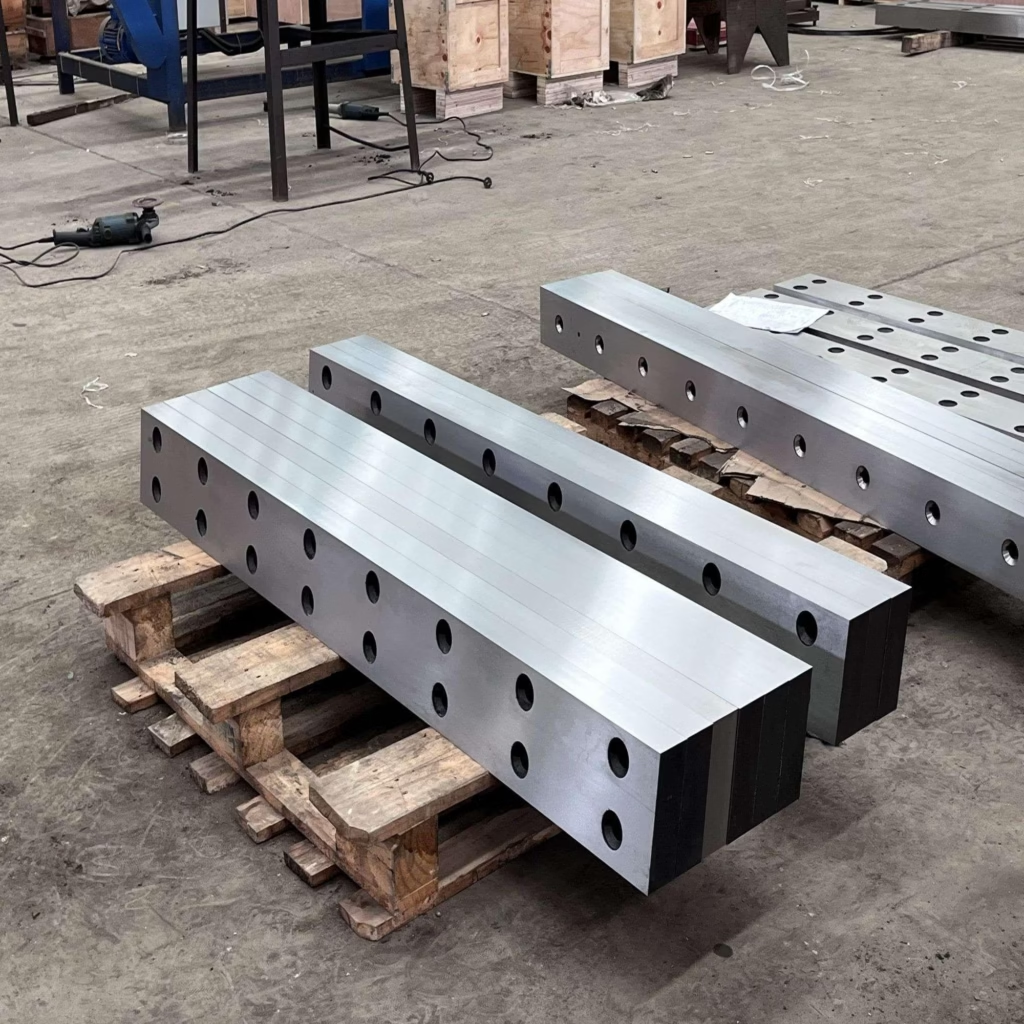
Cold Work Tool Steel (D2 / D3 / SKD11 / Cr12MoV)
Cold work tool steel (AISI D2 / SKD11 / Cr12MoV / 1.2379) is high-carbon high-chromium alloy steel for cutting, blanking, forming, and stamping dies. Achieves HRC 58-62 hardness after heat treatment with exceptional wear resistance. Available as plate, block, round bar, and flat bar. ESR grade available.
| Material | High Carbon High Chromium Alloy Tool Steel |
|---|---|
| Grade / Standard | AISI D2 / D3 / JIS SKD11 / GB Cr12MoV / DIN 1.2379 |
| Diameter | Plate: 5-200mm thick × up to 1500mm wide / Round Bar: 10-500mm dia / Block: up to 30 tons |
| Length | Up to 6m (Round Bar) / Custom (Plate & Block) |
| Delivery Condition | hot_rolled / quenched_tempered |
| Surface Treatment | painting / coated |
| MOQ | 1 Piece (Custom Block) / 1 Ton (Standard Bar) |
| Delivery Time | 20-45 Days (Custom) / 15-25 Days (Stock) |
| Loading Port | Tianjin / Shanghai / Qingdao |
Overview of Cold Work Tool Steel
Cold work tool steel is a specialized category of high-carbon high-chromium alloy steel designed specifically for cutting, blanking, forming, stamping, and shearing dies that operate at room temperature or moderately elevated temperatures up to 200°C. Unlike hot work tool steels which prioritize high-temperature performance, cold work tool steels emphasize maximum wear resistance, dimensional stability during heat treatment, and high compressive strength to maintain sharp cutting edges and precise tool geometry under repeated mechanical loading. Specified primarily under AISI / SAE (American), JIS G4404 (Japanese), DIN 17350 (German), and GB/T 1299 (Chinese) standards, cold work tool steels have become essential materials for stamping dies, blanking dies, drawing dies, forming rolls, shear blades, woodworking knives, and a wide range of industrial cutting and forming tools.
The most widely used cold work tool steel grades worldwide include AISI D2 (American standard, the international benchmark for general-purpose cold work applications), AISI D3 (higher carbon for maximum wear resistance with reduced toughness), JIS SKD11 (Japanese standard equivalent to D2 with slightly modified chemistry), GB Cr12MoV (Chinese standard equivalent to D2 with optimized molybdenum content), and DIN 1.2379 (German standard equivalent to D2). These grades typically contain 1.4-2.3% carbon and 11-13% chromium, providing the high carbide volume fraction necessary for exceptional abrasive wear resistance. The high chromium content also provides excellent through-hardening capability up to 250mm cross-section, dimensional stability with minimal distortion during heat treatment, and good corrosion resistance in atmospheric environments. After proper heat treatment (austenitizing at 1000-1050°C, oil quench, and double tempering at 200-540°C), cold work tool steels achieve hardness levels of HRC 58-62 with exceptional wear resistance and acceptable toughness for most industrial die applications.
Key Features and Heat Treatment
Cold work tool steel features high carbide volume fraction (typically 12-18% by volume) consisting primarily of M7C3 chromium carbides distributed throughout the martensitic matrix, providing the wear-resistant skeleton structure that resists abrasive wear from contact with workpiece materials. The carbide network maintains effectiveness even at the elevated temperatures (150-200°C) generated by friction during high-speed stamping operations, where conventional tool steels would lose hardness through tempering. The high chromium content (11-13%) also provides through-hardening capability up to 250mm cross-section without requiring water quenching, eliminating the risk of quench cracking in complex die geometries.
The steel is supplied in multiple product forms including hot-rolled annealed plates (thickness 5-200mm, width up to 1500mm), forged blocks (up to 30 tons single piece for large die applications), round bars (diameter 10-500mm), and flat bars (custom sizes per drawing). Standard delivery condition is annealed (typically 200-250 HBW maximum) for ease of machining, with quenched and tempered (Q+T) condition available upon request for parts that will not undergo significant machining. Surface conditions include mill finish, peeled and turned, ground, and polished. Each cold work tool steel product undergoes mandatory chemical composition analysis verified by spectroscopic methods, mechanical property testing including hardness verification, ultrasonic testing per EN 10228-3 or ASTM A388 for internal soundness, microstructure inspection per ASTM E45 for non-metallic inclusion control, and dimensional inspection per applicable standards.
Main Applications of Cold Work Tool Steel
Cold work tool steel is the primary material for stamping dies and progressive dies used in high-volume sheet metal forming operations including automotive body panel stamping, appliance housing production, electronic component stamping, electrical lamination dies for motor and transformer cores, and packaging container manufacturing. The grade is essential for blanking dies producing washers, brackets, gaskets, and precision punched components from coiled sheet metal where edge sharpness and dimensional accuracy must be maintained over millions of cycles. Drawing dies for cup-shaped products like beverage cans, fire extinguisher bodies, oxygen tanks, and deep-drawn enclosures rely on cold work tool steels for their combination of wear resistance and surface finish retention.
The metalworking and tool manufacturing industries use cold work tool steels for shear blades and slitter knives in steel processing service centers, woodworking saw blades and planer knives, paper converting and printing industry blades, cold heading dies for fastener production (bolts, nuts, screws), thread rolling dies, cold extrusion dies for soft metals (aluminum, copper, brass), forming rolls for cold roll forming of profiles, and bending dies for press brake operations. Other major applications include plastic injection mold cores requiring high wear resistance for abrasive plastics (glass-filled, mineral-filled compounds), die casting tools for low-melting metals (zinc, lead, tin alloys), powder compaction tooling for ceramic and metal powder pressing, food processing knives and blades, recycling industry shear and cutting tools, machine tool components requiring high wear resistance, and a comprehensive range of industrial cutting, forming, and shaping tools requiring optimal balance of wear resistance, compressive strength, and dimensional stability under repeated mechanical loading.
Why Choose Us for Cold Work Tool Steel
Shandong Tanglu Metal Material Co., Ltd. supplies premium cold work tool steel sourced from major Chinese specialty steel mills with proven international quality including ESR (Electroslag Remelting) grade for premium die applications, plus equivalent international grades from major mills with established export experience. Every cold work tool steel batch undergoes mandatory chemical composition analysis verified by optical emission spectrometry, mechanical property testing including hardness verification at multiple cross-section locations, ultrasonic testing per EN 10228-3 quality classes 1-4, microstructure inspection for inclusion content per ASTM E45, dimensional inspection per applicable standards, and certification of complete metallurgical traceability from heat to finished product.
We offer comprehensive cold work tool steel range including AISI D2, D3, JIS SKD11, GB Cr12MoV, DIN 1.2379, plus oil-hardening (O1, O6) and air-hardening (A2, A6) variants in plate, block, round bar, flat bar, and custom forging forms. With monthly supply capacity of 500 tons of premium tool steels and established export relationships with mold and die manufacturers, automotive stamping companies, electrical lamination producers, woodworking blade manufacturers, and machine tool builders in over 40 countries, we support both small prototype orders and large series production requirements. Each shipment includes original mill test certificate (MTC) conforming to EN 10204 3.1 standard, with EN 10204 3.2, ultrasonic testing reports, microstructure photographs, and third-party inspection (SGS, BV, TUV) available for critical mold and die applications requiring enhanced documentation.
📐 Dimension & Size Table
| Product Form | Size Range | Hardness (Annealed) | Hardness (After Q+T) |
|---|---|---|---|
| Round Bar - Small | Diameter 10-50mm | ≤220 HBW | HRC 58-62 |
| Round Bar - Medium | Diameter 50-150mm | ≤220 HBW | HRC 58-62 |
| Round Bar - Large | Diameter 150-300mm | ≤230 HBW | HRC 58-62 |
| Round Bar - Heavy | Diameter 300-500mm | ≤250 HBW | HRC 56-60 |
| Flat Bar - Thin | 5-30mm thick × 50-300mm wide | ≤220 HBW | HRC 58-62 |
| Flat Bar - Medium | 30-80mm thick × 100-500mm wide | ≤220 HBW | HRC 58-62 |
| Flat Bar - Thick | 80-200mm thick × 200-1000mm wide | ≤230 HBW | HRC 58-62 |
| Plate - Standard | 5-100mm thick × 1000-1500mm wide | ≤220 HBW | HRC 58-62 |
| Plate - Heavy | 100-200mm thick × 800-1500mm wide | ≤230 HBW | HRC 58-62 |
| Forged Block - Small | 100×100×200 to 300×300×500mm | ≤230 HBW | HRC 58-62 |
| Forged Block - Medium | 300×300×500 to 600×600×800mm | ≤230 HBW | HRC 58-62 |
| Forged Block - Large | 600×600×800 to 1500×1500×2000mm | ≤250 HBW | HRC 58-62 |
| Forged Block - Heavy | Up to 30 tons single piece custom | ≤250 HBW | HRC 56-60 |
* Custom sizes available upon request. Tolerances per relevant international standards.
🔬 Chemical Composition
| Element | Min | Max | Display Value | Note |
|---|---|---|---|---|
| C | 1.40 | 1.60 | 1.40-1.60 | AISI D2 / SKD11 / Cr12MoV per AISI |
| Si | 0.10 | 0.60 | 0.10-0.60 | |
| Mn | 0.10 | 0.60 | 0.10-0.60 | |
| P | - | 0.030 | ≤0.030 | |
| S | - | 0.030 | ≤0.030 | |
| Cr | 11.00 | 13.00 | 11.00-13.00 | Carbide-forming, wear resistance |
| Mo | 0.70 | 1.20 | 0.70-1.20 | Hardenability and tempering resistance |
| V | 0.50 | 1.10 | 0.50-1.10 | Carbide refinement, edge retention |
| W | - | - | Optional in some grades | Not in standard D2/SKD11 |
| Ni | - | 0.40 | ≤0.40 | Residual element |
* Chemical composition may vary by heat, thickness and specification. Please refer to the actual mill test certificate.
⚙️ Mechanical Properties
| Property | Value | Unit | Test Condition |
|---|---|---|---|
| Hardness (Annealed) | ≤250 | HBW | Soft annealed for machining |
| Hardness (After Q+T) | 58-62 | HRC | Standard heat treatment for cold work dies |
| Hardness (Maximum Achievable) | 62-64 | HRC | With low tempering temperature 150-200°C |
| Compressive Strength | 2200-2500 | MPa | After standard heat treatment |
| Tensile Strength (Annealed) | ≤770 | MPa | Annealed condition |
| Impact Energy (After Q+T) | 10-20 | J | Charpy V-notch unnotched specimen |
| Wear Resistance Index | 8-10 | (Excellent) | Relative scale 1-10 (D2 reference standard) |
| Dimensional Stability | 0.05-0.10 | % (Low) | Through-hardening with minimal distortion |
| Density | 7.70 | g/cm³ | Reference value |
| Thermal Conductivity | 16-20 | W/m·K | At room temperature |
* Values shown are minimum requirements unless otherwise stated.
📦 Commercial Information
| Packaging | Standard seaworthy export packing for cold work tool steel. Round bars bundled with steel strapping (3-5 wraps per bundle), typical bundle weight 1-3 tons depending on diameter, with anti-rust oil coating to prevent corrosion during transit. Plates and flat bars individually wrapped with anti-rust paper or PE film, then bundled with wooden separators between layers. Forged blocks packed individually with steel angle protection at corners, anti-rust coating on all surfaces, and waterproof shrink wrapping. Each package clearly tagged with heat number, grade designation (D2 / SKD11 / Cr12MoV), dimensions, weight, and delivery condition (annealed / Q+T). For premium ESR grade and large blocks, custom wooden crates with internal steel framework provided to prevent transport damage. Vacuum-sealed packaging available for premium polished surfaces and air shipment requirements. |
|---|---|
| Payment Terms | T/T (Telegraphic Transfer),L/C (Letter of Credit),D/P (Documents against Payment),Western Union,PayPal |
| Price Term | FOB,CFR,CIF,EXW |
| Supply Capacity | 500 Tons/Month (Premium Cold Work Tool Steel) |
| Loading Port | Tianjin / Shanghai / Qingdao |
Why Choose Our Cold Work Tool Steel (D2 / D3 / SKD11 / Cr12MoV)?
Mill Certified Premium Tool Steel
Cold work tool steel supplied with original mill test certificate EN 10204 3.1/3.2, including chemical analysis by optical emission spectrometry, hardness verification, ultrasonic testing per EN 10228-3, microstructure inspection for inclusion content per ASTM E45, and complete metallurgical traceability from heat to finished product.
Comprehensive Form & Size Range
Available in plate (5-200mm thick × up to 1500mm wide), forged block (up to 30 tons single piece), round bar (10-500mm diameter), and flat bar (custom dimensions). Custom forging service per customer drawings with rough, semi-finished, or finished machining options.
Exceptional Wear Resistance HRC 58-62
After standard heat treatment (austenitize 1010°C, oil quench, double temper at 200°C), achieves hardness 58-62 HRC with high carbide volume fraction (12-18% M7C3 chromium carbides) providing exceptional abrasive wear resistance, ideal for high-volume stamping dies and cutting tools.
Multi-Standard International Grades
Available in international tool steel grades including AISI D2 (American), JIS SKD11 (Japanese), GB Cr12MoV (Chinese), DIN 1.2379 / X153CrMoV12 (German), AFNOR Z160CDV12 (French). ESR (Electroslag Remelted) premium quality available for highest die life applications.
Reliable Tool Steel Production
Standard round bar and plate delivery 15-25 days from stock. Custom forging production 30-45 days depending on size and complexity. Established export logistics with experience shipping tool steel blocks up to 30 tons single piece via 40FT FCL or break-bulk vessel arrangements.
🏭 Applications of Cold Work Tool Steel (D2 / D3 / SKD11 / Cr12MoV)
Cold work tool steel is the primary material for stamping dies and progressive dies used in high-volume sheet metal forming operations including automotive body panel stamping (door panels, hoods, fenders, structural reinforcements), appliance housing production (refrigerator panels, washing machine cabinets), electronic component stamping (connector pins, terminals, brackets), electrical lamination dies for motor and transformer cores requiring millions of cycles with consistent dimensional accuracy, and packaging container manufacturing for food cans, beverage cans, and aerosol containers. The grade is essential for blanking dies producing washers, brackets, gaskets, electrical contacts, and precision punched components from coiled sheet metal where edge sharpness and dimensional accuracy must be maintained over millions of cycles. Drawing dies for cup-shaped products like beverage cans, fire extinguisher bodies, oxygen tanks, propane cylinders, and deep-drawn enclosures rely on cold work tool steels for their exceptional combination of wear resistance and surface finish retention through the drawing process. The metalworking and tool manufacturing industries use cold work tool steels for shear blades and slitter knives in steel processing service centers, woodworking saw blades and planer knives, paper converting and printing industry blades, cold heading dies for fastener production (bolts, nuts, screws, rivets), thread rolling dies for screw and bolt manufacturing, cold extrusion dies for soft metals (aluminum, copper, brass profiles), forming rolls for cold roll forming of structural and architectural profiles, and bending dies for press brake operations forming sheet metal components. Other major applications include plastic injection mold cores requiring high wear resistance for abrasive plastics (glass-filled, mineral-filled, and metallic-filled compounds), die casting tools for low-melting metals (zinc, lead, tin alloys), powder compaction tooling for ceramic and metal powder pressing in automotive and electronics industries, food processing knives and blades for meat processing and packaging machinery, recycling industry shear and cutting tools for scrap metal processing, machine tool components requiring high wear resistance such as guide bushings and indexing components, woodworking machinery cutting tools, paper cutting and converting blades, textile industry cutting tools, and a comprehensive range of industrial cutting, forming, and shaping tools requiring optimal balance of wear resistance, compressive strength, and dimensional stability under repeated mechanical loading.
📋 Quality & Certification
Our Certifications
- ✅ ISO 9001:2015
- ✅ CE Marking
- ✅ ABS
- ✅ DNV GL
- ✅ Lloyd's Register (LR)
- ✅ Bureau Veritas (BV)
- ✅ SGS Certified
- ✅ NK
- ✅ RINA
Mill Certificate Type
- 📋 EN 10204 3.1
- 📋 EN 10204 3.2
- 📋 Original Mill Certificate
- 📋 Third Party Inspection Available
- 📋 Certificate of Origin
❓ Frequently Asked Questions
What is cold work tool steel and what makes it different from other tool steels?
Cold work tool steel is a specialized category of high-carbon high-chromium alloy steel designed for cutting, blanking, forming, and stamping dies operating at room temperature or moderately elevated temperatures up to 200°C. The defining characteristics are high carbon content (1.4-2.3%) for high hardness, high chromium content (11-13%) for through-hardening capability and carbide formation, plus molybdenum and vanadium for additional wear resistance and tempering stability. After proper heat treatment, cold work tool steels achieve hardness HRC 58-62 with exceptional wear resistance from the high carbide volume fraction (12-18% M7C3 chromium carbides). Unlike hot work tool steels (H13, H11) which sacrifice some hardness for high-temperature stability, cold work tool steels prioritize maximum wear resistance and dimensional stability for cyclic mechanical loading at relatively low service temperatures. They differ from high-speed steels (HSS) which are designed for cutting at high temperatures generated by chip formation.
What is the difference between AISI D2, D3, SKD11, and Cr12MoV?
These grades are all high-carbon high-chromium cold work tool steels with closely related but distinct chemistries optimized for different applications. AISI D2 (American standard, also EN 1.2379) is the most widely used international benchmark with carbon 1.40-1.60%, chromium 11-13%, molybdenum 0.7-1.2%, and vanadium 0.5-1.1% - provides excellent balance of wear resistance, toughness, and through-hardening capability for general cold work die applications. AISI D3 (American standard, also DIN 1.2080) has higher carbon (2.00-2.35%) and chromium (11-13%) but lacks molybdenum and vanadium, providing maximum wear resistance but reduced toughness, suitable for moderate-load applications where extreme wear resistance is critical (long-run blanking dies, cold extrusion punches). JIS SKD11 (Japanese standard) is essentially identical to AISI D2 with very minor chemistry differences and is direct substitute - widely used in Japanese, Korean, and Southeast Asian manufacturing. GB Cr12MoV (Chinese standard) is the Chinese equivalent of D2 with similar chemistry and properties, sometimes with slightly modified molybdenum content - commonly used in Chinese mold and die industry. For most applications, D2/SKD11/Cr12MoV/1.2379 are interchangeable, while D3 is selected when maximum wear resistance is the priority.
What heat treatment is recommended for D2 / SKD11 cold work tool steel?
Standard heat treatment for D2 / SKD11 / Cr12MoV cold work tool steel involves multiple steps to achieve optimal performance. Soft Annealing (840-870°C, hold 2-4 hours, slow cool to 600°C at 20°C/hour, then air cool) achieves hardness ≤250 HBW for machining and reduces internal stresses. Stress Relieving (650-700°C, hold 2 hours, slow cool) is performed after rough machining to minimize distortion in subsequent heat treatment. The standard hardening cycle includes Preheating (typically 600-650°C and 800-850°C in two stages to minimize thermal shock), Austenitizing (1010-1050°C, hold 30-60 minutes per inch of cross-section to dissolve carbides), Quenching (oil quench is standard, achieving cooling rate sufficient for through-hardening up to 250mm cross-section), and immediate Tempering (must be performed within 1-2 hours to prevent cracking from residual austenite transformation). Standard double tempering at 180-200°C for 2 hours each cycle achieves maximum hardness HRC 60-62, while higher tempering at 480-540°C provides secondary hardening from carbide precipitation, achieving HRC 58-60 with improved toughness. For dimensional stability critical applications, sub-zero treatment at -70°C between tempering cycles can be employed to convert retained austenite to martensite. Vacuum heat treatment is preferred for premium die applications to prevent surface decarburization and oxidation.
What is the difference between standard quality and ESR (Electroslag Remelted) tool steel?
ESR (Electroslag Remelting) is a secondary refining process that significantly improves tool steel quality through controlled melting and solidification under a protective slag layer. Standard quality cold work tool steel is produced through electric arc furnace melting followed by ladle refining and continuous casting or ingot casting, providing acceptable quality for general die applications. ESR processed tool steel undergoes additional remelting where the original ingot is gradually melted electrode-style and re-solidified into a new ingot under protective slag, resulting in significantly improved cleanliness with reduced sulfur content (typically <0.005% vs <0.030% standard), reduced phosphorus content, much lower non-metallic inclusion content (rated A0-A1 per ASTM E45 vs A1-A2 for standard quality), more uniform microstructure with finer carbide distribution, virtually eliminated porosity and segregation defects, and improved machinability and polishability. The improved cleanliness translates to 30-50% longer die life in critical applications, especially for dies producing premium surface finish parts (mirror-polished mold cavities, automotive Class A surface dies). ESR grade is typically 30-50% more expensive than standard quality but is essential for premium die applications including automotive Class A surface stamping dies, high-precision blanking dies for electrical laminations, mirror-polished plastic mold cores, and any application requiring maximum die life or surface quality. Triple-melted (VAR + ESR) premium grades are available for the most critical aerospace and medical die applications.
What product forms and sizes are available for cold work tool steel?
Cold work tool steel is available in multiple product forms to suit different die manufacturing requirements. Round Bars are supplied in diameter range from 10mm (small punch and pin manufacturing) to 500mm (large die components), in standard lengths up to 6 meters, in annealed condition for machining or quenched & tempered (Q+T) condition for direct use. Flat Bars (also called rectangular bars) are supplied in thickness from 5mm to 200mm and width from 50mm to 1000mm, ideal for press brake forming dies, shear blades, and rectangular die components. Plates are supplied in thickness from 5mm to 200mm and width up to 1500mm for large flat die surfaces, sheet metal forming dies, and platen materials. Forged Blocks are produced as large rectangular or round forged sections up to 30 tons single piece for major die components, automotive body panel dies, and large stamping dies, with custom forging service per customer drawings. Custom Forgings are produced per customer drawings with rough machining, semi-finished machining, or finished machining options for complex die geometries. Standard delivery condition is annealed (≤250 HBW for machining), with Q+T condition available for parts requiring no further heat treatment. Surface options include mill finish (black scale), peeled and turned (bright surface), ground (precision dimensions), and polished (mirror surface for premium applications). Custom dimensions, special heat treatment, and value-added services like CNC machining and EDM preparation available upon request.
Get a Quote for
Cold Work Tool Steel (D2 / D3 / SKD11 / Cr12MoV)
Submit your requirements and receive a competitive price quote within 24 hours.
- ✓ Fast response within 24 hours
- ✓ Competitive factory-direct pricing
- ✓ Free technical consultation
- ✓ Mill test certificate provided
- ✓ Flexible payment terms available
⏱ Response within 24 hours
Send Your Inquiry
All fields marked with * are required