
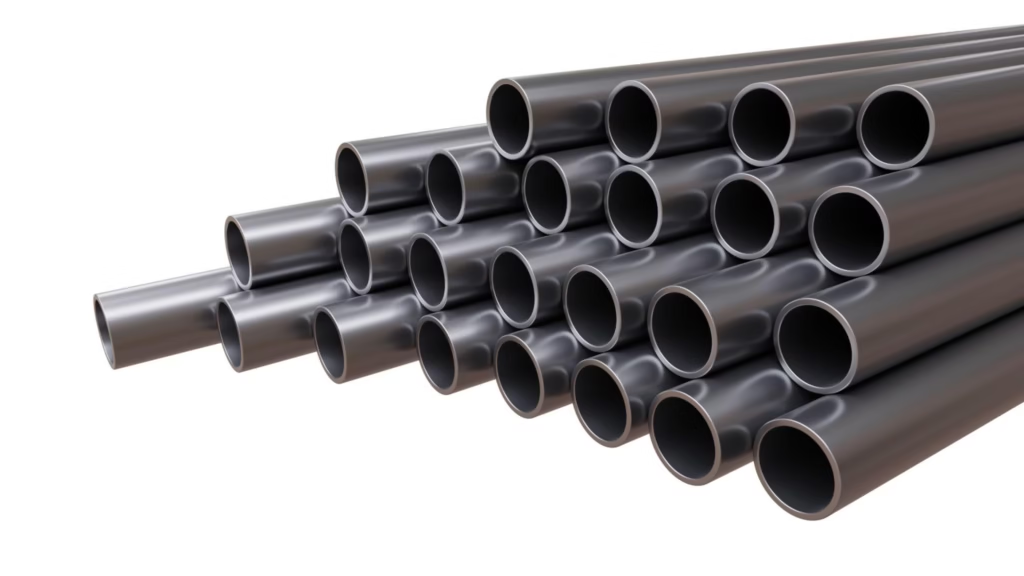
Circular Hollow Section (CHS)
Circular Hollow Section (CHS) is hot-finished or cold-formed structural round tube with equal multi-directional bending resistance and maximum torsional stiffness. OD 21.3mm to 2,000mm, wall 2.0–80mm, lengths 6m/12m. Grades S355J2H, Q345B, A500 Gr.B, A53 Gr.B. Seamless and ERW welded available. Mill test certificate provided.
| Material | Carbon Structural Steel / Low Alloy High Strength Structural Steel |
|---|---|
| Grade / Standard | EN S235JRH / S275J0H / S355J2H / S420MH / S460MH / ASTM A500 Grade B / A53 Grade B / A501 / JIS STK400 / STK490 / GB Q235B / Q345B / Q355B |
| Length | 6m / 12m (Custom up to 18m for large-diameter pile and offshore applications) |
| Delivery Condition | normalized |
| Surface Treatment | shot_blasting / galvanized / coated |
| MOQ | 1 Ton |
| Delivery Time | 15-40 Days / In Stock |
| Loading Port | Tianjin / Shanghai / Qingdao |
Overview of Circular Hollow Section (CHS)
Circular Hollow Section (CHS), also widely referred to as structural round tube, round hollow section, or circular steel tube, is a hot-finished or cold-formed steel section with a circular cross-section that provides equal structural resistance in all radial directions — a unique geometric property that makes CHS the most efficient structural section for members subject to axial compression, torsion, and multi-directional bending simultaneously. The closed circular geometry delivers the highest torsional stiffness of any structural steel section for a given cross-sectional area, equal second moment of area about all axes through the centroid, and the lowest surface area per unit cross-sectional area of any shape — minimising material consumption for corrosion protection coatings and fire protection systems while delivering superior structural efficiency for column, strut, and space frame chord applications.
CHS sections are standardised under EN 10210 (hot-finished structural hollow sections), EN 10219 (cold-formed welded structural hollow sections), ASTM A500 (cold-formed welded round structural tubing), ASTM A501 (hot-formed welded and seamless structural tubing), ASTM A53 (welded and seamless steel pipe), JIS G3444 (carbon steel tubes for general structural purposes), JIS G3466 (carbon steel square and rectangular tubes — also covers round), and GB/T 8162 (seamless steel tubes for structural purposes) / GB/T 6728 (cold-formed hollow sections). Outside diameters range from 21.3mm (½ inch nominal) to 2,000mm and beyond for large-diameter structural applications, with wall thicknesses from 2.0mm to 40mm or more for heavy structural and offshore pile applications. Steel grades span standard carbon structural S235JRH / S275J0H (yield 235–275 MPa) through the dominant S355J2H (yield 355 MPa), high-strength S420MH / S460MH (yield 420–460 MPa), and offshore structural grades S355G8+M / S355G10+M for jack-up rig chord sections under EN 10225.
Key Features and Manufacturing Process
Circular Hollow Sections are produced by two principal manufacturing routes — hot-finished and cold-formed — each with distinct dimensional characteristics, material property distribution, and application suitability. Hot-finished CHS (EN 10210 / ASTM A501 / GB/T 8162 seamless) is produced either by the seamless process (piercing a solid billet at 1200–1280°C through a Mannesmann rotary piercing mill followed by elongating and sizing passes) or by forming a welded tube and hot-sizing above the recrystallisation temperature (above 580°C for EN 10210 compliance). Hot-finishing relieves residual stresses from forming, produces uniform mechanical properties throughout the entire cross-section, and results in tighter dimensional tolerances with smaller wall thickness eccentricity than cold-formed sections — making hot-finished CHS preferred for precise structural connections, heavy offshore structural applications, and fatigue-critical structures where residual stress minimisation is important. Cold-formed CHS (EN 10219 / ASTM A500 / GB/T 6728) is produced by continuously roll-forming steel strip into a circular tube and electric resistance welding (ERW) the longitudinal seam, then cold-sizing to the final diameter — a more economical process providing a wider range of standard diameters and wall thicknesses at lower cost than hot-finished sections.
CHS sections are supplied in standard lengths of 6m and 12m with custom lengths available up to 18m for large-diameter pile and offshore applications, and in outside diameters from 21.3mm to 2,000mm with wall thickness increments of 0.5mm for smaller sections and 1.0–2.0mm for larger structural diameters. Common steel grades include EN S235JRH (yield 235 MPa), S275J0H (yield 275 MPa), S355J2H (yield 355 MPa, dominant structural grade), S420MH and S460MH (high-strength TMCP grades), ASTM A500 Grade B (yield 290 MPa for round, most common American CHS grade), A53 Grade B (yield 240 MPa, standard pipe grade widely used for structural CHS), JIS STK400 / STK490, and GB/T Q235B / Q345B / Q355B. All CHS production undergoes chemical composition analysis, mechanical property testing (yield strength, tensile strength, elongation), dimensional inspection of outside diameter, wall thickness, ovality, straightness, and end squareness per applicable standard, and weld seam nondestructive testing by hydrostatic pressure or electromagnetic examination for ERW sections.
Main Applications of Circular Hollow Section (CHS)
Circular Hollow Section is the dominant structural section for tubular truss and space frame construction in long-span roofs, where CHS chord and web members connected by direct welded joints (T, Y, K, X connections per AISC Chapter K or EN 1993-1-8) provide elegant exposed structural systems for sports stadia, airport terminals, convention centres, railway station concourses, industrial sheds, and pedestrian bridges. The equal biaxial bending resistance and superior torsional stiffness of CHS makes it the optimal section for column members in multi-storey building frames, particularly for architecturally exposed steel (AES) applications in public buildings, retail centres, and transport infrastructure where the circular profile provides a contemporary aesthetic without the directional visual emphasis of rectangular or I-section columns.
Offshore oil and gas structures represent one of the most technically demanding CHS applications — jacket platform legs, braces, and node sections are fabricated from large-diameter heavy-wall CHS (diameter 500–2,000mm, wall 25–80mm) in offshore structural grades S355G8+M or equivalent, with full penetration circumferential butt welds connecting individual CHS sections and complex tubular node fabrication joining multiple brace members at platform nodes. Wind turbine monopile foundations for offshore wind farms are among the largest CHS applications by diameter, with single-piece monopile sections up to 10m diameter and 80–100mm wall thickness driven into the seabed as the primary structural foundation element. Other major applications include: road and pedestrian bridge arch structures and pylon sections; telecommunications and broadcasting antenna masts; electricity transmission and distribution tower sections; port crane boom and jib members; ship hull frames, deck beams, and support pillars; handrail and balustrade systems in public buildings, bridges, and transport infrastructure; conveyor and process pipeline support structures; agricultural building column and rafter sections; greenhouse and horticultural structure frames; flagpole and lighting column structures; architectural feature columns in building facades, atria, and interiors; oil and gas process plant structural supports; petrochemical plant pipe rack primary structural columns; power station structural framing; fluid storage tank support structures; military shelter and rapid-deployment structural frames; and the full spectrum of industrial structural fabrication applications where equal multi-directional load resistance, torsional stiffness, and minimised surface area for corrosion protection are simultaneously required.
Why Choose Us for Circular Hollow Section (CHS)
Shandong Tanglu Metal Material Co., Ltd. supplies premium Circular Hollow Section (CHS) sourced from leading Chinese steel tube producers including Tianjin Pipe Group (TPCO) — one of the world’s largest seamless and welded steel tube producers — alongside Tianjin Youfa Steel Pipe Group and Baosteel, all operating certified production facilities meeting ISO 9001, ISO 14001, EN 10210, EN 10219, API 5L, GB/T 8162, and GB/T 6728 quality and product standard requirements. Every CHS shipment is accompanied by original mill test certificates in EN 10204 3.1 format covering full chemical composition, mechanical property test results (yield strength, tensile strength, elongation), dimensional inspection data including outside diameter, wall thickness, ovality, and straightness, weld seam nondestructive testing confirmation, and complete heat number traceability enabling full batch identification throughout fabrication and construction.
We offer a comprehensive specification range covering CHS outside diameters from 21.3mm to 2,000mm with wall thicknesses 2.0mm to 80mm in both cold-formed (EN 10219 / GB/T 6728) and hot-finished / seamless (EN 10210 / GB/T 8162) production routes, in grades S235JRH, S275J0H, S355J2H, S420MH, S460MH (European), ASTM A500 Grade B, A53 Grade B, A501 (American), JIS STK400, STK490 (Japanese), and GB Q235B / Q345B / Q355B (Chinese). Standard lengths 6m and 12m with custom lengths to 18m. Surface treatment options include bare mill surface, shot blasting Sa2.5, epoxy primer, coal tar epoxy, hot-dip galvanizing, and fusion-bonded epoxy (FBE) for pipeline coating applications. With established monthly supply capacity of 5,000 tons of structural CHS and export relationships with structural steel fabricators, offshore contractors, wind energy developers, bridge builders, and general construction companies across more than 50 countries, we support packages from small architectural and fabrication orders to large offshore and infrastructure project supply contracts. Each shipment includes original mill test certificate per EN 10204 3.1, with EN 10204 3.2, ultrasonic testing reports, and third-party inspection by SGS, Bureau Veritas, ABS, DNV GL, or Lloyd’s Register available for critical structural and offshore projects.
📐 Dimension & Size Table
| Outside Diameter (mm) | Wall Thickness (mm) | Cross Section Area (cm²) | Weight (kg/m) |
|---|---|---|---|
| 48.3 | 3.2 / 4.0 / 5.0 | 4.53 / 5.57 / 6.80 | 3.56 / 4.37 / 5.34 |
| 60.3 | 3.2 / 4.0 / 5.0 | 5.74 / 7.07 / 8.69 | 4.51 / 5.55 / 6.82 |
| 76.1 | 3.2 / 4.0 / 5.0 / 6.3 | 7.34 / 9.07 / 11.20 / 13.90 | 5.75 / 7.11 / 8.77 / 10.91 |
| 88.9 | 3.2 / 4.0 / 5.0 / 6.3 | 8.62 / 10.70 / 13.20 / 16.40 | 6.76 / 8.38 / 10.35 / 12.86 |
| 101.6 | 3.6 / 4.0 / 5.0 / 6.3 | 11.10 / 12.30 / 15.20 / 18.90 | 8.70 / 9.63 / 11.91 / 14.82 |
| 114.3 | 3.6 / 4.0 / 5.0 / 6.3 / 8.0 | 12.50 / 13.90 / 17.20 / 21.40 / 26.80 | 9.83 / 10.88 / 13.48 / 16.83 / 21.03 |
| 139.7 | 4.0 / 5.0 / 6.3 / 8.0 / 10.0 | 17.10 / 21.20 / 26.40 / 33.20 / 40.90 | 13.40 / 16.60 / 20.73 / 26.06 / 32.11 |
| 168.3 | 5.0 / 6.3 / 8.0 / 10.0 / 12.5 | 25.70 / 32.00 / 40.30 / 49.70 / 61.30 | 20.18 / 25.17 / 31.64 / 39.01 / 48.13 |
| 193.7 | 5.0 / 6.3 / 8.0 / 10.0 / 12.5 | 29.60 / 37.10 / 46.70 / 57.70 / 71.30 | 23.27 / 29.12 / 36.65 / 45.27 / 55.96 |
| 219.1 | 5.0 / 6.3 / 8.0 / 10.0 / 12.5 / 16.0 | 33.70 / 42.10 / 53.10 / 65.70 / 81.10 / 102.0 | 26.43 / 33.10 / 41.63 / 51.57 / 63.66 / 80.08 |
| 244.5 | 6.3 / 8.0 / 10.0 / 12.5 / 16.0 | 47.10 / 59.50 / 73.70 / 91.10 / 115.0 | 36.96 / 46.73 / 57.84 / 71.52 / 90.31 |
| 273.0 | 6.3 / 8.0 / 10.0 / 12.5 / 16.0 / 20.0 | 52.80 / 66.60 / 82.60 / 102.0 / 129.0 / 159.0 | 41.42 / 52.28 / 64.86 / 80.33 / 101.23 / 124.82 |
| 323.9 | 8.0 / 10.0 / 12.5 / 16.0 / 20.0 / 25.0 | 79.40 / 98.40 / 122.0 / 155.0 / 191.0 / 235.0 | 62.31 / 77.26 / 95.80 / 121.73 / 149.93 / 184.51 |
| 355.6 | 8.0 / 10.0 / 12.5 / 16.0 / 20.0 / 25.0 | 87.30 / 108.0 / 134.0 / 170.0 / 210.0 / 260.0 | 68.53 / 84.96 / 105.32 / 133.68 / 164.88 / 204.10 |
| 406.4 | 10.0 / 12.5 / 16.0 / 20.0 / 25.0 / 32.0 | 124.0 / 154.0 / 196.0 / 243.0 / 298.0 / 375.0 | 97.44 / 120.96 / 153.88 / 190.77 / 234.03 / 294.62 |
| 457.0 | 10.0 / 12.5 / 16.0 / 20.0 / 25.0 / 32.0 | 140.0 / 174.0 / 221.0 / 274.0 / 337.0 / 426.0 | 109.90 / 136.59 / 173.51 / 215.09 / 264.55 / 334.41 |
| 508.0 | 10.0 / 12.5 / 16.0 / 20.0 / 25.0 / 32.0 / 40.0 | 156.0 / 193.0 / 246.0 / 305.0 / 376.0 / 477.0 / 587.0 | 122.52 / 151.73 / 193.20 / 239.48 / 295.16 / 374.65 / 460.80 |
| 610.0 | 12.5 / 16.0 / 20.0 / 25.0 / 32.0 / 40.0 | 233.0 / 297.0 / 368.0 / 454.0 / 578.0 / 714.0 | 182.91 / 233.15 / 289.04 / 356.55 / 453.93 / 560.77 |
| 711.0 | 16.0 / 20.0 / 25.0 / 32.0 / 40.0 / 50.0 | 347.0 / 431.0 / 532.0 / 678.0 / 841.0 / 1040.0 | 272.38 / 338.43 / 417.62 / 532.23 / 660.29 / 816.40 |
| 813.0 | 16.0 / 20.0 / 25.0 / 32.0 / 40.0 / 50.0 | 397.0 / 494.0 / 610.0 / 778.0 / 967.0 / 1200.0 | 311.66 / 387.94 / 478.98 / 610.83 / 759.04 / 942.00 |
| 1016.0 | 20.0 / 25.0 / 32.0 / 40.0 / 50.0 / 63.0 | 620.0 / 765.0 / 977.0 / 1220.0 / 1520.0 / 1910.0 | 486.70 / 600.53 / 767.15 / 957.40 / 1193.80 / 1499.55 |
* Custom sizes available upon request. Tolerances per relevant international standards.
🔬 Chemical Composition
| Element | Min | Max | Display Value | Note |
|---|---|---|---|---|
| C | - | 0.22 | ≤0.22 | S355J2H per EN 10210-1 / EN 10219-1; Q345B per GB/T 1591 |
| Si | - | 0.55 | ≤0.55 | |
| Mn | 1.00 | 1.60 | 1.00–1.60 | Strengthening element |
| P | - | 0.035 | ≤0.035 | |
| S | - | 0.035 | ≤0.035 | |
| V | - | 0.15 | ≤0.15 | Microalloying element |
| Nb | - | 0.05 | ≤0.05 | Microalloying element |
| Ti | - | 0.05 | ≤0.05 | Microalloying element |
| Cr | - | 0.30 | ≤0.30 | Residual element |
| Ni | - | 0.30 | ≤0.30 | Residual element |
| Cu | - | 0.35 | ≤0.35 | Residual element |
| Mo | - | 0.10 | ≤0.10 | Residual element |
* Chemical composition may vary by heat, thickness and specification. Please refer to the actual mill test certificate.
⚙️ Mechanical Properties
| Property | Value | Unit | Test Condition |
|---|---|---|---|
| Yield Strength (S235JRH) | ≥235 | MPa | Per EN 10210-1 / EN 10219-1, t≤16mm |
| Tensile Strength (S235JRH) | 360–510 | MPa | Per EN 10210-1 / EN 10219-1 |
| Yield Strength (S275J0H) | ≥275 | MPa | Per EN 10210-1 / EN 10219-1, t≤16mm |
| Tensile Strength (S275J0H) | 430–580 | MPa | Per EN 10210-1 / EN 10219-1 |
| Yield Strength (S355J2H) | ≥355 | MPa | Per EN 10210-1 / EN 10219-1, t≤16mm; dominant structural CHS grade |
| Tensile Strength (S355J2H) | 470–630 | MPa | Per EN 10210-1 / EN 10219-1 |
| Elongation (S355J2H) | ≥22 | % | Gauge length 200mm |
| Yield Strength (S420MH / S460MH) | ≥420 / ≥460 | MPa | Per EN 10210-1, TMCP high-strength grade, hot-finished only |
| Tensile Strength (S420MH / S460MH) | 500–660 / 530–720 | MPa | Per EN 10210-1 |
| Yield Strength (ASTM A500 Gr.B — Round) | ≥290 (≥42,000) | MPa (psi) | Per ASTM A500 Grade B round tube — note: lower than square/rectangular Grade B |
| Tensile Strength (ASTM A500 Gr.B — Round) | ≥400 (≥58,000) | MPa (psi) | Per ASTM A500 Grade B |
| Yield Strength (ASTM A53 Gr.B) | ≥240 (≥35,000) | MPa (psi) | Per ASTM A53 Grade B, commonly used as structural CHS |
| Yield Strength (GB Q345B / Q355B) | ≥345 / ≥355 | MPa | Per GB/T 1591, t≤16mm |
| Impact Energy (J2H sub-grade) | ≥27 | J | Charpy V-notch at −20°C per EN 10210-1 / EN 10219-1 |
| Impact Energy (Cold Service, −40°C) | ≥27 | J | Optional for arctic and cold-climate offshore applications |
* Values shown are minimum requirements unless otherwise stated.
📦 Commercial Information
| Packaging | Standard seaworthy export packing for Circular Hollow Section (CHS). Small and medium CHS sections (OD up to 219mm) bundled in hexagonal close-packed arrangements with steel strapping (3–5 wraps per bundle), maximising bundle density and minimising void space — hexagonal packing achieves approximately 91% fill efficiency compared to square packing at 78%. Typical bundle weight 1–5 tons depending on section OD, wall thickness, and length. Each bundle clearly tagged with heat number, grade designation (S355J2H, Q345B, A500 Gr.B, etc.), section designation (OD × wall thickness in mm, e.g. 168.3×8.0), length, and quantity. Plastic end caps applied to both tube ends to protect bore from contamination, moisture ingress, and physical damage during transit and port storage. Anti-rust oil applied to all bare mill surface CHS sections before bundling. Large-diameter CHS sections (OD 273mm and above) individually stacked in single or double layer arrangements with steel chocks and wooden dunnage blocks preventing rolling and layer-to-layer contact during ocean transit. Very large diameter sections (OD 500mm and above) transported as individual pieces with custom timber cradles or steel saddle supports and wire rope lashing to vessel deck or container floor. For 12m lengths, 40HQ container loading for sections up to OD 219mm; break-bulk vessel for larger diameters and longer lengths. Offshore and wind energy monopile sections (OD 3m–10m) transported on heavy-lift semi-submersible vessels or on heavy-lift cargo barges with custom fabricated steel sea-fastening frames. |
|---|---|
| Payment Terms | T/T (Telegraphic Transfer),L/C (Letter of Credit),D/P (Documents against Payment),Western Union,PayPal |
| Price Term | FOB,CFR,CIF,EXW |
| Supply Capacity | 5,000 Tons/Month (Circular Hollow Section CHS) |
| Loading Port | Tianjin / Shanghai / Qingdao |
Why Choose Our Circular Hollow Section (CHS)?
Mill Certified Structural Quality
CHS supplied with original mill test certificate EN 10204 3.1/3.2, covering full chemical composition, mechanical properties (yield strength, tensile strength, elongation, Charpy V-notch impact at −20°C for J2H sub-grade), dimensional inspection per EN 10210-2 / EN 10219-2 / GB/T 8162, weld seam NDE (hydrostatic or electromagnetic), and complete heat number traceability.
Comprehensive CHS Diameter Range
Full CHS range from OD 21.3mm (½ inch nominal) to 2,000mm including all standard EN, ASTM, JIS, and GB sizes, with wall thickness 2.0mm to 80mm. Both cold-formed ERW (EN 10219) and hot-finished / seamless (EN 10210 / GB/T 8162) production routes available. Standard lengths 6m and 12m; custom lengths to 18m for pile and offshore applications.
Equal Multi-Directional Structural Performance
CHS provides identical section properties about all axes — equal moment of inertia, section modulus, and radius of gyration in every direction — delivering maximum structural efficiency for columns, struts, and space frame members under axial load, torsion, and multi-directional bending. Minimum surface area per unit area of any cross-section reduces coating and fire protection material consumption by 20–40% versus equivalent open sections.
Multiple Standards & Grades
Available in EN S235JRH / S275J0H / S355J2H / S420MH / S460MH (European), ASTM A500 Gr.B / A53 Gr.B / A501 (American), JIS STK400 / STK490 (Japanese), and GB Q235B / Q345B / Q355B (Chinese). Offshore structural grades S355G8+M / G10+M and cold-climate impact-tested sub-grades for arctic and sub-arctic service available on request.
Stock Availability & Fast Delivery
Common CHS sizes OD 48.3mm–323.9mm in S355J2H and Q345B maintained in stock for 15–25 days dispatch. Large-diameter and special grades 30–45 days production cycle. Container loading for OD up to 219mm in 12m length; break-bulk vessel for larger diameters. Third-party inspection by SGS, BV, DNV, ABS available.
🏭 Applications of Circular Hollow Section (CHS)
Circular Hollow Section (CHS) serves as the primary structural tube across an exceptionally broad range of industries and applications, exploiting the unique geometric advantage of the circular cross-section — equal structural resistance in all radial directions, maximum torsional stiffness per unit weight, and minimum surface area per unit cross-sectional area — to deliver structural efficiency, aesthetic elegance, and economy of corrosion protection that no other standard structural section can match. In structural building construction, CHS sections function as primary column members in architecturally exposed steel (AES) structures including sports stadia, airport terminals, convention and exhibition centres, shopping centres, transport interchanges, and public building atria where the circular profile provides a visually elegant structural element without the directional visual emphasis of rectangular or I-section columns. Long-span roof truss and space frame construction uses CHS extensively for chord and web members in Vierendeel, Warren, Pratt, and N-truss configurations, with direct welded CHS-to-CHS gap and overlap K-connections providing elegant exposed structural systems without gusset plates or complex connection hardware. Pedestrian and road bridge construction employs CHS for arch sections, cable stay pylon legs, suspension hangers, and primary structural chord members in truss bridge decks, with the circular profile providing superior aerodynamic performance and resistance to wind-induced oscillation compared to open structural sections. The offshore oil and gas industry is one of the largest consumers of heavy-wall large-diameter CHS, fabricating jacket platform leg sections (OD 800–2,000mm, wall 40–80mm), horizontal and diagonal brace members (OD 400–900mm), tubular node sections joining multiple brace members at platform joints, conductor guide frames, and riser support structures from offshore-grade CHS in S355G8+M, S355G10+M, or equivalent high-toughness material certified to DNV GL, ABS, or Lloyd's Register classification society rules. Offshore wind energy monopile foundations (OD 4,000–10,000mm, wall 60–100mm) represent the largest-diameter CHS application, with single-piece monopile can sections fabricated by rolling heavy plate into circular form, welding, and stacking to achieve total monopile lengths of 60–100m for installation in water depths of 20–50m at offshore wind farm sites. Telecommunications, broadcasting, and power transmission tower and mast construction uses CHS for primary leg and bracing sections in lattice towers and monopole structures, where the circular profile's equal wind load resistance in all directions eliminates the need to consider wind attack angle in structural design as required for angular or I-section leg profiles. Marine and shipbuilding applications include vessel hull frame sections, deck beam sections, hatch coaming circular frame members, ship funnel structural support rings, accommodation ladder structural members, pier and dolphin fender pile sections, offshore platform boat landing frames, and subsea pile sleeve sections. Infrastructure applications include roadway and pedestrian bridge handrail and balustrade post sections, highway lighting columns, traffic signal and sign pole sections, airport apron lighting mast sections, flagpole structures, and street furniture structural elements where the circular profile's aesthetic and equal wind resistance properties provide functional and visual advantages over rectangular alternatives. Industrial applications span process plant pipe rack column and diagonal brace sections, oil refinery and petrochemical plant structural support columns, power station boiler house structural columns, wind turbine tower transition piece sections connecting the circular tower to the monopile foundation, agricultural and greenhouse structural framing, heat exchanger shell structural support rings, vertical vessel support skirt sections, and the complete range of industrial structural fabrication where equal biaxial load resistance, torsional stiffness, and minimised maintenance surface area are simultaneously required design objectives.
📋 Quality & Certification
Our Certifications
- ✅ ISO 9001:2015
- ✅ CE Marking
- ✅ ABS
- ✅ DNV GL
- ✅ Lloyd's Register (LR)
- ✅ Bureau Veritas (BV)
- ✅ SGS Certified
- ✅ NK
- ✅ RINA
Mill Certificate Type
- 📋 EN 10204 3.1
- 📋 EN 10204 3.2
- 📋 Original Mill Certificate
- 📋 Third Party Inspection Available
- 📋 Certificate of Origin
❓ Frequently Asked Questions
What is the difference between CHS and SHS/RHS, and when should I choose circular over square or rectangular hollow sections?
CHS (Circular Hollow Section), SHS (Square Hollow Section), and RHS (Rectangular Hollow Section) are all closed tubular steel sections providing high torsional stiffness and enclosed cross-section geometry, but they differ fundamentally in structural behaviour, connection detailing complexity, and aesthetic characteristics. CHS provides equal second moment of area about all axes through the centroid (Ixx = Iyy = I in any direction), making it the structurally optimal section for members subject to combined axial load, biaxial bending, and torsion simultaneously — particularly columns, struts, and space frame members where the dominant load direction is not predetermined. CHS also provides the minimum surface area per unit cross-sectional area of any closed section, reducing coating and fire protection material consumption by 20–40% compared to SHS or RHS of equivalent structural capacity. SHS provides equal section modulus and moment of inertia about the two principal axes (Ixx = Iyy) but lower values than CHS of equal perimeter due to the corner geometry, and delivers flat faces that greatly simplify beam-to-column connections, cladding attachment, and equipment bracket fabrication. RHS provides unequal section properties about the two axes, allowing the designer to orient the stronger axis in the plane of dominant bending for maximum efficiency in beam applications. Choose CHS when: equal multi-directional structural resistance is required; torsional loading is significant; architectural aesthetics favour the circular profile; surface area minimisation for coating economy is important; or CHS-to-CHS welded connections are used in exposed truss structures. Choose SHS for symmetric column applications requiring flat face connections and cladding attachment. Choose RHS for beam and chord applications where bending is predominantly in one plane and flat face geometry is needed for straightforward connection detailing.
What is the difference between hot-finished CHS (EN 10210) and cold-formed CHS (EN 10219)?
Hot-finished CHS (EN 10210) and cold-formed CHS (EN 10219) differ in manufacturing process, residual stress state, dimensional accuracy, corner geometry (for square/rectangular — both appear as smooth circular for CHS), and mechanical property distribution. Cold-formed CHS (EN 10219) is produced by continuously ERW roll-forming steel strip into a circular tube and cold-sizing to the final diameter. Cold-working introduces residual stresses and non-uniform property distribution, with work-hardening particularly pronounced at the seam weld zone and former contact zones from the forming rolls. EN 10219 specifies mechanical properties from specimens cut from the tube body and permits larger dimensional tolerances (outside diameter ±1.0% for OD >220mm, wall thickness ±10%) and higher ovality (the difference between maximum and minimum outside diameter at any cross-section) than hot-finished sections. Cold-formed CHS is more economical and available in a wider range of small to medium diameters. Hot-finished CHS (EN 10210) is produced by forming a tube and hot-sizing above 580°C (or by the seamless piercing and sizing process for seamless CHS), relieving residual stresses and producing uniform, isotropic mechanical properties throughout the cross-section. Dimensional tolerances are tighter (OD ±1.0% for OD >219mm but with tighter ovality limits), and the absence of a visible longitudinal weld seam on the external surface (for seamless) or internal weld bead (for hot-finished welded) simplifies corrosion protection inspection and improves aesthetic appearance for exposed architectural applications. Hot-finished CHS is specified for: fatigue-critical offshore structures where residual stress accelerates crack initiation; precision structural connections using the full cross-section in tension; architecturally exposed applications requiring uniform surface appearance; and high-strength grades S420MH and S460MH only available in hot-finished form per EN 10210. Hot-finished commands a 20–40% price premium over equivalent cold-formed CHS.
What steel grade should I specify for structural CHS — S235JRH, S355J2H, or S420MH?
Grade selection for structural CHS depends on design loads, applicable design code, operating temperature, welding requirements, and project economy objectives. S235JRH (yield ≥235 MPa, per EN 10210-1 / EN 10219-1) is the minimum structural grade suitable for lightly loaded secondary members, handrail posts, agricultural building structural members, light conveyor supports, and temporary works where design stresses are low and section sizes are governed by stiffness or minimum practical dimensions rather than strength. S275J0H (yield ≥275 MPa) provides a modest 17% strength increase over S235JRH and was historically used in the UK and some European markets for medium-load structural CHS, but has largely been superseded by S355J2H in modern structural design. S355J2H (yield ≥355 MPa) is the dominant structural CHS grade worldwide, providing approximately 50% higher yield strength than S235JRH for the same cross-section, enabling significant section size and weight reduction (typically 25–35% less steel weight for equivalent structural performance). The J2H suffix specifies Charpy V-notch impact energy ≥27J at −20°C, suitable for cold-climate outdoor structural applications down to approximately −15°C ambient. S355J2H is specified for primary structural members in building frames, roof trusses, space frames, bridges, offshore platforms, and wind turbine transition pieces where structural efficiency and weight minimisation are important design objectives. S420MH and S460MH (yield ≥420/460 MPa, hot-finished EN 10210 only) are TMCP thermomechanically processed high-strength grades providing further weight savings of 15–20% versus S355J2H at a material cost premium of 20–35%. These grades are specified for weight-critical applications including offshore platform structures where topside weight directly affects jacket and foundation design cost, high-strength truss chord members in long-span structures, and crane boom and jib sections where self-weight reduction improves crane capacity. For arctic and sub-arctic applications below −20°C, supplementary impact testing at −40°C or dedicated arctic structural grades per EN 10225 should be specified.
How are CHS-to-CHS welded connections designed and what are the key limitations?
CHS-to-CHS welded connections (also called tubular connections or node connections) are designed per AISC Specification Chapter K (Connections to Hollow Structural Sections) for American practice or EN 1993-1-8 Clause 7 (Joints in hollow section lattice girders) for European practice. The principal connection types are: T-connections (single branch perpendicular to chord), Y-connections (single branch at angle to chord), K-connections with gap (two branches on one chord side with gap between branch toes — most common in truss design), K-connections with overlap (branches overlapping at toes), and X-connections (branches on opposite chord faces). Design strength equations for each connection type are provided as functions of: chord outside diameter (D) and wall thickness (T); branch outside diameter (d) and wall thickness (t); diameter ratio β = d/D; chord slenderness γ = D/(2T); angle between branch and chord θ; and gap or overlap ratio. Failure modes include: chord face plastification (local yielding of chord wall under branch load — governing for small β ratios); punching shear through chord wall; chord side wall buckling; and branch member failure adjacent to weld. Key design limitations and validity ranges per EN 1993-1-8 Table 7.1: diameter ratio 0.2 ≤ β ≤ 1.0; chord slenderness γ = D/(2T) ≤ 50; wall thickness T ≥ 2.5mm and t ≥ 2.5mm; branch-to-chord angle θ ≥ 30°; chord utilisation ratio (ratio of axial force in chord to chord yield capacity) must be within the range specified in the relevant formula. For CHS trusses, gap connections (with gap g ≥ t₁ + t₂ between branch toes) are generally preferred over overlap connections for fabrication simplicity and quality control. All CHS-to-CHS structural welds should be full circumferential fillet or partial/full penetration groove welds per AWS D1.1 or EN ISO 15614, with particular attention to weld profile at the branch saddle (point of smallest included angle) where incomplete fusion is most likely to occur in manual welding.
What is the difference between ASTM A500 Grade B round tube, ASTM A53 Grade B, and ASTM A501 for structural CHS applications?
ASTM A500, A53, and A501 are three distinct American standards for round structural steel tubes, each with different manufacturing processes, mechanical property requirements, and appropriate structural applications. ASTM A500 Grade B round tube is cold-formed welded (ERW) carbon steel structural tubing with minimum yield strength 42,000 psi (290 MPa) and tensile 58,000 psi (400 MPa) for round sections — note that the A500 round tube yield of 42 ksi is lower than A500 Grade B square/rectangular yield of 46 ksi, a distinction that surprises many structural engineers. A500 is the standard specification for round structural HSS sections in building construction per AISC, available in outside diameters from 1.315 inch (33.4mm) to 20 inch (508mm) with standard HSS wall thicknesses. ASTM A53 Grade B is a specification for welded and seamless black and hot-dip galvanized steel pipe originally developed for pressure piping systems but widely used as structural CHS due to its availability, low cost, and AISC-listed status. A53 Grade B requires minimum yield 35,000 psi (241 MPa) and tensile 60,000 psi (414 MPa). A53 pipe is available in nominal pipe sizes (NPS) from ½ inch to 26 inch (DN 15 to DN 650), with Schedule 40, 80, and XXH wall thicknesses — thicker walls than equivalent HSS for the same OD, making A53 heavier but more economical per length for small-diameter applications. A53 is AISC-listed for structural use as round HSS and is commonly used for handrails, bracing, secondary structural members, and light columns where the pipe schedule wall is acceptable. ASTM A501 specifies hot-formed (hot-finished) welded and seamless carbon steel structural tubing with minimum yield 36,000 psi (248 MPa) and tensile 58,000 psi (400 MPa), manufactured at elevated temperature to relieve cold-forming residual stresses. A501 provides more uniform mechanical properties and larger corner radii than A500, and is preferred for applications requiring superior weldability, large bend radii, or specific section isotropy requirements, at a significant cost premium over A500. For most structural applications per AISC 360, A500 Grade B is the practical and economically preferred specification for round structural CHS.
Get a Quote for
Circular Hollow Section (CHS)
Submit your requirements and receive a competitive price quote within 24 hours.
- ✓ Fast response within 24 hours
- ✓ Competitive factory-direct pricing
- ✓ Free technical consultation
- ✓ Mill test certificate provided
- ✓ Flexible payment terms available
⏱ Response within 24 hours
Send Your Inquiry
All fields marked with * are required