
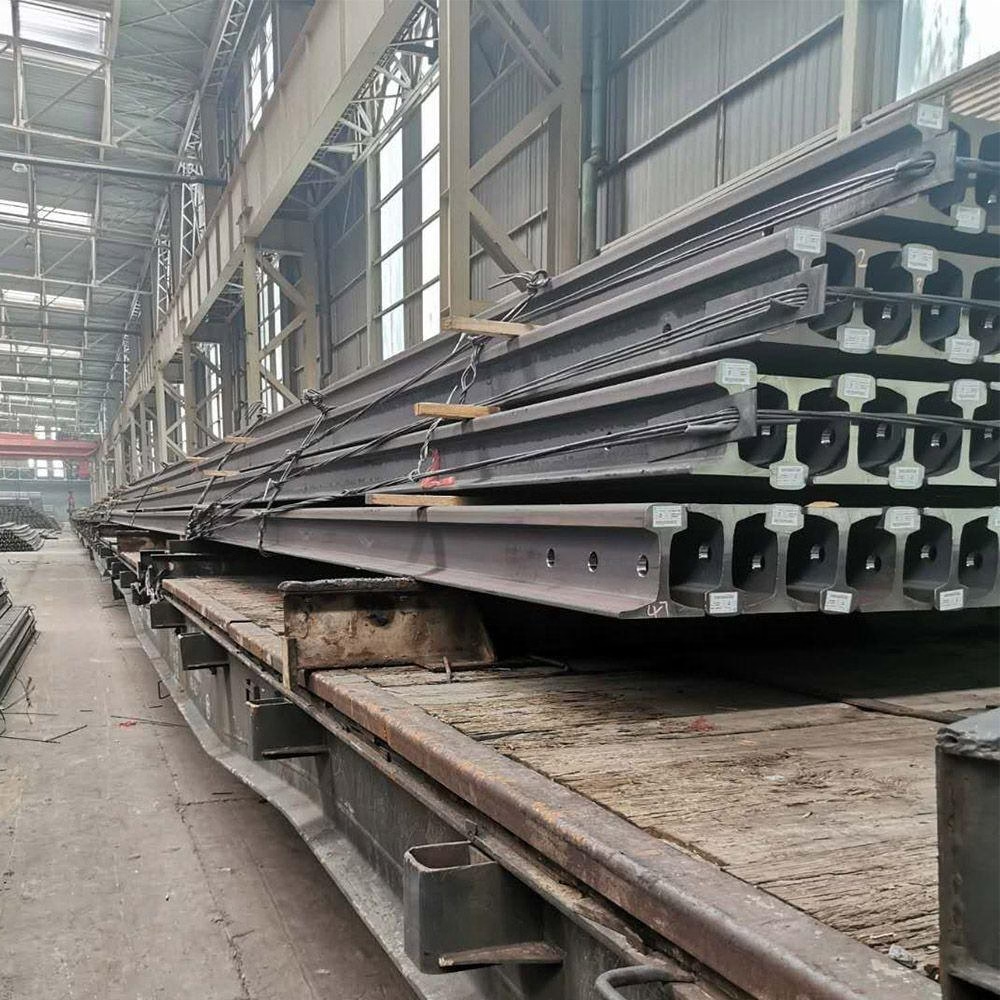
Steel Rail
Steel Rail is hot-rolled asymmetric I-section with hardened head, slender web, and broad base for railway track and crane runway applications. Railway rail 43–75 kg/m, crane rail DIN A45–A150 / QU70–QU120. Grades R220, R260, R350HT, R400HT. Lengths 12m/18m/25m. Mill test certificate provided.
| Material | Carbon Rail Steel / Head-Hardened Pearlitic Rail Steel / Chromium-Alloyed Rail Steel |
|---|---|
| Grade / Standard | EN R200 / R220 / R260 / R320Cr / R350HT / R400HT / GB U71Mn / U75V / U78CrV / AREMA Grade 1 / Grade 2 / Premium / JIS 50N / 60N |
| Section Size | Railway Rail: 43 kg/m to 75 kg/m | Crane Rail: DIN A45 to A150 / GB QU70 to QU120 |
| Flange Width | Railway Rail Base: 114mm – 150mm | Crane Rail Base: 80mm – 200mm |
| Web Height | Railway Rail Height: 140mm – 192mm | Crane Rail Height: 89mm – 175mm |
| Web Thickness | Railway Rail Web: 14mm – 20mm | Crane Rail Web: 16mm – 38mm |
| Length | 12m / 18m / 25m (Flash Butt Welded CWR strings available) |
| Delivery Condition | normalized |
| Surface Treatment | shot_blasting / coated |
| MOQ | 10 Tons |
| Delivery Time | 20-45 Days / In Stock |
| Loading Port | Tianjin / Shanghai / Qingdao |
Overview of Steel Rail
Steel Rail is a hot-rolled structural steel section with an asymmetric I-shaped cross-section specifically engineered to guide and support the wheels of railway vehicles, overhead cranes, port gantry cranes, and industrial material handling equipment. Unlike standard structural I-beams, steel rails feature a broad flat base flange for secure fastening to sleepers or rail seats, a slender web for height and load distribution, and a hardened mushroom-shaped head with a precisely profiled running surface that guides wheel flanges and transfers concentrated wheel loads to the supporting structure below. This purpose-designed geometry distributes dynamic wheel loads efficiently through the rail cross-section, minimises contact stress at the wheel-rail interface, and provides resistance to vertical bending, lateral forces, and rolling contact fatigue throughout the operational service life of the track or crane runway.
Steel rails are classified into two principal categories by application: railway rails for passenger and freight train operations, and crane rails for overhead travelling cranes, port gantry cranes, shipbuilding goliath cranes, and industrial floor-mounted rail systems. Railway rails are standardised under UIC 860 (international heavy haul standard), EN 13674-1 (European railway rail), AREMA (American Railway Engineering and Maintenance-of-Way Association), JIS E1101 / E1120 (Japanese railway rail), and GB/T 2585 (Chinese railway rail), with standard rail profiles designated by linear weight in kg/m — common types including 43 kg/m, 50 kg/m, 60 kg/m (UIC 60), and 75 kg/m for heavy haul applications. Crane rails are standardised under DIN 536 (A-series: A45 to A150), EN 13674-3, JIS E1102, and GB/T 11264, designated by head width in millimetres, covering A45 through A150 for overhead crane runways and QU70 through QU120 for heavy port and shipyard gantry cranes. Steel grades range from standard carbon rail steel R200 / R220 (minimum hardness 200–220 HBW) through head-hardened and heat-treated premium grades R260, R320Cr, R350HT, and R400HT for high-speed railway, heavy haul freight, and high-cycle crane applications requiring maximum wear resistance and rolling contact fatigue life.
Key Features and Manufacturing Process
Steel rails are manufactured by hot rolling at temperatures of 1100–1250°C using dedicated rail rolling mills with calibrated grooved roll passes that progressively shape the base flange, web, and head from a bloom or continuously cast rectangular billet in a sequence of roughing, intermediate, and finishing roll passes. The asymmetric rail cross-section requires precise roll calibration to maintain the critical dimensional tolerances on head width, head height, web thickness, base width, base thickness, and overall height that determine wheel guidance accuracy and rail seat bearing area. After hot rolling, premium grade rails undergo accelerated head hardening by controlled water or air quenching of the rail head from rolling heat or after reheating to austenite temperature, producing a hardened pearlitic microstructure in the head running surface (Brinell hardness 260–400 HBW depending on grade) while the web and base remain relatively soft and tough — this dual-property structure provides wear-resistant running surface combined with ductile base and web sections that resist brittle fracture under impact loading.
Rails are supplied in standard lengths of 12m, 18m, 25m, and 50m (long welded rail for direct fixation track), with flash butt welding service available for producing continuous welded rail (CWR) strings of 150–500m for high-speed railway installation. Standard railway rail profiles include 43 kg/m (light branch line and industrial track), 50 kg/m (standard mainline freight), 60 kg/m / UIC 60 (heavy mainline passenger and freight, the most widely used worldwide), and 75 kg/m (heavy haul freight and mining). Standard crane rail profiles include DIN A45, A55, A65, A75, A100, A120, A150 and GB QU70, QU80, QU100, QU120 for crane runway applications. Steel grades include standard pearlitic carbon rail steel R200 / R220 / R260 (EN 13674-1), head-hardened R320Cr (chromium-alloyed), premium heat-treated R350HT / R400HT for heavy haul and high-speed lines, and AREMA Grade 1 / Grade 2 / Premium for American practice. All rails undergo mandatory dimensional inspection per applicable standard, Brinell hardness testing of the rail head at specified positions, mechanical property testing including tensile strength, yield strength, and elongation on samples cut from the rail, ultrasonic testing for internal defect detection (hydrogen flakes, piping, segregation), drop weight or Charpy impact testing, and surface quality inspection for decarburisation depth, surface cracks, and seam defects.
Main Applications of Steel Rail
Railway rails are the primary application, serving as the running surface and load-bearing element in national mainline railway networks, urban metro and light rail transit systems, high-speed passenger railway lines, heavy haul bulk commodity freight railways for coal, iron ore, and grain transport, dedicated industrial railway sidings and plant railways connecting factories and distribution centres to the national rail network, narrow gauge mining and quarry railways for ore and material transport underground and at surface, logging railways, sugar cane plantation railways, tourism and heritage railway lines, and amusement park ride track systems. The specific rail profile and grade selection depends on axle load, traffic density, train speed, track curvature, and rail grinding maintenance programme — heavier rail profiles and harder grades are specified for high-axle-load freight and heavy-haul operations while lighter profiles are adequate for low-density branch line and industrial siding applications.
Crane rails represent the second major application category, serving as precision running surfaces for overhead travelling cranes in steel mills, fabrication shops, warehouses, paper mills, and automotive manufacturing plants, portal and semi-portal cranes in shipbuilding yards and heavy fabrication facilities, ship-to-shore container cranes and rubber-tyred gantry (RTG) cranes at container terminal ports, coal and bulk cargo grab cranes at power stations and bulk terminals, ladle cranes and charging cranes in steelmaking facilities, stacker-reclaimer machines at bulk material storage yards, automated storage and retrieval systems (AS/RS) in high-bay warehouses, nuclear fuel handling cranes in power plant reactor buildings, and monorail systems in automotive assembly plants and industrial manufacturing facilities. Other significant applications include funicular railway and cable car track systems, rack-and-pinion railway track for steep gradient mountain railways, roller coaster and theme park ride track systems, airport baggage handling system track, industrial floor-mounted transfer car rails for moving heavy tooling and dies between machine stations, and guide rail systems for vertical lifting equipment including material hoists, construction platform hoists, and elevator counterweight guide rails.
Why Choose Us for Steel Rail
Shandong Tanglu Metal Material Co., Ltd. supplies premium steel rails sourced from China’s leading rail producers including Panzhihua Iron & Steel (PanGang) — one of the world’s largest and most technically advanced rail producers supplying rails to China’s high-speed railway network and over 30 countries — and Baotou Steel, with certified production facilities meeting ISO 9001, ISO 14001, UIC 860, EN 13674-1, GB/T 2585, JIS E1101, and AREMA product standard requirements. Every rail shipment is accompanied by original mill test certificates in EN 10204 3.1 format covering chemical composition, mechanical properties (tensile strength, yield strength, elongation), rail head Brinell hardness at specified positions, ultrasonic testing results for internal defect detection, dimensional inspection data, and complete heat number traceability enabling full batch identification.
We offer a comprehensive specification range covering railway rail profiles 43 kg/m, 50 kg/m, 60 kg/m (UIC 60), and 75 kg/m in standard and head-hardened grades R200, R220, R260, R320Cr, R350HT, and R400HT per EN 13674-1 / UIC 860 / GB/T 2585, plus crane rail profiles DIN A45 through A150 and GB QU70 through QU120. Standard lengths 12m, 18m, and 25m, with flash butt welding service for continuous welded rail strings. With established monthly supply capacity of 5,000 tons of steel rail sections and export relationships with railway construction contractors, crane manufacturers, port operators, and industrial facility developers across more than 50 countries, we support both small industrial siding and crane runway projects and large national railway infrastructure supply contracts. Each shipment includes original mill test certificate (MTC) per EN 10204 3.1 standard, with EN 10204 3.2, ultrasonic testing reports, and third-party inspection by SGS, Bureau Veritas, or equivalent inspection bodies available for railway authority and crane manufacturer quality assurance requirements.
📐 Dimension & Size Table
| Rail Profile | Standard | Rail Height (mm) | Head Width (mm) | Base Width (mm) | Web Thickness (mm) | Weight (kg/m) |
|---|---|---|---|---|---|---|
| 43 kg/m | GB/T 2585 / UIC | 140 / 70 / 114 / 14 | 43.0 | |||
| 50 kg/m | GB/T 2585 / UIC | 152 / 70 / 132 / 15 | 50.4 | |||
| 60 kg/m (UIC 60) | EN 13674-1 / UIC 860 | 172 / 72 / 150 / 16.5 | 60.3 | |||
| 75 kg/m | GB/T 2585 | 192 / 75 / 150 / 20 | 74.4 | |||
| 50N (JIS) | JIS E1101 | 153 / 65 / 127 / 15 | 50.4 | |||
| 60N (JIS) | JIS E1101 | 174 / 72 / 150 / 16 | 60.8 | |||
| 115 RE (AREMA) | AREMA | 171 / 73 / 140 / 16 | 57.2 | |||
| 136 RE (AREMA) | AREMA | 185 / 74 / 152 / 17.5 | 67.7 | |||
| DIN A45 | DIN 536 | 89 / 45 / 80 / 16 | 33.3 | |||
| DIN A55 | DIN 536 | 100 / 55 / 95 / 18 | 44.0 | |||
| DIN A65 | DIN 536 | 110 / 65 / 105 / 20 | 52.8 | |||
| DIN A75 | DIN 536 | 120 / 75 / 120 / 22 | 62.9 | |||
| DIN A100 | DIN 536 | 145 / 100 / 150 / 26 | 89.0 | |||
| DIN A120 | DIN 536 | 160 / 120 / 170 / 32 | 118.0 | |||
| DIN A150 | DIN 536 | 180 / 150 / 200 / 38 | 158.0 | |||
| QU70 (GB) | GB/T 11264 | 120 / 70 / 120 / 22 | 63.0 | |||
| QU80 (GB) | GB/T 11264 | 130 / 80 / 130 / 24 | 76.0 | |||
| QU100 (GB) | GB/T 11264 | 150 / 100 / 150 / 28 | 100.0 | |||
| QU120 (GB) | GB/T 11264 | 170 / 120 / 170 / 34 | 130.0 |
* Custom sizes available upon request. Tolerances per relevant international standards.
🔬 Chemical Composition
| Element | Min | Max | Display Value | Note |
|---|---|---|---|---|
| C | 0.60 | 0.82 | 0.60–0.82 | High carbon for pearlitic microstructure and wear resistance; R260/U71Mn typical 0.71–0.82% |
| Si | 0.13 | 0.60 | 0.13–0.60 | Solid solution strengthening |
| Mn | 0.65 | 1.25 | 0.65–1.25 | Hardenability and strengthening element |
| P | - | 0.025 | ≤0.025 | Strictly controlled for toughness |
| S | - | 0.025 | ≤0.025 | Strictly controlled for toughness |
| Cr | - | 0.25 | ≤0.25 | R320Cr / U78CrV: 0.15–0.80% for wear resistance |
| V | - | 0.12 | ≤0.12 | Microalloying for grain refinement; U75V / R350HT: 0.04–0.12% |
| Ni | - | 0.15 | ≤0.15 | Residual element |
| Cu | - | 0.15 | ≤0.15 | Residual element |
| Al | - | 0.004 | ≤0.004 | Strictly limited to prevent alumina inclusions in rail steel |
* Chemical composition may vary by heat, thickness and specification. Please refer to the actual mill test certificate.
⚙️ Mechanical Properties
| Property | Value | Unit | Test Condition |
|---|---|---|---|
| Tensile Strength (R200 / as-rolled light grade) | ≥680 | MPa | Per EN 13674-1, standard carbon rail |
| Tensile Strength (R220 / standard grade) | ≥770 | MPa | Per EN 13674-1 / GB/T 2585 U71Mn |
| Tensile Strength (R260 / mainline freight grade) | ≥880 | MPa | Per EN 13674-1 / UIC 860, most common mainline grade |
| Tensile Strength (R320Cr / Cr-alloyed) | ≥1,080 | MPa | Per EN 13674-1, chromium-alloyed head-hardened |
| Tensile Strength (R350HT / heat-treated) | ≥1,175 | MPa | Per EN 13674-1 / GB/T 2585 U75V, premium HH grade |
| Tensile Strength (R400HT / premium) | ≥1,280 | MPa | Per EN 13674-1, highest wear resistance grade |
| Elongation (R260) | ≥10 | % | Gauge length 200mm |
| Elongation (R350HT / R400HT) | ≥9 | % | Gauge length 200mm |
| Head Hardness (R200) | 200–240 | HBW | Brinell hardness at rail head running surface |
| Head Hardness (R260) | 260–300 | HBW | Brinell hardness at rail head running surface |
| Head Hardness (R350HT) | 350–390 | HBW | Head-hardened, Brinell at running surface |
| Head Hardness (R400HT) | 400–440 | HBW | Premium heat-treated, maximum wear resistance |
| Charpy Impact (R260 at +20°C) | ≥25 | J | V-notch specimen from rail head per EN 13674-1 |
* Values shown are minimum requirements unless otherwise stated.
📦 Commercial Information
| Packaging | Standard seaworthy export packing for steel rail sections. Rails bundled in parallel stacks with steel strapping (3–5 wraps per bundle), typical bundle weight 3–5 tons for railway rail and 2–4 tons for crane rail, depending on profile weight and length. Each bundle clearly tagged with heat number, rail profile designation (60 kg/m UIC 60, DIN A100, QU80, etc.), steel grade (R260, R350HT, U71Mn, etc.), length, and quantity. Wooden dunnage blocks placed between rail layers at regular intervals (maximum 3m spacing) to prevent rail-to-rail contact and base flange deformation during handling and ocean transport. Rail head surfaces protected with anti-rust oil coating applied at mill before bundling; additional protective wrapping with waxed paper or PE film available for premium head-hardened grades. For long rail lengths (18m and 25m), break-bulk vessel loading with dedicated rail stowage on flat deck or in cargo hold with proper chocking and lashing per IMO cargo securing requirements. Container loading available for 12m rails — maximum 8–10 rails per 40HQ container depending on profile weight, with timber blocking to prevent longitudinal shifting during transit. Flash butt welded continuous welded rail (CWR) strings of 150–500m supplied on dedicated rail transport wagons for domestic delivery or on specialist heavy-lift vessels for international projects. |
|---|---|
| Payment Terms | T/T (Telegraphic Transfer),L/C (Letter of Credit),D/P (Documents against Payment),Western Union,PayPal |
| Price Term | FOB,CFR,CIF,EXW |
| Supply Capacity | 5,000 Tons/Month (Steel Rail) |
| Loading Port | Tianjin / Shanghai / Qingdao |
Why Choose Our Steel Rail?
Mill Certified Railway & Crane Rail Quality
Steel rail supplied with original mill test certificate EN 10204 3.1/3.2 covering chemical composition, mechanical properties (tensile strength, yield strength, elongation), rail head Brinell hardness at all specified positions, ultrasonic testing results for internal defect detection (hydrogen flakes, segregation, piping), dimensional inspection per EN 13674-1 / DIN 536 / GB/T 2585 / JIS E1101, and complete heat number traceability.
Complete Railway & Crane Rail Range
Full coverage of railway rail profiles 43 kg/m through 75 kg/m per UIC / EN / GB / JIS / AREMA standards, and crane rail profiles DIN A45 through A150 and GB QU70 through QU120. Standard lengths 12m, 18m, and 25m. Flash butt welding service for continuous welded rail strings available.
Head-Hardened & Heat-Treated Grades
Standard carbon rail R220/R260 through premium head-hardened R350HT and R400HT grades available, providing head Brinell hardness 200–440 HBW. Head-hardened grades deliver 2–3× longer rail service life in curves, heavy haul freight, and high-cycle crane applications by resisting rolling contact fatigue, corrugation, and wear at the wheel-rail contact surface.
Multiple International Standards
Rails available per EN 13674-1 / UIC 860 (European / International), GB/T 2585 / GB/T 11264 (Chinese), JIS E1101 / E1102 (Japanese), AREMA (American), and DIN 536 (German crane rail). Grade equivalencies and cross-standard substitution advisory service available for international railway and crane projects requiring specification compliance.
Reliable Rail Project Supply
Standard railway and crane rail profiles maintained in stock for 20–30 days dispatch. Premium head-hardened and special grades 35–45 days production cycle. Break-bulk vessel loading for long rails (18m/25m) and large tonnage orders; container loading for 12m rails and smaller crane rail profiles. Third-party inspection by SGS, BV, DNV, ABS available.
🏭 Applications of Steel Rail
Steel rail serves as the fundamental load-bearing and guidance element across the full spectrum of railway and rail-guided material handling applications. In national railway infrastructure, 60 kg/m UIC 60 and 75 kg/m heavy rail profiles in R260 and R350HT grades form the primary running surface for high-speed passenger railway lines, mixed passenger-freight mainline networks, dedicated heavy haul freight corridors for bulk commodity transport including iron ore, coal, grain and phosphate, suburban commuter rail networks, and intermodal freight terminal internal railway systems. Lighter 43 kg/m and 50 kg/m profiles in R220/R260 grades serve industrial railway sidings connecting factories, power stations, ports, and logistics centres to the national network, narrow gauge underground mining railways for ore and material transport in tunnel and open-pit mining operations, quarry and aggregate plant internal railways, sugar mill field railways, and heritage and tourism railway lines. Urban mass transit applications include metro and underground railway, light rail transit and tramway systems using dedicated groove rail and Vignole rail profiles, monorail guide beam track, and automated people mover guideway systems at airports and amusement parks. Crane rail applications span the complete industrial spectrum: DIN A45 and A55 light crane rails for small workshop overhead travelling cranes with lifting capacities up to 10 tons, DIN A65 and A75 for medium industrial cranes 10–50 tons in fabrication shops and warehouses, DIN A100 and A120 for heavy industrial cranes 50–200 tons in steel mills, paper mills, shipbuilding shops, and heavy manufacturing facilities, DIN A150 and QU120 for the heaviest applications including steel mill ladle cranes 200–500 tons, shipbuilding goliath cranes, ship-to-shore container cranes at major container terminals, coal and bulk material grab cranes at power stations and bulk terminals, and stacker-reclaimer machines at open-air bulk storage yards. Specialised rail applications include funicular and rack railway track for steep mountain gradient systems, roller coaster and theme park ride steel track, airport people mover and baggage handling system rails, automated guided vehicle (AGV) floor rail systems in automotive and electronics manufacturing plants, transfer car rails for moving heavy tooling, dies, and large assemblies between machining and assembly stations in aerospace and heavy equipment manufacturing facilities, and nuclear power plant spent fuel handling crane rails requiring stringent quality documentation and traceability per nuclear safety regulations.
📋 Quality & Certification
Our Certifications
- ✅ ISO 9001:2015
- ✅ CE Marking
- ✅ ABS
- ✅ DNV GL
- ✅ Lloyd's Register (LR)
- ✅ Bureau Veritas (BV)
- ✅ SGS Certified
- ✅ NK
- ✅ RINA
Mill Certificate Type
- 📋 EN 10204 3.1
- 📋 EN 10204 3.2
- 📋 Original Mill Certificate
- 📋 Third Party Inspection Available
- 📋 Certificate of Origin
❓ Frequently Asked Questions
What is the difference between railway rail and crane rail, and how do I choose the correct type?
Railway rail and crane rail are both asymmetric I-section steel profiles designed to guide and support wheeled vehicles, but they differ significantly in cross-section geometry, designation system, and load characteristics to suit their respective applications. Railway rail (Vignole rail) is designated by linear weight in kg/m (43, 50, 60, 75 kg/m) and features a relatively narrow, rounded mushroom-shaped head optimised for the conical tread profile of railway wheel flanges, a slender web providing sufficient height for bending resistance, and a broad flat base for fastening to timber or concrete sleepers with rail clips, spikes, or baseplate systems. The rounded head profile allows the wheel contact point to shift laterally across the head width as the wheelset steers through curves, distributing rolling contact fatigue damage across the full head width rather than concentrating it at a single point. Crane rail (DIN A-series or GB QU-series) is designated by head width in millimetres (A45, A75, A100, A120, A150; QU70, QU80, QU100, QU120) and features a wider, flat-topped head providing a large contact area for the flat or slightly convex tread of crane wheels, a much heavier web and base section to resist the concentrated static and dynamic wheel loads of overhead cranes (which can reach 500–1,000 kN per wheel for large ladle cranes), and a flat base for bolted attachment to crane runway beams using rail clamps, fishplates, or welded rail seats. Crane rails are not interchangeable with railway rails — using railway rail as crane rail risks premature head wear, head checking, and lateral instability of the crane wheel due to the rounded head profile mismatch with flat crane wheel treads. Selection should be based on: application type (railway track vs. crane runway), wheel load, crane capacity and wheel base, running speed, and applicable design standard (EN 13674 for railway; DIN 536 / GB/T 11264 for crane rail).
What is the difference between R260, R350HT, and R400HT rail grades, and which should I specify?
R260, R350HT, and R400HT are rail steel grades defined in EN 13674-1 (European standard for flat-bottom railway rail), differentiated primarily by rail head hardness and tensile strength, which determine wear resistance and rolling contact fatigue life in service. R260 (minimum tensile strength 880 MPa, head hardness 260–300 HBW) is the standard pearlitic carbon rail grade produced by as-rolled cooling without post-rolling heat treatment. It provides adequate wear resistance for moderate-traffic mainline freight and passenger railways, light industrial railways, and crane runway applications. R260 is the most widely used and most economical rail grade globally, suitable for straight track and gentle curves on lines with axle loads up to approximately 25 tonnes and traffic density up to 25 MGT (million gross tonnes) per year. R350HT (minimum tensile strength 1,175 MPa, head hardness 350–390 HBW) is a head-hardened rail produced by accelerated quenching of the rail head from rolling heat or after reheating, creating a fine pearlitic microstructure with significantly higher hardness than as-rolled R260. R350HT provides 2–3× longer service life than R260 in curved track (radius below 800m), high-axle-load heavy haul freight applications (30–40 tonne axle loads), and high-traffic-density routes where rail grinding intervals are extended. It is specified for curve rails, transition zones, switch and crossing stock rails, and crane rails in high-cycle industrial applications. R400HT (minimum tensile strength 1,280 MPa, head hardness 400–440 HBW) is the premium head-hardened chromium-vanadium alloyed grade providing maximum wear resistance for the most demanding applications including very sharp curves (radius below 400m), heavy haul coal and iron ore railways with 32–40 tonne axle loads, high-speed line switch and crossing rails, and steelmaking ladle crane runways subject to extreme thermal and mechanical cycling. Grade selection should be based on track curvature, design axle load, annual traffic tonnage, rail grinding programme, and life-cycle cost analysis comparing material premium against extended rail replacement intervals.
What lengths are available for steel rail and what is continuous welded rail (CWR)?
Steel rails are supplied from the mill in standard discrete lengths of 12m (most common for crane rail and industrial track), 18m (standard railway rail length for jointed track in many countries), and 25m (the standard mill length for most modern mainline railway supply in Europe, China, and Australia). Some mills produce 50m long rails for direct delivery to flash butt welding plants. Continuous Welded Rail (CWR) is the modern standard for high-speed, heavy haul, and mainline railway track construction, produced by flash butt welding individual mill-length rails end-to-end at a rail welding plant to produce long strings typically 150–500m in length. These welded strings are transported to site on rail wagons or road vehicles and laid directly on prepared sleepers, eliminating the conventional rail joints (fishplated joints) between individual rail lengths. CWR provides major advantages over jointed track: elimination of the impact loading spike at rail joints that causes sleeper damage, ballast deterioration, and rail end batter; significantly smoother ride quality for passengers; lower track maintenance costs; reduced noise and vibration; and higher permissible train speeds. CWR must be installed within a defined temperature range (neutral temperature or stress-free temperature, typically 25–35°C for temperate climates) and anchored with sufficient rail fastening resistance to prevent thermal buckling (sun kinking) in summer heat and rail breakage in winter cold. Flash butt welding of individual rail lengths is also performed on site using mobile flash butt welding machines to close gaps between pre-laid strings. Aluminothermic (thermite) welding is used for site closure welds and repairs. We supply standard mill-length rails (12m, 18m, 25m) and can coordinate flash butt welding services for CWR string production to project requirements.
What is the UIC 60 rail profile and why is it the most widely used worldwide?
UIC 60 (also designated 60E1 per EN 13674-1, or 60 kg/m in Chinese and Japanese standards) is the standard flat-bottom railway rail profile developed and standardised by the International Union of Railways (UIC) with a nominal linear weight of 60.34 kg/m. Its principal dimensions are: total height 172mm, head width 72mm, base width 150mm, web thickness 16.5mm, and head height 51.5mm. UIC 60 has become the dominant mainline railway rail profile worldwide for several reasons: (1) Structural efficiency — the 172mm section height provides excellent bending resistance and section modulus for the 60 kg/m weight, efficiently distributing wheel loads over multiple sleepers and minimising bending stress in the rail web and base. (2) Head geometry — the 72mm head width and carefully profiled head radius are matched to the standard conical wheel tread profile (1:20 or 1:40 taper depending on system) providing optimal contact mechanics, minimising contact stress, and accommodating the range of wheel-rail contact positions encountered through curves. (3) International standardisation — UIC 860 and EN 13674-1 specifications for UIC 60 / 60E1 are accepted by railway authorities across Europe, the Middle East, North Africa, Southeast Asia, and Australia, enabling standardised procurement and rail supply logistics across multiple national networks. (4) Axle load capacity — UIC 60 in R260 grade supports axle loads up to 22.5 tonnes for passenger service and 25 tonnes for freight per UIC loading standards; R350HT grade extends this to 30+ tonnes for heavy haul applications. (5) Supply availability — UIC 60 / 60E1 is the highest-volume production rail profile at most major rail mills worldwide, ensuring competitive pricing, short lead times, and reliable global availability. For projects specifying non-UIC rail profiles (50 kg/m industrial, 75 kg/m heavy haul, AREMA 136RE for American projects), equivalent structural performance can be verified against UIC 60 as the reference section.
How is crane rail selected for an overhead travelling crane application?
Crane rail selection for an overhead travelling crane runway involves matching the rail profile to the crane wheel load, wheel diameter, wheel type, and crane runway beam configuration. The key design parameters are: (1) Maximum wheel load — the heaviest wheel load in the crane's loaded condition, calculated from crane capacity, lifting height, bridge span, end carriage geometry, and dynamic load factors per FEM 1.001 or CMAA 70/74. Typical maximum wheel loads range from 50–150 kN for light workshop cranes to 500–1,000 kN for heavy steelmaking ladle cranes. (2) Wheel diameter and tread width — larger wheel diameters distribute load over a longer rail contact length, reducing contact stress. Crane wheel treads are typically flat or have a slight crown radius, and the rail head width must be matched to the wheel tread width to prevent wheel edge riding on the rail head crown. (3) Contact stress verification — the Hertzian contact stress at the wheel-rail interface must be limited to prevent rail head deformation, plastic flow, and spalling. DIN 536 provides tables of maximum wheel loads for each A-series crane rail profile based on crane wheel diameter and wheel type (cylindrical flat tread vs. flanged). (4) Rail height and base width — sufficient rail height provides bending resistance and web buckling resistance; sufficient base width ensures stable bearing on the crane runway beam top flange and adequate width for rail clamp attachment. General selection guidance: DIN A45/A55 (head width 45–55mm) for cranes up to 10 tons capacity, wheel load up to 80 kN; DIN A65/A75 for 10–32 tons, wheel load 80–160 kN; DIN A100 for 32–100 tons, wheel load 160–320 kN; DIN A120/A150 or QU100/QU120 for over 100 tons heavy industrial cranes, wheel load 320–800 kN. Rail fastening system — rail clamps, bolted fish plates, or continuous welded attachment — must also be specified to ensure rail stability under lateral crane wheel forces and prevent rail creep under repeated thermal and mechanical cycling.
Get a Quote for
Steel Rail
Submit your requirements and receive a competitive price quote within 24 hours.
- ✓ Fast response within 24 hours
- ✓ Competitive factory-direct pricing
- ✓ Free technical consultation
- ✓ Mill test certificate provided
- ✓ Flexible payment terms available
⏱ Response within 24 hours
Send Your Inquiry
All fields marked with * are required