
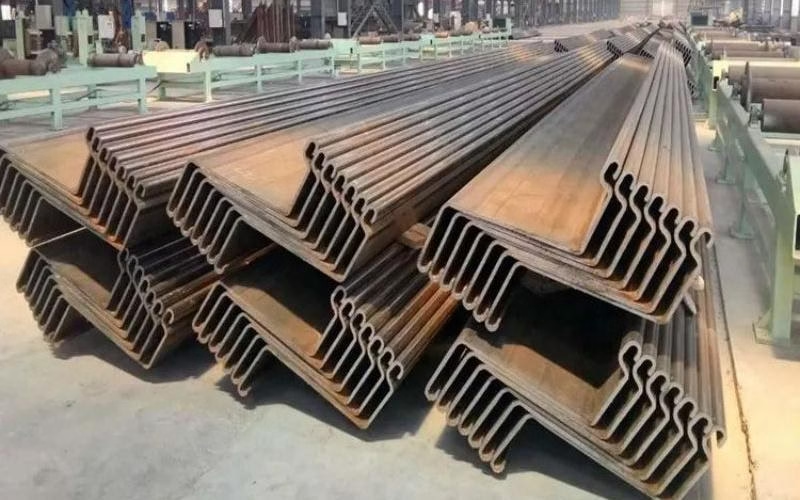
Sheet Pile Steel (Z-Type)
Z-Type Sheet Pile steel is hot-rolled interlocking steel section with Z-shaped profile delivering maximum section modulus efficiency for earth retention and waterfront walls. AZ 12–AZ 50 series, widths 600–800mm, lengths 6–26m. Grades S355GP, S430GP, A572 Gr50, A690. Mill test certificate provided.
| Material | Carbon Structural Steel / Low Alloy High Strength Sheet Piling Steel |
|---|---|
| Grade / Standard | EN S270GP / S355GP / S390GP / S430GP / ASTM A572 Grade 50 / A690 / JIS SY295 / SY390 / GB Q345B / Q355B |
| Section Size | AZ 12 to AZ 50 series | Section height 200mm – 460mm | Single pile width 600mm – 800mm |
| Flange Width | 600mm – 800mm (single pile), 1,200mm – 1,600mm (double pile combined wall) |
| Web Height | 200mm – 460mm (section height) |
| Web Thickness | 8mm – 20mm |
| Length | 6m – 26m (Custom up to 32m) |
| Delivery Condition | hot_rolled / normalized / tmcp / as_rolled |
| Surface Treatment | shot_blasting / galvanized / coated |
| MOQ | 10 Tons |
| Delivery Time | 20-40 Days / In Stock |
| Loading Port | Tianjin / Shanghai / Qingdao |
Overview of Z-Type Sheet Pile Steel
Z-Type Sheet Pile steel is a hot-rolled interlocking structural steel section designed for earth retention, groundwater cut-off, and lateral load resistance in geotechnical and civil engineering applications. Named for its characteristic Z-shaped cross-section, the Z-pile achieves maximum section modulus efficiency by placing the interlocking clutches at the extreme fiber positions — the outermost points of the combined wall section — delivering superior bending resistance per unit weight compared to U-type (Larssen) and flat sheet piles. This geometric advantage makes Z-piles the preferred choice for permanent retaining walls, deep excavation support, waterfront quay walls, and flood defence embankments where high structural efficiency and watertight interlock performance are simultaneously required.
Z-Type sheet piles are manufactured to AZ designation (ArcelorMittal system, now the global reference), PZ designation (US domestic system, formerly Bethlehem Steel), and equivalent metric series under EN 10248 (European hot-rolled sheet piling), JIS A5528, and GB/T 20933 standards. Section modulus values range from approximately 600 cm³/m (light AZ 12 series) to over 4,000 cm³/m (heavy AZ 50 series), with steel grades spanning S270GP, S355GP, S390GP, and S430GP under EN 10248, or ASTM A572 Grade 50 / A690 for marine applications per American practice. The interlock geometry of Z-piles allows individual pile driving then threading into adjacent piles, or pre-clutched pair driving for improved installation speed and reduced interlock declutching risk in difficult soils.
Key Features and Manufacturing Process
Z-Type sheet piles are produced by hot rolling at temperatures of 1100–1250°C using specially profiled horizontal and vertical rolls on universal rolling mills, shaping the distinctive Z-profile with web, two inclined flanges, and thumb-and-finger interlocks at the flange tips simultaneously in a single rolling pass. The interlock geometry is precision-rolled to ensure consistent clutch dimensions across the full production length, enabling reliable field threading of adjacent piles with minimum resistance and watertight engagement after installation. Critical dimensional tolerances — section height, flange width, web thickness, flange thickness, and interlock gap — are maintained per EN 10248-2 or equivalent standards. Combined wall section modulus is verified by independent calculation and certified on the mill test certificate.
Z-piles are supplied in standard single-pile widths of 600mm to 800mm, with combined double-pile wall widths of 1,200mm to 1,600mm, in standard mill lengths of 6m to 26m with custom lengths available up to 32m for deep excavations and offshore applications. Common steel grades include EN S270GP (yield 270 MPa, light temporary works), S355GP (yield 355 MPa, the most widely specified permanent works grade), S390GP (yield 390 MPa, high-efficiency permanent walls), S430GP (yield 430 MPa, premium grade for maximum section efficiency and reduced steel weight), and ASTM A572 Grade 50 / A690 (yield 345 MPa, marine corrosion-resistant for seawater applications). All Z-pile production undergoes mandatory chemical composition analysis, mechanical property testing including yield strength, tensile strength, elongation and optional Charpy V-notch impact at 0°C and −20°C, dimensional inspection per EN 10248-2 / JIS A5528, and interlock profile gauging to ensure field compatibility.
Main Applications of Z-Type Sheet Pile Steel
Z-Type sheet piles are extensively used in permanent and temporary earth retention systems including basement excavation support for high-rise buildings, underground car parks, metro station box excavations, cut-and-cover tunnel construction, utility trench support, deep sewer and drainage installation, pump station excavations, and foundation pit retention for industrial plants where surrounding structures demand minimal ground movement and reliable groundwater cut-off throughout the construction period.
Waterfront and marine infrastructure represents a major application sector including port quay walls and berth structures for container terminals and bulk cargo wharves, river training and flood embankment walls, coastal erosion protection, tidal barrier structures, marina bulkheads, fishing harbour protection walls, canal walls, lock chambers, and river weir structures. Sheet pile retaining walls combined with tie rods and anchor piles or ground anchors are widely employed for these permanent marine applications using higher-grade steels with appropriate corrosion protection systems. Other significant applications include highway and railway embankment support walls, bridge abutment wing walls, pipeline and utility trench protection, cofferdam construction for bridge pier foundations, underground car park perimeter walls, landfill containment barriers for environmental protection, mine tailings dam wall support, cellular cofferdams for dam and weir construction, slope stabilisation walls on steep terrain, military field fortification structures, temporary access road construction over soft ground using sheet piles as working platforms, groundwater cut-off barriers for contaminated land remediation, and combined steel wall systems using Z-piles as primary structural elements with H-pile king posts for soldier pile walls with lagging.
Why Choose Us for Z-Type Sheet Pile Steel
Shandong Tanglu Metal Material Co., Ltd. supplies premium Z-Type sheet pile steel sourced from leading Chinese and international mills including Maanshan Steel (China’s largest sheet pile producer), HBIS, and Laiwu Steel, all with proven international export credentials and certified production facilities complying with ISO 9001, ISO 14001, EN 10248, JIS A5528, and GB/T 20933 requirements. Every Z-pile shipment is backed by original mill test certificates in EN 10204 3.1 format covering full chemical composition, mechanical property test results (yield, tensile, elongation, impact), dimensional inspection data, and heat number traceability enabling full batch identification on site.
We offer a comprehensive specification range covering AZ 12 through AZ 50 series and PZ 22 through PZ 40 equivalent sections, plus metric series from 200 to 460mm section height, in grades S270GP, S355GP, S390GP, S430GP (EN 10248), ASTM A572 Gr50, A690 (marine), JIS SY295, and GB Q345B / Q355B. Standard lengths 6m to 26m with custom mill orders up to 32m, and surface treatment options including bare mill surface, shot blasting (Sa2.5), coal tar epoxy coating, hot-dip galvanizing, and cathodic protection system advisory for marine permanent works. With monthly supply capacity of 5,000 tons of sheet pile sections and established export relationships with geotechnical contractors, marine construction companies, civil engineering consultancies, and infrastructure project owners across more than 50 countries, we support both small temporary excavation packages and large permanent waterfront infrastructure supply contracts. Third-party inspection services including SGS, Bureau Veritas, ABS, DNV, and Lloyd’s Register are readily arranged for critical foundation and marine projects requiring enhanced quality assurance documentation.
📐 Dimension & Size Table
| Section (AZ) | Width per Pile (mm) | Section Height (mm) | Thickness Web/Flange (mm) | Section Modulus (cm³/m) | Weight (kg/m²) |
|---|---|---|---|---|---|
| AZ 12 | 670 | 302 / 9.5 / 9.5 | 600 / 74.3 | ||
| AZ 13 | 670 | 303 / 10.2 / 10.2 | 695 / 80.5 | ||
| AZ 14 | 670 | 304 / 10.9 / 10.9 | 788 / 87.0 | ||
| AZ 17 | 630 | 380 / 9.5 / 9.5 | 940 / 93.2 | ||
| AZ 18 | 630 | 381 / 10.2 / 10.2 | 1,050 / 100.0 | ||
| AZ 19 | 630 | 382 / 10.9 / 10.9 | 1,160 / 107.0 | ||
| AZ 25 | 750 | 426 / 11.2 / 11.2 | 1,510 / 117.0 | ||
| AZ 26 | 750 | 427 / 12.2 / 12.2 | 1,630 / 126.0 | ||
| AZ 28 | 750 | 429 / 13.5 / 13.5 | 1,810 / 138.0 | ||
| AZ 34 | 750 | 459 / 13.5 / 13.5 | 2,180 / 148.0 | ||
| AZ 36 | 750 | 461 / 14.5 / 14.5 | 2,360 / 158.5 | ||
| AZ 38 | 750 | 463 / 15.5 / 15.5 | 2,540 / 169.5 | ||
| AZ 40 | 750 | 465 / 16.5 / 16.5 | 2,720 / 180.5 | ||
| AZ 44 | 800 | 460 / 15.0 / 15.0 | 2,800 / 172.0 | ||
| AZ 46 | 800 | 462 / 16.0 / 16.0 | 3,000 / 183.0 | ||
| AZ 48 | 800 | 464 / 17.0 / 17.0 | 3,200 / 194.0 | ||
| AZ 50 | 800 | 466 / 18.0 / 18.0 | 3,400 / 205.0 |
* Custom sizes available upon request. Tolerances per relevant international standards.
🔬 Chemical Composition
| Element | Min | Max | Display Value | Note |
|---|---|---|---|---|
| C | - | 0.24 | ≤0.24 | EN S355GP / S430GP per EN 10248-1 |
| Si | - | 0.55 | ≤0.55 | |
| Mn | 0.80 | 1.70 | 0.80–1.70 | Strengthening element |
| P | - | 0.035 | ≤0.035 | |
| S | - | 0.030 | ≤0.030 | |
| V | - | 0.20 | ≤0.20 | Microalloying element |
| Nb | - | 0.06 | ≤0.06 | Microalloying element |
| Ti | - | 0.05 | ≤0.05 | Microalloying element |
| Cr | - | 0.30 | ≤0.30 | Residual element |
| Cu | - | 0.55 | ≤0.55 | A690: ≥0.20% for marine corrosion resistance |
| Ni | - | 0.40 | ≤0.40 | Residual element |
* Chemical composition may vary by heat, thickness and specification. Please refer to the actual mill test certificate.
⚙️ Mechanical Properties
| Property | Value | Unit | Test Condition |
|---|---|---|---|
| Yield Strength (S270GP) | ≥270 | MPa | Per EN 10248-1, light temporary works grade |
| Tensile Strength (S270GP) | ≥410 | MPa | Per EN 10248-1 |
| Yield Strength (S355GP) | ≥355 | MPa | Per EN 10248-1, standard permanent works grade |
| Tensile Strength (S355GP) | ≥480 | MPa | Per EN 10248-1 |
| Yield Strength (S390GP) | ≥390 | MPa | Per EN 10248-1, high-efficiency grade |
| Tensile Strength (S390GP) | ≥490 | MPa | Per EN 10248-1 |
| Yield Strength (S430GP) | ≥430 | MPa | Per EN 10248-1, premium high-strength grade |
| Tensile Strength (S430GP) | ≥510 | MPa | Per EN 10248-1 |
| Elongation (all GP grades) | ≥17 | % | Gauge length 80mm, per EN 10248-1 |
| Yield Strength (ASTM A572 Gr50 / A690) | ≥345 | MPa (50 ksi) | American piling / marine grade |
| Tensile Strength (ASTM A572 Gr50 / A690) | ≥450 | MPa (65 ksi) | Per ASTM A572 / A690 |
| Impact Energy (GP grades, 0°C) | ≥27 | J | Charpy V-notch at 0°C, optional per EN 10248-1 |
| Impact Energy (Cold Service, −20°C) | ≥27 | J | Charpy V-notch at −20°C, optional cold-weather service |
* Values shown are minimum requirements unless otherwise stated.
📦 Commercial Information
| Packaging | Standard seaworthy export packing for Z-Type sheet pile steel sections. Piles bundled in stacks with steel strapping (3–5 wraps per bundle), typical bundle weight 3–8 tons depending on section size and length. Each bundle tagged with heat number, grade designation (S355GP, A572 Gr50, Q345B), section designation (AZ 26, AZ 36, etc.), length, pile width, and quantity. Wooden dunnage separators between layers to prevent surface damage and deformation during ocean transport. For long lengths (over 18m) and heavy sections (AZ 36 and above), individual bundle handling with steel chocks, wire rope slings, and spreader beams is provided to prevent bending. Interlock profiles protected with plastic end caps on both pile ends to prevent field threading damage during storage and transport. Custom packaging including individual section wrapping with anti-rust paper, polyethylene film, and VCI (Volatile Corrosion Inhibitor) packaging available for projects requiring extended outdoor storage before installation in humid or tropical climates. |
|---|---|
| Payment Terms | T/T (Telegraphic Transfer),L/C (Letter of Credit),D/P (Documents against Payment),Western Union,PayPal |
| Price Term | FOB,CFR,CIF,EXW |
| Supply Capacity | 5,000 Tons/Month (Sheet Pile Steel Sections) |
| Loading Port | Tianjin / Shanghai / Qingdao |
Why Choose Our Sheet Pile Steel (Z-Type)?
Mill Certified Piling Quality
Z-Type sheet pile supplied with original mill test certificate EN 10204 3.1/3.2, covering full chemical composition, mechanical properties (yield, tensile, elongation, Charpy impact at 0°C and −20°C optional), dimensional inspection per EN 10248-2 / JIS A5528, and interlock profile gauging with complete heat number traceability.
Comprehensive AZ Series Range
Full coverage of AZ 12 through AZ 50 series with section modulus 600–3,400 cm³/m, single pile widths 600–800mm, combined wall widths 1,200–1,600mm. Standard lengths 6m to 26m with custom mill orders up to 32m for deep excavation and offshore applications.
Maximum Section Modulus Efficiency
Z-pile geometry positions interlocking clutches at the extreme fiber — the outermost point of the combined wall — delivering the highest section modulus per unit steel weight of all sheet pile types. This structural efficiency minimises material usage and shipping weight while maximising wall bending resistance for permanent retaining wall design.
Multiple Standards & Grades
Available in international sheet piling grades EN S270GP / S355GP / S390GP / S430GP (European), ASTM A572 Gr50 / A690 (American / marine corrosion-resistant), JIS SY295 / SY390 (Japanese), and GB Q345B / Q355B (Chinese). Cold-weather impact testing at −20°C and marine-grade A690 copper-bearing steel available for aggressive service environments.
Reliable Project Supply
Common AZ series sections maintained in stock for 15–25 days dispatch. Custom sections and premium grades production cycle 30–45 days. Break-bulk vessel loading for large quantities and oversized sections up to 26m length; container stuffing for smaller orders of sections up to 12m.
🏭 Applications of Sheet Pile Steel (Z-Type)
Z-Type sheet piles are widely used in temporary and permanent earth retention systems including deep basement excavation support for high-rise office towers, residential apartments, and underground car parks, metro station box excavations for urban transit systems, cut-and-cover tunnel construction for road and rail, utility trench protection for large-diameter pipelines and sewers, pump station excavation support, and foundation pit retention for industrial facilities where controlling adjacent ground settlement and maintaining groundwater cut-off are critical design requirements. Waterfront and marine infrastructure represents the largest permanent application sector, including port quay walls and berth structures for container terminals, bulk cargo wharves, and Ro-Ro terminals, river training walls for flood protection and navigation channel maintenance, coastal erosion protection revetments, tidal barrier structures and surge barriers, marina bulkheads for pleasure craft and fishing vessels, fishing harbour protection walls, canal lock chambers and weir structures, river embankment and levee reinforcement, and offshore temporary cofferdam structures for bridge pier and marine structure foundations. The highway and railway infrastructure sector employs Z-piles for embankment retaining walls at road widenings, bridge abutment wing walls and wingwalls, noise barrier walls along motorways, slope stabilisation for steep cut slopes on mountainous road alignments, and approach embankment containment. Other major applications include landfill containment barriers for municipal solid waste and hazardous waste facilities, mine tailings storage facility perimeter containment walls, contaminated land groundwater cut-off barriers for environmental remediation projects, cellular cofferdam construction for dam and weir construction, underground car park perimeter walls in urban infill developments, military field engineering structures and temporary bridging approaches, ground improvement containment cells, and combined wall systems pairing Z-pile primary structural members with H-pile king post soldiers for flexible anchor wall configurations in major infrastructure projects.
📋 Quality & Certification
Our Certifications
- ✅ ISO 9001:2015
- ✅ CE Marking
- ✅ ABS
- ✅ DNV GL
- ✅ Lloyd's Register (LR)
- ✅ Bureau Veritas (BV)
- ✅ SGS Certified
- ✅ NK
- ✅ RINA
Mill Certificate Type
- 📋 EN 10204 3.1
- 📋 EN 10204 3.2
- 📋 Original Mill Certificate
- 📋 Third Party Inspection Available
- 📋 Certificate of Origin
❓ Frequently Asked Questions
What is a Z-Type sheet pile and how does it differ from a U-Type (Larssen) sheet pile?
A Z-Type sheet pile is a hot-rolled interlocking steel section with a Z-shaped cross-section in which the interlocking clutches are located at the extreme tips of the flanges — the outermost fibers of the combined wall cross-section. A U-Type (Larssen) sheet pile has a U-shaped profile with clutches positioned at the neutral axis of the combined wall. This geometric difference has a critical structural consequence: because bending stresses are greatest at the extreme fiber, placing the Z-pile clutches at this position means the interlock carries shear force between adjacent piles efficiently, and the full combined wall section modulus is achieved without interlock slip derating in most design standards. In U-pile walls, interlock slip at the neutral axis reduces effective combined section modulus typically by applying a reduction factor (commonly 0.7–0.9 depending on design code and interlock type). As a result, Z-piles provide a higher effective section modulus per unit weight than equivalent U-piles, making them more structurally efficient and often more economical for permanent retaining walls subject to significant bending moments. U-piles remain preferred for crimped or welded interlocks requiring watertight performance in cellular cofferdam construction, and for installations where Z-pile driving is impractical due to soil layering or obstruction.
What is the AZ designation system for Z-Type sheet piles?
The AZ designation system was developed by ArcelorMittal (formerly Arbed / Usinor-Sacilor) and has become the global reference standard for Z-type hot-rolled sheet piles. The AZ number represents the nominal section modulus of the single pile in cm³ divided by 100 for the earlier series, though in modern practice the AZ number is used as a product family identifier rather than a strict section modulus value. Key series include: AZ 12–14 (section height ~300mm, width 670mm, section modulus 600–800 cm³/m combined wall) for light temporary excavation support and small permanent walls; AZ 17–19 (section height ~380mm, width 630mm, section modulus 940–1,160 cm³/m) for medium-depth excavations and moderate permanent walls; AZ 25–28 (section height ~426mm, width 750mm, section modulus 1,510–1,810 cm³/m) for standard commercial and infrastructure retaining walls; AZ 34–40 (section height ~460mm, width 750mm, section modulus 2,180–2,720 cm³/m) for heavy permanent quay walls, deep excavations, and bridge abutments; AZ 44–50 (section height ~460mm, width 800mm, section modulus 2,800–3,400 cm³/m) for major marine infrastructure and deep permanent walls subject to high bending moments. The AZ system replaced the earlier PZ designation used in the United States (PZ 22, PZ 27, PZ 35, PZ 40) — approximate equivalents are PZ 22 ≈ AZ 13, PZ 27 ≈ AZ 18, PZ 35 ≈ AZ 26, PZ 40 ≈ AZ 36.
What steel grades are available for Z-Type sheet piles and which grade should I specify?
Z-Type sheet piles are available in several steel grades suited to different application requirements. EN S270GP (yield ≥270 MPa, per EN 10248-1) is the minimum grade suitable for light temporary works such as shallow utility trenches and temporary construction support where piles will be extracted and reused. EN S355GP (yield ≥355 MPa) is the most widely specified grade for permanent retaining walls, bridge abutments, waterfront structures, and deep excavation permanent walls in moderate environments — it provides an excellent balance of strength, weldability, and cost. EN S390GP (yield ≥390 MPa) and S430GP (yield ≥430 MPa) are premium high-strength grades enabling use of lighter (thinner) sections for the same structural requirement, reducing total steel weight by 10–20% compared to S355GP — the material premium is often offset by lower fabrication, transport, and installation costs on large projects. ASTM A572 Grade 50 (yield ≥345 MPa) is the American equivalent of S355GP used for projects under US codes. ASTM A690 is a special copper-bearing (Cu ≥0.20%) sheet pile grade with enhanced resistance to atmospheric and tidal zone corrosion, typically specified for marine quay walls and waterfront structures where the pile extends through the splash zone without coating. For cold-weather installations (Arctic, northern Canada, Scandinavia), Charpy V-notch impact testing at −20°C or lower should be specified regardless of grade. Grade selection should be made by the structural designer in conjunction with the geotechnical engineer based on design bending moments, section size optimisation, welding requirements, corrosion environment, and applicable design code (EN 1993-5, AISC, BS 8002, etc.).
What lengths are available for Z-Type sheet piles and can they be spliced?
Z-Type sheet piles are standard mill products available in lengths from 6m to 26m, with most mills producing in 0.5m or 1m increments within this range. Custom lengths up to 32m are available as special mill orders with minimum quantity requirements (typically 50–100 tons per length). For deep excavation and marine applications requiring pile embedment plus retained height exceeding 26m, pile splicing is the standard solution. Z-pile splicing is performed by full penetration butt welding per EN 1011-1 or AWS D1.1 welding code using qualified welding procedures and certified welders. Splice joints are located at points of low bending moment — typically near pile mid-length or where bending moment diagrams indicate reduced stress concentration — and staggered between adjacent piles in the wall to avoid a continuous plane of weakness. Unlike H-pile splicing which commonly uses bolted splice plates, Z-pile welded splices are more practical because the Z-profile geometry makes it difficult to fit standard bolted splice plates across the flanges and web simultaneously while maintaining the interlocking capability with adjacent piles. Quality control for Z-pile splices includes visual inspection per AWS D1.1, magnetic particle testing (MT) or ultrasonic testing (UT) of the completed welds, and dimensional check of pile alignment and straightness after splicing. We supply Z-piles in standard available lengths and can advise on optimal pile cutting and splicing plans for projects requiring non-standard total pile lengths.
What corrosion protection is recommended for Z-Type sheet piles in marine and waterfront applications?
Corrosion protection selection for Z-pile sheet walls depends on the exposure zone, design service life, and maintenance accessibility. Marine sheet pile walls experience different corrosion rates across five exposure zones: (1) Atmospheric zone above splash — moderate corrosion, ~0.05mm/year; (2) Splash and spray zone — highest corrosion rate, 0.1–0.3mm/year due to combined wet/dry cycling and high oxygen availability; (3) Tidal zone — moderate, 0.05–0.15mm/year; (4) Immersion zone — reduced rate due to oxygen depletion, 0.04–0.1mm/year; (5) Buried zone below mudline — lowest rate, 0.01–0.05mm/year. Protection strategies include: Corrosion Allowance (additional steel thickness added to design section) — economical for 25-year design life in moderate environments, typically 3–6mm added to calculated design thickness based on EN 1993-5 Table 4.1 corrosion rates; Coal Tar Epoxy Coating (2–3 coats, 250–400μm DFT) — standard for permanent marine walls, effective service life 15–25 years with initial installation; ASTM A690 Marine Grade Steel — copper-bearing (≥0.20% Cu) steel with demonstrated corrosion rate approximately 2× lower than standard carbon steel in the tidal and splash zone, typically providing 40–50 year service life with corrosion allowance alone; Cathodic Protection (CP) using sacrificial zinc or aluminium alloy anodes, or impressed current CP — preferred for 50+ year design life structures, often combined with coal tar epoxy coating on the immersion zone to reduce current demand; Thermal-sprayed aluminium (TSA) coating (200μm per ISO 2063) — premium protection for 30+ years in severe marine environments such as tropical waters and industrial harbours with chemical contamination. Corrosion protection design should follow EN 12499, NACE SP0176, ISO 13173, or BS EN ISO 12944 as applicable to the specific project environment and design life requirement.
Get a Quote for
Sheet Pile Steel (Z-Type)
Submit your requirements and receive a competitive price quote within 24 hours.
- ✓ Fast response within 24 hours
- ✓ Competitive factory-direct pricing
- ✓ Free technical consultation
- ✓ Mill test certificate provided
- ✓ Flexible payment terms available
⏱ Response within 24 hours
Send Your Inquiry
All fields marked with * are required