
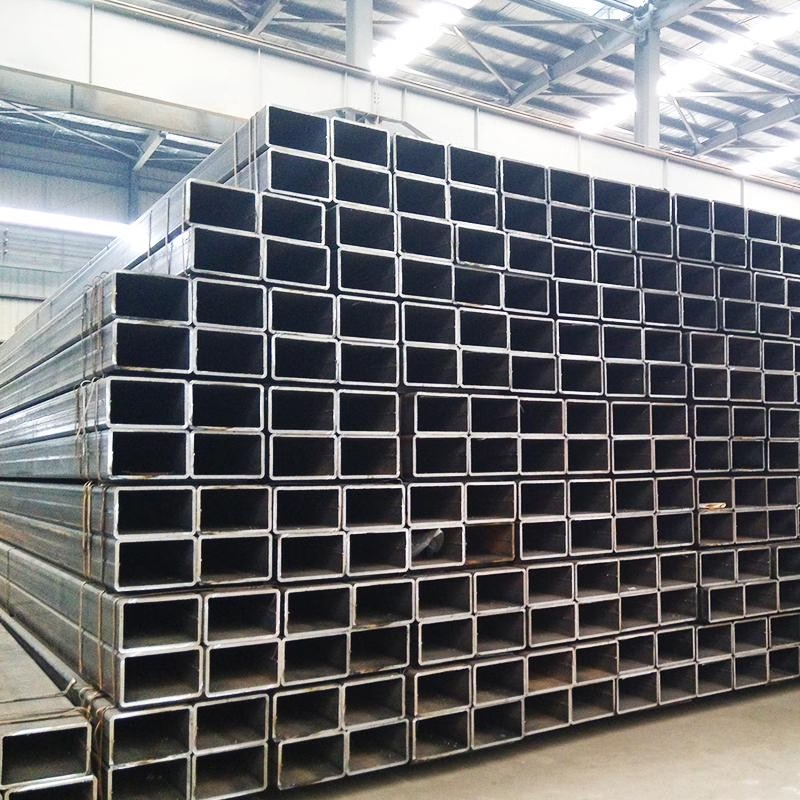
Rectangular Steel Tube (RHS)
Rectangular Steel Tube (RHS) is cold-formed or hot-finished closed rectangular hollow section with high torsional stiffness and biaxial bending resistance. Sizes 50×25mm to 500×300mm, wall thickness 2.0–20mm, lengths 6m/12m. Grades S355J2H, Q345B, A500 Gr.B. Mill test certificate provided.
| Material | Carbon Structural Steel / Low Alloy High Strength Structural Steel |
|---|---|
| Grade / Standard | EN S235JRH / S275J0H / S355J2H / S420MH / S460MH / ASTM A500 Grade B / Grade C / A572 Grade 50 / A1085 / JIS STKR400 / STKR490 / GB Q235B / Q345B / Q355B |
| Length | 6m / 12m (Custom cut-to-length available) |
| Delivery Condition | normalized |
| Surface Treatment | shot_blasting / galvanized / coated |
| MOQ | 1 Ton |
| Delivery Time | 15-35 Days / In Stock |
| Loading Port | Tianjin / Shanghai / Qingdao |
Overview of Rectangular Steel Tube (RHS)
Rectangular Steel Tube, universally designated as RHS (Rectangular Hollow Section), is a cold-formed or hot-finished structural steel section with a closed rectangular cross-section comprising four flat faces joined at right-angle corners with defined internal corner radii. The closed hollow geometry of RHS provides a fundamentally superior structural efficiency compared to open sections such as I-beams, channels, and angles of equivalent weight — the enclosed tubular form delivers high torsional stiffness (several hundred times greater than equivalent open sections), biaxial bending resistance about both principal axes, and a compact external envelope that minimises exposed surface area for corrosion protection, making RHS the preferred section for architecturally exposed structural steelwork, column and strut members subject to multi-directional loading, and space frame and truss applications where aesthetics and structural efficiency must be simultaneously achieved.
RHS sections are manufactured under EN 10219 (cold-formed welded structural hollow sections for cold-finished products), EN 10210 (hot-finished structural hollow sections), ASTM A500 (cold-formed welded and seamless carbon steel structural tubing), ASTM A501 (hot-formed welded and seamless carbon steel structural tubing), JIS G3466 (carbon steel square and rectangular tubes for general structural purposes), and GB/T 6728 (cold-formed hollow sections) / GB/T 28416 (hot-finished hollow sections). Section dimensions range from 50×25mm (smallest standard RHS) to 500×300mm (large structural RHS) with wall thicknesses from 2.0mm to 20mm, and steel grades spanning standard carbon structural S235JRH / S275J0H (yield 235–275 MPa), medium-strength S355J2H (yield 355 MPa, the most widely specified structural RHS grade), and high-strength S420MH / S460MH (yield 420–460 MPa) for weight-critical applications. The two flat parallel faces of different widths — the wider face and the narrower face — allow the designer to orient the section optimally for the dominant bending direction, providing greater design flexibility than square hollow sections (SHS) of equivalent weight.
Key Features and Manufacturing Process
Rectangular Steel Tube is produced by two principal manufacturing routes that determine the section’s dimensional tolerances, corner geometry, residual stress state, and material property distribution. Cold-formed RHS (EN 10219 / ASTM A500 / GB/T 6728) is manufactured by first forming a flat steel strip into a circular tube by continuous cold roll-forming, high-frequency electric resistance welding (ERW) of the longitudinal seam, and then cold-sizing through square or rectangular section forming rolls to the final cross-section shape. The cold-working process introduces beneficial work-hardening that can increase yield strength by 10–20% above the base strip material, particularly at the corners where cold-working is most severe, but also creates residual stresses that reduce effective yield strength under some loading conditions — EN 10219 accounts for this by specifying mechanical property test specimens cut from the flat face, not from the corners. Hot-finished RHS (EN 10210 / ASTM A501 / GB/T 28416) is produced by forming a welded tube and then hot-sizing through calibrated rolls at temperatures above the steel recrystallisation temperature (above 580°C for EN 10210 compliance), or by hot-rolling directly from seamless or welded tube blanks. The hot-finishing process relieves residual stresses, produces uniform mechanical properties around the entire cross-section including corners, and results in sharper corner profiles with tighter dimensional tolerances than cold-formed sections — making hot-finished RHS the preferred choice for precision structural applications and sections requiring consistent mechanical properties for connection design using corner zones.
RHS sections are supplied in standard lengths of 6m and 12m with custom cut-to-length available. Standard dimensions cover width × depth from 50×25mm to 500×300mm with wall thickness increments of 0.5mm for light sections and 1.0–2.0mm for heavier structural sections. Common steel grades include EN S235JRH (yield 235 MPa), S275J0H (yield 275 MPa), S355J2H (yield 355 MPa, dominant structural grade), S420MH and S460MH (high-strength thermomechanically rolled), ASTM A500 Grade B (yield 317 MPa, most common American RHS grade), A500 Grade C (yield 345 MPa), ASTM A572 Grade 50 / A1085 (yield 345 MPa, improved American specification), JIS STKR400 / STKR490, and GB/T 6728 Q235B / Q345B / Q355B. All RHS production undergoes chemical composition analysis, mechanical property testing including yield strength, tensile strength, and elongation, dimensional inspection covering outer dimensions, wall thickness, corner radius, straightness, and squareness per applicable standard tolerance class, and hydrostatic or eddy current testing for weld seam integrity.
Main Applications of Rectangular Steel Tube (RHS)
Rectangular Steel Tube is extensively used in structural steel construction for column and strut members in building frames, portal frames, and industrial structures where biaxial load resistance and aesthetically clean flat faces are required. RHS columns in multi-storey building frames provide efficient load paths for gravity and lateral loads from multiple beam directions, with the flat face geometry simplifying beam-to-column connection detailing using end plates, cleats, and through-bolts compared to open section columns. Roof truss and space frame construction uses RHS extensively for chord and diagonal members, with the rectangular profile allowing the wider face to be oriented in the plane of maximum bending for optimum structural efficiency, and the flat external faces simplifying gusset plate welding and bolted connection fabrication.
The construction and architectural sector employs RHS for canopy and shelter structures, pedestrian bridge handrails and balustrade systems, staircase stringers and structural balusters, curtain wall primary structural frames, facade support systems, mezzanine floor beam sections, shop fitting and display stand structures, and architecturally exposed structural steelwork where the rectangular clean-line profile provides a modern aesthetic superior to open I-section profiles. The transport and automotive manufacturing sector uses RHS for vehicle chassis and subframe members, trailer frame longitudinal and cross-members, bus and coach body frame structural members, agricultural and construction machinery boom and frame elements, forklift mast and carriage frame sections, and railway rolling stock underframe structural members. Other major applications include greenhouse and agricultural building frame construction, solar panel mounting frame structures, industrial racking and shelving systems, conveyor support structures, machine frame and base structural elements, gate and fence post sections, sign gantry and traffic sign support frames, lighting column and street furniture structures, modular building system primary frame members, temporary works falsework and scaffolding structural tubes, offshore topside structural framing, and shipbuilding accommodation block structural members where the RHS geometry provides efficient section properties with reduced painting surface area compared to open structural sections of equivalent load-carrying capacity.
Why Choose Us for Rectangular Steel Tube (RHS)
Shandong Tanglu Metal Material Co., Ltd. supplies premium Rectangular Steel Tube (RHS) sourced from reputable Chinese steel mills including Tianjin Pipe Group (TPCO), Youfa Group, and Huludao City Steel Pipe Industrial, all with certified production facilities meeting ISO 9001, ISO 14001, EN 10219, EN 10210, GB/T 6728, and GB/T 28416 quality and product standard requirements. Every RHS shipment is accompanied by original mill test certificates covering chemical composition, mechanical property test results (yield strength, tensile strength, elongation), dimensional inspection data including outer dimensions, wall thickness variation, corner radius, and straightness, and complete heat number traceability enabling full batch identification throughout the supply chain and on the fabrication floor.
We offer a comprehensive specification range covering RHS dimensions from 50×25mm to 500×300mm with wall thicknesses 2.0mm to 20mm in cold-formed (EN 10219 / GB/T 6728) and hot-finished (EN 10210 / GB/T 28416) production routes, in grades S235JRH, S275J0H, S355J2H, S420MH, S460MH (European), ASTM A500 Grade B/C, A572 Grade 50, A1085 (American), JIS STKR400 / STKR490 (Japanese), and GB Q235B / Q345B / Q355B (Chinese). Standard lengths 6m and 12m with cut-to-length service for fabrication projects. With established monthly supply capacity of 5,000 tons of hollow section steel and export relationships with structural steel fabricators, construction contractors, mechanical engineers, automotive manufacturers, and general engineering companies across more than 50 countries, we support packages from small fabrication material orders to large structural project supply contracts. Each shipment includes original mill test certificate per EN 10204 3.1 standard, with EN 10204 3.2 and third-party inspection by SGS, Bureau Veritas, or equivalent inspection bodies available for critical structural projects requiring enhanced quality documentation.
📐 Dimension & Size Table
| Width × Depth (mm) | Wall Thickness (mm) | Cross Section Area (cm²) | Weight (kg/m) |
|---|---|---|---|
| 50 × 25 | 2.0 / 2.5 / 3.0 | 2.81 / 3.44 / 4.05 | 2.21 / 2.70 / 3.18 |
| 60 × 30 | 2.0 / 2.5 / 3.0 | 3.41 / 4.19 / 4.95 | 2.68 / 3.29 / 3.89 |
| 60 × 40 | 2.0 / 2.5 / 3.0 | 3.81 / 4.69 / 5.55 | 2.99 / 3.68 / 4.36 |
| 80 × 40 | 2.5 / 3.0 / 4.0 | 5.69 / 6.75 / 8.81 | 4.47 / 5.30 / 6.92 |
| 80 × 60 | 2.5 / 3.0 / 4.0 | 6.69 / 7.95 / 10.41 | 5.25 / 6.24 / 8.17 |
| 100 × 50 | 3.0 / 4.0 / 5.0 | 8.55 / 11.21 / 13.81 | 6.71 / 8.80 / 10.84 |
| 100 × 60 | 3.0 / 4.0 / 5.0 | 9.15 / 12.01 / 14.81 | 7.18 / 9.43 / 11.63 |
| 100 × 80 | 3.0 / 4.0 / 5.0 | 10.35 / 13.61 / 16.81 | 8.12 / 10.69 / 13.20 |
| 120 × 60 | 3.0 / 4.0 / 5.0 | 10.35 / 13.61 / 16.81 | 8.12 / 10.69 / 13.20 |
| 120 × 80 | 3.0 / 4.0 / 5.0 / 6.0 | 11.55 / 15.21 / 18.81 / 22.33 | 9.07 / 11.94 / 14.77 / 17.53 |
| 150 × 100 | 4.0 / 5.0 / 6.0 / 8.0 | 19.21 / 23.81 / 28.33 / 37.09 | 15.08 / 18.69 / 22.24 / 29.12 |
| 160 × 80 | 4.0 / 5.0 / 6.0 / 8.0 | 18.41 / 22.81 / 27.13 / 35.49 | 14.45 / 17.91 / 21.30 / 27.86 |
| 180 × 100 | 4.0 / 5.0 / 6.0 / 8.0 | 21.61 / 26.81 / 31.93 / 41.89 | 16.96 / 21.04 / 25.07 / 32.88 |
| 200 × 100 | 4.0 / 5.0 / 6.0 / 8.0 / 10.0 | 23.21 / 28.81 / 34.33 / 45.09 / 55.53 | 18.22 / 22.62 / 26.95 / 35.40 / 43.59 |
| 200 × 120 | 5.0 / 6.0 / 8.0 / 10.0 | 30.81 / 36.73 / 48.29 / 59.53 | 24.19 / 28.83 / 37.91 / 46.74 |
| 200 × 150 | 5.0 / 6.0 / 8.0 / 10.0 | 33.81 / 40.33 / 53.09 / 65.53 | 26.54 / 31.66 / 41.68 / 51.44 |
| 250 × 150 | 6.0 / 8.0 / 10.0 / 12.0 | 46.33 / 61.09 / 75.53 / 89.65 | 36.37 / 47.96 / 59.29 / 70.37 |
| 300 × 150 | 6.0 / 8.0 / 10.0 / 12.0 | 52.33 / 69.09 / 85.53 / 101.65 | 41.08 / 54.24 / 67.14 / 79.80 |
| 300 × 200 | 6.0 / 8.0 / 10.0 / 12.0 / 16.0 | 58.33 / 77.09 / 95.53 / 113.65 / 149.33 | 45.79 / 60.52 / 75.00 / 89.22 / 117.24 |
| 400 × 200 | 8.0 / 10.0 / 12.0 / 16.0 | 93.09 / 115.53 / 137.65 / 181.33 | 73.08 / 90.74 / 108.05 / 142.35 |
| 400 × 300 | 10.0 / 12.0 / 16.0 / 20.0 | 135.53 / 161.65 / 213.33 / 264.53 | 106.44 / 126.89 / 167.46 / 207.66 |
| 500 × 300 | 10.0 / 12.0 / 16.0 / 20.0 | 155.53 / 185.65 / 245.33 / 304.53 | 122.09 / 145.74 / 192.59 / 239.06 |
* Custom sizes available upon request. Tolerances per relevant international standards.
🔬 Chemical Composition
| Element | Min | Max | Display Value | Note |
|---|---|---|---|---|
| C | - | 0.22 | ≤0.22 | S355J2H per EN 10219-1 / EN 10210-1; Q345B per GB/T 1591 |
| Si | - | 0.55 | ≤0.55 | |
| Mn | 1.00 | 1.60 | 1.00–1.60 | Strengthening element |
| P | - | 0.035 | ≤0.035 | |
| S | - | 0.035 | ≤0.035 | |
| V | - | 0.15 | ≤0.15 | Microalloying element |
| Nb | - | 0.05 | ≤0.05 | Microalloying element |
| Ti | - | 0.05 | ≤0.05 | Microalloying element |
| Cr | - | 0.30 | ≤0.30 | Residual element |
| Ni | - | 0.30 | ≤0.30 | Residual element |
| Cu | - | 0.35 | ≤0.35 | Residual element |
| Mo | - | 0.10 | ≤0.10 | Residual element |
* Chemical composition may vary by heat, thickness and specification. Please refer to the actual mill test certificate.
⚙️ Mechanical Properties
| Property | Value | Unit | Test Condition |
|---|---|---|---|
| Yield Strength (S235JRH) | ≥235 | MPa | Per EN 10219-1 / EN 10210-1, t≤16mm |
| Tensile Strength (S235JRH) | 360–510 | MPa | Per EN 10219-1 / EN 10210-1 |
| Elongation (S235JRH) | ≥26 | % | Gauge length 200mm |
| Yield Strength (S275J0H) | ≥275 | MPa | Per EN 10219-1 / EN 10210-1, t≤16mm |
| Tensile Strength (S275J0H) | 430–580 | MPa | Per EN 10219-1 / EN 10210-1 |
| Yield Strength (S355J2H) | ≥355 | MPa | Per EN 10219-1 / EN 10210-1, t≤16mm; most common structural RHS grade |
| Tensile Strength (S355J2H) | 470–630 | MPa | Per EN 10219-1 / EN 10210-1 |
| Elongation (S355J2H) | ≥22 | % | Gauge length 200mm |
| Yield Strength (S420MH / S460MH) | ≥420 / ≥460 | MPa | Per EN 10219-1, TMCP thermomechanically rolled high-strength grade |
| Tensile Strength (S420MH / S460MH) | 500–660 / 530–720 | MPa | Per EN 10219-1 |
| Yield Strength (ASTM A500 Grade B) | ≥317 | MPa (46 ksi) | Per ASTM A500, most common American RHS grade |
| Yield Strength (ASTM A500 Grade C / A1085) | ≥345 | MPa (50 ksi) | Per ASTM A500 Gr.C / A1085 |
| Yield Strength (GB Q345B / Q355B) | ≥345 / ≥355 | MPa | Per GB/T 1591, t≤16mm |
| Impact Energy (J2H / J0H sub-grade) | ≥27 | J | Charpy V-notch at −20°C (J2H) / 0°C (J0H) per EN 10219-1 |
* Values shown are minimum requirements unless otherwise stated.
📦 Commercial Information
| Packaging | Standard seaworthy export packing for Rectangular Steel Tube (RHS) sections. RHS sections bundled in rectangular stacks with steel strapping (2–4 wraps per bundle depending on section size and length), typical bundle weight 1–5 tons. Small RHS sections (50×25mm to 100×60mm) nested in alternating orientations within bundles to maximise packing density and reduce bundle dimensions for container loading efficiency. Large RHS sections (150×100mm and above) flat-stacked with wooden dunnage blocks between layers at maximum 2m spacing to prevent deflection of long sections during handling. Each bundle clearly tagged with heat number, grade designation (S355J2H, Q345B, A500 Gr.B, etc.), section designation (100×60×4mm, 200×100×6mm, etc.), length, and quantity. Anti-rust oil applied to all mill-surface bare RHS before bundling for corrosion protection during ocean transit and storage. For hot-dip galvanized RHS, individual tube ends capped with plastic plugs to prevent zinc buildup inside bore during galvanizing and to protect internal surface from moisture ingress during storage. Container loading: 22–25 tons per 20FT FCL for sections up to 6m; 40HQ container for 12m sections. Custom VCI anti-corrosion paper inner wrapping and polyethylene stretch film outer wrapping available for high-humidity tropical destinations and projects requiring extended storage before fabrication. |
|---|---|
| Payment Terms | T/T (Telegraphic Transfer),L/C (Letter of Credit),D/P (Documents against Payment),Western Union,PayPal |
| Price Term | FOB,CFR,CIF,EXW |
| Supply Capacity | 5,000 Tons/Month (Rectangular Steel Tube RHS) |
| Loading Port | Tianjin / Shanghai / Qingdao |
Why Choose Our Rectangular Steel Tube (RHS)?
Mill Certified Structural Quality
RHS supplied with original mill test certificate EN 10204 3.1/3.2, covering full chemical composition, mechanical properties (yield strength, tensile strength, elongation, Charpy V-notch impact at −20°C for J2H sub-grade), dimensional inspection per EN 10219-2 / EN 10210-2 / GB/T 6728, weld seam integrity testing, and complete heat number traceability.
Comprehensive RHS Size Range
Full RHS range from 50×25mm to 500×300mm with wall thickness 2.0mm to 20mm, covering light architectural sections through heavy structural members. Standard lengths 6m and 12m with cut-to-length service. Both cold-formed (EN 10219) and hot-finished (EN 10210) production routes available.
Superior Torsional Stiffness — Closed Section Advantage
The closed rectangular hollow section provides torsional stiffness several hundred times greater than equivalent-weight open sections (I-beams, channels). Combined with biaxial bending resistance and compact flat face geometry, RHS delivers unmatched structural efficiency for columns, struts, and space frame members subject to multi-directional loading.
Multiple Standards & Grades
Available in EN S235JRH / S275J0H / S355J2H / S420MH / S460MH (European), ASTM A500 Gr.B/C / A1085 (American), JIS STKR400 / STKR490 (Japanese), and GB Q235B / Q345B / Q355B (Chinese). Cold-formed and hot-finished options with impact-tested sub-grades for low-temperature structural applications.
Stock Availability & Fast Delivery
Common RHS sizes in S355J2H and Q345B maintained in stock for 15–25 days dispatch. Custom dimensions and premium grades 25–40 days production cycle. Container loading for sections up to 12m; LCL consolidation available for mixed RHS size orders from stock.
🏭 Applications of Rectangular Steel Tube (RHS)
Rectangular Steel Tube (RHS) is one of the most versatile structural sections in modern steel construction and fabrication, serving primary structural, secondary framing, and architectural roles across virtually every industry sector. In structural building construction, RHS sections function as primary column members in multi-storey building frames, portal frame leg and rafter members for industrial sheds and warehouses, roof truss upper and lower chord sections oriented with the wider face in the plane of bending, bracing members in lateral load resisting systems, purlins and girts for cladding support, mezzanine floor edge beams and internal beams, modular building system primary structural elements, and architecturally exposed structural members in atria, canopies, and glass-roofed structures where the clean flat-face rectangular profile provides a contemporary aesthetic preferred over traditional open sections. The transport and automotive manufacturing sector is a major consumer of RHS sections for heavy vehicle chassis longitudinal and cross-member frames for trucks, trailers, and semi-trailers where the rectangular profile provides efficient section properties and flat mounting faces for body mounting brackets, axle seat fabrication, and fifth-wheel coupling attachment, bus and coach body primary structural frame members, agricultural tractor and implement frame sections, construction machinery boom and stick sections for excavators and cranes, forklift truck mast and carriage frame structural members, and railway rolling stock underframe cross-members and solebar sections. Infrastructure applications include highway sign gantry portal frames and cantilever sign support structures, traffic signal mast arm supports, street lighting column base frames, pedestrian bridge deck framing and handrail post sections, noise barrier wall steel frame primary members, and solar panel ground-mounting frame systems where the rectangular profile's flat faces simplify panel bracket attachment and the closed section resists wind-induced torsional loading on cantilevered mounting arms. Industrial and mechanical engineering applications span machine tool base frames and column structures, automated production line conveyor support frames, industrial racking and very narrow aisle (VNA) storage system uprights and beams, high-bay automated storage and retrieval system (AS/RS) structural members, material handling equipment frames, crane girder stiffener elements, and offshore platform deck structural framing where RHS provides efficient structural performance with minimised painting surface area compared to equivalent open sections. Architectural and commercial applications include shop fitting and retail display structures, exhibition stand and trade fair booth frameworks, gymnasium equipment frames, playground structure primary members, gate and security fence post sections, and interior architectural feature frames in commercial and hospitality building fit-out projects.
📋 Quality & Certification
Our Certifications
- ✅ ISO 9001:2015
- ✅ CE Marking
- ✅ ABS
- ✅ DNV GL
- ✅ Lloyd's Register (LR)
- ✅ Bureau Veritas (BV)
- ✅ SGS Certified
- ✅ NK
- ✅ RINA
Mill Certificate Type
- 📋 EN 10204 3.1
- 📋 EN 10204 3.2
- 📋 Original Mill Certificate
- 📋 Third Party Inspection Available
- 📋 Certificate of Origin
❓ Frequently Asked Questions
What is the difference between RHS and SHS, and when should I choose rectangular over square hollow section?
RHS (Rectangular Hollow Section) and SHS (Square Hollow Section) are both closed rectangular tubular sections, with SHS being the special case where width equals depth. The fundamental structural difference is that RHS has two distinct principal axes with different second moments of area (Ixx ≠ Iyy), allowing the designer to orient the stronger axis in the direction of dominant bending, while SHS provides equal bending resistance about both axes (Ixx = Iyy). Choose RHS when: (1) The member is subject to bending predominantly in one plane — orienting the RHS with the larger dimension in the bending plane provides greater section modulus and thus more efficient use of material than an SHS of equivalent weight. (2) The connection geometry benefits from different face widths — a wider face facilitates easier attachment of multiple incoming members from one direction while the narrower face accommodates connections from the perpendicular direction. (3) Architectural or dimensional constraints require a non-square profile — vehicle chassis rails, trailer longitudinals, and window frame sections often have proportional constraints that favour RHS. Choose SHS when: (1) The member is subject to equal bending in both directions — column sections in building frames, struts in space trusses, and symmetrically loaded posts benefit from SHS's equal biaxial resistance. (2) Rotational symmetry of connections is required — SHS simplifies detailing of four-way connections where equal numbers of members frame in from each direction. (3) Aesthetic uniformity is important — SHS provides a visually symmetric profile suited to architecturally exposed applications where the section is viewed from multiple directions. In practice, RHS is more economical than SHS for beam and chord applications where one bending axis dominates, while SHS is more efficient for column and strut applications under axial load or symmetric biaxial bending.
What is the difference between cold-formed RHS (EN 10219) and hot-finished RHS (EN 10210)?
Cold-formed RHS (EN 10219) and hot-finished RHS (EN 10210) differ in manufacturing process, dimensional accuracy, corner geometry, residual stress state, and mechanical property distribution — differences that affect structural design, connection performance, and material cost. Cold-formed RHS (EN 10219) is produced by continuously cold-rolling steel strip into a circular tube, electric resistance welding the longitudinal seam, and then cold-sizing through square/rectangular forming rolls at room temperature. The cold-working process introduces residual stresses and work-hardens the steel, particularly at the corners where bending strains are concentrated — corner yield strength can be 20–30% higher than the flat face in small sections, but residual stresses and strain-hardening reduce the effective plastic rotation capacity of connections. EN 10219 specifies mechanical properties from flat face specimens only, and the standard permits larger dimensional tolerances (wall thickness tolerance ±10% for t≤5mm) and larger corner radii (up to 3t outer corner radius) than hot-finished sections. Cold-formed RHS is generally less expensive and is the standard choice for most structural applications in building frames, trusses, and secondary framing. Hot-finished RHS (EN 10210) is produced by forming a tube and hot-sizing above the steel recrystallisation temperature (>580°C), which relieves residual stresses and produces uniform, isotropic mechanical properties throughout the cross-section including the corners. Dimensional tolerances are tighter (wall thickness ±10% or 0.5mm, whichever is greater), corner radii are smaller (maximum 2.0t outer), and the section profile is more precise. Hot-finished RHS is specified for: connections utilising the corner zones in tension (T, Y, X branch connections in tubular trusses), sections subject to fatigue loading where residual stresses from cold-forming could accelerate crack initiation, high-strength grades S420MH and S460MH (only available as hot-finished per EN 10210), and precision architectural applications requiring tighter dimensional tolerances. Hot-finished RHS typically commands a 15–30% price premium over cold-formed equivalent sections.
What steel grade should I specify for structural RHS — S235JRH, S275J0H, or S355J2H?
Grade selection for structural RHS depends on design load levels, applicable design code, welding requirements, operating temperature, and project cost objectives. S235JRH (yield ≥235 MPa, per EN 10219-1 / EN 10210-1) is the minimum grade for structural applications and is suitable for lightly loaded secondary members, purlins, girts, handrails, balustrades, non-structural architectural frames, agricultural building framing, and temporary works where design stresses are low and section sizes are governed by stiffness or minimum practical dimensions rather than strength. The JRH sub-grade suffix denotes impact testing at +20°C — adequate for indoor and temperate outdoor applications. S275J0H (yield ≥275 MPa) provides a modest strength increase over S235JRH (approximately 17%) and was historically specified for medium-load structural sections in the UK and some European markets, but has largely been superseded by S355J2H in modern practice. The J0H suffix indicates impact testing at 0°C. S355J2H (yield ≥355 MPa, per EN 10219-1) is the dominant structural RHS grade worldwide, offering approximately 50% higher yield strength than S235JRH for the same cross-section, enabling significant section size and weight reductions (typically 20–35% less steel weight for equivalent structural performance). The J2H suffix specifies Charpy V-notch impact energy ≥27J at −20°C, making it suitable for cold-climate outdoor structural applications down to approximately −15°C ambient temperature. S355J2H is specified for primary structural members in building frames, industrial structures, bridges, offshore platforms, and transport equipment where structural efficiency and weight minimisation are important. For arctic or sub-arctic applications (design temperatures below −20°C), supplementary impact testing at −40°C or S355NLH / S355MLH grades with guaranteed −50°C impact toughness should be considered. For weight-critical applications (aerospace ground equipment, military vehicles, competitive automotive structures), high-strength grades S420MH and S460MH (hot-finished only, EN 10210) provide further weight savings of 15–20% versus S355J2H at a material cost premium.
Can RHS be hot-dip galvanized, and what design considerations are required?
Yes, Rectangular Steel Tube (RHS) can be hot-dip galvanized per ISO 1461 / ASTM A123 to provide long-term corrosion protection for outdoor structural applications including highway sign gantries, solar mounting frames, agricultural buildings, outdoor walkway structures, playground equipment, and marine-adjacent structures. However, hot-dip galvanizing of hollow sections including RHS requires specific design provisions to ensure safe processing and satisfactory coating quality. Critical design requirements for galvanizing RHS: (1) Venting and drainage holes — RHS must have vent holes drilled at both ends and at high and low points of the assembled fabrication to allow complete drainage of acid pickle solution and flux during pre-treatment, free ingress and drainage of molten zinc during galvanizing, and safe escape of steam and gases generated when the cold steel enters the 450°C zinc bath. Minimum vent hole diameter should be 12mm or 25% of the largest cross-section dimension, whichever is greater, per ISO 14713-2. Inadequate venting risks explosive steam generation during dipping, trap flux causing bare spots, or hydraulic pressure bursting the tube. (2) Steel chemistry — silicon content between 0.04–0.14% (Sandelin range) produces excessively thick, brittle zinc coatings on RHS. Specify silicon content <0.04% or 0.15–0.25% for predictable coating quality, or use reactive steel grades formulated for galvanizing compatibility. (3) Fabricated assembly preparation — weld spatter, flux residue, paint, grease, and silicone sealant must be completely removed before galvanizing as these cause bare spots. All welds should be continuous (no intermittent welds) to prevent acid trap and post-galvanizing crevice corrosion. (4) Dimensional distortion — thermal stress from the galvanizing process can cause distortion of slender RHS assemblies. Minimum wall thickness of 4mm is recommended for fabricated RHS assemblies to minimise galvanizing distortion. (5) Internal coating — zinc penetrates only a short distance into RHS bore from vent holes; the internal bore of galvanized RHS is typically bare carbon steel and may corrode if moisture is able to enter through inadequately sealed end caps or vent holes after installation.
What is ASTM A1085 and how does it compare to ASTM A500 for structural RHS?
ASTM A1085 is a relatively new American standard (first published 2013) for cold-formed welded carbon steel hollow structural sections (HSS) that was developed specifically to address several structural engineering concerns with the long-established ASTM A500 standard. Key differences between A1085 and A500: (1) Minimum yield strength — A1085 specifies a single minimum yield strength of 50 ksi (345 MPa) for all HSS shapes and wall thicknesses, eliminating the A500 Grade A (39 ksi / 269 MPa) and Grade B (46 ksi / 317 MPa) grades that created confusion in specifications. This ensures a consistent design basis without the need to differentiate grades. (2) Maximum yield strength limit — A1085 imposes a maximum yield strength of 70 ksi (483 MPa), limiting the yield-to-tensile ratio. This provision, absent in A500, improves connection ductility and prevents connection failures before member yielding in seismic applications — particularly important for special moment frames (SMF) and special concentrically braced frames (SCBF) in seismic design per AISC 341. (3) Wall thickness tolerance — A1085 tightens wall thickness tolerance to ±10% (same as A500) but adds a maximum absolute tolerance of 0.84t for each individual measurement, reducing the variability that affected section property calculations under A500. (4) Charpy V-notch impact testing — A1085 mandates CVN impact testing at −20°F (−29°C) with minimum 25 ft·lbf (34 J) absorbed energy, providing guaranteed low-temperature toughness absent from standard A500. (5) Mass tolerance — A1085 tightens mass (weight) tolerance to ±3.5% versus A500's ±10% for small sections, improving section property consistency. A1085 is now the preferred specification for seismic structural applications and is increasingly specified by structural engineers for all primary structural HSS applications in the United States, commanding a modest price premium (5–10%) over A500 Grade B/C. For international projects, EN 10219 S355J2H is broadly equivalent in yield strength and impact toughness requirements.
Get a Quote for
Rectangular Steel Tube (RHS)
Submit your requirements and receive a competitive price quote within 24 hours.
- ✓ Fast response within 24 hours
- ✓ Competitive factory-direct pricing
- ✓ Free technical consultation
- ✓ Mill test certificate provided
- ✓ Flexible payment terms available
⏱ Response within 24 hours
Send Your Inquiry
All fields marked with * are required