
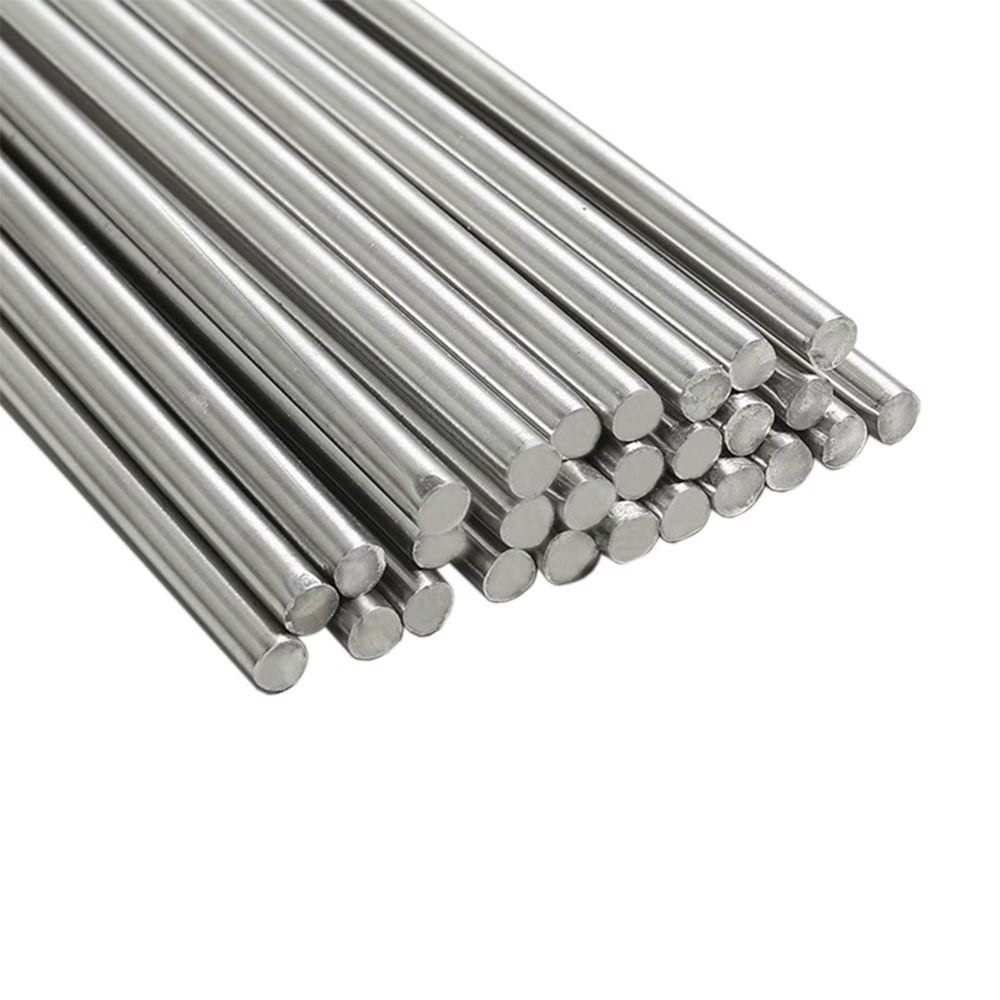
316L Stainless Steel Round Bar
AISI 316L (UNS S31603) is a premium marine-grade austenitic stainless steel round bar containing 2-3% Molybdenum and low carbon for ultimate pitting and corrosion resistance. Diameter 3-500mm, supplied with EN 10204 3.1 MTC.
| Material | Austenitic Stainless Steel (Marine Grade) |
|---|---|
| Grade / Standard | AISI 316L / UNS S31603 |
| Diameter | 3mm - 500mm |
| Length | 3m / 4m / 5m / 6m (or cut to length) |
| Delivery Condition | hot_rolled / cold_rolled |
| Surface Treatment | bare / polished / coated |
| MOQ | 1 Ton |
| Delivery Time | 10-25 Days / In Stock |
| Loading Port | Tianjin / Shanghai / Qingdao |
Overview of 316L Stainless Steel Round Bar
AISI 316L is the second most common austenitic stainless steel grade, globally recognized as the standard “marine grade” stainless steel. Specified under ASTM A276 / ASTM A479 / EN 10088-3 standards with UNS designation S31603, 316L stainless steel round bar is distinguished from 304 by the addition of 2% to 3% molybdenum and a higher nickel content. This specific alloying provides vastly superior resistance to pitting and crevice corrosion, particularly in chloride-rich environments like seawater and de-icing salts. Furthermore, the “L” indicates a low carbon content (maximum 0.030%), which prevents carbide precipitation during welding and high-temperature processing.
316L stainless steel round bar is the premium choice for CNC machining, shaft manufacturing, and precision engineering where extreme corrosion resistance is non-negotiable. It is the international benchmark for manufacturing components used in chemical processing, marine hardware, pharmaceutical equipment, and the oil and gas industry. While carrying a higher initial cost than 304, 316L round bar delivers unmatched lifecycle value in aggressive environments, ensuring structural integrity, hygiene, and aesthetic permanence without the need for post-weld annealing.
Key Features and Manufacturing Methods
316L stainless steel round bar is produced through precision manufacturing processes to meet stringent industrial demands. Hot rolled (HR) bars are produced from premium S31603 billets at 1100-1200°C, offering robust mechanical properties for heavy industrial diameters (16mm to 500mm). These are typically supplied in an annealed and pickled condition (No.1 finish), ideal for subsequent heavy machining or forging operations. Cold drawn (CD) bars are manufactured by drawing the hot-rolled material through tungsten carbide dies at room temperature. This process dramatically improves dimensional tolerances (h9/h11), surface finish (Ra 0.8-1.6μm), and tensile strength, making it the preferred feed for automated CNC lathes (diameters 3mm to 100mm).
For high-precision applications such as pump and motor shafts, peeled and turned bars (20mm to 300mm) and centerless ground bars (3mm to 200mm) are supplied to achieve exact h6/h7 tolerances and pristine, defect-free surfaces. Standard lengths are 3, 4, 5, and 6 meters, with bespoke cut-to-length services available. Every 316L bar undergoes rigorous quality control, including 100% PMI (Positive Material Identification) testing to guarantee Molybdenum content, mechanical tensile/yield testing, and mandatory intergranular corrosion tests per ASTM A262 to verify the integrity of the low-carbon matrix.
Main Applications of 316L Stainless Steel Round Bar
The exceptional chloride and acid resistance of 316L stainless steel round bar makes it indispensable across high-performance industries. In the Marine and Offshore sectors, it is machined into boat propeller shafts, propeller nuts, rigging hardware, subsea sensor housings, and offshore platform fasteners that must survive continuous saltwater exposure. The Chemical and Petrochemical processing industries utilize 316L round bar to machine valve stems, pump shafts, agitators, and flange bolts that handle aggressive organic acids, chlorides, and solvents.
The Pharmaceutical, Biotechnology, and Medical industries rely on 316L round bar because its stable passive layer prevents product contamination. It is used to manufacture sanitary valve components, clean-room equipment, bioreactor shafts, and surgical instruments requiring electropolished finishes. Other critical applications include Food and Beverage processing (especially environments dealing with salts or high-temperature CIP cleaning), wastewater treatment plant components, pulp and paper mill machinery, high-end coastal architectural fittings, and high-performance fasteners engineered to resist stress corrosion cracking.
Why Choose Us for 316L Stainless Steel Round Bar
Shandong Tanglu Metal Material Co., Ltd. is a premier supplier of high-grade 316L stainless steel round bar, partnering with top-tier Chinese mills certified to ISO 9001, ASME, PED 2014/68/EU, and marine classification society standards. We understand that specifying 316L means zero compromise on corrosion resistance; therefore, we strictly guarantee the chemical composition of our bars, ensuring Molybdenum is robustly between 2.0-3.0% and Carbon is strictly ≤0.030% through comprehensive PMI and laboratory testing on every batch.
We offer a massive inventory covering diameters from 3mm to 500mm across hot rolled, cold drawn, and precision centerless ground conditions. With a monthly supply capacity of 5,000 tons and extensive experience supplying global CNC machining centers, pump manufacturers, and marine engineering firms, we efficiently handle both precision trial orders and massive bulk shipments. Every export is meticulously packaged for oceanic transit and accompanied by full traceability via an EN 10204 3.1 Mill Test Certificate. For critical offshore or oil & gas applications, we seamlessly facilitate EN 10204 3.2 certification and third-party inspections (SGS, DNV, BV, LR, ABS).
📐 Dimension & Size Table
| Diameter (mm) | Length (m) | Weight (kg/m) | Tolerance |
|---|---|---|---|
| 3 | 3 / 4 | 0.056 | h11 (± 0.06mm) |
| 5 | 3 / 4 | 0.156 | h11 (± 0.075mm) |
| 6 | 3 / 4 | 0.224 | h11 (± 0.075mm) |
| 8 | 3 / 6 | 0.399 | h11 (± 0.09mm) |
| 10 | 3 / 6 | 0.623 | h11 (± 0.09mm) |
| 12 | 3 / 6 | 0.897 | h11 (± 0.11mm) |
| 16 | 3 / 6 | 1.594 | h11 (± 0.11mm) |
| 20 | 3 / 6 | 2.491 | h11 (± 0.13mm) |
| 25 | 3 / 6 | 3.892 | h11 (± 0.13mm) |
| 30 | 3 / 6 | 5.605 | h11 (± 0.16mm) |
| 40 | 3 / 6 | 9.964 | h11 (± 0.16mm) |
| 50 | 3 / 6 | 15.570 | h11 (± 0.19mm) |
| 60 | 3 / 6 | 22.420 | h11 (± 0.19mm) |
| 80 | 3 / 6 | 39.860 | h11 (± 0.22mm) |
| 100 | 3 / 6 | 62.280 | h11 (± 0.22mm) |
| 150 | 3 / 6 | 140.130 | ± 1.5mm (HR) |
| 200 | 3 / 6 | 249.120 | ± 2.0mm (HR) |
| 250 | 3 / 6 | 389.250 | ± 2.5mm (HR) |
| 300 | 3 / 6 | 560.520 | ± 3.0mm (HR) |
| 400 | 3 / 6 | 996.480 | ± 4.0mm (HR) |
| 500 | 3 / 6 | 1556.870 | ± 5.0mm (HR) |
* Custom sizes available upon request. Tolerances per relevant international standards.
🔬 Chemical Composition
| Element | Min | Max | Display Value | Note |
|---|---|---|---|---|
| C | - | 0.030 | ≤0.030 | Low carbon ensures weldability |
| Si | - | 0.75 | ≤0.75 | |
| Mn | - | 2.00 | ≤2.00 | |
| P | - | 0.045 | ≤0.045 | |
| S | - | 0.030 | ≤0.030 | |
| Cr | 16.00 | 18.00 | 16.00-18.00 | Primary corrosion resistance |
| Ni | 10.00 | 14.00 | 10.00-14.00 | Austenite stabilizer, higher than 304 |
| Mo | 2.00 | 3.00 | 2.00-3.00 | Crucial for pitting/chloride resistance |
| Fe | - | - | Balance | Base element |
* Chemical composition may vary by heat, thickness and specification. Please refer to the actual mill test certificate.
⚙️ Mechanical Properties
| Property | Value | Unit | Test Condition |
|---|---|---|---|
| Tensile Strength (Hot Rolled) | ≥485 | MPa | Solution annealed, per ASTM A276 |
| Yield Strength (Hot Rolled) | ≥170 | MPa | 0.2% proof stress |
| Tensile Strength (Cold Drawn) | ≥620 | MPa | Cold drawn condition |
| Yield Strength (Cold Drawn) | ≥310 | MPa | Cold drawn condition |
| Elongation (Hot Rolled) | ≥40 | % | Gauge length 50mm |
| Elongation (Cold Drawn) | ≥30 | % | Gauge length 50mm |
| Brinell Hardness (HBW) | ≤200 | HBW | Solution annealed |
| Rockwell Hardness (HRB) | ≤90 | HRB | Solution annealed |
| Density | 7.98 | g/cm³ | Slightly heavier than 304 due to Mo |
| Magnetic Permeability | ≤1.02 | μ | Non-magnetic austenitic structure |
* Values shown are minimum requirements unless otherwise stated.
📦 Commercial Information
| Packaging | High-value 316L stainless steel round bars are packed with premium seaworthy protection. Bars are bundled in hexagonal formations with heavy-duty steel strapping and nylon slings to prevent surface marring. Typical bundle weight is 2-5 tons. For cold drawn (bright) and centerless ground bars, each bundle is tightly wrapped in waterproof PE film and thick woven plastic to protect against salt spray during ocean transit. Heavy-duty plastic end caps are applied. Custom ISPM-15 fumigated wooden crates or individual cardboard tubing are highly recommended and available for precision h6/h7 tolerance bars to ensure absolute dimensional and surface integrity upon arrival. |
|---|---|
| Payment Terms | T/T (Telegraphic Transfer),L/C (Letter of Credit),D/P (Documents against Payment),Western Union |
| Price Term | FOB,CFR,CIF,EXW |
| Supply Capacity | 3,000 Tons/Month (Premium Stainless Steel Bars) |
| Loading Port | Tianjin / Shanghai / Qingdao |
Why Choose Our 316L Stainless Steel Round Bar?
Marine Grade Chloride Resistance
Alloyed with 2-3% Molybdenum, 316L round bar provides exceptional resistance to pitting and crevice corrosion in chloride-rich environments, making it the definitive choice for marine hardware and offshore infrastructure.
Excellent Weldability (Low Carbon)
With carbon content strictly controlled to ≤0.030%, 316L prevents carbide precipitation (sensitization) at grain boundaries during welding. This allows for heavy-gauge fabrication without the need for post-weld solution annealing.
Precision Dimensional Tolerances
Available as hot rolled for heavy forging/machining, cold drawn (h11) for automated CNC lathes, and centerless ground (h6/h7) for high-precision pump shafts and electric motor spindles, ranging from 3mm to 500mm.
Medical & Sanitary Compliant
Provides a highly stable passive oxide layer that withstands aggressive sterilization chemicals. Fully compliant for pharmaceutical clean-room hardware, food processing (FDA), and surgical instrument manufacturing.
100% Traceability & PMI Tested
Every single batch is subjected to Positive Material Identification (PMI) to guarantee Molybdenum levels, backed by EN 10204 3.1 Mill Test Certificates and optional third-party classification (DNV, ABS, LR) for marine projects.
🏭 Applications of 316L Stainless Steel Round Bar
316L stainless steel round bar is the premier raw material for machining components subjected to highly corrosive environments. In the Marine and Offshore sectors, it is universally specified for propeller shafts, rudder hardware, marine fasteners, and subsea sensor bodies due to its immunity to seawater pitting. The Chemical and Petrochemical processing industries rely heavily on 316L bar to machine valve stems, pump impellers, agitator shafts, and heat exchanger fittings that handle organic acids, alkalis, and chloride-bearing fluids. Because it will not contaminate sterile fluids and resists harsh Clean-In-Place (CIP) chemicals, the Pharmaceutical and Biotechnology industries use 316L round bar for sanitary valve bodies, bioreactor agitators, and water-for-injection (WFI) system components. Additionally, the Medical industry uses high-purity 316L for surgical instruments and orthopedic implants. Other major applications include high-end food and beverage processing equipment (especially brewing and dairy), wastewater treatment machinery, pulp and paper mill components, desalination plant hardware, and premium architectural fittings exposed to coastal salt spray.
📋 Quality & Certification
Our Certifications
- ✅ ISO 9001:2015
- ✅ ABS
- ✅ DNV GL
- ✅ Lloyd's Register (LR)
- ✅ SGS Certified
Mill Certificate Type
- 📋 EN 10204 3.1
- 📋 EN 10204 3.2
- 📋 Original Mill Certificate
- 📋 Third Party Inspection Available
- 📋 Certificate of Origin
❓ Frequently Asked Questions
What is the difference between 304 and 316L stainless steel round bar?
The primary difference is the chemical composition. 316L contains 2% to 3% Molybdenum (Mo) and a higher Nickel content, whereas 304 contains no Molybdenum. This specific addition gives 316L significantly enhanced resistance to pitting and crevice corrosion in chloride-rich environments like seawater, de-icing salts, and harsh industrial cleaning chemicals. While 304 is great for general indoor or mild outdoor use, 316L is the mandatory choice for marine, heavy chemical, and highly corrosive applications, which justifies its higher price point.
Why is the "L" important in 316L round bar?
The "L" stands for Low Carbon. Standard 316 has a maximum carbon content of 0.08%, while 316L restricts carbon to a maximum of 0.030%. When standard stainless steel is welded or exposed to extreme heat, carbon can bond with chromium to form carbides (sensitization), depleting the surrounding metal of its protective chromium and causing rust. The severely restricted carbon content in 316L prevents this, allowing machined parts to be welded to other components without losing their corrosion resistance, and eliminating the need for post-weld solution annealing.
Is 316L round bar harder to machine than 304?
Yes, 316L is slightly more difficult to machine than 304. Because of the higher nickel and molybdenum content, 316L is tougher and has a higher work-hardening rate. This means the metal hardens rapidly as the cutting tool works it, which can cause faster tool wear. To successfully machine 316L round bar, CNC operators should use sharp tooling (typically carbide), utilize abundant cutting fluid/coolant, maintain heavy, constant feeds, and avoid letting the tool dwell or rub on the workpiece.
Should I order hot rolled or cold drawn 316L round bar?
It depends entirely on your manufacturing process. Hot Rolled (HR) bar has a slightly rougher, duller surface and looser dimensional tolerances. It is usually cheaper and is the best choice if you are going to heavily machine the entire diameter down to a smaller size, or if you plan to forge it. Cold Drawn (CD) bar has a bright, smooth finish, tighter dimensional tolerances (h9/h11), and higher tensile strength due to cold work. CD bar is highly recommended for automatic CNC lathes where the bar is fed directly into the machine and the outer diameter requires minimal to no surface machining.
Is 316L stainless steel round bar completely rust-proof in seawater?
While 316L is globally known as the 'marine grade' and performs exceptionally well in seawater, no stainless steel is 100% rust-proof under every condition. In moving or flowing seawater, 316L performs brilliantly because the oxygen in the water replenishes the metal's passive layer. However, in warm, stagnant seawater, or in tight crevices where oxygen is depleted (like under a threaded nut or marine growth), 316L can eventually experience pitting corrosion. For permanently submerged, stagnant marine applications, regular cleaning or higher-alloy materials like Duplex 2205 may be required.
Get a Quote for
316L Stainless Steel Round Bar
Submit your requirements and receive a competitive price quote within 24 hours.
- ✓ Fast response within 24 hours
- ✓ Competitive factory-direct pricing
- ✓ Free technical consultation
- ✓ Mill test certificate provided
- ✓ Flexible payment terms available
⏱ Response within 24 hours
Send Your Inquiry
All fields marked with * are required