
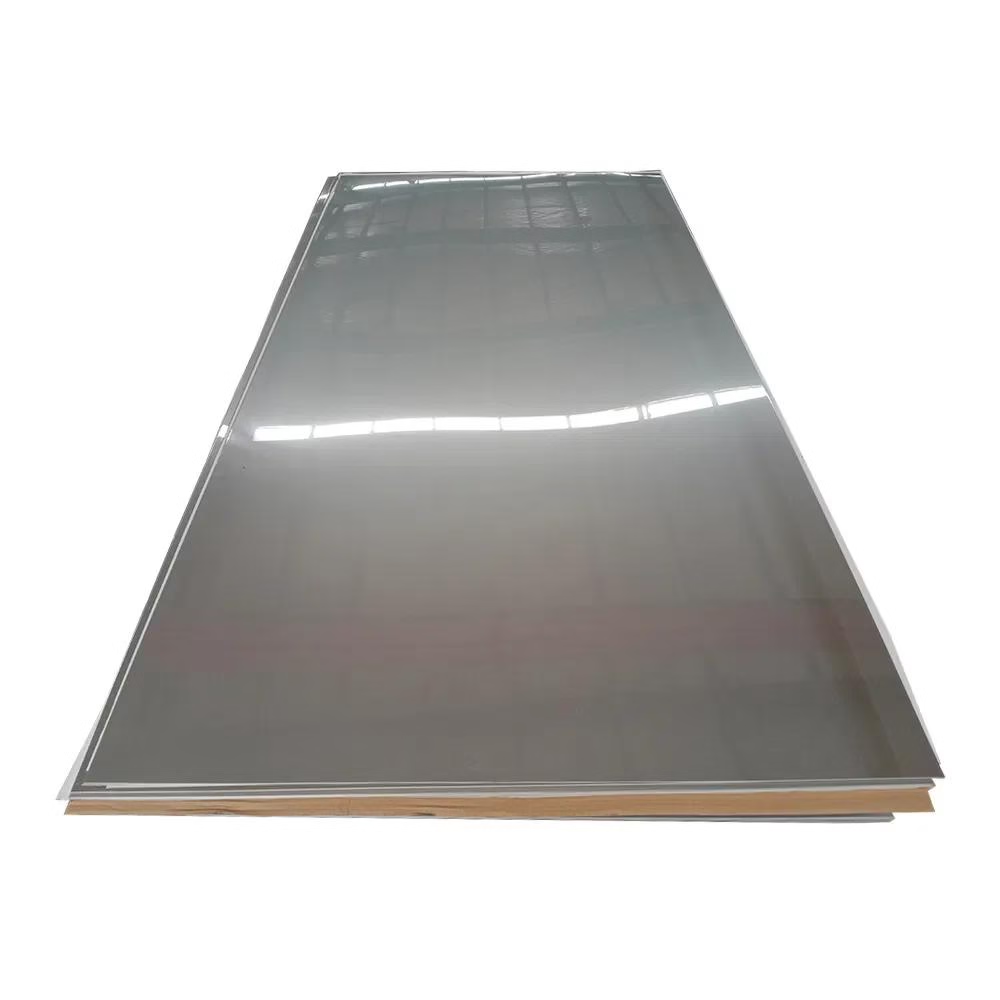
410 Stainless Steel Plate
AISI 410 (UNS S41000) martensitic stainless steel plate, hardenable by heat treatment to achieve high strength (>1200 MPa) and hardness (>40 HRC). Contains 11.5-13.5% Cr. Suitable for steam turbine blades, valves, pumps, cutlery, and wear parts. Thickness 3-100mm, annealed or Q+T condition.
| Material | Martensitic Stainless Steel (Hardenable Cr-steel) |
|---|---|
| Grade / Standard | AISI 410 / UNS S41000 |
| Thickness | 0.3mm - 6.0mm (cold rolled sheet), 3.0mm - 100mm (hot rolled plate) |
| Width | 1000mm - 2000mm (sheet), 1500mm - 2500mm (plate) |
| Length | 2000mm - 6000mm (sheet), 3000mm - 12000mm (plate) |
| Delivery Condition | hot_rolled / cold_rolled |
| Surface Treatment | bare / polished / coated |
| MOQ | 1 Ton |
| Delivery Time | 15-25 Days / Stock Available (Annealed Condition) |
| Loading Port | Tianjin / Shanghai / Qingdao |
Expert on hardening & heat treatment – Response within 24 hours
Overview of 410 Stainless Steel Plate
AISI 410 is a martensitic stainless steel containing 11.5-13.5% chromium, providing a unique combination of high strength, hardness, and wear resistance with moderate corrosion resistance. As a hardenable grade, 410 stainless steel plate can be heat treated by quenching and tempering to achieve a wide range of mechanical properties, from a soft, machinable condition in the annealed state to tensile strengths exceeding 1200 MPa when hardened. The alloy exhibits good resistance to atmospheric corrosion, fresh water, mild acids, and alkalis, making it suitable for applications where both mechanical stress and some corrosion exposure are present.
Specified under ASTM A240 with UNS designation S41000, 410 stainless steel plate is widely used in the production of steam turbine blades, valve components, pump shafts, surgical instruments, cutlery, and a wide range of mechanical parts requiring high strength and abrasion resistance. Its magnetic nature and lower cost compared to austenitic grades like 304 further enhance its appeal for industrial and consumer applications. The plate is available from 3mm to 100mm in thickness, typically supplied in the annealed condition for subsequent machining or heat treatment, or in the quenched and tempered (Q+T) condition for direct use in demanding environments.
Key Features and Heat Treatment
410 stainless steel plate is manufactured via electric arc furnace melting followed by AOD refining, continuous casting, and hot rolling to the required thickness. For thinner gauges, cold rolling with intermediate annealing is performed. The plate is solution-annealed (austenitized) at 815-900°C and slow-cooled to produce a relatively soft ferrite-carbide microstructure, making it suitable for machining, forming, or welding. For end-use requiring high strength and hardness, the plate can be hardened by heating to 925-1010°C, oil or air quenching to form martensite, and then tempering at 150-370°C (for maximum hardness) or at higher temperatures up to 600-700°C for improved toughness with some loss in strength.
Quality control includes chemical analysis (key elements Cr, C, Mn, Si, P, S), tensile testing in both annealed and Q+T conditions, hardness testing (Rockwell or Brinell), and ultrasonic or surface inspection for plate integrity. The plate can be supplied with No.1 surface (hot rolled, annealed, descaled) for general industrial use, 2B finish (cold rolled, annealed, pickled) for moderate corrosion applications, and occasionally No.4 satin finish for decorative or hygienic applications. Dimensional tolerances conform to ASTM A240 or EN 10088-2 standards. Common thickness ranges are 3mm to 100mm for hot-rolled plate and 0.5mm to 6mm for cold-rolled sheet. Widths up to 2500mm and lengths up to 12 meters are available.
Main Applications of 410 Stainless Steel Plate
410 stainless steel plate is extensively used in the power generation industry for steam turbine blades, compressor blades, and rotor spacers where high strength at moderately elevated temperatures is required. The petrochemical and chemical processing industries employ 410 for pump shafts, valve bodies, valve stems, and fittings handling mild corrosive fluids under high mechanical loads. Its high hardness and wear resistance make it a standard material for fasteners, bushings, and bearings in industrial machinery.
The cutlery and kitchenware sector uses 410 for knife blades, scissors, and other cutting tools that need a sharp, durable edge. Surgical instruments such as clamps, forceps, and scalpels also rely on 410’s ability to be hardened and polished to a mirror finish. Automotive and aerospace applications include fuel nozzle components, exhaust valves, and structural brackets. In construction and mining, 410 plates are used for wear plates, chutes, and screening equipment where abrasion resistance is critical. The grade is also popular in the manufacturing of molds, dies, and tooling components.
Why Choose Us for 410 Stainless Steel Plate
Shandong Tanglu Metal Material Co., Ltd. supplies premium 410 stainless steel plate sourced from ISO 9001 and PED certified mills specializing in martensitic stainless steel. Every plate is provided with an EN 10204 3.1 mill test certificate, detailing chemical composition, mechanical properties (tensile, yield, elongation, hardness) in the as-delivered condition, and NDT results when required. For critical applications, we can upgrade to EN 10204 3.2 with independent inspection by SGS, TÜV, or BV.
We stock a comprehensive inventory in thicknesses from 3mm to 50mm, with standard sizes and finishes ready for immediate shipment. Advanced in-house processing includes plasma cutting, oxy-fuel cutting, beveling, and stress-relieving heat treatment according to customer specifications. With a monthly supply capacity of 1,500 tons of martensitic stainless steel plates and a proven export record to over 40 countries, we support both one-off prototype orders and long-term supply agreements for the power, oil & gas, and industrial tooling sectors. Our logistics team ensures robust seaworthy packaging, with edge protectors, moisture-resistant wrapping, and full heat-number traceability, guaranteeing your material arrives undamaged and ready for production.
📐 Dimension & Size Table
| Thickness (mm) | Width (mm) | Length (mm) | Weight (kg/m²) |
|---|---|---|---|
| 1.0 | 1000-1500 | 2000-6000 | 7.75 |
| 1.5 | 1000-1500 | 2000-6000 | 11.62 |
| 2.0 | 1000-1500 | 2000-6000 | 15.50 |
| 3.0 | 1000-2000 | 2000-6000 | 23.25 |
| 5.0 | 1500-2200 | 3000-8000 | 38.75 |
| 6.0 | 1500-2200 | 3000-8000 | 46.50 |
| 8.0 | 1500-2500 | 3000-10000 | 62.00 |
| 10.0 | 1500-2500 | 3000-10000 | 77.50 |
| 12.0 | 1500-2500 | 3000-12000 | 93.00 |
| 15.0 | 1500-2500 | 3000-12000 | 116.25 |
| 20.0 | 1500-2500 | 3000-12000 | 155.00 |
| 25.0 | 1500-2500 | 3000-12000 | 193.75 |
| 30.0 | 1500-2500 | 3000-12000 | 232.50 |
| 40.0 | 1500-2500 | 3000-12000 | 310.00 |
| 50.0 | 1500-2500 | 3000-12000 | 387.50 |
| 60.0 | 1500-2000 | 3000-10000 | 465.00 |
| 80.0 | 1500-2000 | 3000-10000 | 620.00 |
| 100.0 | 1500-2000 | 3000-8000 | 775.00 |
* Custom sizes available upon request. Tolerances per relevant international standards.
🔬 Chemical Composition
| Element | Min | Max | Display Value | Note |
|---|---|---|---|---|
| C | 0.08 | 0.15 | 0.08-0.15 | Per ASTM A240 UNS S41000; enables hardening |
| Mn | - | 1.00 | ≤1.00 | |
| Si | - | 1.00 | ≤1.00 | |
| P | - | 0.040 | ≤0.040 | |
| S | - | 0.030 | ≤0.030 | |
| Cr | 11.50 | 13.50 | 11.50-13.50 | Provides corrosion & oxidation resistance |
| Ni | - | 0.75 | ≤0.75 | Residual, essentially nickel-free |
| Fe | - | - | Balance |
* Chemical composition may vary by heat, thickness and specification. Please refer to the actual mill test certificate.
⚙️ Mechanical Properties
| Property | Value | Unit | Test Condition |
|---|---|---|---|
| Tensile Strength (Annealed) | ≥450 | MPa | Annealed condition, soft and machinable |
| Yield Strength (Annealed) | ≥205 | MPa | 0.2% offset, annealed |
| Elongation (Annealed) | ≥20 | % | Annealed, in 50mm |
| Hardness (Annealed) | ≤217 | HBW | Annealed (max for machining) |
| Tensile Strength (Q+T, typical) | 700-1200+ | MPa | Quenched & Tempered, depending on tempering temp |
| Yield Strength (Q+T, typical) | ≥500 | MPa | Q+T, depending on temper |
| Hardness (Q+T) | 25-45 | HRC | Typically achieved; max ~45 HRC |
| Elastic Modulus | 200 | GPa | Reference value |
| Density | 7.75 | g/cm³ | Reference value |
| Magnetic Permeability | Ferromagnetic | – | Strongly magnetic |
* Values shown are minimum requirements unless otherwise stated.
📦 Commercial Information
| Packaging | Standard seaworthy export packing for heavy stainless steel plate. Thinner sheets are packed in wooden crates with interleaving paper; thicker plates are bundled with edge protectors and steel strapping, coated with anti-rust oil and wrapped in waterproof material. Each bundle clearly tagged with grade (410), heat number, thickness, and weight. ISPM-15 compliant wooden pallets/crates are used for international shipment. Special packaging including vacuum sealing and VCI paper is available for precision-ground or polished products. |
|---|---|
| Payment Terms | T/T (Telegraphic Transfer),L/C at Sight (Letter of Credit),D/P (Documents against Payment) |
| Price Term | FOB,CFR,CIF,EXW |
| Supply Capacity | 1,500 Tons/Month (Martensitic Stainless Steel Plates) |
| Loading Port | Tianjin / Shanghai / Qingdao |
Why Choose Our 410 Stainless Steel Plate?
Hardenable to High Strength & Hardness
Unlike austenitic grades, 410 can be hardened via heat treatment (quench & temper) to achieve tensile strengths up to 1200 MPa and hardness up to 45 HRC, making it ideal for tooling, blades, and wear components.
Cost-Effective Stainless Solution
With virtually no nickel and a lower alloy content than 304/316, 410 offers significant cost savings while still providing useful corrosion resistance, making it a preferred choice for high-strength applications on a budget.
Excellent Machinability in Annealed State
Supplied in soft annealed condition (≤217 HBW), 410 plate machines readily, allowing economic production of complex parts before final heat treatment to achieve the required strength and wear characteristics.
Traceable Quality & Certification
Every plate is supplied with an EN 10204 3.1 certificate confirming chemical composition and mechanical properties. Additional testing (UT, PT) and EN 10204 3.2 inspection by SGS, TÜV, etc. are available for critical rotating parts.
Broad Range of Thicknesses & Sizes
From thin gauge 1mm sheet to heavy 100mm boiler plate, we can supply 410 in a wide dimensional range, with in-house cutting and heat-treatment services to meet exact project specifications.
🏭 Applications of 410 Stainless Steel Plate
410 martensitic stainless steel plate is the workhorse material for steam turbine and gas turbine blades, compressor vanes, and other power generation components where moderate temperature strength and corrosion resistance are needed. In the oil & gas industry, it is used for valve bodies, seats, stems, and pump shafting exposed to mildly corrosive well fluids. The cutlery, surgical instrument, and tooling sectors rely on 410 for knife blades, scissors, forceps, and dies due to its edge-holding ability. Automotive applications include exhaust system hangers, fuel filler necks, and airbag inflator components. It is also widely utilized for general engineering parts such as bearings, fasteners, bushes, and wear plates in mining, agriculture, and construction equipment.
📋 Quality & Certification
Our Certifications
- ✅ ISO 9001:2015
- ✅ CE Marking
- ✅ ABS
- ✅ DNV GL
- ✅ Lloyd's Register (LR)
- ✅ Bureau Veritas (BV)
- ✅ SGS Certified
- ✅ NK
Mill Certificate Type
- 📋 EN 10204 3.1
- 📋 EN 10204 3.2
- 📋 Original Mill Certificate
- 📋 Third Party Inspection Available
- 📋 Certificate of Origin
❓ Frequently Asked Questions
Can 410 stainless steel be hardened?
Yes, 410 is a martensitic stainless steel that can be significantly hardened through heat treatment. The process involves austenitizing at 925-1010°C, followed by oil or air quenching to form a hard martensitic structure. Subsequent tempering between 150°C and 370°C maximizes hardness (up to 45 HRC), while tempering at higher temperatures (e.g., 650°C) reduces hardness but improves toughness. This distinguishes 410 from austenitic grades (like 304/316), which cannot be hardened by heat treatment.
What is the corrosion resistance of 410 stainless steel?
410 offers good resistance to atmospheric corrosion, fresh water, mild acids, and alkalis, especially in the hardened and polished condition. It resists oxidation up to about 650°C continuously. However, its lower chromium content (11.5-13.5%) means it is less corrosion resistant than 304 or 316, particularly in chloride-rich environments (marine, coastal) where pitting can occur. It is best suited for mildly corrosive applications where high mechanical properties are the primary requirement.
Is 410 stainless steel magnetic?
Yes, 410 is ferritic at room temperature and strongly magnetic. This holds true in both the annealed and hardened conditions, distinguishing it from non-magnetic austenitic grades. This magnetic property is useful for applications like solenoid actuators and clamping fixtures.
What is the difference between 410 and 304 stainless steel?
The key differences are: (1) Composition: 410 has 11.5-13.5% Cr and no Ni, while 304 has 18-20% Cr and 8-10.5% Ni. (2) Hardenability: 410 is martensitic and hardenable by heat treatment; 304 is austenitic and cannot be hardened by heat treatment. (3) Corrosion: 304 is far more corrosion resistant. (4) Magnetism: 410 is magnetic; 304 is non-magnetic. (5) Cost: 410 is cheaper. 410 is chosen for strength and wear, 304 for corrosion resistance.
What are the recommended welding procedures for 410 plate?
Welding 410 requires care to prevent cracking. Preheating (200-300°C) is recommended to slow the cooling rate and reduce the martensite hardness in the heat-affected zone. Post-weld heat treatment (PWHT) at 650-750°C (tempering) is usually necessary to restore ductility and toughness. Filler metals like E/ER410 or E/ER309 are commonly used. In some cases, austenitic fillers (ER309) are preferred to deposit a ductile weld metal and avoid post-weld cracking, even though the weld metal won't match the base metal's hardenability.
Get 410 Plate Quote for
410 Stainless Steel Plate
Submit your requirements and receive a competitive price quote within 24 hours.
- ✓ Fast response within 24 hours
- ✓ Competitive factory-direct pricing
- ✓ Free technical consultation
- ✓ Mill test certificate provided
- ✓ Flexible payment terms available
⏱ Expert on hardening & heat treatment – Response within 24 hours
Send Your Inquiry
All fields marked with * are required