
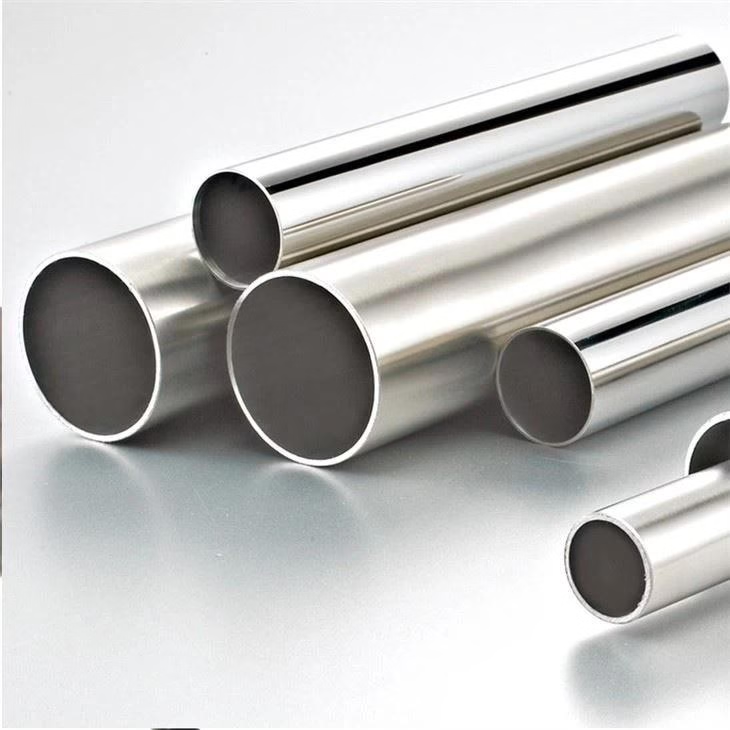
904L Stainless Steel Pipe
904L (UNS N08904) is a super austenitic stainless steel pipe with a deliberate addition of Copper, offering extreme resistance to sulfuric/phosphoric acids and chloride SCC. OD 6-610mm. Supplied with EN 10204 3.1 MTC.
| Material | Super Austenitic Stainless Steel |
|---|---|
| Grade / Standard | 904L / UNS N08904 |
| Outer Diameter (OD) | 6mm - 610mm (NPS 1/8 inch - NPS 24 inch) |
| Wall Thickness (WT) | 0.5mm - 40mm (SCH 5S / 10S / 40S / 80S) |
| Length | 3m / 6m / 12m (or cut to length) |
| Delivery Condition | hot_rolled / cold_rolled |
| Surface Treatment | bare / polished / coated |
| MOQ | 500 Kg |
| Delivery Time | 15-35 Days / Select Sizes In Stock |
| Loading Port | Tianjin / Shanghai / Qingdao |
Overview of 904L Stainless Steel Pipe
904L is a highly alloyed super austenitic stainless steel designed for extreme corrosion resistance in aggressive environments where standard 300-series grades like 316L and 317L fall short. Specified under UNS N08904 and EN 1.4539, and commonly manufactured to ASTM B677 (seamless) or ASTM B673 (welded) and ASTM A312 standards, 904L bridges the gap between standard austenitic stainless steels and highly expensive nickel-based alloys. Its defining metallurgical feature is the substantial addition of Copper (1.0 – 2.0%), which, combined with high Nickel (23-28%) and Molybdenum (4-5%), grants it unparalleled resistance to strong reducing acids, most notably sulfuric acid and phosphoric acid.
Because of its exceptionally high alloy content, 904L stainless steel pipe is virtually immune to chloride-induced stress corrosion cracking (SCC), a common failure mechanism for 304 and 316L. Furthermore, its ultra-low carbon content (≤0.020%) prevents carbide precipitation during welding, ensuring excellent corrosion resistance in the as-welded condition. Available in both seamless and welded forms, 904L is the ultimate piping material for the chemical processing, fertilizer production, marine, and paper and pulp industries where severe acidic and chloride-rich conditions are a constant threat.
Key Features and Manufacturing Methods
Producing 904L stainless steel pipe requires advanced metallurgical expertise to ensure the homogenous distribution of its high-alloy elements. Seamless 904L pipes are extruded from premium N08904 solid billets. Because of its high nickel and molybdenum content, the material exhibits a high work-hardening rate, making cold drawing a slow and meticulous process. Welded 904L pipes are produced using TIG or plasma welding methods without filler metal or with an over-alloyed filler (such as Alloy 625) to guarantee the weld seam matches the corrosion resistance of the parent metal.
All 904L pipes undergo a strict solution annealing process at temperatures between 1090°C and 1175°C, followed by rapid water quenching. This critical heat treatment dissolves any intermetallic phases and restores maximum corrosion resistance. Available in outer diameters from 6mm to 610mm and wall thicknesses covering SCH 5S through SCH 80S (and heavier upon request), every pipe is rigorously tested. Standard quality control includes 100% PMI (Positive Material Identification) to verify the Copper and Molybdenum content, mandatory hydrostatic or eddy current testing, and severe acid corrosion testing per ASTM G28 to ensure flawless performance in the field.
Main Applications of 904L Stainless Steel Pipe
904L stainless steel pipe was originally developed to withstand sulfuric acid, and it remains the premier piping material for manufacturing, storing, and transporting this highly aggressive chemical across a wide range of concentrations. In the Fertilizer Industry, 904L is indispensable for phosphate-based fertilizer production, heavily utilized in piping systems that handle hot, concentrated phosphoric acid.
The high Nickel and Molybdenum content gives 904L exceptional resistance to pitting and crevice corrosion in seawater and brackish water, making it highly valued in the Marine and Offshore Oil & Gas sectors for seawater cooling systems, desalination plants, and subsea control lines. In the Chemical Processing Industry (CPI), it is used to process acetic acid, formic acid, and other organic acids. Furthermore, the Pulp and Paper industry utilizes 904L for bleaching equipment and chemical recovery systems where standard stainless steels would suffer rapid localized corrosion. For any fluid handling system where chlorides, sulfuric acid, or extreme pitting environments are present, 904L provides maximum operational security.
Why Choose Us for 904L Stainless Steel Pipe
Shandong Tanglu Metal Material Co., Ltd. is a trusted supplier of specialty high-nickel alloys and super austenitic stainless steels. Sourcing 904L requires absolute confidence in material chemistry. Our 904L pipes are manufactured by elite, ISO 9001 and PED-certified mills, and we guarantee the strict adherence to the UNS N08904 chemical composition, specifically ensuring the Copper (1.0-2.0%), Nickel (23-28%), and Molybdenum (4-5%) levels are perfectly balanced for maximum acidic resistance.
We understand that 904L is a high-value, mission-critical material. Our quality assurance team conducts 100% PMI testing on every piece before dispatch. We maintain strategic inventories of standard SCH 10S and SCH 40S 904L seamless pipes for rapid deployment to urgent chemical plant turnarounds. Every order is meticulously packed in custom, fumigated wooden crates to protect the pipes during global ocean freight. All shipments are supplied with complete traceability, backed by original EN 10204 3.1 Mill Test Certificates, and we fully support third-party inspections by SGS, TUV, BV, or DNV to verify compliance with your most stringent engineering specifications.
📐 Dimension & Size Table
| OD (inch / mm) | WT SCH 10S (mm) | WT SCH 40S (mm) | WT SCH 80S (mm) |
|---|---|---|---|
| 1/8" (10.3mm) | 1.24 | 1.73 | 2.41 |
| 1/4" (13.7mm) | 1.65 | 2.24 | 3.02 |
| 1/2" (21.3mm) | 2.11 | 2.77 | 3.73 |
| 3/4" (26.7mm) | 2.11 | 2.87 | 3.91 |
| 1" (33.4mm) | 2.77 | 3.38 | 4.55 |
| 1-1/2" (48.3mm) | 2.77 | 3.68 | 5.08 |
| 2" (60.3mm) | 2.77 | 3.91 | 5.54 |
| 2-1/2" (73.0mm) | 3.05 | 5.16 | 7.01 |
| 3" (88.9mm) | 3.05 | 5.49 | 7.62 |
| 4" (114.3mm) | 3.05 | 6.02 | 8.56 |
| 6" (168.3mm) | 3.40 | 7.11 | 10.97 |
| 8" (219.1mm) | 3.76 | 8.18 | 12.70 |
| 10" (273.0mm) | 4.19 | 9.27 | 15.09 |
| 12" (323.8mm) | 4.57 | 10.31 | 17.48 |
| 14" (355.6mm) | 4.78 | 11.13 | 19.05 |
| 16" (406.4mm) | 4.78 | 12.70 | 21.44 |
| 18" (457.0mm) | 4.78 | 14.27 | 23.83 |
| 20" (508.0mm) | 5.54 | 15.09 | 26.19 |
| 24" (610.0mm) | 6.35 | 17.48 | 30.96 |
* Custom sizes available upon request. Tolerances per relevant international standards.
🔬 Chemical Composition
| Element | Min | Max | Display Value | Note |
|---|---|---|---|---|
| C | - | 0.020 | ≤0.020 | Ultra-low carbon prevents sensitization |
| Cr | 19.00 | 23.00 | 19.00-23.00 | Primary oxidation resistance |
| Ni | 23.00 | 28.00 | 23.00-28.00 | Massive Ni ensures SCC immunity & tough matrix |
| Mo | 4.00 | 5.00 | 4.00-5.00 | High Mo for severe pitting resistance |
| Cu | 1.00 | 2.00 | 1.00-2.00 | Crucial for sulfuric & phosphoric acid resistance |
| Mn | - | 2.00 | ≤2.00 | |
| Si | - | 1.00 | ≤1.00 | |
| P | - | 0.045 | ≤0.045 | |
| S | - | 0.035 | ≤0.035 |
* Chemical composition may vary by heat, thickness and specification. Please refer to the actual mill test certificate.
⚙️ Mechanical Properties
| Property | Value | Unit | Test Condition |
|---|---|---|---|
| Tensile Strength (Rm) | ≥490 | MPa | Solution annealed |
| Yield Strength (Rp0.2) | ≥220 | MPa | 0.2% proof stress |
| Elongation (A) | ≥35 | % | Gauge length 50mm |
| Hardness (HRB) | ≤90 | HRB | Max 70-90 HRB typical |
| PREN | ≥34 | - | PREN = %Cr + 3.3x%Mo + 16x%N |
| Hydrostatic Test | Pass | - | Mandatory |
| Density | 8.05 | g/cm³ | Heavier than standard 300-series due to Ni/Mo/Cu |
* Values shown are minimum requirements unless otherwise stated.
📦 Commercial Information
| Packaging | Due to its high intrinsic value and specialized applications, 904L pipe packaging strictly adheres to premium export standards. All pipes are cleaned, passivated, and fitted with heavy-duty plastic end caps to protect bevels and prevent contamination. Pipes are packed into fully enclosed, fumigated ISPM-15 wooden crates. For smaller tubes, individual plastic sleeving is applied. Crates are lined with waterproof plastic and include desiccant packets to eliminate moisture during ocean transit. Detailed metal tags bearing heat numbers, dimensions, and UNS N08904 grade designations are securely attached to the pipes and the exterior of the crate. |
|---|---|
| Payment Terms | T/T (Telegraphic Transfer),L/C (Letter of Credit),D/P (Documents against Payment) |
| Price Term | FOB,CFR,CIF,EXW |
| Supply Capacity | 500 Tons/Month (Super Austenitic Specialty Pipes) |
| Loading Port | Tianjin / Shanghai / Qingdao |
Why Choose Our 904L Stainless Steel Pipe?
Ultimate Sulfuric Acid Resistance
The deliberate addition of 1-2% Copper gives 904L an extraordinary ability to resist sulfuric acid, phosphoric acid, and other reducing acids across a wide range of concentrations and temperatures.
Immunity to Chloride SCC
With a massive Nickel content (23-28%), 904L is virtually immune to Chloride Stress Corrosion Cracking (SCC), a devastating failure mechanism that frequently destroys standard 304 and 316L in warm, chloride-rich environments.
Superior Pitting Resistance (High Mo)
Containing 4-5% Molybdenum, 904L delivers outstanding resistance to pitting and crevice corrosion in seawater, brackish water, and acidic chloride solutions, outperforming standard marine grades.
Excellent Weldability (Low Carbon)
The ultra-low carbon content (max 0.020%) ensures that 904L is highly resistant to intergranular corrosion (sensitization) during welding, requiring no post-weld heat treatment in most applications.
100% PMI & Chemical Assurance
Given the critical nature of the alloy, every single pipe undergoes Positive Material Identification (PMI) to guarantee the precise levels of Cu, Ni, and Mo, supported by EN 10204 3.1 certification.
🏭 Applications of 904L Stainless Steel Pipe
904L stainless steel pipe is strictly engineered for aggressive environments where standard 300-series and duplex grades cannot survive. Its primary domain is the Chemical Processing Industry, specifically in the production, storage, and transport of sulfuric acid and phosphoric acid. The Fertilizer Industry relies heavily on 904L for handling hot, concentrated phosphate streams. Due to its extreme resistance to chloride pitting and SCC, the Marine and Offshore sectors utilize 904L for critical seawater cooling systems, desalination high-pressure headers, and offshore platform process piping. In the Pulp and Paper industry, it is a vital material for bleaching equipment and chemical recovery systems operating in highly corrosive, chloride-bearing environments. Furthermore, 904L is utilized in environmental control technologies, such as scrubbers in flue-gas desulfurization (FGD) systems in power plants, where it easily withstands the acidic condensate that destroys lesser alloys.
📋 Quality & Certification
Our Certifications
- ✅ ISO 9001:2015
- ✅ SGS Certified
Mill Certificate Type
- 📋 EN 10204 3.1
- 📋 EN 10204 3.2
- 📋 Original Mill Certificate
❓ Frequently Asked Questions
What makes 904L different from standard 316L stainless steel?
904L is a 'super austenitic' stainless steel that contains massively more alloying elements than 316L. While 316L has ~10% Nickel and 2% Molybdenum, 904L has 23-28% Nickel, 4-5% Molybdenum, and crucially, 1-2% Copper. This extreme chemistry makes 904L vastly superior to 316L in handling strong reducing acids (like sulfuric and phosphoric acid), and makes it virtually immune to chloride stress corrosion cracking (SCC), which is a common weakness of 316L.
Why is Copper added to 904L stainless steel?
The defining feature of 904L is its deliberate addition of 1.0% to 2.0% Copper. In metallurgy, Copper specifically enhances a metal's resistance to reducing environments. In the case of 904L, the copper addition was specifically designed to provide exceptional resistance to sulfuric acid across a wide range of concentrations and temperatures. Without the copper addition, the steel would rapidly dissolve in these aggressive acidic environments.
Is 904L considered a nickel alloy or a stainless steel?
904L sits on the boundary between the two. Technically, because its iron content is still around 50%, it is classified as a 'super austenitic stainless steel'. However, its UNS designation (N08904) places it in the 'N' category, which is typically reserved for Nickel alloys (like Inconel or Monel). Furthermore, it is often manufactured to ASTM 'B' specifications (like ASTM B677), which are non-ferrous/nickel alloy standards. Regardless of the classification, it performs like an entry-level nickel superalloy.
Can 904L stainless steel pipe be welded easily?
Yes, 904L has excellent weldability due to its ultra-low carbon content (≤0.020%), which prevents sensitization and intergranular corrosion in the heat-affected zone. However, it requires specific filler metals. To match the corrosion resistance of the base metal, an over-alloyed filler metal is typically required, such as AWS A5.14 ERNiCrMo-3 (Alloy 625) or specifically designed 904L fillers. Because it is highly alloyed, care must be taken to minimize heat input to prevent hot cracking.
What is the PREN of 904L?
The Pitting Resistance Equivalent Number (PREN) for 904L is typically between 32 and 36, depending on the exact heat chemistry (PREN = %Cr + 3.3x%Mo + 16x%N). This high PREN value indicates excellent resistance to localized pitting and crevice corrosion in chloride environments (such as seawater), significantly outperforming standard grades like 304 (PREN ~18) and 316L (PREN ~24).
Request a Quote for
904L Stainless Steel Pipe
Submit your requirements and receive a competitive price quote within 24 hours.
- ✓ Fast response within 24 hours
- ✓ Competitive factory-direct pricing
- ✓ Free technical consultation
- ✓ Mill test certificate provided
- ✓ Flexible payment terms available
⏱ Technical pricing within 24 hours
Send Your Inquiry
All fields marked with * are required