
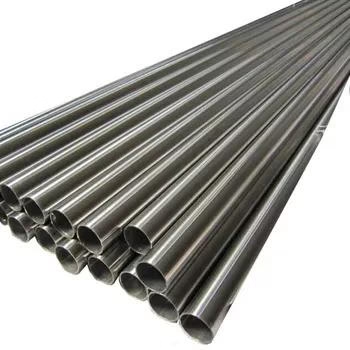
321 Stainless Steel Pipe
AISI 321 (UNS S32100) is a titanium-stabilized austenitic stainless steel pipe designed for high-temperature service (427-815°C). Prevents intergranular corrosion. OD 6-610mm, WT 0.5-40mm. Supplied with EN 10204 3.1 MTC.
| Material | Austenitic Stainless Steel (Titanium Stabilized) |
|---|---|
| Grade / Standard | AISI 321 / UNS S32100 |
| Outer Diameter (OD) | 6mm - 610mm (NPS 1/8 inch - NPS 24 inch) |
| Wall Thickness (WT) | 0.5mm - 40mm (SCH 5S / 10S / 40S / 80S / 160S) |
| Length | 3m / 6m / 12m (or cut to length) |
| Delivery Condition | hot_rolled / cold_rolled |
| Surface Treatment | bare / polished / coated |
| MOQ | 1 Ton |
| Delivery Time | 10-25 Days / In Stock |
| Loading Port | Tianjin / Shanghai / Qingdao |
Overview of 321 Stainless Steel Pipe
AISI 321 is a premium austenitic stainless steel grade stabilized by the addition of Titanium (Ti). Specified under ASTM A312 / ASTM A213 / ASTM A376 standards with UNS designation S32100, 321 stainless steel pipe is specifically engineered for applications operating within the carbide precipitation temperature range of 427°C to 815°C (800°F to 1500°F). While standard 304 stainless steel is susceptible to intergranular corrosion (sensitization) when exposed to these temperatures, the titanium in 321 binds with carbon to form titanium carbides, keeping the chromium in solid solution and maintaining the material’s excellent corrosion resistance.
Primarily manufactured in seamless form for high-temperature, high-pressure industrial applications, and welded form for large-diameter exhaust and ducting systems, 321 stainless steel pipe offers exceptional creep strength and stress rupture properties. It is the material of choice for aerospace exhaust systems, heavy chemical processing, petroleum refining equipment, and high-temperature boiler applications. While “L” grades (like 304L) prevent sensitization during welding, they lack the high-temperature mechanical strength of 321, making 321 the ultimate solution for sustained elevated-temperature service.
Key Features and Manufacturing Methods
321 stainless steel pipe is manufactured to withstand severe thermal cycling and prolonged high-temperature exposure. Seamless pipes (per ASTM A312/A213) are produced from hot-extruded or cold-drawn solid S32100 billets. This seamless structure is critical for high-pressure refining and boiler applications, offering maximum structural integrity. Welded 321 pipes are produced from cold-rolled coils using advanced TIG or plasma welding techniques, often followed by heavy cold working of the weld bead and solution annealing to ensure uniform metallurgical properties across the base metal and weld zone.
Available in a comprehensive outer diameter range from 6mm to 610mm with wall thicknesses from 0.5mm to 40mm (up to SCH 160S/XXS), the pipes are supplied in standard lengths of 3m, 6m, and 12m. The standard surface finish is mill finish (No.1) or pickled and passivated, which is optimal for high-temperature industrial use. Each 321 pipe undergoes rigorous quality control, including precise chemical analysis to verify the critical Titanium-to-Carbon ratio, mandatory hydrostatic or eddy current testing, high-temperature mechanical property verification, and intergranular corrosion testing (ASTM A262) to guarantee performance in extreme thermal environments.
Main Applications of 321 Stainless Steel Pipe
The defining characteristic of 321 stainless steel pipe is its reliability at elevated temperatures, making it indispensable in the petroleum refining and petrochemical industries. It is heavily utilized for catalytic cracking units, polythionic acid environments, high-temperature chemical transfer lines, and refinery piping where temperatures routinely exceed 400°C. In the power generation sector, 321 pipe is used for superheater tubes, radiant superheaters, and boiler tubes in both fossil fuel and nuclear power plants due to its excellent high-temperature creep resistance.
The aerospace and automotive industries rely on 321 for aircraft exhaust manifolds, piston engine exhaust systems, jet engine parts, and heavy-duty commercial vehicle exhaust components that endure severe thermal shock and vibration. Furthermore, it is a primary material for manufacturing industrial expansion joints, bellows, thermal oxidizers, furnace parts, and high-temperature heat exchangers. In these applications, 321 prevents the catastrophic failures associated with intergranular corrosion that would quickly degrade non-stabilized austenitic stainless steels.
Why Choose Us for 321 Stainless Steel Pipe
Shandong Tanglu Metal Material Co., Ltd. is an expert supplier of specialty high-temperature alloys, providing premium 321 stainless steel pipe sourced from world-class ISO 9001, PED, and ASME certified Chinese mills. We understand that the performance of 321 hinges on its precise chemistry; therefore, we strictly guarantee the Titanium addition (minimum 5x Carbon content) through rigorous PMI (Positive Material Identification) and laboratory chemical analysis, ensuring absolute immunity to sensitization for your high-temperature projects.
We maintain a robust inventory of standard SCH 10S, 40S, and 80S seamless 321 pipes, ready for rapid global dispatch. Our technical team works closely with engineering firms to supply cut-to-length, custom-beveled, and fully documented piping packages for refinery turnarounds and boiler maintenance. Every shipment is expertly packaged for safe oceanic transit and includes full material traceability with an EN 10204 3.1 Mill Test Certificate. For critical high-temperature infrastructure, we seamlessly accommodate third-party inspections (SGS, TUV, BV, DNV) and EN 10204 3.2 certification to guarantee total compliance with your engineering specifications.
📐 Dimension & Size Table
| OD (inch / mm) | WT SCH 10S (mm) | WT SCH 40S (mm) | WT SCH 80S (mm) |
|---|---|---|---|
| 1/8" (10.3mm) | 1.24 | 1.73 | 2.41 |
| 1/4" (13.7mm) | 1.65 | 2.24 | 3.02 |
| 1/2" (21.3mm) | 2.11 | 2.77 | 3.73 |
| 3/4" (26.7mm) | 2.11 | 2.87 | 3.91 |
| 1" (33.4mm) | 2.77 | 3.38 | 4.55 |
| 1-1/2" (48.3mm) | 2.77 | 3.68 | 5.08 |
| 2" (60.3mm) | 2.77 | 3.91 | 5.54 |
| 2-1/2" (73.0mm) | 3.05 | 5.16 | 7.01 |
| 3" (88.9mm) | 3.05 | 5.49 | 7.62 |
| 4" (114.3mm) | 3.05 | 6.02 | 8.56 |
| 6" (168.3mm) | 3.40 | 7.11 | 10.97 |
| 8" (219.1mm) | 3.76 | 8.18 | 12.70 |
| 10" (273.0mm) | 4.19 | 9.27 | 15.09 |
| 12" (323.8mm) | 4.57 | 10.31 | 17.48 |
| 14" (355.6mm) | 4.78 | 11.13 | 19.05 |
| 16" (406.4mm) | 4.78 | 12.70 | 21.44 |
| 18" (457.0mm) | 4.78 | 14.27 | 23.83 |
| 20" (508.0mm) | 5.54 | 15.09 | 26.19 |
| 24" (610.0mm) | 6.35 | 17.48 | 30.96 |
* Custom sizes available upon request. Tolerances per relevant international standards.
🔬 Chemical Composition
| Element | Min | Max | Display Value | Note |
|---|---|---|---|---|
| C | - | 0.08 | ≤0.08 | Per ASTM A312 TP321 |
| Si | - | 0.75 | ≤0.75 | |
| Mn | - | 2.00 | ≤2.00 | |
| P | - | 0.045 | ≤0.045 | |
| S | - | 0.030 | ≤0.030 | |
| Cr | 17.00 | 19.00 | 17.00-19.00 | Corrosion resistance |
| Ni | 9.00 | 12.00 | 9.00-12.00 | Austenite stabilizer |
| Ti | 5x(C+N) | 0.70 | 5x(C+N) - 0.70 | Stabilizing element |
| Fe | - | - | Balance | Base element |
* Chemical composition may vary by heat, thickness and specification. Please refer to the actual mill test certificate.
⚙️ Mechanical Properties
| Property | Value | Unit | Test Condition |
|---|---|---|---|
| Tensile Strength (Rm) | ≥515 | MPa | Solution annealed, per ASTM A312 |
| Yield Strength (Rp0.2) | ≥205 | MPa | 0.2% proof stress |
| Elongation (A) | ≥35 | % | Gauge length 50mm |
| Brinell Hardness (HBW) | ≤192 | HBW | Solution annealed |
| Rockwell Hardness (HRB) | ≤90 | HRB | Solution annealed |
| Hydrostatic Test | Pass | - | Mandatory per ASTM A312 |
| Intergranular Corrosion | Pass | - | ASTM A262 Practice E |
| High Temp Creep Resistance | Excellent | - | At 427°C - 815°C |
| Density | 7.93 | g/cm³ | Reference value |
* Values shown are minimum requirements unless otherwise stated.
📦 Commercial Information
| Packaging | Pipes are securely packed for long-distance ocean freight using seaworthy export standards. Small to medium diameter pipes are bundled in hexagonal shapes using thick steel strapping (min. 4 bands per bundle) with plastic caps on all ends to protect bevels and prevent internal contamination. Heavy wall/large diameter 321 seamless pipes are shipped loose with heavy-duty end protectors and wood-crated if required. Weather-proof metal tags containing the Heat Number, Standard (ASTM A312 TP321), OD, WT, and Length are securely attached to every bundle. Custom packing configurations, including VCI wrapping for long-term storage, are available upon request. |
|---|---|
| Payment Terms | T/T (Telegraphic Transfer),L/C (Letter of Credit),D/P (Documents against Payment),Western Union |
| Price Term | FOB,CFR,CIF,EXW |
| Supply Capacity | 2,000 Tons/Month (Specialty Stainless Steel Pipes) |
| Loading Port | Tianjin / Shanghai / Qingdao |
Why Choose Our 321 Stainless Steel Pipe?
Superior High-Temperature Performance
Engineered for continuous service between 427°C and 815°C (800°F - 1500°F), 321 maintains excellent creep strength, stress rupture resistance, and structural stability where standard 304 would fail rapidly.
Titanium Stabilized against Sensitization
The addition of Titanium prevents chromium carbide precipitation at grain boundaries during welding and high-temperature service, rendering the pipe immune to intergranular corrosion without post-weld annealing.
Rigorous Industrial Certification
Manufactured to exact ASTM A312 / A213 standards. Supplied with 100% PMI testing to verify Ti content, mandatory hydrostatic/eddy current testing, and EN 10204 3.1 mill test certificates.
Excellent Heavy Section Weldability
Can be readily welded by all standard fusion methods. Unlike 304, thick-walled 321 piping does not require post-weld solution annealing to restore corrosion resistance, drastically reducing fabrication costs in the field.
Comprehensive Project Supply
Available from NPS 1/8" up to NPS 24" in all standard schedules including heavy-wall SCH 160S/XXS. We hold strategic stock of common sizes for urgent refinery turnarounds and power plant maintenance outages.
🏭 Applications of 321 Stainless Steel Pipe
321 stainless steel pipe is the premier material for industries where sustained high temperatures and harsh chemical environments intersect. In the Oil & Gas and Petrochemical refining sectors, it is a critical component for catalytic cracking systems, polythionic acid environments, high-temperature fluid handling, and hydro-treating processes. The Power Generation industry utilizes 321 extensively for boiler tubes, superheaters, radiant heat panels, and high-pressure steam lines in both fossil fuel and nuclear plants, leveraging its superior creep rupture strength. In Aerospace and Automotive engineering, it is the standard for fabricating aircraft exhaust manifolds, jet engine components, piston engine exhausts, and commercial vehicle emissions systems that endure intense thermal shock. Additionally, 321 is widely used in heavy manufacturing for industrial expansion joints, bellows, thermal oxidizers, furnace parts, and high-temperature heat exchangers. Its unique titanium stabilization ensures that heavy-wall industrial pipework remains free from intergranular corrosion throughout decades of severe thermal cycling.
📋 Quality & Certification
Our Certifications
- ✅ ISO 9001:2015
- ✅ DNV GL
- ✅ Bureau Veritas (BV)
- ✅ SGS Certified
Mill Certificate Type
- 📋 EN 10204 3.1
- 📋 EN 10204 3.2
- 📋 Original Mill Certificate
- 📋 Third Party Inspection Available
❓ Frequently Asked Questions
What is the main difference between 304 and 321 stainless steel pipe?
The critical difference is the addition of Titanium in 321 stainless steel. While 304 is a standard 18/8 austenitic grade, 321 is an 18/9 grade with Titanium added at a minimum of 5 times the carbon content. When 304 is heated between 427°C and 815°C (such as during welding or high-temperature service), carbon binds with chromium, depleting the grain boundaries of chromium and causing intergranular corrosion (sensitization). In 321, the Titanium preferentially binds with the carbon, keeping the chromium intact and maintaining full corrosion resistance at elevated temperatures.
Why use 321 instead of 304L or 316L for high-temperature applications?
While low-carbon grades like 304L and 316L successfully prevent sensitization during welding (because there isn't enough carbon to form harmful carbides), they suffer a significant loss of mechanical strength and creep resistance at elevated temperatures. 321 stainless steel contains standard carbon levels (up to 0.08%), which provides excellent high-temperature strength, while the Titanium addition simultaneously protects against sensitization. This makes 321 the superior choice for continuous service above 400°C where both structural strength and corrosion resistance are required.
What is 321H stainless steel pipe?
321H (UNS S32109) is a higher-carbon variation of standard 321. While standard 321 allows carbon up to 0.08%, 321H dictates a tightly controlled carbon range of 0.04% to 0.10%. This specifically optimized higher carbon content provides even greater high-temperature creep resistance and structural integrity for critical high-pressure, high-temperature applications like superheaters and refinery piping operating above 538°C (1000°F). Both 321 and 321H are titanium-stabilized.
Is 321 stainless steel pipe suitable for marine or high-chloride environments?
No. Despite its excellent high-temperature properties, 321 does not contain Molybdenum and has roughly the same resistance to pitting and crevice corrosion as standard 304. In marine environments, seawater, or high-chloride applications, 321 is highly susceptible to localized corrosion. For these specific environments, a molybdenum-bearing grade like 316L, Duplex 2205, or Super Austenitic stainless steel should be specified instead.
Can 321 stainless steel pipe be polished to a mirror finish?
While 321 can be polished, it is very difficult to achieve a flawless, high-gloss mirror finish (like a No.8 finish on 304 or 316). The titanium addition in 321 forms titanium carbo-nitride inclusions within the steel matrix. During the mechanical polishing process, these hard inclusions can be pulled out or cause micro-scratching (often called 'comet tails' or polishing drag). Therefore, 321 is almost exclusively used for industrial applications in a mill, pickled, or standard brushed finish rather than for decorative architectural purposes.
Request a Quote for
321 Stainless Steel Pipe
Submit your requirements and receive a competitive price quote within 24 hours.
- ✓ Fast response within 24 hours
- ✓ Competitive factory-direct pricing
- ✓ Free technical consultation
- ✓ Mill test certificate provided
- ✓ Flexible payment terms available
⏱ Project pricing within 24 hours
Send Your Inquiry
All fields marked with * are required