
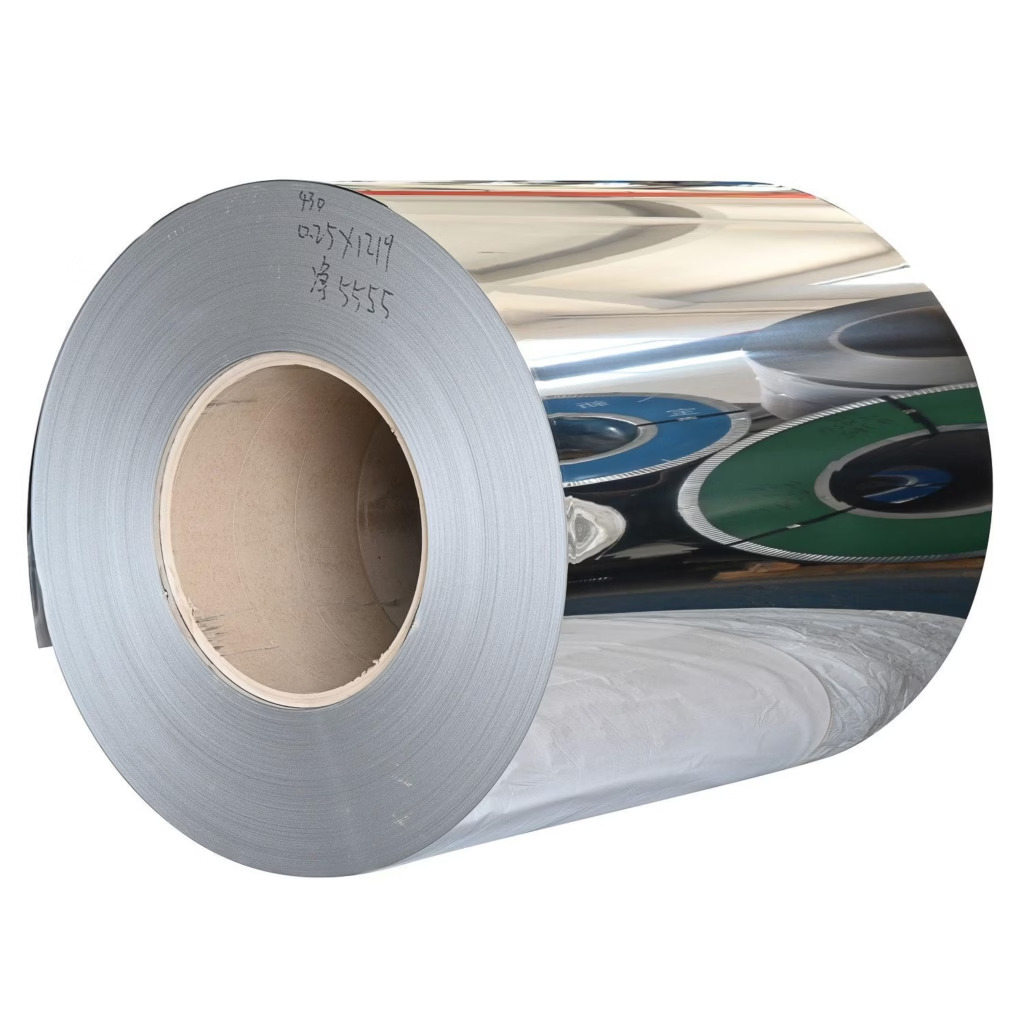
430 Stainless Steel Coil
AISI 430 (UNS S43000) is a cost-effective ferritic stainless steel coil with 16-18% Cr and minimal nickel, offering moderate corrosion resistance, superior machinability, and ferromagnetic properties. Thickness 0.3-10mm, width 600-1500mm, multiple surface finishes (2B/BA/No.4/HL). Ideal for automotive, appliance, and architectural applications. Mill test certificate provided.
| Material | Ferritic Stainless Steel (Chromium-based, Non-austenitic) |
|---|---|
| Grade / Standard | AISI 430 / UNS S43000 |
| Thickness | 0.3mm - 10mm |
| Width | 600mm - 1500mm |
| Inner Diameter (ID) | 508mm / 610mm |
| Coil Weight | 3-8 Tons (Max 10 Tons) |
| Delivery Condition | hot_rolled / cold_rolled / annealed |
| Surface Treatment | bare / polished |
| MOQ | 5 Tons |
| Delivery Time | 5-15 Days / Stock Available |
| Loading Port | Tianjin / Shanghai / Qingdao |
Overview of 430 Stainless Steel Coil
AISI 430 is the most widely used ferritic stainless steel grade, accounting for approximately 30-35% of global ferritic stainless steel coil production. Specified under ASTM A240 / EN 10088-1 standards with UNS designation S43000, 430 stainless steel coil offers a cost-effective combination of moderate corrosion resistance, good formability, excellent magnetic properties, and superior machinability compared to austenitic grades. Containing nominally 16-18% chromium with minimal nickel content (typically 0.75% maximum), the grade provides the characteristic magnetic ferritic microstructure with excellent cold formability for deep drawing, stamping, roll forming, and automotive component fabrication at significantly lower material cost than 304/316 austenitic stainless steels.
430 stainless steel coil is the preferred raw material for cost-sensitive high-volume manufacturing of stainless steel products where moderate corrosion resistance is acceptable and material cost control is critical. Available in both hot rolled (HR) and cold rolled (CR) conditions with multiple surface finishes, the coil is widely used by appliance manufacturers, automotive component suppliers, architectural cladding manufacturers, electrical equipment makers, and industrial fabricators worldwide. The grade resists corrosion in dry atmospheric environments, mild aqueous conditions, food processing at low to moderate temperatures, and indoor/sheltered applications, making it indispensable for automotive trim, kitchen appliance panels, architectural facades, electrical enclosures, and cost-constrained industrial components. Superior magnetic properties make 430 ideal for applications requiring magnetic response (magnetic filters, automotive sensors, decorative magnetic fixtures), and exceptional machinability enables high-speed machining operations for punched, stamped, and formed components.
Key Features and Coil Manufacturing
430 stainless steel coil is manufactured through hot rolling for thicker gauges (typically 2mm to 10mm) or cold rolling for thinner gauges (0.3mm to 4mm), followed by annealing at 750-850°C with controlled cooling to achieve optimal mechanical properties and corrosion resistance. Unlike austenitic stainless steels, 430 does not require solution annealing at extremely high temperatures, reducing processing costs and energy consumption. Cold rolled coils undergo additional pickling and skin pass rolling to achieve precise thickness tolerance and excellent surface quality with minimal surface oxidation. The coil is supplied in standard widths from 600mm to 1500mm with thickness ranging from 0.3mm to 10mm, with custom slitting and recoiling services available.
Multiple surface finishes are available including 2B (cold rolled, annealed, pickled, light cold rolled — most common for general industrial use), BA (bright annealed finish for appliance and decorative applications), No.4 (brushed satin finish for automotive and architectural applications), and HL (hairline finish for architectural cladding and decorative use). Standard inner diameter is 508mm or 610mm, with coil weight typically ranging from 3 to 8 tons depending on thickness and width. Each coil undergoes mandatory chemical composition analysis (PMI verification available), mechanical property testing, magnetic permeability verification, atmospheric corrosion resistance testing per ASTM A240, pitting resistance assessment in mild environments, and surface quality inspection to ensure full compliance with international standards. Superior machinability characteristics (highest among stainless steels) make 430 ideal for secondary machining, punching, stamping, and cold forming operations with minimal tool wear.
Main Applications of 430 Stainless Steel Coil
430 stainless steel coil is the primary raw material for cost-effective high-volume manufacturing across multiple industries where moderate corrosion resistance is acceptable and material cost optimization is critical. Automotive component manufacturers use 430 coil for exterior trim, badging, decorative moldings, grille components, exhaust deflector shields, engine bay shielding, and structural supports where magnetic properties aid assembly and weight reduction is less critical than cost control. Kitchen appliance manufacturers employ 430 coil for refrigerator exterior panels, microwave oven casings, dishwasher door panels, range cooktop trim, stove legs, and structural components where superior formability and machinability reduce fabrication costs compared to 304 austenitic grades.
Architectural and construction applications include building facade cladding, decorative exterior panels, roofing components, interior trim, elevator doors, signage backing, column covers, and environmental barriers where attractive brushed or bright finishes provide aesthetic appeal with moderate corrosion protection in sheltered environments. Electrical equipment manufacturers use 430 coil for control panel enclosures, electrical equipment housings, transformer shields, switchgear components, and industrial control cabinets where magnetic properties improve assembly efficiency and cost-effectiveness. Industrial fabrication includes chemical processing equipment (mild chemical environments only), water treatment system components, industrial ductwork and ventilation, HVAC system components, tank shells for non-corrosive liquid storage, industrial enclosures, and general-purpose fabricated products. Automotive exhaust system components including shields and deflector plates benefit from 430’s heat resistance and machinability. Household and consumer goods applications include sink accessories, cookware handles, kitchen utensil components, decorative fixtures, appliance hardware, and a comprehensive range of stamped, formed, and machined products where cost efficiency and formability are prioritized over maximum corrosion resistance.
Why Choose Us for 430 Stainless Steel Coil
Shandong Tanglu Metal Material Co., Ltd. supplies cost-effective 430 stainless steel coil sourced from major Chinese stainless steel mills including Tisco (Taiyuan Iron & Steel), Baosteel Stainless, Lisco, and Jisco with proven manufacturing expertise and certified production facilities meeting ISO 9001, ISO 14001, and international quality standards. Every 430 coil undergoes mandatory chemical composition analysis (PMI verification available), mechanical property testing including tensile, yield, elongation, and hardness verification, magnetic permeability confirmation, atmospheric corrosion resistance assessment per ASTM A240, surface finish quality inspection, and dimensional verification to ensure full compliance with specifications.
We offer comprehensive specification range covering thickness from 0.3mm to 10mm and width from 600mm to 1500mm in multiple surface finishes (2B, BA, No.4, HL) with flexible coil weight options from 3 to 8 tons to match different processing line requirements for high-volume production. With monthly supply capacity of 8,000 tons of stainless steel coils including 2,500 tons of 430 ferritic grades and established export relationships with automotive suppliers, appliance manufacturers, architectural cladding companies, and industrial fabricators in over 70 countries, we support both large-volume container shipments and specialty orders. 430 coil availability from stock enables rapid delivery of 5-15 days for standard specifications, with custom sizes available within 20-25 days. Each shipment includes original mill test certificate (MTC) conforming to EN 10204 3.1 standard, with EN 10204 3.2, PMI report, and third-party inspection (SGS, BV, ABS) available for critical applications.
Cost-Effective Ferritic Grade Advantage
430 stainless steel coil offers significant cost advantages compared to austenitic 304/316 grades (typically 30-50% lower material cost depending on thickness and volume), making it ideal for large-volume manufacturing where cost control and profitability are critical. The lack of nickel content eliminates exposure to nickel price volatility and supply chain disruptions affecting austenitic grades. Superior machinability (approximately 25-35% faster machining speeds than 304) reduces secondary machining costs for stamped, punched, and formed components. Excellent formability requires less annealing between cold forming passes, reducing processing time and energy costs. Ferromagnetism enables cost-effective automated sorting, assembly, and handling in high-volume production lines. Lower thermal conductivity compared to austenitic grades improves stamping die life and reduces cooling requirements.
📐 Dimension & Size Table
| Thickness (mm) | Width (mm) | Inner Dia (mm) | Coil Weight (T) |
|---|---|---|---|
| 0.3 | 600-1250 | 508 | 3-5 |
| 0.4 | 600-1250 | 508 | 3-5 |
| 0.5 | 600-1500 | 508 | 3-6 |
| 0.6 | 600-1500 | 508 | 3-6 |
| 0.8 | 600-1500 | 508 | 3-6 |
| 1.0 | 600-1500 | 508 / 610 | 3-7 |
| 1.2 | 600-1500 | 508 / 610 | 3-7 |
| 1.5 | 600-1500 | 508 / 610 | 5-8 |
| 2.0 | 600-1500 | 508 / 610 | 5-8 |
| 2.5 | 1000-1500 | 610 | 5-8 |
| 3.0 | 1000-1500 | 610 | 5-8 |
| 4.0 | 1000-1500 | 610 | 5-10 |
| 5.0 | 1000-1500 | 610 | 5-10 |
| 6.0 | 1000-1500 | 610 | 5-10 |
| 8.0 | 1000-1500 | 610 | 5-10 |
| 10.0 | 1000-1500 | 610 | 5-10 |
* Custom sizes available upon request. Tolerances per relevant international standards.
🔬 Chemical Composition
| Element | Min | Max | Display Value | Note |
|---|---|---|---|---|
| C | - | 0.12 | ≤0.12 | Per ASTM A240 430 |
| Si | - | 1.00 | ≤1.00 | |
| Mn | - | 1.00 | ≤1.00 | |
| P | - | 0.040 | ≤0.040 | |
| S | - | 0.030 | ≤0.030 | |
| Cr | 16.00 | 18.00 | 16.00-18.00 | Corrosion resistance element |
| Ni | - | 0.75 | ≤0.75 | Minimal nickel, ferritic structure |
| Mo | - | - | - | Not typically present |
| N | - | - | - | Not typically present |
| Fe | - | - | Balance | Base element |
* Chemical composition may vary by heat, thickness and specification. Please refer to the actual mill test certificate.
⚙️ Mechanical Properties
| Property | Value | Unit | Test Condition |
|---|---|---|---|
| Tensile Strength (Rm) | ≥450 | MPa | Annealed condition, per ASTM A240 |
| Yield Strength (Rp0.2) | ≥275 | MPa | 0.2% proof stress (higher than austenitic 304) |
| Elongation (A) | ≥22 | % | Gauge length 50mm (lower than austenitic grades) |
| Brinell Hardness (HBW) | ≤217 | HBW | Annealed condition |
| Rockwell Hardness (HRB) | ≤95 | HRB | Annealed condition |
| Vickers Hardness (HV) | ≤225 | HV | Annealed condition |
| Impact Energy (KV2) | ≥80 | J | Charpy V-notch at +20°C (lower than austenitic) |
| Density | 7.75 | g/cm³ | Reference value (lighter than austenitic 7.93) |
| Magnetic Permeability | >1.02 | μ | Strongly magnetic ferritic structure |
| Machinability Index | 65-75 | % | Highest among stainless steels (vs 304: 40%) |
* Values shown are minimum requirements unless otherwise stated.
📦 Commercial Information
| Packaging | Standard seaworthy export packing for ferritic stainless steel coils. Each coil wrapped with PE film for moisture and salt spray protection, then bundled with steel strapping (4-6 wraps per coil), with eye protection rings on inner diameter and weatherproof outer wrap. Coils labeled with heat number, grade designation (430 / S43000), thickness, width, coil weight, and surface finish. Standard loading: coil eye horizontal or vertical based on container requirement. Economical packaging reduces overall material cost without sacrificing transit protection. Coils can be more densely loaded per container due to lower density compared to austenitic grades, enabling cost optimization for high-volume shipments. |
|---|---|
| Payment Terms | T/T (Telegraphic Transfer),L/C (Letter of Credit),D/P (Documents against Payment),Western Union,PayPal |
| Price Term | FOB,CFR,CIF,EXW |
| Supply Capacity | 8,000 Tons/Month (Stainless Steel Coils) | 2,500 Tons/Month (430 Ferritic Grade) |
| Loading Port | Tianjin / Shanghai / Qingdao |
Why Choose Our 430 Stainless Steel Coil?
30-50% Cost Advantage vs Austenitic Grades
430 stainless steel coil offers significant cost savings compared to 304/316 austenitic grades (typically 30-50% lower material cost depending on thickness and volume). Eliminates nickel content exposure to price volatility and supply chain disruptions. Ideal for cost-sensitive high-volume manufacturing where moderate corrosion resistance is acceptable.
Superior Machinability & Formability
Exceptional machinability (approximately 25-35% faster machining speeds than 304) reduces secondary machining costs for stamped, punched, and formed components. Superior formability requires less annealing between cold forming passes. Excellent formability from 0.3mm precision foils to 10mm heavy gauge enables complex stamping and deep drawing operations.
Ferromagnetic Properties for Assembly Efficiency
Strongly magnetic ferritic structure enables cost-effective automated sorting, assembly, and magnetic handling in high-volume production lines. Ideal for applications requiring magnetic response including magnetic filters, automotive sensors, decorative magnetic fixtures, and automated assembly systems.
Comprehensive Finish & Specification Options
Available in four standard surface finishes (2B, BA, No.4, HL) from 0.3mm thickness to 10mm heavy gauge, width 600-1500mm. Flexible coil weight 3-8 tons matches high-volume processing line requirements. Custom slitting and recoiling services available for specialty applications.
Rapid Stock Availability Worldwide
Common 430 specifications maintained in large stock for 5-15 days dispatch, fastest among all stainless steel grades. High production volume enables consistent supply for automotive OEM lines, appliance manufacturers, and architectural projects requiring continuous material supply.
🏭 Applications of 430 Stainless Steel Coil
430 stainless steel coil is the primary raw material for cost-effective high-volume manufacturing across automotive, appliance, architectural, and industrial sectors where moderate corrosion resistance is acceptable and material cost control is critical. Automotive component manufacturers use 430 coil for exterior trim, badging, decorative moldings, grille components, exhaust deflector shields, engine bay shielding, and structural supports where ferromagnetism aids assembly and cost efficiency is prioritized over maximum corrosion resistance. Superior machinability enables stamping and punching of complex automotive components at high production speeds. Kitchen appliance manufacturers employ 430 coil for refrigerator exterior panels, microwave oven casings, dishwasher door panels, range cooktop trim, stove legs, and structural components where excellent formability and cost control reduce fabrication costs compared to 304. Architectural and construction applications include building facade cladding, decorative exterior panels, roofing components, interior trim, elevator doors, signage backing, column covers, and environmental barriers where attractive brushed or bright finishes provide aesthetic appeal in sheltered outdoor environments. Electrical equipment manufacturers use 430 coil for control panel enclosures, electrical equipment housings, transformer shields, switchgear components, and industrial control cabinets where ferromagnetism improves assembly efficiency and cost-effectiveness. Industrial fabrication includes chemical processing equipment for mild chemical environments, water treatment system components, industrial ductwork and ventilation, HVAC system components, tank shells for non-corrosive liquid storage, industrial enclosures, and general-purpose fabricated products requiring cost optimization. Automotive exhaust system shields and deflector plates benefit from 430's heat resistance and superior machinability. Household and consumer goods applications include sink accessories, cookware handles, kitchen utensil components, decorative fixtures, appliance hardware, decorative trim, and a comprehensive range of stamped, formed, and machined products where cost efficiency and formability are prioritized.
📋 Quality & Certification
Our Certifications
- ✅ ISO 9001:2015
- ✅ ABS
- ✅ Bureau Veritas (BV)
- ✅ SGS Certified
Mill Certificate Type
- 📋 EN 10204 3.1
- 📋 EN 10204 3.2
- 📋 Original Mill Certificate
- 📋 Third Party Inspection Available
- 📋 Certificate of Origin
❓ Frequently Asked Questions
What is 430 stainless steel coil and how does it differ from 304?
430 is a ferritic austenitic-free stainless steel grade specified under ASTM A240 / EN 10088-1 (equivalent EN 1.4016) with UNS designation S43000. Unlike 304 which is austenitic, 430 contains 16-18% chromium with minimal nickel (typically ≤0.75%) creating a ferritic microstructure that is strongly magnetic (ferromagnetic). The key differences: (1) Cost — 430 costs 30-50% less than 304 due to lower nickel content and no molybdenum, making it ideal for high-volume cost-sensitive manufacturing. (2) Corrosion resistance — 430 offers moderate corrosion resistance suitable for dry atmospheric environments, indoor applications, and mild chemical processing; it is NOT suitable for seawater, high-chloride environments, or harsh chemical exposure like 304. (3) Machinability — 430 has superior machinability (25-35% faster cutting speeds) compared to 304, reducing secondary machining costs. (4) Magnetic properties — 430 is strongly magnetic enabling automated sorting, assembly, and magnetic handling; 304 is non-magnetic. (5) Formability — 430 exhibits excellent cold formability with lower work-hardening rate than 304. (6) Impact resistance — 430 has lower impact toughness (≥80 J vs 304's ≥150 J) and lower elongation (≥22% vs 304's ≥40%), limiting use in extreme low-temperature applications. 430 is ideal for automotive, appliance, and architectural applications; 304 is preferred for food processing, marine environments, and critical corrosion applications.
What are the advantages of ferritic 430 vs austenitic 304 stainless steel?
430 ferritic stainless steel offers several distinct advantages over 304 austenitic grade for specific applications: (1) Significant cost savings — 30-50% lower material cost than 304 due to elimination of expensive nickel and no molybdenum addition, plus lower energy processing costs. (2) Superior machinability — Approximately 25-35% faster cutting speeds than 304, reducing secondary machining costs by 20-30% for stamped, punched, and formed components. Ferritic structure provides chip breakability and tool life advantages. (3) Ferromagnetism — Strongly magnetic properties enable cost-effective automated assembly, sorting, magnetic filters, sensors, and handling systems; 304 non-magnetic cannot use these efficiency features. (4) Lighter weight — Lower density (7.75 g/cm³ vs 304's 7.93 g/cm³) and stronger yield strength (≥275 MPa vs 304's ≥205 MPa) enable thinner gauge usage with equivalent strength, reducing material weight and cost. (5) Excellent cold formability — Lower work-hardening rate than 304 requires fewer annealing cycles between forming operations, reducing processing time and energy cost. (6) Rapid availability — Ferritic grades are typically stocked and available faster (5-15 days) than specialty austenitic grades. The main disadvantage is lower corrosion resistance and impact toughness, limiting use to moderate environments. 430 is optimal when cost control and machinability are priorities; 304 is necessary for superior corrosion resistance and impact resistance.
What surface finishes are available for 430 stainless steel coil?
430 stainless steel coil is available in four primary surface finishes optimized for different aesthetic and functional requirements: (1) 2B finish — cold rolled, annealed, pickled, and lightly cold rolled with smooth reflective appearance; most common and economical finish for industrial applications, automotive components, and appliance interiors where appearance is secondary to cost. (2) BA finish (bright annealed) — bright polished appearance achieved through annealing in protective atmosphere; used for appliance panels, decorative trim, and applications where aesthetic appearance is important but not mirror-like; provides superior cleanliness compared to 2B. (3) No.4 finish (brushed satin) — linearly brushed surface with matte appearance; preferred for automotive trim, architectural panels, decorative fixtures, and applications combining aesthetic appeal with functional durability; hides minor surface defects better than BA. (4) HL finish (hairline) — fine continuous directional brushing providing hairline appearance; used for architectural cladding, interior design elements, and premium decorative applications. 430 is NOT typically offered in polished (No.8) mirror finish as ferric stainless steels do not achieve high-gloss polish comparable to austenitic grades. All finishes are available with surface protection (PE film, VCI paper) for storage and transit. Surface selection should consider both aesthetic requirements and cost implications, as 2B is most economical while BA/No.4 cost 10-20% more for enhanced appearance.
Why is 430 ideal for automotive and appliance manufacturers?
430 stainless steel coil is the preferred ferritic grade for automotive and appliance manufacturers due to unique combination of cost advantages, machinability, formability, and magnetic properties: For automotive applications: (1) Cost efficiency — 30-50% lower material cost than 304 is critical for high-volume automotive production where material cost per unit directly impacts profitability. (2) Superior machinability — Enables stamping and machining of complex automotive trim components (badges, grille inserts, trim rings) at higher production speeds with lower tool wear, reducing manufacturing cost per part. (3) Ferromagnetism — Magnetic properties enable automated assembly of magnetic fastening systems, magnetic sorting of stamped components, and integration with magnetic sensors on assembly lines. (4) Excellent formability — Superior cold formability for stamping, bending, and deep drawing of decorative trim and exterior components. (5) Sufficient corrosion resistance — In sheltered automotive environments and with protective paint systems, 430's moderate corrosion resistance is adequate for trim components; critical structural components use 304. For appliance manufacturers: (1) Cost control — Reduces overall appliance cost by 5-10% compared to 304-based designs, directly improving competitiveness. (2) Superior machinability — Enables economical punching, stamping, and forming of appliance panels and structural components. (3) Aesthetic finishes — BA and No.4 finishes provide attractive appearance for visible appliance surfaces while maintaining cost advantage. (4) Formability — Excellent for complex panel geometries, refrigerator doors, dishwasher panels, range hoods without excessive annealing. (5) Lightweight — Lower density enables thinner gauge usage for equivalent strength, reducing weight and material cost. 430 enables manufacturers to optimize cost while maintaining acceptable performance for these applications, which is why it dominates automotive trim and appliance panel manufacturing.
What are the limitations and corrosion performance of 430 stainless steel?
430 stainless steel offers moderate corrosion resistance suitable for specific environments but has important limitations that restrict its use: Suitable environments for 430: (1) Dry atmospheric conditions — excellent resistance in sheltered indoor and outdoor environments with minimal moisture exposure. (2) Mild aqueous conditions — acceptable performance in fresh water, low-salt environments, and indoor applications with low humidity. (3) Food processing — acceptable for low-temperature food processing and dry food handling; NOT suitable for seafood processing, salt-curing operations, or high-salt food environments. (4) Industrial applications — acceptable for mild chemical environments, non-corrosive liquid storage tanks, and general industrial fabrication. Limitations and unsuitable environments for 430: (1) Seawater and marine environments — 430 will experience rapid pitting corrosion in seawater and salt spray; marine applications absolutely require 316L or higher grades. (2) Chloride-containing solutions — 430 is vulnerable to pitting corrosion in chloride-rich chemicals; chemical processing requires 304 minimum, preferably 316L. (3) Acid exposure — 430 has poor resistance to organic and inorganic acids; chemical processing with acids requires 304/316L. (4) High-humidity tropical environments — prolonged exposure in high-salt coastal climates will cause surface corrosion; coastal applications need 304 or 316L. (5) Crevice corrosion risk — 430 is susceptible to crevice corrosion under gaskets, deposits, and stagnant conditions requiring 304/316L for critical assemblies. Surface protection (painting, protective coatings) can extend 430's service life in marginal environments but cannot overcome fundamental corrosion limitations. 430 is a cost-effective choice ONLY when environmental conditions genuinely permit it; using 430 in unsuitable environments results in premature failure and product liability. Always specify 304 or 316L for critical corrosion-sensitive applications.
Get Competitive Quote for
430 Stainless Steel Coil
Submit your requirements and receive a competitive price quote within 24 hours.
- ✓ Fast response within 24 hours
- ✓ Competitive factory-direct pricing
- ✓ Free technical consultation
- ✓ Mill test certificate provided
- ✓ Flexible payment terms available
⏱ Cost advantage for high-volume orders
Send Your Inquiry
All fields marked with * are required