
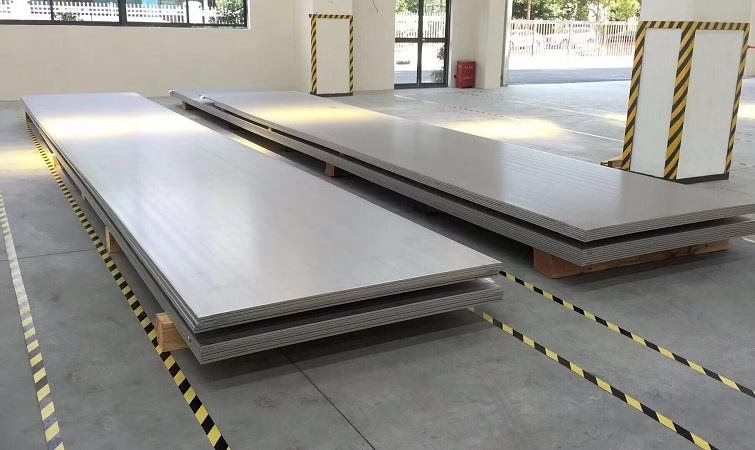
321 Stainless Steel Plate
AISI 321 (UNS S32100) titanium-stabilized austenitic stainless steel plate offering superior high-temperature strength (400-900°C) and resistance to intergranular corrosion after welding. Ti-stabilized, no PWHT required. Ideal for aerospace exhaust, refinery heaters, expansion joints. Thickness 3-100mm, AMS certified.
| Material | Austenitic Stainless Steel (Titanium-Stabilized) |
|---|---|
| Grade / Standard | AISI 321 / UNS S32100 |
| Thickness | 3mm - 100mm (plate), 0.5mm - 6mm (sheet) |
| Width | 1000mm - 2500mm |
| Length | 2000mm - 12000mm (plate), 2000mm - 6000mm (sheet) |
| Delivery Condition | hot_rolled / cold_rolled |
| MOQ | 1 Ton |
| Delivery Time | 15-35 Days / Stock Available for Common Sizes |
| Loading Port | Tianjin / Shanghai / Qingdao |
AMS certified, high-temp qualified - Response within 24 hours
Overview of 321 Stainless Steel Plate
AISI 321 is a titanium-stabilized austenitic stainless steel specifically engineered to resist intergranular corrosion in the temperature range of 425-815°C (the sensitization range) without requiring post-weld heat treatment or low carbon content. Specified under ASTM A240 / EN 10088-2 standards with UNS designation S32100, 321 stainless steel plate contains nominally 17-19% chromium, 9-12% nickel, and a critical addition of titanium (minimum 5 times the carbon content, typically 0.4-0.7%) which preferentially combines with carbon to form stable titanium carbides (TiC) rather than chromium carbides, thereby preventing chromium depletion at grain boundaries and maintaining corrosion resistance even after welding or prolonged high-temperature exposure.
321 stainless steel plate has become the international standard for elevated temperature applications from 400°C to 900°C including aircraft exhaust systems, jet engine components, industrial furnace parts, high-temperature chemical processing equipment, refinery heater tubes, petrochemical expansion joints, power generation superheater tubing, and automotive exhaust manifolds where resistance to intergranular corrosion combined with good high-temperature strength and oxidation resistance are essential. Unlike 304L which achieves intergranular corrosion resistance through low carbon content (≤0.030%), 321 uses titanium stabilization allowing higher carbon content (≤0.08%) which provides better high-temperature creep strength while maintaining excellent weldability and freedom from weld decay. 321 plate is supplied in thickness range from 3mm to 100mm with multiple surface finishes to meet demanding aerospace, petrochemical, and high-temperature industrial requirements.
Key Features and Surface Finishes
321 stainless steel plate is manufactured through hot rolling for thicker gauges (typically over 6mm) or cold rolling for thinner sheets, followed by solution annealing at 1010-1120°C with rapid cooling to dissolve any chromium carbides that may have formed during processing, then typically subjected to a stabilization heat treatment at 870-900°C for 2-4 hours to promote formation of stable titanium carbides (TiC) which prevent subsequent chromium carbide precipitation during welding or service at elevated temperatures. This titanium stabilization treatment is critical for ensuring long-term intergranular corrosion resistance and is verified by intergranular corrosion testing per ASTM A262 Practice E (copper-copper sulfate-sulfuric acid test) confirming complete freedom from sensitization.
The plate undergoes comprehensive quality control including chemical composition verification with special attention to titanium content (minimum 5×C%, typically 0.40-0.70%) and Ti/C ratio verification by OES spectroscopy, mechanical property testing at both room temperature and elevated service temperature (typically 538°C and 650°C for creep and stress rupture data), intergranular corrosion testing per ASTM A262 confirming stabilization effectiveness, high-temperature oxidation testing for aerospace and furnace applications, and dimensional inspection. Available surface finishes include No.1 (hot rolled, annealed, descaled — most common for thick plates and high-temperature industrial applications where surface finish is not critical), 2B (cold rolled, annealed, pickled — for general fabrication and moderate-temperature chemical processing equipment), No.4 (brushed satin finish for architectural high-temperature applications), and BA (bright annealed for aerospace components and precision equipment). Thickness range spans 3mm to 100mm with widths up to 2500mm and standard lengths of 6 meters, with precision cutting services available including laser cutting for aerospace components, plasma cutting for expansion joints, and water jet cutting for furnace parts requiring complex geometries.
Main Applications of 321 Stainless Steel Plate
321 stainless steel plate is the mandatory specification for aerospace and aviation applications including commercial aircraft exhaust systems and tail pipes operating at 400-700°C, jet engine afterburner components and flame holders exposed to 650-900°C, turbine engine exhaust ducts and transition sections, auxiliary power unit (APU) exhaust systems, aircraft firewall assemblies requiring 1100°C short-term exposure capability, helicopter engine mounts and exhaust manifolds, and rocket motor nozzle components where titanium stabilization provides superior resistance to intergranular corrosion after repeated thermal cycling combined with good elevated-temperature strength retention and oxidation resistance up to 900°C, all requiring strict aerospace material specifications (AMS 5510, AMS 5645) and full traceability per AS9100 quality management.
The petrochemical and refining industry extensively uses 321 for high-temperature process equipment including crude oil atmospheric and vacuum distillation column internals (trays, downcomers, chimneys) operating at 350-400°C, catalytic cracking unit (FCC) reactor cyclones and regenerator internals exposed to 650-750°C, delayed coking unit fractionator internals handling high-sulfur environments at 350-450°C, refinery heater and furnace tubes (radiant and convection sections) operating at 500-850°C with good resistance to sulfidation and oxidation, hydrotreating reactor internals and distribution trays at 350-425°C, reformer furnace tubes for hydrogen production at 700-900°C, ethylene cracker furnace tubes (pyrolysis coils) operating at 800-1100°C tube metal temperature, thermal oxidizer combustion chambers at 650-900°C, flare stack tips and burners exposed to 700-1000°C flame temperatures, expansion joints and flex bellows in high-temperature piping systems (400-650°C) compensating for thermal expansion in refinery and chemical plant piping, and heat exchanger tubes in high-temperature corrosive service. Chemical processing plants specify 321 for nitric acid production equipment including absorption towers, bleaching tanks, and concentration equipment operating at 50-150°C where titanium stabilization prevents intergranular corrosion from thermal cycling during startup/shutdown, sulfuric acid concentrators and oleum production equipment, organic acid (acetic acid, formic acid) processing vessels operating at 100-200°C, polymer production reactors requiring frequent thermal cycling, and pharmaceutical fine chemical synthesis equipment with steam jacket heating systems. Power generation facilities use 321 for fossil fuel boiler superheater and reheater tubing operating at 500-600°C and 100-200 bar pressure, heat recovery steam generator (HRSG) superheater sections in combined cycle plants, biomass and waste-to-energy boiler components exposed to high-temperature corrosive flue gas (400-650°C), steam turbine exhaust hoods and casings, and coal-fired boiler economizer tubes in corrosive flue gas service. Automotive and diesel engine manufacturers specify 321 for passenger car exhaust manifolds and downpipes (600-900°C exhaust gas temperature), catalytic converter housings and heat shields requiring 800-1000°C capability, diesel particulate filter (DPF) housings for heavy-duty trucks operating at 600-800°C with periodic regeneration cycles to 1000°C, turbocharger housings and exhaust turbine scrolls exposed to 700-950°C, and motorcycle performance exhaust systems. Other critical high-temperature applications include industrial furnace components (muffles, retorts, conveyor belts, radiant tubes) for heat treating at 650-1000°C, glass manufacturing furnace parts and annealing lehrs, ceramic kiln furniture and kiln car components, incinerator combustion chambers and afterburners, steam generator tube supports and spacers, nuclear power plant steam generator tubing and internals (though 316/316L often preferred), food processing spray dryers and roasters operating at 200-400°C, and high-temperature insulation jacketing and cladding systems.
Why Choose Us for 321 Stainless Steel Plate
Shandong Tanglu Metal Material Co., Ltd. supplies premium 321 stainless steel plate sourced from certified Chinese and international stainless steel mills including Tisco (Taiyuan Iron & Steel), Baosteel Stainless, and Lisco with strict titanium content control (verified minimum 5×C%, typically 0.40-0.70%), proven aerospace AMS specification compliance capability, and certified production facilities meeting ISO 9001, AS9100 (aerospace quality management), ISO 14001, ASME Section I (power boilers) and Section VIII (pressure vessels), PED 2014/68/EU, and NACE MR0175/ISO 15156 requirements for sour service oil and gas applications. Every 321 plate undergoes mandatory chemical composition analysis with special verification of titanium content and Ti/C ratio (must be ≥5:1) by OES or ICP spectroscopy ensuring effective stabilization, PMI (Positive Material Identification) testing available for critical aerospace and nuclear applications, mechanical property testing including room temperature tensile/yield/elongation and elevated temperature creep-rupture data at 538°C and 650°C for refinery and power generation specifications, intergranular corrosion testing per ASTM A262 Practice E confirming complete freedom from sensitization after stabilization heat treatment, high-temperature oxidation testing per ASTM A176 or customer specifications, grain size analysis per ASTM E112 (typically ASTM No. 6-8 for aerospace specifications), surface finish quality inspection, and dimensional inspection per ASTM A240 / EN 10088-2 latest revision.
We offer comprehensive thickness range from 3mm aerospace sheet to 100mm thick plates for refinery furnace applications, multiple surface finishes (No.1 for industrial high-temperature service, 2B for chemical processing, No.4 for architectural, BA for aerospace precision components) with aerospace AMS 5510 and AMS 5645 material specifications available with full test reports and material certifications, standard widths up to 2500mm and lengths up to 12 meters for large refinery and power generation projects, plus precision fabrication services including laser cutting with ±0.1mm tolerance for aerospace components requiring tight dimensional control, plasma cutting for expansion joint segments and furnace parts, water jet cutting for complex geometries avoiding heat-affected zones, edge beveling for welding preparation on thick refinery heater tubes, and solution annealing + stabilization heat treatment services for customer-supplied components requiring post-fabrication heat treatment to restore corrosion resistance. With monthly supply capacity of 3,000 tons of specialty stainless steel plates and established export experience to aerospace manufacturers (aircraft exhaust systems, jet engine components), petrochemical refineries (FCC units, heater tubes, expansion joints), power generation plants (superheater tubes, HRSG components), automotive exhaust system manufacturers, high-temperature furnace builders, and chemical processing equipment fabricators in over 40 countries including demanding aerospace markets (USA FAA-PMA certified suppliers, European EASA approved manufacturers, Asian aircraft MRO facilities) and refinery projects (Middle East, Southeast Asia, North America), we support both small prototype orders for aerospace R&D and large project supply contracts for refinery turnarounds and power plant construction. Each shipment includes original mill test certificate (MTC) conforming to EN 10204 3.1 standard with verified titanium content (≥5×C%), Ti/C ratio calculation, stabilization heat treatment parameters (temperature and time documented), grain size data, and complete chemical analysis and mechanical properties, with EN 10204 3.2 third-party inspection, PMI report with Ti verification, ASTM A262 Practice E intergranular corrosion test report with photographic evidence of specimen condition, elevated temperature mechanical property data (creep-rupture at 538°C/650°C for refinery specifications), high-temperature oxidation test results, aerospace AMS certification with material test reports (MTR) per AMS 2750 and AMS 2759 heat treatment specifications, NACE compliance certification for sour service refinery applications, and independent third-party inspection (SGS, BV, TÜV, ABS, DNV, Lloyds Register, Intertek) available for critical aerospace, nuclear, refinery, power generation, and chemical processing applications requiring enhanced documentation, material traceability to original heat number, code compliance verification, and project-specific material qualification testing per customer engineering specifications.
📐 Dimension & Size Table
| Thickness (mm) | Width (mm) | Length (mm) | Weight (kg/m²) |
|---|---|---|---|
| 3 | 1000-2000 | 2000-6000 | 23.95 |
| 4 | 1000-2000 | 2000-6000 | 31.93 |
| 5 | 1000-2000 | 2000-6000 | 39.92 |
| 6 | 1000-2000 | 2000-6000 | 47.90 |
| 8 | 1000-2200 | 2000-8000 | 63.86 |
| 10 | 1000-2200 | 2000-8000 | 79.83 |
| 12 | 1500-2200 | 3000-8000 | 95.79 |
| 16 | 1500-2200 | 3000-8000 | 127.72 |
| 20 | 1500-2500 | 3000-10000 | 159.65 |
| 25 | 1500-2500 | 3000-10000 | 199.56 |
| 30 | 1500-2500 | 3000-10000 | 239.48 |
| 40 | 1500-2500 | 3000-12000 | 319.30 |
| 50 | 1500-2500 | 3000-12000 | 399.13 |
| 60 | 1500-2200 | 3000-12000 | 478.95 |
| 80 | 1500-2200 | 3000-10000 | 638.60 |
| 100 | 1500-2000 | 3000-8000 | 798.25 |
* Custom sizes available upon request. Tolerances per relevant international standards.
🔬 Chemical Composition
| Element | Min | Max | Display Value | Note |
|---|---|---|---|---|
| C | - | 0.08 | ≤0.08 | Per ASTM A240 321 |
| Si | - | 0.75 | ≤0.75 | |
| Mn | - | 2.00 | ≤2.00 | |
| P | - | 0.045 | ≤0.045 | |
| S | - | 0.030 | ≤0.030 | |
| Cr | 17.00 | 19.00 | 17.00-19.00 | Corrosion & oxidation resistance |
| Ni | 9.00 | 12.00 | 9.00-12.00 | Austenite stabilizer |
| Ti | 5×C (min) | 0.70 | 5×C% min, ≤0.70 | KEY ELEMENT - Stabilization against intergranular corrosion |
| N | - | 0.10 | ≤0.10 | Optional |
| Fe | - | - | Balance | Base element |
* Chemical composition may vary by heat, thickness and specification. Please refer to the actual mill test certificate.
⚙️ Mechanical Properties
| Property | Value | Unit | Test Condition |
|---|---|---|---|
| Tensile Strength (Rm) | ≥515 | MPa | Solution annealed + stabilized, per ASTM A240 |
| Yield Strength (Rp0.2) | ≥205 | MPa | 0.2% proof stress at room temperature |
| Elongation (A) | ≥40 | % | Gauge length 50mm |
| Brinell Hardness (HBW) | ≤217 | HBW | Solution annealed + stabilized |
| Rockwell Hardness (HRB) | ≤95 | HRB | Solution annealed + stabilized |
| Vickers Hardness (HV) | ≤220 | HV | Solution annealed + stabilized |
| Impact Energy (KV2) | ≥150 | J | Charpy V-notch at +20°C |
| Density | 7.93 | g/cm³ | Reference value |
| Elevated Temp Tensile (538°C) | ≥310 | MPa | Typical for refinery service |
| Elevated Temp Tensile (650°C) | ≥240 | MPa | Typical for refinery service |
| Max Service Temperature | 900 | °C | Continuous oxidation resistance |
| Magnetic Permeability | ≤1.02 | μ | Non-magnetic austenitic structure |
* Values shown are minimum requirements unless otherwise stated.
📦 Commercial Information
| Packaging | Standard seaworthy export packing for 321 stainless steel plates with protection suitable for aerospace and high-temperature industrial applications. Thinner plates and aerospace sheets (≤6mm) individually wrapped with PE film and protective interleaving paper, then bundled with corrosion-resistant steel strapping and protective wooden frame to prevent edge damage and surface contamination critical for aerospace specifications. Each aerospace-grade sheet individually identified with heat number traceability tag. Thicker plates (>6mm) for refinery and power generation bundled with heavy-duty steel strapping and corner edge protectors, with weather-resistant interleaving paper between plates to prevent surface scratching and atmospheric corrosion during transit. Bundle weight typically 3-5 tons optimized for crane handling at fabrication facilities. Each bundle clearly tagged with heat number, grade designation (321 / S32100), verified titanium content and Ti/C ratio, stabilization heat treatment confirmation, dimensions, surface finish, aerospace AMS specification compliance (if applicable), and quantity. For aerospace applications requiring contamination control, special clean packaging with particle-free PE film wrapping, sealed in moisture-proof bags with desiccant available. For refinery and power generation projects, bundles marked with project-specific identification, material test report (MTR) references, and customer purchase order numbers. Wooden crates with ISPM-15 fumigation certification available for air shipment to aerospace facilities and export to countries requiring phytosanitary compliance. High-value aerospace components receive individual protective packaging with foam cushioning and rigid outer containers preventing damage during air freight. |
|---|---|
| Payment Terms | T/T (Telegraphic Transfer),L/C at Sight (Letter of Credit),D/P (Documents against Payment),D/A (Documents against Acceptance),Western Union,PayPal (for small orders) |
| Price Term | FOB,CFR,CIF,EXW,DDP,DAP |
| Supply Capacity | 3,000 Tons/Month (Specialty Stainless Steel Plates) |
| Loading Port | Tianjin / Shanghai / Qingdao |
Why Choose Our 321 Stainless Steel Plate?
Titanium-Stabilized Against Sensitization
321 plate with verified titanium content (minimum 5×C%, typically 0.40-0.70%) forming stable TiC carbides preventing chromium depletion at grain boundaries. Supplied with EN 10204 3.1/3.2 certificate including Ti/C ratio verification, ASTM A262 Practice E intergranular corrosion test confirmation, stabilization heat treatment parameters, and complete chemical analysis with elevated temperature mechanical properties for refinery specifications.
Superior High-Temperature Performance 400-900°C
Excellent elevated temperature strength retention (≥310 MPa at 538°C, ≥240 MPa at 650°C) and oxidation resistance up to 900°C continuous service. Ideal for aerospace exhaust systems (700-900°C), refinery heater tubes (500-850°C), expansion joints (400-650°C), FCC reactor internals (650-750°C), and automotive catalytic converters (800-1000°C). Superior to 304/304L for high-temperature applications.
Excellent Weldability Without PWHT
Titanium stabilization prevents carbide precipitation during welding, maintaining intergranular corrosion resistance in heat-affected zones without post-weld heat treatment. Suitable for complex welded aerospace components, refinery expansion bellows, furnace assemblies, and chemical processing equipment. TIG, MIG, SMAW welding qualified with ER321 filler metal.
Aerospace AMS & Industrial Code Certified
AMS 5510 (sheet) and AMS 5645 (plate) certified for aerospace applications with full material test reports per AMS 2750. ASME Section I (power boilers) and Section VIII (pressure vessels) code compliant for refinery and power generation. NACE MR0175/ISO 15156 compliant for sour service. AS9100 quality system for aerospace traceability. ISO 9001, PED 2014/68/EU certified.
Stock & Custom Heat Treatment Services
Common aerospace thicknesses (1-6mm sheet, 8-25mm plate) in stock for 15-25 days dispatch. Heavy refinery plates (30-100mm) production cycle 30-40 days. Solution annealing + stabilization heat treatment services available for customer components. Precision laser cutting for aerospace tolerances ±0.1mm. Experienced in aerospace (AOG support), refinery turnaround, and power plant project delivery.
🏭 Applications of 321 Stainless Steel Plate
321 stainless steel plate is the mandatory specification for aerospace and aviation high-temperature applications including commercial aircraft turbofan engine exhaust systems (tail pipes, mixers, nozzles) operating at 400-700°C continuous with short-term excursions to 900°C, jet engine afterburner sections and flame holders exposed to 650-900°C combustion gases, turbine engine exhaust ducts and transition sections between high-pressure turbine and low-pressure turbine, auxiliary power unit (APU) exhaust stacks and ducting for Boeing 737/747/777/787 and Airbus A320/A330/A350/A380 aircraft families, aircraft firewall assemblies and fire-resistant bulkheads requiring 1100°C short-term exposure capability per FAR Part 25 fire protection requirements, helicopter turboshaft engine exhaust manifolds and IR suppression systems for military and civilian rotorcraft (Sikorsky UH-60, Bell 412, AgustaWestland AW139), military fighter jet exhaust nozzles and afterburner components for F-16, F/A-18, Eurofighter Typhoon, Rafale operating at 800-1000°C, rocket motor nozzle throat inserts and expansion sections for solid and liquid propellant motors, spacecraft re-entry vehicle heat shield support structures, and satellite thruster components requiring high-temperature oxidation resistance combined with titanium-stabilized intergranular corrosion resistance after repeated thermal cycling from -150°C (upper atmosphere/space) to +900°C (exhaust gas/re-entry heating), all manufactured to strict aerospace material specifications AMS 5510 (sheet and strip) and AMS 5645 (plate) with full chemical analysis, mechanical properties, grain size control (ASTM No. 6-8), intergranular corrosion testing, and complete heat number traceability per AS9100 Rev D aerospace quality management system requirements. The petrochemical refining and chemical processing industry extensively uses 321 for high-temperature process equipment including crude oil atmospheric distillation unit (CDU) column internals such as bubble cap trays, valve trays, sieve trays, downcomer plates, and chimney sections operating at 180-350°C, vacuum distillation unit (VDU) internals handling reduced crude at 350-400°C under 20-40 mmHg vacuum, fluid catalytic cracking (FCC) unit reactor cyclone separators and disengaging sections exposed to 650-750°C catalyst regeneration temperatures with erosive catalyst circulation, FCC regenerator cyclones and plenum chambers operating at 700-760°C with CO combustion promoter addition, delayed coking unit fractionator tower internals processing high-sulfur heavy residuals at 350-450°C, visbreaker fractionator internals for heavy fuel oil upgrading at 400-480°C, hydrotreating and hydrocracking reactor catalyst support grids and distribution trays operating at 350-425°C and 50-200 bar pressure in hydrogen-rich environment, catalytic reformer furnace radiant and convection tubes for naphtha reforming producing high-octane gasoline and hydrogen at 480-540°C reactor inlet temperature with furnace tubes operating at 700-900°C metal temperature, ethylene cracker pyrolysis furnace radiant tubes (pyrolysis coils) operating at 800-1100°C tube metal temperature cracking naphtha or ethane feedstock, steam methane reformer (SMR) primary reformer tubes for hydrogen and synthesis gas production operating at 750-900°C tube metal temperature with 25-35 bar internal pressure, ammonia synthesis plant secondary reformer tubes and high-temperature shift converter internals at 700-850°C, refinery fired heater and process furnace radiant tubes (straight tubes, return bends, U-bends) for crude oil preheating, vacuum residue heating, and delayed coker furnaces operating at 500-850°C with good resistance to sulfidation, carburization, and thermal cycling fatigue, high-temperature thermal oxidizer combustion chambers for VOC (Volatile Organic Compound) destruction operating at 650-900°C, flare stack tips, pilots, and burner assemblies exposed to 700-1000°C flame temperatures with thermal shock from intermittent flaring, expansion joints and metal bellows assemblies in high-temperature piping systems (steam lines, hot oil circulation, process gas transfer) operating at 400-650°C compensating for 100-500mm thermal expansion in refinery and chemical plant piping, and heat exchanger tube bundles in high-temperature corrosive service where resistance to intergranular corrosion from thermal cycling during startup/shutdown/upset conditions is critical for long-term reliability. Chemical processing plants specify 321 for nitric acid (HNO3) production equipment including absorption towers, bleaching vessels, and concentration equipment operating at 50-150°C where titanium stabilization prevents intergranular corrosion from thermal cycling and oxidizing acid environment, sulfuric acid (H2SO4) concentrators operating at 150-250°C, oleum (fuming sulfuric acid) production and storage equipment, organic acid processing vessels for acetic acid, formic acid, and propionic acid production operating at 100-200°C, polymer production reactors for polyethylene, polypropylene, and PVC requiring frequent thermal cycling between ambient and 150-250°C reaction temperatures, pharmaceutical fine chemical and API (Active Pharmaceutical Ingredient) synthesis equipment with steam-jacketed vessels and heating coils requiring resistance to thermal cycling and aggressive cleaning chemicals, and specialty chemical batch reactors with electrical or steam heating systems. Power generation facilities use 321 for fossil fuel boiler superheater tubes in coal-fired, oil-fired, and natural gas-fired power plants operating at 500-600°C steam temperature and 100-200 bar pressure with corrosive flue gas containing SO2, SO3, and chlorides on the fire side, boiler reheater tube sections operating at similar temperatures with additional thermal fatigue from load cycling, heat recovery steam generator (HRSG) superheater and reheater sections in combined cycle gas turbine (CCGT) power plants with exhaust gas temperatures 550-650°C, biomass and waste-to-energy boiler superheater tubes exposed to highly corrosive flue gas (400-650°C) containing potassium chlorides, sulfur compounds, and heavy metals from biomass/waste combustion, concentrated solar power (CSP) plant molten salt receiver tubes operating at 550-600°C, steam turbine exhaust hoods and casings for large utility turbines, economizer tubes in coal-fired boiler convection sections exposed to corrosive flue gas (300-450°C) with SO2/SO3 acid dew point corrosion risk, and emission control system components including selective catalytic reduction (SCR) reactor housings and ductwork operating at 300-400°C. Automotive and diesel engine manufacturers extensively specify 321 for passenger car exhaust manifolds collecting exhaust from engine cylinders at 600-900°C exhaust gas temperature, exhaust downpipes and intermediate pipes routing hot exhaust from manifold to catalytic converter, three-way catalytic converter (TWC) outer housings and heat shields protecting underbody components from 800-1000°C catalyst substrate temperatures, diesel oxidation catalyst (DOC) housings for diesel engines, diesel particulate filter (DPF) housings for heavy-duty trucks and off-highway equipment operating at 600-800°C during normal operation with periodic regeneration cycles to 1000-1100°C for soot oxidation, selective catalytic reduction (SCR) mixer housings and urea injection nozzle mounts for diesel NOx emission control, gasoline particulate filter (GPF) housings for direct-injection gasoline engines, turbocharger exhaust turbine housings (hot side) and exhaust manifold integrated turbocharger housings exposed to 700-950°C exhaust gas, motorcycle and high-performance automotive exhaust header pipes and collector sections requiring lightweight construction with high-temperature oxidation resistance, and exhaust gas recirculation (EGR) cooler housings for diesel and gasoline engines. Other critical high-temperature industrial applications include heat treating furnace components such as muffles (retort furnaces for case hardening, nitriding, carbonitriding), radiant tubes (indirect-fired furnaces for bright annealing, sintering, brazing), conveyor belts and fixtures for continuous heat treating lines operating at 650-1000°C, roller hearth furnace rollers and skid rails, walking beam furnace structural components, pusher furnace push bars and support beams, glass manufacturing lehrs (annealing furnaces) and tempering furnaces operating at 400-700°C, ceramic kiln furniture including setter plates, saggers, and kiln car frames for pottery, tile, and technical ceramics firing at 800-1200°C (though higher-temperature alloys often preferred above 1000°C), municipal and hazardous waste incinerator primary and secondary combustion chambers operating at 850-1100°C, medical waste incinerator afterburners ensuring complete organic destruction, crematory retort linings and burner assemblies, industrial oven components for powder coating curing, paint baking, and composite curing operating at 150-400°C, food processing equipment including coffee roasters, grain dryers, and spray dryers operating at 200-400°C, steam generator tube supports and spacers in nuclear and fossil power plants, nuclear power plant steam generator U-bend supports (though 316/316L often preferred for primary coolant contact), high-temperature insulation jacketing and cladding systems protecting personnel from hot piping and equipment, architectural applications including fireplace surrounds and chimney liners requiring high-temperature oxidation resistance with aesthetic appearance, laboratory muffle furnaces and crucible furnaces for materials testing and research, and additive manufacturing (3D printing) build chamber components requiring thermal stability and oxidation resistance during high-temperature metal powder sintering processes.
📋 Quality & Certification
Our Certifications
- ✅ ISO 9001:2015
- ✅ DNV GL
- ✅ Bureau Veritas (BV)
- ✅ SGS Certified
Mill Certificate Type
- 📋 EN 10204 3.1
- 📋 EN 10204 3.2
- 📋 Certificate of Origin
❓ Frequently Asked Questions
What is the difference between 321 and 304/304L stainless steel for high-temperature applications?
The critical difference is TITANIUM STABILIZATION in 321 providing superior high-temperature performance compared to 304/304L: (1) HIGH-TEMPERATURE STRENGTH - 321 maintains significantly higher strength at elevated temperatures: at 538°C (1000°F), 321 retains tensile strength ≥310 MPa while 304 drops to ≈240 MPa, and at 650°C (1200°F), 321 maintains ≥240 MPa while 304 falls to ≈180 MPa, making 321 the required specification for refinery heater tubes (500-850°C), expansion joints (400-650°C), furnace components (650-1000°C), and aerospace exhaust systems (700-900°C) where creep resistance and dimensional stability under sustained load at temperature are critical; (2) INTERGRANULAR CORROSION RESISTANCE - 321 uses titanium (Ti content minimum 5× carbon content, typically 0.40-0.70%) which preferentially combines with carbon to form stable titanium carbides (TiC) rather than chromium carbides (Cr23C6), preventing chromium depletion at grain boundaries that causes intergranular corrosion (sensitization) when exposed to 425-815°C during welding or service, while 304L achieves the same resistance through low carbon content (≤0.030%) which limits high-temperature strength; standard 304 (with carbon up to 0.08%) is highly susceptible to weld decay unless post-weld solution annealed at 1010-1120°C which is impractical for large welded structures like refinery columns, expansion joints, and furnace assemblies; (3) OXIDATION RESISTANCE - 321 provides superior resistance to high-temperature oxidation forming a tenacious chromium oxide (Cr2O3) scale stable to 900°C continuous service (short-term to 1000°C), making it suitable for aircraft exhaust systems, automotive catalytic converter housings, furnace muffles, and incinerator components, while 304/304L begin to experience excessive oxide scaling above 800°C with potential scale spalling during thermal cycling; (4) WELDING - Both 321 and 304L can be welded without post-weld heat treatment and maintain intergranular corrosion resistance, but 321 provides superior weld metal and HAZ (heat-affected zone) strength at elevated service temperatures critical for aerospace, refinery, and power generation applications; (5) CARBIDE PRECIPITATION BEHAVIOR - When exposed to 425-815°C sensitization range during welding or service, standard 304 forms chromium carbides at grain boundaries depleting chromium locally and creating pathways for intergranular attack in corrosive environments, 304L avoids this through low carbon leaving insufficient carbon for carbide formation, while 321 forms stable TiC carbides that do not deplete chromium and actually strengthen grain boundaries at elevated temperatures; (6) COST - 321 typically costs 15-30% more than 304 and 10-20% more than 304L (as of 2024: 304 ≈$2,800-3,500/ton, 304L ≈$2,900-3,700/ton, 321 ≈$3,400-4,500/ton FOB China) due to titanium addition and more complex stabilization heat treatment, but is essential for high-temperature applications where 304/304L would fail prematurely. SELECTION GUIDELINES: CHOOSE 321 FOR: Continuous service above 400°C requiring strength retention (refinery heaters, reformer tubes, superheater tubes), thermal cycling applications between ambient and 400-900°C (expansion joints, furnace components, exhaust systems), aerospace applications requiring high-temperature oxidation resistance combined with intergranular corrosion resistance per AMS 5510/5645, automotive exhaust components (manifolds, catalyst housings, DPF housings) experiencing 600-1000°C with thermal shock, and welded structures operating at 400-900°C where post-weld heat treatment is impractical. CHOOSE 304L FOR: Welded equipment operating below 400°C (pharmaceutical vessels, food processing tanks, chemical storage), cryogenic applications (-196°C to ambient), and applications where low carbon is specified for corrosion resistance but high-temperature strength is not required. CHOOSE 304 FOR: Non-welded components (flanges, fittings, fasteners) operating below 400°C where higher strength than 304L is beneficial and sensitization is not a concern. For maximum high-temperature performance above 650°C, consider upgrading from 321 to higher alloys: 309 (19Cr-12Ni) or 310 (25Cr-20Ni) austenitic for better oxidation resistance to 1100-1150°C, or nickel-base superalloys (Inconel 600, 625, 718) for creep strength above 700°C in demanding aerospace and power generation applications.
Why is 321 stainless steel specified for aircraft exhaust systems instead of 304 or 316?
321 stainless steel is the mandatory specification for aircraft exhaust systems (tail pipes, mixers, nozzles, afterburner components) due to a unique combination of properties specifically required for aerospace high-temperature service: (1) HIGH-TEMPERATURE OXIDATION RESISTANCE - Aircraft turbofan engine exhaust gases reach 400-700°C continuously (up to 900°C in afterburner sections and 1100°C in military fighter jet reheat), requiring material that forms stable, adherent chromium oxide (Cr2O3) protective scale resisting oxidation and preventing rapid metal loss; 321 provides excellent oxidation resistance to 900°C continuous (short-term 1000-1100°C) with minimal oxide scale formation and spalling during thermal cycling, while 304/304L begin excessive scaling above 800°C and 316/316L actually perform worse at high temperature due to molybdenum oxide (MoO3) formation which is volatile above 750°C causing accelerated metal wastage; (2) THERMAL CYCLING DURABILITY - Aircraft exhaust systems experience extreme thermal cycling: cold soak at -55°C during high-altitude cruise, rapid heating to 600-900°C during takeoff/climb, cooling during descent, and repeated cycles during multiple flights per day over 20-30 year aircraft service life; 321's titanium-stabilized microstructure resists thermal fatigue cracking and maintains structural integrity through 20,000+ thermal cycles, while unstabilized 304 would develop intergranular cracking from repeated sensitization in the 425-815°C range; (3) INTERGRANULAR CORROSION RESISTANCE - Aircraft exhaust systems are complex welded fabrications (tail pipe sections, flanged joints, mixer assemblies, acoustic liners) that cannot be post-weld solution annealed due to size and assembly constraints; 321's titanium stabilization (Ti ≥5×C%, typically 0.40-0.70%) prevents chromium carbide precipitation during welding and service, maintaining intergranular corrosion resistance in heat-affected zones and preventing weld decay that would cause cracking and structural failure, while standard 304 would require post-weld heat treatment (impractical) and 304L lacks high-temperature strength; (4) ELEVATED TEMPERATURE STRENGTH - Exhaust components must maintain structural integrity under combined thermal stress, pressure loading (especially in afterburner sections), vibrational stress from engine operation, and aerodynamic loads during flight; 321 retains tensile strength ≥310 MPa at 538°C and ≥240 MPa at 650°C providing adequate creep resistance to prevent sagging, deformation, or rupture during sustained high-temperature operation, while 304/304L have 20-30% lower strength at these temperatures potentially leading to creep deformation; (5) WEIGHT OPTIMIZATION - Commercial aircraft design is critically weight-sensitive (every 1 kg of weight reduction saves $100-300 annually in fuel costs over aircraft lifetime); 321's superior high-temperature strength allows thinner-wall construction compared to 304/304L achieving the same structural performance with 10-15% weight savings for a complete exhaust system (typically 200-600 kg for widebody aircraft like Boeing 777/787 or Airbus A350), while 316/316L would be heavier and provide no benefit since molybdenum's corrosion resistance advantage is irrelevant for exhaust gas service and actually detrimental for high-temperature oxidation; (6) AEROSPACE SPECIFICATION COMPLIANCE - Aircraft exhaust systems must meet strict aerospace material specifications AMS 5510 (sheet and strip) and AMS 5645 (plate) which define precise chemical composition limits, mechanical properties at room and elevated temperatures, grain size control (ASTM No. 6-8 to prevent excessive grain growth at service temperature), intergranular corrosion resistance per ASTM A262 Practice E, and complete material traceability per AS9100 aerospace quality management; these specifications were developed specifically for 321 based on 70+ years of proven aerospace service experience since the 1940s-1950s development of jet engines; (7) PROVEN SERVICE HISTORY - 321 has demonstrated exceptional reliability in aircraft exhaust systems for major commercial aircraft (Boeing 737/747/757/767/777/787, Airbus A320/A330/A340/A350/A380), business jets (Gulfstream, Bombardier, Dassault), regional aircraft (Embraer, Bombardier CRJ/Q400), and military fighters (F-16, F/A-18, Eurofighter, Rafale) with service lives exceeding 25-35 years and 50,000+ flight hours without premature failure; (8) FABRICABILITY - 321 provides excellent formability for deep-drawing exhaust nozzle sections and mixer lobes, good weldability with ER321 filler metal for TIG and resistance welding of thin-wall sections (0.5-3.0mm typical for exhaust components), and stable microstructure resistant to grain growth during welding preventing loss of mechanical properties. WHY NOT OTHER GRADES: 304/304L - Insufficient high-temperature strength, poor oxidation resistance above 800°C, intergranular corrosion risk (304) or inadequate strength (304L); 316/316L - Molybdenum provides no benefit for exhaust gas corrosion (low chloride), volatile MoO3 formation above 750°C accelerates oxidation, higher cost, heavier weight, and Mo embrittlement of grain boundaries at high temperature; 309/310 - Better oxidation resistance to 1100-1150°C but significantly more expensive, heavier (higher nickel content increases density), and excessive for typical 700-900°C exhaust service except specialized afterburner components; Inconel 625/718 - Superior high-temperature creep strength but 5-10× cost of 321, difficult fabrication, and unnecessary for exhaust duct applications (reserved for turbine section components). For these reasons, 321 remains the industry-standard material for commercial and military aircraft exhaust systems worldwide, specified by Boeing, Airbus, GE Aviation, Pratt & Whitney, Rolls-Royce, Safran, and all major aircraft and engine manufacturers, with no viable lower-cost alternative providing equivalent high-temperature performance, durability, and weight efficiency.
What welding procedures and filler metals should be used for 321 stainless steel plate?
Welding 321 titanium-stabilized stainless steel requires specific procedures and filler metal selection to maintain intergranular corrosion resistance and high-temperature properties: FILLER METAL SELECTION: (1) ER321 (AWS A5.9 / ASME SFA-5.9) - PREFERRED filler metal matching 321 base metal composition including titanium stabilization (Ti ≥5×C%), used for GTAW/TIG and GMAW/MIG welding of 321 to 321, providing weld metal with equivalent high-temperature strength, oxidation resistance, and intergranular corrosion resistance as base metal; typical composition 18.0-20.0% Cr, 9.0-11.0% Ni, 0.40-0.70% Ti, ensuring weld deposit remains stabilized and resistant to sensitization during service at 400-900°C; suitable for aerospace exhaust systems per AMS 5680, refinery expansion joints, furnace components, and all applications requiring weld properties matching base metal; (2) ER347 (AWS A5.9) - ACCEPTABLE alternative filler using columbium/niobium stabilization (Nb ≥10×C%) instead of titanium, widely used for welding 321 in industrial applications (refinery, power generation, chemical processing) where material cost reduction is important and Ti-stabilized weld metal is not mandated by specification; ER347 provides equivalent intergranular corrosion resistance and slightly higher high-temperature strength than ER321 due to niobium carbide (NbC) precipitation strengthening, though aerospace specifications typically require matching ER321 filler; (3) ER308L (AWS A5.9) - Sometimes used for welding 321 in non-high-temperature applications (<400°C) or for root/fill passes in multi-layer welds with ER321 cap passes, providing lower-cost alternative with good corrosion resistance due to low carbon content (≤0.03%) though lacking titanium stabilization and having lower high-temperature strength; NOT recommended for service above 400°C or aerospace applications; (4) Covered Electrodes for SMAW - E321-15, E321-16, E321-17 (AWS A5.4) for stick welding in field conditions or positional welding where GTAW/GMAW are impractical, with proper electrode storage (<150°F, <65°C and <50% RH) to prevent moisture pickup causing porosity. QUALIFIED WELDING PROCESSES: (1) GTAW/TIG (Gas Tungsten Arc Welding) - PREFERRED for aerospace applications, thin sections (≤6mm), root passes, and all applications requiring highest weld quality; use ER321 filler wire (1.6-3.2mm diameter), pure argon (99.99%+) or argon+1-3% hydrogen shielding gas for face, pure argon backing gas for full-penetration welds preventing root oxidation (sugaring), DC electrode negative (DCEN) polarity, amperage 80-250A depending on thickness, travel speed 10-20 cm/min, and tight arc length (2-3mm) for clean, spatter-free welds; for aerospace exhaust systems, autogenous (no filler) TIG welding of thin-wall sections (0.5-2.0mm) common using edge preparation and precise fit-up; (2) GMAW/MIG (Gas Metal Arc Welding) - Most productive for thick sections (>4mm) in refinery and power generation fabrication; use ER321 wire (0.9-1.6mm diameter), shielding gas argon+1-2% O2 or tri-mix (Ar+He+CO2) for better penetration on thick plates, spray transfer mode (>250A) for plates >8mm or pulsed-spray for thinner sections, heat input control 0.8-2.5 kJ/mm to minimize grain growth; (3) SMAW/Stick (Shielded Metal Arc Welding) - Field welding of refinery expansion joints, furnace repairs, and site construction where portability required; use E321-15/16/17 electrodes with DCEP polarity and proper inter-pass cleaning; (4) SAW (Submerged Arc Welding) - Automated welding of thick plates (>12mm) for pressure vessels and refinery equipment using ER321 wire with neutral flux; (5) Resistance Welding - Seam welding and spot welding of aerospace exhaust components (thin-wall sections 0.5-2.0mm). CRITICAL WELDING PARAMETERS: (1) HEAT INPUT CONTROL - Maintain 0.5-2.5 kJ/mm to prevent excessive grain growth which reduces high-temperature creep resistance; calculate as: Heat Input kJ/mm = (Arc Voltage × Current × 60) / (1000 × Travel Speed mm/min); for aerospace thin-wall welding, use minimal heat input (≤0.8 kJ/mm) to prevent burn-through and distortion; maximum interpass temperature 150°C (measured 75mm from weld) to control grain size and maintain mechanical properties; (2) JOINT PREPARATION - Machine or grind edges removing any contamination; typical included angle 60-75° for V-groove welds with 1.5-3.0mm root gap; thoroughly clean within 50mm of joint using dedicated stainless steel wire brush (never used on carbon steel) or solvent degreasing removing all oil, grease, and surface contamination; (3) SHIELDING AND BACKING GAS - Use argon or argon-rich mixtures for face shielding; CRITICAL for full-penetration welds: purge root side with pure argon or forming gas (95% N2 + 5% H2) until oxygen content <100 ppm verified by oxygen analyzer before striking arc, maintaining purge during welding and until weld cools below 200°C to prevent chromium carbide/oxide formation (sugaring) on root side that depletes chromium causing corrosion and cosmetic defects; for aerospace applications, purge dams or inflatable bladders used to create sealed purge chambers; (4) PREHEAT - Generally NOT required for 321 stainless steel even for thick sections (>50mm), though preheat to 50-150°C may help prevent cracking when welding in very cold environments (<0°C) or on highly restrained joints; NEVER preheat above 200°C as this can promote carbide precipitation; (5) POST-WELD HEAT TREATMENT - PWHT is NOT required for 321 due to titanium stabilization preventing sensitization; however, STABILIZATION HEAT TREATMENT at 870-900°C for 2-4 hours may be specified for critical high-temperature service (aerospace, refinery heaters) to promote complete precipitation of fine titanium carbide particles in weld metal and HAZ improving high-temperature creep strength and intergranular corrosion resistance; this stabilization must be followed by rapid cooling to prevent chromium carbide formation during cooling through 425-815°C range; for stress relief only (dimensional stability), heating to 870-900°C (below sensitization range) acceptable. DEFECT PREVENTION: (1) HOT CRACKING - 321 has some susceptibility to weld solidification cracking due to relatively high carbon content; prevent by: maintaining weld metal ferrite number FN 4-10 (use ER321 filler providing balanced austenite-ferrite solidification), avoiding excessive constraint, using proper joint design with adequate root gap, and controlling heat input; for aerospace thin-wall welds, edge preparation and autogenous welding reduces cracking tendency; (2) POROSITY - Use properly stored dry electrodes/wire, clean dry base metal, adequate gas flow rates (12-15 L/min TIG, 20-25 L/min MIG), wind protection for outdoor welding; (3) LACK OF FUSION - Maintain proper heat input, ensure joint cleanliness, use adequate weave technique on thick sections; (4) ROOT OXIDATION (Sugaring) - Absolutely prevent by proper backing gas purging; root oxidation depletes chromium from inner surface causing intergranular corrosion and cosmetic defects unacceptable for aerospace and high-purity applications; (5) GRAIN GROWTH - Control heat input and interpass temperature preventing excessive grain growth which reduces elevated-temperature creep resistance and impact toughness; for aerospace applications, grain size ASTM No. 6-8 must be maintained in weld HAZ verified by metallographic examination. QUALITY CONTROL: (1) VISUAL INSPECTION - 100% visual per AWS D17.1 (aerospace), AWS D1.6 (structural), or ASME Section VIII checking for surface defects, weld profile, undercut, overlap, discoloration indicating inadequate shielding; (2) PMI (Positive Material Identification) - Verify filler metal and tack welds using XRF analyzer confirming Ti content >0.30% distinguishing ER321 from ER308/ER316 preventing material mix-ups; (3) NDT - Radiography (RT), ultrasonic testing (UT), liquid penetrant testing (PT), or dye penetrant per aerospace (AMS 2630, AMS 2644) or ASME code requirements; for aerospace exhaust welds, 100% RT or UT typical; (4) INTERGRANULAR CORROSION TESTING - ASTM A262 Practice E on weld coupons verifying HAZ and weld metal resistance to sensitization; (5) ELEVATED TEMPERATURE MECHANICAL TESTING - For refinery and power generation pressure vessels, stress-rupture or creep testing at service temperature (typically 538°C or 650°C) verifying weld joint strength; (6) METALLOGRAPHY - Aerospace specifications may require metallographic examination of weld cross-sections verifying grain size (ASTM No. 6-8), absence of excessive carbides, and proper ferrite content (FN 4-10). For aerospace applications requiring AMS 5510/5645 compliance, all welding must follow approved WPS (Welding Procedure Specification) qualified per AWS D17.1 with documented PQR (Procedure Qualification Record) including complete mechanical testing, radiography, and metallographic examination, with welder qualification per AWS D17.1 and complete weld documentation maintaining AS9100 traceability requirements for airworthiness certification.
Can 321 stainless steel be used for refinery expansion joints, and what thickness is recommended?
Yes, 321 stainless steel is the PREFERRED material for refinery expansion joints (also called expansion bellows or metal flexible connectors) operating in high-temperature piping systems, and is extensively used in petroleum refineries, petrochemical plants, and power generation facilities. 321's combination of high-temperature strength, oxidation resistance, titanium stabilization preventing intergranular corrosion from thermal cycling, and excellent fatigue resistance make it ideal for expansion joint service. THICKNESS RECOMMENDATIONS BY APPLICATION: (1) SINGLE-PLY BELLOWS for refinery piping 2-12 inch diameter (DN50-DN300) operating at 400-650°C typically use 321 sheet/plate thickness 0.8-2.0mm; thinner material (0.8-1.2mm) provides better flexibility and higher cycle life for applications with large movement (±50-100mm axial expansion, ±10-20° angular deflection) such as hot oil circulation lines, delayed coker unit piping, and FCC reactor transfer lines; thicker material (1.5-2.0mm) used for higher pressure service (10-40 bar) or when mechanical strength and puncture resistance are priorities over maximum flexibility; (2) MULTI-PLY BELLOWS (2-3 layers) for critical high-pressure or high-cycle applications use individual ply thickness 0.5-1.0mm 321 sheet with total wall thickness 1.0-3.0mm depending on pressure rating and movement requirements; multi-ply construction provides redundancy (leak-before-burst failure mode), higher pressure capability, and extended cycle life for severe service such as catalytic reformer furnace outlet piping, ethylene cracker transfer line exchangers, and steam turbine exhaust connections; (3) REINFORCED BELLOWS with external rings or internal sleeves for very high pressure (>40 bar) or large diameter (>600mm) may use 321 plate thickness 2.5-6.0mm for bellows convolutions combined with thicker (6-12mm) reinforcing rings providing structural support; (4) EXPANSION JOINT END CONNECTIONS (flanges, pipe stubs, weld ends) typically fabricated from 321 plate thickness 6-25mm depending on piping size and ASME B16.5 or B16.47 flange class; for example, 6-inch 300# flange requires approximately 12-16mm plate, while 24-inch 600# flange requires 40-50mm plate, though carbon steel flanges with 321 bellows are more common for economic reasons. DESIGN CONSIDERATIONS: (1) OPERATING TEMPERATURE RANGE - 321 is suitable for continuous service 400-900°C making it ideal for refinery high-temperature applications: crude unit overhead vapor lines (180-350°C) - 321 acceptable though 304/304L often adequate and more economical; atmospheric distillation sidestream lines (250-380°C) - 321 recommended for thermal cycling resistance; vacuum distillation transfer lines (350-400°C) - 321 mandatory; FCC reactor/regenerator cyclone gas lines (650-750°C) - 321 required with thick-wall construction (1.5-2.0mm); delayed coker fractionator overhead (350-450°C) - 321 recommended; catalytic reformer charge heater outlet (480-540°C) - 321 mandatory with stabilization heat treatment; hydrotreater reactor effluent (350-425°C) - 321 preferred; ethylene cracker transfer line (700-850°C measured gas temperature, 400-600°C metal temperature) - 321 required, may upgrade to 321H (carbon 0.04-0.08% for higher creep strength) or Inconel 625 for most severe service; steam lines (saturated steam 200-350°C or superheated steam 400-550°C) - 321 excellent choice; hot oil circulation (300-400°C) - 321 ideal; flare headers and risers (ambient to 400°C with occasional 800°C flaring events) - 321 provides thermal shock resistance; (2) THERMAL CYCLING FATIGUE - Expansion joints experience severe low-cycle fatigue from repeated thermal expansion/contraction during plant startup, shutdown, process upsets, and normal operation; 321's titanium-stabilized microstructure resists thermal fatigue cracking and intergranular corrosion from repeated exposure to sensitization temperature range (425-815°C) that would cause premature failure of unstabilized 304; typical refinery expansion joint design life: 2,000-10,000 full thermal cycles depending on movement amplitude and pressure; 321 enables maximum cycle life compared to alternative materials; (3) PRESSURE RATING - Bellows pressure capability depends on convolution geometry (depth, pitch, number of plies) and material thickness; typical single-ply 321 expansion joints: 1.0mm thickness rated 6-16 bar depending on diameter and convolution design, 1.5mm thickness rated 10-25 bar, 2.0mm thickness rated 16-40 bar; multi-ply construction increases rating 1.5-2× per additional ply; for pressure >40 bar, reinforced bellows with rings or internally-guided designs required; (4) MOVEMENT CAPABILITY - Thinner 321 material provides greater flexibility: 0.8-1.0mm sheet allows ±75-100mm axial compression/extension for 6-8 inch expansion joints, while 1.5-2.0mm material limits movement to ±40-60mm; for applications requiring large movement (thermal expansion >100mm over pipe length), use thinnest practical 321 sheet (0.8-1.2mm) with multi-ply construction if pressure requires; (5) CORROSION ENVIRONMENT - 321 provides excellent resistance to: high-temperature oxidation (protective Cr2O3 scale to 900°C), sulfidation in refinery service (hydrogen sulfide, sulfur compounds at 350-650°C), carburization in ethylene crackers (carbon deposition at 700-850°C though coatings often added), and steam oxidation (superheated steam to 600°C); for services with significant chloride content or aqueous corrosion at lower temperatures (<300°C), consider 321 with 316L overlay or upgrade to 316L/317L; (6) WELDABILITY - 321 expansion joint fabrication requires extensive welding (convolution forming welds, end connection welds, attachment welds); titanium stabilization allows welding without post-weld heat treatment while maintaining intergranular corrosion resistance critical for long service life; use ER321 filler metal with proper procedures including backing gas purging preventing root oxidation; for aerospace-quality expansion joints, all welds 100% radiographed or ultrasonically tested. THICKNESS SELECTION EXAMPLES: Small refinery piping expansion joint (4-inch, PN25, 450°C, ±50mm movement): Single-ply 1.2mm 321 sheet, ER321 TIG welded, 2,500 cycle design life; Medium refinery expansion joint (12-inch, PN40, 550°C, ±75mm movement): Two-ply 1.0mm+1.0mm 321 sheet, total 2.0mm, 5,000 cycle design life; Large high-temperature expansion joint (24-inch, PN64, 650°C, ±40mm movement): Three-ply 1.2mm+1.2mm+1.2mm 321 sheet, external reinforcing rings from 8mm 321 plate, 3,000 cycle design life; Ethylene cracker transfer line expansion joint (8-inch, PN100, 750°C gas / 550°C metal, ±30mm): Single-ply 2.0mm 321H sheet (higher carbon for creep strength) with internal sleeve, or upgrade to Inconel 625 for maximum reliability. ALTERNATIVES TO 321: For lower temperature service (<400°C): 304 or 304L more economical if thermal cycling/sensitization not a concern; For higher temperature (>700°C continuous): 321H (carbon 0.04-0.08% vs ≤0.08% for 321 provides better creep strength), 347/347H (niobium-stabilized alternative), 309S (better oxidation resistance to 1000°C), 310S (best oxidation resistance to 1100°C), or Inconel 625 nickel-base superalloy (superior creep strength above 650°C); For corrosive service with high temperature: 316L for chloride resistance at moderate temperature (<400°C), or 321 clad with Inconel for severe combined high temperature + corrosion. 321 remains the most cost-effective material for the vast majority of refinery, petrochemical, and power generation expansion joint applications operating at 400-700°C, providing proven reliability, excellent fabricability, and 15-25 year service life with proper design, installation, and maintenance.
What is the maximum service temperature for 321 stainless steel in continuous and intermittent operation?
The maximum service temperature for 321 stainless steel depends on the specific performance criterion (oxidation resistance, mechanical strength, or structural stability) and whether operation is continuous or intermittent: CONTINUOUS SERVICE TEMPERATURE LIMITS: (1) OXIDATION RESISTANCE - 321 provides excellent resistance to high-temperature oxidation forming a protective, adherent chromium oxide (Cr2O3) scale that is stable up to 900°C (1650°F) in continuous air or combustion gas environments; this makes 321 suitable for continuous service in aircraft exhaust systems (typical 600-700°C), refinery furnace tubes (500-850°C), automotive exhaust manifolds (typical 600-800°C continuous with transient peaks), industrial furnace components (650-900°C), and power generation superheater tubes (500-600°C); above 900°C continuous, the Cr2O3 scale begins to volatilize and spall during thermal cycling, with oxidation rate increasing dramatically above 950°C causing excessive metal loss (>0.5mm/year scale formation and spalling), requiring upgrade to higher chromium grades like 309S (19-21% Cr, suitable to 1000°C continuous) or 310S (24-26% Cr, suitable to 1100°C continuous); for extended service life in oxidizing atmospheres, practical continuous limit is 850-870°C with design corrosion allowance accounting for oxide scale formation (typically 0.5-1.5mm allowance for 100,000 hour / 11-year service); (2) CREEP STRENGTH - 321 maintains useful mechanical strength at elevated temperature with typical tensile strength values: 515 MPa at 20°C (room temperature), 380 MPa at 400°C, 310 MPa at 538°C (1000°F), 240 MPa at 650°C (1200°F), 165 MPa at 760°C (1400°F), and 110 MPa at 870°C (1600°F); for applications requiring sustained load-bearing capacity, maximum continuous service temperature depends on allowable stress and required service life: for low-stress applications (architectural, exhaust ducting, furnace enclosures) with <20 MPa applied stress, continuous operation to 900°C is acceptable; for moderate-stress applications (expansion joints, heat exchanger tubes, process piping) with 20-60 MPa stress, limit to 700-800°C continuous to prevent excessive creep deformation; for high-stress applications (pressure vessels, boiler tubes, high-pressure piping) with >60 MPa design stress, limit to 550-650°C continuous; ASME Boiler and Pressure Vessel Code Section I and Section VIII provide maximum allowable stress values for 321 at elevated temperatures used for pressure equipment design: at 538°C allowable stress ≈90 MPa, at 650°C ≈60 MPa, at 704°C ≈40 MPa, with values decreasing further at higher temperatures accounting for time-dependent creep rupture; for critical creep-limited applications above 650°C, consider upgrading from standard 321 to 321H (controlled carbon 0.04-0.08% providing carbide precipitation strengthening and better creep resistance) or higher nickel alloys (800H/800HT with 30-35% Ni, or Inconel 600/625 with 58-72% Ni) offering superior creep strength; (3) CARBIDE STABILITY - 321's titanium carbide (TiC) stabilization is effective preventing chromium carbide precipitation up to approximately 870°C; above this temperature during prolonged exposure, titanium carbides may coarsen or dissolve with potential for chromium carbide formation upon cooling, though this is generally not limiting for most industrial applications since above 870°C oxidation and creep become more critical design factors; (4) SIGMA PHASE FORMATION - Like all austenitic stainless steels, 321 can form brittle sigma phase (Fe-Cr intermetallic compound) during prolonged exposure to 600-900°C temperature range (peak formation rate 650-800°C); sigma phase precipitation reduces ductility and toughness, and can decrease corrosion resistance; for applications with sustained service in this temperature range (>10,000 hours at 650-850°C), periodic inspection and potential replacement may be necessary, though 321's relatively modest chromium content (17-19% vs 25% for 310S) reduces sigma phase formation tendency compared to higher-chromium grades; rapid thermal cycling tends to suppress sigma formation. INTERMITTENT / SHORT-TERM TEMPERATURE CAPABILITY: (1) SHORT-TERM OXIDATION - 321 can withstand SHORT-TERM or INTERMITTENT exposure to 1000-1100°C (1830-2010°F) for limited duration (minutes to hours) without catastrophic oxidation or melting (melting point ≈1400-1450°C); this capability is critical for: aircraft exhaust systems experiencing 900-1000°C transient peaks during takeoff power, automotive catalytic converter housings reaching 1000-1100°C during catalyst light-off or driving under full load, diesel particulate filter (DPF) housings experiencing 1000-1100°C during active regeneration cycles (typically 20-30 minutes every 300-500 km), industrial furnace components subjected to temperature excursions during startup or process upsets, and incinerator components with intermittent high-temperature flame impingement; after short-term exposure to 1000-1100°C, 321 will have formed thicker oxide scale (1-5mm depending on time at temperature) which may spall upon cooling but typically does not cause structural damage if exposure duration <10 hours cumulative; (2) THERMAL SHOCK - 321's austenitic structure (face-centered cubic, relatively low thermal expansion coefficient 17-18 × 10⁻⁶/°C at 20-900°C) provides good thermal shock resistance for rapid temperature changes, making it suitable for: refinery flare systems experiencing rapid heating from ambient to 700-900°C when flaring begins, automotive exhaust systems with cold start heating from -20°C to 800°C in <60 seconds, and furnace components with frequent shutdown/startup cycles; 321 can typically withstand 500-1000°C/minute heating rates and ΔT thermal shocks of 500-700°C without cracking, though welded joints and complex geometries with stress concentrations are more susceptible to thermal fatigue cracking requiring design consideration; (3) TRANSIENT MECHANICAL LOADING - For brief overload conditions at elevated temperature (pressure surge, mechanical impact), 321 retains adequate ductility and toughness allowing transient stress above normal design limits without brittle fracture; hot tensile ductility (elongation ≥30-40%) is maintained to 900°C enabling accommodation of thermal expansion stresses and mechanical overloads. TEMPERATURE LIMITS BY APPLICATION: Commercial aircraft exhaust (turbofan): 600-750°C continuous, 900-1000°C transient (takeoff), 1100°C emergency (engine fire); Military fighter exhaust (afterburner): 800-900°C continuous reheat, 1000-1100°C transient; Automotive exhaust manifold: 650-850°C continuous, 950-1050°C transient (full load); Catalytic converter housing: 400-600°C continuous, 1000-1100°C transient (light-off, regeneration); Refinery furnace radiant tubes: 750-900°C continuous tube metal temperature for ≈2-5 year run length between turnarounds; Refinery heater convection tubes: 500-650°C continuous for extended service (5-10 years); FCC reactor cyclones: 650-750°C continuous in catalyst regenerator; Boiler superheater tubes: 500-600°C continuous steam temperature (corresponding to ≈550-650°C tube metal temperature); Expansion joints: 400-650°C continuous with unlimited thermal cycles; Furnace muffles and retorts: 650-900°C continuous process temperature; Incinerator components: 850-1000°C continuous, 1100-1200°C transient. For service above these temperature limits, material upgrades should be considered: 309S for 900-1000°C continuous, 310S for 1000-1100°C continuous, or nickel-base superalloys (Inconel 600/601/625, Haynes 214/230) for >1100°C or high-stress elevated temperature service requiring maximum creep strength and oxidation resistance.
Get Aerospace/Refinery 321 Quote for
321 Stainless Steel Plate
Submit your requirements and receive a competitive price quote within 24 hours.
- ✓ Fast response within 24 hours
- ✓ Competitive factory-direct pricing
- ✓ Free technical consultation
- ✓ Mill test certificate provided
- ✓ Flexible payment terms available
⏱ AMS certified, high-temp qualified - Response within 24 hours
Send Your Inquiry
All fields marked with * are required