
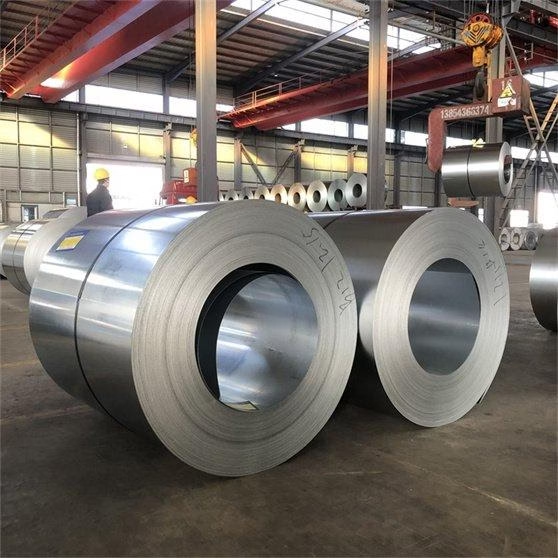
316L Stainless Steel Coil
AISI 316L (UNS S31603) is a premium austenitic stainless steel coil with superior corrosion resistance for marine, chemical, pharmaceutical, and offshore applications. Contains 16-18% Cr, 10-14% Ni, 2-3% Mo, and ≤0.030% C. Thickness 0.3-14mm, width 600-1524mm, multiple surface finishes (2B/BA/No.4/HL/No.8). Ferric chloride test certified. Mill test certificate provided.
| Material | Austenitic Stainless Steel (Low Carbon, Molybdenum-Alloyed) |
|---|---|
| Grade / Standard | AISI 316L / UNS S31603 |
| Thickness | 0.3mm - 14mm |
| Width | 600mm - 1524mm |
| Inner Diameter (ID) | 508mm / 610mm |
| Coil Weight | 3-8 Tons (Max 10 Tons) |
| Delivery Condition | hot_rolled / cold_rolled |
| Surface Treatment | bare / polished |
| MOQ | 3 Tons |
| Delivery Time | 15-25 Days / Specialty Stock |
| Loading Port | Tianjin / Shanghai / Qingdao |
Overview of 316L Stainless Steel Coil
AISI 316L is a premium austenitic stainless steel grade widely used in corrosion-critical applications, accounting for approximately 20-25% of specialized stainless steel coil production globally. Specified under ASTM A240 / EN 10088-2 standards with UNS designation S31603, 316L stainless steel coil offers superior corrosion resistance compared to 304, particularly in chloride-rich environments, seawater, chemical processing, pharmaceutical applications, and highly aggressive industrial settings. Containing nominally 16-18% chromium, 10-14% nickel, and 2-3% molybdenum with low carbon content (maximum 0.030%), the grade provides exceptional resistance to pitting corrosion, stress corrosion cracking, and intergranular corrosion while maintaining the characteristic non-magnetic austenitic microstructure with excellent cold formability for complex fabrication operations.
316L stainless steel coil is the preferred raw material for critical manufacturing applications requiring superior corrosion resistance and material reliability in harsh chemical environments. Available in both hot rolled (HR) and cold rolled (CR) conditions with multiple surface finishes, the coil is widely used by chemical processing equipment manufacturers, pharmaceutical producers, offshore and marine engineers, desalination equipment fabricators, and premium appliance manufacturers worldwide. The grade resists corrosion in seawater, salt spray, chloride-containing solutions, organic and inorganic acids at elevated temperatures, pulp and paper processing chemicals, pharmaceutical solutions, and most industrial chemicals, making it indispensable for marine applications, chemical reactors, pharmaceutical equipment, food processing in salt-rich environments, and specialized industrial manufacturing.
Key Features and Coil Manufacturing
316L stainless steel coil is manufactured through hot rolling for thicker gauges (typically 3mm to 14mm) or cold rolling for thinner gauges (0.3mm to 6mm), followed by solution annealing at 1040-1120°C with rapid cooling to dissolve carbides and achieve optimal corrosion resistance, particularly in intergranular regions. The low carbon content (≤0.030%) eliminates the need for post-weld stress relief in most applications, preventing sensitization and intergranular corrosion that can occur at welded joints. Cold rolled coils undergo additional pickling and skin pass rolling to achieve precise thickness tolerance (typically ±0.05mm) and excellent surface quality. The coil is supplied in standard widths from 600mm to 1524mm with thickness ranging from 0.3mm to 14mm, with custom slitting and recoiling services available.
Multiple surface finishes are available including 2B (cold rolled, annealed, pickled, light cold rolled — most common for industrial use), BA (bright annealed, mirror-like reflective surface for premium applications), No.4 (brushed satin finish for marine and architectural applications), HL (hairline finish for decorative use), and No.8 (mirror polish for high-end pharmaceutical and medical equipment). Standard inner diameter is 508mm or 610mm, with coil weight typically ranging from 3 to 8 tons depending on thickness and width. Each coil undergoes mandatory chemical composition analysis (PMI verification available), mechanical property testing, intergranular corrosion testing per ASTM A262 Practice E (ferric chloride test, mandatory for 316L), pitting resistance equivalent number (PREN) calculation, and surface quality inspection to ensure full compliance with international standards and enhanced corrosion resistance specifications.
Main Applications of 316L Stainless Steel Coil
316L stainless steel coil is the primary raw material for specialized manufacturing in corrosion-critical applications across multiple industries. Marine and offshore engineering uses 316L coil for subsea equipment components, seawater heat exchanger tubes, offshore platform piping, mooring hardware, splash zone protective panels, and maritime vessel structural components where exceptional seawater corrosion resistance is mandatory. The chemical and petrochemical industry employs 316L coil for reactor vessels, heat exchanger shells, distillation column components, chemical processing piping, acid storage tanks, and chlorine handling equipment requiring resistance to corrosive chemical solutions.
Pharmaceutical and biotechnology manufacturing utilizes 316L coil for cGMP (current Good Manufacturing Practice) compliant equipment including fermentation vessel jackets, purification system components, injectable drug processing containers, and cleanroom compatible fabrication requiring high purity and intergranular corrosion resistance. The desalination and water treatment industry uses 316L coil for seawater reverse osmosis membrane housings, evaporator components, and brine handling equipment. Food processing in salt-rich environments (seafood processing, salt curing operations, dairy with salt additives) relies on 316L for equipment durability and contamination prevention. Other critical applications include pulp and paper mill components, chemical tanker construction, pollution control equipment, laboratory and medical apparatus manufacturing, high-purity water systems, molten salt equipment, textile machinery in corrosive dye environments, and aerospace components requiring superior fatigue and corrosion resistance for reliability in harsh operating conditions.
Why Choose Us for 316L Stainless Steel Coil
Shandong Tanglu Metal Material Co., Ltd. supplies premium 316L stainless steel coil sourced from major Chinese stainless steel mills including Tisco (Taiyuan Iron & Steel), Baosteel Stainless, and Lisco with proven international export experience and certified production facilities meeting ISO 9001, ISO 14001, ASME, PED, and DNV requirements for critical applications. Every 316L coil undergoes mandatory chemical composition analysis (PMI verification available), mechanical property testing including tensile, yield, elongation, and hardness verification, mandatory intergranular corrosion testing per ASTM A262 Practice E (ferric chloride immersion test for 316L certification), pitting resistance equivalent number (PREN) verification, surface finish quality inspection, and dimensional inspection per ASTM A240 / EN 10088-2 latest revision with enhanced quality standards.
We offer comprehensive specification range covering thickness from 0.3mm to 14mm and width from 600mm to 1524mm in multiple surface finishes (2B, BA, No.4, HL, No.8) with flexible coil weight options from 3 to 8 tons to match different processing line requirements for critical applications. With monthly supply capacity of 8,000 tons of stainless steel coils including 1,200 tons of 316L specialty grades and established export relationships with chemical equipment manufacturers, marine engineers, pharmaceutical equipment suppliers, and specialized OEM manufacturers in over 60 countries, we support both small specialty orders and large bulk container shipments for critical projects. Each shipment includes original mill test certificate (MTC) conforming to EN 10204 3.1 standard with ferric chloride test results, PREN values, and material traceability per heat number, with EN 10204 3.2, PMI report, third-party inspection (SGS, BV, ABS, DNV, LR, TÜV), and certificate of analysis available for critical applications and marine/aerospace certifications.
Premium Grade Certification for 316L
316L stainless steel coil requires enhanced quality assurance compared to 304 grade due to critical application environments. Our 316L supply includes mandatory ferric chloride test (ASTM A262 Practice E) confirming intergranular corrosion resistance, PREN (Pitting Resistance Equivalent Number) calculation per formula PREN = %Cr + 3.3×%Mo + 16×%N to verify pitting resistance performance in chloride environments, and full chemical traceability for pharmaceutical and marine certifications. All 316L coils maintain low carbon content (≤0.030%) to prevent chromium carbide precipitation at weld HAZ (heat-affected zones), eliminating sensitization without post-weld stress relief requirements.
📐 Dimension & Size Table
| Thickness (mm) | Width (mm) | Inner Dia (mm) | Coil Weight (T) |
|---|---|---|---|
| 0.3 | 600-1250 | 508 | 3-5 |
| 0.4 | 600-1250 | 508 | 3-5 |
| 0.5 | 600-1500 | 508 | 3-6 |
| 0.6 | 600-1500 | 508 | 3-6 |
| 0.8 | 600-1500 | 508 | 3-6 |
| 1.0 | 600-1500 | 508 / 610 | 3-7 |
| 1.2 | 600-1500 | 508 / 610 | 3-7 |
| 1.5 | 600-1500 | 508 / 610 | 5-8 |
| 2.0 | 600-1500 | 508 / 610 | 5-8 |
| 2.5 | 1000-1524 | 610 | 5-8 |
| 3.0 | 1000-1524 | 610 | 5-8 |
| 4.0 | 1000-1524 | 610 | 5-10 |
| 5.0 | 1000-1524 | 610 | 5-10 |
| 6.0 | 1000-1524 | 610 | 5-10 |
| 8.0 | 1000-1500 | 610 | 5-10 |
| 10.0 | 1000-1500 | 610 | 5-10 |
| 12.0 | 1000-1500 | 610 | 5-10 |
| 14.0 | 1000-1500 | 610 | 5-10 |
* Custom sizes available upon request. Tolerances per relevant international standards.
🔬 Chemical Composition
| Element | Min | Max | Display Value | Note |
|---|---|---|---|---|
| C | - | 0.030 | ≤0.030 | Per ASTM A240 316L (low carbon prevents sensitization) |
| Si | - | 0.75 | ≤0.75 | |
| Mn | - | 2.00 | ≤2.00 | |
| P | - | 0.045 | ≤0.045 | |
| S | - | 0.030 | ≤0.030 | |
| Cr | 16.00 | 18.00 | 16.00-18.00 | Corrosion resistance element |
| Ni | 10.00 | 14.00 | 10.00-14.00 | Austenite stabilizer |
| Mo | 2.00 | 3.00 | 2.00-3.00 | Pitting resistance in chloride environments |
| N | - | 0.10 | ≤0.10 | Optional (increases PREN) |
| Fe | - | - | Balance | Base element |
* Chemical composition may vary by heat, thickness and specification. Please refer to the actual mill test certificate.
⚙️ Mechanical Properties
| Property | Value | Unit | Test Condition |
|---|---|---|---|
| Tensile Strength (Rm) | ≥485 | MPa | Solution annealed, per ASTM A240 |
| Yield Strength (Rp0.2) | ≥170 | MPa | 0.2% proof stress |
| Elongation (A) | ≥40 | % | Gauge length 50mm |
| Brinell Hardness (HBW) | ≤217 | HBW | Solution annealed |
| Rockwell Hardness (HRB) | ≤95 | HRB | Solution annealed |
| Vickers Hardness (HV) | ≤225 | HV | Solution annealed |
| Impact Energy (KV2) | ≥150 | J | Charpy V-notch at +20°C |
| Density | 8.00 | g/cm³ | Reference value |
| Magnetic Permeability | ≤1.02 | μ | Non-magnetic austenitic structure |
| PREN (Pitting Resistance Equivalent Number) | ≥43 | PREN | Calculated: %Cr + 3.3×%Mo + 16×%N |
* Values shown are minimum requirements unless otherwise stated.
📦 Commercial Information
| Packaging | Premium seaworthy export packing for marine-grade stainless steel coils. Each coil wrapped with VCI (volatile corrosion inhibitor) anti-corrosion paper for extended storage protection, then wrapped with PE film, and bundled with heavy-duty stainless steel strapping (6-8 wraps per coil for reinforcement), with eye protection rings on inner diameter and waterproof outer wrap for ocean transit. Coils labeled with heat number, grade designation (316L / S31603), thickness, width, coil weight, surface finish, ferric chloride test certification, and PREN value. Standard loading: coil eye horizontal or vertical based on container type. Specialized packaging for pharmaceutical and marine applications including individual cardboard separators, vacuum-sealed protective film, wooden cradles with reinforced chocks, and certified corrosion-inhibiting desiccant for premium surface finishes (BA / No.8) to prevent surface degradation during extended transit. |
|---|---|
| Payment Terms | T/T (Telegraphic Transfer),L/C (Letter of Credit),D/P (Documents against Payment),Western Union,PayPal |
| Price Term | FOB,CFR,CIF,EXW |
| Supply Capacity | 8,000 Tons/Month (Stainless Steel Coils) | 1,200 Tons/Month (316L Specialty) |
| Loading Port | Tianjin / Shanghai / Qingdao |
Why Choose Our 316L Stainless Steel Coil?
Ferric Chloride Test Certified Premium Grade
316L stainless steel coil supplied with original mill test certificate EN 10204 3.1/3.2 including mandatory ferric chloride immersion test per ASTM A262 Practice E (confirms intergranular corrosion resistance), chemical analysis (PMI verification available), mechanical properties, PREN calculation per international formula, and complete heat number traceability for marine and pharmaceutical certifications.
Marine & Seawater Grade Corrosion Resistance
Superior pitting and crevice corrosion resistance in chloride-rich seawater, salt spray, and marine splash zone applications. PREN value minimum 43 provides exceptional durability in subsea equipment, offshore platforms, desalination plants, and coastal installations. Low carbon content (≤0.030%) eliminates sensitization at welds without post-weld stress relief requirements.
Pharmaceutical & Chemical Process Grade
cGMP (current Good Manufacturing Practice) compliant material meeting pharmaceutical equipment standards. Resists aggressive chemical solutions, organic and inorganic acids at elevated temperatures, and pharmaceutical manufacturing environments. Intergranular corrosion resistance certified for fermentation vessels, purification systems, and injectable drug processing equipment.
DNV GL, ABS, BV, LR Marine Certifications
DNV GL, ABS, BV, Lloyd's Register, and TÜV certifications for offshore and marine applications. PED (Pressure Equipment Directive) compliance for pressure vessel and heat exchanger manufacturing. ASME certification available for U-stamped equipment fabrication in North America.
Advanced Corrosion Performance Specifications
PREN verification minimum 43 ensures pitting resistance in 6% FeCl3 solution. Full intergranular corrosion testing confirms resistance to weld sensitization. Extended ferric chloride immersion testing (72 hours) per ASTM A262 Practice E validates material integrity for critical offshore and chemical processing applications.
🏭 Applications of 316L Stainless Steel Coil
316L stainless steel coil is the primary raw material for specialized manufacturing in corrosion-critical applications requiring superior seawater, chemical, and pharmaceutical resistance. Marine and offshore engineering uses 316L coil for subsea piping components, seawater heat exchanger tubes and shells, offshore platform structural elements, splash zone protective panels, desalination plant evaporator components, and maritime vessel internal systems where exceptional resistance to seawater corrosion and salt spray is mandatory for extended service life (20-30+ years). The chemical and petrochemical industry employs 316L coil for reactor vessels containing chloride-based chemicals, heat exchanger shells for aggressive solutions, distillation column components, corrosive acid and alkali storage tanks, chlorine and bromine handling equipment, and pipeline fabrication for high-temperature chemical processing requiring stress corrosion cracking resistance.
Pharmaceutical and biotechnology manufacturing utilizes 316L coil for FDA/cGMP-compliant equipment including fermentation vessel jackets, membrane filtration housings, injectable drug processing containers, purification system piping, cleanroom compatible fabrication, sterile water storage tanks, and high-purity chemical processing equipment where material traceability and intergranular corrosion resistance prevent product contamination and ensure regulatory compliance. The desalination and water treatment industry uses 316L coil for seawater reverse osmosis membrane housings, thermal desalination evaporator components, brine handling equipment, and seawater intake piping systems. Food processing in salt-rich environments (seafood processing plants, salt curing operations, seafood preservation equipment) relies on 316L for extended equipment durability and contamination prevention. Pulp and paper mill components including bleaching equipment, chlorine dioxide generation systems, and corrosive pulping chemical handling benefit from 316L's superior acid resistance. Other critical applications include chemical tanker construction, pollution control and waste treatment equipment, laboratory and medical apparatus manufacturing, high-purity water systems and ultrapure water piping, molten salt thermal energy storage equipment, textile machinery in harsh chemical dye environments, aerospace components for seawater/salt atmosphere conditions, and specialized industrial fabrication where material purity, mechanical properties, and guaranteed corrosion resistance are essential for long-term reliability in harsh operating environments.
📋 Quality & Certification
Our Certifications
- ✅ ISO 9001:2015
- ✅ ABS
- ✅ DNV GL
- ✅ Lloyd's Register (LR)
- ✅ Bureau Veritas (BV)
- ✅ SGS Certified
Mill Certificate Type
- 📋 EN 10204 3.1
- 📋 EN 10204 3.2
- 📋 Original Mill Certificate
- 📋 Third Party Inspection Available
- 📋 Certificate of Origin
❓ Frequently Asked Questions
What is 316L stainless steel coil and how does it differ from 304?
316L is a premium austenitic stainless steel grade specified under ASTM A240 / EN 10088-2 (equivalent EN 1.4404) with UNS designation S31603. Compared to 304 stainless steel, 316L contains additional 2-3% molybdenum which significantly enhances pitting and crevice corrosion resistance in chloride-rich environments such as seawater, salt spray, and chemical processing. The low carbon content (≤0.030% vs 304's ≤0.08%) prevents sensitization and intergranular corrosion at welds without requiring post-weld stress relief, making it ideal for critical welded assemblies. 316L is supplied in hot rolled (HR, 3-14mm) and cold rolled (CR, 0.3-6mm) conditions with multiple surface finishes (2B, BA, No.4, HL, No.8). Every 316L coil is certified with ferric chloride immersion test (ASTM A262 Practice E) confirming intergranular corrosion resistance and PREN (Pitting Resistance Equivalent Number) verification, mandatory certifications not required for 304. 316L costs approximately 25-35% more than 304 but provides exceptional durability in marine, chemical, pharmaceutical, and high-corrosion environments.
What does PREN mean and why is it important for 316L stainless steel?
PREN stands for Pitting Resistance Equivalent Number, a calculated value that predicts a stainless steel's resistance to pitting corrosion in chloride-containing solutions (seawater, salt environments, chemical processing). PREN is calculated using the formula: PREN = %Cr + 3.3×%Mo + 16×%N, where Chromium, Molybdenum, and Nitrogen contents are the key elements contributing to pitting resistance. For 316L stainless steel, the minimum PREN value is approximately 43, compared to 304's PREN of only ~26-28, demonstrating 316L's significantly superior performance in aggressive chloride environments. Higher PREN values indicate better pitting resistance. For seawater and marine applications, PREN values above 40 are generally recommended. For severe chemical environments (concentrated acids, high-temperature chloride solutions), PREN values above 50 are preferred. Suppliers must calculate and certify PREN values for all 316L shipments, particularly for marine classification society approvals (DNV GL, ABS, BV, Lloyd's Register). Custom nitrogen-enhanced 316LN grades can achieve PREN values above 50 for extreme chloride environments.
What is the ferric chloride test and why is it mandatory for 316L?
The ferric chloride (FeCl3) immersion test is a mandatory quality verification procedure per ASTM A262 Practice E standard specifically for 316L and other low-carbon austenitic stainless steels. The test submerges stainless steel samples in 6% ferric chloride solution at 24-26°C for 72 hours (extended duration confirms intergranular corrosion resistance). After immersion, samples are visually examined and analyzed under microscope to detect any intergranular corrosion attack (thin lines or etching patterns indicating chromium carbide precipitation and sensitization at grain boundaries). 316L's low carbon content (≤0.030%) prevents chromium carbide formation at welds, and the ferric chloride test confirms this benefit — samples must show no intergranular corrosion for the material to qualify as true 316L grade. Higher-carbon materials (316 vs 316L) may require post-weld heat treatment to pass this test, a costly additional requirement. Every 316L coil shipment includes a ferric chloride test report as proof of intergranular corrosion resistance, particularly important for marine, pharmaceutical, and chemical equipment where weld integrity is critical and in-service corrosion failure is unacceptable.
Why is 316L preferred for marine and seawater applications?
316L stainless steel is the preferred material for marine and seawater applications because its 2-3% molybdenum content provides exceptional pitting and crevice corrosion resistance in highly aggressive chloride-rich seawater environments. Seawater contains approximately 3.5% dissolved salts (primarily sodium chloride), creating extremely corrosive conditions that cause rapid pitting attacks on 304 stainless steel and other lower-grade materials within months of exposure. 316L's PREN value of 43+ indicates reliable long-term performance in these harsh conditions. Additionally, 316L's low carbon content eliminates weld sensitization without requiring expensive post-weld heat treatment (PWHT), making it economical for complex welded fabrications such as heat exchangers, piping systems, and structural components used in offshore platforms, desalination plants, and seawater cooling systems. Marine classification societies (DNV GL, ABS, Lloyd's Register, BV) specifically approve and certify 316L for subsea equipment, offshore platforms (splash zone components especially critical), seawater piping, heat exchangers, and vessel components. Expected service life for properly designed 316L components in seawater is 20-30+ years with minimal maintenance, compared to 304's 2-5 year life in identical conditions.
What surface finishes are available for 316L stainless steel coil?
316L stainless steel coil is available in five primary surface finishes optimized for different application environments. 2B finish (cold rolled, annealed, pickled, and lightly cold rolled) is the most common industrial finish with smooth reflective appearance, used for chemical processing equipment, desalination components, and general industrial fabrication. BA finish (bright annealed in protective atmosphere) provides high-gloss mirror-like reflective surface with enhanced aesthetic appeal and superior cleanliness for pharmaceutical equipment, food processing, and high-purity applications where surface contamination must be minimized. No.4 finish (linearly brushed satin) is preferred for marine equipment, architectural panels, and applications requiring decorative appearance with corrosion resistance (hides minor surface defects better than BA). HL finish (hairline brushed) offers fine continuous polishing lines suitable for decorative marine and architectural applications. No.8 finish (mirror polish) provides high-gloss reflective surface for premium pharmaceutical vessels, luxury fixtures, and applications where appearance is critical. For all finishes, 316L coils are supplied with protective VCI (volatile corrosion inhibitor) paper wrapping and stainless steel strapping to prevent surface degradation during storage and transit, particularly important for BA and No.8 finishes prone to fingerprinting and salt corrosion.
Request Marine Grade Quote for
316L Stainless Steel Coil
Submit your requirements and receive a competitive price quote within 24 hours.
- ✓ Fast response within 24 hours
- ✓ Competitive factory-direct pricing
- ✓ Free technical consultation
- ✓ Mill test certificate provided
- ✓ Flexible payment terms available
⏱ Response within 12 hours for critical projects
Send Your Inquiry
All fields marked with * are required